Spiral Model
Spiral Model
Application Of Spiral Model
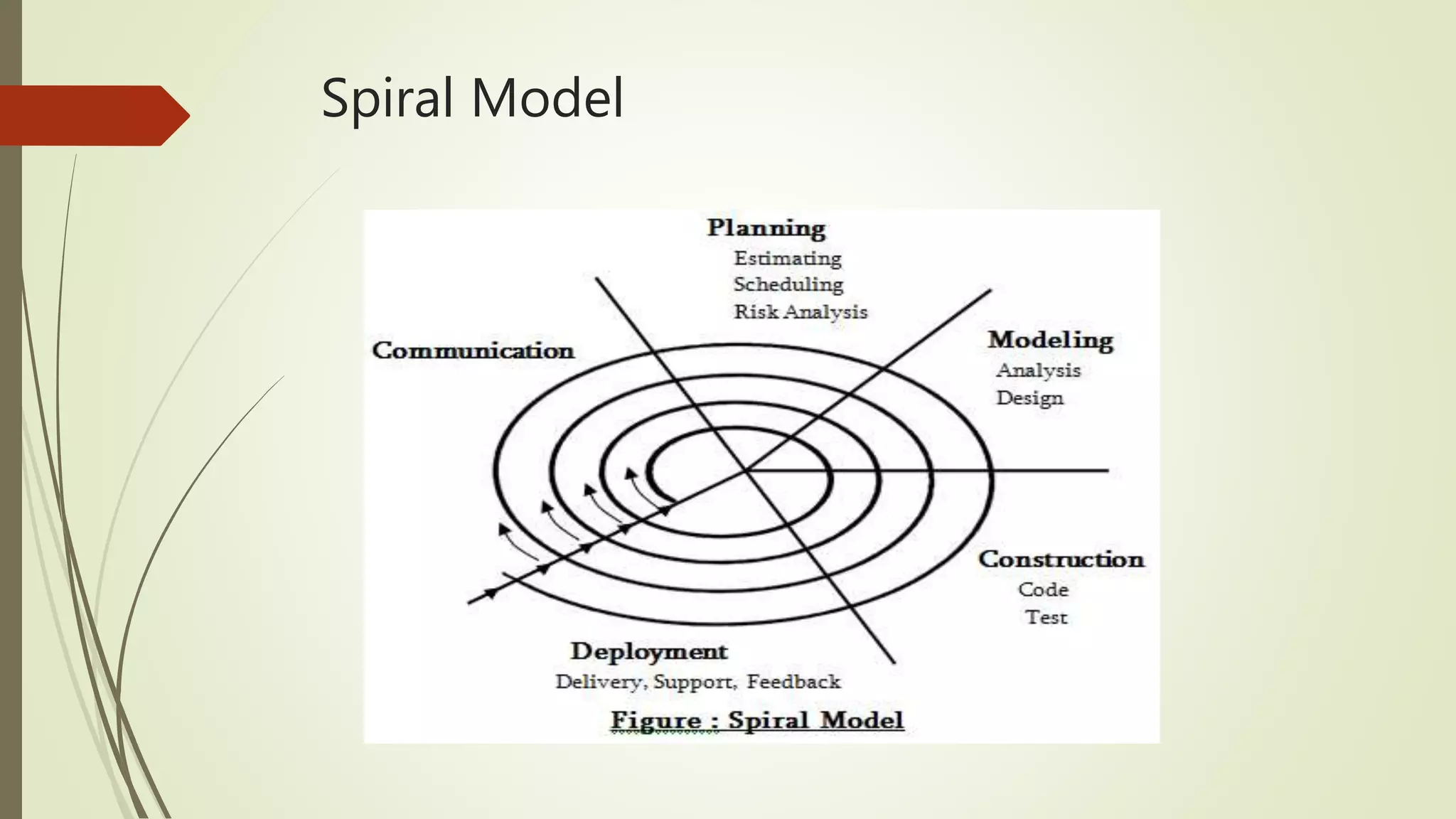
FOUR PHASES OF SPIRAL MODEL4
• Planning
• RiskAnalysis
• Engineering
• Evalution
PLANNING
• This phase starts with gathering the business
requirements in the baseline spiral.
• Planning includes estimating the cost, schedule
and resources for the iteration.
5
RISK ANALYSIS
• In this phase analyst assume all the possible risks
that could be occurred during future
development.
• A prototype is produced at the end ofthe risk
analysis phase.
6
ENGINEERING
• In this phase software is developed,
along with testing at the end of the
phase.
• Hence this phase includes testing,
coding and deploying software at the
customer site.
7
EVALUATION
• In this phase, Customers evaluate the so
far developed version of the software.
• In the end, planning for the next phase
is started.
8
When to use Spiral Model
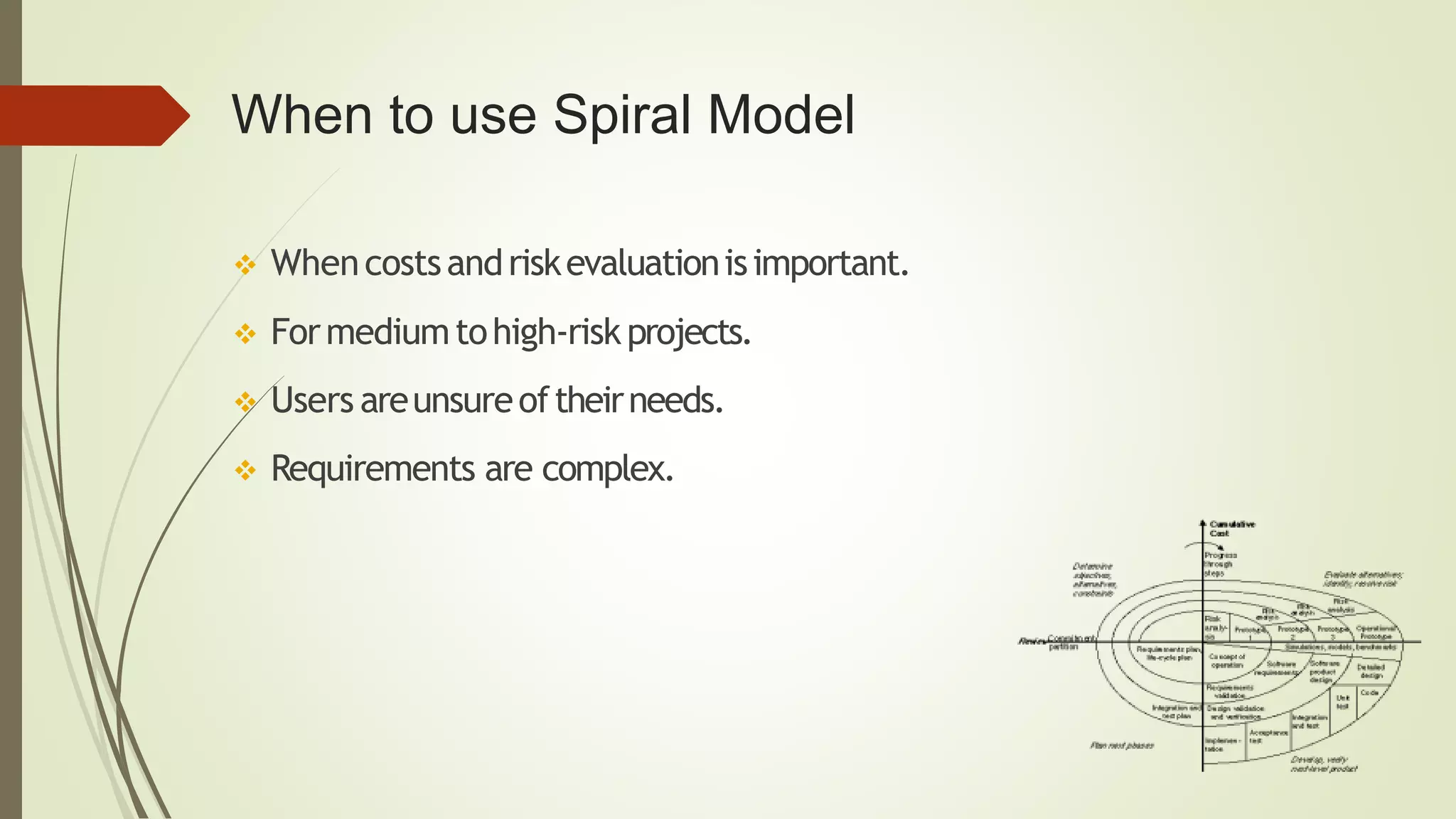
 Whencostsandriskevaluationisimportant.
 Formediumtohigh-risk projects.
 Users areunsureoftheirneeds.
 Requirements are complex.
Advantages
 Changing requirements can be accommodated.
 Allowsforextensiveuseofprototypes.
 Requirementscanbecaptured more accurately.
 Users seethesystemearly.
 Early and frequent feedback from users.
Disadvantages
 End ofprojectmaynotbeknownearly.
 Not suitableforsmallorlowrisk projectsand could be
expensiveforsmallprojects.
 Process iscomplex.
 Spiralmaygo indefinitely.
15

Spiral model

  • 1.
  • 2.
  • 3.
  • 4.
    FOUR PHASES OFSPIRAL MODEL4 • Planning • RiskAnalysis • Engineering • Evalution
  • 5.
    PLANNING • This phasestarts with gathering the business requirements in the baseline spiral. • Planning includes estimating the cost, schedule and resources for the iteration. 5
  • 6.
    RISK ANALYSIS • Inthis phase analyst assume all the possible risks that could be occurred during future development. • A prototype is produced at the end ofthe risk analysis phase. 6
  • 7.
    ENGINEERING • In thisphase software is developed, along with testing at the end of the phase. • Hence this phase includes testing, coding and deploying software at the customer site. 7
  • 8.
    EVALUATION • In thisphase, Customers evaluate the so far developed version of the software. • In the end, planning for the next phase is started. 8
  • 9.
    When to useSpiral Model  Whencostsandriskevaluationisimportant.  Formediumtohigh-risk projects.  Users areunsureoftheirneeds.  Requirements are complex.
  • 10.
    Advantages  Changing requirementscan be accommodated.  Allowsforextensiveuseofprototypes.  Requirementscanbecaptured more accurately.  Users seethesystemearly.  Early and frequent feedback from users.
  • 11.
    Disadvantages  End ofprojectmaynotbeknownearly. Not suitableforsmallorlowrisk projectsand could be expensiveforsmallprojects.  Process iscomplex.  Spiralmaygo indefinitely.
  • 12.