WATER FALL MODEL
Software Development life cycle
CONTENT’S
▪ History of water fall model
▪ Features of water fall model
▪ Phases of water fall model
▪ Description of the phases
▪ Advantages & Disadvantages
HISTORY OF WATER FALL MODEL
▪ Winston w.Royce citied in an article in 1970
▪ Presented it as non-working model
▪ Ever since widely used for software projects development
▪ Royce didn’t use the term water fall model
FEATURES OF WATER FALL MODEL
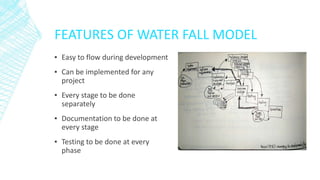
▪ Easy to flow during development
▪ Can be implemented for any
project
▪ Every stage to be done
separately
▪ Documentation to be done at
every stage
▪ Testing to be done at every
phase
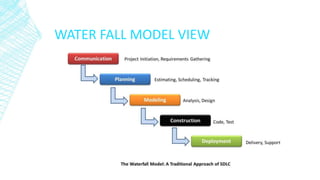
WATER FALL MODEL VIEW
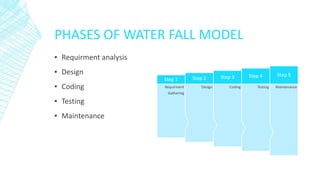
PHASES OF WATER FALL MODEL
▪ Requirment analysis
▪ Design
▪ Coding
▪ Testing
▪ Maintenance
Maintenance
Step 5
Testing
Step 4
Coding
Step 3
Design
Step 2
Requirment
Gathering
Step 1
REQUIREMENT GATHERING
▪ 1st pahse of water fall model
▪ Includes meeting of customer and getting requirements
▪ Most crucial phase any misunderstanding leads to validation issues
▪ Details must be accurated & detailed with no ambiguities
▪ Understand customer requirements and specifications
▪ End product should meet customer expectations
▪ Documented and discussed further with the customer for reviewing
REQUIREMENT GATHERING PHASE
DESIGN
▪ Customer requirements are broken to various modules for development
▪ Hardware and software modules are identified & designed separately
▪ Algorithm's and diagram's defining scope objective of each model are
developed
▪ Intermediate phase between requirement gathering and coding phase
▪ Focuses on program attribute’s such as
Data structure
sotware architecture
algorithm details etc
Design needs to be documented for further use
DESIGNING PHASE
CODING
▪ Design converted to machine readable form code
▪ If design is done effectively then coding can be done effectively
▪ Coding is done by dividing the project into small modules
▪ Programs are created for the small modules than creating for whole
project
▪ According to the design the programmers do code for thesoftware
▪ Then the created programme’s are documented
CODING PHASE
TESTING
 Individual and integrated components are methodlogically verified to
ensure that they are error free and meet the requirments of customer
 In the whole testing part is divided into two parts namely
1) inside test
2)outside test
▪ After testing the documentation for testing is to be done
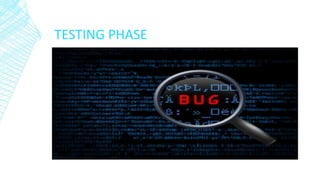
TESTING PHASE
MAINTENANCE
▪ Final phase of water fall model
▪ Product handed over to customer after alpha & beta testing
▪ After deployment on client side the maintenance team should
undertake maintenance activities by visiting client site
▪ Longest phase of software development life cycle which includes
meet the changing customer needs
adapted to accomdate changes in external environment
correct errors and oversights previously undetected in testing phase
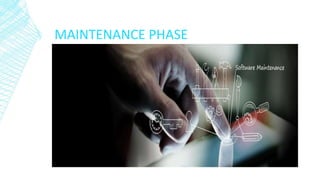
MAINTENANCE PHASE
ADVANTAGES AND DISADVANTAGES
▪ Advantages
▪ Easy to implement
▪ Requires completing one phase
before moving to next phase
▪ Easy to develop various
software's within small span of
time
▪ Disadvantage’s
▪ Not possible to state all
requirement's at once during
requirement gathering
▪ Working model can be seen only
at the end
▪ Backtrack is not possible in this
model
THANK YOU
B.akhil
CSE
13E51A0511

Water fall model

  • 1.
    WATER FALL MODEL SoftwareDevelopment life cycle
  • 2.
    CONTENT’S ▪ History ofwater fall model ▪ Features of water fall model ▪ Phases of water fall model ▪ Description of the phases ▪ Advantages & Disadvantages
  • 3.
    HISTORY OF WATERFALL MODEL ▪ Winston w.Royce citied in an article in 1970 ▪ Presented it as non-working model ▪ Ever since widely used for software projects development ▪ Royce didn’t use the term water fall model
  • 4.
    FEATURES OF WATERFALL MODEL ▪ Easy to flow during development ▪ Can be implemented for any project ▪ Every stage to be done separately ▪ Documentation to be done at every stage ▪ Testing to be done at every phase
  • 5.
  • 6.
    PHASES OF WATERFALL MODEL ▪ Requirment analysis ▪ Design ▪ Coding ▪ Testing ▪ Maintenance Maintenance Step 5 Testing Step 4 Coding Step 3 Design Step 2 Requirment Gathering Step 1
  • 7.
    REQUIREMENT GATHERING ▪ 1stpahse of water fall model ▪ Includes meeting of customer and getting requirements ▪ Most crucial phase any misunderstanding leads to validation issues ▪ Details must be accurated & detailed with no ambiguities ▪ Understand customer requirements and specifications ▪ End product should meet customer expectations ▪ Documented and discussed further with the customer for reviewing
  • 8.
  • 9.
    DESIGN ▪ Customer requirementsare broken to various modules for development ▪ Hardware and software modules are identified & designed separately ▪ Algorithm's and diagram's defining scope objective of each model are developed ▪ Intermediate phase between requirement gathering and coding phase ▪ Focuses on program attribute’s such as Data structure sotware architecture algorithm details etc Design needs to be documented for further use
  • 10.
  • 11.
    CODING ▪ Design convertedto machine readable form code ▪ If design is done effectively then coding can be done effectively ▪ Coding is done by dividing the project into small modules ▪ Programs are created for the small modules than creating for whole project ▪ According to the design the programmers do code for thesoftware ▪ Then the created programme’s are documented
  • 12.
  • 13.
    TESTING  Individual andintegrated components are methodlogically verified to ensure that they are error free and meet the requirments of customer  In the whole testing part is divided into two parts namely 1) inside test 2)outside test ▪ After testing the documentation for testing is to be done
  • 14.
  • 15.
    MAINTENANCE ▪ Final phaseof water fall model ▪ Product handed over to customer after alpha & beta testing ▪ After deployment on client side the maintenance team should undertake maintenance activities by visiting client site ▪ Longest phase of software development life cycle which includes meet the changing customer needs adapted to accomdate changes in external environment correct errors and oversights previously undetected in testing phase
  • 16.
  • 17.
    ADVANTAGES AND DISADVANTAGES ▪Advantages ▪ Easy to implement ▪ Requires completing one phase before moving to next phase ▪ Easy to develop various software's within small span of time ▪ Disadvantage’s ▪ Not possible to state all requirement's at once during requirement gathering ▪ Working model can be seen only at the end ▪ Backtrack is not possible in this model
  • 18.