WaterFall Model
What is Waterfall Model?
• The waterfall model is a linear, sequential approach to the
software development life cycle (SDLC) that is popular in
software engineering and product development. The waterfall
model emphasizes a logical progression of steps.
One should use the waterfall model only when:
- Requirements are very clear and fixed.
- There are no ambiguous requirements.
- The project is short.
- low budget projects.
History of Waterfall Model
• Firstly presented by Herbert Benington in 1956.
• Which was republished in 1983.
• Winston Royes formally cited this as article in 1970.
• But Royes did not mention Waterfall term in that.
• ‘Waterfall’ term was first used by Bell in 1976.
• The US dept. of Defense worked with this for software
development in 1985 and stated the six phases of the model.
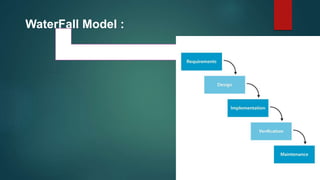
WaterFall Model :
Advantages of waterfall model:
• Good for small projects.
• Clearly defined stages.
• Easy to use and follow.
• When you move to the next phase, you have a clear picture of
previous phases.
• Design errors are identified early,before any software is writte
• Change is limited.
• Stakeholders and customers are engaged regularly.
• Not useful for large project.
• High amounts of risk and uncertainty.
• Difficult to add or change requirements if they are
identified and needed after the first phase.
• There is a big problem if testing fails the software.
• Can take a long time to deliver.
Disadvantages of waterfall model:
Limitations of WaterFall model:
• Does not show iteration in software life cycle.
• Does not show overlap between phases.
• Software requirements are tested late in life cycle.
• Operational system available late in life cycle.
• Does not support partial system development.
Waterfall model

Waterfall model

  • 1.
  • 2.
    What is WaterfallModel? • The waterfall model is a linear, sequential approach to the software development life cycle (SDLC) that is popular in software engineering and product development. The waterfall model emphasizes a logical progression of steps.
  • 3.
    One should usethe waterfall model only when: - Requirements are very clear and fixed. - There are no ambiguous requirements. - The project is short. - low budget projects.
  • 4.
    History of WaterfallModel • Firstly presented by Herbert Benington in 1956. • Which was republished in 1983. • Winston Royes formally cited this as article in 1970. • But Royes did not mention Waterfall term in that. • ‘Waterfall’ term was first used by Bell in 1976. • The US dept. of Defense worked with this for software development in 1985 and stated the six phases of the model.
  • 5.
  • 6.
    Advantages of waterfallmodel: • Good for small projects. • Clearly defined stages. • Easy to use and follow. • When you move to the next phase, you have a clear picture of previous phases. • Design errors are identified early,before any software is writte • Change is limited. • Stakeholders and customers are engaged regularly.
  • 7.
    • Not usefulfor large project. • High amounts of risk and uncertainty. • Difficult to add or change requirements if they are identified and needed after the first phase. • There is a big problem if testing fails the software. • Can take a long time to deliver. Disadvantages of waterfall model:
  • 8.
    Limitations of WaterFallmodel: • Does not show iteration in software life cycle. • Does not show overlap between phases. • Software requirements are tested late in life cycle. • Operational system available late in life cycle. • Does not support partial system development.