System Development Life Cycle 
By- Sumit Bansal 
Princy Gupta 
Anjali Arora
SDLC 
Stands for Software Development 
Life Cycle. 
 Standard model used world wide 
to develop a software. 
Necessary to ensure the quality of 
the software. 
Logical steps taken to develop a 
software product.
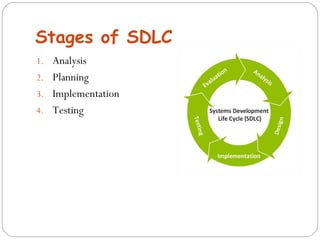
Stages of SDLC 
1. Analysis 
2. Planning 
3. Implementation 
4. Testing
Analysis 
• The first and the most important phase in the 
SDLC. 
•Determine where the problem is. 
• Breaking down the system requirements. 
•Must be done carefully. 
•Any error in this phase will cost a lot !!
Planning 
Determine who will do what ! 
 Tasks are assigned to team members. 
 It all starts here.
Implementation 
The most expensive phase. 
 Also the longest one!
Testing 
 The never ending phase. 
 In this phase we TEST, TEST, TEST, and TEST. 
 Very important phase.
SDLC Models 
Build and fix model 
Water Fall model 
Iterative enhancement model 
Prototyping model 
Spiral Model
Build & fix model 
Fix 
Build 
Code 
•Product is constructed without 
specifications or any attempt at design 
• Adhoc approach and not well defined 
•Simple two phase model 
•Suitable for small programming 
•Maintenance is practically not 
possible 
•Code soon becomes unfixable & un 
enhance able
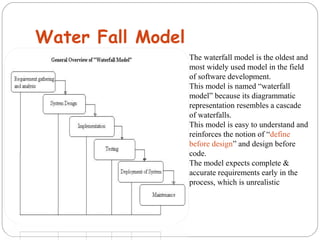
Water Fall Model 
The waterfall model is the oldest and 
most widely used model in the field 
of software development. 
This model is named “waterfall 
model” because its diagrammatic 
representation resembles a cascade 
of waterfalls. 
This model is easy to understand and 
reinforces the notion of “define 
before design” and design before 
code. 
The model expects complete & 
accurate requirements early in the 
process, which is unrealistic
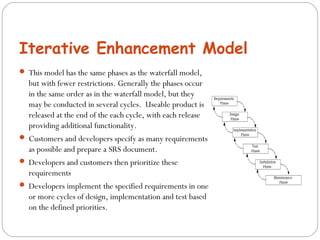
Iterative Enhancement Model 
 This model has the same phases as the waterfall model, 
but with fewer restrictions. Generally the phases occur 
in the same order as in the waterfall model, but they 
may be conducted in several cycles. Useable product is 
released at the end of the each cycle, with each release 
providing additional functionality. 
 Customers and developers specify as many requirements 
as possible and prepare a SRS document. 
 Developers and customers then prioritize these 
requirements 
 Developers implement the specified requirements in one 
or more cycles of design, implementation and test based 
on the defined priorities.
Prototyping Model 
The prototype may be a usable program but is not suitable as 
the final software product. 
The development of a prototype might involve extra cost.
Spiral Model
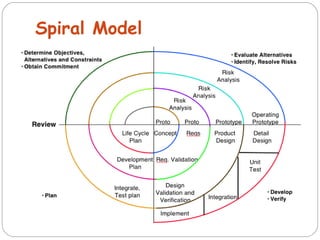
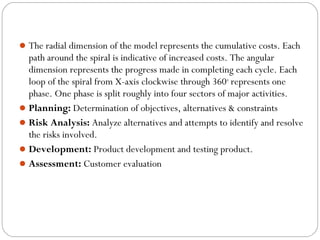
The radial dimension of the model represents the cumulative costs. Each 
path around the spiral is indicative of increased costs. The angular 
dimension represents the progress made in completing each cycle. Each 
loop of the spiral from X-axis clockwise through 360o represents one 
phase. One phase is split roughly into four sectors of major activities. 
Planning: Determination of objectives, alternatives & constraints 
Risk Analysis: Analyze alternatives and attempts to identify and resolve 
the risks involved. 
Development: Product development and testing product. 
Assessment: Customer evaluation
The Rapid Application Development 
(RAD) Model 
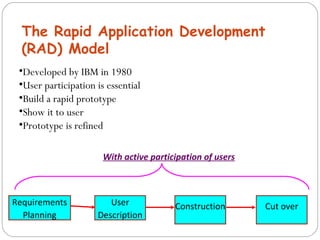
Requirements 
Planning 
User 
Description 
Construction Cut over 
•Developed by IBM in 1980 
•User participation is essential 
•Build a rapid prototype 
•Show it to user 
•Prototype is refined 
With active participation of users
Disadvantages of RAD model 
Not an appropriate model in the absence of user 
participation. 
Highly specialized & skilled developers are required and 
such developers are not easily available.
Thank You 

SDLC- concept and models

  • 1.
    System Development LifeCycle By- Sumit Bansal Princy Gupta Anjali Arora
  • 2.
    SDLC Stands forSoftware Development Life Cycle.  Standard model used world wide to develop a software. Necessary to ensure the quality of the software. Logical steps taken to develop a software product.
  • 3.
    Stages of SDLC 1. Analysis 2. Planning 3. Implementation 4. Testing
  • 4.
    Analysis • Thefirst and the most important phase in the SDLC. •Determine where the problem is. • Breaking down the system requirements. •Must be done carefully. •Any error in this phase will cost a lot !!
  • 5.
    Planning Determine whowill do what !  Tasks are assigned to team members.  It all starts here.
  • 6.
    Implementation The mostexpensive phase.  Also the longest one!
  • 7.
    Testing  Thenever ending phase.  In this phase we TEST, TEST, TEST, and TEST.  Very important phase.
  • 8.
    SDLC Models Buildand fix model Water Fall model Iterative enhancement model Prototyping model Spiral Model
  • 9.
    Build & fixmodel Fix Build Code •Product is constructed without specifications or any attempt at design • Adhoc approach and not well defined •Simple two phase model •Suitable for small programming •Maintenance is practically not possible •Code soon becomes unfixable & un enhance able
  • 10.
    Water Fall Model The waterfall model is the oldest and most widely used model in the field of software development. This model is named “waterfall model” because its diagrammatic representation resembles a cascade of waterfalls. This model is easy to understand and reinforces the notion of “define before design” and design before code. The model expects complete & accurate requirements early in the process, which is unrealistic
  • 11.
    Iterative Enhancement Model  This model has the same phases as the waterfall model, but with fewer restrictions. Generally the phases occur in the same order as in the waterfall model, but they may be conducted in several cycles. Useable product is released at the end of the each cycle, with each release providing additional functionality.  Customers and developers specify as many requirements as possible and prepare a SRS document.  Developers and customers then prioritize these requirements  Developers implement the specified requirements in one or more cycles of design, implementation and test based on the defined priorities.
  • 12.
    Prototyping Model Theprototype may be a usable program but is not suitable as the final software product. The development of a prototype might involve extra cost.
  • 13.
  • 14.
    The radial dimensionof the model represents the cumulative costs. Each path around the spiral is indicative of increased costs. The angular dimension represents the progress made in completing each cycle. Each loop of the spiral from X-axis clockwise through 360o represents one phase. One phase is split roughly into four sectors of major activities. Planning: Determination of objectives, alternatives & constraints Risk Analysis: Analyze alternatives and attempts to identify and resolve the risks involved. Development: Product development and testing product. Assessment: Customer evaluation
  • 15.
    The Rapid ApplicationDevelopment (RAD) Model Requirements Planning User Description Construction Cut over •Developed by IBM in 1980 •User participation is essential •Build a rapid prototype •Show it to user •Prototype is refined With active participation of users
  • 16.
    Disadvantages of RADmodel Not an appropriate model in the absence of user participation. Highly specialized & skilled developers are required and such developers are not easily available.
  • 17.

Editor's Notes

  • #10 adhoc-=not well defined
  • #11 Testing=single testing 2) integeration testing
  • #12 Iteration-repetetions Srs=software requirement specification
  • #13 Prototype=sample