Disclaimer: This presentation is prepared by trainees of
baabtra as a part of mentoring program. This is not official
document of baabtra –Mentoring Partner
Baabtra-Mentoring Partner is the mentoring division of baabte System Technologies Pvt .
Ltd
Software Development Life Cycle

MOHAMMED REHAB
ribu99@gmail.com
www.facebook.com/moham
med.rehab.1
twitter.com/ribu99
in.linkedin.com/in/mohamm
edrehab
+919895253399
Modern Software Development
• Modern software development is no longer a
simple process
• There is a process that accompanies the
development of every software
• SDLC is a collection of best practices and
methodologies
Why understand SDLC?
• Helps to improve the quality of your work
• Helps to improve your productivity

• Without an accepted process and
methodology there are chances to –
– Deliver the project late
– Deliver the project over budget
MODELS
MODELS
• Waterfall Model
• Incremental Model
• Agile Model
• Spiral Model
WATERFALL MODEL
• First process model that was introduced
• Also referred to as linear sequential life cycle
model
• Very simple to understand and use
WATERFALL MODEL
WATERFALL MODEL
• Each phase must be fully completed before
the next phase begins
• A review takes place at the end of each phase
• Phases do not overlap
Advantages of Waterfall model
• Easy to understand and use

• Phases are processed and completed one at a
time
• Works well for smaller projects
Disadvantages of Waterfall model
• No working software is produced until late
during the life cycle
• Not a good model for complex projects
• Even a small change in a phase can cause big
problems in the subsequent phases
When to use Waterfall model

• When requirements are well known and clear
• When the project to be developed is small
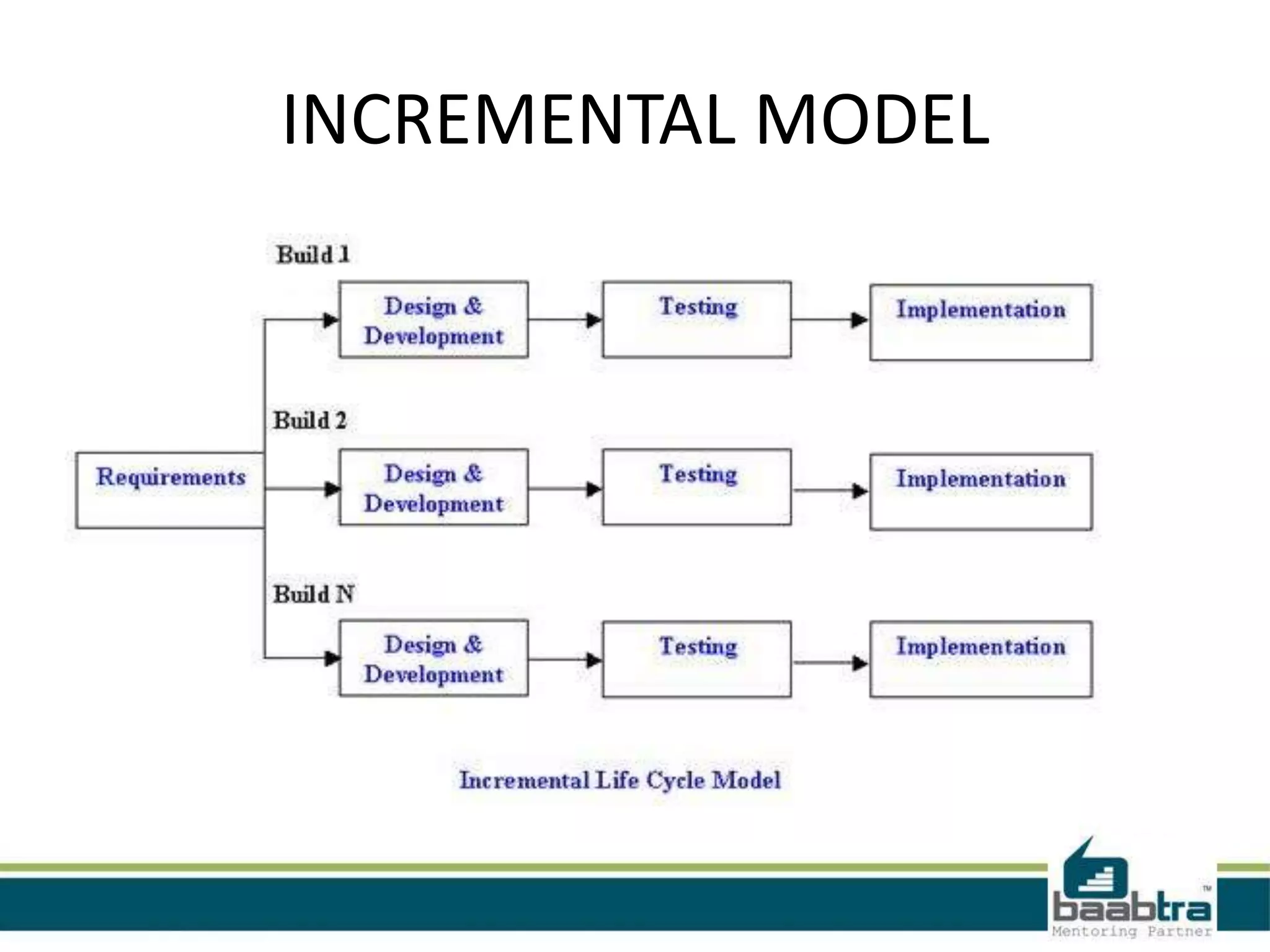
INCREMENTAL MODEL
INCREMENTAL MODEL
• Whole requirement is divided into various
builds

• Multiple development cycles take place
• Cycles are divided up into more easily
manageable modules
INCREMENTAL MODEL

• Each module passes through the design,
implementation and testing phases
• Working version of the software is produced with the
first module
INCREMENTAL MODEL
• Each subsequent release of module adds
function to the previous release
• The process continues till the complete system
is achieved
Advantages of Incremental model
• Generates working software early during the
software life cycle
• Easier to test and debug
• Customer can respond to each built
Disadvantages of Incremental model
• Needs good planning and design
• Needs a clear and complete idea of whole
system before it can be broken down
When to use Incremental model
• Requirements of the complete system are
clearly understood
• There is a need to get a product to the market
early
AGILE MODEL
AGILE MODEL
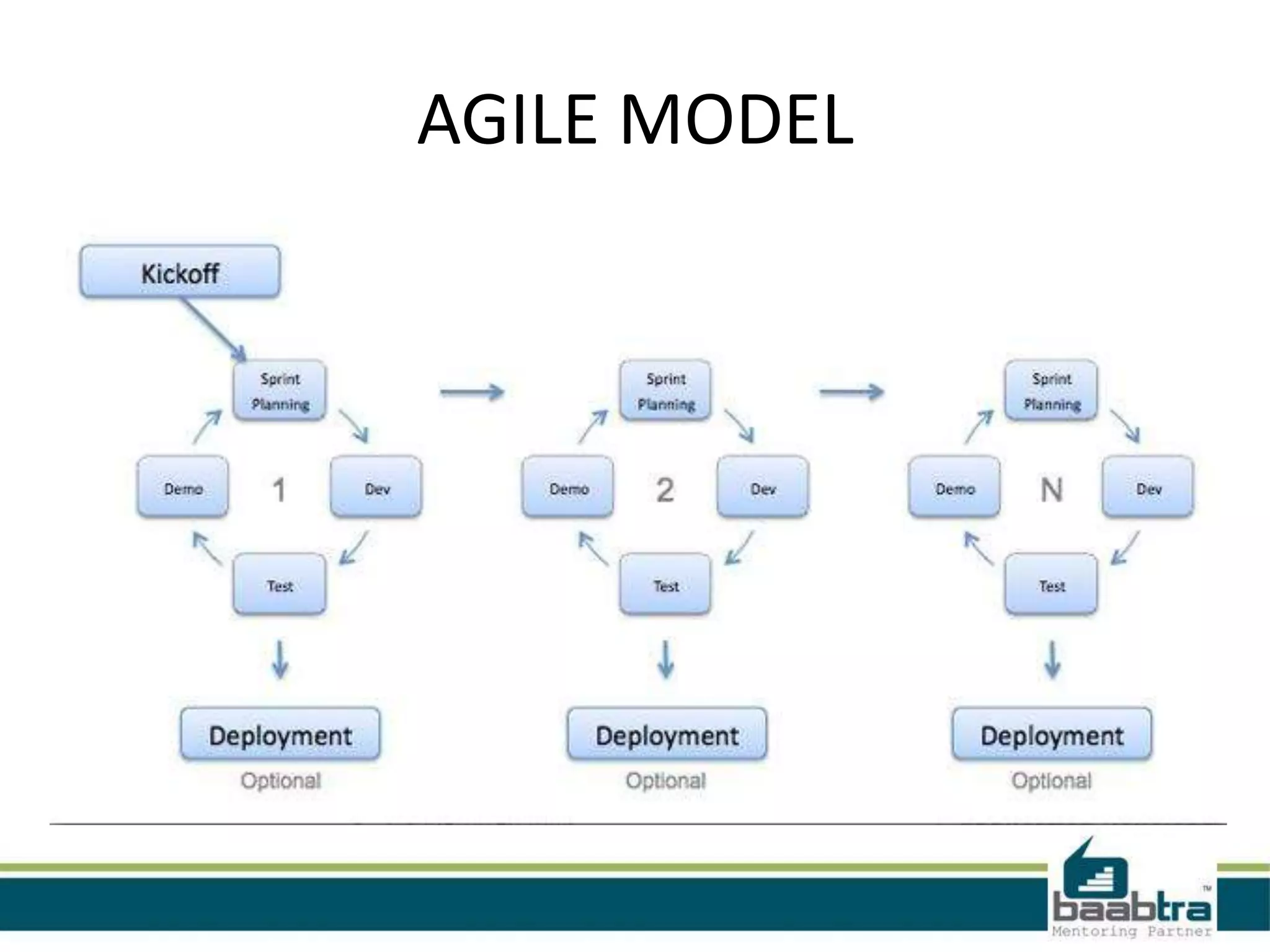
• It is also a type of incremental model
• Software is developed in rapid cycles

• Small incremental releases with each release
building on previous functionality
• Each release is thoroughly tested to ensure
software quality
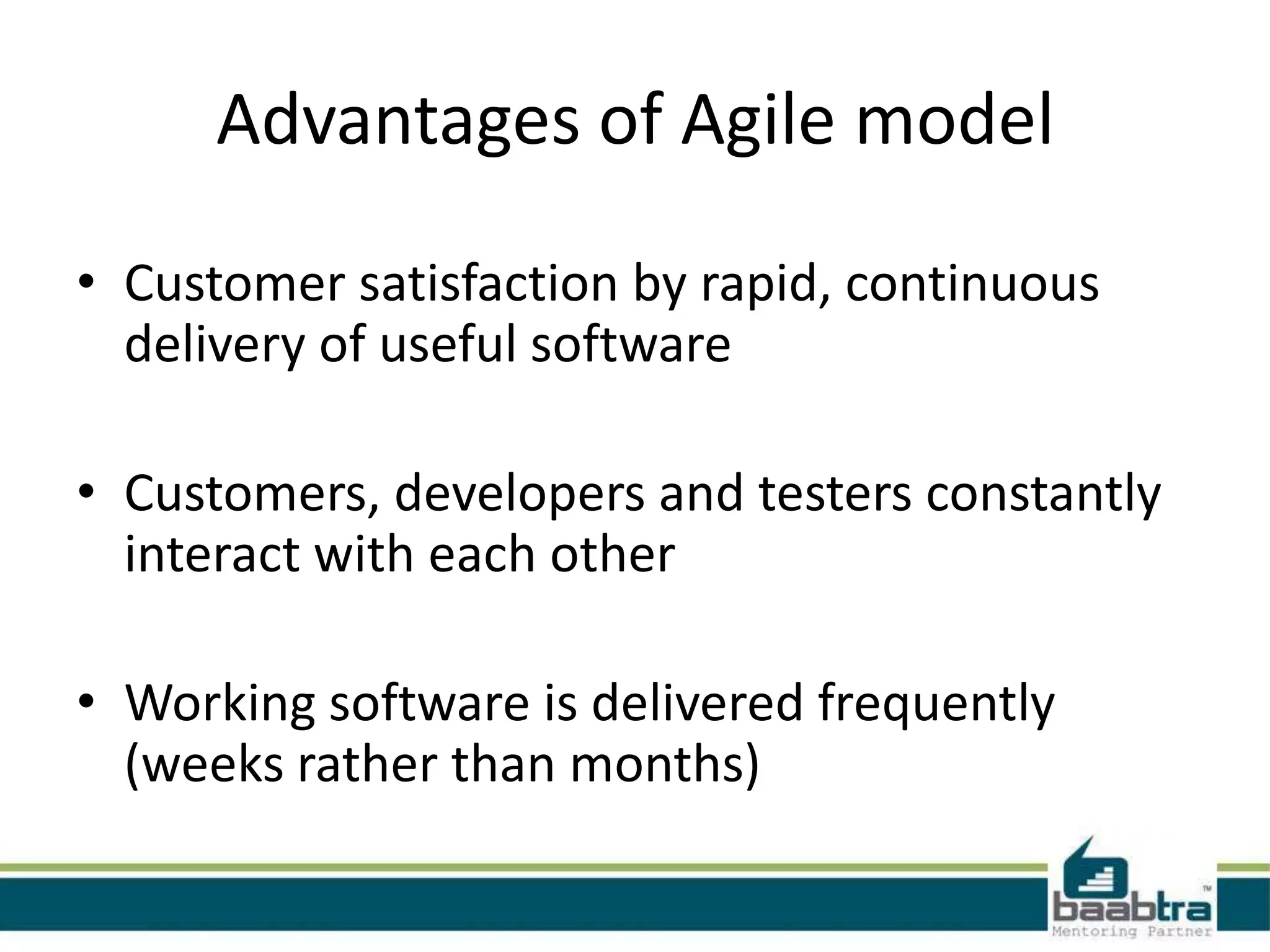
Advantages of Agile model
• Customer satisfaction by rapid, continuous
delivery of useful software

• Customers, developers and testers constantly
interact with each other
• Working software is delivered frequently
(weeks rather than months)
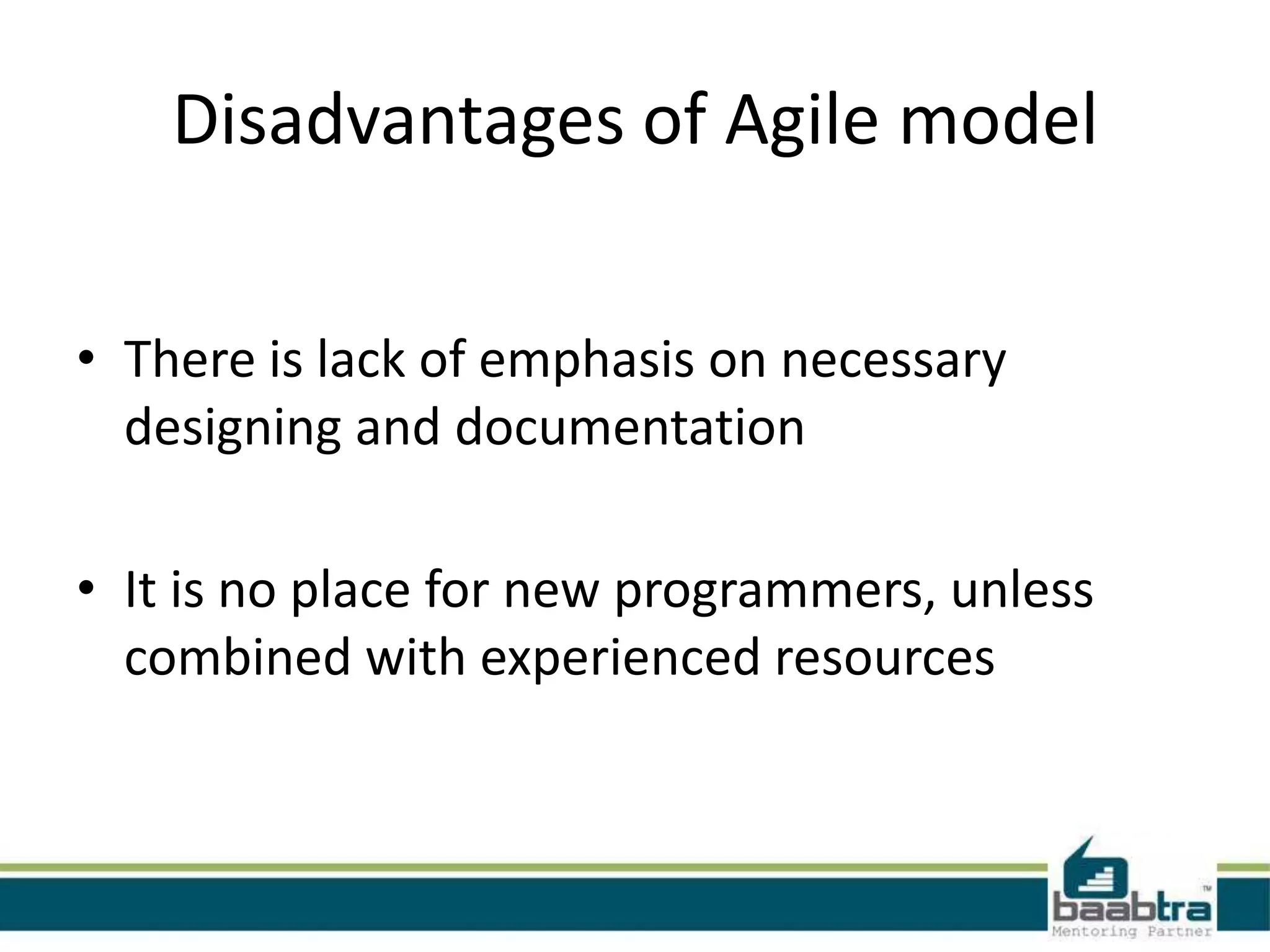
Disadvantages of Agile model
• There is lack of emphasis on necessary
designing and documentation
• It is no place for new programmers, unless
combined with experienced resources
When to use Agile model
• Frequency of new increments to the software
is more
• Stakeholders find that they get more freedom
of time and options using this model
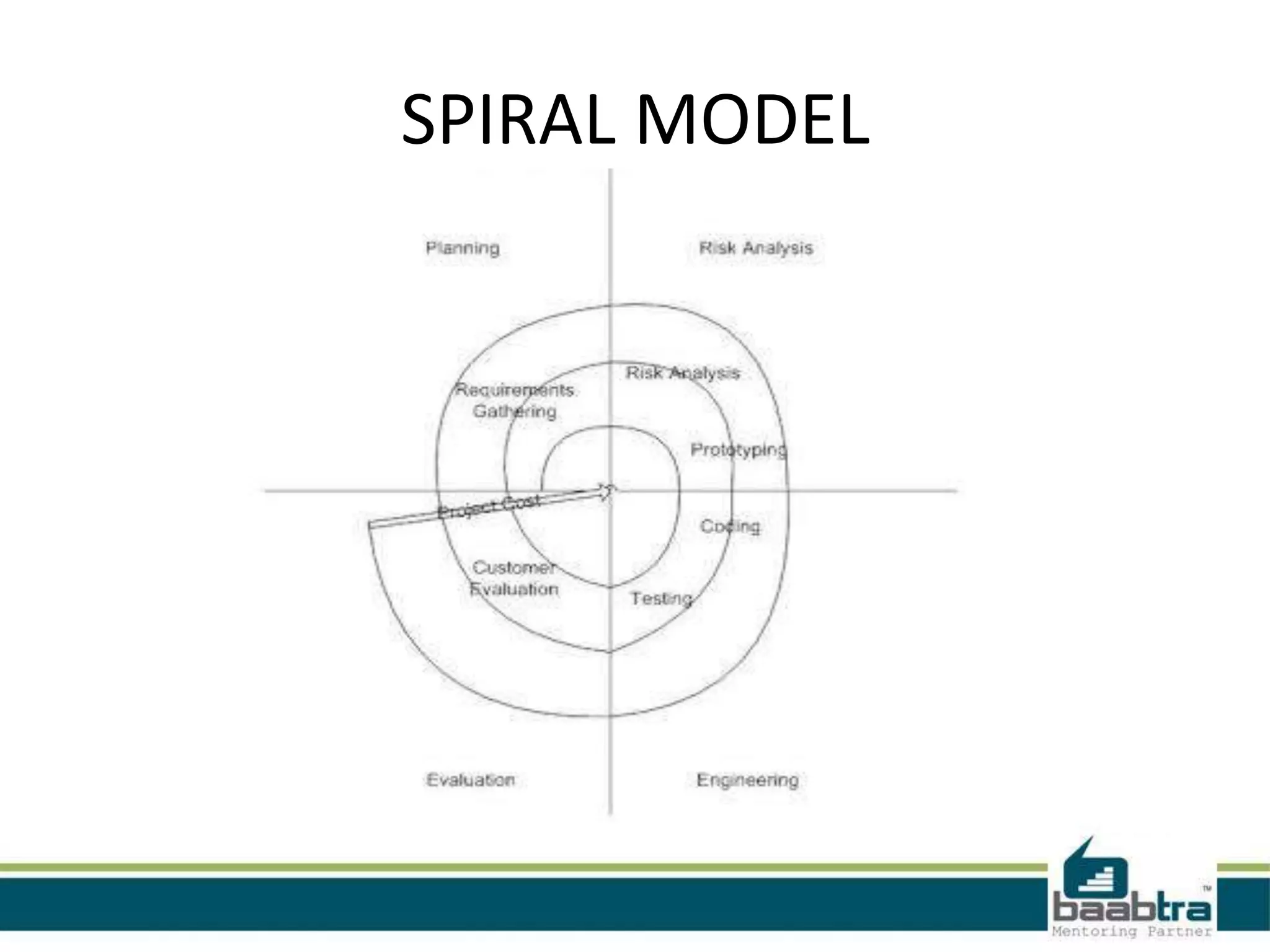
SPIRAL MODEL
• A model similar to incremental model with
more emphasis on risk analysis
• Has four phases
– Planning
– Risk analysis
– Engineering
– Evaluation

• A software project repeatedly passes through
these phases
SPIRAL MODEL
SPIRAL MODEL
• Planning phase
– Requirements are gathered

• Risk analysis phase
– A process is undertaken to identify the risks and
alternate solutions
– A prototype is produced at the end of this phase
SPIRAL MODEL
• Engineering phase
– Software is produced in this phase

• Evaluation phase
– Allows the customer to evaluate the output of the
project to date before the project continues to the
next spiral
Advantages of Spiral model
• High amount of risk analysis and hence,
avoidance of Risk is enhanced
• Additional Functionality can be added at a
later date
• Software is produced early in the software life
cycle
Disadvantages of Spiral model
• Risk analysis requires highly specific expertise
• Project’s success is highly dependent on the
risk analysis phase
• Less effective for smaller projects
When to use Spiral model
• When costs and risk evaluation is important

• For medium to high-risk projects
• Users are unsure of their needs
If this presentation helped you, please visit our
page facebook.com/baabtra and like it.

Thanks in advance.
www.baabtra.com | www.massbaab.com |www.baabte.com
Contact Us
Emarald Mall (Big Bazar Building)
Mavoor Road, Kozhikode,
Kerala, India.
Ph: + 91 – 495 40 25 550

Start up Village
Eranakulam,
Kerala, India.
Email: info@baabtra.com

NC Complex, Near Bus Stand
Mukkam, Kozhikode,
Kerala, India.
Ph: + 91 – 495 40 25 550

sdlc

  • 2.
    Disclaimer: This presentationis prepared by trainees of baabtra as a part of mentoring program. This is not official document of baabtra –Mentoring Partner Baabtra-Mentoring Partner is the mentoring division of baabte System Technologies Pvt . Ltd
  • 3.
    Software Development LifeCycle MOHAMMED REHAB ribu99@gmail.com www.facebook.com/moham med.rehab.1 twitter.com/ribu99 in.linkedin.com/in/mohamm edrehab +919895253399
  • 4.
    Modern Software Development •Modern software development is no longer a simple process • There is a process that accompanies the development of every software • SDLC is a collection of best practices and methodologies
  • 5.
    Why understand SDLC? •Helps to improve the quality of your work • Helps to improve your productivity • Without an accepted process and methodology there are chances to – – Deliver the project late – Deliver the project over budget
  • 6.
  • 7.
    MODELS • Waterfall Model •Incremental Model • Agile Model • Spiral Model
  • 8.
    WATERFALL MODEL • Firstprocess model that was introduced • Also referred to as linear sequential life cycle model • Very simple to understand and use
  • 9.
  • 10.
    WATERFALL MODEL • Eachphase must be fully completed before the next phase begins • A review takes place at the end of each phase • Phases do not overlap
  • 11.
    Advantages of Waterfallmodel • Easy to understand and use • Phases are processed and completed one at a time • Works well for smaller projects
  • 12.
    Disadvantages of Waterfallmodel • No working software is produced until late during the life cycle • Not a good model for complex projects • Even a small change in a phase can cause big problems in the subsequent phases
  • 13.
    When to useWaterfall model • When requirements are well known and clear • When the project to be developed is small
  • 14.
  • 15.
    INCREMENTAL MODEL • Wholerequirement is divided into various builds • Multiple development cycles take place • Cycles are divided up into more easily manageable modules
  • 16.
    INCREMENTAL MODEL • Eachmodule passes through the design, implementation and testing phases • Working version of the software is produced with the first module
  • 17.
    INCREMENTAL MODEL • Eachsubsequent release of module adds function to the previous release • The process continues till the complete system is achieved
  • 18.
    Advantages of Incrementalmodel • Generates working software early during the software life cycle • Easier to test and debug • Customer can respond to each built
  • 19.
    Disadvantages of Incrementalmodel • Needs good planning and design • Needs a clear and complete idea of whole system before it can be broken down
  • 20.
    When to useIncremental model • Requirements of the complete system are clearly understood • There is a need to get a product to the market early
  • 21.
  • 22.
    AGILE MODEL • Itis also a type of incremental model • Software is developed in rapid cycles • Small incremental releases with each release building on previous functionality • Each release is thoroughly tested to ensure software quality
  • 23.
    Advantages of Agilemodel • Customer satisfaction by rapid, continuous delivery of useful software • Customers, developers and testers constantly interact with each other • Working software is delivered frequently (weeks rather than months)
  • 24.
    Disadvantages of Agilemodel • There is lack of emphasis on necessary designing and documentation • It is no place for new programmers, unless combined with experienced resources
  • 25.
    When to useAgile model • Frequency of new increments to the software is more • Stakeholders find that they get more freedom of time and options using this model
  • 26.
    SPIRAL MODEL • Amodel similar to incremental model with more emphasis on risk analysis • Has four phases – Planning – Risk analysis – Engineering – Evaluation • A software project repeatedly passes through these phases
  • 27.
  • 28.
    SPIRAL MODEL • Planningphase – Requirements are gathered • Risk analysis phase – A process is undertaken to identify the risks and alternate solutions – A prototype is produced at the end of this phase
  • 29.
    SPIRAL MODEL • Engineeringphase – Software is produced in this phase • Evaluation phase – Allows the customer to evaluate the output of the project to date before the project continues to the next spiral
  • 30.
    Advantages of Spiralmodel • High amount of risk analysis and hence, avoidance of Risk is enhanced • Additional Functionality can be added at a later date • Software is produced early in the software life cycle
  • 31.
    Disadvantages of Spiralmodel • Risk analysis requires highly specific expertise • Project’s success is highly dependent on the risk analysis phase • Less effective for smaller projects
  • 32.
    When to useSpiral model • When costs and risk evaluation is important • For medium to high-risk projects • Users are unsure of their needs
  • 34.
    If this presentationhelped you, please visit our page facebook.com/baabtra and like it. Thanks in advance. www.baabtra.com | www.massbaab.com |www.baabte.com
  • 35.
    Contact Us Emarald Mall(Big Bazar Building) Mavoor Road, Kozhikode, Kerala, India. Ph: + 91 – 495 40 25 550 Start up Village Eranakulam, Kerala, India. Email: info@baabtra.com NC Complex, Near Bus Stand Mukkam, Kozhikode, Kerala, India. Ph: + 91 – 495 40 25 550