Sayed Farhan Ali Shah 
BS(I.T) 5° semester P-3 
RollNO: (39) 
Subject: Introduction to software 
development 
Teacher: Sir Asadullah Kehar 
Date:7/5/2014
 Spiral model is an evolutionary software process model which is a 
combination of an iterative nature of prototyping and systematic aspects 
of traditional waterfall model.
 The spiral model was defined by Barry Boehm in his 
1988 article. 
 This model was not the first model to discuss 
iterative development, but it was the first model to 
explain why the iteration matters.
When costs and risk evaluation is important. 
For medium to high-risk projects. 
Users are unsure of their needs. 
Requirements are complex. 
Significant changes are expected.
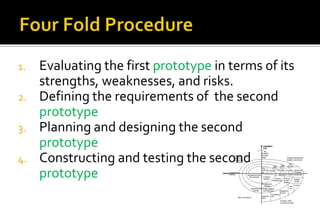
1. Evaluating the first prototype in terms of its 
strengths, weaknesses, and risks. 
2. Defining the requirements of the second 
prototype 
3. Planning and designing the second 
prototype 
4. Constructing and testing the second 
prototype
 A prototype is an early sample, model or 
release of a product built to test a concept or 
process or to act as a thing to be replicated or 
learned from. 
6
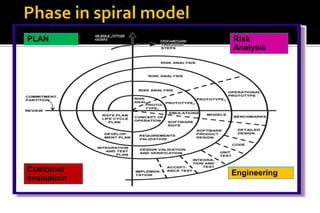
PLAN Risk 
Analysis 
Customer Engineering 
evaluation
The objectives, alternatives and constraints 
of the project are determined and are 
documented.
 All possible alternatives, which can help in 
developing a cost effective project are 
analyzed 
This phase identify and resolve all the 
possible risks in the project development.
The actual development of the project is 
carried out 
The output of this phase is passed through all 
the phases iteratively in order to obtain 
improvements in the same.
Developed product is passed on to the 
customer in order to receive customer’s 
comments and suggestions. 
This phase is very much similar toTESTING 
phase.
 The spiral model is used most often in large 
projects. 
 For smaller projects, the concept of agile 
software development is becoming a viable 
alternative. 
 It is also reasonable to use the spiral model in 
projects where business goals are unstable .
 Changing requirements can be 
accommodated. 
Allows for extensive use of prototypes. 
Requirements can be captured more 
accurately. 
Users see the system early. 
Early and frequent feedback from users.
End of project may not be known early. 
Not suitable for small or low risk projects and 
could be expensive for small projects. 
Process is complex 
Spiral may go indefinitely. 
Risk assessment expertise is required.
15

Spiral model presentation

  • 1.
    Sayed Farhan AliShah BS(I.T) 5° semester P-3 RollNO: (39) Subject: Introduction to software development Teacher: Sir Asadullah Kehar Date:7/5/2014
  • 2.
     Spiral modelis an evolutionary software process model which is a combination of an iterative nature of prototyping and systematic aspects of traditional waterfall model.
  • 3.
     The spiralmodel was defined by Barry Boehm in his 1988 article.  This model was not the first model to discuss iterative development, but it was the first model to explain why the iteration matters.
  • 4.
    When costs andrisk evaluation is important. For medium to high-risk projects. Users are unsure of their needs. Requirements are complex. Significant changes are expected.
  • 5.
    1. Evaluating thefirst prototype in terms of its strengths, weaknesses, and risks. 2. Defining the requirements of the second prototype 3. Planning and designing the second prototype 4. Constructing and testing the second prototype
  • 6.
     A prototypeis an early sample, model or release of a product built to test a concept or process or to act as a thing to be replicated or learned from. 6
  • 7.
    PLAN Risk Analysis Customer Engineering evaluation
  • 8.
    The objectives, alternativesand constraints of the project are determined and are documented.
  • 9.
     All possiblealternatives, which can help in developing a cost effective project are analyzed This phase identify and resolve all the possible risks in the project development.
  • 10.
    The actual developmentof the project is carried out The output of this phase is passed through all the phases iteratively in order to obtain improvements in the same.
  • 11.
    Developed product ispassed on to the customer in order to receive customer’s comments and suggestions. This phase is very much similar toTESTING phase.
  • 12.
     The spiralmodel is used most often in large projects.  For smaller projects, the concept of agile software development is becoming a viable alternative.  It is also reasonable to use the spiral model in projects where business goals are unstable .
  • 13.
     Changing requirementscan be accommodated. Allows for extensive use of prototypes. Requirements can be captured more accurately. Users see the system early. Early and frequent feedback from users.
  • 14.
    End of projectmay not be known early. Not suitable for small or low risk projects and could be expensive for small projects. Process is complex Spiral may go indefinitely. Risk assessment expertise is required.
  • 15.