StepsIn Simulation Study
NALIN
ADHIKARY
nalin.com.np
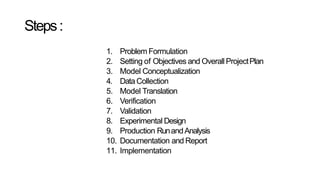
Steps:
1. Problem Formulation
2. Setting of Objectives and Overall ProjectPlan
3. Model Conceptualization
4. Data Collection
5. Model Translation
6. Verification
7. Validation
8. Experimental Design
9. Production RunandAnalysis
10. Documentation and Report
11. Implementation
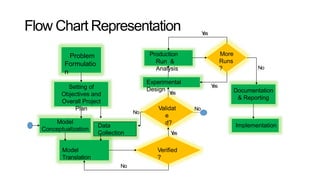
Flow Chart Representation
Problem
Formulatio
n
Setting of
Objectives and
Overall Project
Plan
Model
Conceptualization
Data
Collection
Model
Translation
Experimental
Design
Production
Run &
Analysis
More
Runs
?
Validat
e
d?
Verified
?
Documentation
& Reporting
Implementation
No
Yes
Yes
No
Yes
Yes
No
No
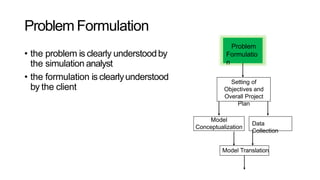
Problem Formulation
• the problem is clearly understoodby
the simulation analyst
• the formulation is clearlyunderstood
by the client
Problem
Formulatio
n
Setting of
Objectives and
Overall Project
Plan
Model
Conceptualization
Data
Collection
Model Translation
Setting of Objectives and Overall ProjectPlan
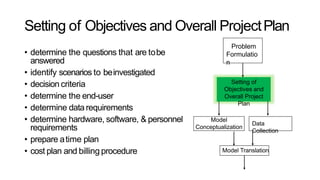
• determine the questions that are tobe
answered
• identify scenarios to beinvestigated
• decision criteria
• determine the end-user
• determine datarequirements
• determine hardware, software, & personnel
requirements
• prepare atime plan
• cost plan and billing procedure
Problem
Formulatio
n
Setting of
Objectives and
Overall Project
Plan
Model
Conceptualization
Data
Collection
Model Translation
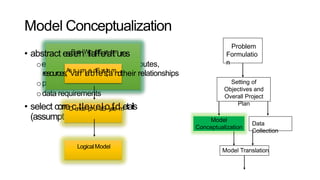
Model Conceptualization
oevents, activities, entities, attributes,
operformance measures
odata requirements
(assumptions)
Problem
Formulatio
n
Setting of
Objectives and
Overall Project
Plan
Model
Conceptualization
Data
Collection
Model Translation
• abstract essReeanlWtioarlldfSeysatetmures
resources,As
vs
au
rm
iae
bd
lS
eys
st
,e
am
ndtheir relationships
• select correCcontcleeptvueallSoysftedmetails
LogicalModel
Data Collection
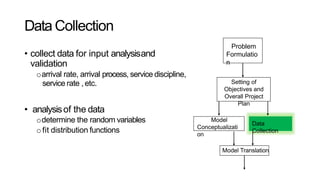
• collect data for input analysisand
validation
oarrival rate, arrival process, service discipline,
service rate , etc.
• analysisof the data
odetermine the random variables
ofit distribution functions
Problem
Formulatio
n
Setting of
Objectives and
Overall Project
Plan
Model
Conceptualizati
on
Data
Collection
Model Translation
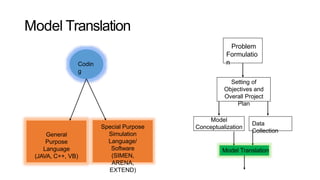
Model Translation
Problem
Formulatio
n
Setting of
Objectives and
Overall Project
Plan
Model
Conceptualization
Data
Collection
Model Translation
Codin
g
General
Purpose
Language
(JAVA, C++, VB)
Special Purpose
Simulation
Language/
Software
(SIMEN,
ARENA,
EXTEND)
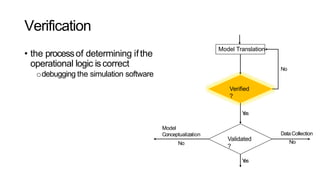
Verification
• the processof determining ifthe
operational logic iscorrect
odebugging the simulation software
Model Translation
Verified
?
Validated
?
No
Yes
Yes
DataCollection
No
Model
Conceptualization
No
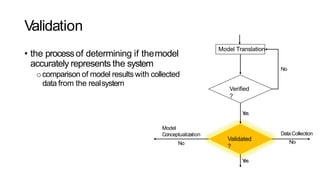
Validation
• the processof determining if themodel
accurately represents the system
ocomparison of model results with collected
data from the realsystem
Model Translation
Verified
?
Validated
?
No
Yes
Yes
DataCollection
No
Model
Conceptualization
No
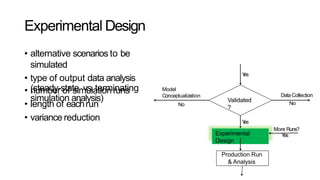
Experimental Design
• alternative scenarios to be
simulated
• type of output data analysis
(steady-state vs.terminating
simulation analysis)
• number of simulationruns
• length of eachrun
• variance reduction
Validated
?
Yes
Yes
DataCollection
No
Model
Conceptualization
No
Experimental
Design
More Runs?
Yes
Production Run
& Analysis
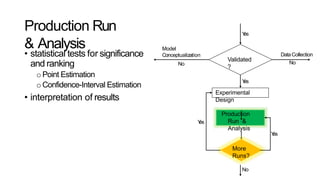
Production Run
& Analysis
• statistical tests for significance
and ranking
o Point Estimation
oConfidence-Interval Estimation
• interpretation of results
Validated
?
Yes
Yes
DataCollection
No
Model
Conceptualization
No
Experimental
Design
Production
Run &
Analysis
More
Runs?
Yes
Yes
No
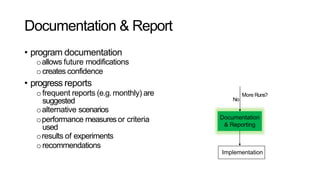
Documentation & Report
• program documentation
oallows future modifications
ocreates confidence
• progress reports
ofrequent reports (e.g. monthly) are
suggested
oalternative scenarios
operformance measuresor criteria
used
oresults of experiments
orecommendations
Documentation
& Reporting
Implementation
No
More Runs?
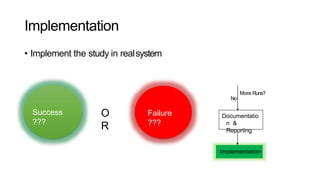
Implementation
• Implement the study in realsystem
Documentatio
n &
Reporting
Implementation
More Runs?
No
Success
???
Failure
???
O
R
References
• www.engr.sjsu.edu
• www.ewp.rpi.edu/hartford
Thank you
!

Steps in simulation study

  • 1.
  • 2.
    Steps: 1. Problem Formulation 2.Setting of Objectives and Overall ProjectPlan 3. Model Conceptualization 4. Data Collection 5. Model Translation 6. Verification 7. Validation 8. Experimental Design 9. Production RunandAnalysis 10. Documentation and Report 11. Implementation
  • 3.
    Flow Chart Representation Problem Formulatio n Settingof Objectives and Overall Project Plan Model Conceptualization Data Collection Model Translation Experimental Design Production Run & Analysis More Runs ? Validat e d? Verified ? Documentation & Reporting Implementation No Yes Yes No Yes Yes No No
  • 4.
    Problem Formulation • theproblem is clearly understoodby the simulation analyst • the formulation is clearlyunderstood by the client Problem Formulatio n Setting of Objectives and Overall Project Plan Model Conceptualization Data Collection Model Translation
  • 5.
    Setting of Objectivesand Overall ProjectPlan • determine the questions that are tobe answered • identify scenarios to beinvestigated • decision criteria • determine the end-user • determine datarequirements • determine hardware, software, & personnel requirements • prepare atime plan • cost plan and billing procedure Problem Formulatio n Setting of Objectives and Overall Project Plan Model Conceptualization Data Collection Model Translation
  • 6.
    Model Conceptualization oevents, activities,entities, attributes, operformance measures odata requirements (assumptions) Problem Formulatio n Setting of Objectives and Overall Project Plan Model Conceptualization Data Collection Model Translation • abstract essReeanlWtioarlldfSeysatetmures resources,As vs au rm iae bd lS eys st ,e am ndtheir relationships • select correCcontcleeptvueallSoysftedmetails LogicalModel
  • 7.
    Data Collection • collectdata for input analysisand validation oarrival rate, arrival process, service discipline, service rate , etc. • analysisof the data odetermine the random variables ofit distribution functions Problem Formulatio n Setting of Objectives and Overall Project Plan Model Conceptualizati on Data Collection Model Translation
  • 8.
    Model Translation Problem Formulatio n Setting of Objectivesand Overall Project Plan Model Conceptualization Data Collection Model Translation Codin g General Purpose Language (JAVA, C++, VB) Special Purpose Simulation Language/ Software (SIMEN, ARENA, EXTEND)
  • 9.
    Verification • the processofdetermining ifthe operational logic iscorrect odebugging the simulation software Model Translation Verified ? Validated ? No Yes Yes DataCollection No Model Conceptualization No
  • 10.
    Validation • the processofdetermining if themodel accurately represents the system ocomparison of model results with collected data from the realsystem Model Translation Verified ? Validated ? No Yes Yes DataCollection No Model Conceptualization No
  • 11.
    Experimental Design • alternativescenarios to be simulated • type of output data analysis (steady-state vs.terminating simulation analysis) • number of simulationruns • length of eachrun • variance reduction Validated ? Yes Yes DataCollection No Model Conceptualization No Experimental Design More Runs? Yes Production Run & Analysis
  • 12.
    Production Run & Analysis •statistical tests for significance and ranking o Point Estimation oConfidence-Interval Estimation • interpretation of results Validated ? Yes Yes DataCollection No Model Conceptualization No Experimental Design Production Run & Analysis More Runs? Yes Yes No
  • 13.
    Documentation & Report •program documentation oallows future modifications ocreates confidence • progress reports ofrequent reports (e.g. monthly) are suggested oalternative scenarios operformance measuresor criteria used oresults of experiments orecommendations Documentation & Reporting Implementation No More Runs?
  • 14.
    Implementation • Implement thestudy in realsystem Documentatio n & Reporting Implementation More Runs? No Success ??? Failure ??? O R
  • 15.
  • 16.