Spiral Model
Presented by – YASH PRASHANT PUROHIT
20MIS0364
1
Contents
• What is Spiral Model?
• Phases
• When to use Spiral Model?
• Advantages and Disadvantages
• Conclusion
2
What is spiral model?
• Spiral model is one of the most important Software Development
Life Cycle models, which provides support for Risk Handling.
• Spiral Model is a combination of a waterfall model and prototype
model.
• Each phase in spiral model begins with a design goal and ends with
the client reviewing the progress.
3
• The spiral model was first mentioned by Barry Boehm in his 1986 paper.
• The spiral model is similar to the incremental model, with more emphasis
placed on risk analysis.
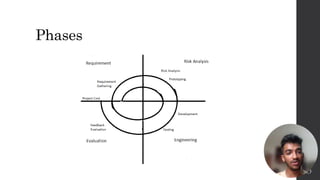
• The spiral model has four phases: Planning, Risk Analysis, Engineering
and Evaluation.
• Software project repeatedly passes through these four phases in iterations
(called Spirals).
4
Four Phases of Spiral model
• Planning
• Risk Analysis
• Engineering
• Evolution
5
Phases
6
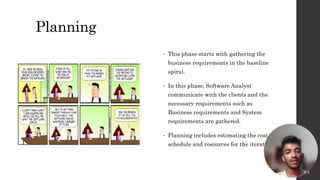
Planning
• This phase starts with gathering the
business requirements in the baseline
spiral.
• In this phase, Software Analyst
communicate with the clients and the
necessary requirements such as
Business requirements and System
requirements are gathered.
• Planning includes estimating the cost,
schedule and resources for the iteration.
7
Risk Analysis
• In this phase analyst assume all
the possible risks that could be
occurred during future
development.
• A prototype is produced at the end
of the risk analysis phase.
• If any risk is found during the risk
analysis then alternate solutions
are suggested and implemented.
8
Engineering
• In this phase software is
developed, along with
testing at the end of the
phase.
• Hence this phase includes
testing, coding and
deploying software at the
customer site.
9
Evaluation
• In this phase, Customers
evaluate the so far
developed version of the
software.
• In the end, planning for the
next phase is started.
10
When to use spiral model?
• When project is large
• Where the software needs continuous risk evaluation.
• When risk and costs evaluation is important
• For medium to high-risk projects
• When requirements are unclear and complex.
11
Advantages of Spiral model
• Additional functionality or changes can be done at a later stage.
• Cost estimation becomes easy as the prototype building is done in
small fragments.
• Continuous or repeated development helps in risk management.
• Development is fast and features are added in a systematic way.
• There is always a space for customer feedback and the changes are
implemented faster.
12
Disadvantages of Spiral model
• Risk of not meeting the schedule or budget.
• It works best for large projects only also demands risk
assessment expertise.
• For its smooth operation spiral model protocol needs to be
followed strictly.
• Documentation is more as it has intermediate phases.
• It is not advisable for smaller project, it might cost them a lot.
13
Conclusion
• Each spiral can be termed as a loop and each loop is a separate
development process in a spiral model.
• This model is very good to use for larger projects where you can
develop and deliver smaller prototypes and can enhance it to make
the larger software.
• The implementation of this model requires experienced resources as
risk analysis is a very integral part of this model and risk analysis
requires expertise and as a result this model becomes costly.
14
Thank You!
15

Spiral Model in Software Development Engineering

  • 1.
    Spiral Model Presented by– YASH PRASHANT PUROHIT 20MIS0364 1
  • 2.
    Contents • What isSpiral Model? • Phases • When to use Spiral Model? • Advantages and Disadvantages • Conclusion 2
  • 3.
    What is spiralmodel? • Spiral model is one of the most important Software Development Life Cycle models, which provides support for Risk Handling. • Spiral Model is a combination of a waterfall model and prototype model. • Each phase in spiral model begins with a design goal and ends with the client reviewing the progress. 3
  • 4.
    • The spiralmodel was first mentioned by Barry Boehm in his 1986 paper. • The spiral model is similar to the incremental model, with more emphasis placed on risk analysis. • The spiral model has four phases: Planning, Risk Analysis, Engineering and Evaluation. • Software project repeatedly passes through these four phases in iterations (called Spirals). 4
  • 5.
    Four Phases ofSpiral model • Planning • Risk Analysis • Engineering • Evolution 5
  • 6.
  • 7.
    Planning • This phasestarts with gathering the business requirements in the baseline spiral. • In this phase, Software Analyst communicate with the clients and the necessary requirements such as Business requirements and System requirements are gathered. • Planning includes estimating the cost, schedule and resources for the iteration. 7
  • 8.
    Risk Analysis • Inthis phase analyst assume all the possible risks that could be occurred during future development. • A prototype is produced at the end of the risk analysis phase. • If any risk is found during the risk analysis then alternate solutions are suggested and implemented. 8
  • 9.
    Engineering • In thisphase software is developed, along with testing at the end of the phase. • Hence this phase includes testing, coding and deploying software at the customer site. 9
  • 10.
    Evaluation • In thisphase, Customers evaluate the so far developed version of the software. • In the end, planning for the next phase is started. 10
  • 11.
    When to usespiral model? • When project is large • Where the software needs continuous risk evaluation. • When risk and costs evaluation is important • For medium to high-risk projects • When requirements are unclear and complex. 11
  • 12.
    Advantages of Spiralmodel • Additional functionality or changes can be done at a later stage. • Cost estimation becomes easy as the prototype building is done in small fragments. • Continuous or repeated development helps in risk management. • Development is fast and features are added in a systematic way. • There is always a space for customer feedback and the changes are implemented faster. 12
  • 13.
    Disadvantages of Spiralmodel • Risk of not meeting the schedule or budget. • It works best for large projects only also demands risk assessment expertise. • For its smooth operation spiral model protocol needs to be followed strictly. • Documentation is more as it has intermediate phases. • It is not advisable for smaller project, it might cost them a lot. 13
  • 14.
    Conclusion • Each spiralcan be termed as a loop and each loop is a separate development process in a spiral model. • This model is very good to use for larger projects where you can develop and deliver smaller prototypes and can enhance it to make the larger software. • The implementation of this model requires experienced resources as risk analysis is a very integral part of this model and risk analysis requires expertise and as a result this model becomes costly. 14
  • 15.