Distributed Systems Analysis and Design
01780036214 by EK7
Group Member
Saikat Rahman
Biprojit Saha
Mirza Minhaz Ahmed
Md Islam Khan
Saikat Rahman
Md Islam Khan
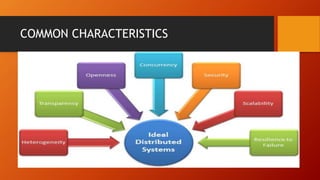
COMMON CHARACTERISTICS
HETEROGENEITY
Variety and differences in:
Networks
Computer hardware
Operating systems
Programming languages
Implementations by different developers
OPENNESS
 Openness of a computer system:
-- is the characteristic that determines whether the
System can be extended re-implemented in various
way.
SECURITY
 In a distributed system, clients send requests to access
data managed by servers, resources in the networks:
Doctors requesting records from hospitals.
Users purchase products through electronic commerce.
SCALABILITY
Challenges:
Controlling the cost of physical resources.
Controlling the performance loss.
Biprojit Saha
Basic Design Issues
• General software engineering principles include
rigor and formality, separation of concerns,
modularity, abstraction, anticipation of
change, …
• Specific issues for distributed systems:
• Naming
• Communication
• Software structure
• System architecture
• Workload allocation
• Consistency maintenance
14
Naming
• A name is resolved when translated into an
interpretable form for resource/object
reference.
• Communication identifier (IP address + port
number)
• Name resolution involves several translation
steps
15
Communication
• Separated components communicate with sending processes
and receiving processes for data transfer and
synchronization.
• Message passing: send and receive primitives
• synchronous or blocking
• asynchronous or non-blocking
• Abstractions defined: channels, sockets, ports.
16
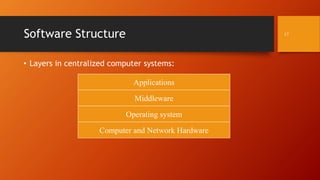
Software Structure
• Layers in centralized computer systems:
Applications
Middleware
Operating system
Computer and Network Hardware
17
SYSTEM ARCHITECTURES
• Client-Server
• Peer-to-Peer
• Services provided by multiple servers
• Proxy servers and caches
• Mobile code and mobile agents
• Network computers
• Thin clients and mobile devices
18
Name: Mirza Minhaz Ahmed
Part: Pros and Cons of the
distributed systems
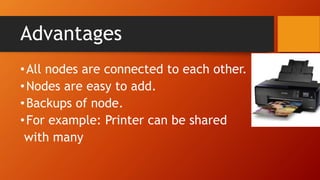
Advantages
•All nodes are connected to each other.
•Nodes are easy to add.
•Backups of node.
•For example: Printer can be shared
with many
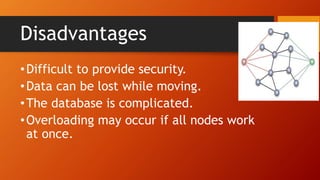
Disadvantages
•Difficult to provide security.
•Data can be lost while moving.
•The database is complicated.
•Overloading may occur if all nodes work
at once.
Distributed systems-analysis-and-design

Distributed systems-analysis-and-design

  • 1.
    Distributed Systems Analysisand Design 01780036214 by EK7
  • 2.
    Group Member Saikat Rahman BiprojitSaha Mirza Minhaz Ahmed Md Islam Khan
  • 3.
  • 7.
  • 8.
  • 9.
    HETEROGENEITY Variety and differencesin: Networks Computer hardware Operating systems Programming languages Implementations by different developers
  • 10.
    OPENNESS  Openness ofa computer system: -- is the characteristic that determines whether the System can be extended re-implemented in various way.
  • 11.
    SECURITY  In adistributed system, clients send requests to access data managed by servers, resources in the networks: Doctors requesting records from hospitals. Users purchase products through electronic commerce.
  • 12.
    SCALABILITY Challenges: Controlling the costof physical resources. Controlling the performance loss.
  • 13.
  • 14.
    Basic Design Issues •General software engineering principles include rigor and formality, separation of concerns, modularity, abstraction, anticipation of change, … • Specific issues for distributed systems: • Naming • Communication • Software structure • System architecture • Workload allocation • Consistency maintenance 14
  • 15.
    Naming • A nameis resolved when translated into an interpretable form for resource/object reference. • Communication identifier (IP address + port number) • Name resolution involves several translation steps 15
  • 16.
    Communication • Separated componentscommunicate with sending processes and receiving processes for data transfer and synchronization. • Message passing: send and receive primitives • synchronous or blocking • asynchronous or non-blocking • Abstractions defined: channels, sockets, ports. 16
  • 17.
    Software Structure • Layersin centralized computer systems: Applications Middleware Operating system Computer and Network Hardware 17
  • 18.
    SYSTEM ARCHITECTURES • Client-Server •Peer-to-Peer • Services provided by multiple servers • Proxy servers and caches • Mobile code and mobile agents • Network computers • Thin clients and mobile devices 18
  • 19.
    Name: Mirza MinhazAhmed Part: Pros and Cons of the distributed systems
  • 20.
    Advantages •All nodes areconnected to each other. •Nodes are easy to add. •Backups of node. •For example: Printer can be shared with many
  • 21.
    Disadvantages •Difficult to providesecurity. •Data can be lost while moving. •The database is complicated. •Overloading may occur if all nodes work at once.

Editor's Notes

  • #15 According to the Fundamentals of Software Engineering book by Ghezzi et. al., software engineering principles include (1) Rigor and Formality (2) Separation of Concerns (3) Modularity (4) Abstraction (5) Anticipation of Change (6) Generality and (7) Incrementality. Specific issues need to be resolved for the design of software for distributed systems.
  • #16 Name: names that can be interpreted by users or by programs Identifier: names that can be interpreted or used only by programs. At each name translation step, a name or identifier is mapped to a lower-level identifier that can be used to specify a resource when communicating with some software component, until a communication id is produced that is acceptable to the communication subsystem, and that is used to transmit a request to a resource manager. Names having some hierarchical structure representing an internal hierarchic name space (/etc/passwd) organizational hierarchy (cse.cuhk.edu.hk) a flat set of numeric or symbolic identifier advantages: each part of a name is resolved relative to a separate context, and the same name may be used with different meaning in different context Names are always resolved relative to some context. Contexts are represented by name tables or databases. In the case of file systems, each directory represents a context. To resolve a name, we must supply the context and the name. A name service accepts requests for the translation of names or identifiers in one name space to identifier in some other space. It also handles name registration, deletion, and provides up-to-date information. Naming schemes can be designed to protect the resources from unauthorized access. Each id is chosen so that it is hard to reproduce, and their client’s authority is being checked by the naming service. Ids which meet this requirement are known as capabilities.
  • #17 Synchronization prevent sending or receiving process from continuing until the other process makes an action that frees it. Each message-passing action involves the transmission by the sending process of a set of data values (a message) through a specified communication mechanism (a channel or port) and the acceptance by the receiving process of a message. Synchronous (blocking) means that the sender waits after transmitting a message until the receiver has performed a receive operation. Asynchronous (non-blocking) means that the message is placed in a queue of messages waiting for the receiver to accept them and the sending process can proceed immediately. Distributed systems can be designed entirely in terms of message-passing, but there are certain useful communication patterns (collective of primitives for high-level operations). Client-server communication model is for service provision: 1. Transmission of a request from a client to a server; 2. Execution of the request by the server; 3. Transmission of a reply to the client. Function shipping: the server acts as an execution environment and interpreter for programs, and clients transmit sequences of instructions for interpretation (e.g., PostScript files sent to printer). Multicasting: sending a message to the members of a specified group of processes. Multicasting examples: locating an object, fault tolerance, and multiple update.
  • #18 Middleware provides run-time support for programming language, such as interpreters and libraries OS is the main system software to manage basic resources and to provide user and application services: Basic resource management: - memory allocation and protection - process creation and processor scheduling - peripheral device handling User and application services: - user authentication and access control (e.g., login facilities) - file management and file access facilities - clock facilities