WATERFALL MODEL & SPIRAL MODEL
-TYPES OF SDLC
1
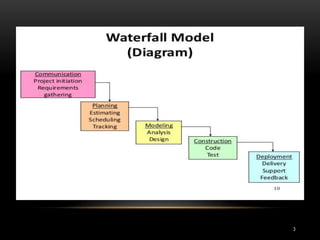
WATERFALL MODEL
 Sequential(non-iterative) design process
 Progress falls from top to bottom like a cascading waterfall.
 Review takes place at end of each phase to determine if project
is on right path and whether or not to discard the project.
 Software testing starts only after development process
completes.
2
3
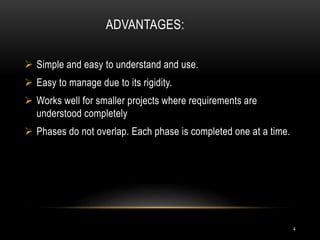
ADVANTAGES:
 Simple and easy to understand and use.
 Easy to manage due to its rigidity.
 Works well for smaller projects where requirements are
understood completely
 Phases do not overlap. Each phase is completed one at a time.
4
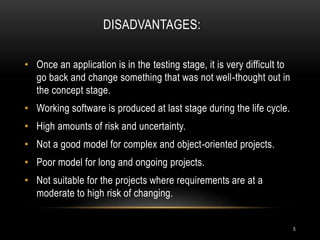
DISADVANTAGES:
• Once an application is in the testing stage, it is very difficult to
go back and change something that was not well-thought out in
the concept stage.
• Working software is produced at last stage during the life cycle.
• High amounts of risk and uncertainty.
• Not a good model for complex and object-oriented projects.
• Poor model for long and ongoing projects.
• Not suitable for the projects where requirements are at a
moderate to high risk of changing.
5
-Type of SDLC
SPIRAL MODEL
6
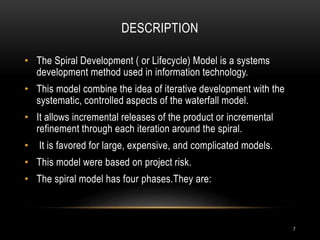
DESCRIPTION
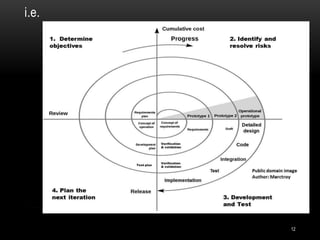
• The Spiral Development ( or Lifecycle) Model is a systems
development method used in information technology.
• This model combine the idea of iterative development with the
systematic, controlled aspects of the waterfall model.
• It allows incremental releases of the product or incremental
refinement through each iteration around the spiral.
• It is favored for large, expensive, and complicated models.
• This model were based on project risk.
• The spiral model has four phases.They are:
7
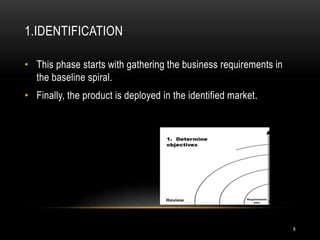
1.IDENTIFICATION
• This phase starts with gathering the business requirements in
the baseline spiral.
• Finally, the product is deployed in the identified market.
8
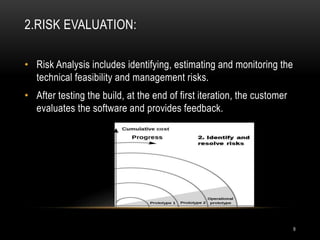
2.RISK EVALUATION:
• Risk Analysis includes identifying, estimating and monitoring the
technical feasibility and management risks.
• After testing the build, at the end of first iteration, the customer
evaluates the software and provides feedback.
9
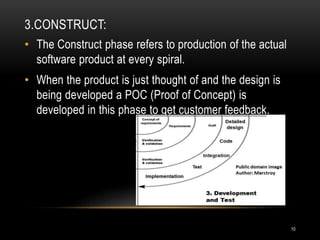
3.CONSTRUCT:
• The Construct phase refers to production of the actual
software product at every spiral.
• When the product is just thought of and the design is
being developed a POC (Proof of Concept) is
developed in this phase to get customer feedback.
10
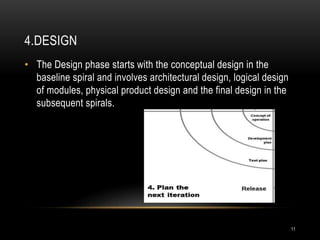
4.DESIGN
• The Design phase starts with the conceptual design in the
baseline spiral and involves architectural design, logical design
of modules, physical product design and the final design in the
subsequent spirals.
11
i.e.
12
ADVANTAGES:
• Changing requirements can be accommodated.
• Allows extensive use of prototypes.
• Requirements can be captured more accurately.
• Users see the system early.
• Development can be divided into smaller parts and the risky
parts can be developed earlier which helps in better risk
management.
13
DISADVANTAGES:
• Management is more complex.
• End of the project may not be known early.
• Not suitable for small or low risk projects and could be
expensive for small projects.
• Process is complex
• Large number of intermediate stages requires excessive
documentation.
14
Presented by : Shirisha Maharjan
15

Waterfall model and spiral model

  • 1.
    WATERFALL MODEL &SPIRAL MODEL -TYPES OF SDLC 1
  • 2.
    WATERFALL MODEL  Sequential(non-iterative)design process  Progress falls from top to bottom like a cascading waterfall.  Review takes place at end of each phase to determine if project is on right path and whether or not to discard the project.  Software testing starts only after development process completes. 2
  • 3.
  • 4.
    ADVANTAGES:  Simple andeasy to understand and use.  Easy to manage due to its rigidity.  Works well for smaller projects where requirements are understood completely  Phases do not overlap. Each phase is completed one at a time. 4
  • 5.
    DISADVANTAGES: • Once anapplication is in the testing stage, it is very difficult to go back and change something that was not well-thought out in the concept stage. • Working software is produced at last stage during the life cycle. • High amounts of risk and uncertainty. • Not a good model for complex and object-oriented projects. • Poor model for long and ongoing projects. • Not suitable for the projects where requirements are at a moderate to high risk of changing. 5
  • 6.
  • 7.
    DESCRIPTION • The SpiralDevelopment ( or Lifecycle) Model is a systems development method used in information technology. • This model combine the idea of iterative development with the systematic, controlled aspects of the waterfall model. • It allows incremental releases of the product or incremental refinement through each iteration around the spiral. • It is favored for large, expensive, and complicated models. • This model were based on project risk. • The spiral model has four phases.They are: 7
  • 8.
    1.IDENTIFICATION • This phasestarts with gathering the business requirements in the baseline spiral. • Finally, the product is deployed in the identified market. 8
  • 9.
    2.RISK EVALUATION: • RiskAnalysis includes identifying, estimating and monitoring the technical feasibility and management risks. • After testing the build, at the end of first iteration, the customer evaluates the software and provides feedback. 9
  • 10.
    3.CONSTRUCT: • The Constructphase refers to production of the actual software product at every spiral. • When the product is just thought of and the design is being developed a POC (Proof of Concept) is developed in this phase to get customer feedback. 10
  • 11.
    4.DESIGN • The Designphase starts with the conceptual design in the baseline spiral and involves architectural design, logical design of modules, physical product design and the final design in the subsequent spirals. 11
  • 12.
  • 13.
    ADVANTAGES: • Changing requirementscan be accommodated. • Allows extensive use of prototypes. • Requirements can be captured more accurately. • Users see the system early. • Development can be divided into smaller parts and the risky parts can be developed earlier which helps in better risk management. 13
  • 14.
    DISADVANTAGES: • Management ismore complex. • End of the project may not be known early. • Not suitable for small or low risk projects and could be expensive for small projects. • Process is complex • Large number of intermediate stages requires excessive documentation. 14
  • 15.
    Presented by :Shirisha Maharjan 15