WATERFALL MODEL
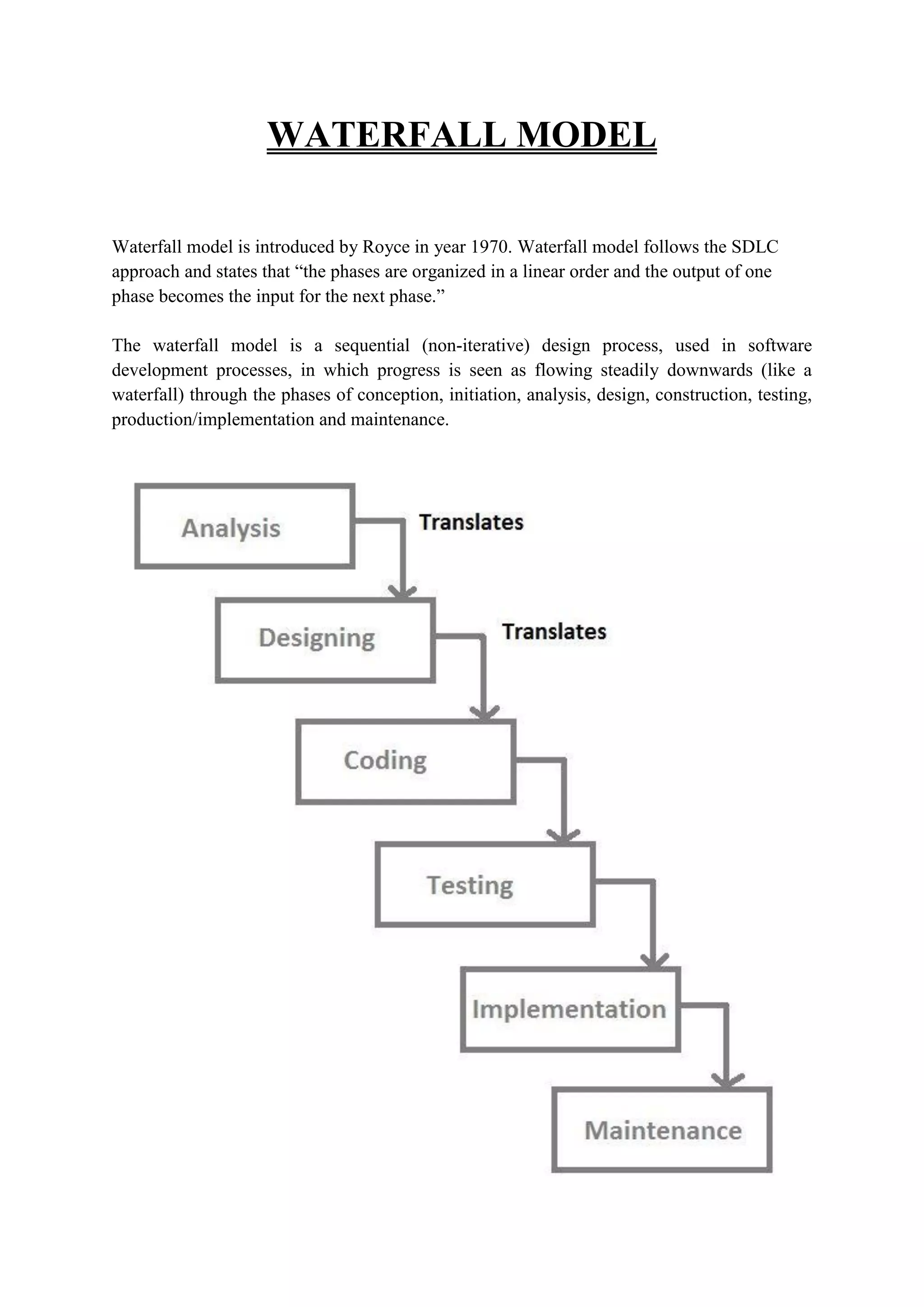
Waterfall model is introduced by Royce in year 1970. Waterfall model follows the SDLC
approach and states that “the phases are organized in a linear order and the output of one
phase becomes the input for the next phase.”
The waterfall model is a sequential (non-iterative) design process, used in software
development processes, in which progress is seen as flowing steadily downwards (like a
waterfall) through the phases of conception, initiation, analysis, design, construction, testing,
production/implementation and maintenance.
Advantages of waterfall model:
 This model is simple and easy to understand and use.
 It is easy to manage due to the rigidity of the model – each phase has specific
deliverables and a review process.
 In this model phases are processed and completed one at a time. Phases do not
overlap.
 Waterfall model works well for smaller projects where requirements are very well
understood.
Disadvantages of waterfall model:
 Once an application is in the testing stage, it is very difficult to go back and change
something that was not well-thought out in the concept stage.
 No working software is produced until late during the life cycle.
 High amounts of risk and uncertainty.
 Not a good model for complex and object-oriented projects.
 Poor model for long and ongoing projects.
 Not suitable for the projects where requirements are at a moderate to high risk of
changing.
When to use the waterfall model:
 This model is used only when the requirements are very well known, clear and fixed.
 Product definition is stable.
 Technology is understood.
 There are no ambiguous requirements
 Ample resources with required expertise are available freely
 The project is short.
Limitations of the waterfall model:
 The model implies that you should attempt to complete a given stage before moving
on to the next stage
 Does not account for the fact that requirements constantly change.
 It also means that customers cannot use anything until the entire system is
complete.
 The model makes no allowances for prototyping.
 It implies that you can get the requirements right by simply writing them down and
reviewing them.
 The model implies that once the product is finished, everything else is maintenance.
ASSIGNMENT OF M.I.S.
on
“SYSTEM DEVELOPMENT LIFE CYCLE”
&
“WATERFALL MODEL”
MASTER OF BUSINESS ADMINISTRATION
2015-2017
Submitted to: Submitted by:
Dr. Vageesh Paliwal Sandeep Kumar,
(Asst. Professor) Prashant Saini
(MBA III sem.)
FACULTY OF MANAGEMENT STUDIES
GURUKUL KANGRI VISHWAVIDYALAYA
HARIDWAR-249404

Waterfall model

  • 1.
    WATERFALL MODEL Waterfall modelis introduced by Royce in year 1970. Waterfall model follows the SDLC approach and states that “the phases are organized in a linear order and the output of one phase becomes the input for the next phase.” The waterfall model is a sequential (non-iterative) design process, used in software development processes, in which progress is seen as flowing steadily downwards (like a waterfall) through the phases of conception, initiation, analysis, design, construction, testing, production/implementation and maintenance.
  • 2.
    Advantages of waterfallmodel:  This model is simple and easy to understand and use.  It is easy to manage due to the rigidity of the model – each phase has specific deliverables and a review process.  In this model phases are processed and completed one at a time. Phases do not overlap.  Waterfall model works well for smaller projects where requirements are very well understood. Disadvantages of waterfall model:  Once an application is in the testing stage, it is very difficult to go back and change something that was not well-thought out in the concept stage.  No working software is produced until late during the life cycle.  High amounts of risk and uncertainty.  Not a good model for complex and object-oriented projects.  Poor model for long and ongoing projects.  Not suitable for the projects where requirements are at a moderate to high risk of changing. When to use the waterfall model:  This model is used only when the requirements are very well known, clear and fixed.  Product definition is stable.  Technology is understood.  There are no ambiguous requirements  Ample resources with required expertise are available freely  The project is short.
  • 3.
    Limitations of thewaterfall model:  The model implies that you should attempt to complete a given stage before moving on to the next stage  Does not account for the fact that requirements constantly change.  It also means that customers cannot use anything until the entire system is complete.  The model makes no allowances for prototyping.  It implies that you can get the requirements right by simply writing them down and reviewing them.  The model implies that once the product is finished, everything else is maintenance.
  • 4.
    ASSIGNMENT OF M.I.S. on “SYSTEMDEVELOPMENT LIFE CYCLE” & “WATERFALL MODEL” MASTER OF BUSINESS ADMINISTRATION 2015-2017 Submitted to: Submitted by: Dr. Vageesh Paliwal Sandeep Kumar, (Asst. Professor) Prashant Saini (MBA III sem.) FACULTY OF MANAGEMENT STUDIES GURUKUL KANGRI VISHWAVIDYALAYA HARIDWAR-249404