Android Operating System
Contents
• Introduction
• Origin of Android
• Open handset Alliance(OHA)
• Features of Android
• The android software architecture
• Versions of android
• Android application development
• Software features
• Hardware features
• Application life cycle
• Limitations
• Conclusion and future scope
Introduction
• Android is Linux based operating system designed primarily for
mobile devices such as smartphones and tablets.
• Android was first developed as a ADVANCED OPERATING SUSTEM for
digital cameras.
• There are more than 4,00,000 apps in android market.
• Android specially developed for applications.
• The android is an open source.
Origin of Android
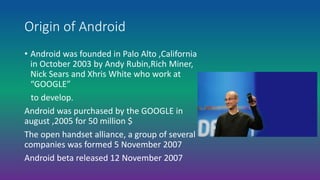
• Android was founded in Palo Alto ,California
in October 2003 by Andy Rubin,Rich Miner,
Nick Sears and Xhris White who work at
“GOOGLE”
to develop.
Android was purchased by the GOOGLE in
august ,2005 for 50 million $
The open handset alliance, a group of several
companies was formed 5 November 2007
Android beta released 12 November 2007
Open handset Alliance(OHA)
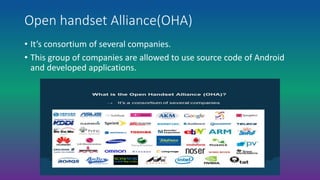
• It’s consortium of several companies.
• This group of companies are allowed to use source code of Android
and developed applications.
Features of Android
• Android can run multiple apps at the same time
• Also support optimized graphics VGA, 2D graphics and 3D graphics.
• Android lets you change your setting faster.
• It gives you more options to fit your budget.
• Android keeps information visible on your home screen.
Features of Android
• Android support wireless communication
• Open source –free development platform.
• Built in services like GPS,SQL Database, browser and maps.
• Portability across current and future hardware.
The android software architecture
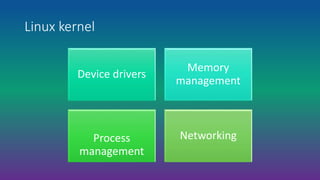
• Linux kernel
• Libraries
• Android run time
• Core libraries
• Dalvik virtual machine
• Application layer
• Application framework
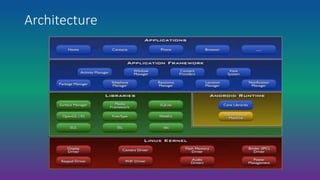
Architecture
Linux kernel
Device drivers
Memory
management
Process
management
Networking
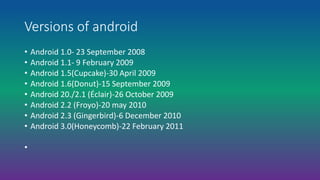
Versions of android
• Android 1.0- 23 September 2008
• Android 1.1- 9 February 2009
• Android 1.5(Cupcake)-30 April 2009
• Android 1.6(Donut)-15 September 2009
• Android 20./2.1 (Éclair)-26 October 2009
• Android 2.2 (Froyo)-20 may 2010
• Android 2.3 (Gingerbird)-6 December 2010
• Android 3.0(Honeycomb)-22 February 2011
•
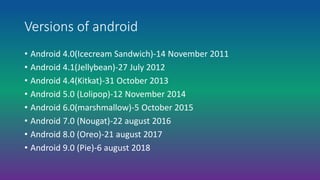
Versions of android
• Android 4.0(Icecream Sandwich)-14 November 2011
• Android 4.1(Jellybean)-27 July 2012
• Android 4.4(Kitkat)-31 October 2013
• Android 5.0 (Lolipop)-12 November 2014
• Android 6.0(marshmallow)-5 October 2015
• Android 7.0 (Nougat)-22 august 2016
• Android 8.0 (Oreo)-21 august 2017
• Android 9.0 (Pie)-6 august 2018
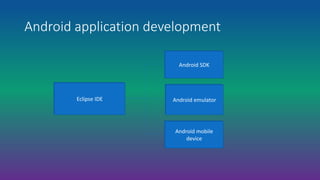
Android application development
Eclipse IDE
Android SDK
Android emulator
Android mobile
device
Eclipse IDE
Android SDK
Android emulator
Android mobile
device
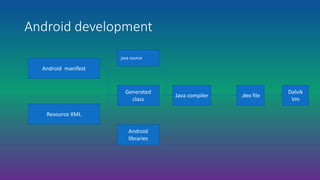
Android development
java source
Android manifest
Resource XML
Generated
class
Android
libraries
Java compiler .dex file
Dalvik
Vm
Software features
• Integrated browser based on the open source web kit engine
• SQLite for relational data storage
• Media support for common audio, video and still image formats
• Dalvik Virtual Machine optimized for mobile devices
Hardware features
• Cellular networking :GSM,EDGE,3G
• LAN : Bluetooth and Wi-Fi
• Graphics hardware acceleration
• Camera, GPS and compass
• Touch screen and accelerometer for motion sensing
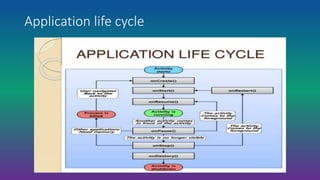
Application life cycle
Limitations
 Making source code available to everyone inevitably invites the
attention of hackers.
 Android operating system uses more amount of battery as compared
to normal mobile phones.
 It has been seen that it has security related issues.
 As well as android is world of applications we continuously need to
connected with the internet which is not possible for all the users.
Conclusion and future scope
• Android is now stepping up in next level of mobile internet.
• There are chances of android mobile sales in whole world becomes
more then iPhone
• There are chances of Android may become the widely used operating
system in world as it has found its applications in many appliances
such as washing machine, microwave ovens, cameras,TVs etc.
• Google may launch another version of android that starts L because
Google is launching all the android versions in the alphabetical order.
Android operating system

Android operating system

  • 1.
  • 2.
    Contents • Introduction • Originof Android • Open handset Alliance(OHA) • Features of Android • The android software architecture • Versions of android • Android application development • Software features • Hardware features • Application life cycle • Limitations • Conclusion and future scope
  • 3.
    Introduction • Android isLinux based operating system designed primarily for mobile devices such as smartphones and tablets. • Android was first developed as a ADVANCED OPERATING SUSTEM for digital cameras. • There are more than 4,00,000 apps in android market. • Android specially developed for applications. • The android is an open source.
  • 4.
    Origin of Android •Android was founded in Palo Alto ,California in October 2003 by Andy Rubin,Rich Miner, Nick Sears and Xhris White who work at “GOOGLE” to develop. Android was purchased by the GOOGLE in august ,2005 for 50 million $ The open handset alliance, a group of several companies was formed 5 November 2007 Android beta released 12 November 2007
  • 5.
    Open handset Alliance(OHA) •It’s consortium of several companies. • This group of companies are allowed to use source code of Android and developed applications.
  • 6.
    Features of Android •Android can run multiple apps at the same time • Also support optimized graphics VGA, 2D graphics and 3D graphics. • Android lets you change your setting faster. • It gives you more options to fit your budget. • Android keeps information visible on your home screen.
  • 7.
    Features of Android •Android support wireless communication • Open source –free development platform. • Built in services like GPS,SQL Database, browser and maps. • Portability across current and future hardware.
  • 8.
    The android softwarearchitecture • Linux kernel • Libraries • Android run time • Core libraries • Dalvik virtual machine • Application layer • Application framework
  • 9.
  • 10.
  • 11.
    Versions of android •Android 1.0- 23 September 2008 • Android 1.1- 9 February 2009 • Android 1.5(Cupcake)-30 April 2009 • Android 1.6(Donut)-15 September 2009 • Android 20./2.1 (Éclair)-26 October 2009 • Android 2.2 (Froyo)-20 may 2010 • Android 2.3 (Gingerbird)-6 December 2010 • Android 3.0(Honeycomb)-22 February 2011 •
  • 12.
    Versions of android •Android 4.0(Icecream Sandwich)-14 November 2011 • Android 4.1(Jellybean)-27 July 2012 • Android 4.4(Kitkat)-31 October 2013 • Android 5.0 (Lolipop)-12 November 2014 • Android 6.0(marshmallow)-5 October 2015 • Android 7.0 (Nougat)-22 august 2016 • Android 8.0 (Oreo)-21 august 2017 • Android 9.0 (Pie)-6 august 2018
  • 13.
    Android application development EclipseIDE Android SDK Android emulator Android mobile device Eclipse IDE Android SDK Android emulator Android mobile device
  • 14.
    Android development java source Androidmanifest Resource XML Generated class Android libraries Java compiler .dex file Dalvik Vm
  • 15.
    Software features • Integratedbrowser based on the open source web kit engine • SQLite for relational data storage • Media support for common audio, video and still image formats • Dalvik Virtual Machine optimized for mobile devices
  • 16.
    Hardware features • Cellularnetworking :GSM,EDGE,3G • LAN : Bluetooth and Wi-Fi • Graphics hardware acceleration • Camera, GPS and compass • Touch screen and accelerometer for motion sensing
  • 17.
  • 18.
    Limitations  Making sourcecode available to everyone inevitably invites the attention of hackers.  Android operating system uses more amount of battery as compared to normal mobile phones.  It has been seen that it has security related issues.  As well as android is world of applications we continuously need to connected with the internet which is not possible for all the users.
  • 19.
    Conclusion and futurescope • Android is now stepping up in next level of mobile internet. • There are chances of android mobile sales in whole world becomes more then iPhone • There are chances of Android may become the widely used operating system in world as it has found its applications in many appliances such as washing machine, microwave ovens, cameras,TVs etc. • Google may launch another version of android that starts L because Google is launching all the android versions in the alphabetical order.