Decision Tree
Group Member:
Md Ibrahim Adham Mesu
Sakib Hasan Rial
Lifonar Afrin Lifa
Md Islam Khan
Abdullah Al Redwan
Content:
Introduction
Types
Algorithm
Cart Algorithm
C5.0 Algorithm
Advantages
Limitation
Application
What is Decision Tree?
Decision Tree:
A decision tree is a graphical representation of possible solutions to a
decision based on certain conditions.
It's called a decision tree because it starts with a single box (or root),
which then branches off into a number of solutions, just like a tree.
Decision trees provide an effective method of Decision Making.
Decision Tree:
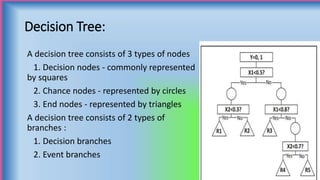
A decision tree consists of 3 types of nodes
1. Decision nodes - commonly represented
by squares
2. Chance nodes - represented by circles
3. End nodes - represented by triangles
A decision tree consists of 2 types of
branches :
1. Decision branches
2. Event branches
Fig: Decision Tree
Algorithm
Input:
D // Training data
Output:
T //Decision tree
DT Build algorithm
// Simplistic algorithm to illustrate naive approach to building DT
Types of Decision Trees:
Types of decision tree is based on the type of target variable we
have. It can be of two types:
Categorical Variable Decision Tree
Continuous Variable Decision Tree
Categorical Variable Decision Tree:
Decision Tree which has categorical
target variable then it called as
categorical variable decision tree.
E.g.:- In scenario, where the target
variable was “Student will distributed
in gender and height” i.e. YES or NO.
Continuous Variable Decision Tree:
Decision Tree has continuous target variable then it is called as
Continuous Variable Decision Tree.
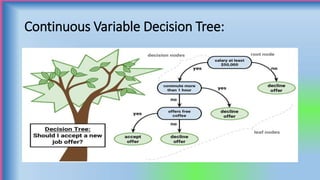
E.g.:-
A worker thinking about his salary and take decision. Is he accept
new job offer(yes/ no). In this case, we are predicting values for
continuous variable.
Continuous Variable Decision Tree:
Assumptions while creating Decision Tree:
Some of the assumptions we make while using Decision tree:
At the beginning, the whole training set is considered as the root.
Feature values are preferred to be categorical. If the values are
continuous then they are discretized prior to building the model.
Records are distributed recursively on the basis of attribute values.
Order to placing attributes as root or internal node of the tree is done
by using some statistical approach.
Different types of Algorithm:
HUNTS
CART
ID3
C5.0
SPRINT
CHAID
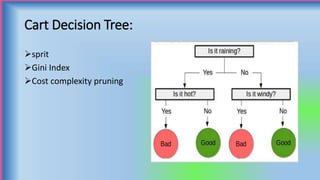
Cart Decision Tree:
sprit
Gini Index
Cost complexity pruning
C5.0 Decision Tree:
Multi sprit
Info gain
Pessimistic pruning
Advantages:
Decision Trees are easy to explain. It results in a set of rules.
It follows the same approach as humans generally follow while
making decisions.
Interpretation of a complex Decision Tree model can be simplified by
its visualizations. Even a naive person can understand logic.
The Number of hyper-parameters to be tuned is almost null.
It can be combined with other decision techniques.
Limitation:
There is a high probability of overfitting in Decision Tree.
Generally, it gives low prediction accuracy for a dataset as compared
to other machine learning algorithms.
Information gain in a decision tree with categorical variables gives a
biased response for attributes with greater no. of categories.
Calculations can become complex when there are many class labels.
Application of decision Tree:
Decision tree has been used to develop models for prediction and
classification in different domains some of which are:
Business management
Customer relationship management
Fraudulent statement detection
Engineering
Energy consumption
Fault diagnosis
Healthcare management
Agriculture
Applications in Real Life
Selecting a flight to travel
Choosing a best friend
Handling late night cravings
Applications in Business
Alternatives: Decision tree helps organizations to view the
alternatives way that can happen.
Events: Possible result may have two events.
Outcomes: Possible result from the decision tree.
References:
Kamiński, B.; Jakubczyk, M.; Szufel, P. (2017). "A framework for
sensitivity analysis of decision trees“
Quinlan, J. R. (1987). "Simplifying decision trees". International
Journal of Man-Machine Studies.
Venky Rao(2013 ).Journal “Introduction to Classification & Regression
Trees (CART).
Utgoff, P. E. (1989). “Incremental induction of decision trees”.
Machine learning.
Decision tree

Decision tree

  • 1.
    Decision Tree Group Member: MdIbrahim Adham Mesu Sakib Hasan Rial Lifonar Afrin Lifa Md Islam Khan Abdullah Al Redwan
  • 2.
  • 3.
  • 4.
    Decision Tree: A decisiontree is a graphical representation of possible solutions to a decision based on certain conditions. It's called a decision tree because it starts with a single box (or root), which then branches off into a number of solutions, just like a tree. Decision trees provide an effective method of Decision Making.
  • 5.
    Decision Tree: A decisiontree consists of 3 types of nodes 1. Decision nodes - commonly represented by squares 2. Chance nodes - represented by circles 3. End nodes - represented by triangles A decision tree consists of 2 types of branches : 1. Decision branches 2. Event branches
  • 6.
  • 7.
    Algorithm Input: D // Trainingdata Output: T //Decision tree DT Build algorithm // Simplistic algorithm to illustrate naive approach to building DT
  • 8.
    Types of DecisionTrees: Types of decision tree is based on the type of target variable we have. It can be of two types: Categorical Variable Decision Tree Continuous Variable Decision Tree
  • 9.
    Categorical Variable DecisionTree: Categorical Variable Decision Tree: Decision Tree which has categorical target variable then it called as categorical variable decision tree. E.g.:- In scenario, where the target variable was “Student will distributed in gender and height” i.e. YES or NO.
  • 10.
    Continuous Variable DecisionTree: Continuous Variable Decision Tree: Decision Tree has continuous target variable then it is called as Continuous Variable Decision Tree. E.g.:- A worker thinking about his salary and take decision. Is he accept new job offer(yes/ no). In this case, we are predicting values for continuous variable.
  • 11.
  • 12.
    Assumptions while creatingDecision Tree: Some of the assumptions we make while using Decision tree: At the beginning, the whole training set is considered as the root. Feature values are preferred to be categorical. If the values are continuous then they are discretized prior to building the model. Records are distributed recursively on the basis of attribute values. Order to placing attributes as root or internal node of the tree is done by using some statistical approach.
  • 13.
    Different types ofAlgorithm: HUNTS CART ID3 C5.0 SPRINT CHAID
  • 14.
    Cart Decision Tree: sprit GiniIndex Cost complexity pruning
  • 15.
    C5.0 Decision Tree: Multisprit Info gain Pessimistic pruning
  • 16.
    Advantages: Decision Trees areeasy to explain. It results in a set of rules. It follows the same approach as humans generally follow while making decisions. Interpretation of a complex Decision Tree model can be simplified by its visualizations. Even a naive person can understand logic. The Number of hyper-parameters to be tuned is almost null. It can be combined with other decision techniques.
  • 17.
    Limitation: There is ahigh probability of overfitting in Decision Tree. Generally, it gives low prediction accuracy for a dataset as compared to other machine learning algorithms. Information gain in a decision tree with categorical variables gives a biased response for attributes with greater no. of categories. Calculations can become complex when there are many class labels.
  • 18.
    Application of decisionTree: Decision tree has been used to develop models for prediction and classification in different domains some of which are: Business management Customer relationship management Fraudulent statement detection Engineering Energy consumption Fault diagnosis Healthcare management Agriculture
  • 19.
    Applications in RealLife Selecting a flight to travel Choosing a best friend Handling late night cravings
  • 20.
    Applications in Business Alternatives:Decision tree helps organizations to view the alternatives way that can happen. Events: Possible result may have two events. Outcomes: Possible result from the decision tree.
  • 21.
    References: Kamiński, B.; Jakubczyk,M.; Szufel, P. (2017). "A framework for sensitivity analysis of decision trees“ Quinlan, J. R. (1987). "Simplifying decision trees". International Journal of Man-Machine Studies. Venky Rao(2013 ).Journal “Introduction to Classification & Regression Trees (CART). Utgoff, P. E. (1989). “Incremental induction of decision trees”. Machine learning.