BY
EBOT WALTER OJONG
Ph.D. CHEMICAL PATHOLOGY
GIT DISORDERS
07/06/2021 GIT Disorders Dr E.W.Ojong 1
DIORDERS OF THE STOMACH
07/06/2021 GIT Disorders Dr E.W.Ojong 2
PEPTIC ULCER DISEASE
Helicobacter pylori is now accepted to be the main cause of gastric
and duodenal ulcers; other causes include NSAIDs and, very rarely,
the Zollinger–Ellison syndrome.
The bacterium is present in the mucous layer of the stomach in half
of the population of the world.
Carriers of the organism are at increased risk of gastric cancer
(twofold to tenfold) and peptic ulcer (threefold to tenfold).
About 90% of gastric cancer patients are infected with H. pylori,
compared with 40% to 60% of age-matched controls and there is a
significant correlation between infection rates and gastric cancer
incidence and mortality.
07/06/2021 GIT Disorders Dr E.W.Ojong 3
PEPTIC ULCER DISEASE
At least 95% of patients with duodenal ulcer disease are
infected with H. pylori, and eradication of H. pylori is the
recommended treatment for patients with duodenal or
gastric ulcer who are H. pylori-positive.
The reason for a gastric mucosal infection causing
duodenal ulceration is complex but involves a number of
pathways leading to increased acid production.
Infection always causes a chronic inflammation even
when endoscopic investigation appears normal.
07/06/2021 GIT Disorders Dr E.W.Ojong 4
DIAGNOSIS OF PEPTIC ULCER
DISEASE
Biopsy tests may give false negative results because colonisation
may be patchy, and hence multiple sites are sampled.
Basal and post-prandial gastrin levels are higher in those with
infection, and returns to normal when the infection is treated.
H. pylori produces urease, and hydrolysis of endogenous urea to
bicarbonate and ammonia may create a more hospitable
microenvironment for its survival in the stomach. The ability of the
organism to rapidly hydrolyse urea is the basis of the urea breath
tests and of the direct urease tests on gastric biopsy samples.
 Mammalian cells do not produce urease.
07/06/2021 GIT Disorders Dr E.W.Ojong 5
DIAGNOSIS OF PEPTIC ULCER
DISEASE
Urea breath tests are simple to perform, with sensitivity and
specificity both greater than 95%. Urea labelled with either 13C or
14C is given orally as a drink or a capsule to swallow with water;
urease from gastric H. pylori rapidly hydrolyses the ingested urea
to produce labelled bicarbonate, which is absorbed into the blood
and exhaled as 14CO2 or 13CO2.
While serological tests are used to identify patients who have
been infected with the organism, they are less helpful in
confirming its eradication because of the slow reduction in
antibody titres.
In the stool test, specific H. pylori antigens are detected in
microtiter plates coated with polyclonal antibodies.
07/06/2021 GIT Disorders Dr E.W.Ojong 6
DIORDERS OF THE INTESTINE
07/06/2021 GIT Disorders Dr E.W.Ojong 7
COELIAC DISEASE (GLUTEN
SENSITIVE ENTEROPATHY)
 This is a T-cell mediated response to gluten – one of the
major proteins in wheat, but also present to a lesser
extent in oats, barley and rye.
 Coeliac disease has a genetic component with a higher
(1%) prevalence in populations that have evolved on a
wheat and barley based diet such as Caucasians.
 It is much rarer in other populations such as Africans
and Asians.
07/06/2021 GIT Disorders Dr E.W.Ojong 8
COELIAC DISEASE (GLUTEN SENSITIVE ENTEROPATHY)
 In susceptible individuals, transglutaminases (enzymes
released from intestinal cells when injured) attempt to
cross-link glutamine residues on absorbed gluten
peptides but because this protein resists degradation an
antigenic complex then forms between glutaminase and
gluten.
 This complex triggers a T-cell mediated response in the
small intestinal mucosa with resultant inflammation
whenever gluten is ingested.
 Repeated inflammation damages the small intestinal
mucosa causing small nutrient malabsorption and
episodes of osmotic diarrhoea.
07/06/2021 GIT Disorders Dr E.W.Ojong 9
COELIAC DISEASE (GLUTEN SENSITIVE ENTEROPATHY)
 Severe cases of coeliac disease typically present at <2 years of age
with failure to thrive, abdominal distension and diarrhoea but with
the advent of more sensitive tests more patients are diagnosed
who have mild intestinal symptoms, iron deficiency anaemia,
vitamin D deficiency and frequently another auto-immune disease,
e.g. diabetes mellitus type 1 and thyroid involvement.
 Circulating antibodies to tissue transglutaminase (tTG) are found in
patients with coeliac disease and testing for anti-tTG IgA is the first
line investigation of choice. Anti-tTG IgA has a high sensitivity and
specificity for coeliac disease and is useful both in screening and in
monitoring the response to treatment.
 A small intestinal (Jejunal) biopsy for histology is the gold standard -
the mucosa becomes flattened, with villous atrophy, and infiltrated
with lymphocytes.
07/06/2021 GIT Disorders Dr E.W.Ojong 10
LACTOSE INTOLERANCE
07/06/2021 GIT Disorders Dr E.W.Ojong 11
LACTOSE INTOLERANCE
Lactose is a disaccharide which reduces
Benedict’s reagent.
Lactose can be distinguished from glucose
by the use of glucose oxidase method which
gives a negative result with lactose.
It is found mainly in milk and diary products
07/06/2021 GIT Disorders Dr E.W.Ojong 12
LACTOSE INTOLERANCE
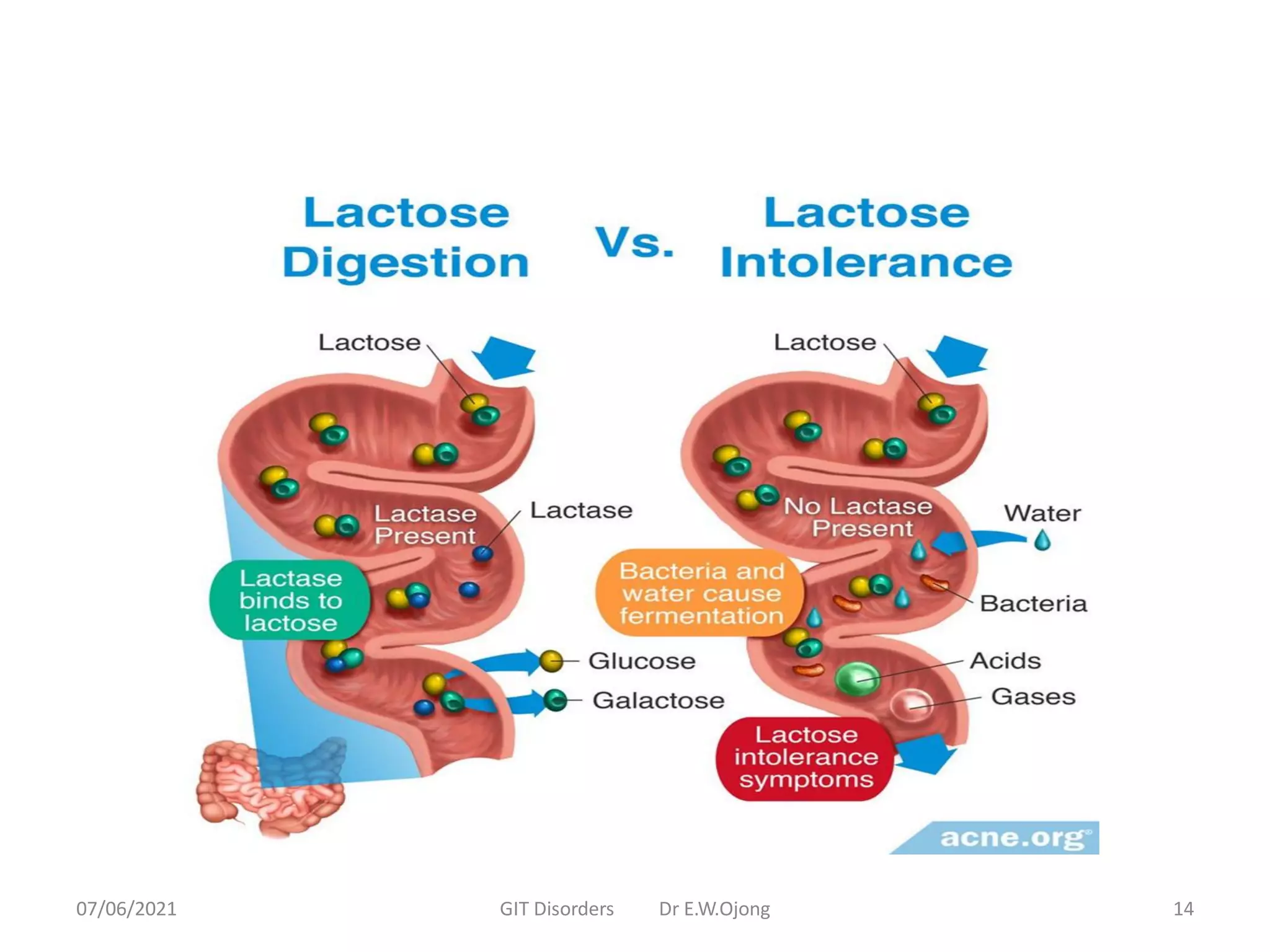
Lactose in humans is synthesized only in the
mammary glands.
During intestinal digestion, it is broken
down into glucose and galactose by the
intestinal enzyme lactase.
There are two known forms of lactase
deficiency, one in infants and young children,
and the other in adults.
07/06/2021 GIT Disorders Dr E.W.Ojong 13
07/06/2021 GIT Disorders Dr E.W.Ojong 14
LACTOSE INTOLERANCE
Lactose intolerance may be genetic or
acquired.
Because lactose intolerance subjects have
lactase deficiency, lactose digestion and
absorption will not occur.
The gut is flooded with undigested lactose
load which osmotically retain fluid, causing
diarrhoea.
07/06/2021 GIT Disorders Dr E.W.Ojong 15
LACTOSE INTOLERANCE
Bacterial fermentation of sugar in the colon leads to
gaseous acidic stool.
Stools typically have a low pH and are positive for
reducing substances (in this case glucose from bacterial
action on undigested lactose).
Since lactase is located in the brush border of the
mucosal cells, secondary deficiency may occur in diseases
associated with morphological changes of the jejunal
mucosal e.g. coeliac disease, tropical sprue, parasitic
infections (particularly Giardia lamblia and Strongyloides
stercoralis).
07/06/2021 GIT Disorders Dr E.W.Ojong 16
LACTOSE INTOLERANCE
This deficiency is usually reversible following
recovery from the above mentioned
disorders.
In Africa, childhood lactase deficiency is
usually secondary to kwashiorkor and acute
viral gastroenteritis in which there is
widespread damage to mucosal cells.
 Acquired lactase deficiency is very common
in adult Africans.
07/06/2021 GIT Disorders Dr E.W.Ojong 17
SYMPTOMS OF LACTOSE INTOLERANCE
Abdominal symptoms occur as soon as milk
and milk products (milk, ice-cream or
yoghurt)which contain lactose are
consumed,
Abdominal bloating
Abdominal cramp
Flatus
Diarrhoea
07/06/2021 GIT Disorders Dr E.W.Ojong 18
SMALL BOWEL BACTERIA OVERGROWTH
The small intestine is usually sterile.
However, in some conditions, anaerobic bacteria
colonise the intestine.
This often causes fat malabsorption, due at least partly
to excessive deconjugation of bile acid conjugates by
the bacteria and the premature passive reabsorption of
the resulting unconjugated bile acids.
Fat malabsorption and fat-soluble vitamin (A, D, E and
K) deficiency.
07/06/2021 GIT Disorders Dr E.W.Ojong 19
SMALL BOWEL BACTERIA OVERGROWTH
This leads to a relative deficiency of bile salts in the
intestinal lumen and decreased micelle formation.
Vitamin B12 deficiency may also develop due to its
consumption by the bacteria.
The clinical symptoms of bacterial overgrowth are
abdominal pain, diarrhoea, and steatorrhea.
07/06/2021 GIT Disorders Dr E.W.Ojong 20
ABNORMALITIES OF THE SMALL INTESTINE
ASSOCIATED WITH BACTERIAL OVERGROWTH
Overgrowth may occur where there is stagnation of bowel contents such as in:
 Impaired bowel motility (advanced age, denervation as in diabetes mellitus, infiltrations as
in amyloidosis, and strictures);
 Fistula between small and large bowel;
 Gastric hypochlorhydria
 Blind loops (small bowel diverticula, surgical loops).
 Impaired systemic immune mechanisms
 Use of oral antibiotics
 Use of proton pump inhibitors
 intrinsic small bowel disease (e.g. jejunal diverticulosis, coeliac disease, small bowel
Crohn’s disease)
 Autonomic neuropathy
 Systemic sclerosis
 Post-gastrectomy
07/06/2021 GIT Disorders Dr E.W.Ojong 21
DIAGNOSIS OF SMALL BOWEL BACTERIA OVERGROWTH
The gold standard investigation is jejunal aspiration and
demonstrating an elevated bacterial count of >l07
organisms/mL and >l04 anaerobes/mL .
Hydrogen breath tests following lactulose (a sugar laxative
only broken down by bacterial action) or glucose
administration can also be used.
07/06/2021 GIT Disorders Dr E.W.Ojong 22
PROTEIN LOSING ENTEROPATHY
 In health, most of the protein in faeces
represents sloughed enterocytes and proteins in
secretions.
 Albumin loss is < 1% of the serum pool.
 Losses of serum proteins can increase 10-100 fold
into the bowel lumen and their passage in the
faeces.
07/06/2021 GIT Disorders Dr E.W.Ojong 23
PROTEIN LOSING ENTEROPATHY
 Protein loss through the GIT can be caused by a wide range of
disorders, e.g. inflammation or ulceration of a segment of the
small or large bowel as in Crohn’s disease and ulcerative colitis) or
stomach, diseases in which the intestinal lymphatics are
obstructed, conditions where there is increased lymphatic
pressure (e.g., lymphoma and Whipple disease), and disorders
associated with altered immune status (such as systemic lupus
erythematosus and some food allergies).
07/06/2021 GIT Disorders Dr E.W.Ojong 24
DIAGNOSIS OF PROTEIN LOSING ENTEROPATHY
 The diagnosis of protein-losing enteropathy is considered in patients with
hypoalbuminaemia in whom renal loss, liver disease, and malnutrition have
been excluded.
 Faecal clearance of alpha -l-antitrypsin (AT), after measurement in serum and a
weighed timed stool sample is used as a marker of GI protein loss.
 AT in faeces and serum is measured most conveniently by radial
immunodiffusion.
 Faeces should be collected quantitatively, preferably for 3 days, in pre-weighed
containers and kept refrigerated.
 The AT is extracted into saline before analysis.
 AT clearance (mL/d) is calculated as [(faecal weight x faecal AT
concentration)/serum AT], where faecal weight is expressed in g/day, faecal AT
in mg/kg faeces, and serum AT in mg/L.
07/06/2021 GIT Disorders Dr E.W.Ojong 25
PANCREAS: EXOCRINE DISEASES
07/06/2021 GIT Disorders Dr E.W.Ojong 26
ACUTE PANCREATITIS
An acute episode of enzymatic destruction of the
pancreas due to the escape of active pancreatic enzymes
into the pancreatic tissue.
The probable common mechanism is premature
activation of proteases within the pancreas.
There is leakage of activated pancreatic enzymes into the
pancreas and surrounding tissues with acute
inflammation and haemorrhage.
Acute pancreatitis is a medical emergency with acute
severe abdominal pain with rapid progression to shock.
07/06/2021 GIT Disorders Dr E.W.Ojong 27
CAUSES AETIOLOGY OF ACUTE PANCREATITIS
Gallstones
Alcohol (usually following heavy binge type ingestion –
typical presentation is a male patient presenting with
acute abdominal pain on a Monday or Tuesday morning
after a heavy weekend of drinking)
Infections (e.g. mumps)
Hypertriglyceridaemia
Trauma
Hypercalcaemia.
Iatrogenic (e.g. post surgical)
Idiopathic
Miscellaneous: cardiac surgery, scorpion bite
07/06/2021 GIT Disorders Dr E.W.Ojong 28
BIOCHEMICAL FEATURES OF ACUTE PANCREATITIS
Hyperglycaemia due to transient β-cell dysfunction
Hypocalcaemia that occurs as a result of deposition of insoluble
calcium soaps that form as a result of lipase digestion of fat in the
retroperitoneum.
Obstructive jaundice with elevated conjugated bilirubin, ALP and
GGT may indicate an obstructed common bile duct due to gall
stones, a pancreas head carcinoma or ascaris worms.
Lipaemic serum may indicate that hypertriglyceridaemia, may be
the predisposing cause of the acute pancreatitis.
Elevated procalcitonin (PCT) – a marker of gram –ve sepsis may also
be increased in acute pancreatitis.
07/06/2021 GIT Disorders Dr E.W.Ojong 29
DIAGNOSIS OF ACUTE PANCREATITIS
Serum amylase is the most widely used, but returns to
normal relatively rapidly (+72 hours) because of renal
clearance.
Amylase is not entirely specific - increases (usually
smaller) are seen in other acute upper GIT pathology e.g.
perforating duodenal ulcer or bowel infarction.
Other useful tests include urine amylase,
amylase/creatinine clearance ratio (increased in acute
pancreatitis).
Serum lipase is recommended as it suffers from very few
of these drawbacks; however, it is a lot more more
expensive.
07/06/2021 GIT Disorders Dr E.W.Ojong 30
CHRONIC PANCREATITIS
An inflammatory disease characterized by
persistent and progressive destruction of the
pancreas leading to destruction of both
endocrine and exocrine function.
The destroyed pancreatic parenchyma is
replaced by fibrous tissue and cysts.
Presents with malabsorption (particularly of
fat), and sometimes with secondary diabetes.
07/06/2021 GIT Disorders Dr E.W.Ojong 31
CHRONIC PANCREATITIS
In Western countries, the most common
cause is alcohol (60% to 90% of all cases of
chronic pancreatitis), although as only 5% to
15% of heavy drinkers develop the disease.
There are clearly other predisposing factors
(e.g., smoking and diets high in fat and
protein).
07/06/2021 GIT Disorders Dr E.W.Ojong 32
CAUSES AETIOLOGY OF CHRONIC PANCREATITIS
Alcohol
Tropical (Nutritional)
Hereditary (Trypsinogen and inhibitory protein
defects, cystic fibrosis, trans-membrane regulator
CFTR defects
Idiopathic
Trauma
Hypercalcaemia
07/06/2021 GIT Disorders Dr E.W.Ojong 33
NEUROENDOCRINE TUMOURS
07/06/2021 GIT Disorders Dr E.W.Ojong 34
GASTRINOMA AND THE ZOLLINGER-ELLISON
SYNDROME
The G cells located in the distal part of the stomach (antrum)
normally secrete gastrin, a hormone.
In normal physiological conditions, an alkaline medium created by
food or antacids stimulates the secretion of gastrin.
The gastrin in turn stimulates the parietal cells of the stomach to
produce gastric acid.
This leads to the reduction of the pH to acidic levels in the stomach.
By negative feedback, the low pH medium created by the gastric
acid suppresses further production of gastrin by the G cells of the
antrum of the stomach.
07/06/2021 GIT Disorders Dr E.W.Ojong 35
GASTRINOMA AND THE ZOLLINGER-ELLISON
SYNDROME
A tumour involving the delta cells of the islet of langerhans is called
the delta cell adenoma (may either be benign or malignant).
This tumour causes the condition known as Zollinger-Ellison
syndrome.
In this syndrome, the delta cells secrete excessive amounts of
gastrin.
This then stimulates the parietal cells of the stomach to produce an
increased volume of gastric juice.
The enormous output of hydrochloric acid and pepsin leads to
severe peptic ulcer sometimes accompanied by excessive diarrhoea.
07/06/2021 GIT Disorders Dr E.W.Ojong 36
GASTRINOMA AND THE ZOLLINGER-ELLISON
SYNDROME
Ulcer maybe single or multiple in the oesophagus, second, third and
fourth portion of the duodenum and in the jejunum, in addition to
the stomach and duodenal bulb.
The diagnosis of gastrin-secreting pancreas should be suspected if
the plasma fasting gastrin concentration is over 400pg per
ml(normal level is less than 200 pg per ml).
A confirmatory test is demonstration of a 400 pg per ml or more rise
of serum gastrin concentration from the fasting level on infusion of
15 mg of calcium gluconate per kg body weight over four hours.
07/06/2021 GIT Disorders Dr E.W.Ojong 37
GASTRINOMA AND THE ZOLLINGER-ELLISON SYNDROME
A comparable test can be carried out with a secretin preparation.
Intravenous injection of secretin- about 1 unit per kg body weight –
produces a high increase in serum gastrin concentration in patients
with gastrinoma. This is not seen in patients with ordinary duodenal
ulcer.
Zollinger-Ellison syndrome may also be due to:
 Hyperplasia or tumour of the gastric G cells
 Familial gastrinoma
 Parathyroid adenomas
 Adenoma or carcinoma of pituitary gland, thyroid gland, adrenal medulla
(phaechromocytoma)
 Pernicious anaemia
 Atrophic gastritis
07/06/2021 GIT Disorders Dr E.W.Ojong 38
THE WATERY DIARRHOEA HYPOKALAEMIA
ACHLORHYDIA SYNDROME (VIPOMA)
 A vipoma is a non-beta pancreatic islet cell tumour secreting
vasoactive intestinal peptide (VIP), resulting in a syndrome of
watery diarrhoea, hypokalaemia, and achlorhydria (WDHA
syndrome).
 They are rare but potentially fatal if unattended to urgently.
 The severity of the diarrhoea is comparable to that seen in
cholera with excretions in excess of 2 L/24 h.
 The diagnostic feature of the diarrhoea is that it continues
despite prolonged fasting.
 Plasma VIP concentrations are elevated 4–5-fold;
07/06/2021 GIT Disorders Dr E.W.Ojong 39
THE WATERY DIARRHOEA HYPOKALAEMIA
ACHLORHYDIA SYNDROME (VIPOMA)
 VIPomas have the same propensity as glucagonomas for
malignancy and the same imaging techniques are used to localize
the tumour as in glucagonomas.
 Diagnosis is by serum VIP levels. Tumour is localized with CT and
endoscopic ultrasound.
 While surgery is usually considered, their medical management
remains important with rehydration and correction of electrolyte
disturbances in severe cases, and use of antidiarrhoeals (e.g.
loperamide, codeine phosphate and somatostatin analogues).
07/06/2021 GIT Disorders Dr E.W.Ojong 40
OTHER TUMOURS
Carcinoid tumours and somatostatinomas.
07/06/2021 GIT Disorders Dr E.W.Ojong 41
MALABSORPTION
A condition that prevents absorption of
nutrients through the small intestine.
 Malabsorption may be caused by infection,
medication, small intestine surgery and
disorders such as coeliac disease.
Symptoms include weight loss, bloating and
sometimes diarrhoea. Eventually, the brain,
nervous system, bones, liver and other
organs can be affected.
07/06/2021 GIT Disorders Dr E.W.Ojong 42
CAUSES OF MALABSORPTION
The main causes of malabsorption are
Gastric: Zollinger-Ellison syndrome, gastrectomy
Pancreatic: cystic fibrosis, chronic pancreatitis, pancreatic
cancer.
Bile acid deficiency: small bowel bacterial overgrowth,
terminal ileal disease or resection.
Reduction in absorptive surface: coeliac disease, tropical
sprue, inflammatory bowel disease
Specific disorders: hypolactasia, vitamin B12 deficiency
07/06/2021 GIT Disorders Dr E.W.Ojong 43
BIOCHEMICAL EVIDENCE OF MALABSORPTION
Iron, Haemoglobin and MCV – Iron, Folate and B12
Malabsorption.
Albumin – protein malabsorption
 Cholesterol, Vitamins A and D and prothrombin time (Vit
K) – fat malabsorption.
Plasma Calcium, Magnesium, Phosphate and Zinc –
electrolyte and small molecule malabsorption
07/06/2021 GIT Disorders Dr E.W.Ojong 44
DIAGNOSIS OF MALABSORPTION
Gastroscopy (with duodenal biopsy for histology)
 Faecal elastase for pancreatic function
TTG antibodies for coeliac disease
Stool reducing substances and osmolar gap (to identify
carbohydrate malabsorption)
Faecal fat and faecal steatocrit (a measurement of the
percentage of fat in faeces) –(fat malabsorption)
07/06/2021 GIT Disorders Dr E.W.Ojong 45
ASSIGNMENT
1. Discuss the biochemical changes associated with
diarrhoea.
2. Discuss the biochemical changes associated with
vomitting
07/06/2021 GIT Disorders Dr E.W.Ojong 46

GIT Disorders 2.pdf

  • 1.
    BY EBOT WALTER OJONG Ph.D.CHEMICAL PATHOLOGY GIT DISORDERS 07/06/2021 GIT Disorders Dr E.W.Ojong 1
  • 2.
    DIORDERS OF THESTOMACH 07/06/2021 GIT Disorders Dr E.W.Ojong 2
  • 3.
    PEPTIC ULCER DISEASE Helicobacterpylori is now accepted to be the main cause of gastric and duodenal ulcers; other causes include NSAIDs and, very rarely, the Zollinger–Ellison syndrome. The bacterium is present in the mucous layer of the stomach in half of the population of the world. Carriers of the organism are at increased risk of gastric cancer (twofold to tenfold) and peptic ulcer (threefold to tenfold). About 90% of gastric cancer patients are infected with H. pylori, compared with 40% to 60% of age-matched controls and there is a significant correlation between infection rates and gastric cancer incidence and mortality. 07/06/2021 GIT Disorders Dr E.W.Ojong 3
  • 4.
    PEPTIC ULCER DISEASE Atleast 95% of patients with duodenal ulcer disease are infected with H. pylori, and eradication of H. pylori is the recommended treatment for patients with duodenal or gastric ulcer who are H. pylori-positive. The reason for a gastric mucosal infection causing duodenal ulceration is complex but involves a number of pathways leading to increased acid production. Infection always causes a chronic inflammation even when endoscopic investigation appears normal. 07/06/2021 GIT Disorders Dr E.W.Ojong 4
  • 5.
    DIAGNOSIS OF PEPTICULCER DISEASE Biopsy tests may give false negative results because colonisation may be patchy, and hence multiple sites are sampled. Basal and post-prandial gastrin levels are higher in those with infection, and returns to normal when the infection is treated. H. pylori produces urease, and hydrolysis of endogenous urea to bicarbonate and ammonia may create a more hospitable microenvironment for its survival in the stomach. The ability of the organism to rapidly hydrolyse urea is the basis of the urea breath tests and of the direct urease tests on gastric biopsy samples.  Mammalian cells do not produce urease. 07/06/2021 GIT Disorders Dr E.W.Ojong 5
  • 6.
    DIAGNOSIS OF PEPTICULCER DISEASE Urea breath tests are simple to perform, with sensitivity and specificity both greater than 95%. Urea labelled with either 13C or 14C is given orally as a drink or a capsule to swallow with water; urease from gastric H. pylori rapidly hydrolyses the ingested urea to produce labelled bicarbonate, which is absorbed into the blood and exhaled as 14CO2 or 13CO2. While serological tests are used to identify patients who have been infected with the organism, they are less helpful in confirming its eradication because of the slow reduction in antibody titres. In the stool test, specific H. pylori antigens are detected in microtiter plates coated with polyclonal antibodies. 07/06/2021 GIT Disorders Dr E.W.Ojong 6
  • 7.
    DIORDERS OF THEINTESTINE 07/06/2021 GIT Disorders Dr E.W.Ojong 7
  • 8.
    COELIAC DISEASE (GLUTEN SENSITIVEENTEROPATHY)  This is a T-cell mediated response to gluten – one of the major proteins in wheat, but also present to a lesser extent in oats, barley and rye.  Coeliac disease has a genetic component with a higher (1%) prevalence in populations that have evolved on a wheat and barley based diet such as Caucasians.  It is much rarer in other populations such as Africans and Asians. 07/06/2021 GIT Disorders Dr E.W.Ojong 8
  • 9.
    COELIAC DISEASE (GLUTENSENSITIVE ENTEROPATHY)  In susceptible individuals, transglutaminases (enzymes released from intestinal cells when injured) attempt to cross-link glutamine residues on absorbed gluten peptides but because this protein resists degradation an antigenic complex then forms between glutaminase and gluten.  This complex triggers a T-cell mediated response in the small intestinal mucosa with resultant inflammation whenever gluten is ingested.  Repeated inflammation damages the small intestinal mucosa causing small nutrient malabsorption and episodes of osmotic diarrhoea. 07/06/2021 GIT Disorders Dr E.W.Ojong 9
  • 10.
    COELIAC DISEASE (GLUTENSENSITIVE ENTEROPATHY)  Severe cases of coeliac disease typically present at <2 years of age with failure to thrive, abdominal distension and diarrhoea but with the advent of more sensitive tests more patients are diagnosed who have mild intestinal symptoms, iron deficiency anaemia, vitamin D deficiency and frequently another auto-immune disease, e.g. diabetes mellitus type 1 and thyroid involvement.  Circulating antibodies to tissue transglutaminase (tTG) are found in patients with coeliac disease and testing for anti-tTG IgA is the first line investigation of choice. Anti-tTG IgA has a high sensitivity and specificity for coeliac disease and is useful both in screening and in monitoring the response to treatment.  A small intestinal (Jejunal) biopsy for histology is the gold standard - the mucosa becomes flattened, with villous atrophy, and infiltrated with lymphocytes. 07/06/2021 GIT Disorders Dr E.W.Ojong 10
  • 11.
    LACTOSE INTOLERANCE 07/06/2021 GITDisorders Dr E.W.Ojong 11
  • 12.
    LACTOSE INTOLERANCE Lactose isa disaccharide which reduces Benedict’s reagent. Lactose can be distinguished from glucose by the use of glucose oxidase method which gives a negative result with lactose. It is found mainly in milk and diary products 07/06/2021 GIT Disorders Dr E.W.Ojong 12
  • 13.
    LACTOSE INTOLERANCE Lactose inhumans is synthesized only in the mammary glands. During intestinal digestion, it is broken down into glucose and galactose by the intestinal enzyme lactase. There are two known forms of lactase deficiency, one in infants and young children, and the other in adults. 07/06/2021 GIT Disorders Dr E.W.Ojong 13
  • 14.
    07/06/2021 GIT DisordersDr E.W.Ojong 14
  • 15.
    LACTOSE INTOLERANCE Lactose intolerancemay be genetic or acquired. Because lactose intolerance subjects have lactase deficiency, lactose digestion and absorption will not occur. The gut is flooded with undigested lactose load which osmotically retain fluid, causing diarrhoea. 07/06/2021 GIT Disorders Dr E.W.Ojong 15
  • 16.
    LACTOSE INTOLERANCE Bacterial fermentationof sugar in the colon leads to gaseous acidic stool. Stools typically have a low pH and are positive for reducing substances (in this case glucose from bacterial action on undigested lactose). Since lactase is located in the brush border of the mucosal cells, secondary deficiency may occur in diseases associated with morphological changes of the jejunal mucosal e.g. coeliac disease, tropical sprue, parasitic infections (particularly Giardia lamblia and Strongyloides stercoralis). 07/06/2021 GIT Disorders Dr E.W.Ojong 16
  • 17.
    LACTOSE INTOLERANCE This deficiencyis usually reversible following recovery from the above mentioned disorders. In Africa, childhood lactase deficiency is usually secondary to kwashiorkor and acute viral gastroenteritis in which there is widespread damage to mucosal cells.  Acquired lactase deficiency is very common in adult Africans. 07/06/2021 GIT Disorders Dr E.W.Ojong 17
  • 18.
    SYMPTOMS OF LACTOSEINTOLERANCE Abdominal symptoms occur as soon as milk and milk products (milk, ice-cream or yoghurt)which contain lactose are consumed, Abdominal bloating Abdominal cramp Flatus Diarrhoea 07/06/2021 GIT Disorders Dr E.W.Ojong 18
  • 19.
    SMALL BOWEL BACTERIAOVERGROWTH The small intestine is usually sterile. However, in some conditions, anaerobic bacteria colonise the intestine. This often causes fat malabsorption, due at least partly to excessive deconjugation of bile acid conjugates by the bacteria and the premature passive reabsorption of the resulting unconjugated bile acids. Fat malabsorption and fat-soluble vitamin (A, D, E and K) deficiency. 07/06/2021 GIT Disorders Dr E.W.Ojong 19
  • 20.
    SMALL BOWEL BACTERIAOVERGROWTH This leads to a relative deficiency of bile salts in the intestinal lumen and decreased micelle formation. Vitamin B12 deficiency may also develop due to its consumption by the bacteria. The clinical symptoms of bacterial overgrowth are abdominal pain, diarrhoea, and steatorrhea. 07/06/2021 GIT Disorders Dr E.W.Ojong 20
  • 21.
    ABNORMALITIES OF THESMALL INTESTINE ASSOCIATED WITH BACTERIAL OVERGROWTH Overgrowth may occur where there is stagnation of bowel contents such as in:  Impaired bowel motility (advanced age, denervation as in diabetes mellitus, infiltrations as in amyloidosis, and strictures);  Fistula between small and large bowel;  Gastric hypochlorhydria  Blind loops (small bowel diverticula, surgical loops).  Impaired systemic immune mechanisms  Use of oral antibiotics  Use of proton pump inhibitors  intrinsic small bowel disease (e.g. jejunal diverticulosis, coeliac disease, small bowel Crohn’s disease)  Autonomic neuropathy  Systemic sclerosis  Post-gastrectomy 07/06/2021 GIT Disorders Dr E.W.Ojong 21
  • 22.
    DIAGNOSIS OF SMALLBOWEL BACTERIA OVERGROWTH The gold standard investigation is jejunal aspiration and demonstrating an elevated bacterial count of >l07 organisms/mL and >l04 anaerobes/mL . Hydrogen breath tests following lactulose (a sugar laxative only broken down by bacterial action) or glucose administration can also be used. 07/06/2021 GIT Disorders Dr E.W.Ojong 22
  • 23.
    PROTEIN LOSING ENTEROPATHY In health, most of the protein in faeces represents sloughed enterocytes and proteins in secretions.  Albumin loss is < 1% of the serum pool.  Losses of serum proteins can increase 10-100 fold into the bowel lumen and their passage in the faeces. 07/06/2021 GIT Disorders Dr E.W.Ojong 23
  • 24.
    PROTEIN LOSING ENTEROPATHY Protein loss through the GIT can be caused by a wide range of disorders, e.g. inflammation or ulceration of a segment of the small or large bowel as in Crohn’s disease and ulcerative colitis) or stomach, diseases in which the intestinal lymphatics are obstructed, conditions where there is increased lymphatic pressure (e.g., lymphoma and Whipple disease), and disorders associated with altered immune status (such as systemic lupus erythematosus and some food allergies). 07/06/2021 GIT Disorders Dr E.W.Ojong 24
  • 25.
    DIAGNOSIS OF PROTEINLOSING ENTEROPATHY  The diagnosis of protein-losing enteropathy is considered in patients with hypoalbuminaemia in whom renal loss, liver disease, and malnutrition have been excluded.  Faecal clearance of alpha -l-antitrypsin (AT), after measurement in serum and a weighed timed stool sample is used as a marker of GI protein loss.  AT in faeces and serum is measured most conveniently by radial immunodiffusion.  Faeces should be collected quantitatively, preferably for 3 days, in pre-weighed containers and kept refrigerated.  The AT is extracted into saline before analysis.  AT clearance (mL/d) is calculated as [(faecal weight x faecal AT concentration)/serum AT], where faecal weight is expressed in g/day, faecal AT in mg/kg faeces, and serum AT in mg/L. 07/06/2021 GIT Disorders Dr E.W.Ojong 25
  • 26.
    PANCREAS: EXOCRINE DISEASES 07/06/2021GIT Disorders Dr E.W.Ojong 26
  • 27.
    ACUTE PANCREATITIS An acuteepisode of enzymatic destruction of the pancreas due to the escape of active pancreatic enzymes into the pancreatic tissue. The probable common mechanism is premature activation of proteases within the pancreas. There is leakage of activated pancreatic enzymes into the pancreas and surrounding tissues with acute inflammation and haemorrhage. Acute pancreatitis is a medical emergency with acute severe abdominal pain with rapid progression to shock. 07/06/2021 GIT Disorders Dr E.W.Ojong 27
  • 28.
    CAUSES AETIOLOGY OFACUTE PANCREATITIS Gallstones Alcohol (usually following heavy binge type ingestion – typical presentation is a male patient presenting with acute abdominal pain on a Monday or Tuesday morning after a heavy weekend of drinking) Infections (e.g. mumps) Hypertriglyceridaemia Trauma Hypercalcaemia. Iatrogenic (e.g. post surgical) Idiopathic Miscellaneous: cardiac surgery, scorpion bite 07/06/2021 GIT Disorders Dr E.W.Ojong 28
  • 29.
    BIOCHEMICAL FEATURES OFACUTE PANCREATITIS Hyperglycaemia due to transient β-cell dysfunction Hypocalcaemia that occurs as a result of deposition of insoluble calcium soaps that form as a result of lipase digestion of fat in the retroperitoneum. Obstructive jaundice with elevated conjugated bilirubin, ALP and GGT may indicate an obstructed common bile duct due to gall stones, a pancreas head carcinoma or ascaris worms. Lipaemic serum may indicate that hypertriglyceridaemia, may be the predisposing cause of the acute pancreatitis. Elevated procalcitonin (PCT) – a marker of gram –ve sepsis may also be increased in acute pancreatitis. 07/06/2021 GIT Disorders Dr E.W.Ojong 29
  • 30.
    DIAGNOSIS OF ACUTEPANCREATITIS Serum amylase is the most widely used, but returns to normal relatively rapidly (+72 hours) because of renal clearance. Amylase is not entirely specific - increases (usually smaller) are seen in other acute upper GIT pathology e.g. perforating duodenal ulcer or bowel infarction. Other useful tests include urine amylase, amylase/creatinine clearance ratio (increased in acute pancreatitis). Serum lipase is recommended as it suffers from very few of these drawbacks; however, it is a lot more more expensive. 07/06/2021 GIT Disorders Dr E.W.Ojong 30
  • 31.
    CHRONIC PANCREATITIS An inflammatorydisease characterized by persistent and progressive destruction of the pancreas leading to destruction of both endocrine and exocrine function. The destroyed pancreatic parenchyma is replaced by fibrous tissue and cysts. Presents with malabsorption (particularly of fat), and sometimes with secondary diabetes. 07/06/2021 GIT Disorders Dr E.W.Ojong 31
  • 32.
    CHRONIC PANCREATITIS In Westerncountries, the most common cause is alcohol (60% to 90% of all cases of chronic pancreatitis), although as only 5% to 15% of heavy drinkers develop the disease. There are clearly other predisposing factors (e.g., smoking and diets high in fat and protein). 07/06/2021 GIT Disorders Dr E.W.Ojong 32
  • 33.
    CAUSES AETIOLOGY OFCHRONIC PANCREATITIS Alcohol Tropical (Nutritional) Hereditary (Trypsinogen and inhibitory protein defects, cystic fibrosis, trans-membrane regulator CFTR defects Idiopathic Trauma Hypercalcaemia 07/06/2021 GIT Disorders Dr E.W.Ojong 33
  • 34.
    NEUROENDOCRINE TUMOURS 07/06/2021 GITDisorders Dr E.W.Ojong 34
  • 35.
    GASTRINOMA AND THEZOLLINGER-ELLISON SYNDROME The G cells located in the distal part of the stomach (antrum) normally secrete gastrin, a hormone. In normal physiological conditions, an alkaline medium created by food or antacids stimulates the secretion of gastrin. The gastrin in turn stimulates the parietal cells of the stomach to produce gastric acid. This leads to the reduction of the pH to acidic levels in the stomach. By negative feedback, the low pH medium created by the gastric acid suppresses further production of gastrin by the G cells of the antrum of the stomach. 07/06/2021 GIT Disorders Dr E.W.Ojong 35
  • 36.
    GASTRINOMA AND THEZOLLINGER-ELLISON SYNDROME A tumour involving the delta cells of the islet of langerhans is called the delta cell adenoma (may either be benign or malignant). This tumour causes the condition known as Zollinger-Ellison syndrome. In this syndrome, the delta cells secrete excessive amounts of gastrin. This then stimulates the parietal cells of the stomach to produce an increased volume of gastric juice. The enormous output of hydrochloric acid and pepsin leads to severe peptic ulcer sometimes accompanied by excessive diarrhoea. 07/06/2021 GIT Disorders Dr E.W.Ojong 36
  • 37.
    GASTRINOMA AND THEZOLLINGER-ELLISON SYNDROME Ulcer maybe single or multiple in the oesophagus, second, third and fourth portion of the duodenum and in the jejunum, in addition to the stomach and duodenal bulb. The diagnosis of gastrin-secreting pancreas should be suspected if the plasma fasting gastrin concentration is over 400pg per ml(normal level is less than 200 pg per ml). A confirmatory test is demonstration of a 400 pg per ml or more rise of serum gastrin concentration from the fasting level on infusion of 15 mg of calcium gluconate per kg body weight over four hours. 07/06/2021 GIT Disorders Dr E.W.Ojong 37
  • 38.
    GASTRINOMA AND THEZOLLINGER-ELLISON SYNDROME A comparable test can be carried out with a secretin preparation. Intravenous injection of secretin- about 1 unit per kg body weight – produces a high increase in serum gastrin concentration in patients with gastrinoma. This is not seen in patients with ordinary duodenal ulcer. Zollinger-Ellison syndrome may also be due to:  Hyperplasia or tumour of the gastric G cells  Familial gastrinoma  Parathyroid adenomas  Adenoma or carcinoma of pituitary gland, thyroid gland, adrenal medulla (phaechromocytoma)  Pernicious anaemia  Atrophic gastritis 07/06/2021 GIT Disorders Dr E.W.Ojong 38
  • 39.
    THE WATERY DIARRHOEAHYPOKALAEMIA ACHLORHYDIA SYNDROME (VIPOMA)  A vipoma is a non-beta pancreatic islet cell tumour secreting vasoactive intestinal peptide (VIP), resulting in a syndrome of watery diarrhoea, hypokalaemia, and achlorhydria (WDHA syndrome).  They are rare but potentially fatal if unattended to urgently.  The severity of the diarrhoea is comparable to that seen in cholera with excretions in excess of 2 L/24 h.  The diagnostic feature of the diarrhoea is that it continues despite prolonged fasting.  Plasma VIP concentrations are elevated 4–5-fold; 07/06/2021 GIT Disorders Dr E.W.Ojong 39
  • 40.
    THE WATERY DIARRHOEAHYPOKALAEMIA ACHLORHYDIA SYNDROME (VIPOMA)  VIPomas have the same propensity as glucagonomas for malignancy and the same imaging techniques are used to localize the tumour as in glucagonomas.  Diagnosis is by serum VIP levels. Tumour is localized with CT and endoscopic ultrasound.  While surgery is usually considered, their medical management remains important with rehydration and correction of electrolyte disturbances in severe cases, and use of antidiarrhoeals (e.g. loperamide, codeine phosphate and somatostatin analogues). 07/06/2021 GIT Disorders Dr E.W.Ojong 40
  • 41.
    OTHER TUMOURS Carcinoid tumoursand somatostatinomas. 07/06/2021 GIT Disorders Dr E.W.Ojong 41
  • 42.
    MALABSORPTION A condition thatprevents absorption of nutrients through the small intestine.  Malabsorption may be caused by infection, medication, small intestine surgery and disorders such as coeliac disease. Symptoms include weight loss, bloating and sometimes diarrhoea. Eventually, the brain, nervous system, bones, liver and other organs can be affected. 07/06/2021 GIT Disorders Dr E.W.Ojong 42
  • 43.
    CAUSES OF MALABSORPTION Themain causes of malabsorption are Gastric: Zollinger-Ellison syndrome, gastrectomy Pancreatic: cystic fibrosis, chronic pancreatitis, pancreatic cancer. Bile acid deficiency: small bowel bacterial overgrowth, terminal ileal disease or resection. Reduction in absorptive surface: coeliac disease, tropical sprue, inflammatory bowel disease Specific disorders: hypolactasia, vitamin B12 deficiency 07/06/2021 GIT Disorders Dr E.W.Ojong 43
  • 44.
    BIOCHEMICAL EVIDENCE OFMALABSORPTION Iron, Haemoglobin and MCV – Iron, Folate and B12 Malabsorption. Albumin – protein malabsorption  Cholesterol, Vitamins A and D and prothrombin time (Vit K) – fat malabsorption. Plasma Calcium, Magnesium, Phosphate and Zinc – electrolyte and small molecule malabsorption 07/06/2021 GIT Disorders Dr E.W.Ojong 44
  • 45.
    DIAGNOSIS OF MALABSORPTION Gastroscopy(with duodenal biopsy for histology)  Faecal elastase for pancreatic function TTG antibodies for coeliac disease Stool reducing substances and osmolar gap (to identify carbohydrate malabsorption) Faecal fat and faecal steatocrit (a measurement of the percentage of fat in faeces) –(fat malabsorption) 07/06/2021 GIT Disorders Dr E.W.Ojong 45
  • 46.
    ASSIGNMENT 1. Discuss thebiochemical changes associated with diarrhoea. 2. Discuss the biochemical changes associated with vomitting 07/06/2021 GIT Disorders Dr E.W.Ojong 46