Spectrophotometry-Instrumentation
A spectrophotometer is an instrument used for:
 measuring the transmittance or absorbance of a sample as a function of
wavelength.
Measuring the absorbance of a series of samples at a single wavelength.
The principle of working of
spectrophotometer depends on
photoelectric phenomenon, where,
the intensity of EMR is measured
through the intensity of electric
current produced by electrons
liberated from a photosensitive metal
under the influence of incident EMR.
Instrumentation-Spectrophotometer
1- Radiant energy source.
2- Dispersing system (or monochromator) “ wave length selector”.
3- Sample compartment (cuvette).
4- Detector.
5- Recorder (meter).
Instrument Components
All instruments for absorption measurements with UV, VIS and IR radiation are
made up of 5 components shown in this figure.
The 5 basic components of Spectrophotometer are:
Spectrophotometer- Instrument Components
1. Source of Light:
a. Deuterium (hydrogen) Lamp 190~420nm UV region
b. Tungsten Lamp350 ~ 2,500nm Vis and near IR region
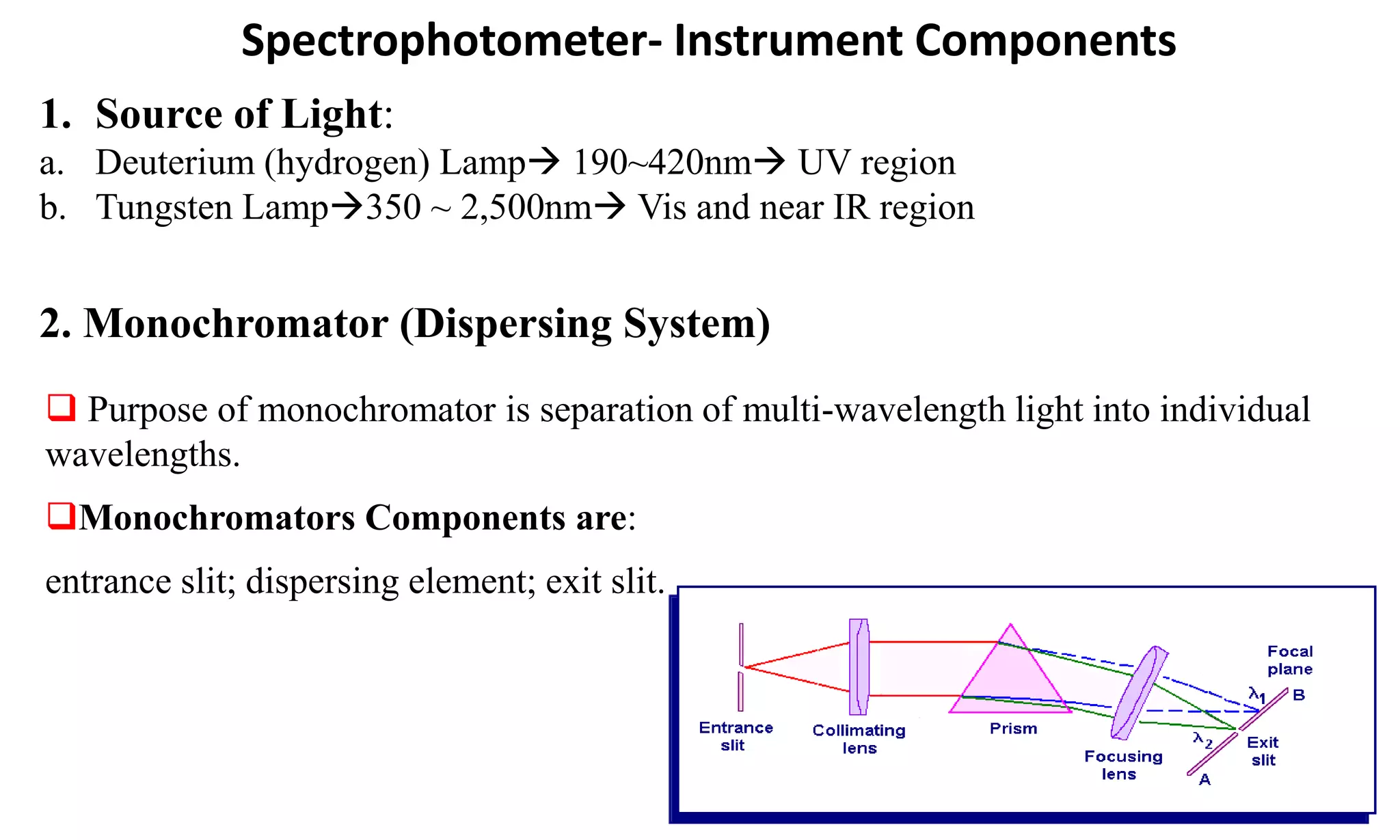
 Purpose of monochromator is separation of multi-wavelength light into individual
wavelengths.
Monochromators Components are:
entrance slit; dispersing element; exit slit.
2. Monochromator (Dispersing System)
Dispersing Element (Device):
Monochromatic light may be obtained by the use of Three types of dispersing elements
Filter: acts by selective absorption of unwanted  and transmit the complementary color
Prism: acts by refraction of light
grating: acts by diffraction and interference.
Dispersing Element (Device):
a. Filters
Act by selective absorption of unwanted  and
transmit the complementary color, which is needed
to be absorbed by the sample to be analyzed.
Wavelength
absorbed (nm)
Absorbed
color
Transmitted
color
400 Violet Yellow-green
450 Blue Yellow
500 Green red
550 Yellow Blue
600 Orange Green-blue
700 red Green
Color substances appears colored because they
selectively absorbed some of wavelengths of
visible light and transmitted other wavelengths
or colors.
For example red substances absorb green
wavelengths from the visible region, so the
transmitted light appears red, table 1.
Spectrophotometer –Instrument Components
2. Monochromator
c. Grating
It Acts by diffraction and interference
It consists of a large number of parallel grooves, very close to
each other, on a highly polished surface e.g aluminum or
aluminized glass (600 line/mm).
Each groove functions as a scattering center for light rays falling
on its edge. Through diffraction and interference, the grating make
the light beam into almost single .
b. Prism
 Act by refraction of light.
 In visible range we use glass prism.
 In U.V range we use prism made of quartz (fused silica).
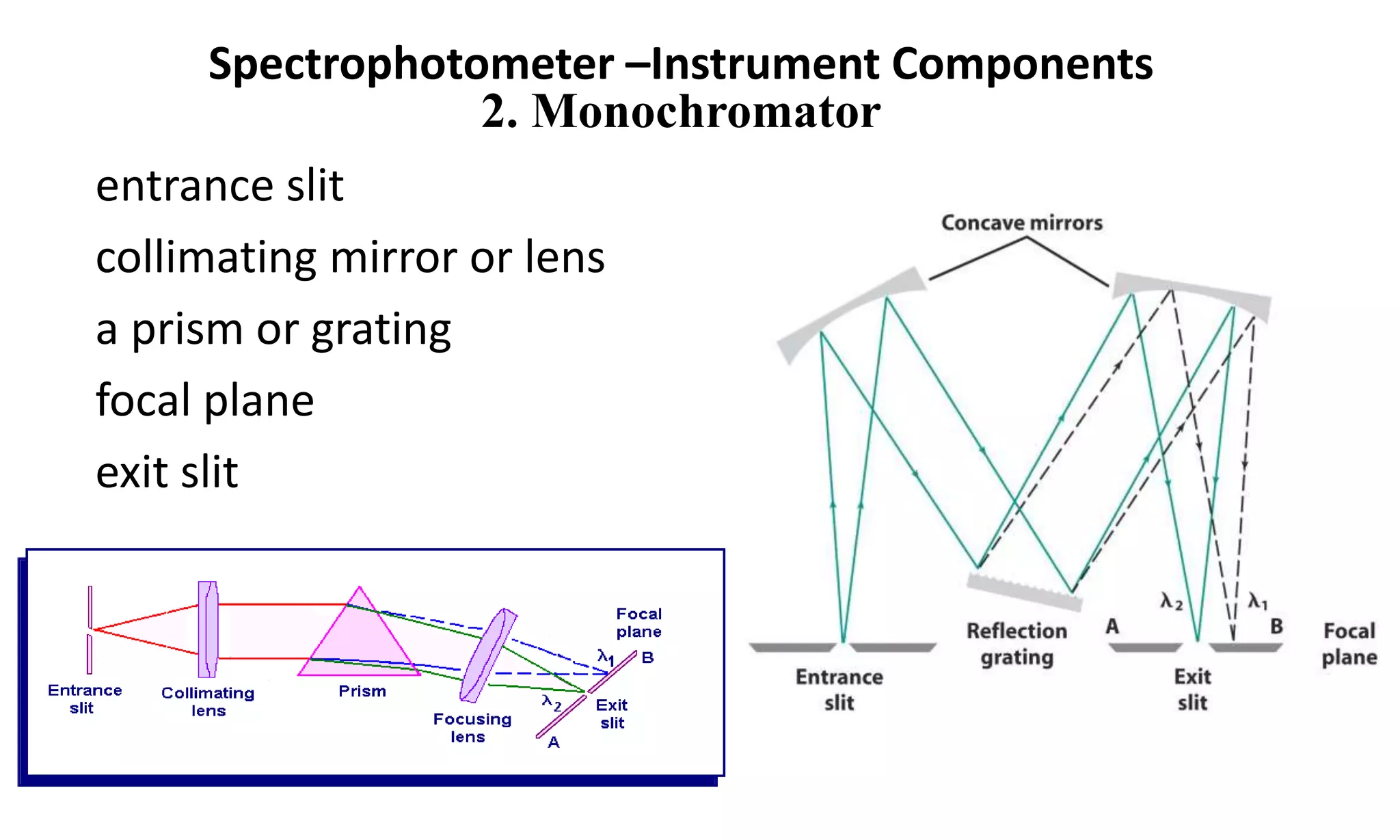
a. entrance slit
b. collimating mirror or lens
c. a prism or grating
d. focal plane
e. exit slit
Spectrophotometer –Instrument Components
2. Monochromator
Spectrophotometer –Instrument Components
3. Sample Container (Absorption Cell)
The sample compartment contains a cell holder and sample container (cuvette-cell).
Sample Container should be
Transparent to excitation light.
Compatible with samples.
Sample container can made of
1. Quartz, used for UV-Vis region
2. Glass, used for Vis
There is a wide variety of cuvette of different shape and size, choice depends on the
type of analysis and sample volume.
The most common cuvettes for VIS and UV-spectra have a 1.00cm path length.
Spectrophotometer Components
4. Detector (Transducer)
 There are many Types of Detectors:
 Phototubes
 Photomultiplier Tubes
 Photodiodes
 Photodiode arrays
 Detector converts electromagnetic ( radiant , photons) energy to an electrical signal.
Ideal detector :
high sensitivity,
high signal/noise,
constant response for λs,
and fast response time.
Spectrophotometer Components
4. Detector (Transducer)
 Photons  photoelectrons
the “photocurrent” is proportional to intensity
Application a potential between the electrodes, cause the emitted photoelectrons to
migrate to the wire anode, producing a current.
This current is proportional to the number of photons. This current is readily amplified
and measured.
 Phototube Detector
PMT is a very sensitive detector
Spectrophotometer Components
4. Detector (Transducer)
 Photomultiplier tube Detector
The Spectrophotometer
1) Spectrophotometer
a) Single-beam
b) Double-beam
 Spectrophotometer may be classified as:
 single or double beam (design of instrument), as shown in figure.
Double Beam Spectrophotometer: The advantages :
(1) Stability of the readings over time
(2) The ability to simultaneous correct for any solvent or
peripheral substance effects.
The disadvantages :
Expense and less sensitivity to measure
highly absorbing samples.
12
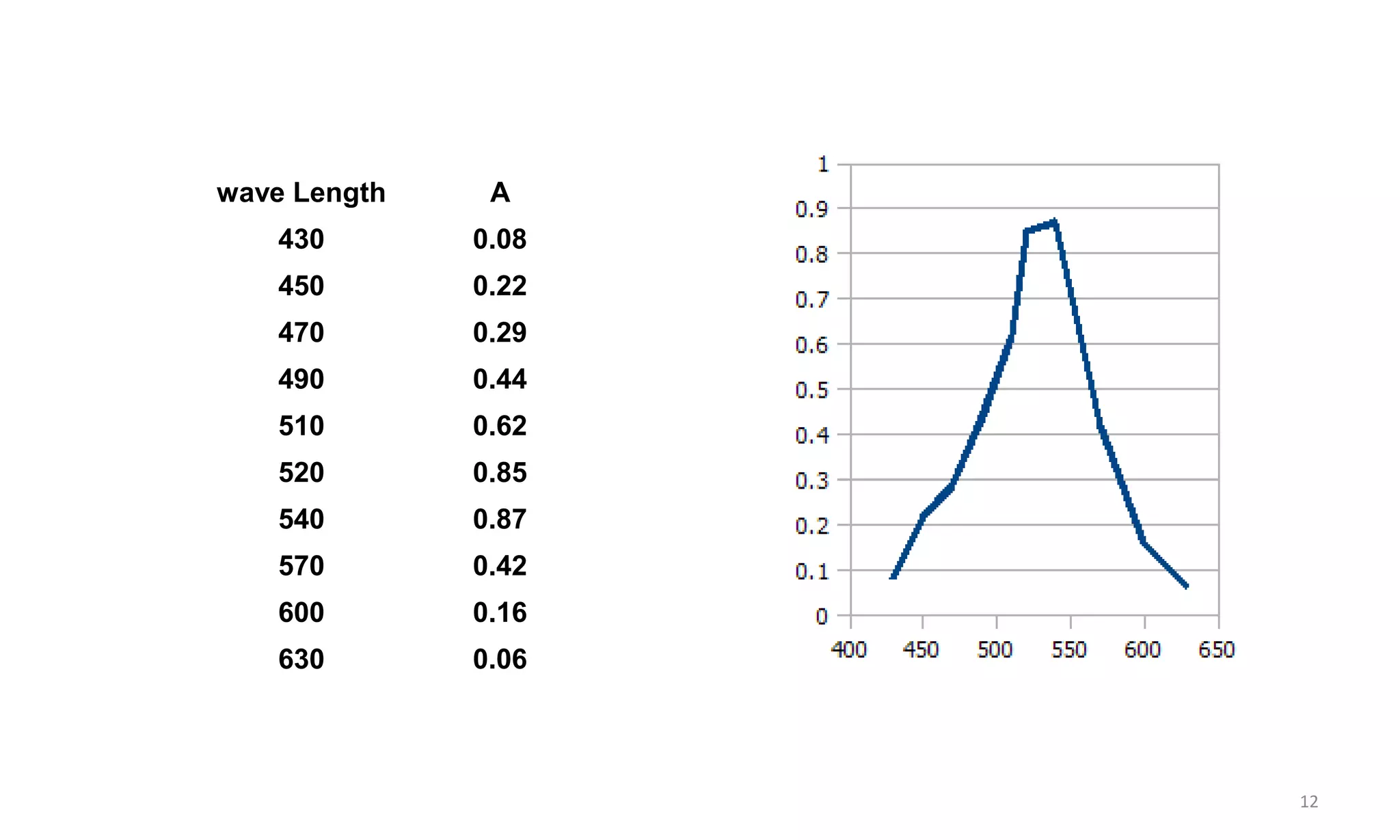
wave Length A
430 0.08
450 0.22
470 0.29
490 0.44
510 0.62
520 0.85
540 0.87
570 0.42
600 0.16
630 0.06
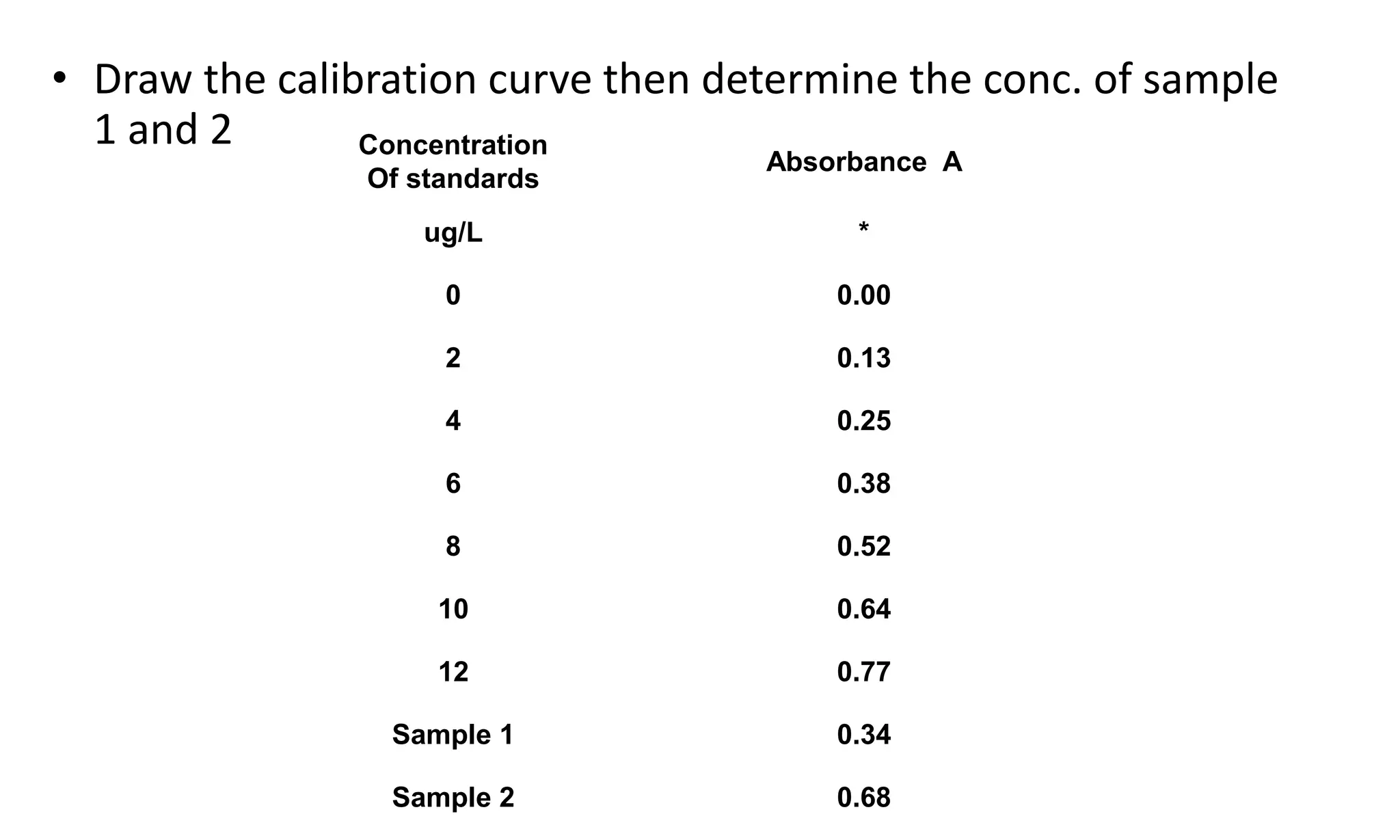
• Draw the calibration curve then determine the conc. of sample
1 and 2 Concentration
Of standards
Absorbance A
ug/L *
0 0.00
2 0.13
4 0.25
6 0.38
8 0.52
10 0.64
12 0.77
Sample 1 0.34
Sample 2 0.68
• Draw the standard addition curve then determine the conc. of
the unknown sample.
Concentration
Added to sample
Absorbance A
ug/L *
0 0.35
2 0.48
4 0.60
6 0.73
8 0.87
10 0.99

Spectroscopy الشيت الثالث.pptx

  • 1.
    Spectrophotometry-Instrumentation A spectrophotometer isan instrument used for:  measuring the transmittance or absorbance of a sample as a function of wavelength. Measuring the absorbance of a series of samples at a single wavelength. The principle of working of spectrophotometer depends on photoelectric phenomenon, where, the intensity of EMR is measured through the intensity of electric current produced by electrons liberated from a photosensitive metal under the influence of incident EMR.
  • 2.
    Instrumentation-Spectrophotometer 1- Radiant energysource. 2- Dispersing system (or monochromator) “ wave length selector”. 3- Sample compartment (cuvette). 4- Detector. 5- Recorder (meter). Instrument Components All instruments for absorption measurements with UV, VIS and IR radiation are made up of 5 components shown in this figure. The 5 basic components of Spectrophotometer are:
  • 3.
    Spectrophotometer- Instrument Components 1.Source of Light: a. Deuterium (hydrogen) Lamp 190~420nm UV region b. Tungsten Lamp350 ~ 2,500nm Vis and near IR region  Purpose of monochromator is separation of multi-wavelength light into individual wavelengths. Monochromators Components are: entrance slit; dispersing element; exit slit. 2. Monochromator (Dispersing System)
  • 4.
    2. Monochromator (DispersingSystem) Dispersing Element (Device): Monochromatic light may be obtained by the use of Three types of dispersing elements Filter: acts by selective absorption of unwanted  and transmit the complementary color Prism: acts by refraction of light grating: acts by diffraction and interference. Dispersing Element (Device): a. Filters Act by selective absorption of unwanted  and transmit the complementary color, which is needed to be absorbed by the sample to be analyzed. Wavelength absorbed (nm) Absorbed color Transmitted color 400 Violet Yellow-green 450 Blue Yellow 500 Green red 550 Yellow Blue 600 Orange Green-blue 700 red Green Color substances appears colored because they selectively absorbed some of wavelengths of visible light and transmitted other wavelengths or colors. For example red substances absorb green wavelengths from the visible region, so the transmitted light appears red, table 1.
  • 5.
    Spectrophotometer –Instrument Components 2.Monochromator c. Grating It Acts by diffraction and interference It consists of a large number of parallel grooves, very close to each other, on a highly polished surface e.g aluminum or aluminized glass (600 line/mm). Each groove functions as a scattering center for light rays falling on its edge. Through diffraction and interference, the grating make the light beam into almost single . b. Prism  Act by refraction of light.  In visible range we use glass prism.  In U.V range we use prism made of quartz (fused silica).
  • 6.
    a. entrance slit b.collimating mirror or lens c. a prism or grating d. focal plane e. exit slit Spectrophotometer –Instrument Components 2. Monochromator
  • 7.
    Spectrophotometer –Instrument Components 3.Sample Container (Absorption Cell) The sample compartment contains a cell holder and sample container (cuvette-cell). Sample Container should be Transparent to excitation light. Compatible with samples. Sample container can made of 1. Quartz, used for UV-Vis region 2. Glass, used for Vis There is a wide variety of cuvette of different shape and size, choice depends on the type of analysis and sample volume. The most common cuvettes for VIS and UV-spectra have a 1.00cm path length.
  • 8.
    Spectrophotometer Components 4. Detector(Transducer)  There are many Types of Detectors:  Phototubes  Photomultiplier Tubes  Photodiodes  Photodiode arrays  Detector converts electromagnetic ( radiant , photons) energy to an electrical signal. Ideal detector : high sensitivity, high signal/noise, constant response for λs, and fast response time.
  • 9.
    Spectrophotometer Components 4. Detector(Transducer)  Photons  photoelectrons the “photocurrent” is proportional to intensity Application a potential between the electrodes, cause the emitted photoelectrons to migrate to the wire anode, producing a current. This current is proportional to the number of photons. This current is readily amplified and measured.  Phototube Detector
  • 10.
    PMT is avery sensitive detector Spectrophotometer Components 4. Detector (Transducer)  Photomultiplier tube Detector
  • 11.
    The Spectrophotometer 1) Spectrophotometer a)Single-beam b) Double-beam  Spectrophotometer may be classified as:  single or double beam (design of instrument), as shown in figure. Double Beam Spectrophotometer: The advantages : (1) Stability of the readings over time (2) The ability to simultaneous correct for any solvent or peripheral substance effects. The disadvantages : Expense and less sensitivity to measure highly absorbing samples.
  • 12.
    12 wave Length A 4300.08 450 0.22 470 0.29 490 0.44 510 0.62 520 0.85 540 0.87 570 0.42 600 0.16 630 0.06
  • 13.
    • Draw thecalibration curve then determine the conc. of sample 1 and 2 Concentration Of standards Absorbance A ug/L * 0 0.00 2 0.13 4 0.25 6 0.38 8 0.52 10 0.64 12 0.77 Sample 1 0.34 Sample 2 0.68
  • 14.
    • Draw thestandard addition curve then determine the conc. of the unknown sample. Concentration Added to sample Absorbance A ug/L * 0 0.35 2 0.48 4 0.60 6 0.73 8 0.87 10 0.99