SOLUBILIZATION &
    METHOD OF
    SOLUBILIZATION
)
SOLUBILITY
 It can be defined quantitatively as the conc. of solute in
  a saturated solution at a certain temperature, and
  qualitatively as the spontaneous interaction of two or
  more substances to form a homogenous molecular
  dispersion It can also be defined as the molecular
  dispersion of solute in the solvent.
 Importance of solubility:

 It is an important physico-chemical property of the drug,

 It is an important parameter to achieve desired
  concentration in systemic circulation .
 Solubility behavior of the drug is a one of the important
  aspects of preformulation testing for poorly soluble drug
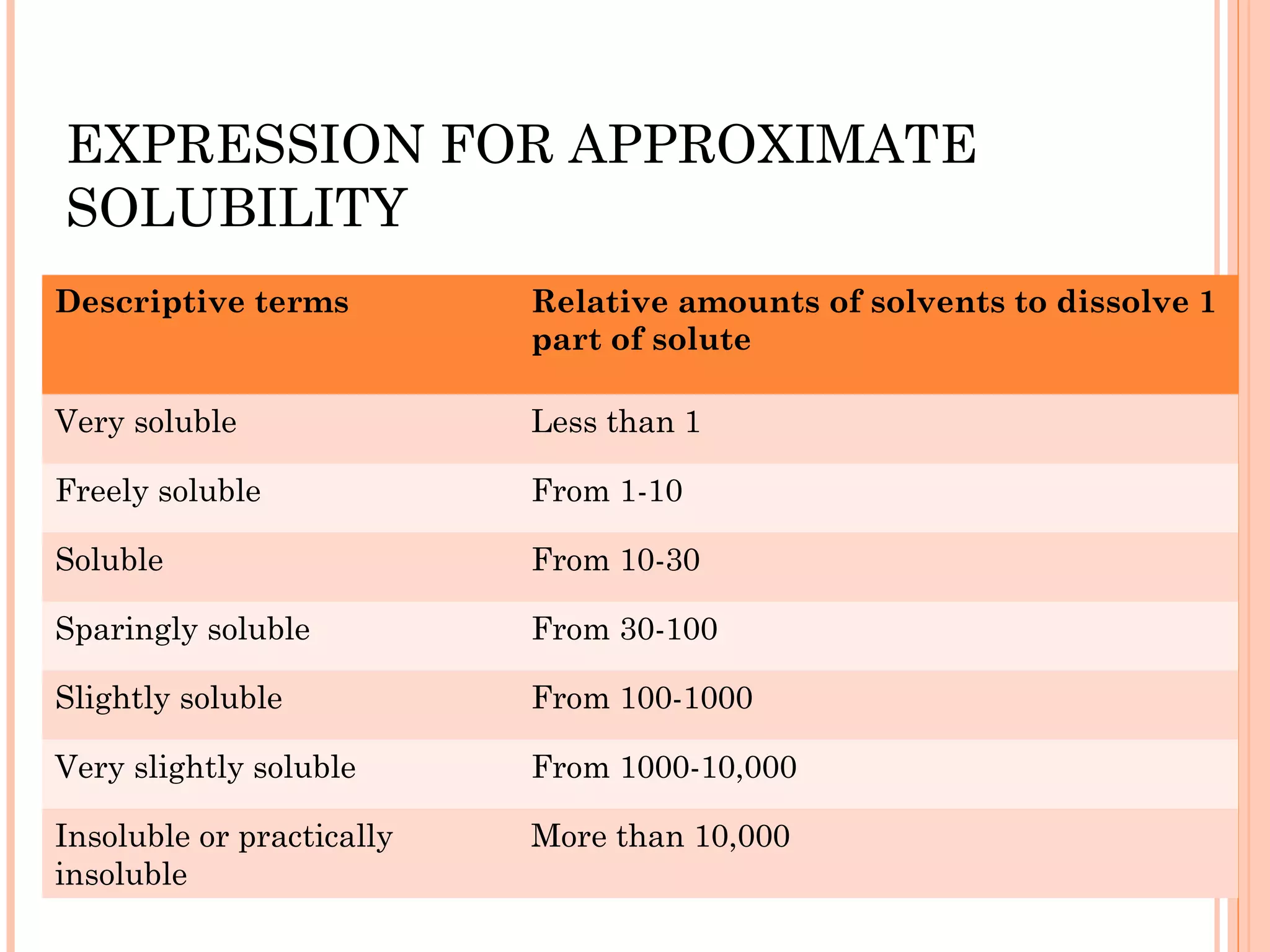
EXPRESSION FOR APPROXIMATE
SOLUBILITY
Descriptive terms          Relative amounts of solvents to dissolve 1
                           part of solute

Very soluble               Less than 1

Freely soluble             From 1-10

Soluble                    From 10-30

Sparingly soluble          From 30-100

Slightly soluble           From 100-1000

Very slightly soluble      From 1000-10,000

Insoluble or practically   More than 10,000
insoluble
PROBLEMS WITH POOR SOLUBILITY:
 Reduced drug efficiency
 Reduced absorption of drug

 May cause side effects
SOLUBILIZATION
   It can be defined as the preparation of a
    thermodynamically stable isotropic solution of a
    substance normally insoluble or very slightly
    soluble in a given solvent by the addition of
    component or components or by any suitable
    methods
PROCESS OF
SOLUBILIZATION
1)   Breaking of inter-ionic or inter–molecular bonds
     in the solute
2)    Separation of solute molecules to provide space
     for the solute
3)    Interaction between the solvent and solute
     molecule or ion
a)   Molecules of solids break away from bulk
b)   Separation of solvent molecules
c)   Freed solid molecules is integrated into the holes
     of solvent molecule
SOLUBILIZATION TECHNIQUES- CO-
    SOLVENCY
 Substances like weak electrolytes and non-polar molecules
  are poorly soluble in water .
 The solubility of these substances can be enhanced by the
  addition of water miscible solvents in which the drug has
  good solubility.
 This process of improving solubility is called as co-solvency
  and the solvents used are known as co-solvents.
 This technique is mainly used in the formulation of
  parenterals.
 Commonly used co-solvents are Ethanol, Sorbitol, Glycerin,
  Polyethylene glycol, propylene glycol etc.
 The solubilizing effect by co-solvency is depends on the
  polarity of the drug with respect to solvent and co-solvent.
  That means more non-polar the solute the greater is the
  solubilization achieved by the added solvents
• Mechanism responsible for solubility enhancement
through co-solvency is by reducing the interfacial tension
the predominantly aqueous solution and hydrophobic
solutes and reduces the contact angle between the solid and
liquid
• Co-solvents increases the solubility by reducing the
difference between the polarity of the drug and water
sustem
Ex. For co-solvency
The solubility of diazepam can be increased by using 10%
ethanol and 40% propylene glycol.
 Phenobarbitone is relatively insoluble in water but it
solubility can be increased by using mixture of solvents
like water, alcohol and glycerin
ADDITION OF SURFACTANTS
 Surfactants are very useful as absorption enhancers and
  enhance both dissolution rate as well as permeability of
  the drug .
 Surfactants act by reducing the surface tension and forms
  colloidal aggregates known as micelles. Micelles are formed
  at CMC .
 Ability of a surfactant solution to dissolve or solubilise
  water insoluble materials starts at CMC and increases
  with increase in conc. of micelles .
 Lipophilic surfactants with HLB value higher than 15 are
  best solubilising agents Concentration of surfactant must
  be controlled very less conc.                 Improper
  solubilization
 very high conc.                 Affect on bioavailability
SOLID DISPERSION TECHNIQUE
  It is the dispersion of one or more active ingredients in an
   inert carrier or matrix in solid state prepared by fusion or
   melting-solvent method.
 It is the dispersion of a drug or drugs in solid diluent or
   diluents. Solid dispersions may also be called “ solid state
   dispersions”. Solid dispersion provides particle size
   reduction and increased rates of dissolution
 Various systems of solid dispersions:

1) Simple eutectic mixtures
2) Solid solutions
3) Glass solution and glass suspension
4) Amorphous precipitation of drug in crystalline carrier
5) Compound or complex formation between drug and
   carrier
6) Any combination among the above
COMPLEXATION
 It is reversible association of a substrate and
  ligand molecule.
 The most common complexing ligands are
  cyclodextrins, caffeine, urea, polyethylene glycol,
  N methylglucamide.
 cyclodextrin are unique since they increase the
  water solubility of poorly soluble drugs by fitting
  them into the hydrophobic cavity of the
  cyclodextrin molecule.
 These cyclodextrins have the ability to form
  molecular inclusion complexes with hydrophobic
  drugs having poor aqueous solubility.
CHANGING TEMPERATURE
 The solubility of a solute or solid in a liquid is dependent
  on temperature, nature of solute and nature of solvent
 ∆Hs( heat of solution) represents the heat released or
  absorbed when a mole of solute is dissolved in a large
  amount of solvent
 If the solution process is endothermic, increase in
  temperature increases the solubility of the solute
 And if the solution process is exothermic, increase in
  temperature decreases the solubility of the solute
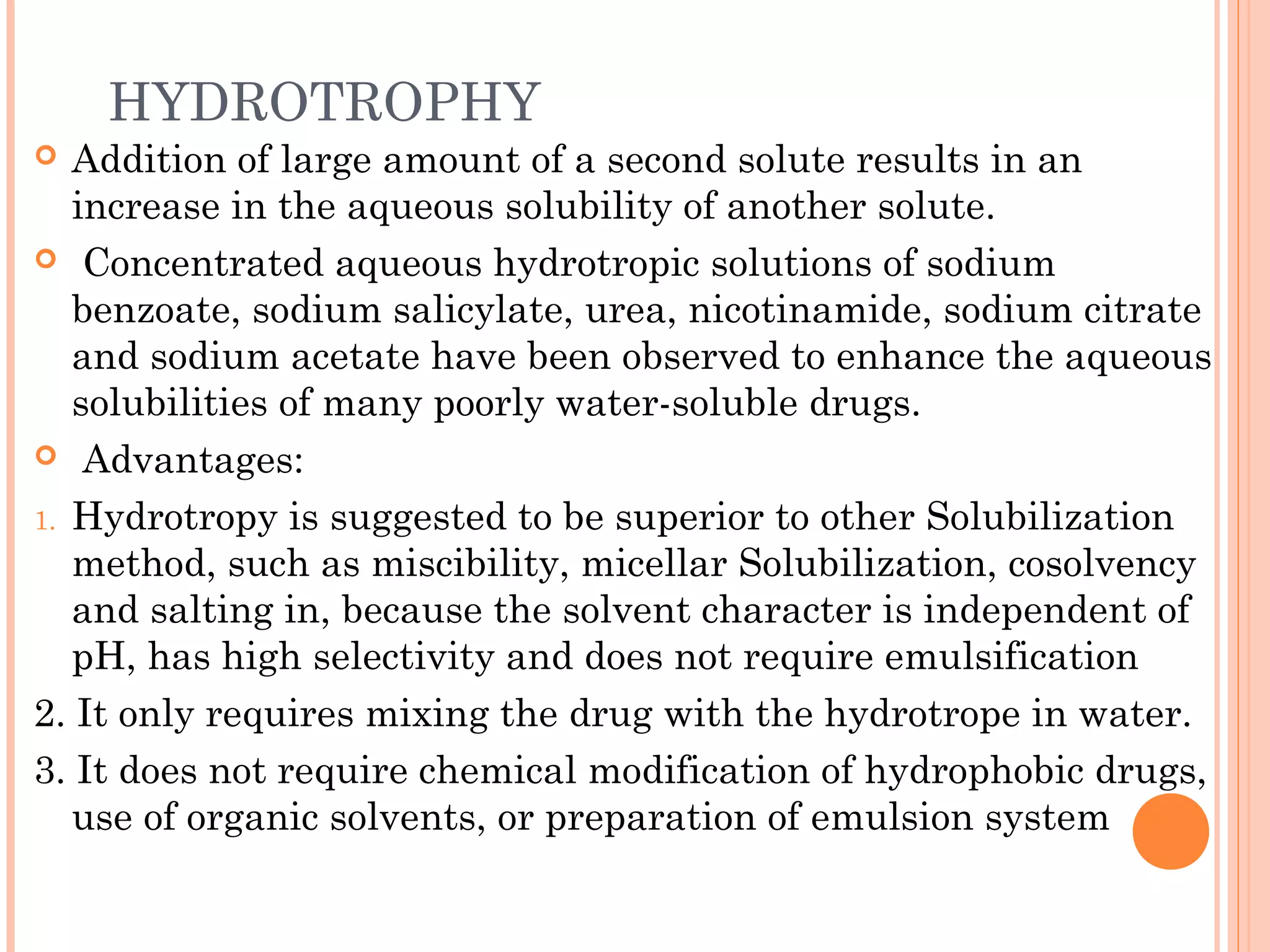
HYDROTROPHY
  Addition of large amount of a second solute results in an
   increase in the aqueous solubility of another solute.
 Concentrated aqueous hydrotropic solutions of sodium
   benzoate, sodium salicylate, urea, nicotinamide, sodium citrate
   and sodium acetate have been observed to enhance the aqueous
   solubilities of many poorly water-soluble drugs.
 Advantages:

1. Hydrotropy is suggested to be superior to other Solubilization
   method, such as miscibility, micellar Solubilization, cosolvency
   and salting in, because the solvent character is independent of
   pH, has high selectivity and does not require emulsification
2. It only requires mixing the drug with the hydrotrope in water.
3. It does not require chemical modification of hydrophobic drugs,
   use of organic solvents, or preparation of emulsion system
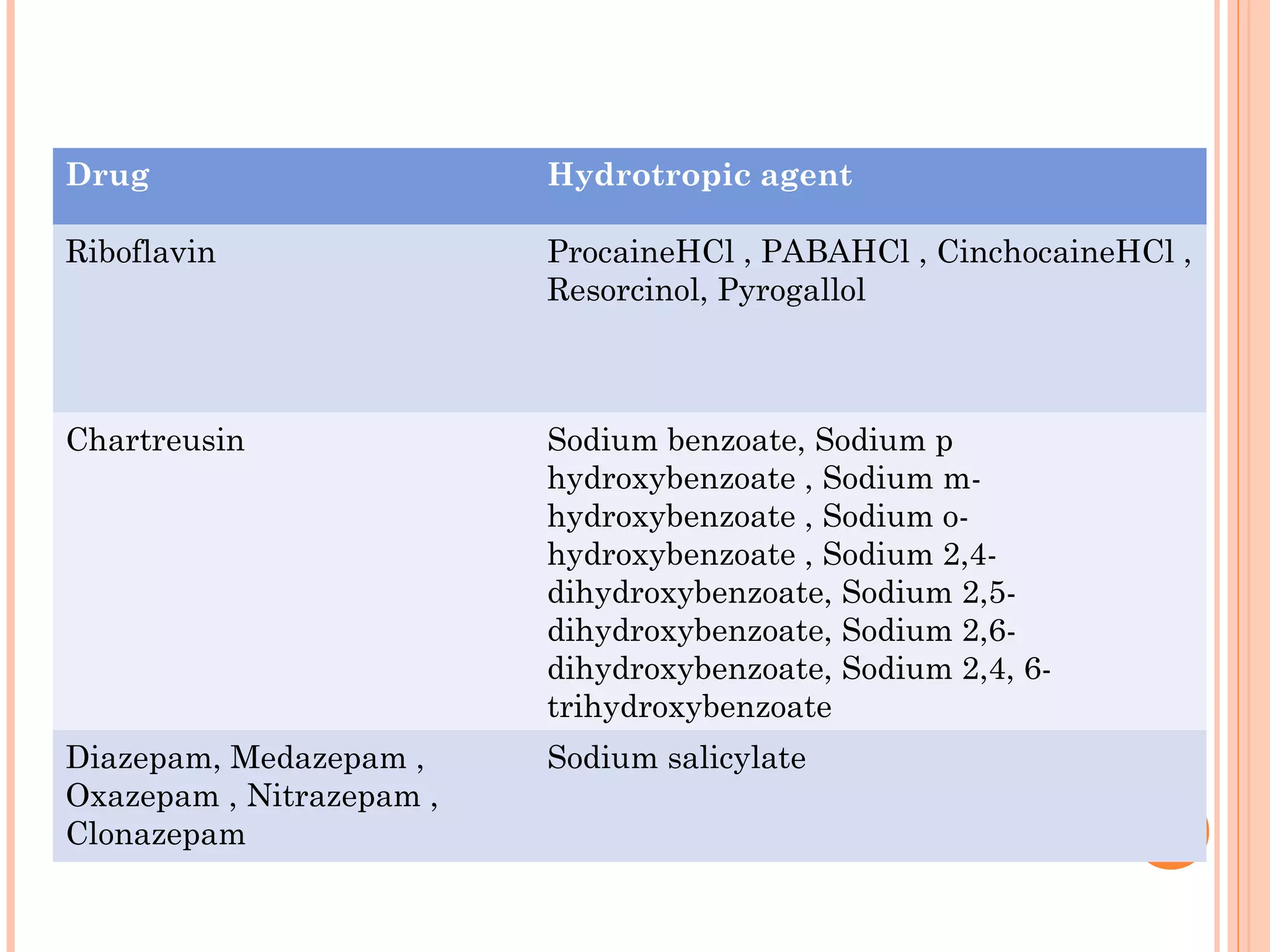
Drug                      Hydrotropic agent

Riboflavin                ProcaineHCl , PABAHCl , CinchocaineHCl ,
                          Resorcinol, Pyrogallol


Chartreusin               Sodium benzoate, Sodium p
                          hydroxybenzoate , Sodium m-
                          hydroxybenzoate , Sodium o-
                          hydroxybenzoate , Sodium 2,4-
                          dihydroxybenzoate, Sodium 2,5-
                          dihydroxybenzoate, Sodium 2,6-
                          dihydroxybenzoate, Sodium 2,4, 6-
                          trihydroxybenzoate
Diazepam, Medazepam ,     Sodium salicylate
Oxazepam , Nitrazepam ,
Clonazepam
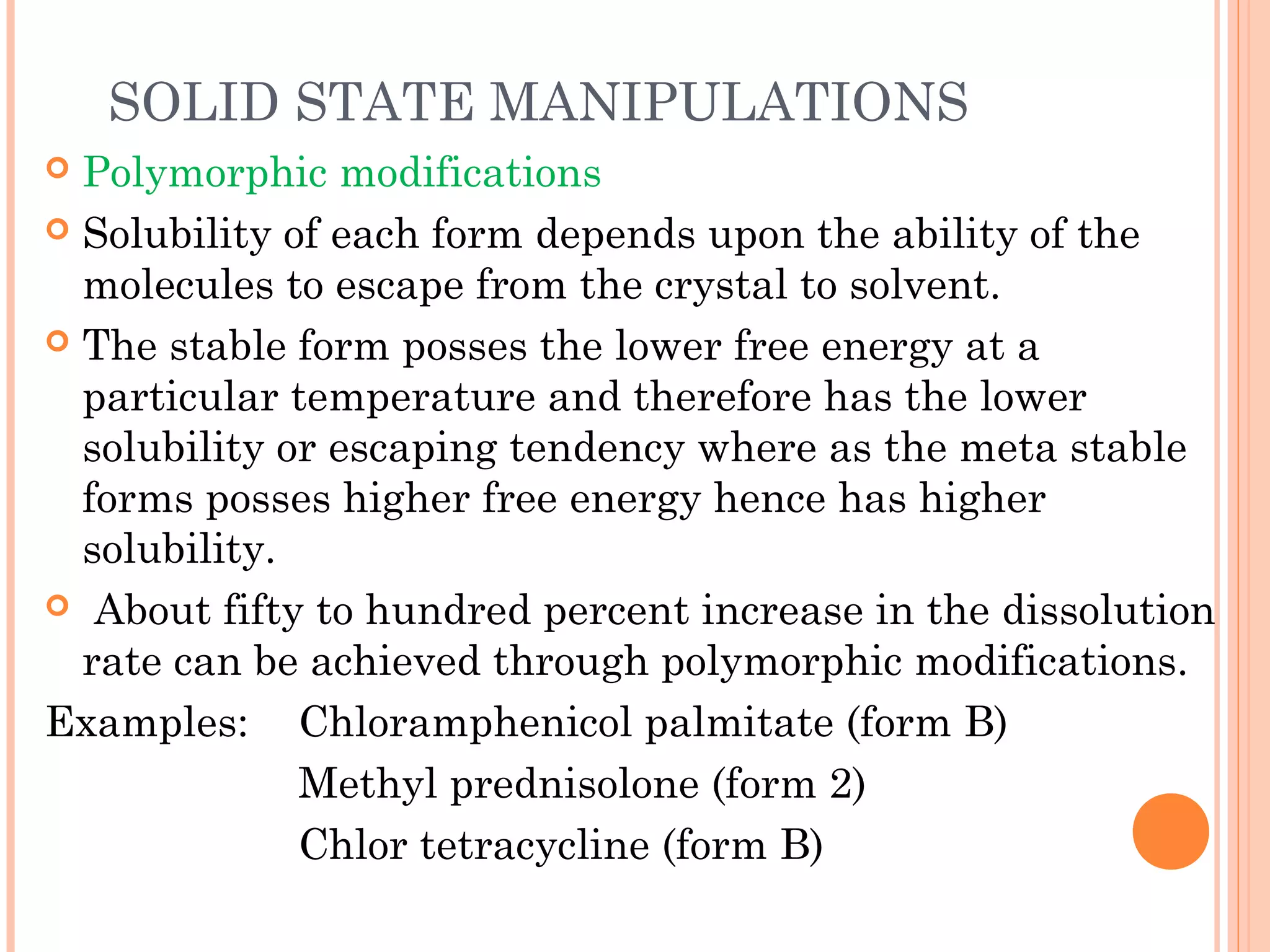
SOLID STATE MANIPULATIONS
 Polymorphic modifications
 Solubility of each form depends upon the ability of the
  molecules to escape from the crystal to solvent.
 The stable form posses the lower free energy at a
  particular temperature and therefore has the lower
  solubility or escaping tendency where as the meta stable
  forms posses higher free energy hence has higher
  solubility.
 About fifty to hundred percent increase in the dissolution
  rate can be achieved through polymorphic modifications.
Examples: Chloramphenicol palmitate (form B)
              Methyl prednisolone (form 2)
              Chlor tetracycline (form B)
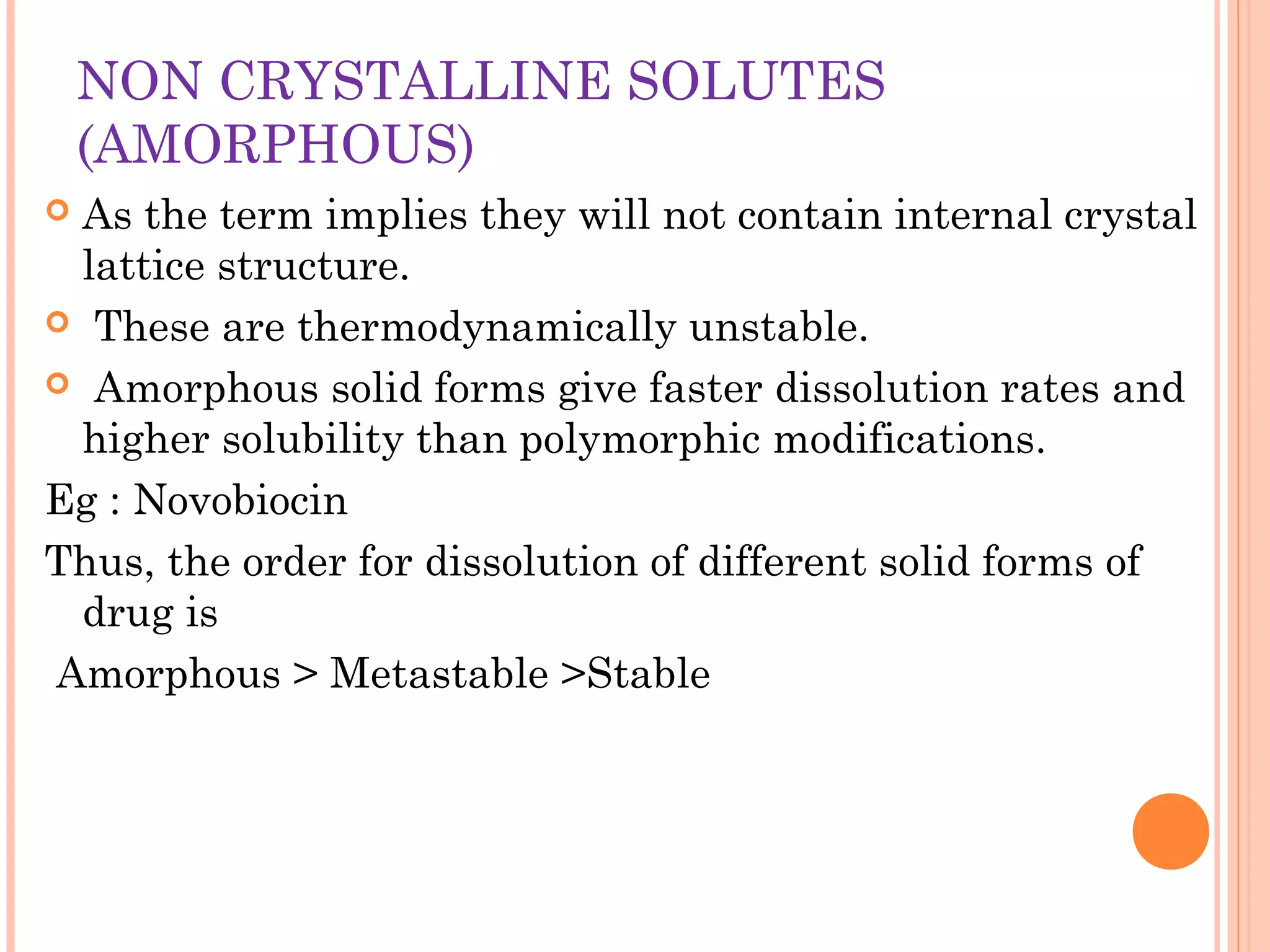
NON CRYSTALLINE SOLUTES
    (AMORPHOUS)
As the term implies they will not contain internal crystal
 lattice structure.
 These are thermodynamically unstable.

 Amorphous solid forms give faster dissolution rates and
 higher solubility than polymorphic modifications.
Eg : Novobiocin
Thus, the order for dissolution of different solid forms of
 drug is
Amorphous > Metastable >Stable
SOLVATES (PSEUDO POLYMORPHISM ) 
 The recrystallization of many drug substances
 from solution will results in the formation of
 solids containing solvent molecules as an integral
 part of their crystal structure. Majority of these
 crystalline materials referred as pseudo
 polymorphs, contain stoichiometric amount of
 solvent.
                 Anhydrates > hydrates
           Organic solvates > organic non-solvates
Enhances the solubility of drug markedly.
Examples: Pentanol solvates of fludrocortisone
           Chloroform solvates of griseofulvin
           Cephalexin hydrate
Salt formation
 Salts have improved solubility and dissolution
characteristics in comparison to the original drug. Alkali
metal salts of acidic drugs like penicillin and strong acid
salts of basic drugs like atropine are water-soluble than
the parent drug.

Precipitation:
In this method, the poorly aqueous soluble drug is
dissolved in a suitable organic solvent followed by its
rapid mixing with a non-solvent to effect precipitation of
drug in nano size particles. The product so prepared is
also called as hydrosol. Ex. Cyclosporine
Other techniques
•Micronization
•Nanonisation
• Supercritical Fluid Recrystallization
• Spray freezing into liquid and lyophilization
•Evaporative precipitation into aqueous solution
•Use of precipitation inhibitors
•Selective Adsorption on Insoluble Carriers
•Solvent Deposition
• Drug derivatisation
Conclusion
The aqueous solubility of drug is often a limiting
factor in developing most desirable dosage form.
A highly solubilized formulation is highly desired
to minimize dissolution limited absorption .Often,
these early stage formulations become the
backbone for the later stage commercial
formulations. But still there has been a lot of
research going on in this topic and many newer
and advanced methods are used to enhance the
solubility of the drug.

Solubilization

  • 1.
    SOLUBILIZATION & METHOD OF SOLUBILIZATION )
  • 2.
    SOLUBILITY  It canbe defined quantitatively as the conc. of solute in a saturated solution at a certain temperature, and qualitatively as the spontaneous interaction of two or more substances to form a homogenous molecular dispersion It can also be defined as the molecular dispersion of solute in the solvent.  Importance of solubility:  It is an important physico-chemical property of the drug,  It is an important parameter to achieve desired concentration in systemic circulation .  Solubility behavior of the drug is a one of the important aspects of preformulation testing for poorly soluble drug
  • 3.
    EXPRESSION FOR APPROXIMATE SOLUBILITY Descriptiveterms Relative amounts of solvents to dissolve 1 part of solute Very soluble Less than 1 Freely soluble From 1-10 Soluble From 10-30 Sparingly soluble From 30-100 Slightly soluble From 100-1000 Very slightly soluble From 1000-10,000 Insoluble or practically More than 10,000 insoluble
  • 4.
    PROBLEMS WITH POORSOLUBILITY:  Reduced drug efficiency  Reduced absorption of drug  May cause side effects
  • 5.
    SOLUBILIZATION  It can be defined as the preparation of a thermodynamically stable isotropic solution of a substance normally insoluble or very slightly soluble in a given solvent by the addition of component or components or by any suitable methods
  • 6.
    PROCESS OF SOLUBILIZATION 1) Breaking of inter-ionic or inter–molecular bonds in the solute 2) Separation of solute molecules to provide space for the solute 3) Interaction between the solvent and solute molecule or ion a) Molecules of solids break away from bulk b) Separation of solvent molecules c) Freed solid molecules is integrated into the holes of solvent molecule
  • 7.
    SOLUBILIZATION TECHNIQUES- CO- SOLVENCY  Substances like weak electrolytes and non-polar molecules are poorly soluble in water .  The solubility of these substances can be enhanced by the addition of water miscible solvents in which the drug has good solubility.  This process of improving solubility is called as co-solvency and the solvents used are known as co-solvents.  This technique is mainly used in the formulation of parenterals.  Commonly used co-solvents are Ethanol, Sorbitol, Glycerin, Polyethylene glycol, propylene glycol etc.  The solubilizing effect by co-solvency is depends on the polarity of the drug with respect to solvent and co-solvent. That means more non-polar the solute the greater is the solubilization achieved by the added solvents
  • 8.
    • Mechanism responsiblefor solubility enhancement through co-solvency is by reducing the interfacial tension the predominantly aqueous solution and hydrophobic solutes and reduces the contact angle between the solid and liquid • Co-solvents increases the solubility by reducing the difference between the polarity of the drug and water sustem Ex. For co-solvency The solubility of diazepam can be increased by using 10% ethanol and 40% propylene glycol. Phenobarbitone is relatively insoluble in water but it solubility can be increased by using mixture of solvents like water, alcohol and glycerin
  • 9.
    ADDITION OF SURFACTANTS Surfactants are very useful as absorption enhancers and enhance both dissolution rate as well as permeability of the drug .  Surfactants act by reducing the surface tension and forms colloidal aggregates known as micelles. Micelles are formed at CMC .  Ability of a surfactant solution to dissolve or solubilise water insoluble materials starts at CMC and increases with increase in conc. of micelles .  Lipophilic surfactants with HLB value higher than 15 are best solubilising agents Concentration of surfactant must be controlled very less conc. Improper solubilization  very high conc. Affect on bioavailability
  • 10.
    SOLID DISPERSION TECHNIQUE  It is the dispersion of one or more active ingredients in an inert carrier or matrix in solid state prepared by fusion or melting-solvent method.  It is the dispersion of a drug or drugs in solid diluent or diluents. Solid dispersions may also be called “ solid state dispersions”. Solid dispersion provides particle size reduction and increased rates of dissolution  Various systems of solid dispersions: 1) Simple eutectic mixtures 2) Solid solutions 3) Glass solution and glass suspension 4) Amorphous precipitation of drug in crystalline carrier 5) Compound or complex formation between drug and carrier 6) Any combination among the above
  • 11.
    COMPLEXATION  It isreversible association of a substrate and ligand molecule.  The most common complexing ligands are cyclodextrins, caffeine, urea, polyethylene glycol, N methylglucamide.  cyclodextrin are unique since they increase the water solubility of poorly soluble drugs by fitting them into the hydrophobic cavity of the cyclodextrin molecule.  These cyclodextrins have the ability to form molecular inclusion complexes with hydrophobic drugs having poor aqueous solubility.
  • 12.
    CHANGING TEMPERATURE  Thesolubility of a solute or solid in a liquid is dependent on temperature, nature of solute and nature of solvent  ∆Hs( heat of solution) represents the heat released or absorbed when a mole of solute is dissolved in a large amount of solvent  If the solution process is endothermic, increase in temperature increases the solubility of the solute  And if the solution process is exothermic, increase in temperature decreases the solubility of the solute
  • 13.
    HYDROTROPHY  Additionof large amount of a second solute results in an increase in the aqueous solubility of another solute.  Concentrated aqueous hydrotropic solutions of sodium benzoate, sodium salicylate, urea, nicotinamide, sodium citrate and sodium acetate have been observed to enhance the aqueous solubilities of many poorly water-soluble drugs.  Advantages: 1. Hydrotropy is suggested to be superior to other Solubilization method, such as miscibility, micellar Solubilization, cosolvency and salting in, because the solvent character is independent of pH, has high selectivity and does not require emulsification 2. It only requires mixing the drug with the hydrotrope in water. 3. It does not require chemical modification of hydrophobic drugs, use of organic solvents, or preparation of emulsion system
  • 14.
    Drug Hydrotropic agent Riboflavin ProcaineHCl , PABAHCl , CinchocaineHCl , Resorcinol, Pyrogallol Chartreusin Sodium benzoate, Sodium p hydroxybenzoate , Sodium m- hydroxybenzoate , Sodium o- hydroxybenzoate , Sodium 2,4- dihydroxybenzoate, Sodium 2,5- dihydroxybenzoate, Sodium 2,6- dihydroxybenzoate, Sodium 2,4, 6- trihydroxybenzoate Diazepam, Medazepam , Sodium salicylate Oxazepam , Nitrazepam , Clonazepam
  • 15.
    SOLID STATE MANIPULATIONS Polymorphic modifications  Solubility of each form depends upon the ability of the molecules to escape from the crystal to solvent.  The stable form posses the lower free energy at a particular temperature and therefore has the lower solubility or escaping tendency where as the meta stable forms posses higher free energy hence has higher solubility.  About fifty to hundred percent increase in the dissolution rate can be achieved through polymorphic modifications. Examples: Chloramphenicol palmitate (form B) Methyl prednisolone (form 2) Chlor tetracycline (form B)
  • 16.
    NON CRYSTALLINE SOLUTES (AMORPHOUS) As the term implies they will not contain internal crystal lattice structure.  These are thermodynamically unstable.  Amorphous solid forms give faster dissolution rates and higher solubility than polymorphic modifications. Eg : Novobiocin Thus, the order for dissolution of different solid forms of drug is Amorphous > Metastable >Stable
  • 17.
    SOLVATES (PSEUDO POLYMORPHISM)   The recrystallization of many drug substances from solution will results in the formation of solids containing solvent molecules as an integral part of their crystal structure. Majority of these crystalline materials referred as pseudo polymorphs, contain stoichiometric amount of solvent. Anhydrates > hydrates Organic solvates > organic non-solvates Enhances the solubility of drug markedly. Examples: Pentanol solvates of fludrocortisone Chloroform solvates of griseofulvin Cephalexin hydrate
  • 18.
    Salt formation Saltshave improved solubility and dissolution characteristics in comparison to the original drug. Alkali metal salts of acidic drugs like penicillin and strong acid salts of basic drugs like atropine are water-soluble than the parent drug. Precipitation: In this method, the poorly aqueous soluble drug is dissolved in a suitable organic solvent followed by its rapid mixing with a non-solvent to effect precipitation of drug in nano size particles. The product so prepared is also called as hydrosol. Ex. Cyclosporine
  • 19.
    Other techniques •Micronization •Nanonisation • SupercriticalFluid Recrystallization • Spray freezing into liquid and lyophilization •Evaporative precipitation into aqueous solution •Use of precipitation inhibitors •Selective Adsorption on Insoluble Carriers •Solvent Deposition • Drug derivatisation
  • 20.
    Conclusion The aqueous solubilityof drug is often a limiting factor in developing most desirable dosage form. A highly solubilized formulation is highly desired to minimize dissolution limited absorption .Often, these early stage formulations become the backbone for the later stage commercial formulations. But still there has been a lot of research going on in this topic and many newer and advanced methods are used to enhance the solubility of the drug.