DEPARTMENT OF PHARMACEUTICS
Presented BY
Nagabhushan Shet
M. Pharm 1st Year ( I semester)
SOLUBILITY STUDIES
BHARATI VIDYAPEETH (DEEMED UNIVERSITY)
POONA COLLEGE OF PHARMACY, PUNE
Poona College Of Pharmacy, Pune
What is solubility?
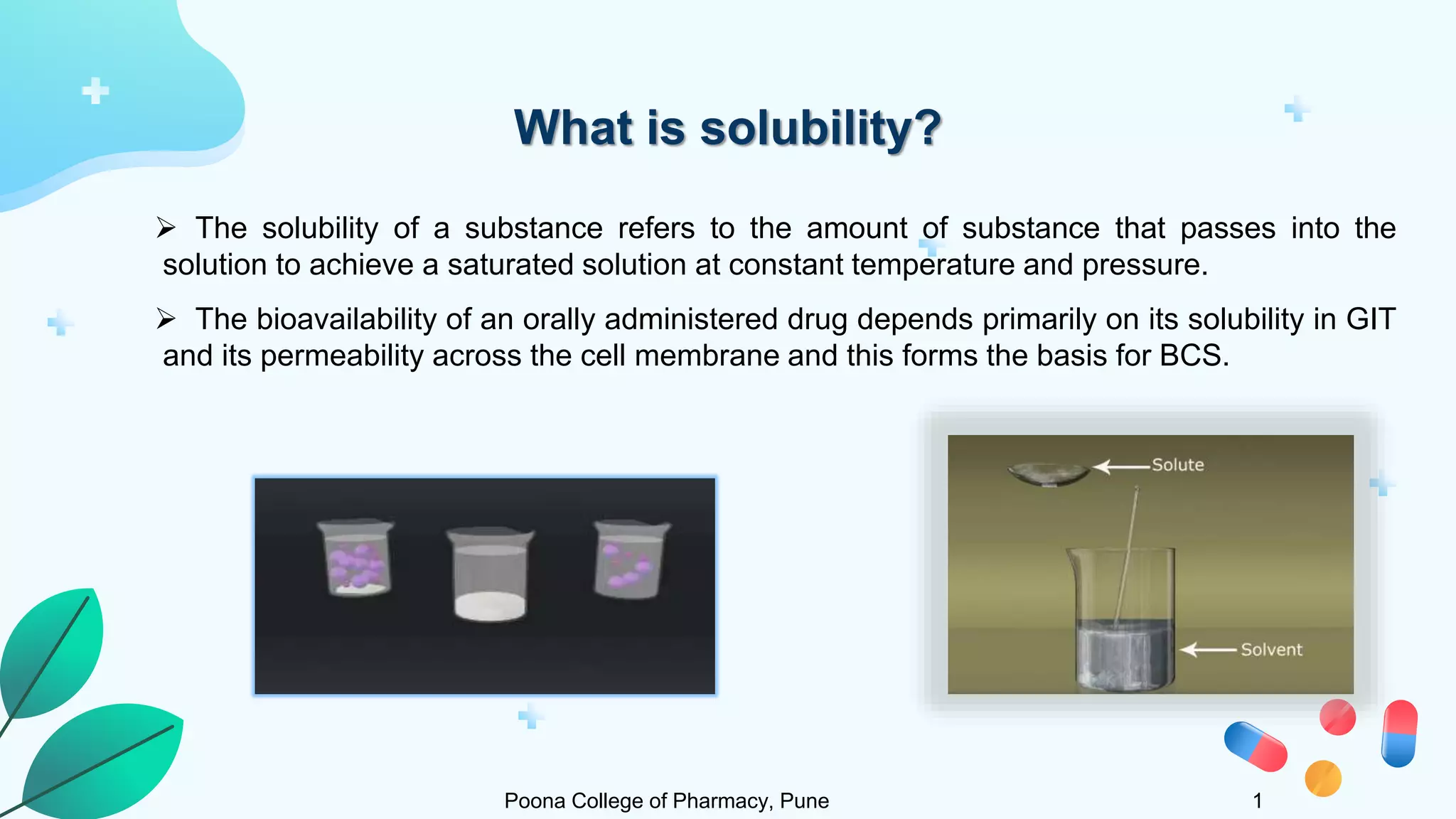
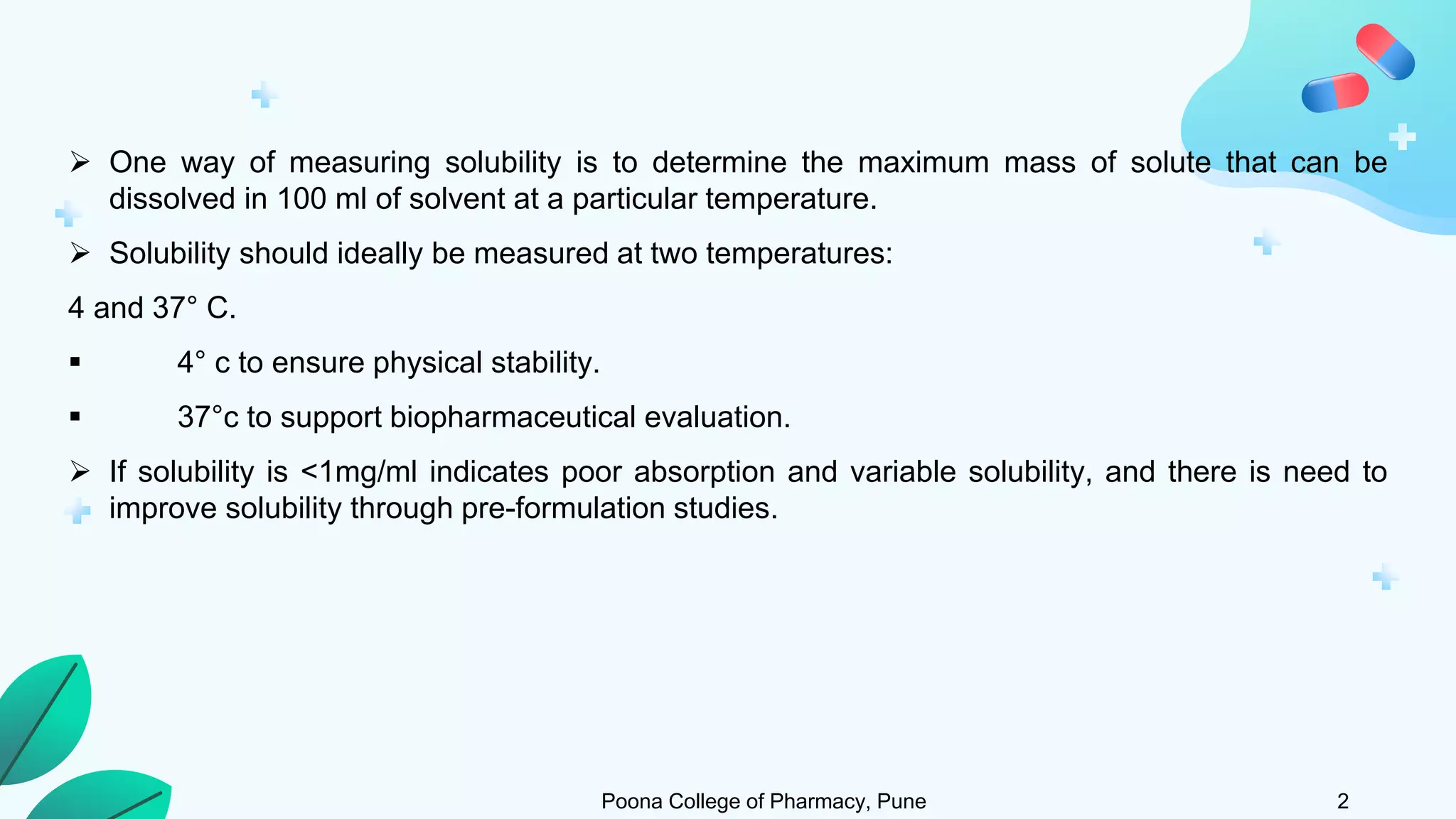
 The solubility of a substance refers to the amount of substance that passes into the
solution to achieve a saturated solution at constant temperature and pressure.
 The bioavailability of an orally administered drug depends primarily on its solubility in GIT
and its permeability across the cell membrane and this forms the basis for BCS.
Poona College of Pharmacy, Pune 1
 One way of measuring solubility is to determine the maximum mass of solute that can be
dissolved in 100 ml of solvent at a particular temperature.
 Solubility should ideally be measured at two temperatures:
4 and 37° C.
 4° c to ensure physical stability.
 37°c to support biopharmaceutical evaluation.
 If solubility is <1mg/ml indicates poor absorption and variable solubility, and there is need to
improve solubility through pre-formulation studies.
Poona College of Pharmacy, Pune 2
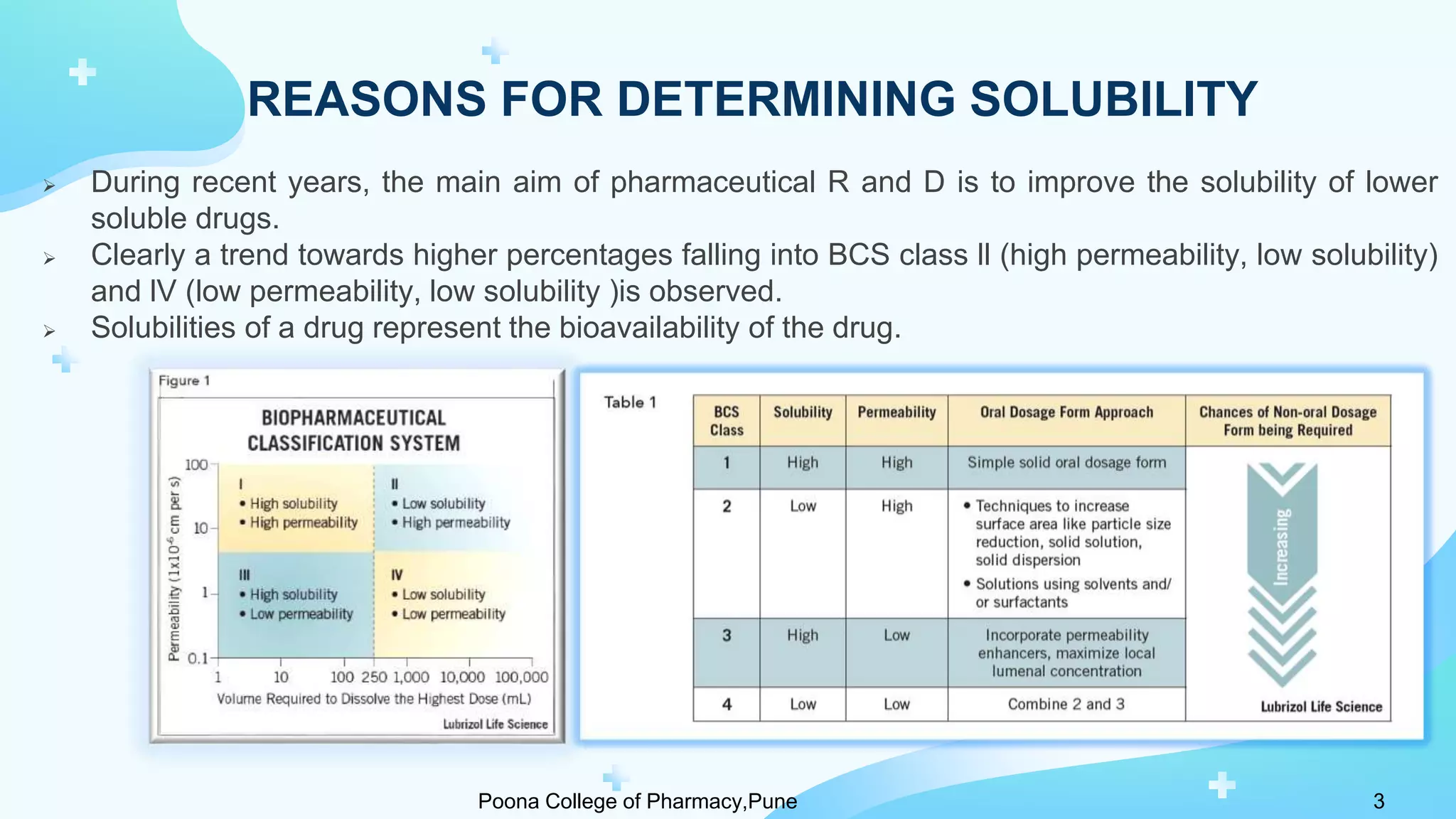
 During recent years, the main aim of pharmaceutical R and D is to improve the solubility of lower
soluble drugs.
 Clearly a trend towards higher percentages falling into BCS class ll (high permeability, low solubility)
and lV (low permeability, low solubility )is observed.
 Solubilities of a drug represent the bioavailability of the drug.
REASONS FOR DETERMINING SOLUBILITY
Poona College of Pharmacy,Pune 3
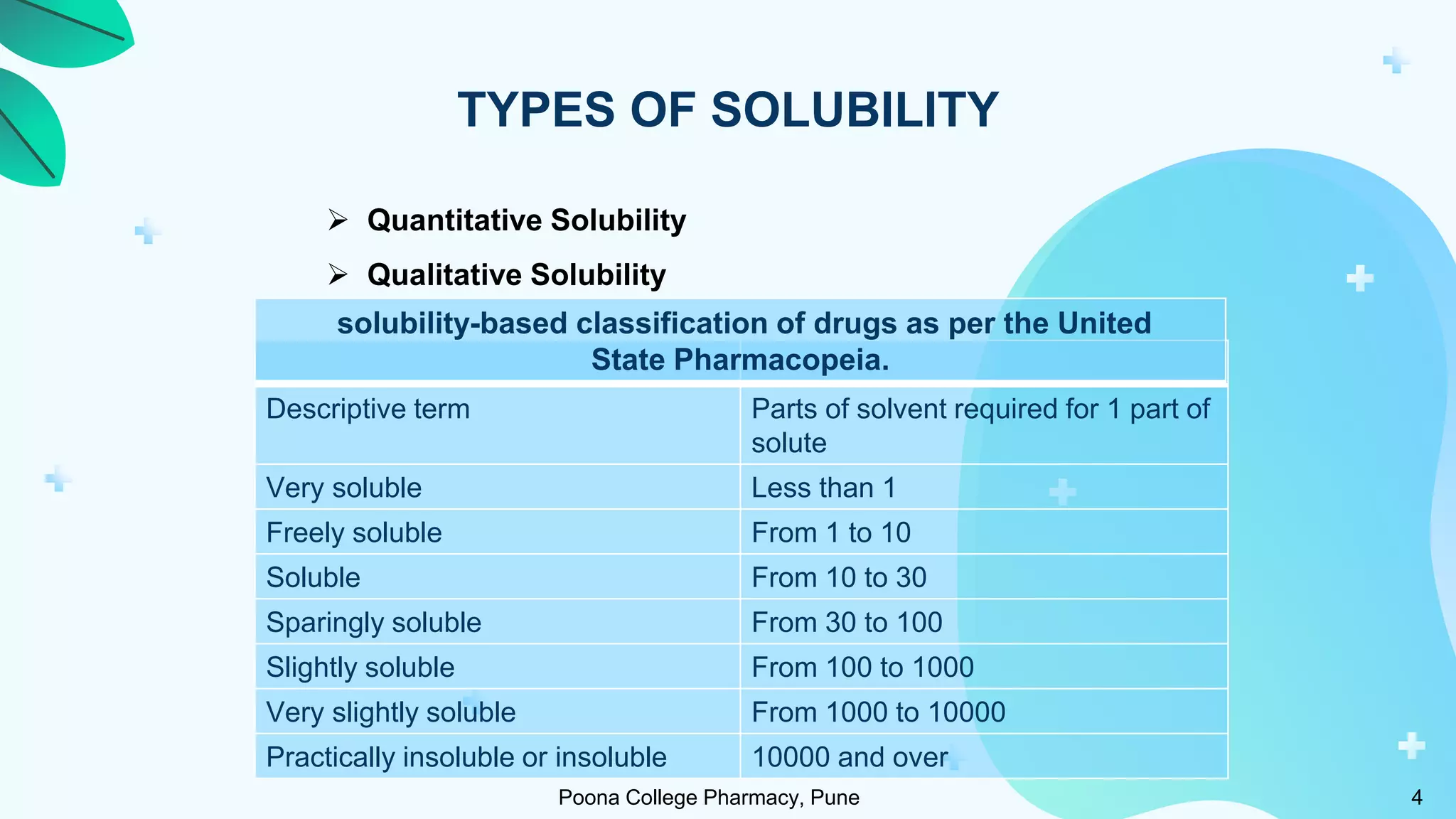
TYPES OF SOLUBILITY
 Quantitative Solubility
 Qualitative Solubility
Descriptive term Parts of solvent required for 1 part of
solute
Very soluble Less than 1
Freely soluble From 1 to 10
Soluble From 10 to 30
Sparingly soluble From 30 to 100
Slightly soluble From 100 to 1000
Very slightly soluble From 1000 to 10000
Practically insoluble or insoluble 10000 and over
solubility-based classification of drugs as per the United
State Pharmacopeia.
Poona College Pharmacy, Pune 4
Solubility studies include
1. Intrinsic solubility
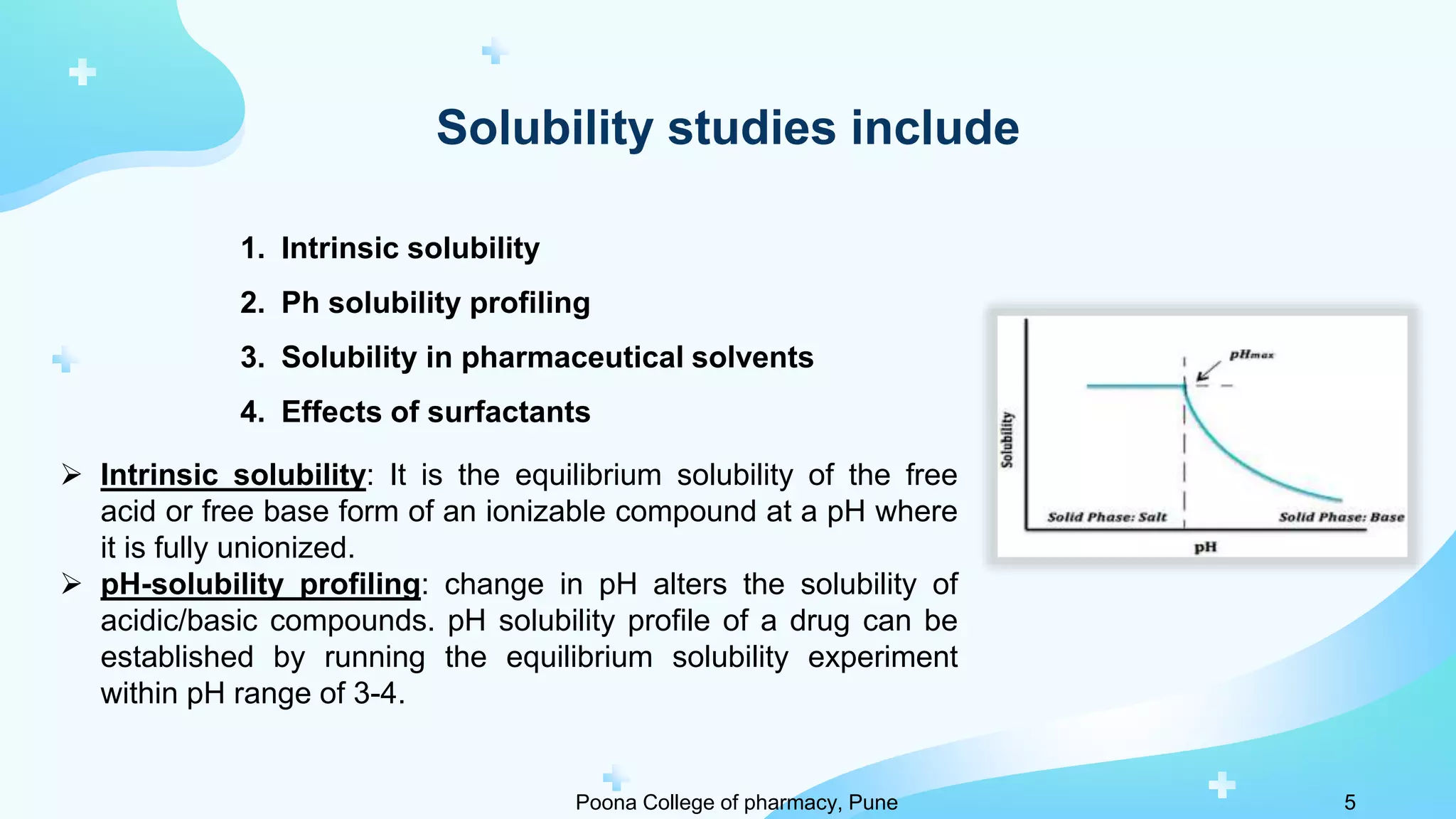
2. Ph solubility profiling
3. Solubility in pharmaceutical solvents
4. Effects of surfactants
 Intrinsic solubility: It is the equilibrium solubility of the free
acid or free base form of an ionizable compound at a pH where
it is fully unionized.
 pH-solubility profiling: change in pH alters the solubility of
acidic/basic compounds. pH solubility profile of a drug can be
established by running the equilibrium solubility experiment
within pH range of 3-4.
Poona College of pharmacy, Pune 5
 Solubility in pharmaceutical solvents: To enhance the solubility of pharmaceutical products, add co-
solvents
examples: ethanol, methanol, etc...
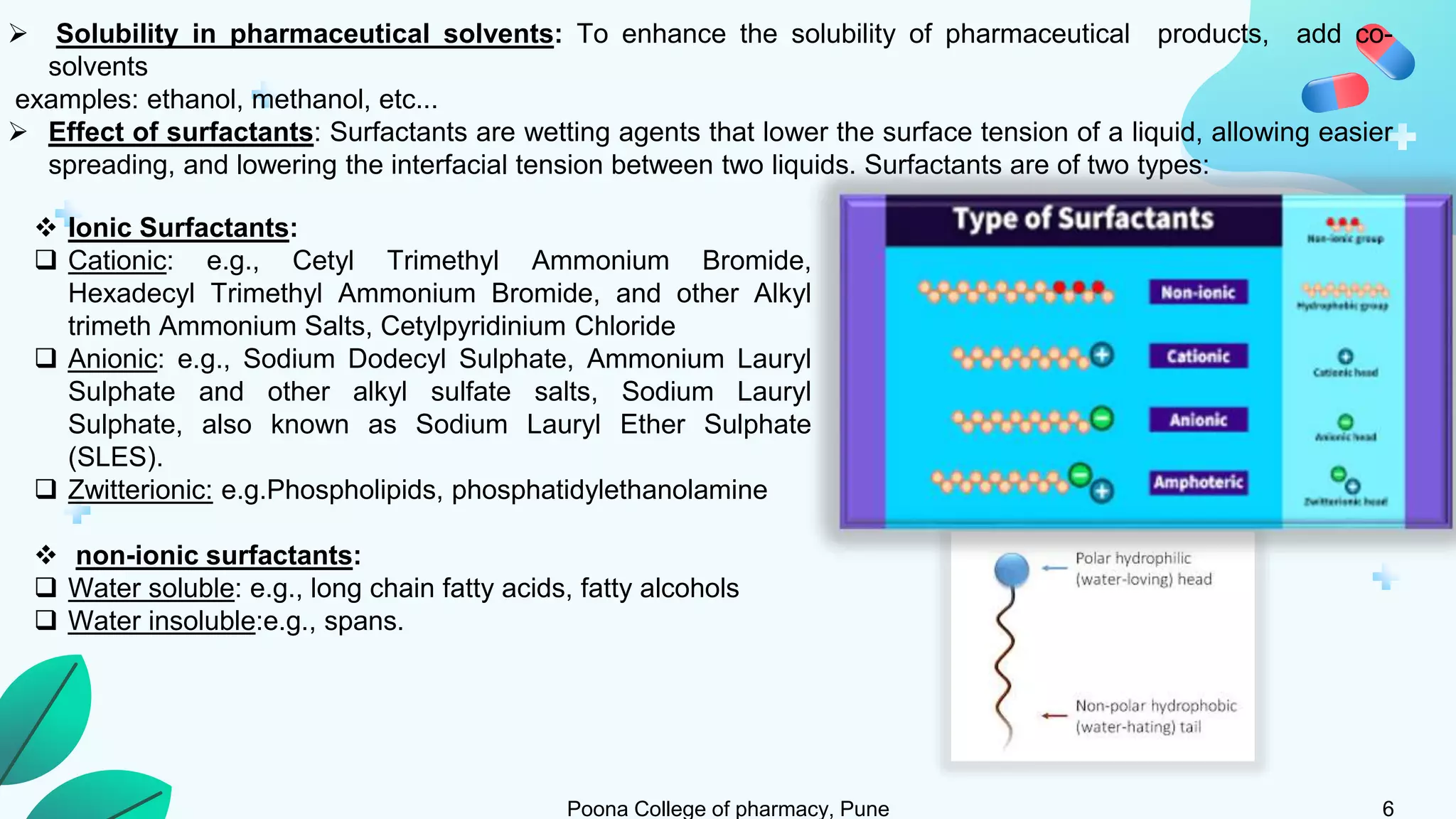
 Effect of surfactants: Surfactants are wetting agents that lower the surface tension of a liquid, allowing easier
spreading, and lowering the interfacial tension between two liquids. Surfactants are of two types:
 Ionic Surfactants:
 Cationic: e.g., Cetyl Trimethyl Ammonium Bromide,
Hexadecyl Trimethyl Ammonium Bromide, and other Alkyl
trimeth Ammonium Salts, Cetylpyridinium Chloride
 Anionic: e.g., Sodium Dodecyl Sulphate, Ammonium Lauryl
Sulphate and other alkyl sulfate salts, Sodium Lauryl
Sulphate, also known as Sodium Lauryl Ether Sulphate
(SLES).
 Zwitterionic: e.g.Phospholipids, phosphatidylethanolamine
 non-ionic surfactants:
 Water soluble: e.g., long chain fatty acids, fatty alcohols
 Water insoluble:e.g., spans.
Poona College of pharmacy, Pune 6
PREFORMULATION SOLUBILITY STUDIES
1. Pka determination
2. Effect of temperature
3. Solubilization
4. Partition coefficient
5. Dissolution
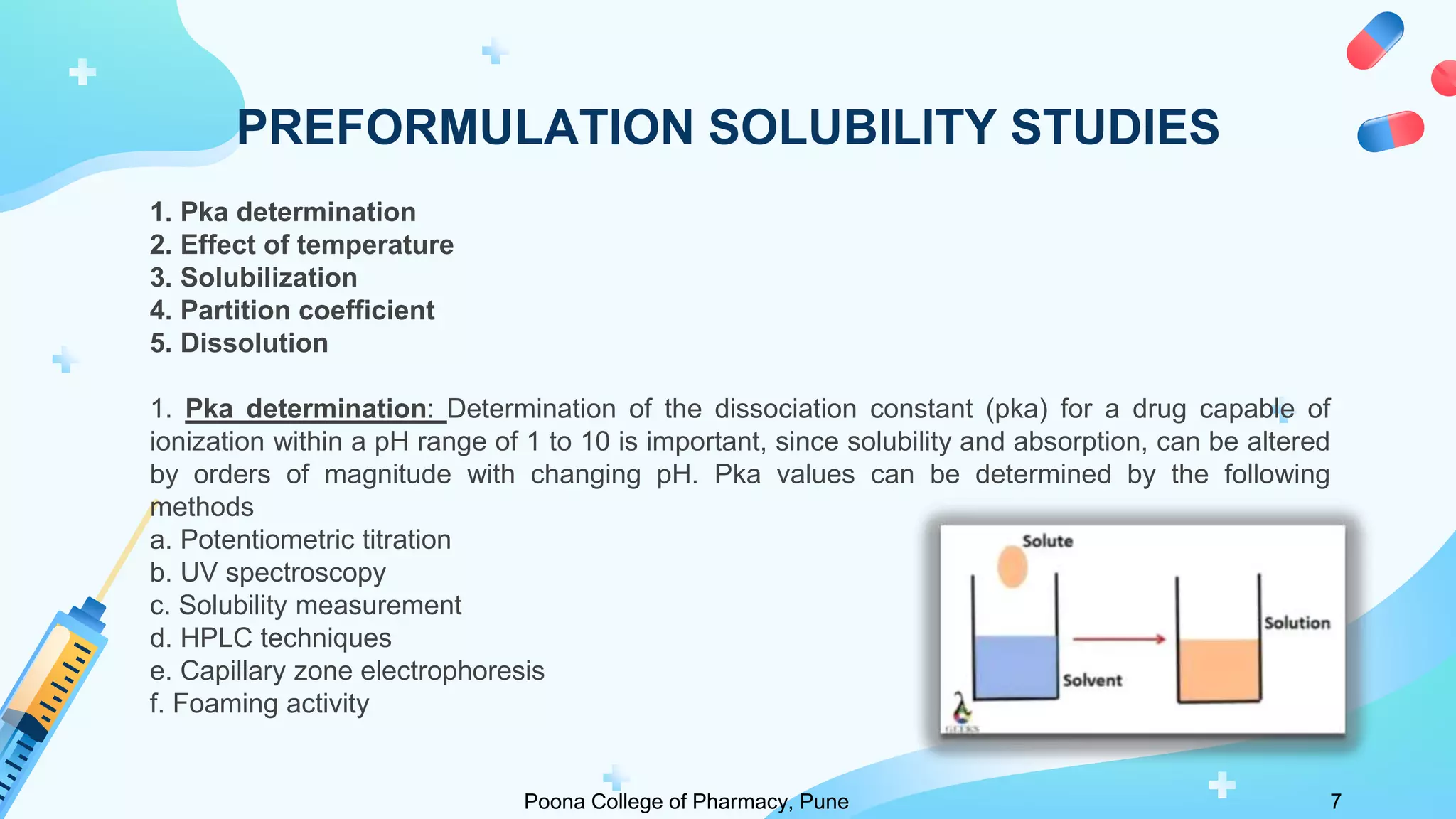
1. Pka determination: Determination of the dissociation constant (pka) for a drug capable of
ionization within a pH range of 1 to 10 is important, since solubility and absorption, can be altered
by orders of magnitude with changing pH. Pka values can be determined by the following
methods
a. Potentiometric titration
b. UV spectroscopy
c. Solubility measurement
d. HPLC techniques
e. Capillary zone electrophoresis
f. Foaming activity
Poona College of Pharmacy, Pune 7
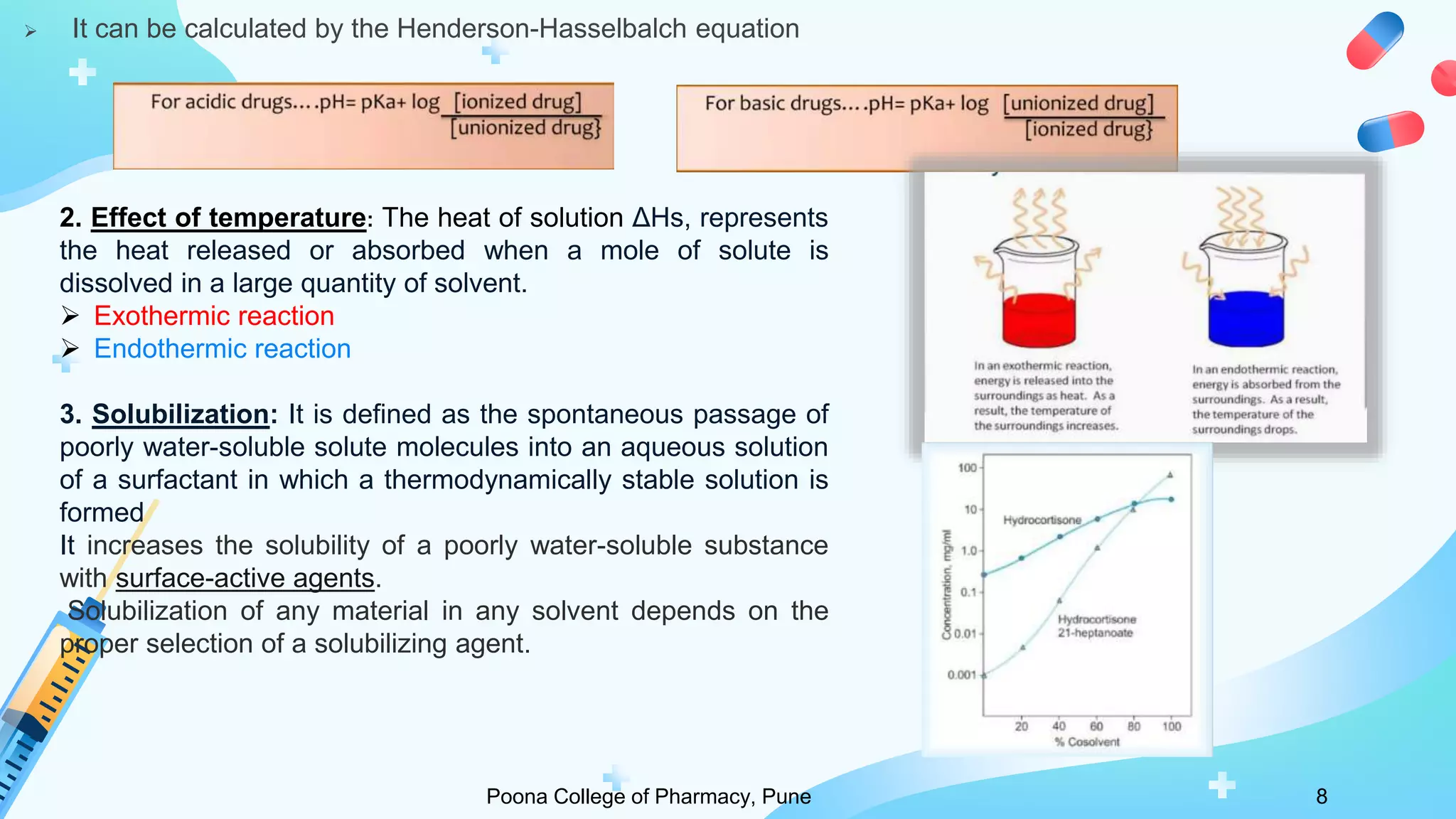
 It can be calculated by the Henderson-Hasselbalch equation
2. Effect of temperature: The heat of solution ΔHs, represents
the heat released or absorbed when a mole of solute is
dissolved in a large quantity of solvent.
 Exothermic reaction
 Endothermic reaction
3. Solubilization: It is defined as the spontaneous passage of
poorly water-soluble solute molecules into an aqueous solution
of a surfactant in which a thermodynamically stable solution is
formed
It increases the solubility of a poorly water-soluble substance
with surface-active agents.
Solubilization of any material in any solvent depends on the
proper selection of a solubilizing agent.
Poona College of Pharmacy, Pune 8
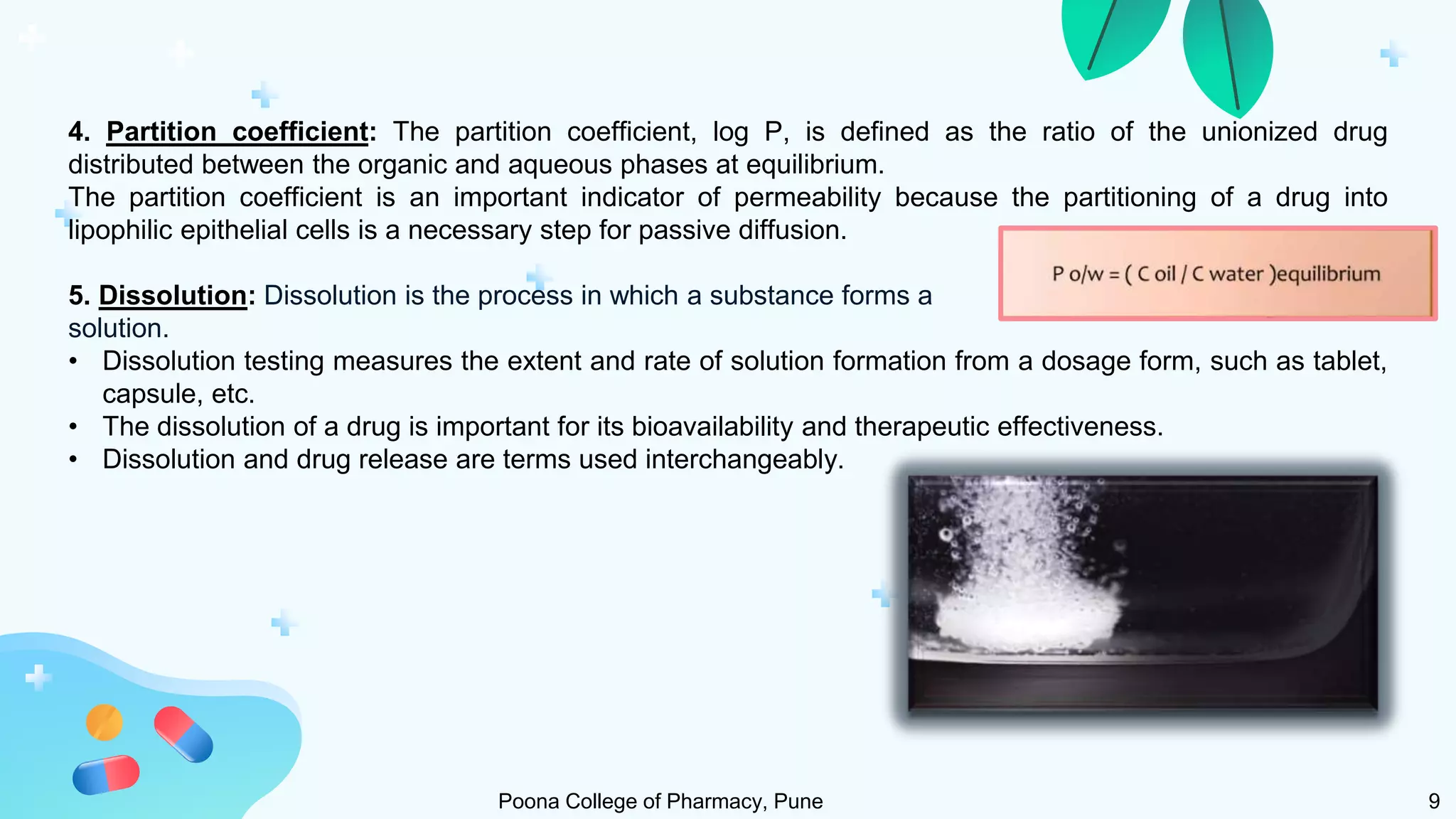
4. Partition coefficient: The partition coefficient, log P, is defined as the ratio of the unionized drug
distributed between the organic and aqueous phases at equilibrium.
The partition coefficient is an important indicator of permeability because the partitioning of a drug into
lipophilic epithelial cells is a necessary step for passive diffusion.
5. Dissolution: Dissolution is the process in which a substance forms a
solution.
• Dissolution testing measures the extent and rate of solution formation from a dosage form, such as tablet,
capsule, etc.
• The dissolution of a drug is important for its bioavailability and therapeutic effectiveness.
• Dissolution and drug release are terms used interchangeably.
Poona College of Pharmacy, Pune 9
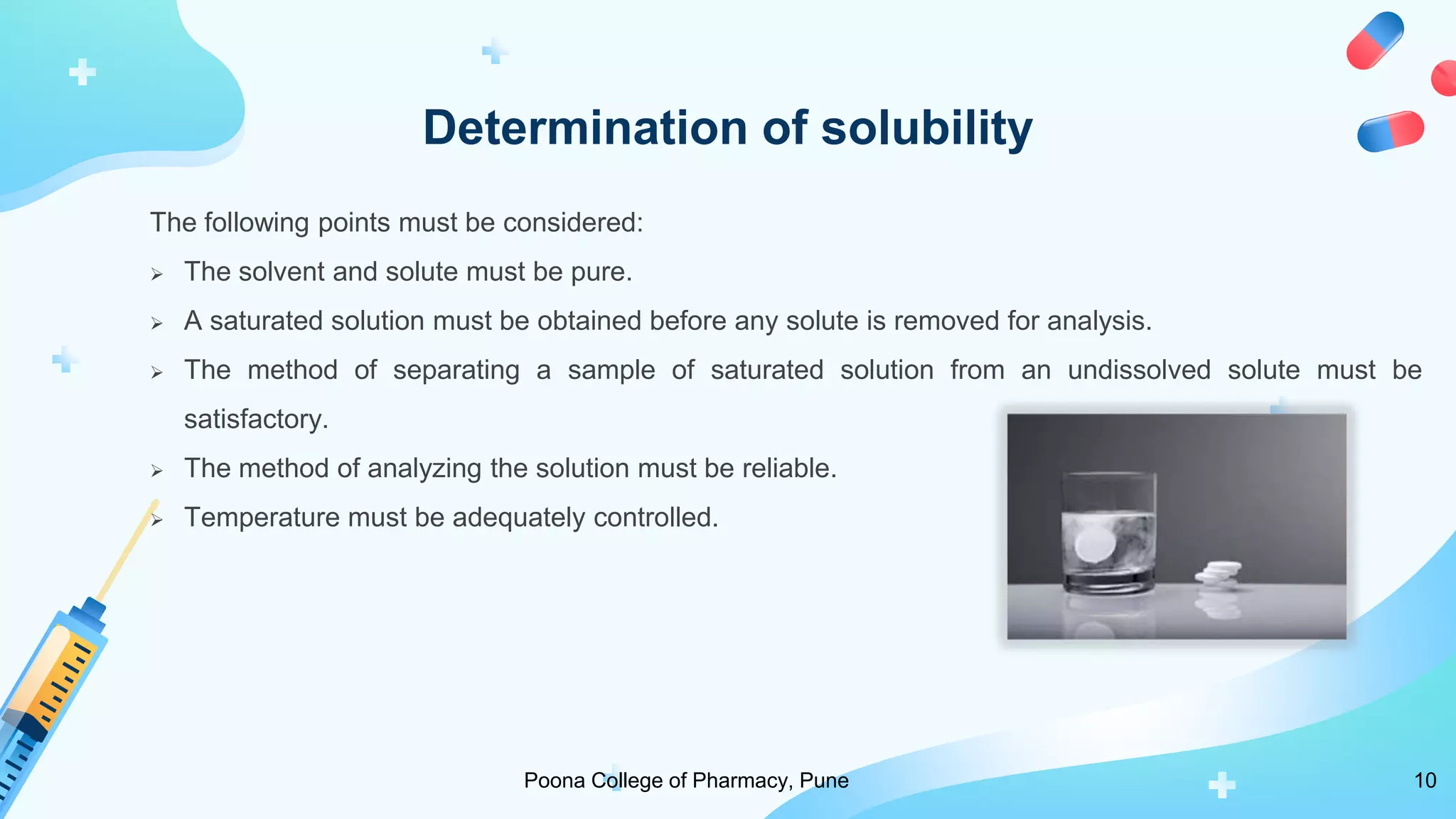
Determination of solubility
The following points must be considered:
 The solvent and solute must be pure.
 A saturated solution must be obtained before any solute is removed for analysis.
 The method of separating a sample of saturated solution from an undissolved solute must be
satisfactory.
 The method of analyzing the solution must be reliable.
 Temperature must be adequately controlled.
Poona College of Pharmacy, Pune 10
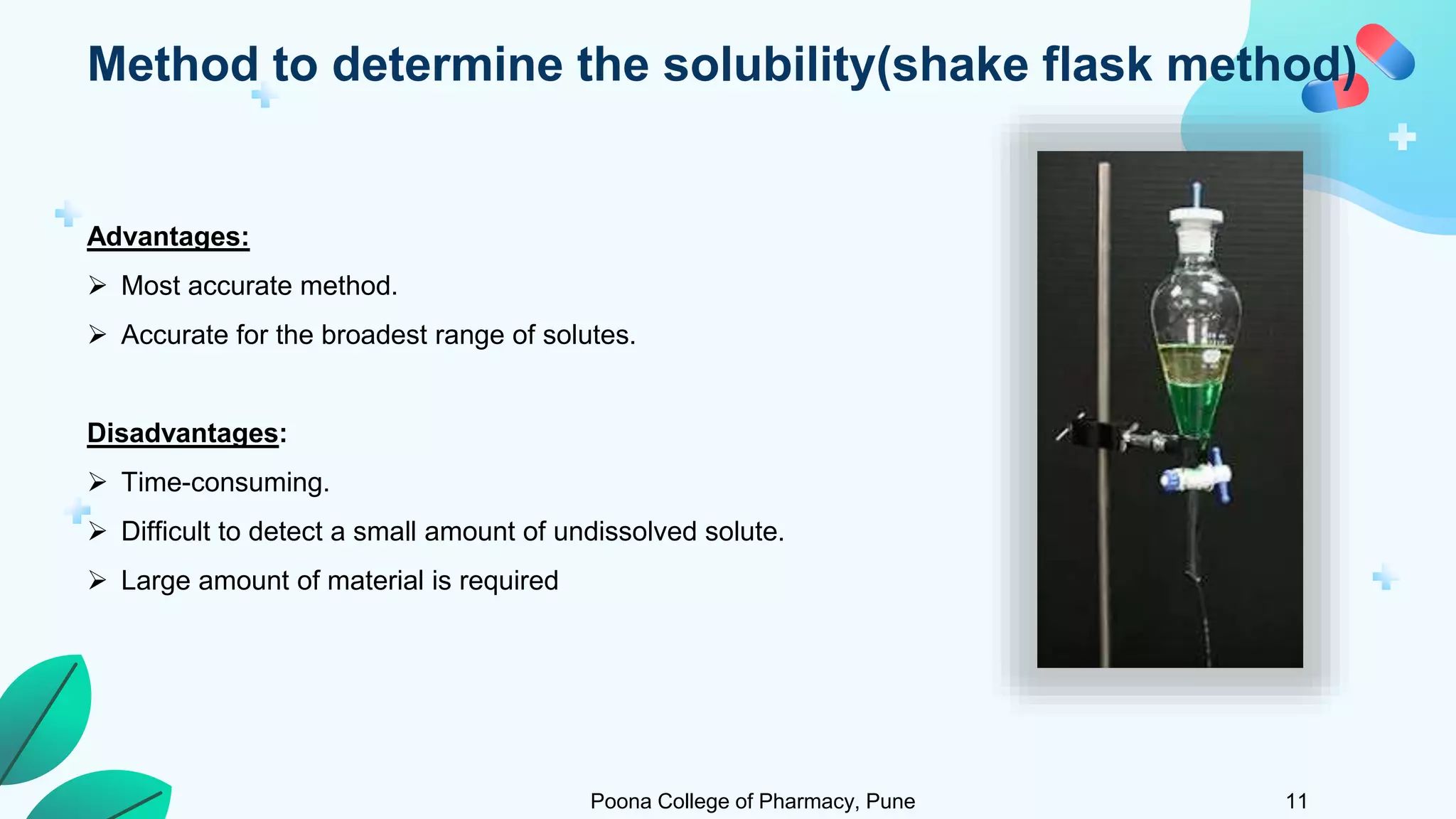
Method to determine the solubility(shake flask method)
Advantages:
 Most accurate method.
 Accurate for the broadest range of solutes.
Disadvantages:
 Time-consuming.
 Difficult to detect a small amount of undissolved solute.
 Large amount of material is required
Poona College of Pharmacy, Pune 11
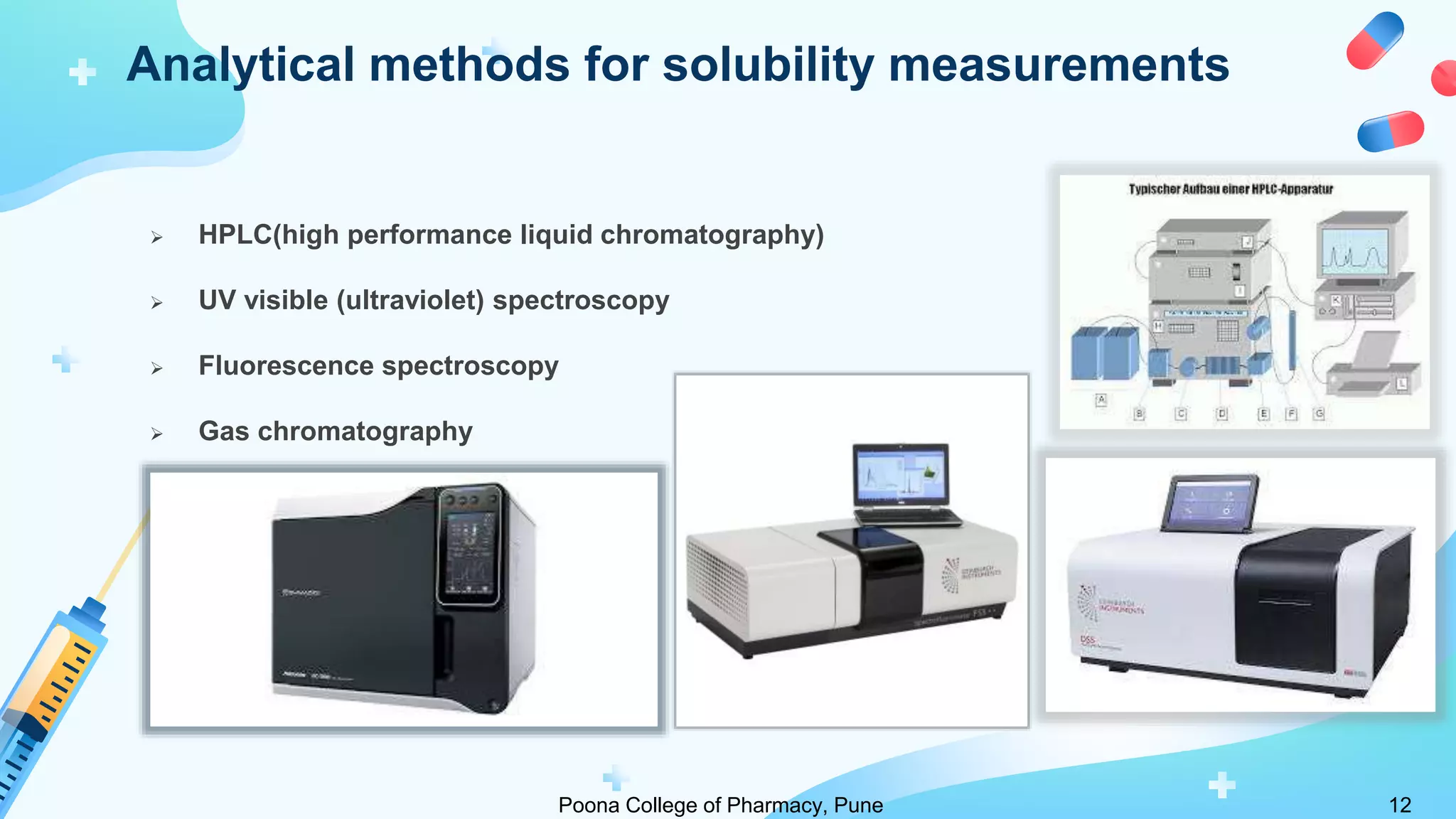
Analytical methods for solubility measurements
 HPLC(high performance liquid chromatography)
 UV visible (ultraviolet) spectroscopy
 Fluorescence spectroscopy
 Gas chromatography
Poona College of Pharmacy, Pune 12
Advantages of analytical methods
 Direct analysis of aqueous samples
 High sensitivity
 Specific determination of drug concentration due to chromatographic separation of
drug from impurities or degradation products
Poona college of pharmacy, Pune 13
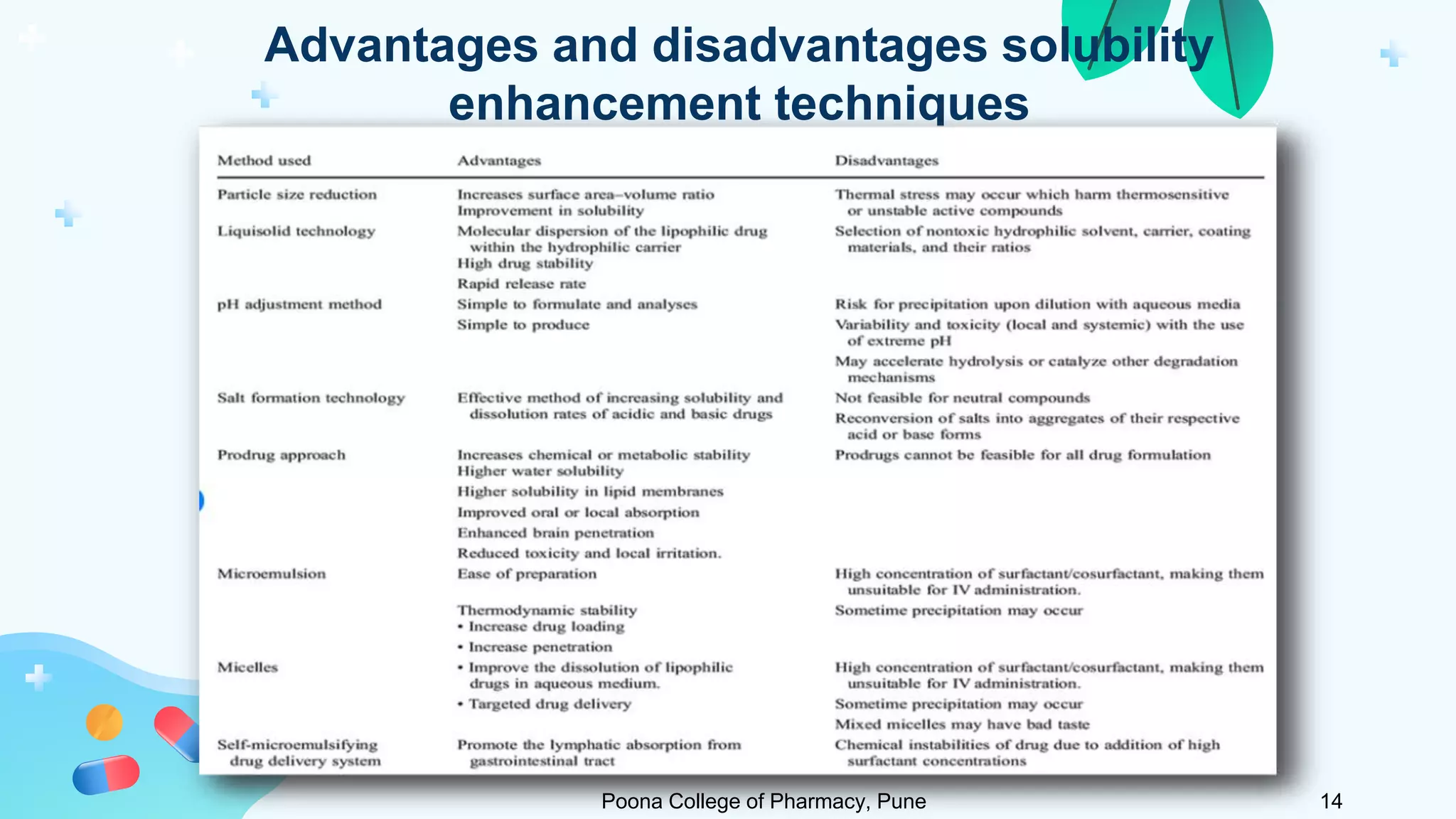
Advantages and disadvantages solubility
enhancement techniques
Poona College of Pharmacy, Pune 14
Reference
Poona College of Pharmacy, Pune 15
 Lachman and Liebermann's “ The Theory and Practice of Industrial Pharmacy” Fourth Edition page
number – 528 to 548.
 Remington, “The Science and Practice of Pharmacy” Volume-I, chapter 2, page number 83 to 98
 Drug Solubility: Importance and Enhancement Techniques Ketan T. Savjani, Anuradha K. Gajjar, and
Jignasa K. Savjani, International journal of pharmaceutics, Volume 19, Article ID 195727,
SOLUBILITY STUDIES

SOLUBILITY STUDIES

  • 1.
    DEPARTMENT OF PHARMACEUTICS PresentedBY Nagabhushan Shet M. Pharm 1st Year ( I semester) SOLUBILITY STUDIES BHARATI VIDYAPEETH (DEEMED UNIVERSITY) POONA COLLEGE OF PHARMACY, PUNE Poona College Of Pharmacy, Pune
  • 2.
    What is solubility? The solubility of a substance refers to the amount of substance that passes into the solution to achieve a saturated solution at constant temperature and pressure.  The bioavailability of an orally administered drug depends primarily on its solubility in GIT and its permeability across the cell membrane and this forms the basis for BCS. Poona College of Pharmacy, Pune 1
  • 3.
     One wayof measuring solubility is to determine the maximum mass of solute that can be dissolved in 100 ml of solvent at a particular temperature.  Solubility should ideally be measured at two temperatures: 4 and 37° C.  4° c to ensure physical stability.  37°c to support biopharmaceutical evaluation.  If solubility is <1mg/ml indicates poor absorption and variable solubility, and there is need to improve solubility through pre-formulation studies. Poona College of Pharmacy, Pune 2
  • 4.
     During recentyears, the main aim of pharmaceutical R and D is to improve the solubility of lower soluble drugs.  Clearly a trend towards higher percentages falling into BCS class ll (high permeability, low solubility) and lV (low permeability, low solubility )is observed.  Solubilities of a drug represent the bioavailability of the drug. REASONS FOR DETERMINING SOLUBILITY Poona College of Pharmacy,Pune 3
  • 5.
    TYPES OF SOLUBILITY Quantitative Solubility  Qualitative Solubility Descriptive term Parts of solvent required for 1 part of solute Very soluble Less than 1 Freely soluble From 1 to 10 Soluble From 10 to 30 Sparingly soluble From 30 to 100 Slightly soluble From 100 to 1000 Very slightly soluble From 1000 to 10000 Practically insoluble or insoluble 10000 and over solubility-based classification of drugs as per the United State Pharmacopeia. Poona College Pharmacy, Pune 4
  • 6.
    Solubility studies include 1.Intrinsic solubility 2. Ph solubility profiling 3. Solubility in pharmaceutical solvents 4. Effects of surfactants  Intrinsic solubility: It is the equilibrium solubility of the free acid or free base form of an ionizable compound at a pH where it is fully unionized.  pH-solubility profiling: change in pH alters the solubility of acidic/basic compounds. pH solubility profile of a drug can be established by running the equilibrium solubility experiment within pH range of 3-4. Poona College of pharmacy, Pune 5
  • 7.
     Solubility inpharmaceutical solvents: To enhance the solubility of pharmaceutical products, add co- solvents examples: ethanol, methanol, etc...  Effect of surfactants: Surfactants are wetting agents that lower the surface tension of a liquid, allowing easier spreading, and lowering the interfacial tension between two liquids. Surfactants are of two types:  Ionic Surfactants:  Cationic: e.g., Cetyl Trimethyl Ammonium Bromide, Hexadecyl Trimethyl Ammonium Bromide, and other Alkyl trimeth Ammonium Salts, Cetylpyridinium Chloride  Anionic: e.g., Sodium Dodecyl Sulphate, Ammonium Lauryl Sulphate and other alkyl sulfate salts, Sodium Lauryl Sulphate, also known as Sodium Lauryl Ether Sulphate (SLES).  Zwitterionic: e.g.Phospholipids, phosphatidylethanolamine  non-ionic surfactants:  Water soluble: e.g., long chain fatty acids, fatty alcohols  Water insoluble:e.g., spans. Poona College of pharmacy, Pune 6
  • 8.
    PREFORMULATION SOLUBILITY STUDIES 1.Pka determination 2. Effect of temperature 3. Solubilization 4. Partition coefficient 5. Dissolution 1. Pka determination: Determination of the dissociation constant (pka) for a drug capable of ionization within a pH range of 1 to 10 is important, since solubility and absorption, can be altered by orders of magnitude with changing pH. Pka values can be determined by the following methods a. Potentiometric titration b. UV spectroscopy c. Solubility measurement d. HPLC techniques e. Capillary zone electrophoresis f. Foaming activity Poona College of Pharmacy, Pune 7
  • 9.
     It canbe calculated by the Henderson-Hasselbalch equation 2. Effect of temperature: The heat of solution ΔHs, represents the heat released or absorbed when a mole of solute is dissolved in a large quantity of solvent.  Exothermic reaction  Endothermic reaction 3. Solubilization: It is defined as the spontaneous passage of poorly water-soluble solute molecules into an aqueous solution of a surfactant in which a thermodynamically stable solution is formed It increases the solubility of a poorly water-soluble substance with surface-active agents. Solubilization of any material in any solvent depends on the proper selection of a solubilizing agent. Poona College of Pharmacy, Pune 8
  • 10.
    4. Partition coefficient:The partition coefficient, log P, is defined as the ratio of the unionized drug distributed between the organic and aqueous phases at equilibrium. The partition coefficient is an important indicator of permeability because the partitioning of a drug into lipophilic epithelial cells is a necessary step for passive diffusion. 5. Dissolution: Dissolution is the process in which a substance forms a solution. • Dissolution testing measures the extent and rate of solution formation from a dosage form, such as tablet, capsule, etc. • The dissolution of a drug is important for its bioavailability and therapeutic effectiveness. • Dissolution and drug release are terms used interchangeably. Poona College of Pharmacy, Pune 9
  • 11.
    Determination of solubility Thefollowing points must be considered:  The solvent and solute must be pure.  A saturated solution must be obtained before any solute is removed for analysis.  The method of separating a sample of saturated solution from an undissolved solute must be satisfactory.  The method of analyzing the solution must be reliable.  Temperature must be adequately controlled. Poona College of Pharmacy, Pune 10
  • 12.
    Method to determinethe solubility(shake flask method) Advantages:  Most accurate method.  Accurate for the broadest range of solutes. Disadvantages:  Time-consuming.  Difficult to detect a small amount of undissolved solute.  Large amount of material is required Poona College of Pharmacy, Pune 11
  • 13.
    Analytical methods forsolubility measurements  HPLC(high performance liquid chromatography)  UV visible (ultraviolet) spectroscopy  Fluorescence spectroscopy  Gas chromatography Poona College of Pharmacy, Pune 12
  • 14.
    Advantages of analyticalmethods  Direct analysis of aqueous samples  High sensitivity  Specific determination of drug concentration due to chromatographic separation of drug from impurities or degradation products Poona college of pharmacy, Pune 13
  • 15.
    Advantages and disadvantagessolubility enhancement techniques Poona College of Pharmacy, Pune 14
  • 16.
    Reference Poona College ofPharmacy, Pune 15  Lachman and Liebermann's “ The Theory and Practice of Industrial Pharmacy” Fourth Edition page number – 528 to 548.  Remington, “The Science and Practice of Pharmacy” Volume-I, chapter 2, page number 83 to 98  Drug Solubility: Importance and Enhancement Techniques Ketan T. Savjani, Anuradha K. Gajjar, and Jignasa K. Savjani, International journal of pharmaceutics, Volume 19, Article ID 195727,