Solubility Enhancement Techniques
Presented by
Dhanashree R. Kavhale
M. Pharm. (Pharmaceutical Chemistry) Sem- II
Department of Pharmaceutical Sciences
Rashtrasant Tukadoji Maharaj Nagpur University, Nagpur - 440033
Contents
1. Introduction
2. Solubility criteria
3. Need of Solubility
4. Factors affecting solubility
5. Enhancement techniques
6. Solubility enhancers
7. References
2
Introduction
 ‘Solubility’ is defined as maximum amount of solute that can be dissolved in a
given amount of solvent to form a homogenous system at specified
conditions.[1]
 In quantitative terms it is concentration of dissolved solute in a saturated
solution at a specific temperature.[5]
 In qualitative terms it means continuous interaction of two or more compound
to form one phase.
 The solubility of a drug is represented through various concentration
expressions such as parts, percentage, molarity, molality, mole fraction.[1]
3
USP and BP Solubility Criteria 4
Descriptive terms Parts of solvent required for the
one part of solute[3]
Very soluble Less than 1
Freely soluble From 1 to 10
Soluble From10 to 30
Sparingly soluble From 30 to 100
Slightly soluble From 100 to 1000
Very slightly soluble From 1000 to 10,000
Insoluble More than 10,000
Need of Solubility
 Therapeutic effectiveness of a drug depends up on the bioavailability
and ultimately upon the solubility of drug molecule.[4]
 It is important parameter to achieve desired concentration of drug in
systemic circulation for pharmacological response to be shown.
 Any drug to be absorbed must be soluble or present in the form of an
aqueous solution at the site of absorption.[4]
5
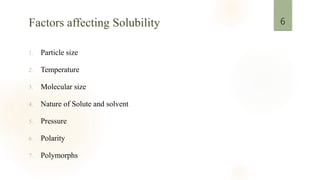
Factors affecting Solubility
1. Particle size
2. Temperature
3. Molecular size
4. Nature of Solute and solvent
5. Pressure
6. Polarity
7. Polymorphs
6
Enhancement Techniques
 When the solubility of substances in aqueous media is limited, here are
various techniques to improve the solubility of poorly soluble drug.[4]
7
Solubility
Enhancement
techniques
• Physical modification
• Chemical modification
• pH adjustment
• Supercritical fluid process
8
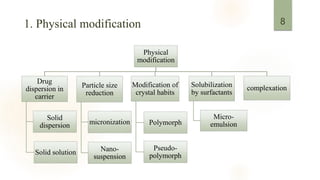
Physical
modification
Drug
dispersion in
carrier
Solid
dispersion
Solid solution
Particle size
reduction
micronization
Nano-
suspension
Modification of
crystal habits
Polymorph
Pseudo-
polymorph
Solubilization
by surfactants
Micro-
emulsion
complexation
1. Physical modification
Particle size reduction:
 Micronization:
Increase dissolution – increase S.A. e.g.: progesterone, fenofibrate.
 Nanosuspension:
Used to drugs that are insoluble in water & oils. Nanosuspension is biphasic system
which consists nano size particle in aqueous vehicle.[2]
Drug dispersion in carrier:
 Solid solution:
Blend of two crystals to form one new phase.
 Solid dispersion:
Hydrophobic drug + hydrophilic matrix. Thermal decomposition can be prevented.
9
Modification of crystal habits:
 Based on polymorphism as different polymorphs of drugs are chemically
identical, but they exhibit different physicochemical properties.[2]
 Order for dissolution of different solid forms of drug is:
Amorphous >Metastable polymorph >Stable polymorph
Solubility by surfactants:
 The addition of surfactants decreases the surface tension and increase the
solubility of the lipophilic drugs.[1]
Complexation:
 Drugs have been complexed with cyclodextrins to improve water solubility and
drug stability.[3]
10
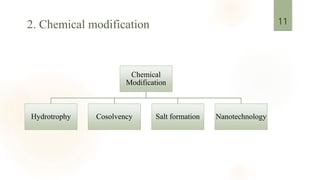
Chemical
Modification
Hydrotrophy Cosolvency Salt formation Nanotechnology
11
2. Chemical modification
3. pH adjustment
 To access the solubility by this approach, the buffer capacity and tolerability of
the selected pH are important to consider.[4]
 Excipients act as alkalizing agents may increase the solubility of weekly basic
drugs.[4]
 Supercritical fluids (SCFs) can dissolve nonvolatile solvents, with the critical
point of carbon dioxide.[5]
 It is safe, environmentally friendly, and economical.
 Low operating conditions are required.
12
4. Supercritical fluid process
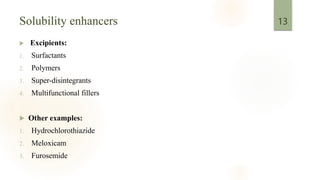
Solubility enhancers 13
 Excipients:
1. Surfactants
2. Polymers
3. Super-disintegrants
4. Multifunctional fillers
 Other examples:
1. Hydrochlorothiazide
2. Meloxicam
3. Furosemide
References
1. Vemula VR, Lagishetty V, Lingala S. Solubility Enhancement Techniques.
International Journal of Pharmaceutical Sciences Review and Research, 2010;
5(1): 41-51.
2. Yasir M, Asif M, Kumar A, Aggarval A. Biopharmaceutical Classification
System: An Account. International Journal of PharmTech Research, 2010;
2(3): 1681-1690.
3. Cook J, Addicks W, Wu YH. Application of the Biopharmaceutical
Classification System in Clinical Drug Development—An Industrial View.
The AAPS Journal, 2008; 10(2): 306-310
14
15
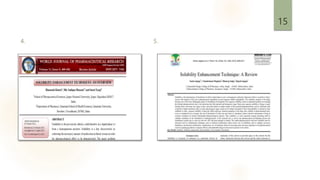
4. 5.
Thank you..
16

solubility EnhancementTechniques.pptx

  • 1.
    Solubility Enhancement Techniques Presentedby Dhanashree R. Kavhale M. Pharm. (Pharmaceutical Chemistry) Sem- II Department of Pharmaceutical Sciences Rashtrasant Tukadoji Maharaj Nagpur University, Nagpur - 440033
  • 2.
    Contents 1. Introduction 2. Solubilitycriteria 3. Need of Solubility 4. Factors affecting solubility 5. Enhancement techniques 6. Solubility enhancers 7. References 2
  • 3.
    Introduction  ‘Solubility’ isdefined as maximum amount of solute that can be dissolved in a given amount of solvent to form a homogenous system at specified conditions.[1]  In quantitative terms it is concentration of dissolved solute in a saturated solution at a specific temperature.[5]  In qualitative terms it means continuous interaction of two or more compound to form one phase.  The solubility of a drug is represented through various concentration expressions such as parts, percentage, molarity, molality, mole fraction.[1] 3
  • 4.
    USP and BPSolubility Criteria 4 Descriptive terms Parts of solvent required for the one part of solute[3] Very soluble Less than 1 Freely soluble From 1 to 10 Soluble From10 to 30 Sparingly soluble From 30 to 100 Slightly soluble From 100 to 1000 Very slightly soluble From 1000 to 10,000 Insoluble More than 10,000
  • 5.
    Need of Solubility Therapeutic effectiveness of a drug depends up on the bioavailability and ultimately upon the solubility of drug molecule.[4]  It is important parameter to achieve desired concentration of drug in systemic circulation for pharmacological response to be shown.  Any drug to be absorbed must be soluble or present in the form of an aqueous solution at the site of absorption.[4] 5
  • 6.
    Factors affecting Solubility 1.Particle size 2. Temperature 3. Molecular size 4. Nature of Solute and solvent 5. Pressure 6. Polarity 7. Polymorphs 6
  • 7.
    Enhancement Techniques  Whenthe solubility of substances in aqueous media is limited, here are various techniques to improve the solubility of poorly soluble drug.[4] 7 Solubility Enhancement techniques • Physical modification • Chemical modification • pH adjustment • Supercritical fluid process
  • 8.
    8 Physical modification Drug dispersion in carrier Solid dispersion Solid solution Particlesize reduction micronization Nano- suspension Modification of crystal habits Polymorph Pseudo- polymorph Solubilization by surfactants Micro- emulsion complexation 1. Physical modification
  • 9.
    Particle size reduction: Micronization: Increase dissolution – increase S.A. e.g.: progesterone, fenofibrate.  Nanosuspension: Used to drugs that are insoluble in water & oils. Nanosuspension is biphasic system which consists nano size particle in aqueous vehicle.[2] Drug dispersion in carrier:  Solid solution: Blend of two crystals to form one new phase.  Solid dispersion: Hydrophobic drug + hydrophilic matrix. Thermal decomposition can be prevented. 9
  • 10.
    Modification of crystalhabits:  Based on polymorphism as different polymorphs of drugs are chemically identical, but they exhibit different physicochemical properties.[2]  Order for dissolution of different solid forms of drug is: Amorphous >Metastable polymorph >Stable polymorph Solubility by surfactants:  The addition of surfactants decreases the surface tension and increase the solubility of the lipophilic drugs.[1] Complexation:  Drugs have been complexed with cyclodextrins to improve water solubility and drug stability.[3] 10
  • 11.
    Chemical Modification Hydrotrophy Cosolvency Saltformation Nanotechnology 11 2. Chemical modification
  • 12.
    3. pH adjustment To access the solubility by this approach, the buffer capacity and tolerability of the selected pH are important to consider.[4]  Excipients act as alkalizing agents may increase the solubility of weekly basic drugs.[4]  Supercritical fluids (SCFs) can dissolve nonvolatile solvents, with the critical point of carbon dioxide.[5]  It is safe, environmentally friendly, and economical.  Low operating conditions are required. 12 4. Supercritical fluid process
  • 13.
    Solubility enhancers 13 Excipients: 1. Surfactants 2. Polymers 3. Super-disintegrants 4. Multifunctional fillers  Other examples: 1. Hydrochlorothiazide 2. Meloxicam 3. Furosemide
  • 14.
    References 1. Vemula VR,Lagishetty V, Lingala S. Solubility Enhancement Techniques. International Journal of Pharmaceutical Sciences Review and Research, 2010; 5(1): 41-51. 2. Yasir M, Asif M, Kumar A, Aggarval A. Biopharmaceutical Classification System: An Account. International Journal of PharmTech Research, 2010; 2(3): 1681-1690. 3. Cook J, Addicks W, Wu YH. Application of the Biopharmaceutical Classification System in Clinical Drug Development—An Industrial View. The AAPS Journal, 2008; 10(2): 306-310 14
  • 15.
  • 16.