SOLUBILITY ENHANCEMENT
TECHNIQUES
PREPARED BY
ARPNA INDURKHYA
ASSOCIATE PROFESSOR,
SRI AUROBINDO INSTITUTE OF PHARMACY, INDORE
CONTENTS
INTRODUCTION
IMPORTANCE OF SOLUBILITY
NEED OF IMPROVING SOLUBILITY
TECHNIQUES OF SOLUBILITY ENHANCEMENT
APPLICATIONS
REGULATORY ASPECTS TO CONSIDER FOR SOLUBILITY-ENHANCEMENT
APPROACHES
CONCLUSION
REFERENCES
214-12-2020
INTRODUCTION
Solubility:
• The term ‘Solubility’ is defined as maximum amount of
solute that can be dissolved in a given amount of
solvent to form a homogenous system at specified
temperature.
• The solubility of a drug is represented through various
concentration expressions such as parts, percentage,
molarity, molality, volume fraction, mole fraction.
314-12-2020
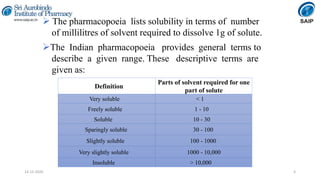
Definition
Parts of solvent required for one
part of solute
Very soluble < 1
Freely soluble 1 - 10
Soluble 10 - 30
Sparingly soluble 30 - 100
Slightly soluble 100 - 1000
Very slightly soluble 1000 - 10,000
Insoluble > 10,000
4
 The pharmacopoeia lists solubility in terms of number
of millilitres of solvent required to dissolve 1g of solute.
The Indian pharmacopoeia provides general terms to
describe a given range. These descriptive terms are
given as:
14-12-2020
IMPORTANCE OF SOLUBILITY
• Therapeutic effectiveness of a drug depends upon the
bioavailability and ultimately upon the solubility of
drug molecules.
• Solubility is one of the important parameter to achieve
desired concentration of drug in systemic circulation
for pharmacological response to be shown.
• Currently only 8% of new drug candidates have both
high solubility and permeability.
• Nearly 40% of the new chemical entities currently
being discovered are poorly water soluble.
514-12-2020
Contd..
6
• More than one-third of the drugs listed in the U.S. Pharmacopoeia fall into
the poorly water-soluble or water-insoluble categories.
• Low aqueous solubility is the major problem encountered with formulation
development of new chemical entities.
• Any drug to be absorbed must be present in the form of an aqueous
solution at the site of absorption. Water is the solvent of choice for liquid
pharmaceutical formulations.
• Most of drugs are weakly acidic and weakly basic with poor aqueous
solubility. Hence various techniques are used for the improvement of the
solubility of poorly water-soluble drugs.
14-12-2020
NEED FOR SOLUBILITY
ENHANCEMENT
• There are variety of new drugs & their derivatives are
available. But less than 40% of lipophilic drugs candidates
fail to reach market due to poor bioavailability, even though
these drugs might exhibit potential pharmacodynamic
activities.
• The lipophilic drug that reaches market requires a high dose to
attain proper pharmacological action.
• The basic aim of the further formulation & development is to
make that drug available at proper site of action within
optimum dose.
714-12-2020
Solubility of drug is largely due to,
 Polarity of the solvents, that is, to its dipole
moment.
A polar solvent dissolves ionic solutes and other
polar substances.
 The ability of solute to form hydrogen bond with
solvent.
 Also depends on the ratio of the polar to non polar
groups of the molecule.
814-12-2020
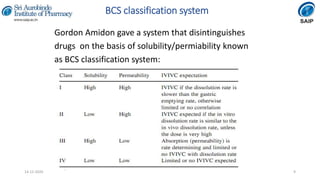
BCS classification system
Gordon Amidon gave a system that disintinguishes
drugs on the basis of solubility/permiability known
as BCS classification system:
914-12-2020
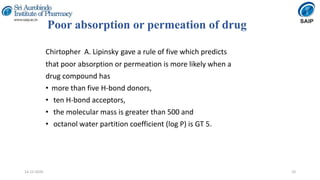
Poor absorption or permeation of drug
Chirtopher A. Lipinsky gave a rule of five which predicts
that poor absorption or permeation is more likely when a
drug compound has
• more than five H-bond donors,
• ten H-bond acceptors,
• the molecular mass is greater than 500 and
• octanol water partition coefficient (log P) is GT 5.
1014-12-2020
Process of Solubilization
11
Step 1: Holes opens in the solvent
Step2: Molecules of the solid breaks away from the bulk
Step 3:The freed solid molecule is intergrated into the hole in the solvent
14-12-2020
Techniques of Solubility
Enhancement
12
I. Physical Modifications
A. Particle size reduction
a. Micronization
b. Sonocrystalisation
c. Supercritical fluid process
B. Modification of the crystal habit
a. Polymorphs
b. Pseudopolymorphs
C. Drug dispersion in carriers
a. Eutectic mixtures
b. Solid dispersions
c. Solid solutions
14-12-2020
D. Complexation
a. Cyclodextrin inclusion complexes
E. Emulsion System
a. Solid state emulsion
b. Microemulsions
c. Self emulsifying drug delivery systems (SEDDS)
d. Self microemulsifying drug delivery systems
(SMEDDS)
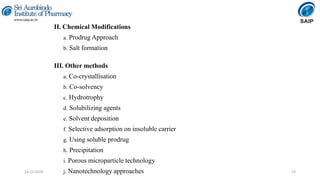
II. Chemical Modifications
a. Prodrug Approach
b. Salt formation
III. Other methods
a. Co-crystallisation
b. Co-solvency
c. Hydrotrophy
d. Solubilizing agents
e. Solvent deposition
f. Selective adsorption on insoluble carrier
g. Using soluble prodrug
h. Precipitation
i. Porous microparticle technology
j. Nanotechnology approaches 1314-12-2020
A. Particle size reduction:
• Particle size reduction can be achieved by
a. Micronization
b. Sonocrystallisation
c. Supercritical fluid process
a. Micronization:
• Micronization increases the dissolution rate of drugs through increased
surface area.
• Micronization of drugs is done by milling techniques using jet mill, rotor
stator colloid mills etc.
• Micronization is not suitable for drugs having a high dose number because
it does not change the saturation solubility of the drug.
• The process involves reducing the size of the solid drug particles to 1 to
10 microns commonly by spray drying or by use of attrition methods
(fluid energy or jet mill).The process is also called micro-milling.
1414-12-2020
Other techniques for reduction of the
particle size
1. Sonocrystallisation
2. Supercritical fluid process
1. Sonocrystallisation:
The novel approach for particle size reduction on the basis
of crystallisation by using ultrasound is Sonocrystallisation.
• Sonocrystallisation utilizes ultrasound power for inducing
crystallisation.
• It not only enhances the nucleation rate but also an effective
means of size reduction and controlling size distribution of
the active pharmaceutical ingredients.
• Most applications use ultrasound in the range 20 kHz-5
MHz
1514-12-2020
2. Supercritical fluid process:
• Novel nanosizing and solubilization technology whose
application has increased particle size reduction via
supercritical fluid (SCF) processes.
• A supercritical fluid (SF) can be defined as a dense
noncondensable fluid.
• Supercritical fluids are fluids whose temperature and pressure
are greater than its critical temperature (Tc) and critical
pressure (Tp).
• A SCF process allows micronisation of drug particles within
narrow range of particle size, often to sub-micron levels.
Current SCF processes have demonstrated the ability to create
nanoparticulate suspensions of particles 5 to 2,000 nm in
diameter .
1614-12-2020
Supercritical fluid region
1714-12-2020
B. Modification of the crystal habit:
• Broadly polymorphs can be classified as enantiotropes and monotropes
based on thermodynamic properties.
• In the case of an enantiotropic system, one polymorphs form can change
reversibly into another at a definite transition temperature below the
melting point, while no reversible transition is possible for monotropes.
• Metastable forms are associated with higher energy and thus higher
solubility.
• Similarly the amorphous form of drug is always more suited than
crystalline form due to higher energy associated and increase surface area.
• The anhydrous form of a drug has greater solubility than the hydrates. This
is because the hydrates are already in interaction with water and therefore
have less energy for crystal breakup in comparison to the anhydrates.
1814-12-2020
• Some drugs can exist in amorphous form (i.e. having no internal
crystal structure).
• Such drugs represent the highest energy state and can be considered
as super cooled liquids.
• They have greater aqueous solubility than the crystalline forms
because they require less energy to transfer a molecule into solvent.
Thus, the order for dissolution of different solid forms of drug is
• Melting followed by a rapid cooling or recrystallization from
different solvents can be produce metastable forms of a drug.
19
Amorphous >Metastable polymorph >Stable polymorph
14-12-2020
C. Drug dispersion in carriers:
• The term “solid dispersions” refers to the dispersion of one or more active
ingredients in an inert carrier in a solid state, frequently prepared by the
1.Hotmelt method.
2.Solvent evaporation method.
3.Hotmelt extrusion method.
1. Hot melt method:
Sekiguchi and Obi, used a hot melt method to prepare solid dispersion.
Sulphathiazole and urea were melted together and then cooled in an ice bath.
The resultant solid mass was then milled to reduce the particle size. Cooling
leads to supersaturation, but due to solidification the dispersed drug becomes
trapped within the carrier matrix.
2014-12-2020
2. Solvent Evaporation Method:
• An important prerequisite for the manufacture of a solid dispersion using the solvent
method is that both the drug and the carrier are sufficiently soluble in the solvent. The
solvent can be removed by various methods like by spray-drying or by freeze-drying.
• Temperatures used for solvent evaporation generally lie in the range 23-65 oC.
• These techniques have problems such as negative effects of the solvents on the
environment and high cost of production , hot melt extrusion method is preferred in
preparing solid solutions.
3. Hot-melt Extrusion:
• Melt extrusion was used as a manufacturing tool in the pharmaceutical industry as early as
1971.
• It has been reported that melt extrusion of miscible components results in amorphous solid
solution formation, whereas extrusion of an immiscible component leads to amorphous
drug dispersed in crystalline excipient.
• The process has been useful in the preparation of solid dispersions in a single step.
2114-12-2020
D. COMPLEXATION:
Cyclodextrin Inclusion Complexes
• Cyclodextrins (CD) are bucket shaped cyclicoligosaccharides composed of
6-8 dextrose units (α, β, γ CD ) respectively joined through C-C double
bonds.
• The interior of these molecules is lipophilic and exterior of these molecules
is hydrophobic. Lipophilic molecules can be incorporated into interior
cavity of CD leading to better stability, high water solubility, and increased
biovailability or decreased undesirable side effects.
• The presence of hydroxyl groups on the external surface of the CD
molecule increases the possibility of hydrogen bonding with the drug
molecules resulting in the formation of non-inclusion complexes as well.
2214-12-2020
• At present most widely used CD are 2-hydroxy propyl- β cyclodextrin,
methyl β cyclodextrin etc due to high water solubility and low toxicity. The
complex of praziquantel with β CD showed significantly improved
dissolution profile compared with that of pure drug whereas hydrophobic
CD can act as sustained release carriers for water soluble drugs.
• The inclusion complexes of aceclofenac with hydroxypropyl-β-cyclodextrin
provided increased dissolution rates as well as improved therapeutic effect.
2314-12-2020
E. Solubilization by surfactants:
• Surfactants are molecules with distinct polar and nonpolar regions. Most
surfactants consist of a hydrocarbon segment connected to a polar group.
The polar group can be anionic, cationic, zwitter ionic or nonionic.
• The presence of surfactants may lower the surface tension and increase the
solubility of the drug within an organic solvent
Microemulsion:
• A microemulsion is a four-component system composed of external phase,
internal phase, surfactant and co-surfactant.
• The addition of surfactant, which is predominately soluble in the internal
phase unlike the cosurfactant, results in the formation of an optically clear,
isotropic, thermodynamically stable emulsion. It is termed as
microemulsion because of the internal phase is <0.1 micron droplet
diameter.
2414-12-2020
• The formation of microemulsion is spontaneous and does not involve the
input of external energy as in case of coarse emulsions.
• The surfactant and the cosurfactant alternate each other and form a mixed
film at the interface, which contributes to the stability of the microemulsion.
• Non-ionic surfactants, such as Tweens (polysorbates) and Labrafil
(polyoxyethylated oleic glycerides), with high hyrophile-lipophile balances
are often used to ensure immediate formation of oil-in-water droplets during
production.
• Advantages of microemulsion over coarse emulsion ,It’s ease of preparation
due to spontaneous formation, thermodynamic stability, transparent and
elegant appearance, enhanced penetration through the biological
membranes, increased bioavailability and less inter- and intra-individual
variability in drug pharmacokinetics.
2514-12-2020
SMEDDS & SEDDS
• Self microemulsifying drug delivery systems (SMEDDS) are
defined as mixtures of natural or synthetic oils, solid or liquid
surfactants, or alternatively, one or more hydrophilic solvents and
co-solvents/surfactants.
• They have a unique ability of forming fine oil-in-water (o/w)
micro emulsions upon mild agitation followed by dilution in
aqueous media, such as gastrointestinal fluids (GI) fluids.
2614-12-2020
Contd…
• SMEDDS spread readily in the GI tract, and the digestive
motility of the stomach and the intestine provide the
agitation necessary for Self Emulsification.
• The basic difference between self emulsifying drug
delivery systems (SEDDS) also called as self emulsifying
oil formulation (SEOF) and SMEDDS is SEDDS
typically produce opaque emulsions with a droplet size
between 100 and 300nm while SMEDDS form
transparent microemulsions with a droplet size of less
than 50
2714-12-2020
B. CHEMICAL MODIFICATIONS
1. Prodrug approach:
Recent developments in prodrug design strategy are:
• Phosphate prodrugs :
The synthesis of phosphate esters is most commonly used approach
in enhancement of aqueous solubility of hydrophobic drugs as they
exhibit highersolubility than parent drug and are also ionizable.
• Polymer prodrugs:
Hydrophilic polymers have been explored in preparation of prodrugs
of poorly soluble drugs.
Polymer bound prodrugs are capable of tumour targeting by
enhanced permeability and retention effect.
Poorly soluble anticancer drugs can be formulated like this.
Hydroxylpropyl methacrylamide (HPMA) polymer has been
extensively investigated for polymer prodrugs.
2814-12-2020
2. Salt formation
• The solubility of ionizable drug can be enhanced exponentially
by alteration in the pH of the system. Ionizable drug should be
either weak acid or weak base.
• For example the solubility of slightly soluble acid is increased as
the pH is increased by addition of alkali, the reason being that a
salt is formed (e.g. Aspirin, Theophylline, Barbiturates).
• At a given pH, the solubility of a drug is constant.
2914-12-2020
III. Other methods
1.Co-crystallization:
• A co-crystal may be defined as a crystalline material that
consists of two or more molecular (and electrically neutral)
species held together by non-covalent forces.
• Co-crystals are more stable, particularly as the co-crystallizing
agents are solids at room temperature.
• Only three of the co-crystallizing agents are classified as
generally recognised as safe (GRAS) it includes saccharin,
nicotinamide and acetic acid limiting the pharmaceutical
applications.
• Co-crystals can be prepared by evaporation of a heteromeric
solution or by grinding the components together. Another
technique for the preparation of co-crystals includes
sublimation, growth from the melt, and slurry preparation. 3014-12-2020
2. Cosolvency:
• The solubilisation of drugs in co-solvents is an another technique for
improving the solubility of poorly soluble drug.
• It is well-known that the addition of an organic cosolvent to water can
dramatically change the solubility of drugs.
• Weak electrolytes and nonpolar molecules have poor water solubility and it
can be improved by altering polarity of the solvent.
• This can be achieved by addition of another solvent. This process is known
as cosolvency. Solvent used to increase solubility known as cosolvent.
• Cosolvent system works by reducing the interfacial tension between the
aqueous solution and hydrophobic solute. It is also commonly referred to as
solvent blending.
3114-12-2020
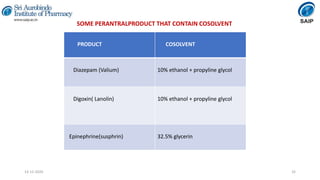
SOME PERANTRALPRODUCT THAT CONTAIN COSOLVENT
32
PRODUCT COSOLVENT
Diazepam (Valium) 10% ethanol + propyline glycol
Digoxin( Lanolin) 10% ethanol + propyline glycol
Epinephrine(susphrin) 32.5% glycerin
14-12-2020
3. Hydrotrophy:
• Hydrotrophy designate the increase in solubility in water due to the
presence of large amount of additives.
• The mechanism by which it improves solubility is more closely related to
complexation involving a weak interaction between the hydrotrophic agents
(sodium benzoate, sodium acetate, sodium alginate, and urea).
• New emerging concepts: Mixed hydrotropy, Mixed solvancy
4. Solubilizing agents:
• The solubility of poorly soluble drug can also be improved by various
solubilizing materials.
• PEG 400 is improving the solubility of hydrochlorthiazide85. Modified
gum karaya (MGK), a recently developed excipient was evaluated as
carrier for dissolution enhancement of poorly soluble drug, nimodipine.
3314-12-2020
5.Solvent deposition:
• In this method, the poorly aqueous soluble drug such as Nifedipine is
dissolved in an organic solvent like alcohol and deposited on an inert
hydrophilic solid matrix such as starch or microcrystalline cellulose and
evaporation of solvent is done.
6.Selective adsorption on insoluble carriers:
• A highly active adsorbent such as inorganic clays like Bentonite can
enhance the dissolution rate of poorly water-soluble drugs such as
griseofulvin, indomethacin and prednisone by maintaining the
concentration gradient at its maximum.
• Two reasons suggested for rapid release of drugs from the surface of clays
:-
1. weak physical bonding between adsorbate and adsorbent.
2. hydration and swelling of the clay in the aqueous media.
3414-12-2020
7. Vesicular approaches:
• Recently lipid vesicles were found to be of very much use in membrane biology.
These vesicles were first reported by Bingham in 1965 and thereby also called
Bingham bodies.
• The vesicular approach basically takes into consideration the concept of micellar
solubilzation.
• Poorly soluble compounds which fit into the micelle structure are most
appropriate.
• These micelles soak up the lipophilic substance in their lipophilic region and
subsequently no dissolution of poorly soluble compound needed before absorption
as the drug is already in solubilized form.
• They are easy to formulate and reproducible on large scale.
• Various possible systems based on vesicular approach are
a. Liposomes b. Niosomes c. Pharmacosomes
3514-12-2020
8. Nanotechnology approaches:
For many new chemical enteties of very low solubility ,oral bioavailability
enhancement by micronization is not sufficeint because micronized product
has a tendency of agglomeration, which leads to decreased effective
surface area for dissolution .
• Nanotechnology refers broadly to the study and use of materials and
structures at the nanoscale level of approximately 100 nanometers (nm) or
less.
a. Nanocrystal: Size: 1-1000 nm
• Nanocrystals are particles composed of 100% active pharmaceutical
ingredient (API) devoid of any carrier and form ultrafine dispersion in
media.
• The term ‘nanocrystals’ is a misnomer, as these particles can subsist not
only in crystalline state but also in the amorphous state.
3614-12-2020
b. Solid Liquid Nanoparticles:
• Solid lipid nanoparticles (SLNs) are particulate systems with mean particle
diameters ranging from 50-1000nm.
• They are derived in oil in water emulsions by replacing liquid lipid by solid
lipid.
• The formulation components of SLNs include solid lipid, emulsifier and
water. They are used for controlled release, targeting of drugs, modification
of dissolution rate and enhancement in bioavailability as they possess
adhesive properties by which they get adhere to gut wall and release the
drug at the site of absorption.
• There are number of potential advantages associated with SLNs as lipid
matrix of system is made from physiologically tolerated lipids components
which reduces the risk of toxicity, they can be produced on large industrial
scale by high pressure homogenization, they have the ability of being stable
for atleast 3 years
3714-12-2020
c. Nanosuspension:
• Nanosuspensions have emerged as promising strategy for efficient delivery
of poorly water soluble drugs because of their versatile features and unique
advantages often referred as hydrosols, are very finely dispersed solid
particles in aqueous vehicle.
• The particle size distribution of the solid particles in nanosuspensions is
usually less than one micron with an average particle size ranging between
200 and 600 nm.
• Nanosuspension improved the overall bioavailability by increased in surface
area and saturation solubility aided by particle size reduction.
• They are prepared by Precipitation, High pressure homogenization and Pearl
milling
• Nanosuspension approach has been employed on drugs like paclitaxel,
tarazepide, amphotericin B which are still on research stage.
3814-12-2020
d. NanoMorph:
• The NanoMorph technology is to convert drug substances with low water-
solubility from a coarse crystalline state into amorphous nanoparticles.
• A suspension of drug substance in solvent is fed into a chamber, where it is
rapidly mixed with another solvent.
• Immediately the drug substance suspension is converted into a true
molecular solution. The admixture of an aqueous solution of a polymer
induces precipitation of the drug substance
• The polymer keeps the drug substance particles in their nanoparticulate state
and prevents them from aggregation or growth. Using this technology the
coarse crystalline drug substances are transformed into a nanodispersed
amorphous state, without any physical milling or grinding procedures. It
leads to the preparation of amorphous nanoparticles.
3914-12-2020
Other novel Nanotechnology approaches:
• Nanoedge technology
• Nanopure technology
• Nanocochelate technology
4014-12-2020
APPLICATION OF SOLUBILITY
• Solubility is of fundamental importance in a large number of scientific
disciplines and practical applications, to the use of medicines, and the transport
of pollutants.
• Solubility is represents a fundamental concept in fields of research such as
chemistry, physics, food science, pharmaceutical, and biological sciences.
• The solubility of a substance becomes specially important in the
pharmaceutical field because it often represents a major factor that controls the
bioavailability of a drug substance.
• Solubility is commonly used to describe the substance, to indicate a substance's
polarity, to help to distinguish it from other substances, and as a guide to
applications of the substance.
• Solubility of a substance is useful when separating mixtures.
• Moreover, solubility and solubility-related properties can also provide
important information regarding the structure of drug substances, and in their
range of possible intermolecular interactions.
4114-12-2020
Conclusion
42
A drug administered in solution form immediately available for absorption.
Solubility is a most important parameter for the oral bioavailability of
poorly soluble drugs.
Dissolution of drug is the rate determining step for oral absorption of the
poorly water soluble drugs, which can subsequently affect the in vivo
absorption of drug.
Currently only 8% of new drug candidates have both high solubility and
permeability.
Because of solubility problem of many drugs the bioavailability of them
gets affected and hence solubility enhancement becomes necessary.
 It is now possible that to increase the solubility of poorly soluble drugs
with the help of various techniques.
14-12-2020
References
43
1. Leon Lachman; Herberta.Lieberman; Joseph L.Kanig The Theory and Practice of Industrial
Pharmacy . Third Indian Edition, 1990, Varghese publishing house, Bombay, pp 4587-466.
2. Swarbrick James, Encyclopedia of Pharmaceutical Technology, Third Edition, Vol. 1, 2007,
Informa Healthcare USA, Inc. pp 3311-3331.
3. Patrick J. Sinko, Martin’ .Physical Pharmacy and Pharmaceutical Sciences , Fifth edition,2006,
Wolters Kluwer,Pvt. Ltd., New Delhi, pp 232-233.
4. Indian Pharmacopoeia, . Goverment of India ministry of health and family Welfare, 4th ed., The
Controller of Publication, Delhi, 143.
5. Rong Liu, Water-Insoluble Drug Formulation, Second Edition , 2008, CRC press Tylor Francis
Group, London, Newyork, PP 1, 227.
. Aultons E. Michael, Aultons’s Pharmaceutics; The Design and Manufacturing of Medicines, Third
Edition, Chrchill Livingstone Elsevier Ltd., Philadelphia, USA, 2007, pp 337-342.
7. Ritika. Harikumar S. L, Aggarwal Geeta, Formulation tactics for the delivery of poorly soluble
drugs, International Journal of Pharm Tech research, 2012,4 (3) , pp 914-923.
8. Savini T Ketan, Gajjar K. Anuradha and Saviani K. Jignasa Drug Solubility: Importance and
Enhancement Techniques
9. Lobenberg, R, Amidon, GL. Modern bioavailability, bioequivalence and biopharmaceutical
classification system. New Scientific Approaches to International Regulatory Standards, European
Journal of Pharmaceutics & Biopharmaceutics, 2000, 50, pp3-20
14-12-2020
14-12-2020 44

Solubility enhancement techniques

  • 1.
    SOLUBILITY ENHANCEMENT TECHNIQUES PREPARED BY ARPNAINDURKHYA ASSOCIATE PROFESSOR, SRI AUROBINDO INSTITUTE OF PHARMACY, INDORE
  • 2.
    CONTENTS INTRODUCTION IMPORTANCE OF SOLUBILITY NEEDOF IMPROVING SOLUBILITY TECHNIQUES OF SOLUBILITY ENHANCEMENT APPLICATIONS REGULATORY ASPECTS TO CONSIDER FOR SOLUBILITY-ENHANCEMENT APPROACHES CONCLUSION REFERENCES 214-12-2020
  • 3.
    INTRODUCTION Solubility: • The term‘Solubility’ is defined as maximum amount of solute that can be dissolved in a given amount of solvent to form a homogenous system at specified temperature. • The solubility of a drug is represented through various concentration expressions such as parts, percentage, molarity, molality, volume fraction, mole fraction. 314-12-2020
  • 4.
    Definition Parts of solventrequired for one part of solute Very soluble < 1 Freely soluble 1 - 10 Soluble 10 - 30 Sparingly soluble 30 - 100 Slightly soluble 100 - 1000 Very slightly soluble 1000 - 10,000 Insoluble > 10,000 4  The pharmacopoeia lists solubility in terms of number of millilitres of solvent required to dissolve 1g of solute. The Indian pharmacopoeia provides general terms to describe a given range. These descriptive terms are given as: 14-12-2020
  • 5.
    IMPORTANCE OF SOLUBILITY •Therapeutic effectiveness of a drug depends upon the bioavailability and ultimately upon the solubility of drug molecules. • Solubility is one of the important parameter to achieve desired concentration of drug in systemic circulation for pharmacological response to be shown. • Currently only 8% of new drug candidates have both high solubility and permeability. • Nearly 40% of the new chemical entities currently being discovered are poorly water soluble. 514-12-2020
  • 6.
    Contd.. 6 • More thanone-third of the drugs listed in the U.S. Pharmacopoeia fall into the poorly water-soluble or water-insoluble categories. • Low aqueous solubility is the major problem encountered with formulation development of new chemical entities. • Any drug to be absorbed must be present in the form of an aqueous solution at the site of absorption. Water is the solvent of choice for liquid pharmaceutical formulations. • Most of drugs are weakly acidic and weakly basic with poor aqueous solubility. Hence various techniques are used for the improvement of the solubility of poorly water-soluble drugs. 14-12-2020
  • 7.
    NEED FOR SOLUBILITY ENHANCEMENT •There are variety of new drugs & their derivatives are available. But less than 40% of lipophilic drugs candidates fail to reach market due to poor bioavailability, even though these drugs might exhibit potential pharmacodynamic activities. • The lipophilic drug that reaches market requires a high dose to attain proper pharmacological action. • The basic aim of the further formulation & development is to make that drug available at proper site of action within optimum dose. 714-12-2020
  • 8.
    Solubility of drugis largely due to,  Polarity of the solvents, that is, to its dipole moment. A polar solvent dissolves ionic solutes and other polar substances.  The ability of solute to form hydrogen bond with solvent.  Also depends on the ratio of the polar to non polar groups of the molecule. 814-12-2020
  • 9.
    BCS classification system GordonAmidon gave a system that disintinguishes drugs on the basis of solubility/permiability known as BCS classification system: 914-12-2020
  • 10.
    Poor absorption orpermeation of drug Chirtopher A. Lipinsky gave a rule of five which predicts that poor absorption or permeation is more likely when a drug compound has • more than five H-bond donors, • ten H-bond acceptors, • the molecular mass is greater than 500 and • octanol water partition coefficient (log P) is GT 5. 1014-12-2020
  • 11.
    Process of Solubilization 11 Step1: Holes opens in the solvent Step2: Molecules of the solid breaks away from the bulk Step 3:The freed solid molecule is intergrated into the hole in the solvent 14-12-2020
  • 12.
    Techniques of Solubility Enhancement 12 I.Physical Modifications A. Particle size reduction a. Micronization b. Sonocrystalisation c. Supercritical fluid process B. Modification of the crystal habit a. Polymorphs b. Pseudopolymorphs C. Drug dispersion in carriers a. Eutectic mixtures b. Solid dispersions c. Solid solutions 14-12-2020 D. Complexation a. Cyclodextrin inclusion complexes E. Emulsion System a. Solid state emulsion b. Microemulsions c. Self emulsifying drug delivery systems (SEDDS) d. Self microemulsifying drug delivery systems (SMEDDS)
  • 13.
    II. Chemical Modifications a.Prodrug Approach b. Salt formation III. Other methods a. Co-crystallisation b. Co-solvency c. Hydrotrophy d. Solubilizing agents e. Solvent deposition f. Selective adsorption on insoluble carrier g. Using soluble prodrug h. Precipitation i. Porous microparticle technology j. Nanotechnology approaches 1314-12-2020
  • 14.
    A. Particle sizereduction: • Particle size reduction can be achieved by a. Micronization b. Sonocrystallisation c. Supercritical fluid process a. Micronization: • Micronization increases the dissolution rate of drugs through increased surface area. • Micronization of drugs is done by milling techniques using jet mill, rotor stator colloid mills etc. • Micronization is not suitable for drugs having a high dose number because it does not change the saturation solubility of the drug. • The process involves reducing the size of the solid drug particles to 1 to 10 microns commonly by spray drying or by use of attrition methods (fluid energy or jet mill).The process is also called micro-milling. 1414-12-2020
  • 15.
    Other techniques forreduction of the particle size 1. Sonocrystallisation 2. Supercritical fluid process 1. Sonocrystallisation: The novel approach for particle size reduction on the basis of crystallisation by using ultrasound is Sonocrystallisation. • Sonocrystallisation utilizes ultrasound power for inducing crystallisation. • It not only enhances the nucleation rate but also an effective means of size reduction and controlling size distribution of the active pharmaceutical ingredients. • Most applications use ultrasound in the range 20 kHz-5 MHz 1514-12-2020
  • 16.
    2. Supercritical fluidprocess: • Novel nanosizing and solubilization technology whose application has increased particle size reduction via supercritical fluid (SCF) processes. • A supercritical fluid (SF) can be defined as a dense noncondensable fluid. • Supercritical fluids are fluids whose temperature and pressure are greater than its critical temperature (Tc) and critical pressure (Tp). • A SCF process allows micronisation of drug particles within narrow range of particle size, often to sub-micron levels. Current SCF processes have demonstrated the ability to create nanoparticulate suspensions of particles 5 to 2,000 nm in diameter . 1614-12-2020
  • 17.
  • 18.
    B. Modification ofthe crystal habit: • Broadly polymorphs can be classified as enantiotropes and monotropes based on thermodynamic properties. • In the case of an enantiotropic system, one polymorphs form can change reversibly into another at a definite transition temperature below the melting point, while no reversible transition is possible for monotropes. • Metastable forms are associated with higher energy and thus higher solubility. • Similarly the amorphous form of drug is always more suited than crystalline form due to higher energy associated and increase surface area. • The anhydrous form of a drug has greater solubility than the hydrates. This is because the hydrates are already in interaction with water and therefore have less energy for crystal breakup in comparison to the anhydrates. 1814-12-2020
  • 19.
    • Some drugscan exist in amorphous form (i.e. having no internal crystal structure). • Such drugs represent the highest energy state and can be considered as super cooled liquids. • They have greater aqueous solubility than the crystalline forms because they require less energy to transfer a molecule into solvent. Thus, the order for dissolution of different solid forms of drug is • Melting followed by a rapid cooling or recrystallization from different solvents can be produce metastable forms of a drug. 19 Amorphous >Metastable polymorph >Stable polymorph 14-12-2020
  • 20.
    C. Drug dispersionin carriers: • The term “solid dispersions” refers to the dispersion of one or more active ingredients in an inert carrier in a solid state, frequently prepared by the 1.Hotmelt method. 2.Solvent evaporation method. 3.Hotmelt extrusion method. 1. Hot melt method: Sekiguchi and Obi, used a hot melt method to prepare solid dispersion. Sulphathiazole and urea were melted together and then cooled in an ice bath. The resultant solid mass was then milled to reduce the particle size. Cooling leads to supersaturation, but due to solidification the dispersed drug becomes trapped within the carrier matrix. 2014-12-2020
  • 21.
    2. Solvent EvaporationMethod: • An important prerequisite for the manufacture of a solid dispersion using the solvent method is that both the drug and the carrier are sufficiently soluble in the solvent. The solvent can be removed by various methods like by spray-drying or by freeze-drying. • Temperatures used for solvent evaporation generally lie in the range 23-65 oC. • These techniques have problems such as negative effects of the solvents on the environment and high cost of production , hot melt extrusion method is preferred in preparing solid solutions. 3. Hot-melt Extrusion: • Melt extrusion was used as a manufacturing tool in the pharmaceutical industry as early as 1971. • It has been reported that melt extrusion of miscible components results in amorphous solid solution formation, whereas extrusion of an immiscible component leads to amorphous drug dispersed in crystalline excipient. • The process has been useful in the preparation of solid dispersions in a single step. 2114-12-2020
  • 22.
    D. COMPLEXATION: Cyclodextrin InclusionComplexes • Cyclodextrins (CD) are bucket shaped cyclicoligosaccharides composed of 6-8 dextrose units (α, β, γ CD ) respectively joined through C-C double bonds. • The interior of these molecules is lipophilic and exterior of these molecules is hydrophobic. Lipophilic molecules can be incorporated into interior cavity of CD leading to better stability, high water solubility, and increased biovailability or decreased undesirable side effects. • The presence of hydroxyl groups on the external surface of the CD molecule increases the possibility of hydrogen bonding with the drug molecules resulting in the formation of non-inclusion complexes as well. 2214-12-2020
  • 23.
    • At presentmost widely used CD are 2-hydroxy propyl- β cyclodextrin, methyl β cyclodextrin etc due to high water solubility and low toxicity. The complex of praziquantel with β CD showed significantly improved dissolution profile compared with that of pure drug whereas hydrophobic CD can act as sustained release carriers for water soluble drugs. • The inclusion complexes of aceclofenac with hydroxypropyl-β-cyclodextrin provided increased dissolution rates as well as improved therapeutic effect. 2314-12-2020
  • 24.
    E. Solubilization bysurfactants: • Surfactants are molecules with distinct polar and nonpolar regions. Most surfactants consist of a hydrocarbon segment connected to a polar group. The polar group can be anionic, cationic, zwitter ionic or nonionic. • The presence of surfactants may lower the surface tension and increase the solubility of the drug within an organic solvent Microemulsion: • A microemulsion is a four-component system composed of external phase, internal phase, surfactant and co-surfactant. • The addition of surfactant, which is predominately soluble in the internal phase unlike the cosurfactant, results in the formation of an optically clear, isotropic, thermodynamically stable emulsion. It is termed as microemulsion because of the internal phase is <0.1 micron droplet diameter. 2414-12-2020
  • 25.
    • The formationof microemulsion is spontaneous and does not involve the input of external energy as in case of coarse emulsions. • The surfactant and the cosurfactant alternate each other and form a mixed film at the interface, which contributes to the stability of the microemulsion. • Non-ionic surfactants, such as Tweens (polysorbates) and Labrafil (polyoxyethylated oleic glycerides), with high hyrophile-lipophile balances are often used to ensure immediate formation of oil-in-water droplets during production. • Advantages of microemulsion over coarse emulsion ,It’s ease of preparation due to spontaneous formation, thermodynamic stability, transparent and elegant appearance, enhanced penetration through the biological membranes, increased bioavailability and less inter- and intra-individual variability in drug pharmacokinetics. 2514-12-2020
  • 26.
    SMEDDS & SEDDS •Self microemulsifying drug delivery systems (SMEDDS) are defined as mixtures of natural or synthetic oils, solid or liquid surfactants, or alternatively, one or more hydrophilic solvents and co-solvents/surfactants. • They have a unique ability of forming fine oil-in-water (o/w) micro emulsions upon mild agitation followed by dilution in aqueous media, such as gastrointestinal fluids (GI) fluids. 2614-12-2020
  • 27.
    Contd… • SMEDDS spreadreadily in the GI tract, and the digestive motility of the stomach and the intestine provide the agitation necessary for Self Emulsification. • The basic difference between self emulsifying drug delivery systems (SEDDS) also called as self emulsifying oil formulation (SEOF) and SMEDDS is SEDDS typically produce opaque emulsions with a droplet size between 100 and 300nm while SMEDDS form transparent microemulsions with a droplet size of less than 50 2714-12-2020
  • 28.
    B. CHEMICAL MODIFICATIONS 1.Prodrug approach: Recent developments in prodrug design strategy are: • Phosphate prodrugs : The synthesis of phosphate esters is most commonly used approach in enhancement of aqueous solubility of hydrophobic drugs as they exhibit highersolubility than parent drug and are also ionizable. • Polymer prodrugs: Hydrophilic polymers have been explored in preparation of prodrugs of poorly soluble drugs. Polymer bound prodrugs are capable of tumour targeting by enhanced permeability and retention effect. Poorly soluble anticancer drugs can be formulated like this. Hydroxylpropyl methacrylamide (HPMA) polymer has been extensively investigated for polymer prodrugs. 2814-12-2020
  • 29.
    2. Salt formation •The solubility of ionizable drug can be enhanced exponentially by alteration in the pH of the system. Ionizable drug should be either weak acid or weak base. • For example the solubility of slightly soluble acid is increased as the pH is increased by addition of alkali, the reason being that a salt is formed (e.g. Aspirin, Theophylline, Barbiturates). • At a given pH, the solubility of a drug is constant. 2914-12-2020
  • 30.
    III. Other methods 1.Co-crystallization: •A co-crystal may be defined as a crystalline material that consists of two or more molecular (and electrically neutral) species held together by non-covalent forces. • Co-crystals are more stable, particularly as the co-crystallizing agents are solids at room temperature. • Only three of the co-crystallizing agents are classified as generally recognised as safe (GRAS) it includes saccharin, nicotinamide and acetic acid limiting the pharmaceutical applications. • Co-crystals can be prepared by evaporation of a heteromeric solution or by grinding the components together. Another technique for the preparation of co-crystals includes sublimation, growth from the melt, and slurry preparation. 3014-12-2020
  • 31.
    2. Cosolvency: • Thesolubilisation of drugs in co-solvents is an another technique for improving the solubility of poorly soluble drug. • It is well-known that the addition of an organic cosolvent to water can dramatically change the solubility of drugs. • Weak electrolytes and nonpolar molecules have poor water solubility and it can be improved by altering polarity of the solvent. • This can be achieved by addition of another solvent. This process is known as cosolvency. Solvent used to increase solubility known as cosolvent. • Cosolvent system works by reducing the interfacial tension between the aqueous solution and hydrophobic solute. It is also commonly referred to as solvent blending. 3114-12-2020
  • 32.
    SOME PERANTRALPRODUCT THATCONTAIN COSOLVENT 32 PRODUCT COSOLVENT Diazepam (Valium) 10% ethanol + propyline glycol Digoxin( Lanolin) 10% ethanol + propyline glycol Epinephrine(susphrin) 32.5% glycerin 14-12-2020
  • 33.
    3. Hydrotrophy: • Hydrotrophydesignate the increase in solubility in water due to the presence of large amount of additives. • The mechanism by which it improves solubility is more closely related to complexation involving a weak interaction between the hydrotrophic agents (sodium benzoate, sodium acetate, sodium alginate, and urea). • New emerging concepts: Mixed hydrotropy, Mixed solvancy 4. Solubilizing agents: • The solubility of poorly soluble drug can also be improved by various solubilizing materials. • PEG 400 is improving the solubility of hydrochlorthiazide85. Modified gum karaya (MGK), a recently developed excipient was evaluated as carrier for dissolution enhancement of poorly soluble drug, nimodipine. 3314-12-2020
  • 34.
    5.Solvent deposition: • Inthis method, the poorly aqueous soluble drug such as Nifedipine is dissolved in an organic solvent like alcohol and deposited on an inert hydrophilic solid matrix such as starch or microcrystalline cellulose and evaporation of solvent is done. 6.Selective adsorption on insoluble carriers: • A highly active adsorbent such as inorganic clays like Bentonite can enhance the dissolution rate of poorly water-soluble drugs such as griseofulvin, indomethacin and prednisone by maintaining the concentration gradient at its maximum. • Two reasons suggested for rapid release of drugs from the surface of clays :- 1. weak physical bonding between adsorbate and adsorbent. 2. hydration and swelling of the clay in the aqueous media. 3414-12-2020
  • 35.
    7. Vesicular approaches: •Recently lipid vesicles were found to be of very much use in membrane biology. These vesicles were first reported by Bingham in 1965 and thereby also called Bingham bodies. • The vesicular approach basically takes into consideration the concept of micellar solubilzation. • Poorly soluble compounds which fit into the micelle structure are most appropriate. • These micelles soak up the lipophilic substance in their lipophilic region and subsequently no dissolution of poorly soluble compound needed before absorption as the drug is already in solubilized form. • They are easy to formulate and reproducible on large scale. • Various possible systems based on vesicular approach are a. Liposomes b. Niosomes c. Pharmacosomes 3514-12-2020
  • 36.
    8. Nanotechnology approaches: Formany new chemical enteties of very low solubility ,oral bioavailability enhancement by micronization is not sufficeint because micronized product has a tendency of agglomeration, which leads to decreased effective surface area for dissolution . • Nanotechnology refers broadly to the study and use of materials and structures at the nanoscale level of approximately 100 nanometers (nm) or less. a. Nanocrystal: Size: 1-1000 nm • Nanocrystals are particles composed of 100% active pharmaceutical ingredient (API) devoid of any carrier and form ultrafine dispersion in media. • The term ‘nanocrystals’ is a misnomer, as these particles can subsist not only in crystalline state but also in the amorphous state. 3614-12-2020
  • 37.
    b. Solid LiquidNanoparticles: • Solid lipid nanoparticles (SLNs) are particulate systems with mean particle diameters ranging from 50-1000nm. • They are derived in oil in water emulsions by replacing liquid lipid by solid lipid. • The formulation components of SLNs include solid lipid, emulsifier and water. They are used for controlled release, targeting of drugs, modification of dissolution rate and enhancement in bioavailability as they possess adhesive properties by which they get adhere to gut wall and release the drug at the site of absorption. • There are number of potential advantages associated with SLNs as lipid matrix of system is made from physiologically tolerated lipids components which reduces the risk of toxicity, they can be produced on large industrial scale by high pressure homogenization, they have the ability of being stable for atleast 3 years 3714-12-2020
  • 38.
    c. Nanosuspension: • Nanosuspensionshave emerged as promising strategy for efficient delivery of poorly water soluble drugs because of their versatile features and unique advantages often referred as hydrosols, are very finely dispersed solid particles in aqueous vehicle. • The particle size distribution of the solid particles in nanosuspensions is usually less than one micron with an average particle size ranging between 200 and 600 nm. • Nanosuspension improved the overall bioavailability by increased in surface area and saturation solubility aided by particle size reduction. • They are prepared by Precipitation, High pressure homogenization and Pearl milling • Nanosuspension approach has been employed on drugs like paclitaxel, tarazepide, amphotericin B which are still on research stage. 3814-12-2020
  • 39.
    d. NanoMorph: • TheNanoMorph technology is to convert drug substances with low water- solubility from a coarse crystalline state into amorphous nanoparticles. • A suspension of drug substance in solvent is fed into a chamber, where it is rapidly mixed with another solvent. • Immediately the drug substance suspension is converted into a true molecular solution. The admixture of an aqueous solution of a polymer induces precipitation of the drug substance • The polymer keeps the drug substance particles in their nanoparticulate state and prevents them from aggregation or growth. Using this technology the coarse crystalline drug substances are transformed into a nanodispersed amorphous state, without any physical milling or grinding procedures. It leads to the preparation of amorphous nanoparticles. 3914-12-2020
  • 40.
    Other novel Nanotechnologyapproaches: • Nanoedge technology • Nanopure technology • Nanocochelate technology 4014-12-2020
  • 41.
    APPLICATION OF SOLUBILITY •Solubility is of fundamental importance in a large number of scientific disciplines and practical applications, to the use of medicines, and the transport of pollutants. • Solubility is represents a fundamental concept in fields of research such as chemistry, physics, food science, pharmaceutical, and biological sciences. • The solubility of a substance becomes specially important in the pharmaceutical field because it often represents a major factor that controls the bioavailability of a drug substance. • Solubility is commonly used to describe the substance, to indicate a substance's polarity, to help to distinguish it from other substances, and as a guide to applications of the substance. • Solubility of a substance is useful when separating mixtures. • Moreover, solubility and solubility-related properties can also provide important information regarding the structure of drug substances, and in their range of possible intermolecular interactions. 4114-12-2020
  • 42.
    Conclusion 42 A drug administeredin solution form immediately available for absorption. Solubility is a most important parameter for the oral bioavailability of poorly soluble drugs. Dissolution of drug is the rate determining step for oral absorption of the poorly water soluble drugs, which can subsequently affect the in vivo absorption of drug. Currently only 8% of new drug candidates have both high solubility and permeability. Because of solubility problem of many drugs the bioavailability of them gets affected and hence solubility enhancement becomes necessary.  It is now possible that to increase the solubility of poorly soluble drugs with the help of various techniques. 14-12-2020
  • 43.
    References 43 1. Leon Lachman;Herberta.Lieberman; Joseph L.Kanig The Theory and Practice of Industrial Pharmacy . Third Indian Edition, 1990, Varghese publishing house, Bombay, pp 4587-466. 2. Swarbrick James, Encyclopedia of Pharmaceutical Technology, Third Edition, Vol. 1, 2007, Informa Healthcare USA, Inc. pp 3311-3331. 3. Patrick J. Sinko, Martin’ .Physical Pharmacy and Pharmaceutical Sciences , Fifth edition,2006, Wolters Kluwer,Pvt. Ltd., New Delhi, pp 232-233. 4. Indian Pharmacopoeia, . Goverment of India ministry of health and family Welfare, 4th ed., The Controller of Publication, Delhi, 143. 5. Rong Liu, Water-Insoluble Drug Formulation, Second Edition , 2008, CRC press Tylor Francis Group, London, Newyork, PP 1, 227. . Aultons E. Michael, Aultons’s Pharmaceutics; The Design and Manufacturing of Medicines, Third Edition, Chrchill Livingstone Elsevier Ltd., Philadelphia, USA, 2007, pp 337-342. 7. Ritika. Harikumar S. L, Aggarwal Geeta, Formulation tactics for the delivery of poorly soluble drugs, International Journal of Pharm Tech research, 2012,4 (3) , pp 914-923. 8. Savini T Ketan, Gajjar K. Anuradha and Saviani K. Jignasa Drug Solubility: Importance and Enhancement Techniques 9. Lobenberg, R, Amidon, GL. Modern bioavailability, bioequivalence and biopharmaceutical classification system. New Scientific Approaches to International Regulatory Standards, European Journal of Pharmaceutics & Biopharmaceutics, 2000, 50, pp3-20 14-12-2020
  • 44.