BRIEF PRESENTATION
of
SHORT TERMTRAINING
at
ONIOSOME HEALTHCARE PVT.LTD.
MOHALI
PRESENTED BY :
DHRITIMAN BHARGAB
B.PHARMA
MUR1600162
ROLL NO. 160100960013
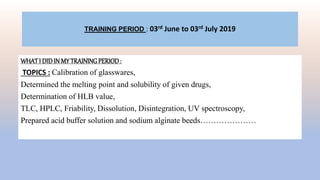
TRAINING PERIOD : 03rd June to 03rd July 2019
WHATI DIDIN MY TRAININGPERIOD:
TOPICS : Calibration of glasswares,
Determined the melting point and solubility of given drugs,
Determination of HLB value,
TLC, HPLC, Friability, Dissolution, Disintegration, UV spectroscopy,
Prepared acid buffer solution and sodium alginate beeds…………………
DETERMINATION
OF
HYDROPHILIC –LIPHOPHILIC
BALANCE VALUE
INTRODUCTION
In past fifty years, there has been a tremendous growth in the field of
surfactants. The term surfactants include emulsifiers, wetting agents,
suspending agents, detergents, anti-foam compounds and many others.
 Therefore, there classification is very important to choose suitable surfactant
to give maximum effect.
William Griffin, in the late 1940s, introduced the Hydrophilic-Lipophilic Balance
system (HLB) as a way of figuring out which emulsifier would work best with
the oil phase of an emulsified product
DEFINITION:
It is the relative efficiency of the hydrophilic portion of the surfactant
molecule to its lipophilic portion of the same molecule .
Emulsifiers / Surfactants are characterized according to the "balance"
between the hydrophilic ("water-loving") and lipophilic ("oil-loving")
portions of their molecules.
An emulsifier that is lipophilic in character is assigned a low HLB number
and an emulsifier that is hydrophilic in character is assigned a high number.
The midpoint is approximately ten and the assigned values have ranged from
one to forty.
The hydrophilic-lipophilic balance (HLB) number indicates the polarity of the
molecules in a range of 1-40, with the most commonly used emulsifiers
having a value between 1 and 20.
The HLB number increases with increasing hydrophilicity.
Lipophilic tails align with oil
Hydrophilic heads align with water
Lipophilic Tail & Hydrophilic Head
 The theory behind HLB is that emulsifier having low HLB
value tend to be oil soluble and materials having high values
tend to be water soluble.
 However, this doesn’t always be right, e.g., two emulsifiers
may have the same HLB and exhibit different solubility
characteristics.
 Further, one should take a point into consideration that
chemical type alone doesn’t establish hydrophilic-lipophilic
balance.
 Thus, soaps may range from strongly hydrophilic for sodium
laurate to strongly lipophilic for aluminium oleate; esters,
ether-esters, and ethers may range from low to high HLB’s,
sulphates and sulfonates may range from medium to high.
Determination of HLB
For most polyhydric alcohol fatty acid esters approximate values may
be calculated with the formula:
Where,
• S= saponification number of the ester
• A= acid number of the acid
Determination of HLB “Requirement”
The desired HLB numbers can also be achieved by mixing lipophilic and
hydrophilic surfactants.
 William Griffin devised HLB System to calculated amount of emulsifier
to get the desired HLB.
hlb scale :
Applications of Surfactants depending on HLB
The HLB system is very useful to distinguish the surfactants according
to their applications.
Generally, the applications for nonionic surfactants within the
following HLB ranges are as follows:HLB range Application
4-6 w/o emulsifiers
7-9 wetting agents
8-18 o/w emulsifiers
13-15 Detergents
10-18 Solubilizers
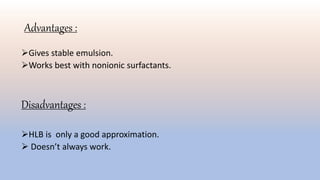
Advantages :
Gives stable emulsion.
Works best with nonionic surfactants.
Disadvantages :
HLB is only a good approximation.
 Doesn’t always work.
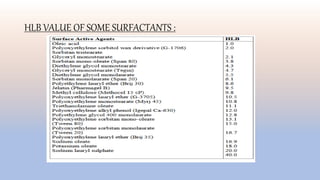
HLB VALUE OF SOME SURFACTANTS :
Let’s conclude by :
The HLB system, though it does not indicate the overall efficiency of
the surfactant, it does tell “what it will do” i.e. what kind of an
emulsion or product to expect.
By so doing, it enables us to compare various chemical types of
surfactants at their optimum balance.
The HLB system appears to be suitable for all types of problems
employing surface active agents.
HLB SCALE