DECOMPOSITION AND
STABILIZATION OF
PHARMACEUTICAL PRODUCTS
Prepared by:
K. ARSHAD AHMED KHAN
M.Pharm, (Ph.D)
Dept. of Pharmaceutics
RIPER.
CONTENTS:
•Introduction.
•Stability of Medicinally Active Agents.
•Reasons to study Drug Stability.
•Types of drug degradation.
1. Physical degradation.
2. Chemical degradation.
INTRODUCTION:
Drug decomposition or degradation
occurs during storage because of chemical
alterations (reactions) of the active
ingredients or additives.
The knowledge of chemical kinetics is
helpful to predict the rate of such reactions
and furthermore to evaluate the shelf-life.
STABILITY OF MEDICINALLY
ACTIVE AGENTS:
Definition:
The time lapse during which the drug
products retains the same properties &
characteristics that is possessed at the time
of manufacture.
It is obligatory to the manufacturer to
indicate the shelf-life of the drug on the
label.
Reasons to study drug instability:
1. Chemical degradation leads to lowering of
drug conc.
2. Formation of toxic metabolites on
degradation.
3. Instability owing to change in physical
appearance of the dosage form.
TYPES OF DRUG DEGRADATION:
Physical Degradation Chemical
Decomposition
Loss of volatile constituents Hydrolysis
Loss of water Oxidation
Absorption of water
Crystal growth
Polymorphism
Color changes
I. Physical Degradation Of Pharmaceutical Product:
1. Loss of volatile ingredients:
Medicinal agents like Camphor, Iodine, Menthol,
Ethanol or Chloroform have a tendency to evaporate
from the product during storage.
Prevention:
Keep the product
in well-closed
containers &
Store in a cool
place.
2. Loss of Water:
Loss of vehicle from the product leads to decrease in
weight, rise in conc. of drug and increase in potency,
leading to drug overdose. eg. Borax, Caffeine.
Similarly, loss of vehicle causes the emulsions to
crack.
3. Absorption of water:
Absorption of moisture from the atmosphere causes
increase in product weight, also dilutes the dose
therefore decrease in its potency.
Deliquescent substances like Calcium chloride,
Potassium carbonate absorb water. Gelatin capsules
will absorb moisture & become sticky.
Preventive
Measure:
Store the
product in a
well-closed
container.
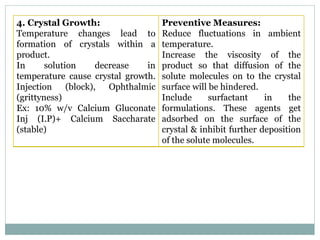
4. Crystal Growth:
Temperature changes lead to
formation of crystals within a
product.
In solution decrease in
temperature cause crystal growth.
Injection (block), Ophthalmic
(grittyness)
Ex: 10% w/v Calcium Gluconate
Inj (I.P)+ Calcium Saccharate
(stable)
Preventive Measures:
Reduce fluctuations in ambient
temperature.
Increase the viscosity of the
product so that diffusion of the
solute molecules on to the crystal
surface will be hindered.
Include surfactant in the
formulations. These agents get
adsorbed on the surface of the
crystal & inhibit further deposition
of the solute molecules.
5. Polymorphism:
Polymorphs exhibit significant
differences in important physico-
chemical properties like solubility,
dissolution rate & melting point.
In polymorphs metastable form is
selected during formulation.
Ex: Cortisone acetate suspension
Preventive Measures:
Add suspending agents to
increase viscosity & prevent
diffusion, conversion of
polymorphs
6. Colour Changes:
Indicates chemical or photochemical
decomposition of the active ingredient.
Generally dyes.
Ex: Indigo+Reducing subatances
Tartrazine+additives.
Preventive Measures:
Protect the product from light &
air. Avoid the use of reducing
agents as additives.
(eg: Dextrose)
Use UV- absorbing substances in
the formulation.
(2,4 dihydrobenzophenone)
II. Chemical Decomposition Of Drugs:
Presence of more than one functional groups
leads to chemical reactions causing stability
problems.
It is a combined effect of presence of different
ingredients as well as the environmental factors
like, moisture, heat, light, radiation.
Few important decomposition reactions include:
Hydrolysis, Oxidation & Miscellaneous reactions.
1. HYDROLYSIS:
Principles:
1. Drugs with ester & amide group react with one molecule
of water & undergo hydrolysis. (ester>amide )
Ex: Ester(Asprin+water------salicylic acid+acetic acid)
Amide (Salicylamide+water----- salicylic acid+ammonia)
2. Nature of drugs is either weak acid or bases, they are in
the form of ions or neutral molecules. So, ionic species get
hydrolysed at a faster rate than that of the neutral ones.
3. Hydrolysis is catalysed by H+ & (OH)- ions. (H+<(OH)- )
Prevention of Hydrolysis
Eliminating moisture & catalytic species (H+ and (OH)-)
1. Buffers:
Drug +buffer Optimum pH (3.5-5)  drug stable
Ex: Pilocarpine+alkaline pH  unionised form  high action.
2. Complexation:
Benzocaine+aq.solution  Hydrolysis (ion-dipole interaction )
Benzocaine+Caffine  COMPLEXATION  prevent ion-dipole interaction
3. Suppression of solubility:
Drug solubility decreases  drug insoluble  NO Hydrolysis
(a) Additives (citrates, dextrose).
(b) Poorly soluble Salts (Pencillin  Procaine pencillin).
(c) Derivatives (Erythromycin- Erythromycin Sterate,
Chloramphenicol- Chloramphenicol Palmitate)
4. Removal of water
(a) Storing drug in dry form. Ex: Streptomycin Injection (reconstituted)
(b) Using water immiscible vehicle. Ex: Asprin+silicone fluid.
2. OXIDATION:
It involves removal of electrons from a molecule.
Reaction between a compound & molecular oxygen is called
‘Autooxidation.’ ex: fats & oils
Principles governing oxidation of drugs:
1. Presence of atmospheric oxygen promotes rate of
oxidation. (Autooxidation)
2. Oxidation liberates free radicals & chain reactions
occur. Light provides the necessary energy to initiate the
oxidation process.
3. Presence of trace metals increases rate of oxidation.
Ex: Ascorbic acid + Cu+2  Dehydro Ascorbic acid.
4. Organic Peroxides initiate chain reactions.
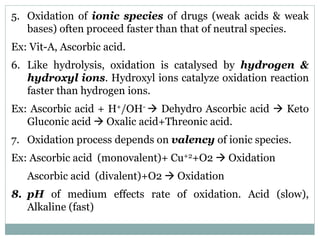
5. Oxidation of ionic species of drugs (weak acids & weak
bases) often proceed faster than that of neutral species.
Ex: Vit-A, Ascorbic acid.
6. Like hydrolysis, oxidation is catalysed by hydrogen &
hydroxyl ions. Hydroxyl ions catalyze oxidation reaction
faster than hydrogen ions.
Ex: Ascorbic acid + H+/OH-  Dehydro Ascorbic acid  Keto
Gluconic acid  Oxalic acid+Threonic acid.
7. Oxidation process depends on valency of ionic species.
Ex: Ascorbic acid (monovalent)+ Cu+2+O2  Oxidation
Ascorbic acid (divalent)+O2  Oxidation
8. pH of medium effects rate of oxidation. Acid (slow),
Alkaline (fast)
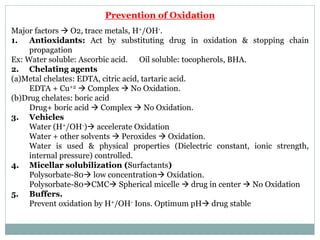
Prevention of Oxidation
Major factors  O2, trace metals, H+/OH-.
1. Antioxidants: Act by substituting drug in oxidation & stopping chain
propagation
Ex: Water soluble: Ascorbic acid. Oil soluble: tocopherols, BHA.
2. Chelating agents
(a)Metal chelates: EDTA, citric acid, tartaric acid.
EDTA + Cu+2  Complex  No Oxidation.
(b)Drug chelates: boric acid
Drug+ boric acid  Complex  No Oxidation.
3. Vehicles
Water (H+/OH-) accelerate Oxidation
Water + other solvents  Peroxides  Oxidation.
Water is used & physical properties (Dielectric constant, ionic strength,
internal pressure) controlled.
4. Micellar solubilization (Surfactants)
Polysorbate-80 low concentration Oxidation.
Polysorbate-80CMC Spherical micelle  drug in center  No Oxidation
5. Buffers.
Prevent oxidation by H+/OH- Ions. Optimum pH drug stable
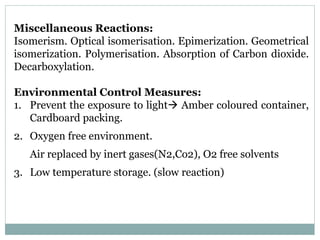
Miscellaneous Reactions:
Isomerism. Optical isomerisation. Epimerization. Geometrical
isomerization. Polymerisation. Absorption of Carbon dioxide.
Decarboxylation.
Environmental Control Measures:
1. Prevent the exposure to light Amber coloured container,
Cardboard packing.
2. Oxygen free environment.
Air replaced by inert gases(N2,Co2), O2 free solvents
3. Low temperature storage. (slow reaction)
References:
1. Drug Stability, Principles & Practices. III rd
Edition, Marcel Dekker by J.T. Carstensen & C.
T. Rhodes. Page no.113-133 & 415.
2. Textbook of Physical Pharmaceutics by C. V. S.
Subramanyam, Vallabh Prakashan. Page no.51-
67.
Thank you….