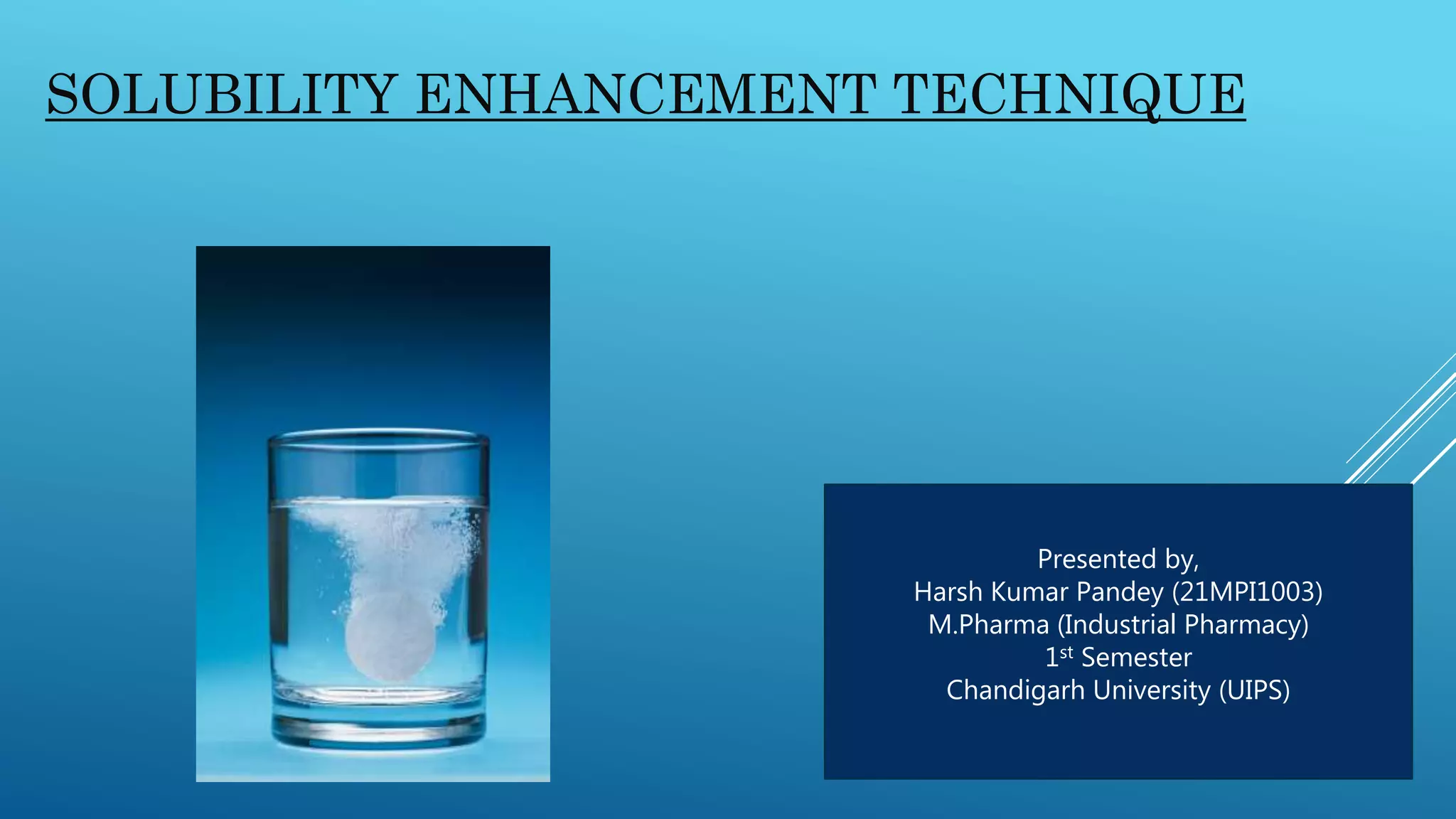

SOLUBILITY ENHANCEMENT TECHNIQUE
Presented by,
Harsh Kumar Pandey (21MPI1003)
M.Pharma (Industrial Pharmacy)
1st Semester
Chandigarh University (UIPS)
SOLUBILITY
Qualitative Terms: Solubility is defined as, “the spontaneous interactions of two or more substances
to form a homogenous molecular dispersion”.
Quantitative Terms: Solubility is defined as, “ the concentration of a solute in a saturated solution at
a constant temperature”.
What is Solubility Enhancement
Many drugs are not sufficiently soluble in water and aqueous. Drug solubility must be increased by
the inclusion of other solvents and chemicals, that process is called solubility enhancement and the
chemical or solvent which is used to increase solubility is called solubility enhancer. The nature of
solubility enhancer is depends on the drug molecule and the route of administration.
SOLUBILITY ENHANCEMENT
TECHNIQUES
Solubility enhancement techniques can be categorized in to three types which are:
1. PHYSICAL MODIFICATIONS
• Particle size reduction (micronization, Nanosuspension )
• Modification of the crystal habit ( Polymorphs )
• Drug dispersion in carriers (Eutectic mixtures, Solid dispersion)
2. CHEMICAL MODIFICATIONS
• Change of pH • Use of buffer • Derivatization • Complexation • Salt formation
3. OTHER METHODS • Supercritical fluid process • Sonocrystalization • Micro-emulsion
• Solubilizers • Co-solvency • Hydrotrophy
PHYSICAL MODIFICATION
PARTICAL SIZE REDUCTION The solubility of drug is often intrinsically related to drug particle size, as a
particle become smaller, the surface area to volume ratio increases. The larger surface area allows greater
interaction with the solvent which causes an increase in solubility. By reducing particle size, increased surface
area improves the dissolution properties.
Micronization
It is a conventional technique for the particle size reduction. It increases the dissolution rate of drugs through
increased surface area, by decreasing particle size. Micronization of drugs is done by milling techniques using
jet mill, rotor stator colloid mills.
Nanosuspension
This technology is applied to poorly soluble drugs that are insoluble in both water and oils. A pharmaceutical
nanosuspension is biphasic systems consisting of nano sized drug particles stabilized by surfactants for either
oral and topical use or parenteral and pulmonary administration. The particle size distribution of the solid
particles in nanosuspensions is usually less than one micron with an average particle size ranging between 200
and 600 nm.
MODIFICATION OF THE CRYSTAL HABIT
Polymorphs
Enantiotropic- One polymorphs form can change reversibly into another at a definite transition temperature
below the melting point.
Monotropic- No reversible transition is possible.
• Metastable forms are associated with higher energy and thus higher solubility. Similarly the amorphous
form of drug is always more suited than crystalline form due to higher energy associated and increased
surface area.
• The anhydrous form of a drug has greater solubility than the hydrates. This is because the hydrates are
already in interaction with water and therefore have less energy for crystal breakup in comparison to the
anhydrates.
• Amorphous form of drug have greater aqueous solubility than the crystalline forms because they require
less energy to transfer a molecule into solvent. Thus the order for dissolution of different solid forms of drug
is Amorphous > metastable polymorph > stable polymorph
• Melting followed by a rapid cooling or recrystallization from different solvents can produce metastable
forms of a drug.
DRUG DISPERSION IN CARRIERS
Solid Dispersion The term “solid dispersions” refers to the dispersion of one or more active
ingredients in an inert carrier in a solid state, prepared by
• Hot melt method
• Solvent evaporation method
• Hot melt extrusion method
Eutectic mixture A mixture of two or more components that, while not normally interacting to
create a new chemical substance, inhibit the crystallization phase of one another at certain ratios,
resulting in a system with a lower melting point than any of the components.
CHEMICAL MODIFICATIONS
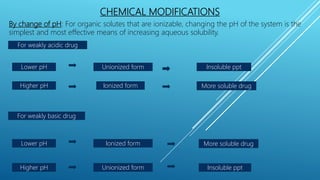
By change of pH: For organic solutes that are ionizable, changing the pH of the system is the
simplest and most effective means of increasing aqueous solubility.
For weakly acidic drug
Lower pH Unionized form Insoluble ppt
Higher pH Ionized form More soluble drug
For weakly acidic drug
For weakly basic drug
Lower pH Ionized form More soluble drug
Higher pH Unionized form Insoluble ppt
DERIVATIZATION
It is a technique used in chemistry which transforms a chemical compound into a product of similar
chemical structure, called derivative. Derivatives have different solubility as that of adduct. It is used
for quantification of adduct formation of esters and amides via acyl chloride.
SALT FORMATION
• Dissolution rate of particular salt is usually different from that of parent compound. Sodium and
potassium salt of weak acid dissolve more rapidly than that of pure salt.
• Limitation of salt formation includes epigastric distress due to high alkalinity, reactivity with
atmospheric water and carbon dioxide leads to precipitation.
COMPLEXATION It is the reversible association between two or more molecules to form a non
bonded entity with a well defined Stoichiometry. E.g. Chelates (EDTA), Molecular complexes
(polymer), etc.
OTHER METHODS
SONOCRYSTALIZATION
• Recrystallization of poorly soluble materials using liquid solvents and antisolvents has also been employed
successfully to reduce particle size.
• The novel approach for particle size reduction on the basis of crystallization by using ultrasound is
Sonocrystallization.
• Sonocrystallization utilizes ultrasound power characterized by a frequency range of 20–100 kHz for inducing
crystallization. It’s not only enhances the nucleation rate but also an effective means of size reduction and
controlling size distribution of the active pharmaceutical ingredients
HYDROTROPY
•It is a solubilization phenomenon whereby addition of large amount of a second solute results in an increase in
the aqueous solubility of existing solute.
• Concentrated aqueous hydrotropic solutions of sodium benzoate, sodium salicylate, urea, nicotinamide,
sodium citrate, and sodium acetate have been observed to enhance the aqueous solubilities of many poorly
water- soluble drugs
CO-SOLVENCY
• The solubility of poorly soluble drugs in water can be increased by mixing it with some water miscible
solvent in which the drug is readily soluble. This process is known as co-solvency and the solvent used in
combination are known as cosolvent.
• Cosolvent system works by reducing the interfacial tension between the aqueous solution and
hydrophobic solute. It is also commonly known as solvent blending.
• There is a dramatic change in the solubility of drugs by addition of organic co-solvent into the water.
The cosolvents are having hydrogen acceptor or donor groups with a small hydrocarbon region.
MICRO-EMULSION
• A micro emulsion is an optically clear pre-concentrate, isotropic, thermo dynamically stable transparent
(or translucent) system, containing a mixture of oil, hydrophilic surfactant and hydrophilic solvent which
dissolves a poorly water soluble drug.
• Upon contact with water, the formulations spontaneously disperse to form a very clear emulsion of
exceedingly small and uniform oil droplets containing the solubilized poorly soluble drug.
• Micro-emulsions have been employed to increase the solubility of many drugs that are practically
insoluble in water, along with incorporation of proteins for oral, parenteral, as well as
percutaneous/transdermal use
SOLUBILIZING AGENTS
It is also known as solubilizer, the solubility of poorly soluble drug can also be improved by various solubilizing
materials. PEG 400 is improving the solubility of hydrochlorthiazide85. Modified gum karaya (MGK), a recently
developed excipient was evaluated as carrier for dissolution enhancement of poorly soluble drug, nimodipine.
SUPERCRITICAL FLUID PROCESS
• A supercritical fluids are dense non-condensable fluid whose temperature and pressure are greater than its
critical temperature ( Tc ) and critical pressure ( Pc ) allowing it to assume the properties of both a liquid and a
gas.
• Through manipulation of the pressure of SCFs, the favorable characteristics of gases – high diffusivity, low
viscosity and low surface tension may be imparted upon the liquids to precisely control the solubilization of a
drug with a supercritical fluid.
• Once the drug particles are solubilized within SCFs, they may be recrystallized at greatly reduced particle
sizes.
• A SCF process allows micronisation of drug particles within narrow range of particle size, often to sub-micron
levels.
REFERENCE
•Jinal N. Patel1, Dharmendra M. Rathod1, Nirav A. Patel2 and Moin K. Modasiya, Int. J. of Pharm. & Life Sci.
(IJPLS), Vol. 3, Issue 2: Feb.: 2012, 1459-1469 ,Techniques to improve the solubility of poorly soluble drugs
• Ketan T. Savjani, Anuradha K. Gajjar, and Jignasa K. Savjani, International Scholarly Research Network, ISRN
Pharmaceutics Volume 2012, Article ID 195727, 10 pages doi:10.5402/2012/195727
• WWW.Wikipedia.com ( Solubility )
• WWW.Slideshare.com ( Methods to improve solubility )
solubility enhancement technique presentation.pptx

solubility enhancement technique presentation.pptx

  • 1.
    SOLUBILITY ENHANCEMENT TECHNIQUE Presentedby, Harsh Kumar Pandey (21MPI1003) M.Pharma (Industrial Pharmacy) 1st Semester Chandigarh University (UIPS)
  • 2.
    SOLUBILITY Qualitative Terms: Solubilityis defined as, “the spontaneous interactions of two or more substances to form a homogenous molecular dispersion”. Quantitative Terms: Solubility is defined as, “ the concentration of a solute in a saturated solution at a constant temperature”. What is Solubility Enhancement Many drugs are not sufficiently soluble in water and aqueous. Drug solubility must be increased by the inclusion of other solvents and chemicals, that process is called solubility enhancement and the chemical or solvent which is used to increase solubility is called solubility enhancer. The nature of solubility enhancer is depends on the drug molecule and the route of administration.
  • 3.
    SOLUBILITY ENHANCEMENT TECHNIQUES Solubility enhancementtechniques can be categorized in to three types which are: 1. PHYSICAL MODIFICATIONS • Particle size reduction (micronization, Nanosuspension ) • Modification of the crystal habit ( Polymorphs ) • Drug dispersion in carriers (Eutectic mixtures, Solid dispersion) 2. CHEMICAL MODIFICATIONS • Change of pH • Use of buffer • Derivatization • Complexation • Salt formation 3. OTHER METHODS • Supercritical fluid process • Sonocrystalization • Micro-emulsion • Solubilizers • Co-solvency • Hydrotrophy
  • 4.
    PHYSICAL MODIFICATION PARTICAL SIZEREDUCTION The solubility of drug is often intrinsically related to drug particle size, as a particle become smaller, the surface area to volume ratio increases. The larger surface area allows greater interaction with the solvent which causes an increase in solubility. By reducing particle size, increased surface area improves the dissolution properties. Micronization It is a conventional technique for the particle size reduction. It increases the dissolution rate of drugs through increased surface area, by decreasing particle size. Micronization of drugs is done by milling techniques using jet mill, rotor stator colloid mills. Nanosuspension This technology is applied to poorly soluble drugs that are insoluble in both water and oils. A pharmaceutical nanosuspension is biphasic systems consisting of nano sized drug particles stabilized by surfactants for either oral and topical use or parenteral and pulmonary administration. The particle size distribution of the solid particles in nanosuspensions is usually less than one micron with an average particle size ranging between 200 and 600 nm.
  • 5.
    MODIFICATION OF THECRYSTAL HABIT Polymorphs Enantiotropic- One polymorphs form can change reversibly into another at a definite transition temperature below the melting point. Monotropic- No reversible transition is possible. • Metastable forms are associated with higher energy and thus higher solubility. Similarly the amorphous form of drug is always more suited than crystalline form due to higher energy associated and increased surface area. • The anhydrous form of a drug has greater solubility than the hydrates. This is because the hydrates are already in interaction with water and therefore have less energy for crystal breakup in comparison to the anhydrates. • Amorphous form of drug have greater aqueous solubility than the crystalline forms because they require less energy to transfer a molecule into solvent. Thus the order for dissolution of different solid forms of drug is Amorphous > metastable polymorph > stable polymorph • Melting followed by a rapid cooling or recrystallization from different solvents can produce metastable forms of a drug.
  • 6.
    DRUG DISPERSION INCARRIERS Solid Dispersion The term “solid dispersions” refers to the dispersion of one or more active ingredients in an inert carrier in a solid state, prepared by • Hot melt method • Solvent evaporation method • Hot melt extrusion method Eutectic mixture A mixture of two or more components that, while not normally interacting to create a new chemical substance, inhibit the crystallization phase of one another at certain ratios, resulting in a system with a lower melting point than any of the components.
  • 7.
    CHEMICAL MODIFICATIONS By changeof pH: For organic solutes that are ionizable, changing the pH of the system is the simplest and most effective means of increasing aqueous solubility. For weakly acidic drug Lower pH Unionized form Insoluble ppt Higher pH Ionized form More soluble drug For weakly acidic drug For weakly basic drug Lower pH Ionized form More soluble drug Higher pH Unionized form Insoluble ppt
  • 8.
    DERIVATIZATION It is atechnique used in chemistry which transforms a chemical compound into a product of similar chemical structure, called derivative. Derivatives have different solubility as that of adduct. It is used for quantification of adduct formation of esters and amides via acyl chloride. SALT FORMATION • Dissolution rate of particular salt is usually different from that of parent compound. Sodium and potassium salt of weak acid dissolve more rapidly than that of pure salt. • Limitation of salt formation includes epigastric distress due to high alkalinity, reactivity with atmospheric water and carbon dioxide leads to precipitation. COMPLEXATION It is the reversible association between two or more molecules to form a non bonded entity with a well defined Stoichiometry. E.g. Chelates (EDTA), Molecular complexes (polymer), etc.
  • 9.
    OTHER METHODS SONOCRYSTALIZATION • Recrystallizationof poorly soluble materials using liquid solvents and antisolvents has also been employed successfully to reduce particle size. • The novel approach for particle size reduction on the basis of crystallization by using ultrasound is Sonocrystallization. • Sonocrystallization utilizes ultrasound power characterized by a frequency range of 20–100 kHz for inducing crystallization. It’s not only enhances the nucleation rate but also an effective means of size reduction and controlling size distribution of the active pharmaceutical ingredients HYDROTROPY •It is a solubilization phenomenon whereby addition of large amount of a second solute results in an increase in the aqueous solubility of existing solute. • Concentrated aqueous hydrotropic solutions of sodium benzoate, sodium salicylate, urea, nicotinamide, sodium citrate, and sodium acetate have been observed to enhance the aqueous solubilities of many poorly water- soluble drugs
  • 10.
    CO-SOLVENCY • The solubilityof poorly soluble drugs in water can be increased by mixing it with some water miscible solvent in which the drug is readily soluble. This process is known as co-solvency and the solvent used in combination are known as cosolvent. • Cosolvent system works by reducing the interfacial tension between the aqueous solution and hydrophobic solute. It is also commonly known as solvent blending. • There is a dramatic change in the solubility of drugs by addition of organic co-solvent into the water. The cosolvents are having hydrogen acceptor or donor groups with a small hydrocarbon region. MICRO-EMULSION • A micro emulsion is an optically clear pre-concentrate, isotropic, thermo dynamically stable transparent (or translucent) system, containing a mixture of oil, hydrophilic surfactant and hydrophilic solvent which dissolves a poorly water soluble drug. • Upon contact with water, the formulations spontaneously disperse to form a very clear emulsion of exceedingly small and uniform oil droplets containing the solubilized poorly soluble drug. • Micro-emulsions have been employed to increase the solubility of many drugs that are practically insoluble in water, along with incorporation of proteins for oral, parenteral, as well as percutaneous/transdermal use
  • 11.
    SOLUBILIZING AGENTS It isalso known as solubilizer, the solubility of poorly soluble drug can also be improved by various solubilizing materials. PEG 400 is improving the solubility of hydrochlorthiazide85. Modified gum karaya (MGK), a recently developed excipient was evaluated as carrier for dissolution enhancement of poorly soluble drug, nimodipine. SUPERCRITICAL FLUID PROCESS • A supercritical fluids are dense non-condensable fluid whose temperature and pressure are greater than its critical temperature ( Tc ) and critical pressure ( Pc ) allowing it to assume the properties of both a liquid and a gas. • Through manipulation of the pressure of SCFs, the favorable characteristics of gases – high diffusivity, low viscosity and low surface tension may be imparted upon the liquids to precisely control the solubilization of a drug with a supercritical fluid. • Once the drug particles are solubilized within SCFs, they may be recrystallized at greatly reduced particle sizes. • A SCF process allows micronisation of drug particles within narrow range of particle size, often to sub-micron levels.
  • 12.
    REFERENCE •Jinal N. Patel1,Dharmendra M. Rathod1, Nirav A. Patel2 and Moin K. Modasiya, Int. J. of Pharm. & Life Sci. (IJPLS), Vol. 3, Issue 2: Feb.: 2012, 1459-1469 ,Techniques to improve the solubility of poorly soluble drugs • Ketan T. Savjani, Anuradha K. Gajjar, and Jignasa K. Savjani, International Scholarly Research Network, ISRN Pharmaceutics Volume 2012, Article ID 195727, 10 pages doi:10.5402/2012/195727 • WWW.Wikipedia.com ( Solubility ) • WWW.Slideshare.com ( Methods to improve solubility )