
GUIDED BY 
Mrs. YASMEEN BEGUM 
ASST PROFESSOR 
(M.pharm) 
MALLA REDDY COLLEGE OF PHARMACY 
Maisammaguda, Dhulapally (post via 
Hakimpet), 
Sec-bad-14 
PRESENTED BY 
C.R.NEETHU 
256213885003 
M.Pharm (Analysis)
CONTENTS 
 INTRODUCTION 
 SOLUBILITY 
 SALT FORMATION 
 CO-SOLVENCY 
 ANALYTICAL TECHNIQUES 
 CONCLUSION
INTRODUCTION 
• Therapeutic effectiveness of a drug depends 
upon the bioavailability and ultimately upon 
the solubility of drug molecules. 
• Solubility is one of the important parameter to 
achieve desired concentration of drug in 
systemic circulation for pharmacological 
response to be shown. 
• Currently only 8% of new drug have both high 
solubility and permeability.
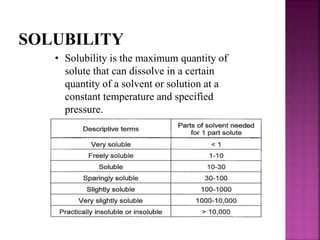
SOLUBILITY 
• Solubility is the maximum quantity of 
solute that can dissolve in a certain 
quantity of a solvent or solution at a 
constant temperature and specified 
pressure.
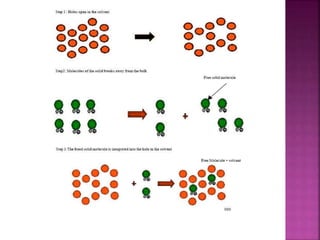
Process of solubilization 
Step 1: 
Holes opens in the solvent. 
Step2 : 
Molecules of the solid breaks away from the bulk. 
Step 3: 
The freed solid molecule is integrated into the hole in the solvent.
TECHNIQUES TO IMPROVE 
SOLUBILITY: 
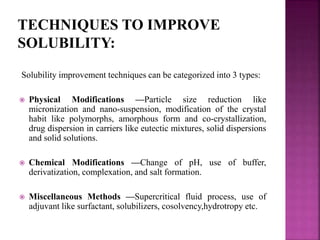
Solubility improvement techniques can be categorized into 3 types: 
 Physical Modifications —Particle size reduction like 
micronization and nano-suspension, modification of the crystal 
habit like polymorphs, amorphous form and co-crystallization, 
drug dispersion in carriers like eutectic mixtures, solid dispersions 
and solid solutions. 
 Chemical Modifications —Change of pH, use of buffer, 
derivatization, complexation, and salt formation. 
 Miscellaneous Methods —Supercritical fluid process, use of 
adjuvant like surfactant, solubilizers, cosolvency,hydrotropy etc.
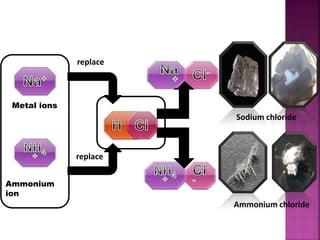
Metal ions 
Ammonium 
ion 
replace 
replace 
Sodium chloride 
Ammonium chloride
IDEAL CHARACTERISTICS OF 
SALT FORMATION 
chemically 
stable. 
not 
hygroscopic. 
presents no 
processing 
problems. 
dissolves 
quickly from 
solid dosage 
forms.
SALT FORMATION 
 Salt formation is one of the simplest chemical 
reactions, involving either a proton transfer or a 
neutralization reaction between an acid and a base. 
 The salt form of a drugs is usually more soluble than 
parent drug . 
 An alkaloidal base is slightly soluble in water, But if 
the pH of medium is reduced by addition of acid, the 
solubility of the base increases. The reason for this 
increase in solubility: as the pH continues to reduce, 
the base is converted to a salt, which is relatively more 
soluble in water. 
 Examples include Atropine , Bupivacaine, etc.
The solubility of slightly soluble acid is increased as the pH is 
increased by addition of alkali, the reason being that a salt is 
formed. 
Examples include Aspirin , Theophylline , Barbiturates . 
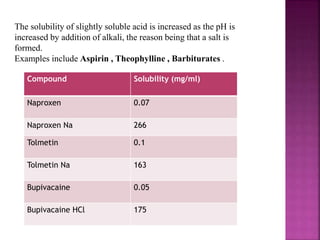
Compound Solubility (mg/ml) 
Naproxen 0.07 
Naproxen Na 266 
Tolmetin 0.1 
Tolmetin Na 163 
Bupivacaine 0.05 
Bupivacaine HCl 175
Use of Salt Form 
 Salts have improved solubility and dissolution characteristics in 
comparison to the original drug. 
 It is generally accepted that a minimum difference of 3 units between 
the pKa value of the group and that of its counter ion is required to 
form stable salts. 
 Alkali metal salts of acidic drugs like penicillin’s and strong acid 
salts of basic drugs like atropine are water soluble than the parent 
drug 
 Salt formation is frequently performed on weak acidic or basic 
drugs because it is a relatively simple chemical manipulation, which 
may alter the physicochemical formulation, biopharmaceutical, 
and therapeutic properties of a drug without modifying the basic 
chemical structure.
CO-SOLVENCY 
• The solubility of a poorly water soluble drug can be 
increased by the addition of a water miscible solvent 
in which the drug has a good solubility. This whole 
procedure is known as co-solvency and the solvent is 
called co-solvents. 
• Co-solvents are mixtures of water and one or more 
water miscible solvents used to create a solution with 
enhanced solubility for a poorly water soluble drug. 
• It is commonly referred to as solvent blending.
Characteristics of Co-Solvents 
Non toxic. 
Non 
irritant. 
Able to 
solubilize 
the drug in 
given 
solvent. 
Able to 
cross the 
membrane
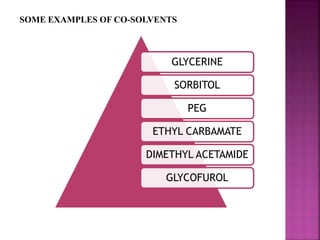
SOME EXAMPLES OF CO-SOLVENTS 
GLYCERINE 
SORBITOL 
PEG 
ETHYL CARBAMATE 
DIMETHYL ACETAMIDE 
GLYCOFUROL
MECHANISM OF CO-SOLVENT : 
Mechanism responsible for solubility enhancement 
through co-solvency is by 
 Reducing the interfacial tension (polarity 
differences) between the aqueous solution and 
hydrophobic solutes. 
 Reducing the contact angle between solid and 
liquid. 
Co-solvents can increase the solubility of a nonpolar 
drug up to several orders of magnitude compared to its 
aqueous solubility.
Solubilization by Co-solvents: 
• Weak electrolytes and non polar molecules have 
poor aqueous solubility. Their solubility in water 
is increased by addition of water miscible solvents 
in which drug has good solubility . 
• The cosolvents such as propylene glycol, 
polyethylene glycol, ethanol, glycerin aid in 
solubilizing the drug in aqueous vehicle. 
• The solubilizing effect by cosolvency primarily 
dependent upon the polarity of drug with respect 
to solvent and cosolvent.
 Several analytical techniques were used for the 
purpose of salt identification and solubility 
dissolution rates investigations, these techniques 
included NMR, FT-IR, and TLC. 
 Analysis for salt formation confirmation, XRD 
characterization of the salt material, thermal 
analysis included DSC, TGA, and HPLC. 
 For qualification and quantification of the new 
crystals pH-solubility studies and finally intrinsic 
dissolution rate studies.
The role of counter-ion in salt formation to improve the 
solubility of poorly water soluble drugs in the case of 
Flurbiprofen and Tris(hydroxymethyl)amino methane 
• This study shows the role of salt formation in 
improving the solubility and dissolution rates of 
Flurbiprofen, which is one of the poorly water 
soluble drugs. 
• Tris[hydroxymethyl]aminomethane was used as 
a counter-ion and the Flurbiprofen-Tris salt was 
crystallized from acetonitrile as solvent.
 Flurbiprofen: is a non-steroidal anti-inflammatory drug 
(NSAID) that readily forms carboxylic acid salts. It is 
administered for its anti-inflammatory, antipyretic, analgesic 
effects, and to inhibit intraoperative mitosis. 
 Tris[hydroxymethyl]aminomethane: was used as a 
counter-ion . 
 Acetonitrile: is a polar solvent that used to crystallize the 
Flurbiprofen-Tris salt . 
MSc presentation project 24 
EXAMPLE :
The Flurbiprofen and Tris [hydroxy methyl]amino methane were 
combined to prepare an soluble salt, which was then precipitated 
and yield the final product. 
MSc presentation project 
- + 
3 
Acetonitrile 
Flurbiprofen 
Tris[hydroxymethy 
l]aminomethane 
The 
equation 
reaction 
reactants product 
Flurbiprofen- 
Tris salt 
Solvent
 Differential Scanning Calorimetric (DSC) 
 Thermo Gravimetric Analysis (TGA) 
 High Pressure Liquid Chromatography (HPLC) 
 Ultra Violet spectroscopy (UV) 
MSc presentation project 26
Analytical methods: 
Differential Scanning Calorimetric (DSC) 
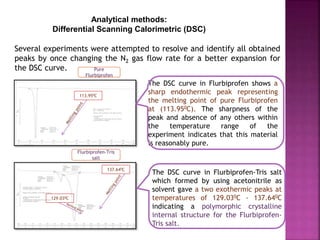
Several experiments were attempted to resolve and identify all obtained 
peaks by once changing the N2 gas flow rate for a better expansion for 
the DSC curve. 
The DSC curve in Flurbiprofen shows a 
sharp endothermic peak representing 
the melting point of pure Flurbiprofen 
at (113.950C). The sharpness of the 
peak and absence of any others within 
the temperature range of the 
experiment indicates that this material 
is reasonably pure. 
The DSC curve in Flurbiprofen-Tris salt 
which formed by using acetonitrile as 
solvent gave a two exothermic peaks at 
temperatures of 129.030C - 137.640C 
indicating a polymorphic crystalline 
internal structure for the Flurbiprofen- 
Tris salt. 
113.950C 
137.640C 
MSc presentation project 27 
129.030C 
Pure 
Flurbiprofen 
Flurbiprofen-Tris 
salt
Analytical methods: 
Thermo Gravimetric Analysis (TGA) 
The weight is steady until 
160oC 
For Flurbiprofen and its salt, the weights of the samples were steady 
until 160oC, and then a dramatic change happened from 160oC until 
260oC. 
• The weight loss of the Flurbiprofen was 1.637mg (54.5%). 
• The weight loss of the Flurbiprofen-Tris salt was 1.966mg 
MSc presentation project 28 
(50.3%). 
The weight is steady until 
160oC 
The weight loss of the 
Flurbiprofen is 1.637mg 
(54.5%) 
The weight loss of the 
Flurbiprofen-Tris salt is 1.966mg 
(50.3%)
Analytical methods: 
High Pressure Liquid Chromatography (HPLC) 
Flurbiprofen-Tris saturated 
salt 
Conc. Using HPLC (mol/ml) 
Saturated salt 1 5.43477E-04 
Saturated salt 2 4.92823E-04 
Saturated salt 3 4.95105E-04 
The mean of saturated salt 5.10500E-04 
MSc presentation project 29 
Conc. (ppm) Conc. Of 
Flurbiprofen 
(mol/ml) 
Conc. Of 
Flurbiprofen-Tris 
salt (mol/ml) 
10 3.97100E-05 2.84643E-05 
25 1.01118E-04 6.97923E-05 
50 2.10014E-04 1.32468E-04 
75 3.05400E-04 2.05545E-04 
100 4.08564E-04 2.75064E-04 
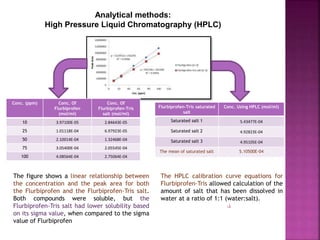
The figure shows a linear relationship between 
the concentration and the peak area for both 
the Flurbiprofen and the Flurbiprofen-Tris salt. 
Both compounds were soluble, but the 
Flurbiprofen-Tris salt had lower solubility based 
on its sigma value, when compared to the sigma 
value of Flurbiprofen 
The HPLC calibration curve equations for 
Flurbiprofen-Tris allowed calculation of the 
amount of salt that has been dissolved in 
water at a ratio of 1:1 (water:salt).
Analytical methods: 
Ultra Violet spectroscopy (UV) 
Flurbiprofen-Tris saturated 
salt 
Conc. Using UV (mol/ml) 
Saturated salt 1 527.2689301 
Saturated salt 2 479.0071659 
Saturated salt 3 481.1811309 
The mean of saturated salt 495.81908 
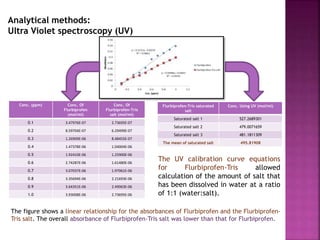
The UV calibration curve equations 
for Flurbiprofen-Tris allowed 
calculation of the amount of salt that 
has been dissolved in water at a ratio 
of 1:1 (water:salt). 
MSc presentation project 30 
Conc. (ppm) Conc. Of 
Flurbiprofen 
(mol/ml) 
Conc. Of 
Flurbiprofen-Tris 
salt (mol/ml) 
0.1 3.47976E-07 2.73695E-07 
0.2 8.59704E-07 6.29499E-07 
0.3 1.26909E-06 8.48455E-07 
0.4 1.47378E-06 1.04004E-06 
0.5 1.92410E-06 1.25900E-06 
0.6 2.74287E-06 1.61480E-06 
0.7 3.07037E-06 1.97061E-06 
0.8 3.35694E-06 2.21693E-06 
0.9 3.64351E-06 2.49063E-06 
1.0 3.93008E-06 2.73695E-06 
The figure shows a linear relationship for the absorbances of Flurbiprofen and the Flurbiprofen- 
Tris salt. The overall absorbance of Flurbiprofen-Tris salt was lower than that for Flurbiprofen.
CONCLUSION 
 The aqueous solubility of drug is often a limiting factor in developing most 
desirable dosage form.Hence, Increasing the water solubility of insoluble or 
slightly soluble compounds is of major concern for pharmaceutical 
researchers. 
 A highly solubilized formulation is desired to minimize 
dissolution limited absorption. 
 Newly developed techniques could bridge the gap between dissolution and 
absorption for many such drugs.Research in this area still continues to be 
promising and challenging for optimization of the drug delivery
Neethu ppt

Neethu ppt

  • 1.
    GUIDED BY Mrs.YASMEEN BEGUM ASST PROFESSOR (M.pharm) MALLA REDDY COLLEGE OF PHARMACY Maisammaguda, Dhulapally (post via Hakimpet), Sec-bad-14 PRESENTED BY C.R.NEETHU 256213885003 M.Pharm (Analysis)
  • 2.
    CONTENTS  INTRODUCTION  SOLUBILITY  SALT FORMATION  CO-SOLVENCY  ANALYTICAL TECHNIQUES  CONCLUSION
  • 3.
    INTRODUCTION • Therapeuticeffectiveness of a drug depends upon the bioavailability and ultimately upon the solubility of drug molecules. • Solubility is one of the important parameter to achieve desired concentration of drug in systemic circulation for pharmacological response to be shown. • Currently only 8% of new drug have both high solubility and permeability.
  • 4.
    SOLUBILITY • Solubilityis the maximum quantity of solute that can dissolve in a certain quantity of a solvent or solution at a constant temperature and specified pressure.
  • 5.
    Process of solubilization Step 1: Holes opens in the solvent. Step2 : Molecules of the solid breaks away from the bulk. Step 3: The freed solid molecule is integrated into the hole in the solvent.
  • 7.
    TECHNIQUES TO IMPROVE SOLUBILITY: Solubility improvement techniques can be categorized into 3 types:  Physical Modifications —Particle size reduction like micronization and nano-suspension, modification of the crystal habit like polymorphs, amorphous form and co-crystallization, drug dispersion in carriers like eutectic mixtures, solid dispersions and solid solutions.  Chemical Modifications —Change of pH, use of buffer, derivatization, complexation, and salt formation.  Miscellaneous Methods —Supercritical fluid process, use of adjuvant like surfactant, solubilizers, cosolvency,hydrotropy etc.
  • 10.
    Metal ions Ammonium ion replace replace Sodium chloride Ammonium chloride
  • 11.
    IDEAL CHARACTERISTICS OF SALT FORMATION chemically stable. not hygroscopic. presents no processing problems. dissolves quickly from solid dosage forms.
  • 12.
    SALT FORMATION Salt formation is one of the simplest chemical reactions, involving either a proton transfer or a neutralization reaction between an acid and a base.  The salt form of a drugs is usually more soluble than parent drug .  An alkaloidal base is slightly soluble in water, But if the pH of medium is reduced by addition of acid, the solubility of the base increases. The reason for this increase in solubility: as the pH continues to reduce, the base is converted to a salt, which is relatively more soluble in water.  Examples include Atropine , Bupivacaine, etc.
  • 13.
    The solubility ofslightly soluble acid is increased as the pH is increased by addition of alkali, the reason being that a salt is formed. Examples include Aspirin , Theophylline , Barbiturates . Compound Solubility (mg/ml) Naproxen 0.07 Naproxen Na 266 Tolmetin 0.1 Tolmetin Na 163 Bupivacaine 0.05 Bupivacaine HCl 175
  • 14.
    Use of SaltForm  Salts have improved solubility and dissolution characteristics in comparison to the original drug.  It is generally accepted that a minimum difference of 3 units between the pKa value of the group and that of its counter ion is required to form stable salts.  Alkali metal salts of acidic drugs like penicillin’s and strong acid salts of basic drugs like atropine are water soluble than the parent drug  Salt formation is frequently performed on weak acidic or basic drugs because it is a relatively simple chemical manipulation, which may alter the physicochemical formulation, biopharmaceutical, and therapeutic properties of a drug without modifying the basic chemical structure.
  • 16.
    CO-SOLVENCY • Thesolubility of a poorly water soluble drug can be increased by the addition of a water miscible solvent in which the drug has a good solubility. This whole procedure is known as co-solvency and the solvent is called co-solvents. • Co-solvents are mixtures of water and one or more water miscible solvents used to create a solution with enhanced solubility for a poorly water soluble drug. • It is commonly referred to as solvent blending.
  • 17.
    Characteristics of Co-Solvents Non toxic. Non irritant. Able to solubilize the drug in given solvent. Able to cross the membrane
  • 18.
    SOME EXAMPLES OFCO-SOLVENTS GLYCERINE SORBITOL PEG ETHYL CARBAMATE DIMETHYL ACETAMIDE GLYCOFUROL
  • 19.
    MECHANISM OF CO-SOLVENT: Mechanism responsible for solubility enhancement through co-solvency is by  Reducing the interfacial tension (polarity differences) between the aqueous solution and hydrophobic solutes.  Reducing the contact angle between solid and liquid. Co-solvents can increase the solubility of a nonpolar drug up to several orders of magnitude compared to its aqueous solubility.
  • 20.
    Solubilization by Co-solvents: • Weak electrolytes and non polar molecules have poor aqueous solubility. Their solubility in water is increased by addition of water miscible solvents in which drug has good solubility . • The cosolvents such as propylene glycol, polyethylene glycol, ethanol, glycerin aid in solubilizing the drug in aqueous vehicle. • The solubilizing effect by cosolvency primarily dependent upon the polarity of drug with respect to solvent and cosolvent.
  • 22.
     Several analyticaltechniques were used for the purpose of salt identification and solubility dissolution rates investigations, these techniques included NMR, FT-IR, and TLC.  Analysis for salt formation confirmation, XRD characterization of the salt material, thermal analysis included DSC, TGA, and HPLC.  For qualification and quantification of the new crystals pH-solubility studies and finally intrinsic dissolution rate studies.
  • 23.
    The role ofcounter-ion in salt formation to improve the solubility of poorly water soluble drugs in the case of Flurbiprofen and Tris(hydroxymethyl)amino methane • This study shows the role of salt formation in improving the solubility and dissolution rates of Flurbiprofen, which is one of the poorly water soluble drugs. • Tris[hydroxymethyl]aminomethane was used as a counter-ion and the Flurbiprofen-Tris salt was crystallized from acetonitrile as solvent.
  • 24.
     Flurbiprofen: isa non-steroidal anti-inflammatory drug (NSAID) that readily forms carboxylic acid salts. It is administered for its anti-inflammatory, antipyretic, analgesic effects, and to inhibit intraoperative mitosis.  Tris[hydroxymethyl]aminomethane: was used as a counter-ion .  Acetonitrile: is a polar solvent that used to crystallize the Flurbiprofen-Tris salt . MSc presentation project 24 EXAMPLE :
  • 25.
    The Flurbiprofen andTris [hydroxy methyl]amino methane were combined to prepare an soluble salt, which was then precipitated and yield the final product. MSc presentation project - + 3 Acetonitrile Flurbiprofen Tris[hydroxymethy l]aminomethane The equation reaction reactants product Flurbiprofen- Tris salt Solvent
  • 26.
     Differential ScanningCalorimetric (DSC)  Thermo Gravimetric Analysis (TGA)  High Pressure Liquid Chromatography (HPLC)  Ultra Violet spectroscopy (UV) MSc presentation project 26
  • 27.
    Analytical methods: DifferentialScanning Calorimetric (DSC) Several experiments were attempted to resolve and identify all obtained peaks by once changing the N2 gas flow rate for a better expansion for the DSC curve. The DSC curve in Flurbiprofen shows a sharp endothermic peak representing the melting point of pure Flurbiprofen at (113.950C). The sharpness of the peak and absence of any others within the temperature range of the experiment indicates that this material is reasonably pure. The DSC curve in Flurbiprofen-Tris salt which formed by using acetonitrile as solvent gave a two exothermic peaks at temperatures of 129.030C - 137.640C indicating a polymorphic crystalline internal structure for the Flurbiprofen- Tris salt. 113.950C 137.640C MSc presentation project 27 129.030C Pure Flurbiprofen Flurbiprofen-Tris salt
  • 28.
    Analytical methods: ThermoGravimetric Analysis (TGA) The weight is steady until 160oC For Flurbiprofen and its salt, the weights of the samples were steady until 160oC, and then a dramatic change happened from 160oC until 260oC. • The weight loss of the Flurbiprofen was 1.637mg (54.5%). • The weight loss of the Flurbiprofen-Tris salt was 1.966mg MSc presentation project 28 (50.3%). The weight is steady until 160oC The weight loss of the Flurbiprofen is 1.637mg (54.5%) The weight loss of the Flurbiprofen-Tris salt is 1.966mg (50.3%)
  • 29.
    Analytical methods: HighPressure Liquid Chromatography (HPLC) Flurbiprofen-Tris saturated salt Conc. Using HPLC (mol/ml) Saturated salt 1 5.43477E-04 Saturated salt 2 4.92823E-04 Saturated salt 3 4.95105E-04 The mean of saturated salt 5.10500E-04 MSc presentation project 29 Conc. (ppm) Conc. Of Flurbiprofen (mol/ml) Conc. Of Flurbiprofen-Tris salt (mol/ml) 10 3.97100E-05 2.84643E-05 25 1.01118E-04 6.97923E-05 50 2.10014E-04 1.32468E-04 75 3.05400E-04 2.05545E-04 100 4.08564E-04 2.75064E-04 The figure shows a linear relationship between the concentration and the peak area for both the Flurbiprofen and the Flurbiprofen-Tris salt. Both compounds were soluble, but the Flurbiprofen-Tris salt had lower solubility based on its sigma value, when compared to the sigma value of Flurbiprofen The HPLC calibration curve equations for Flurbiprofen-Tris allowed calculation of the amount of salt that has been dissolved in water at a ratio of 1:1 (water:salt).
  • 30.
    Analytical methods: UltraViolet spectroscopy (UV) Flurbiprofen-Tris saturated salt Conc. Using UV (mol/ml) Saturated salt 1 527.2689301 Saturated salt 2 479.0071659 Saturated salt 3 481.1811309 The mean of saturated salt 495.81908 The UV calibration curve equations for Flurbiprofen-Tris allowed calculation of the amount of salt that has been dissolved in water at a ratio of 1:1 (water:salt). MSc presentation project 30 Conc. (ppm) Conc. Of Flurbiprofen (mol/ml) Conc. Of Flurbiprofen-Tris salt (mol/ml) 0.1 3.47976E-07 2.73695E-07 0.2 8.59704E-07 6.29499E-07 0.3 1.26909E-06 8.48455E-07 0.4 1.47378E-06 1.04004E-06 0.5 1.92410E-06 1.25900E-06 0.6 2.74287E-06 1.61480E-06 0.7 3.07037E-06 1.97061E-06 0.8 3.35694E-06 2.21693E-06 0.9 3.64351E-06 2.49063E-06 1.0 3.93008E-06 2.73695E-06 The figure shows a linear relationship for the absorbances of Flurbiprofen and the Flurbiprofen- Tris salt. The overall absorbance of Flurbiprofen-Tris salt was lower than that for Flurbiprofen.
  • 31.
    CONCLUSION  Theaqueous solubility of drug is often a limiting factor in developing most desirable dosage form.Hence, Increasing the water solubility of insoluble or slightly soluble compounds is of major concern for pharmaceutical researchers.  A highly solubilized formulation is desired to minimize dissolution limited absorption.  Newly developed techniques could bridge the gap between dissolution and absorption for many such drugs.Research in this area still continues to be promising and challenging for optimization of the drug delivery