SMART CARDS
Contents
 Introduction.
 What is a Smart Card?
 History.
 Smart Card Resources.
 MicroAnatomy of a Smart Card.
 Smart Card pieces and parts .
 Varieties of Smart Cards.
 Major Benefits that Smart Cards offer.
 Smart Card Services.
 Smart Card Application.
 Future.
 Queries.
INTRODUCTION
 A Smart Card is like an “electronic wallet”.

 It provides not only memory capacity, but
  computational capability as well and thus the
  chip is capable of processing data.

 Smart Cards can store several hundred times
  more data than a conventional cards with a
  magnetic stripe and can be programmed to
  reveal only the relevant information.
What is a Smart Cards
           ?
 A smart card is a device that includes an
  embedded integrated circuit that can be either a
  secure microcontroller or equivalent intelligence
  with internal memory or a memory chip alone.

 Two types
   -Memory-only chips
   -Microprocessor chips
What is a Smart Cards
           ?
 Can hold up to 32,000 bytes.

 With an embedded microcontroller, smart cards
  have the unique ability to store large amounts of
  data, carry out their own on-card functions (e.g.,
  encryption and mutual authentication) and interact
  intelligently with a smart card reader.
History
 The technology has its historical origin in the
  seventies when inventors in Germany , Japan ,
  and France filed the original patents.

 While inventors in the U.S , Japan and Austria,
  were issued patents, it was French who put big
  money to push the techhnology.
History
 The industry has been growing at tremendous rate
  is shipping more than one billion (1,000,000,000)
  cards per year (since 1998).

 The current world population of Smart Cards of
  some 1.7 billion is set to increase to 4 billion or
  more cards within the next 3-4 years.
Smart Card
               Resources


  Contact


Contactless
MicroAnatomy of a
    Smart Card
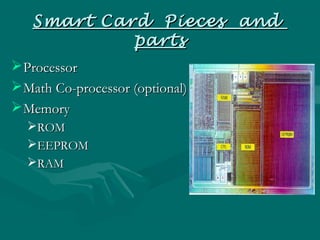
Smart Card Pieces and
            parts
 Processor
 Math Co-processor (optional)
 Memory
  ROM
  EEPROM
  RAM
Varieties of Smart
          Cards
Smart Cards come in two varieties:

 Contact Smart Card .
 Contactless Smart Card.
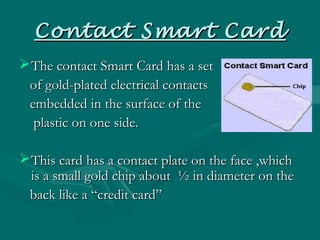
Contact Smart Card
 The contact Smart Card has a set
 of gold-plated electrical contacts
 embedded in the surface of the
  plastic on one side.

 This card has a contact plate on the face ,which
  is a small gold chip about ½ in diameter on the
 back like a “credit card”
Contactless Smart
                   Card
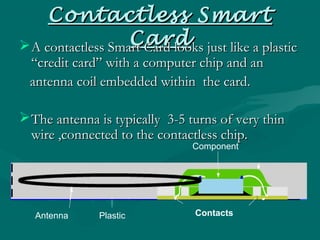
 A contactless Smart Card looks just like a plastic
 “credit card” with a computer chip and an
 antenna coil embedded within the card.

 The antenna is typically 3-5 turns of very thin
  wire ,connected to the contactless chip.
                                Component


  Antenna     Plastic           Contacts
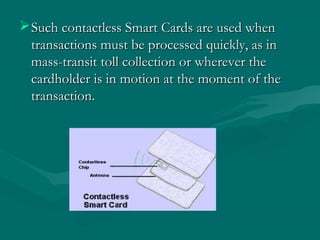
 Such contactless Smart Cards are used when
  transactions must be processed quickly, as in
  mass-transit toll collection or wherever the
  cardholder is in motion at the moment of the
  transaction.
Major Benefits that
       Smart Cards offer
Security :
  a) chip is tamper-resistant
  b) information stored on the card can be PIN coded
  c) capable of performing encryption and/or read/write

   d) each smart card has its own unique serial number
Intelligence :
  a) capable of processing , not just storing information
Major Benefits that
     Smart Cards offer

    b) Smart cards can communicate with
     devices through smart card reader
Convenience :
   a) chip is tamper-resistant
   b) Smart Cards provide a portable, easy to use
       form factor that many are familiar with using
Smart Card
      Services
 Data Storage & retrieval.
 Authentication.
 Cryptography.
 Signature .
 Multiple application.
Smart Card
          Applications
 Smart Cards are being deployed in public and
  private marketplaces.
 There are over 300,000,000 GSM mobile
  telephones with Smart Cards which contain the
  mobile phone security and subscription
  information.
 Streamlining healthcare Services.
 Automating transportation Services.
Future
 Embedding similar circuits in everyday objects, such as
  key rings, watches, glasses, rings or earrings could
  perform the same electronic function.

 Soon it will be possible to authorize the use of
  electronic information in Smart Cards by using a
  spoken word or the touch of a hand.

 In the future, the traditional magnetic strip card will be
  replaced and integrated together into a single card by
  using the multi-application Smart Card, which is known
  as an electronic purse or wallet in the Smart Card industry.
 With global financial institutions pushing for migrating
  their credit card and debit card transactions towards
  smart card-based transactions, the future of smart cards
  does seem bright.

 "From year 2005 onwards, as per EMV II compliance
 (EuroPay, MasterCard, Visa), all new credit/debit cards
 will be issued only on chip (instead of magnetic strip)
 which will drive huge growth in this segment. Security
 concerns in financial transactions will also force banks to
 opt for smart cards sooner or later."
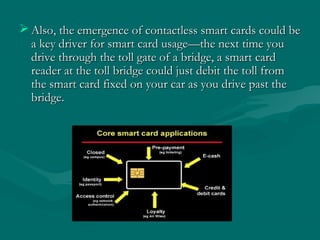
 Also, the emergence of contactless smart cards could be
  a key driver for smart card usage—the next time you
  drive through the toll gate of a bridge, a smart card
  reader at the toll bridge could just debit the toll from
  the smart card fixed on your car as you drive past the
  bridge.
Thank You
This is just the beginning; soon it will
   influence the way we shop, see the
doctor, use the telephone and even enjoy
                 leisure!!!


        Any Query?????

Smart cards

  • 1.
  • 2.
    Contents  Introduction.  Whatis a Smart Card?  History.  Smart Card Resources.  MicroAnatomy of a Smart Card.  Smart Card pieces and parts .  Varieties of Smart Cards.  Major Benefits that Smart Cards offer.  Smart Card Services.  Smart Card Application.  Future.  Queries.
  • 3.
    INTRODUCTION  A SmartCard is like an “electronic wallet”.  It provides not only memory capacity, but computational capability as well and thus the chip is capable of processing data.  Smart Cards can store several hundred times more data than a conventional cards with a magnetic stripe and can be programmed to reveal only the relevant information.
  • 4.
    What is aSmart Cards ?  A smart card is a device that includes an embedded integrated circuit that can be either a secure microcontroller or equivalent intelligence with internal memory or a memory chip alone.  Two types -Memory-only chips -Microprocessor chips
  • 5.
    What is aSmart Cards ?  Can hold up to 32,000 bytes.  With an embedded microcontroller, smart cards have the unique ability to store large amounts of data, carry out their own on-card functions (e.g., encryption and mutual authentication) and interact intelligently with a smart card reader.
  • 6.
    History  The technologyhas its historical origin in the seventies when inventors in Germany , Japan , and France filed the original patents.  While inventors in the U.S , Japan and Austria, were issued patents, it was French who put big money to push the techhnology.
  • 7.
    History  The industryhas been growing at tremendous rate is shipping more than one billion (1,000,000,000) cards per year (since 1998).  The current world population of Smart Cards of some 1.7 billion is set to increase to 4 billion or more cards within the next 3-4 years.
  • 8.
    Smart Card Resources Contact Contactless
  • 9.
  • 10.
    Smart Card Piecesand parts  Processor  Math Co-processor (optional)  Memory ROM EEPROM RAM
  • 11.
    Varieties of Smart Cards Smart Cards come in two varieties:  Contact Smart Card .  Contactless Smart Card.
  • 12.
    Contact Smart Card The contact Smart Card has a set of gold-plated electrical contacts embedded in the surface of the plastic on one side.  This card has a contact plate on the face ,which is a small gold chip about ½ in diameter on the back like a “credit card”
  • 13.
    Contactless Smart Card  A contactless Smart Card looks just like a plastic “credit card” with a computer chip and an antenna coil embedded within the card.  The antenna is typically 3-5 turns of very thin wire ,connected to the contactless chip. Component Antenna Plastic Contacts
  • 14.
     Such contactlessSmart Cards are used when transactions must be processed quickly, as in mass-transit toll collection or wherever the cardholder is in motion at the moment of the transaction.
  • 15.
    Major Benefits that Smart Cards offer Security : a) chip is tamper-resistant b) information stored on the card can be PIN coded c) capable of performing encryption and/or read/write d) each smart card has its own unique serial number Intelligence : a) capable of processing , not just storing information
  • 16.
    Major Benefits that Smart Cards offer b) Smart cards can communicate with devices through smart card reader Convenience : a) chip is tamper-resistant b) Smart Cards provide a portable, easy to use form factor that many are familiar with using
  • 17.
    Smart Card Services  Data Storage & retrieval.  Authentication.  Cryptography.  Signature .  Multiple application.
  • 18.
    Smart Card Applications  Smart Cards are being deployed in public and private marketplaces.  There are over 300,000,000 GSM mobile telephones with Smart Cards which contain the mobile phone security and subscription information.  Streamlining healthcare Services.  Automating transportation Services.
  • 19.
    Future  Embedding similarcircuits in everyday objects, such as key rings, watches, glasses, rings or earrings could perform the same electronic function.  Soon it will be possible to authorize the use of electronic information in Smart Cards by using a spoken word or the touch of a hand.  In the future, the traditional magnetic strip card will be replaced and integrated together into a single card by using the multi-application Smart Card, which is known as an electronic purse or wallet in the Smart Card industry.
  • 20.
     With globalfinancial institutions pushing for migrating their credit card and debit card transactions towards smart card-based transactions, the future of smart cards does seem bright.  "From year 2005 onwards, as per EMV II compliance (EuroPay, MasterCard, Visa), all new credit/debit cards will be issued only on chip (instead of magnetic strip) which will drive huge growth in this segment. Security concerns in financial transactions will also force banks to opt for smart cards sooner or later."
  • 21.
     Also, theemergence of contactless smart cards could be a key driver for smart card usage—the next time you drive through the toll gate of a bridge, a smart card reader at the toll bridge could just debit the toll from the smart card fixed on your car as you drive past the bridge.
  • 22.
  • 23.
    This is justthe beginning; soon it will influence the way we shop, see the doctor, use the telephone and even enjoy leisure!!! Any Query?????