Presented By:
B.PRADEEP KUMAR
 Introduction
 History
 What is a Smart Card?
 Construction of Smart Cards
 Examples of Smart Cards
 Application
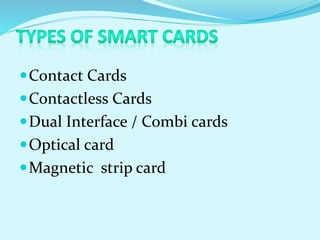
 Types of Smart Cards
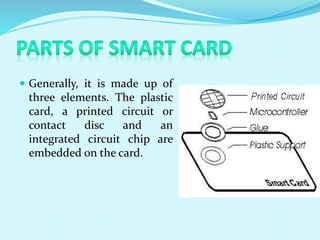
 Parts of Smart Cards
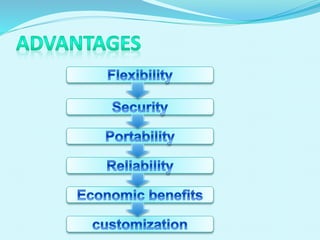
 Advantages
 Disadvantages
 conclusion
 In 1968 German inventors patent combination
of plastic cards with micro chips.
Smart card are used for various purpose for
telecommunication to retail
It is a secure device
 1968
German inventor Jurgen Dethloff along with Helmet
Grotrupp filed a patent for using plastic as a carrier for
microchips.
 1970
Dr. Kunitaka Arimura of Japan filed the first and only
patent on the smart card concept
 1974
Roland Moreno of France files the original patent for the
IC card, later dubbed the “smart card.”
 1977
Three commercial manufacturers, Bull CP8, SGS
Thomson, and Schlumberger began developing the IC
card product.
 Standard credit card-sized with microchip embedded on it
 Two types
I. Memory-only chips
II. Microprocessor chips
 Can hold up to 32,000 bytes
 Newer smart cards have math co-processors
I. Perform complex encryption routines quickly
Contact Cards
Contactless Cards
Dual Interface / Combi cards
Optical card
Magnetic strip card
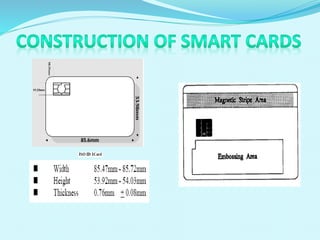
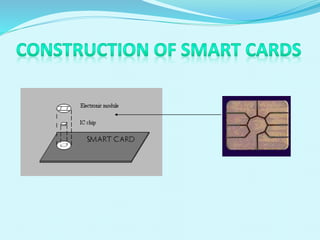
 Generally, it is made up of
three elements. The plastic
card, a printed circuit or
contact disc and an
integrated circuit chip are
embedded on the card.
 NOT tamper proof
 Can be lost/stolen
 Lack of user mobility – only possible if user has
smart card reader every he goes
 Has to use the same reader technology
 Can be expensive
 Working from PC – software based token will be
better
 No benefits to using a token on multiple PCs to
using a smart card
 Still working on bugs
 Payment System
 Smart Networking
 National ID / Authentication
 University Identification
 Financial Applications
 Retail & Loyalty
 Communication Applications
 Transportation
 Enhanced security
 Offline transactions
 Multifunctional
 Customization
 Economical
 Portable
Thus this cheaper is used in the encryption algorithm,
which gave high performance.
It is now highly easy to store the information like PIN
in the smart card safely.
It avoid the forgery attack efficiently.
Smart card ppt

Smart card ppt

  • 1.
  • 2.
     Introduction  History What is a Smart Card?  Construction of Smart Cards  Examples of Smart Cards  Application  Types of Smart Cards  Parts of Smart Cards  Advantages  Disadvantages  conclusion
  • 3.
     In 1968German inventors patent combination of plastic cards with micro chips. Smart card are used for various purpose for telecommunication to retail It is a secure device
  • 4.
     1968 German inventorJurgen Dethloff along with Helmet Grotrupp filed a patent for using plastic as a carrier for microchips.  1970 Dr. Kunitaka Arimura of Japan filed the first and only patent on the smart card concept  1974 Roland Moreno of France files the original patent for the IC card, later dubbed the “smart card.”  1977 Three commercial manufacturers, Bull CP8, SGS Thomson, and Schlumberger began developing the IC card product.
  • 5.
     Standard creditcard-sized with microchip embedded on it  Two types I. Memory-only chips II. Microprocessor chips  Can hold up to 32,000 bytes  Newer smart cards have math co-processors I. Perform complex encryption routines quickly
  • 8.
    Contact Cards Contactless Cards DualInterface / Combi cards Optical card Magnetic strip card
  • 9.
     Generally, itis made up of three elements. The plastic card, a printed circuit or contact disc and an integrated circuit chip are embedded on the card.
  • 11.
     NOT tamperproof  Can be lost/stolen  Lack of user mobility – only possible if user has smart card reader every he goes  Has to use the same reader technology  Can be expensive  Working from PC – software based token will be better  No benefits to using a token on multiple PCs to using a smart card  Still working on bugs
  • 12.
     Payment System Smart Networking  National ID / Authentication  University Identification  Financial Applications  Retail & Loyalty  Communication Applications  Transportation
  • 13.
     Enhanced security Offline transactions  Multifunctional  Customization  Economical  Portable
  • 14.
    Thus this cheaperis used in the encryption algorithm, which gave high performance. It is now highly easy to store the information like PIN in the smart card safely. It avoid the forgery attack efficiently.