 A smart card, or integrated circuit card (ICC), is any
pocket sized card with embedded integrated circuits.
 A smart card is any card with a capability to relate
information to a particular application such as:
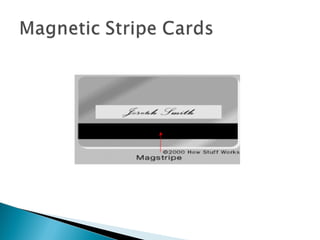
◦ Magnetic Stripe Cards
◦ Optical Cards
◦ Memory Cards
◦ Microprocessor Cards
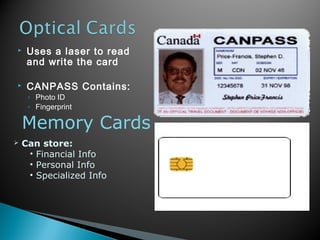
 Uses a laser to read
and write the card
 CANPASS Contains:
◦ Photo ID
◦ Fingerprint
Memory Cards
 Can store:
• Financial Info
• Personal Info
• Specialized Info
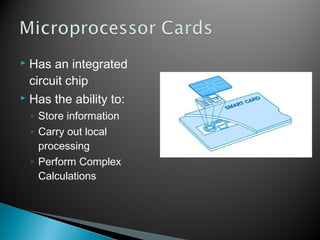
 Has an integrated
circuit chip
 Has the ability to:
◦ Store information
◦ Carry out local
processing
◦ Perform Complex
Calculations
Smart Cards with a microprocessor look like standard
plastic cards but are equipped with embedded circuit IC
chip. Microprocessor cards can: store information, carry
out local processing on the data stored, and perform
complex calculations. A microprocessor chip can add,
delete and otherwise manipulate information in its
memory. It can be viewed as a miniature computer with an
input/output port, operating system and hard disk.
Microprocessor chips are available 8, 16, and 32 bit
architectures.
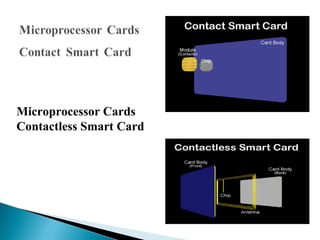
There are two types of microprocessor cards. These
cards take the form of either contact cards, which
require a card reader, or contact-less cards, which use
radio frequency signals to operate.
Microprocessor Cards
Contactless Smart Card
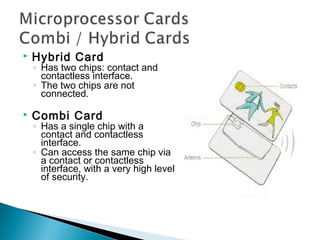
 Hybrid Card
◦ Has two chips: contact and
contactless interface.
◦ The two chips are not
connected.
 Combi Card
◦ Has a single chip with a
contact and contactless
interface.
◦ Can access the same chip via
a contact or contactless
interface, with a very high level
of security.
 Commercial Applications
◦ Banking/payment
◦ Identification
◦ Ticketing
◦ Parking and toll collection
◦ Universities use smart cards for ID
purposes and at the the library,
 Mobile Telecommunications
◦ SIM cards used on cell phones
◦ Over 300,000,000 GSM phones with
smart cards
◦ Contains mobile phone security,
subscription information, phone
number on the network,
In comparison to it’s predecessor, the magnetic strip card, smart
cards have many advantages including:
◦ Life of a smart card is longer
◦ A single smart card can house multiple applications. Just one card can
be used as your license, passport, credit card, ATM card, ID Card, etc.
◦ Smart cards are more secure than magnetic stripe cards
◦ Data on a smart card can be protected against unauthorized viewing. As
a result of this confidential data, PINs and passwords can be stored on a
smart card.
• chip is tamper-resistant
- information stored on the card can be PIN code and/or read-write
protected
- each smart card has its own, unique serial number
• capable of processing, not just storing information
- Smart cards can communicate with computing devices through a smart
card reader
- information and applications on a card can be updated without having to
issue new cards
• A smart card carries more information than can be accommodated on a
magnetic stripe card. It can make a decision, as it has relatively powerful
processing capabilities that allow it to do more than a magnetic stripe
card .
+ NOT tamper proof
+ Can be lost/stolen
+ Lack of user mobility – only possible if user has smart card reader
every he goes
+ Has to use the same reader technology
+ Can be expensive
+ Working from PC – software based token will be better
+ No benefits to using a token on multiple PCs to using a smart
card
+ Still working on bugs

Smart card technology

  • 2.
     A smartcard, or integrated circuit card (ICC), is any pocket sized card with embedded integrated circuits.  A smart card is any card with a capability to relate information to a particular application such as: ◦ Magnetic Stripe Cards ◦ Optical Cards ◦ Memory Cards ◦ Microprocessor Cards
  • 4.
     Uses alaser to read and write the card  CANPASS Contains: ◦ Photo ID ◦ Fingerprint Memory Cards  Can store: • Financial Info • Personal Info • Specialized Info
  • 5.
     Has anintegrated circuit chip  Has the ability to: ◦ Store information ◦ Carry out local processing ◦ Perform Complex Calculations
  • 6.
    Smart Cards witha microprocessor look like standard plastic cards but are equipped with embedded circuit IC chip. Microprocessor cards can: store information, carry out local processing on the data stored, and perform complex calculations. A microprocessor chip can add, delete and otherwise manipulate information in its memory. It can be viewed as a miniature computer with an input/output port, operating system and hard disk. Microprocessor chips are available 8, 16, and 32 bit architectures. There are two types of microprocessor cards. These cards take the form of either contact cards, which require a card reader, or contact-less cards, which use radio frequency signals to operate.
  • 7.
  • 8.
     Hybrid Card ◦Has two chips: contact and contactless interface. ◦ The two chips are not connected.  Combi Card ◦ Has a single chip with a contact and contactless interface. ◦ Can access the same chip via a contact or contactless interface, with a very high level of security.
  • 9.
     Commercial Applications ◦Banking/payment ◦ Identification ◦ Ticketing ◦ Parking and toll collection ◦ Universities use smart cards for ID purposes and at the the library,  Mobile Telecommunications ◦ SIM cards used on cell phones ◦ Over 300,000,000 GSM phones with smart cards ◦ Contains mobile phone security, subscription information, phone number on the network,
  • 10.
    In comparison toit’s predecessor, the magnetic strip card, smart cards have many advantages including: ◦ Life of a smart card is longer ◦ A single smart card can house multiple applications. Just one card can be used as your license, passport, credit card, ATM card, ID Card, etc. ◦ Smart cards are more secure than magnetic stripe cards ◦ Data on a smart card can be protected against unauthorized viewing. As a result of this confidential data, PINs and passwords can be stored on a smart card.
  • 11.
    • chip istamper-resistant - information stored on the card can be PIN code and/or read-write protected - each smart card has its own, unique serial number • capable of processing, not just storing information - Smart cards can communicate with computing devices through a smart card reader - information and applications on a card can be updated without having to issue new cards • A smart card carries more information than can be accommodated on a magnetic stripe card. It can make a decision, as it has relatively powerful processing capabilities that allow it to do more than a magnetic stripe card .
  • 12.
    + NOT tamperproof + Can be lost/stolen + Lack of user mobility – only possible if user has smart card reader every he goes + Has to use the same reader technology + Can be expensive + Working from PC – software based token will be better + No benefits to using a token on multiple PCs to using a smart card + Still working on bugs

Editor's Notes