KUMAR SANDEEP 807048 EEE-1 SMART  CARDS
Overview Introduction History of Smart Cards Smart Card Technology Security Mechanisms Applications of Smart Cards Advantages  & Disadvantages Future Aspects Conclusion
IMAGINE
What is a Smart Card?  A Smart card is a plastic card about the size of a credit card, with an embedded microchip that can be loaded with data, used for telephone calling, cash payments , and other applications, and then periodically refreshed for additional use.
History 70’s Smart Card First Patent in Germany and later  in France and Japan. 80’s  Mass usage in Pay Phones and Debit Cards. 90’s Smart Card based Mobiles Chips & Sim Cards.
History 2000’s Payment and Ticketing Applications  Credit cards, Mass transit (Smartrip) Healthcare and Identification  Insurance information, Drivers license
Card Elements Magnetic Stripe Chip   Embossing  (Card Number / Name / Validity, etc.) Logo Hologram
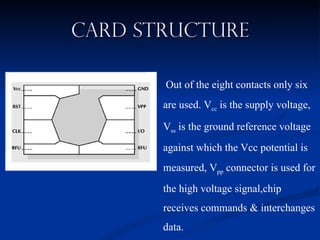
Electrical signals description    : Clocking or timing signal (optional use by the  card). GND  :  Ground  (reference voltage). VPP  : Programming voltage input (deprecated / optional use by the card). I/O  : Input or Output for serial data to the integrated circuit inside the card. AUX1(C4):  Auxilliary contact; USB devices: D + AUX2(C8)  :  Auxilliary contact; USB device s:  D - VCC :  Power supply input    : Either used itself (reset signal supplied from the interface device) or in combination with an internal reset control circuit  (optional use by the card) . Fig : A smart card pin out RST CLK
CARD STRUCTURE Out of the eight contacts only six are used. V cc  is the supply voltage, V ss  is the ground reference voltage against which the Vcc potential is measured, V pp  connector is used for the high voltage signal,chip receives commands & interchanges data.
Typical Configurations 256 bytes to 4KB RAM. 8KB to 32KB ROM. 1KB to 32KB EEPROM. 8-bit to 16-bit CPU.  8051 based designs are common. The price of a mid-level chip when produced in bulk is less than US$1.
Smart Card Readers Computer based readers Connect through USB or COM (Serial) ports Dedicated terminals Usually with a small screen, keypad, printer, often also have biometric devices such as thumb print scanner.
Terminal/PC Card Interaction The terminal/PC sends commands to the card (through the serial line). The card executes the command and sends back the reply. The terminal/PC cannot directly access memory of the card so data in the card is protected from  unauthorized access. This is what makes the card  smart.
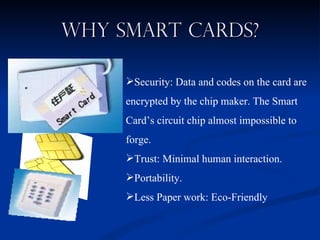
Why Smart Cards? Security: Data and codes on the card are encrypted by the chip maker. The Smart Card’s circuit chip almost impossible to forge. Trust: Minimal human interaction. Portability. Less Paper work: Eco-Friendly
Two Types of Chips Memory chip   Acts as a small floppy disk with optional security Are inexpensive Offer little security features  Microprocessor  Can add, delete, and manipulate its memory.  Acts as a miniature computer that includes an operating system, hard disk, and input/output ports.  Provides more security and memory and can even download applications.
From 1 billion to 4 billion units in 10 years… Worldwide smart card shipments 925 960 2655 3325 Millions of units Microprocessor cards Memory cards 4285 3580 925 960 0 500 1000 1500 2000 2500 3000 3500 4000 4500 1999 2000 2001 2002 2003 2004 2005 2006 2007 2008 2009
Smart Cards in  everyday life… Ticketing Payment Loyalty Transport Smart Poster Health card Communication
Contact Smart Cards Requires insertion into a smart card reader with a direct connection  This physical contact allows for transmission of commands, data, and card status to take place
Contactless Smart Cards  Require only close proximity to a reader Both the reader and card have antennas through which the two communicate  Ideal for applications that require very fast card interfaces
Categories of Smart Cards Based on the type of IC chip  embedded on the Smart Card. They are categorized into  three types :- IC Micro Processor Cards IC Memory Cards Optical Memory Cards
Key Attributes Security to make the Digital Life safe and enjoyable Ease of Use to enable all of us to access to the Digital World   Privacy to respect each individual’s freedom and intimacy   SAFE
Biometric techniques Finger print identification. Features of finger prints can be kept on the card (even verified on the card) Photograph/IRIS pattern etc. Such information is to be verified by a person. The information can be stored in the card securely
So many Smart Cards with us at all times….. In our GSM phone (the SIM card) Inside our Wallets Credit/Debit cards HealthCare cards Loyalty cards Our corporate badge Our Passport   Our e-Banking OTP …  and the list keeps growing
Our Industries Is rapidly changing   eTicketing Interactive billboards Transports Retail New solutions leveraging on mobile contactless services
Smart Card Applications Government programs Banking & Finance Mobile Communication Pay Phone Cards Transportation Electronic Tolls Passports Electronic Cash Retailer Loyalty Programs Information security
Banking and finance Electronic purse to replace coins for small purchases in vending machines . Credit and debit cards Securing payments across the internet
Smart card Pay phones  Outside of the United States there is a widespread use of payphones  phone company does not have to collect coins the users do not have to have coins or remember long access numbers and PIN codes The risk of vandalism is very low since these payphones are smart card-based. “Generally, a phone is attacked if there is some money inside it, as in the case of coin-based payphone
Transportation Driver’s license Mass transit fare collection system Electronic toll collection system
It’s no longer only «Cards» e-Passport: the first Smart Secure Device 45 Millions e-Passport in 2009
E Governance As the amount of business and holiday travel increases security continues to be a top concern for governments worldwide. When fully implemented smart passport solutions help to reduce fraud and forgery of travel documents. Enhanced security for travellers Philips launched such a project  with the US in 2004.
Student id card All-purpose student ID card (a/k/a campus card), containing a variety of applications such as electronic purse (for vending machines, laundry machines, library card, and meal card).
Threats in Using Smart Cards failure rate probability of breaking: keeping in wallets  may damage the chip on the card. malware attacks: active malwares on systems  may result in modifying the transactions .
ADVANTAGES Proven to be more reliable than the magnetic stripe card. Can store up to thousands of times of the information than the magnetic stripe card. Reduces tampering and counterfeiting through high security mechanisms such as advanced encryption and biometrics. Can be disposable or reusable. Performs multiple functions. Has wide range of applications (e.g., banking, transportation, healthcare...) Compatible with portable electronics (e.g., PCs, telephones...) Evolves rapidly applying semi-conductor technology
Disadvantages Smart cards used for client-side identification and authentication are the most secure way for eg. internet banking applications, but the security is never 100% sure. In the example of internet banking, if the PC is infected with any kind of  malware , the security model is broken. Malware can override the communication (both input via keyboard and output via application screen) between the user and the internet banking application (eg. browser). This would result in modifying transactions by the malware and unnoticed by the user. There is malware in the wild with this capability (eg. Trojan. Silentbanker).
Remedies… Banks like  Fortis  and  Dexia  in Belgium combine a Smart card with an unconnected card reader to avoid this problem. The customer enters a challenge received from the bank's website, his PIN and the transaction amount into the card reader, the card reader returns an 8-digit signature. This signature is manually copied to the PC and verified by the bank. This method prevents malware from changing the transaction amount.
Future Aspects Soon it will be possible to access the data in Smart cards by the use of  Biometrics. Smart card Readers can be built into future computers or peripherals which will enable the users to pay for goods purchased on the internet. In the near future, the multifunctional smart card will replace the traditional magnetic swipe card. Smart Card is not only a data store, but also a programmable, portable, tamper resistant memory storage.
The Smart card success story 2040 410 205 2600 500 225 3000 580 295 Identity & others Banking - Retail Telecom (SIM) +15% +27% +22% +16% +31% +10% 2007 2008 2009 Microprocessor Smart Cards Shipments  ( Millions of units ) 0 500 1000 1500 2000 2500 3000 3500 4000
By 2020 … 20 Billion Smart Secure Devices >4 Billion Mobile Appliances users >4 Billion e-ID documents in use
Conclusion…  Smart Cards will evolve into a broader family of Devices More new shapes for new applications Our virtual « digital personal attributes » Embedded software and ultra-embedded nanotechnologies The only mistake to avoid for our Industry is to entertain an endless debate about fears. We will build the best solutions and the best value for people to enjoy many new services Political ownership and communication will be key to success Education … more Education Preparing people to use those Smart Secure Devices is as important as teaching them how to read and write Smart Cards will evolve into a broader family of Devices More new shapes for new applications Embedded software and ultra-embedded nanotechnologies The only mistake to avoid for our Industry is to entertain an endless debate about fears. We will build the best solutions and the best value for people to enjoy many new services Education … more Education Preparing people to use those Smart Secure Devices is as important as teaching them how to read and write Conclusion:
Smart Cards will evolve into a broader family of Devices More new shapes for new applications Our virtual « digital personal attributes » Embedded software and ultra-embedded nanotechnologies The only mistake to avoid for our Industry is to entertain an endless debate about fears. We will build the best solutions and the best value for people to enjoy many new services Political ownership and communication will be key to success Education … more Education Preparing people to use those Smart Secure Devices is as important as teaching them how to read and write Conclusion:
 

Smart cards

  • 1.
    KUMAR SANDEEP 807048EEE-1 SMART CARDS
  • 2.
    Overview Introduction Historyof Smart Cards Smart Card Technology Security Mechanisms Applications of Smart Cards Advantages & Disadvantages Future Aspects Conclusion
  • 3.
  • 4.
    What is aSmart Card? A Smart card is a plastic card about the size of a credit card, with an embedded microchip that can be loaded with data, used for telephone calling, cash payments , and other applications, and then periodically refreshed for additional use.
  • 5.
    History 70’s SmartCard First Patent in Germany and later in France and Japan. 80’s Mass usage in Pay Phones and Debit Cards. 90’s Smart Card based Mobiles Chips & Sim Cards.
  • 6.
    History 2000’s Paymentand Ticketing Applications Credit cards, Mass transit (Smartrip) Healthcare and Identification Insurance information, Drivers license
  • 7.
    Card Elements MagneticStripe Chip Embossing (Card Number / Name / Validity, etc.) Logo Hologram
  • 8.
    Electrical signals description  : Clocking or timing signal (optional use by the card). GND  : Ground (reference voltage). VPP  : Programming voltage input (deprecated / optional use by the card). I/O  : Input or Output for serial data to the integrated circuit inside the card. AUX1(C4): Auxilliary contact; USB devices: D + AUX2(C8) : Auxilliary contact; USB device s: D - VCC : Power supply input   : Either used itself (reset signal supplied from the interface device) or in combination with an internal reset control circuit (optional use by the card) . Fig : A smart card pin out RST CLK
  • 9.
    CARD STRUCTURE Outof the eight contacts only six are used. V cc is the supply voltage, V ss is the ground reference voltage against which the Vcc potential is measured, V pp connector is used for the high voltage signal,chip receives commands & interchanges data.
  • 10.
    Typical Configurations 256bytes to 4KB RAM. 8KB to 32KB ROM. 1KB to 32KB EEPROM. 8-bit to 16-bit CPU. 8051 based designs are common. The price of a mid-level chip when produced in bulk is less than US$1.
  • 11.
    Smart Card ReadersComputer based readers Connect through USB or COM (Serial) ports Dedicated terminals Usually with a small screen, keypad, printer, often also have biometric devices such as thumb print scanner.
  • 12.
    Terminal/PC Card InteractionThe terminal/PC sends commands to the card (through the serial line). The card executes the command and sends back the reply. The terminal/PC cannot directly access memory of the card so data in the card is protected from unauthorized access. This is what makes the card smart.
  • 13.
    Why Smart Cards?Security: Data and codes on the card are encrypted by the chip maker. The Smart Card’s circuit chip almost impossible to forge. Trust: Minimal human interaction. Portability. Less Paper work: Eco-Friendly
  • 14.
    Two Types ofChips Memory chip Acts as a small floppy disk with optional security Are inexpensive Offer little security features Microprocessor Can add, delete, and manipulate its memory. Acts as a miniature computer that includes an operating system, hard disk, and input/output ports. Provides more security and memory and can even download applications.
  • 15.
    From 1 billionto 4 billion units in 10 years… Worldwide smart card shipments 925 960 2655 3325 Millions of units Microprocessor cards Memory cards 4285 3580 925 960 0 500 1000 1500 2000 2500 3000 3500 4000 4500 1999 2000 2001 2002 2003 2004 2005 2006 2007 2008 2009
  • 16.
    Smart Cards in everyday life… Ticketing Payment Loyalty Transport Smart Poster Health card Communication
  • 17.
    Contact Smart CardsRequires insertion into a smart card reader with a direct connection This physical contact allows for transmission of commands, data, and card status to take place
  • 18.
    Contactless Smart Cards Require only close proximity to a reader Both the reader and card have antennas through which the two communicate Ideal for applications that require very fast card interfaces
  • 19.
    Categories of SmartCards Based on the type of IC chip embedded on the Smart Card. They are categorized into three types :- IC Micro Processor Cards IC Memory Cards Optical Memory Cards
  • 20.
    Key Attributes Securityto make the Digital Life safe and enjoyable Ease of Use to enable all of us to access to the Digital World Privacy to respect each individual’s freedom and intimacy SAFE
  • 21.
    Biometric techniques Fingerprint identification. Features of finger prints can be kept on the card (even verified on the card) Photograph/IRIS pattern etc. Such information is to be verified by a person. The information can be stored in the card securely
  • 22.
    So many SmartCards with us at all times….. In our GSM phone (the SIM card) Inside our Wallets Credit/Debit cards HealthCare cards Loyalty cards Our corporate badge Our Passport Our e-Banking OTP … and the list keeps growing
  • 23.
    Our Industries Israpidly changing eTicketing Interactive billboards Transports Retail New solutions leveraging on mobile contactless services
  • 24.
    Smart Card ApplicationsGovernment programs Banking & Finance Mobile Communication Pay Phone Cards Transportation Electronic Tolls Passports Electronic Cash Retailer Loyalty Programs Information security
  • 25.
    Banking and financeElectronic purse to replace coins for small purchases in vending machines . Credit and debit cards Securing payments across the internet
  • 26.
    Smart card Payphones Outside of the United States there is a widespread use of payphones phone company does not have to collect coins the users do not have to have coins or remember long access numbers and PIN codes The risk of vandalism is very low since these payphones are smart card-based. “Generally, a phone is attacked if there is some money inside it, as in the case of coin-based payphone
  • 27.
    Transportation Driver’s licenseMass transit fare collection system Electronic toll collection system
  • 28.
    It’s no longeronly «Cards» e-Passport: the first Smart Secure Device 45 Millions e-Passport in 2009
  • 29.
    E Governance Asthe amount of business and holiday travel increases security continues to be a top concern for governments worldwide. When fully implemented smart passport solutions help to reduce fraud and forgery of travel documents. Enhanced security for travellers Philips launched such a project with the US in 2004.
  • 30.
    Student id cardAll-purpose student ID card (a/k/a campus card), containing a variety of applications such as electronic purse (for vending machines, laundry machines, library card, and meal card).
  • 31.
    Threats in UsingSmart Cards failure rate probability of breaking: keeping in wallets may damage the chip on the card. malware attacks: active malwares on systems may result in modifying the transactions .
  • 32.
    ADVANTAGES Proven tobe more reliable than the magnetic stripe card. Can store up to thousands of times of the information than the magnetic stripe card. Reduces tampering and counterfeiting through high security mechanisms such as advanced encryption and biometrics. Can be disposable or reusable. Performs multiple functions. Has wide range of applications (e.g., banking, transportation, healthcare...) Compatible with portable electronics (e.g., PCs, telephones...) Evolves rapidly applying semi-conductor technology
  • 33.
    Disadvantages Smart cardsused for client-side identification and authentication are the most secure way for eg. internet banking applications, but the security is never 100% sure. In the example of internet banking, if the PC is infected with any kind of malware , the security model is broken. Malware can override the communication (both input via keyboard and output via application screen) between the user and the internet banking application (eg. browser). This would result in modifying transactions by the malware and unnoticed by the user. There is malware in the wild with this capability (eg. Trojan. Silentbanker).
  • 34.
    Remedies… Banks like Fortis and Dexia in Belgium combine a Smart card with an unconnected card reader to avoid this problem. The customer enters a challenge received from the bank's website, his PIN and the transaction amount into the card reader, the card reader returns an 8-digit signature. This signature is manually copied to the PC and verified by the bank. This method prevents malware from changing the transaction amount.
  • 35.
    Future Aspects Soonit will be possible to access the data in Smart cards by the use of Biometrics. Smart card Readers can be built into future computers or peripherals which will enable the users to pay for goods purchased on the internet. In the near future, the multifunctional smart card will replace the traditional magnetic swipe card. Smart Card is not only a data store, but also a programmable, portable, tamper resistant memory storage.
  • 36.
    The Smart cardsuccess story 2040 410 205 2600 500 225 3000 580 295 Identity & others Banking - Retail Telecom (SIM) +15% +27% +22% +16% +31% +10% 2007 2008 2009 Microprocessor Smart Cards Shipments ( Millions of units ) 0 500 1000 1500 2000 2500 3000 3500 4000
  • 37.
    By 2020 …20 Billion Smart Secure Devices >4 Billion Mobile Appliances users >4 Billion e-ID documents in use
  • 38.
    Conclusion… SmartCards will evolve into a broader family of Devices More new shapes for new applications Our virtual « digital personal attributes » Embedded software and ultra-embedded nanotechnologies The only mistake to avoid for our Industry is to entertain an endless debate about fears. We will build the best solutions and the best value for people to enjoy many new services Political ownership and communication will be key to success Education … more Education Preparing people to use those Smart Secure Devices is as important as teaching them how to read and write Smart Cards will evolve into a broader family of Devices More new shapes for new applications Embedded software and ultra-embedded nanotechnologies The only mistake to avoid for our Industry is to entertain an endless debate about fears. We will build the best solutions and the best value for people to enjoy many new services Education … more Education Preparing people to use those Smart Secure Devices is as important as teaching them how to read and write Conclusion:
  • 39.
    Smart Cards willevolve into a broader family of Devices More new shapes for new applications Our virtual « digital personal attributes » Embedded software and ultra-embedded nanotechnologies The only mistake to avoid for our Industry is to entertain an endless debate about fears. We will build the best solutions and the best value for people to enjoy many new services Political ownership and communication will be key to success Education … more Education Preparing people to use those Smart Secure Devices is as important as teaching them how to read and write Conclusion:
  • 40.