RFID
Radio Frequency Identification
AMBER BHAUMIK
PG-DESD
What is RFID?







Radio Frequency Identification
The use of radio frequency readers
and tags to identify real objects.
New frontier in the field of information
technology
One form of Automatic Identification

What does it mean to identify something?
Identification






Assign IDs to objects
Link the ID to additional information
about the object
Link the ID to complementary info
Find similar objects
How Does RFID Work?


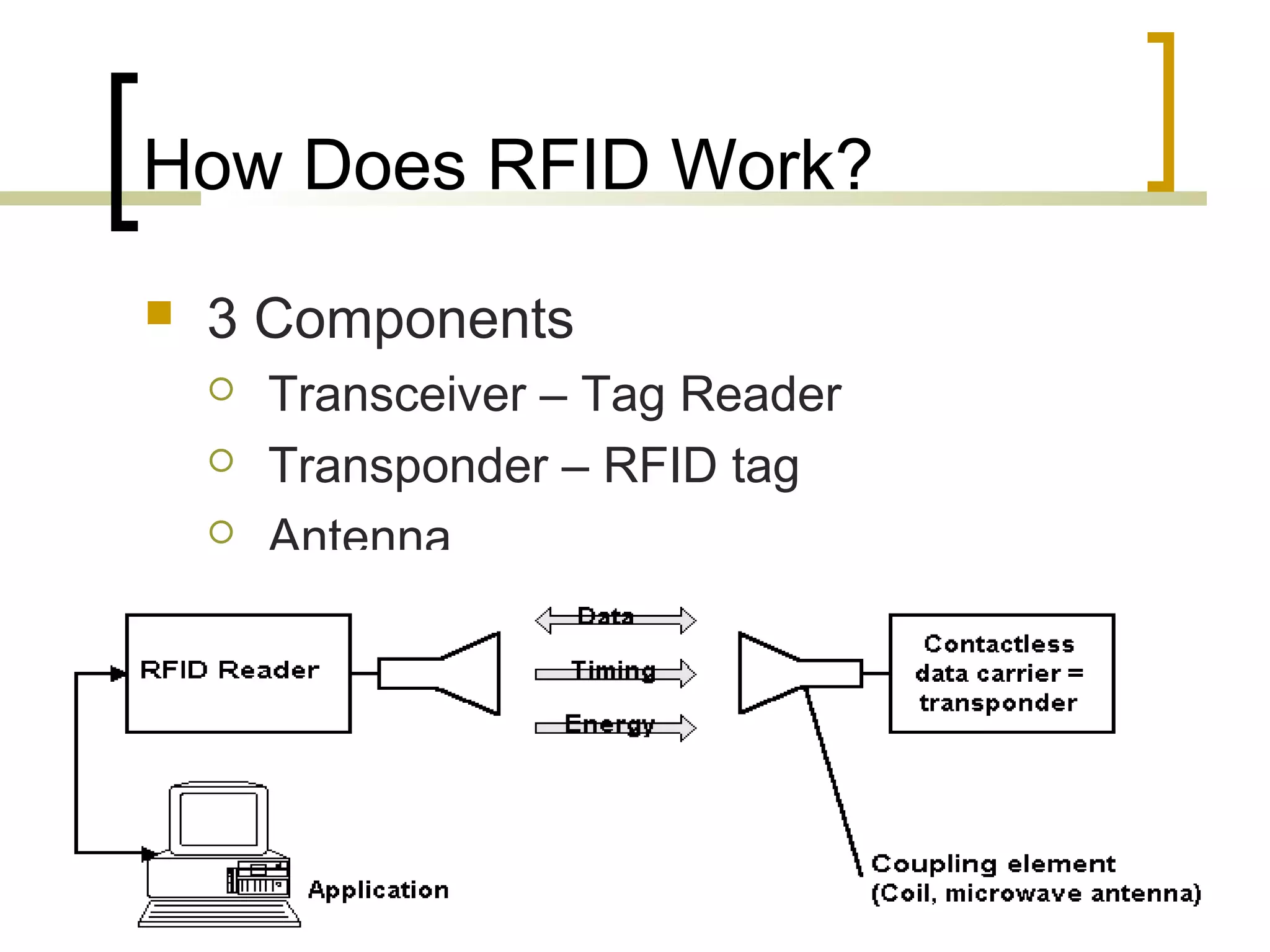
3 Components




Transceiver – Tag Reader
Transponder – RFID tag
Antenna
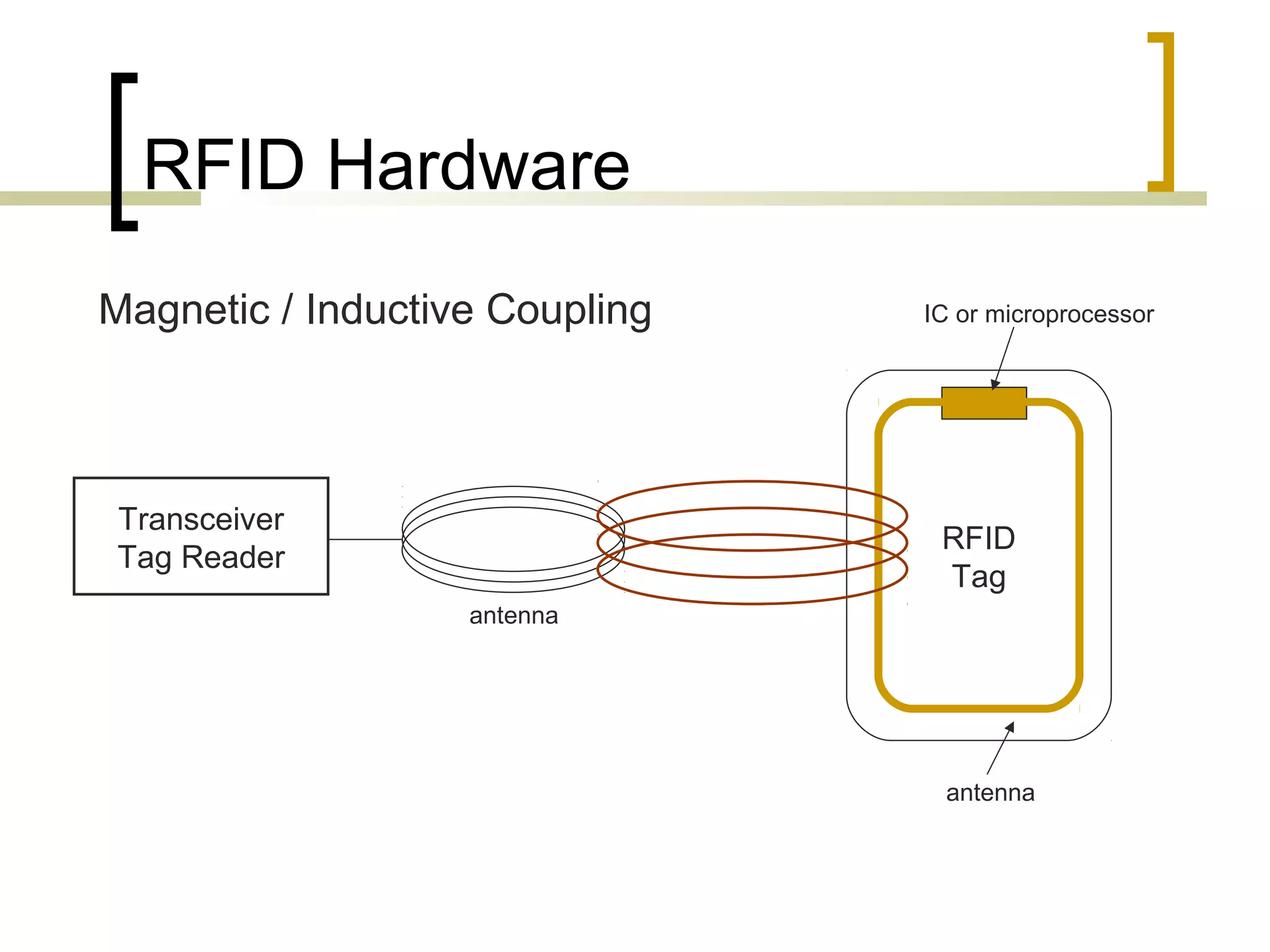
RFID Hardware
Magnetic / Inductive Coupling

Transceiver
Tag Reader

IC or microprocessor

RFID
Tag
antenna

antenna
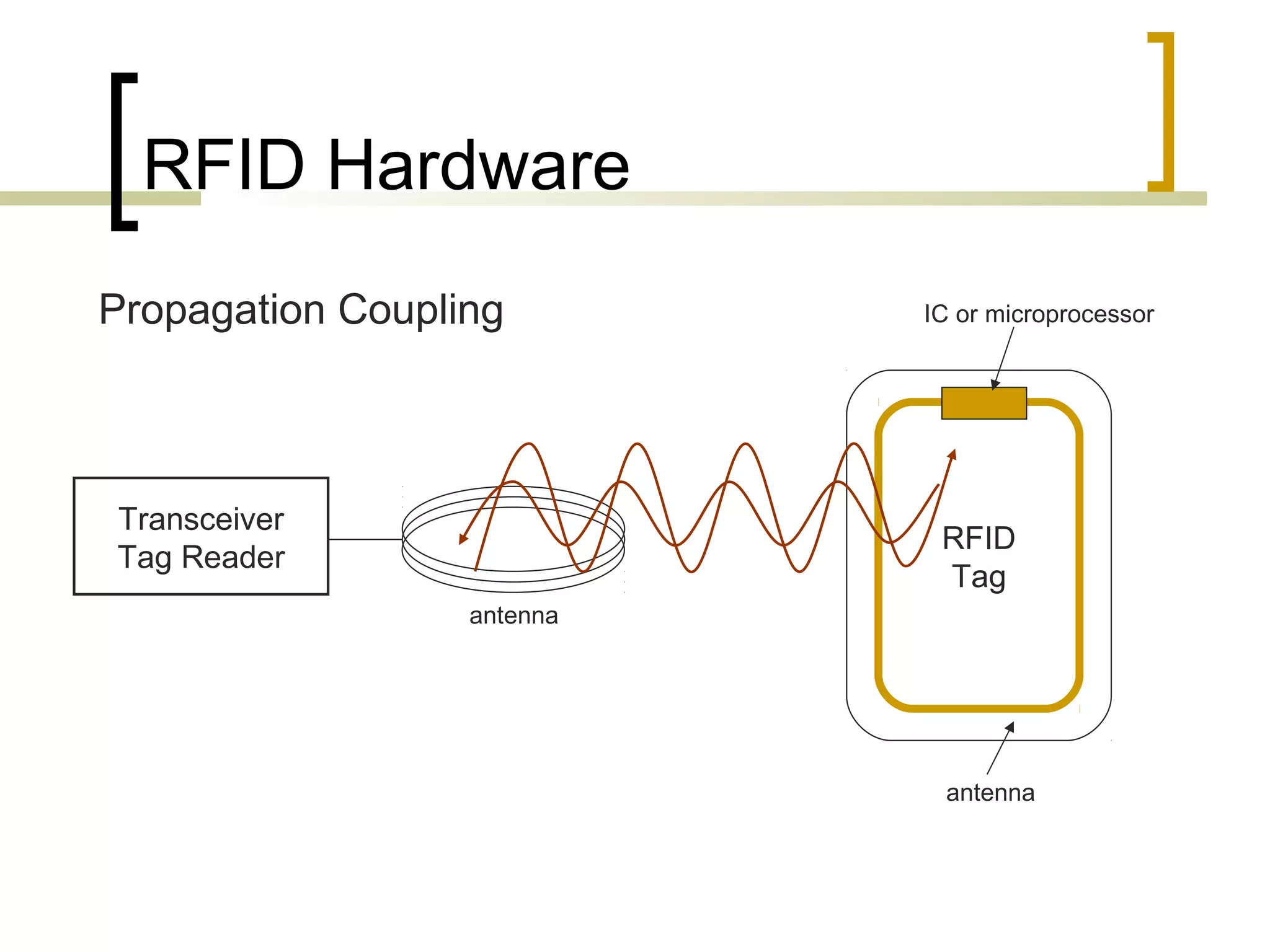
RFID Hardware
Propagation Coupling

Transceiver
Tag Reader

IC or microprocessor

RFID
Tag
antenna

antenna
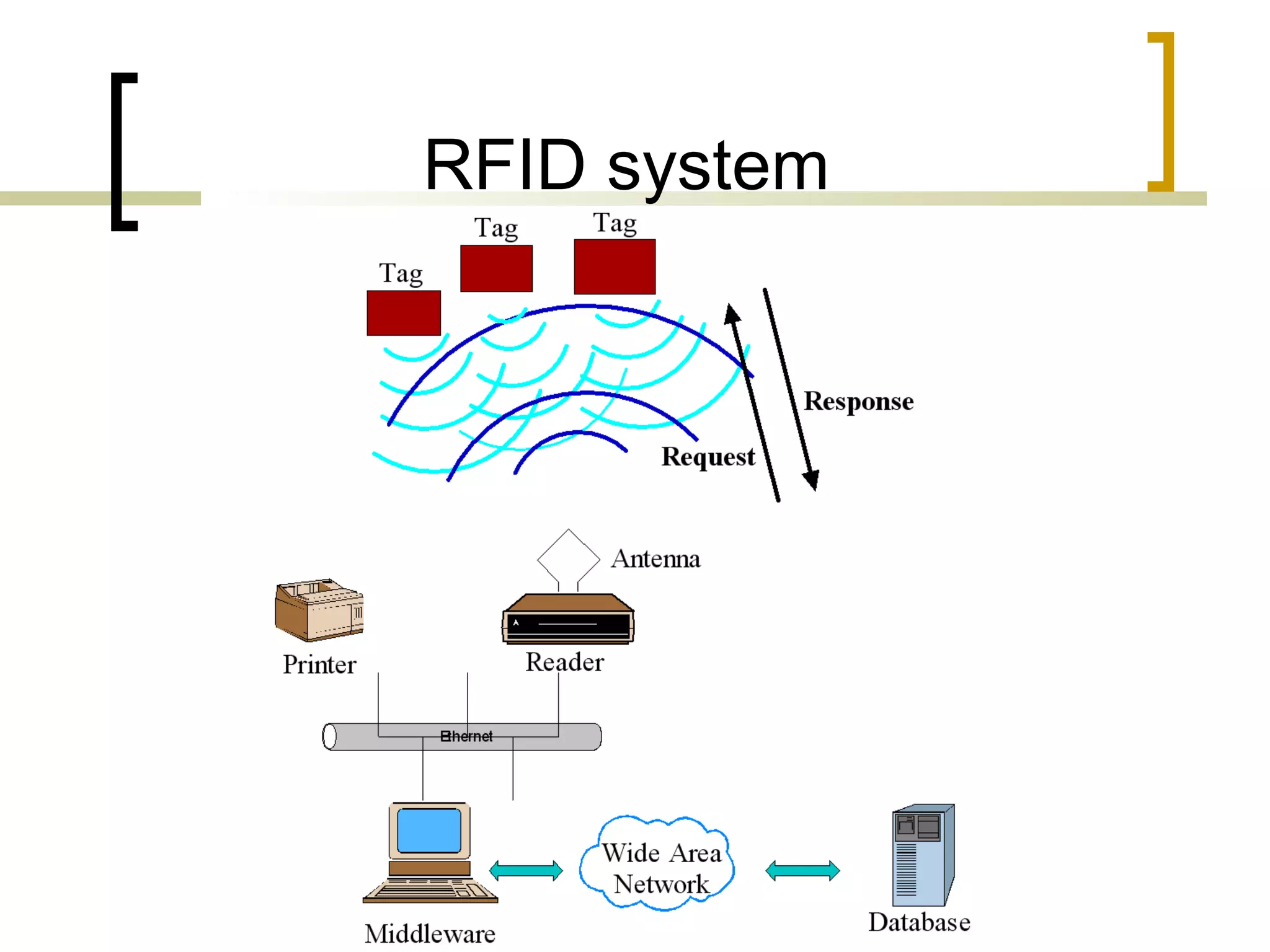
RFID system
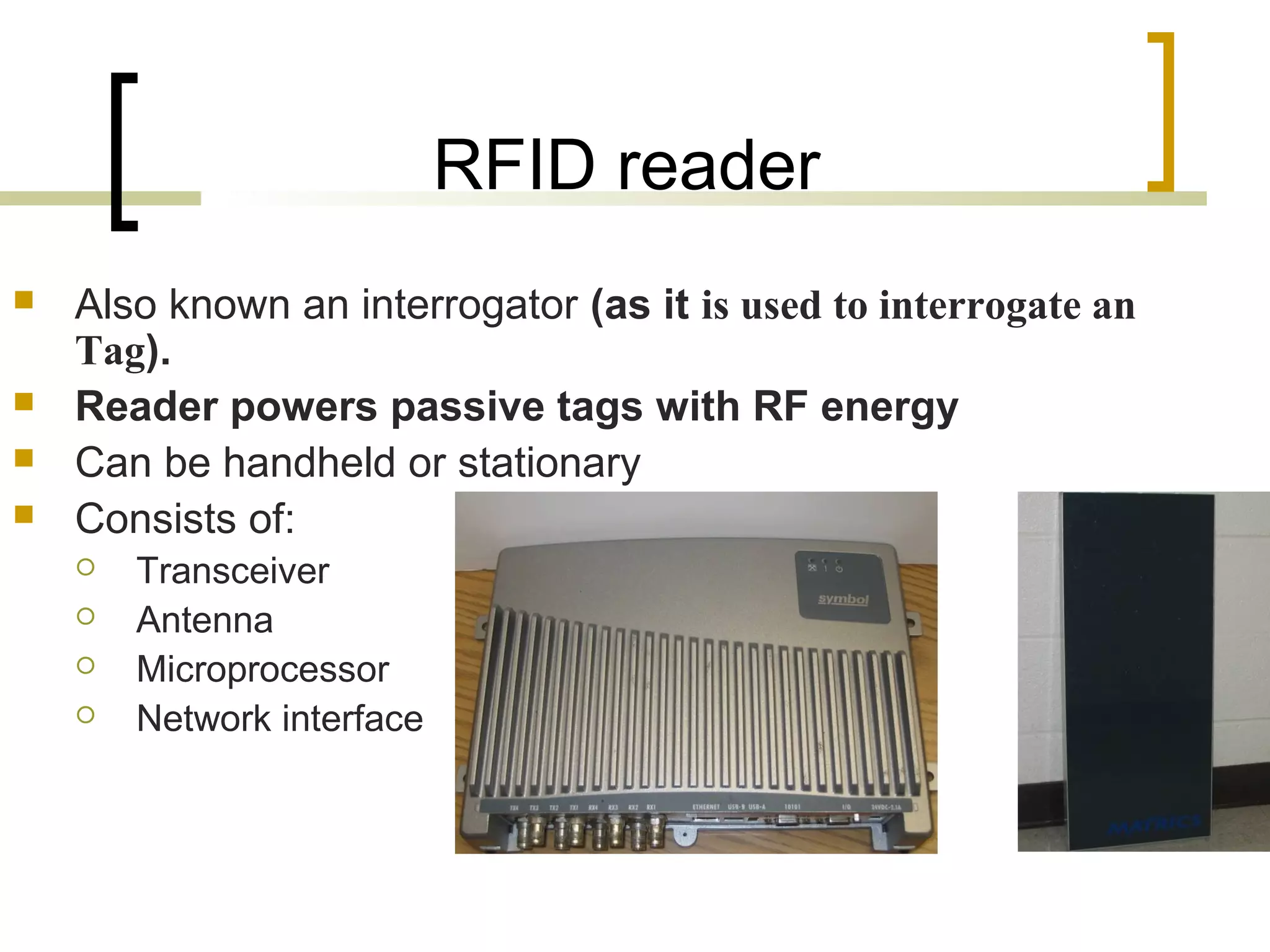
RFID reader





Also known an interrogator (as it is used to interrogate an
Tag).
Reader powers passive tags with RF energy
Can be handheld or stationary
Consists of:





Transceiver
Antenna
Microprocessor
Network interface
RFID tags




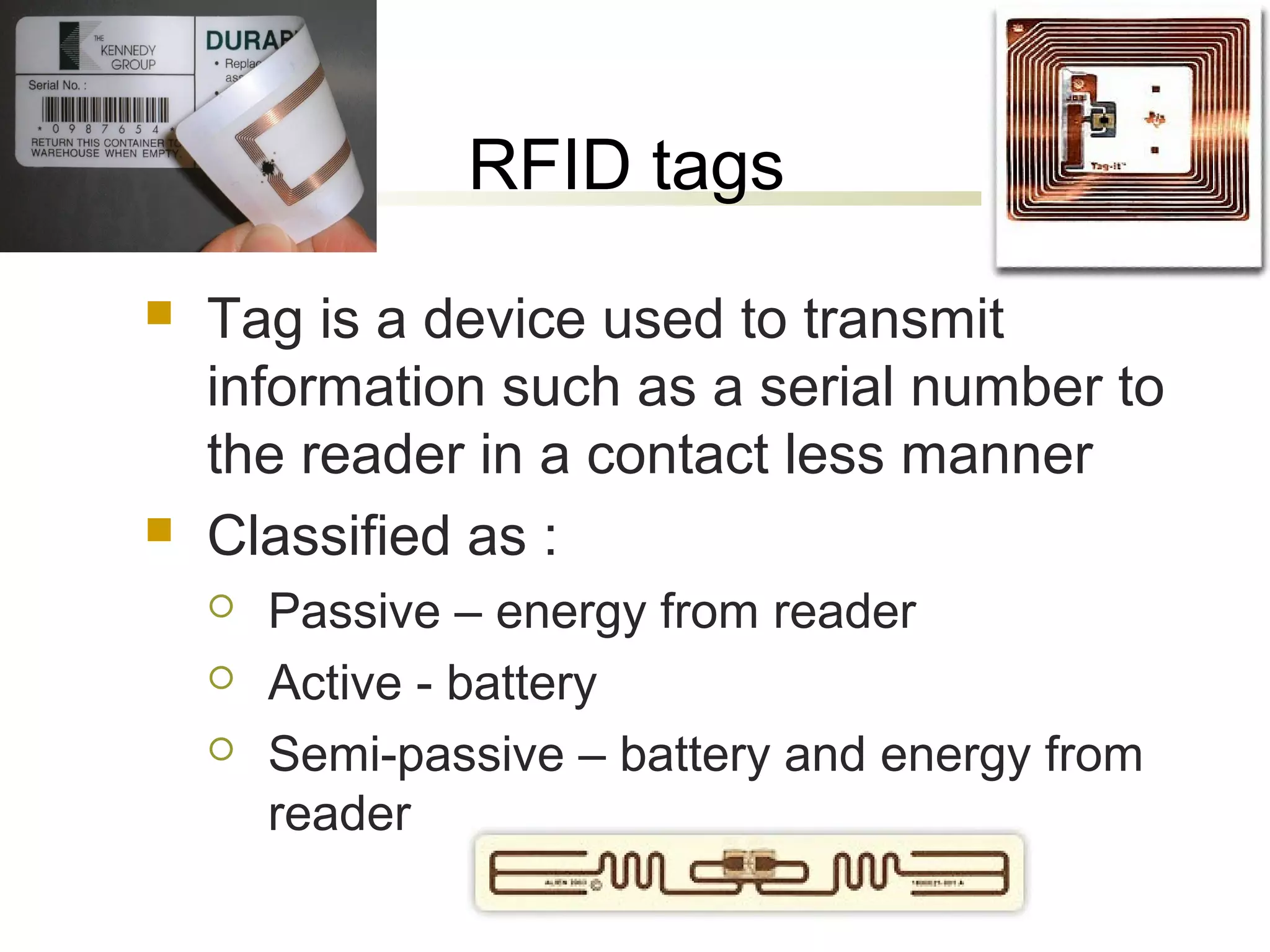
Tag is a device used to transmit
information such as a serial number to
the reader in a contact less manner
Classified as :




Passive – energy from reader
Active - battery
Semi-passive – battery and energy from
reader
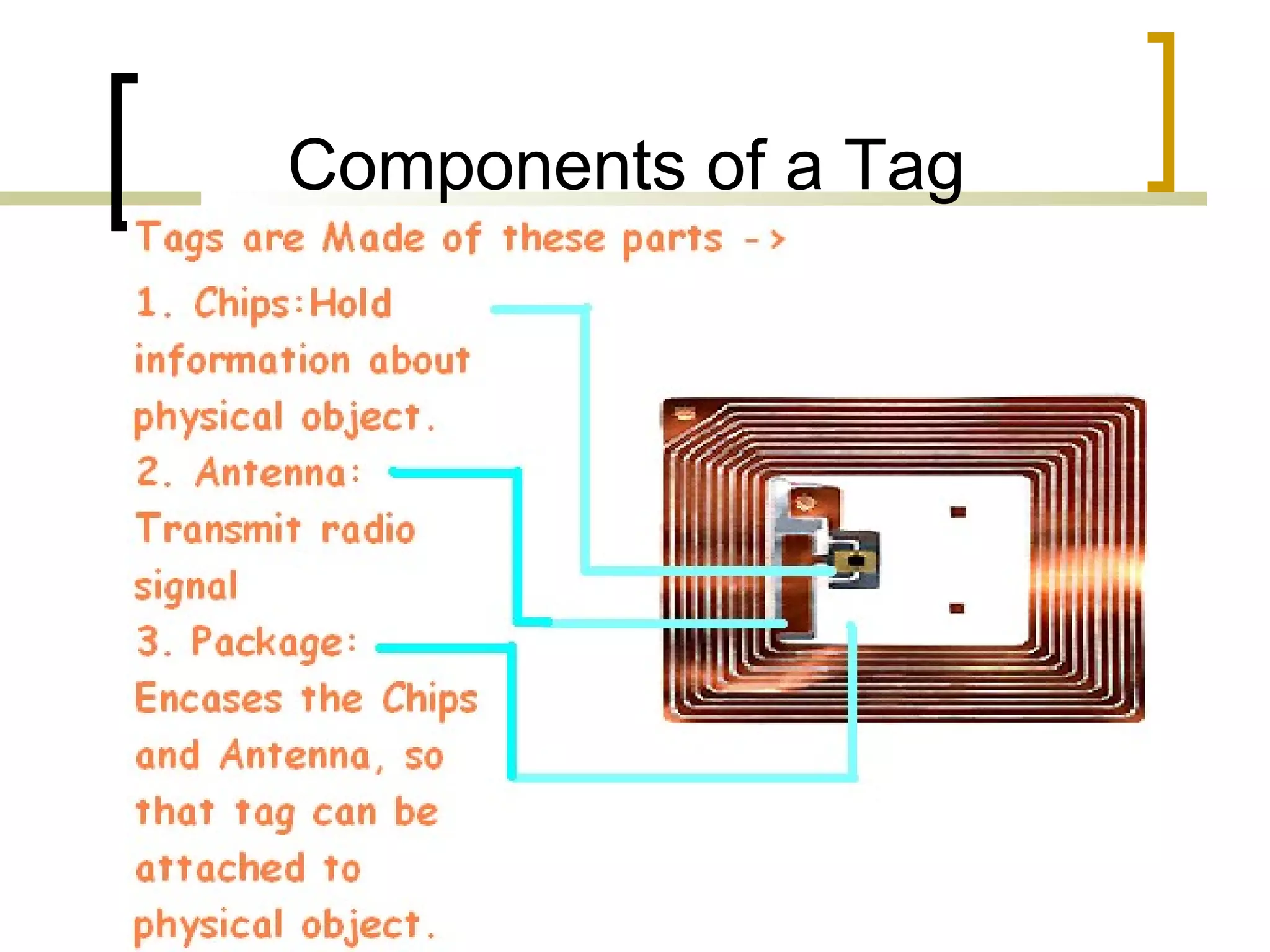
Components of a Tag
Types of Tags


Passive Tags





No battery
Low cost

Active Tags





On-board transceiver
Battery – must be replaced
Longer range
High cost
Types of Tags


Read Only





factory programmed
usually chipless

Read / Write





on-board memory
can save data
can change ID
higher cost
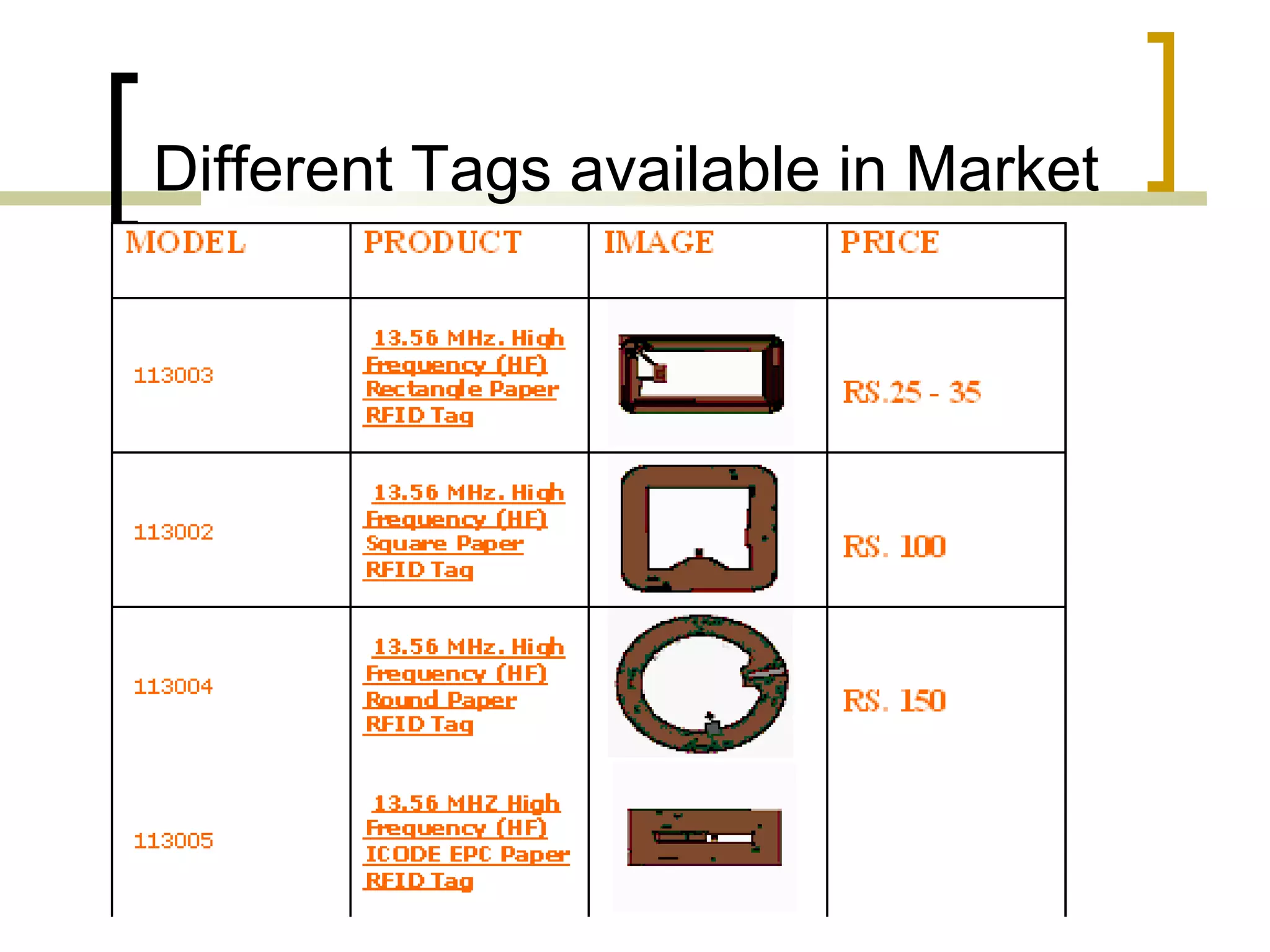
Different Tags available in Market
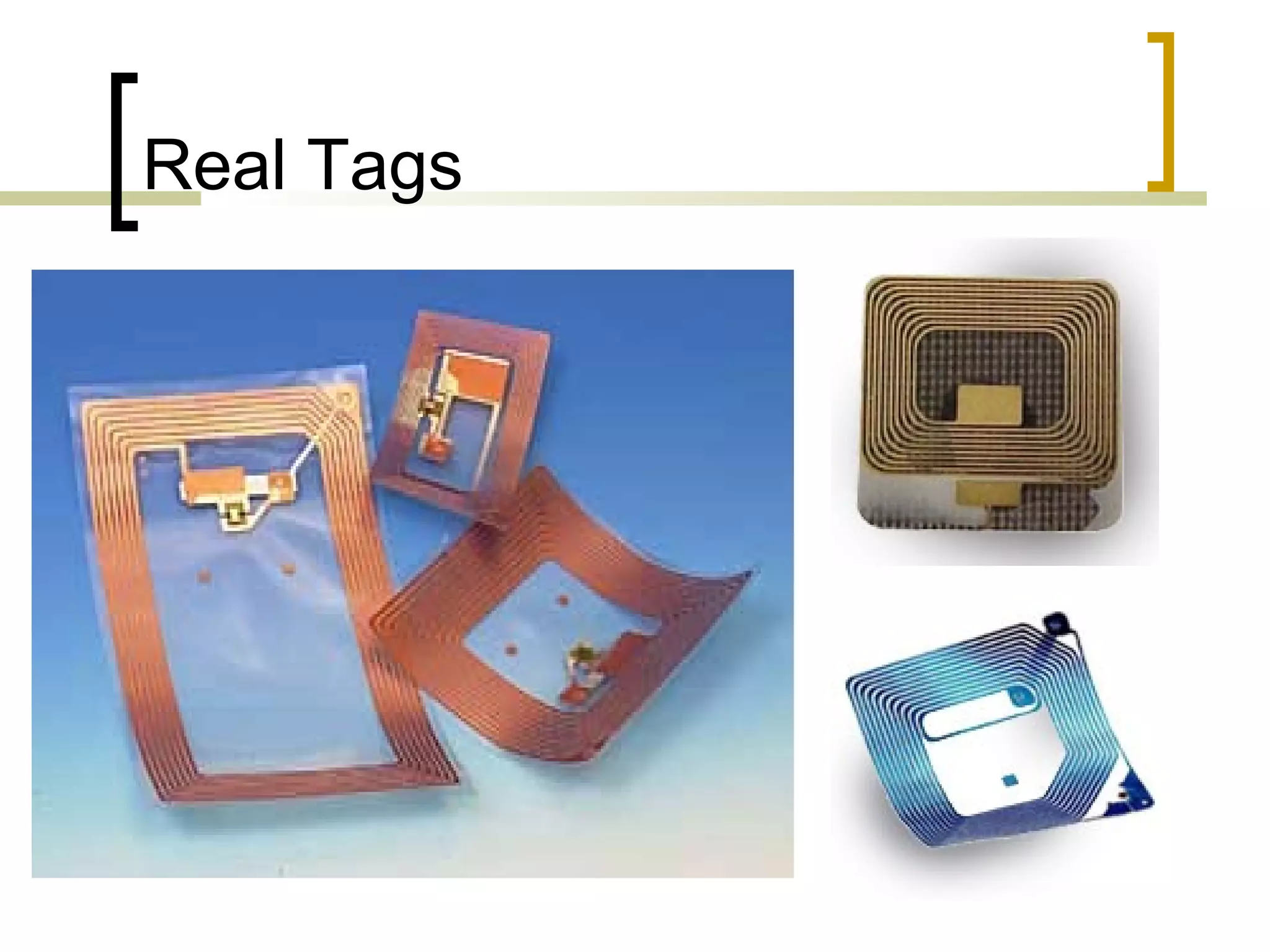
Real Tags
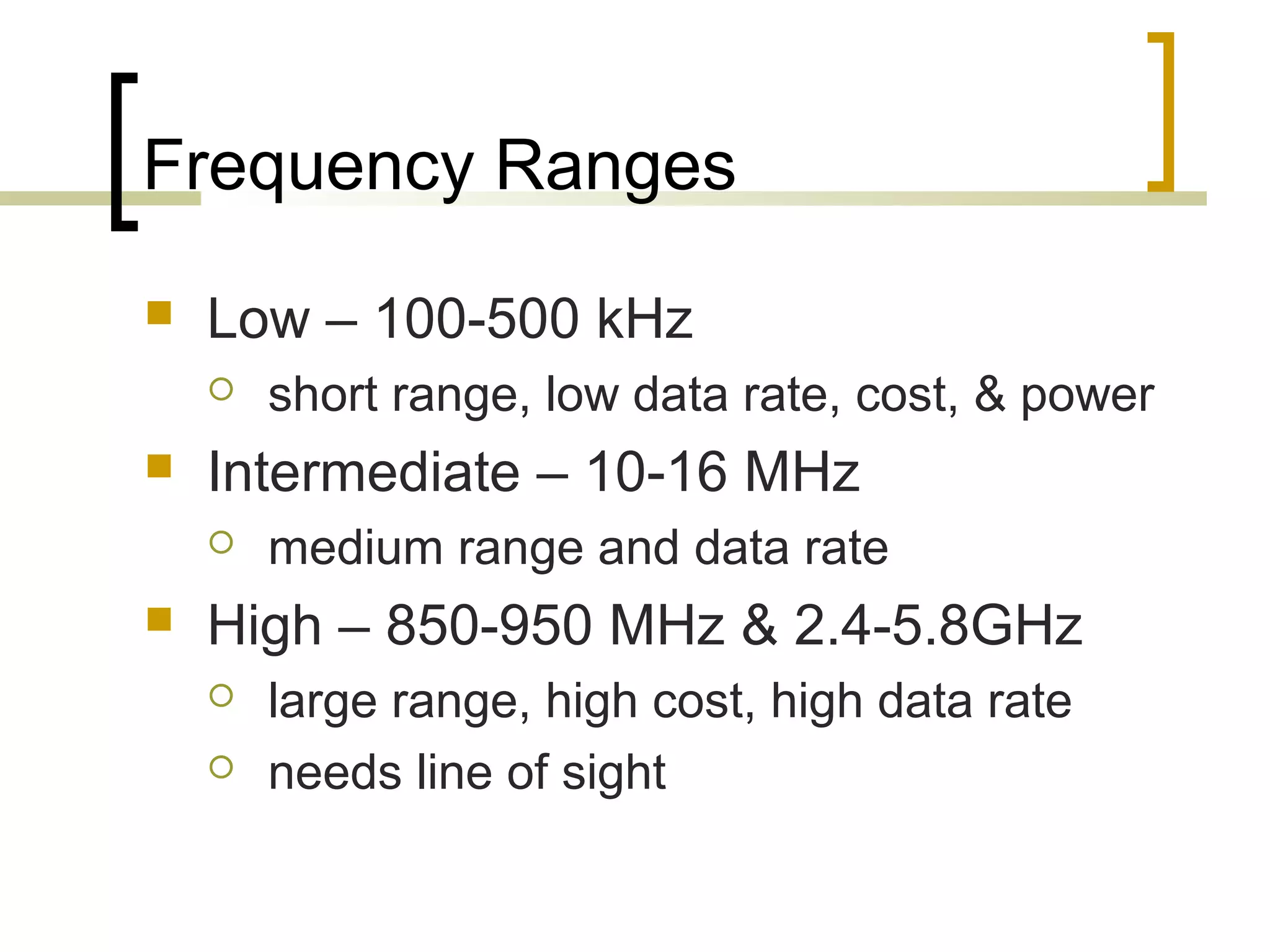
Frequency Ranges


Low – 100-500 kHz




Intermediate – 10-16 MHz




short range, low data rate, cost, & power
medium range and data rate

High – 850-950 MHz & 2.4-5.8GHz



large range, high cost, high data rate
needs line of sight
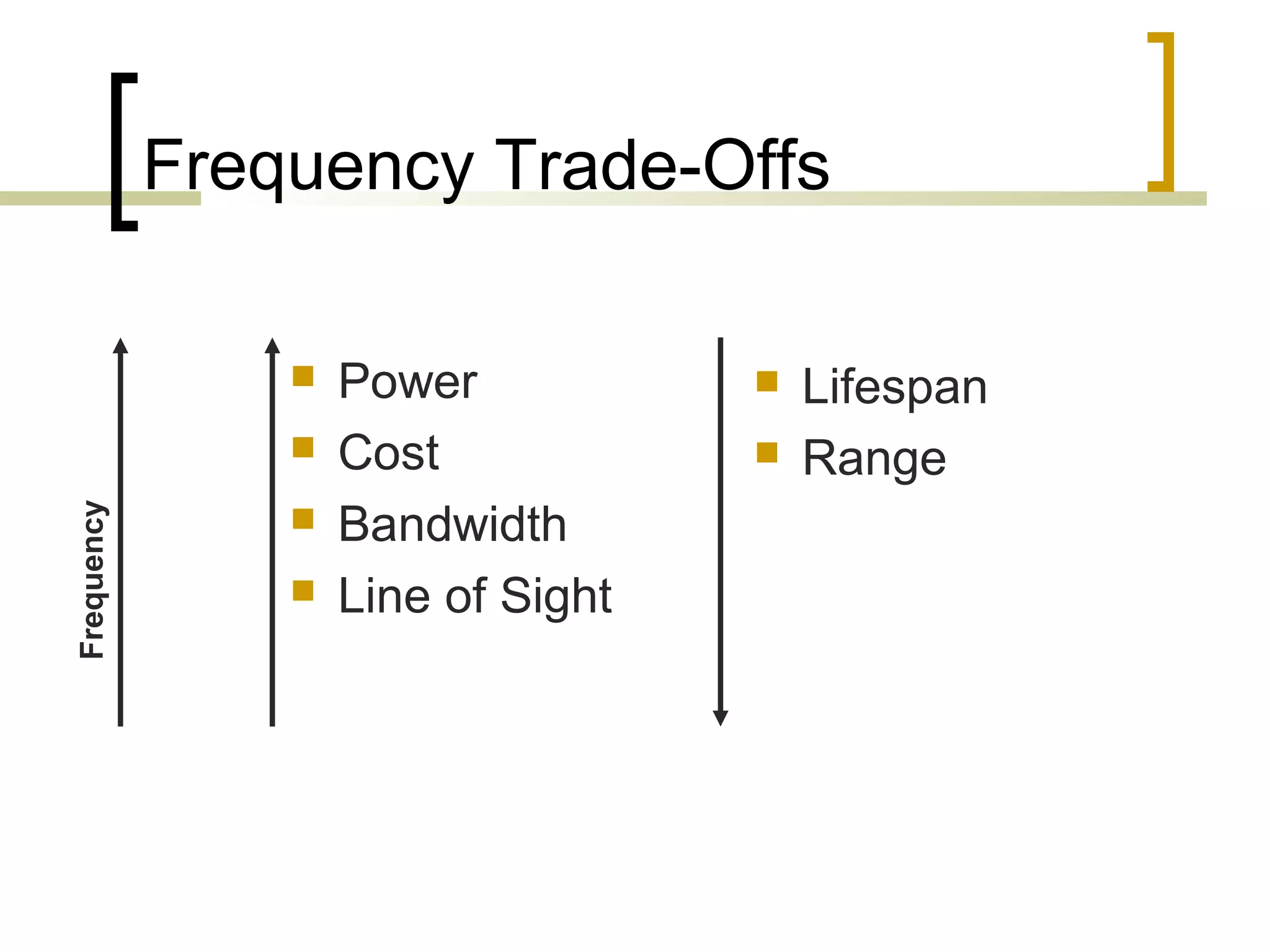
Frequency Trade-Offs


Frequency





Power
Cost
Bandwidth
Line of Sight




Lifespan
Range
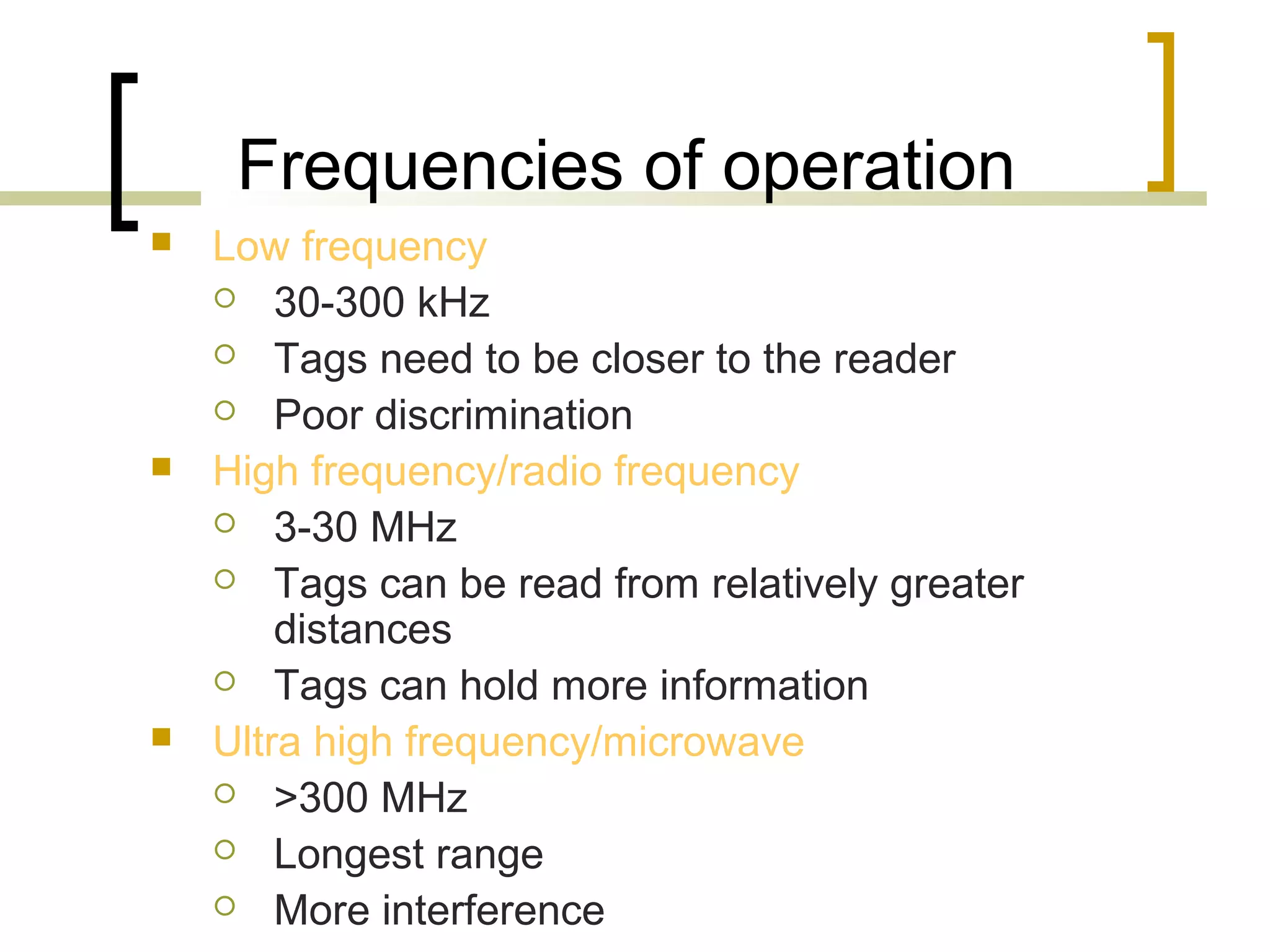
Frequencies of operation






Low frequency
 30-300 kHz
 Tags need to be closer to the reader
 Poor discrimination
High frequency/radio frequency
 3-30 MHz
 Tags can be read from relatively greater
distances
 Tags can hold more information
Ultra high frequency/microwave
 >300 MHz
 Longest range
 More interference
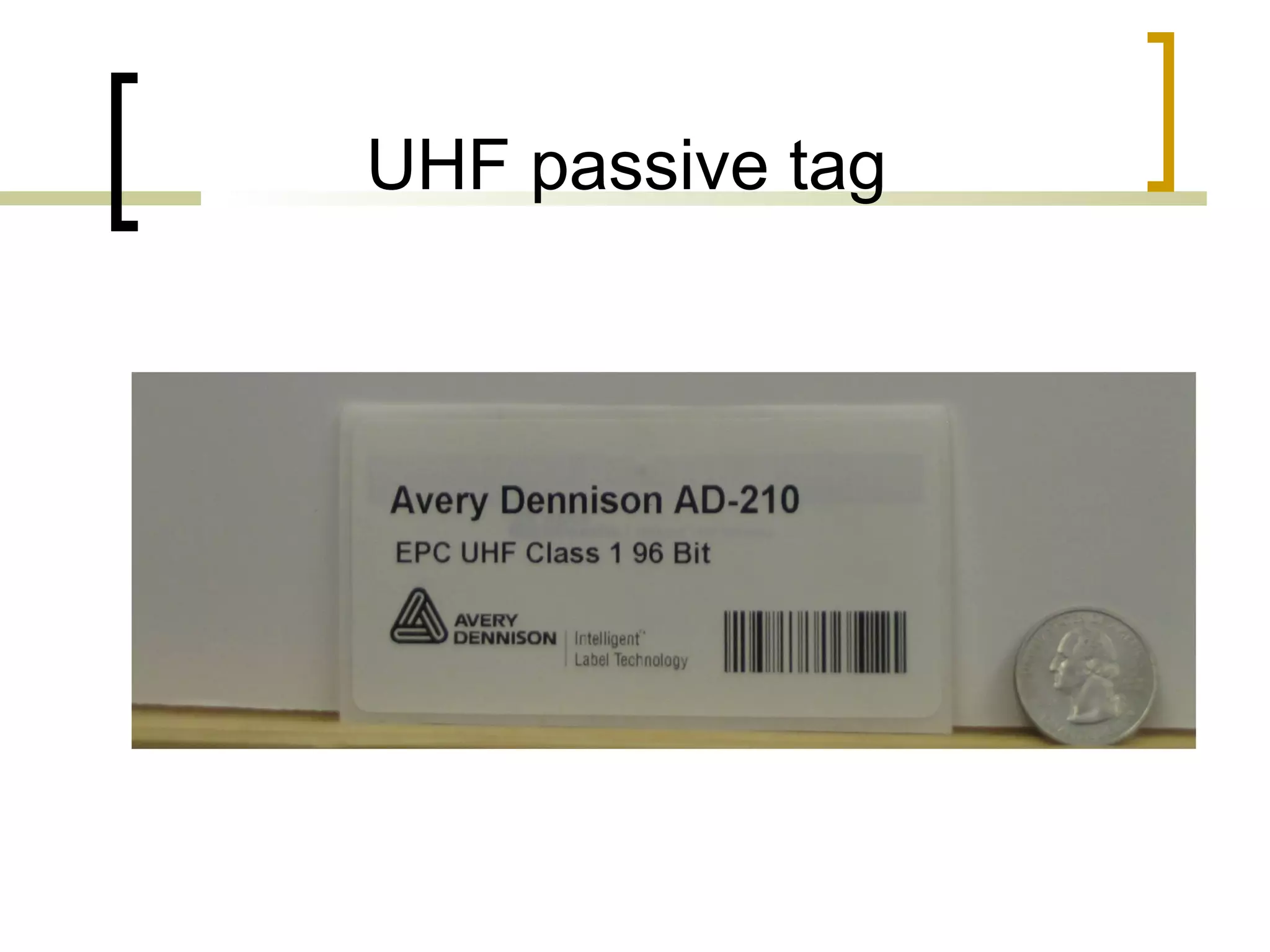
UHF passive tag
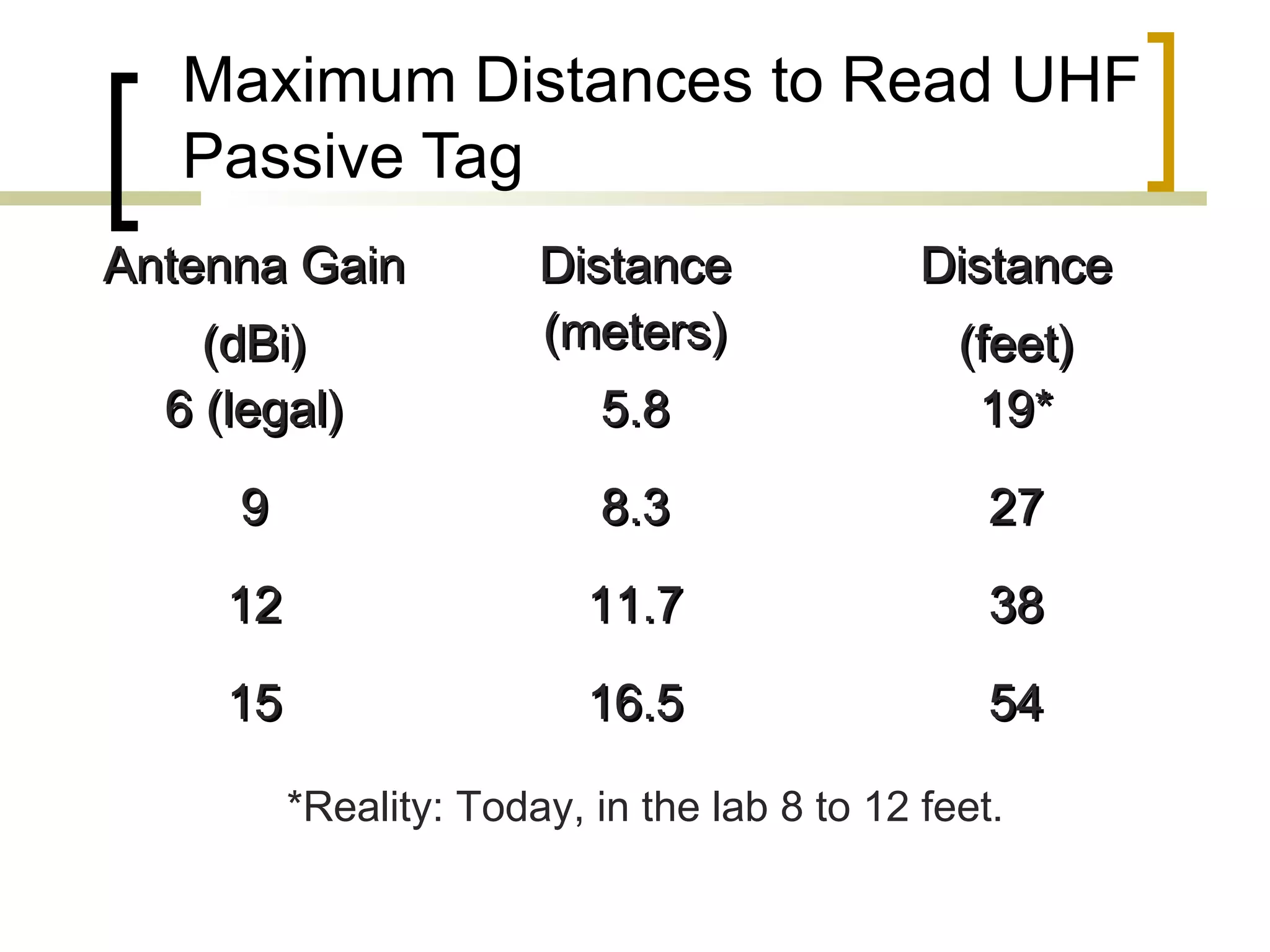
Maximum Distances to Read UHF
Passive Tag
Antenna Gain
(dBi)
6 (legal)

Distance
(meters)

Distance

5.8

(feet)
19*

9

8.3

27

12

11.7

38

15

16.5

54

*Reality: Today, in the lab 8 to 12 feet.
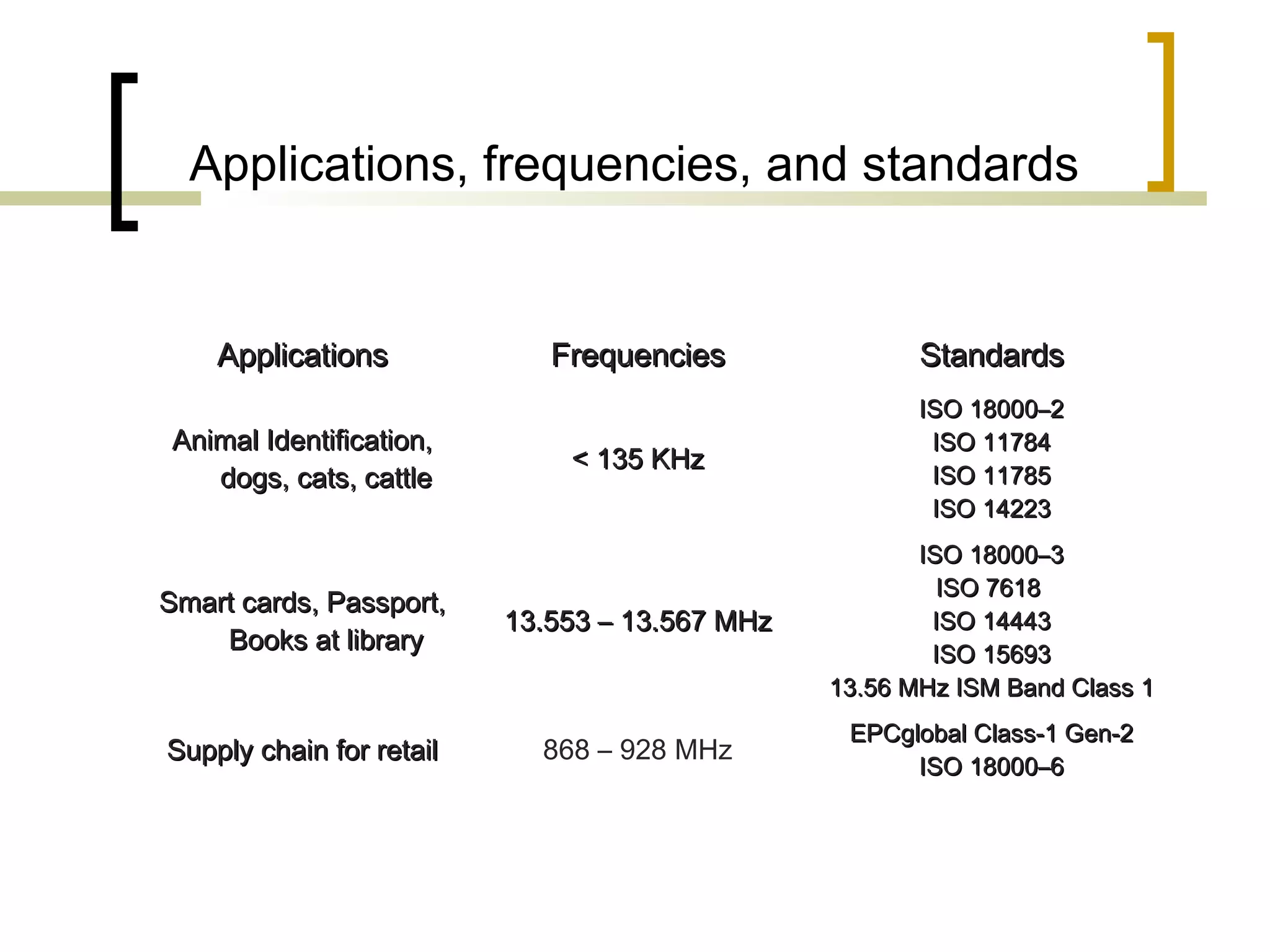
Applications, frequencies, and standards

Applications

Frequencies

Standards

< 135 KHz

ISO 18000–2
ISO 11784
ISO 11785
ISO 14223

Smart cards, Passport,
Books at library

13.553 – 13.567 MHz

ISO 18000–3
ISO 7618
ISO 14443
ISO 15693
13.56 MHz ISM Band Class 1

Supply chain for retail

868 – 928 MHz

EPCglobal Class-1 Gen-2
ISO 18000–6

Animal Identification,
dogs, cats, cattle
Data Transfer



Frequency Shift Keying (FSK)
Phase Shift Keying (PSK)
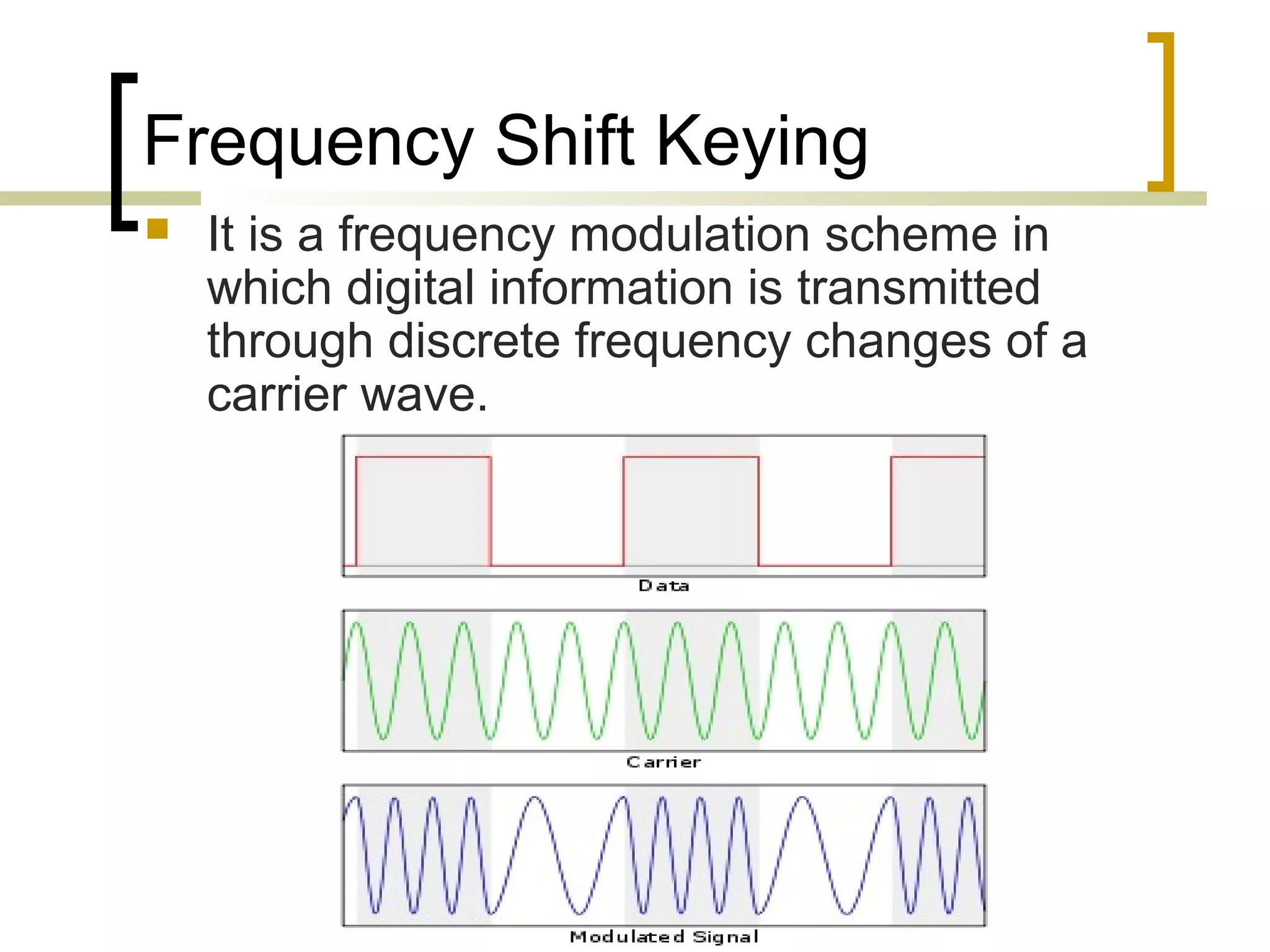
Frequency Shift Keying


It is a frequency modulation scheme in
which digital information is transmitted
through discrete frequency changes of a
carrier wave.
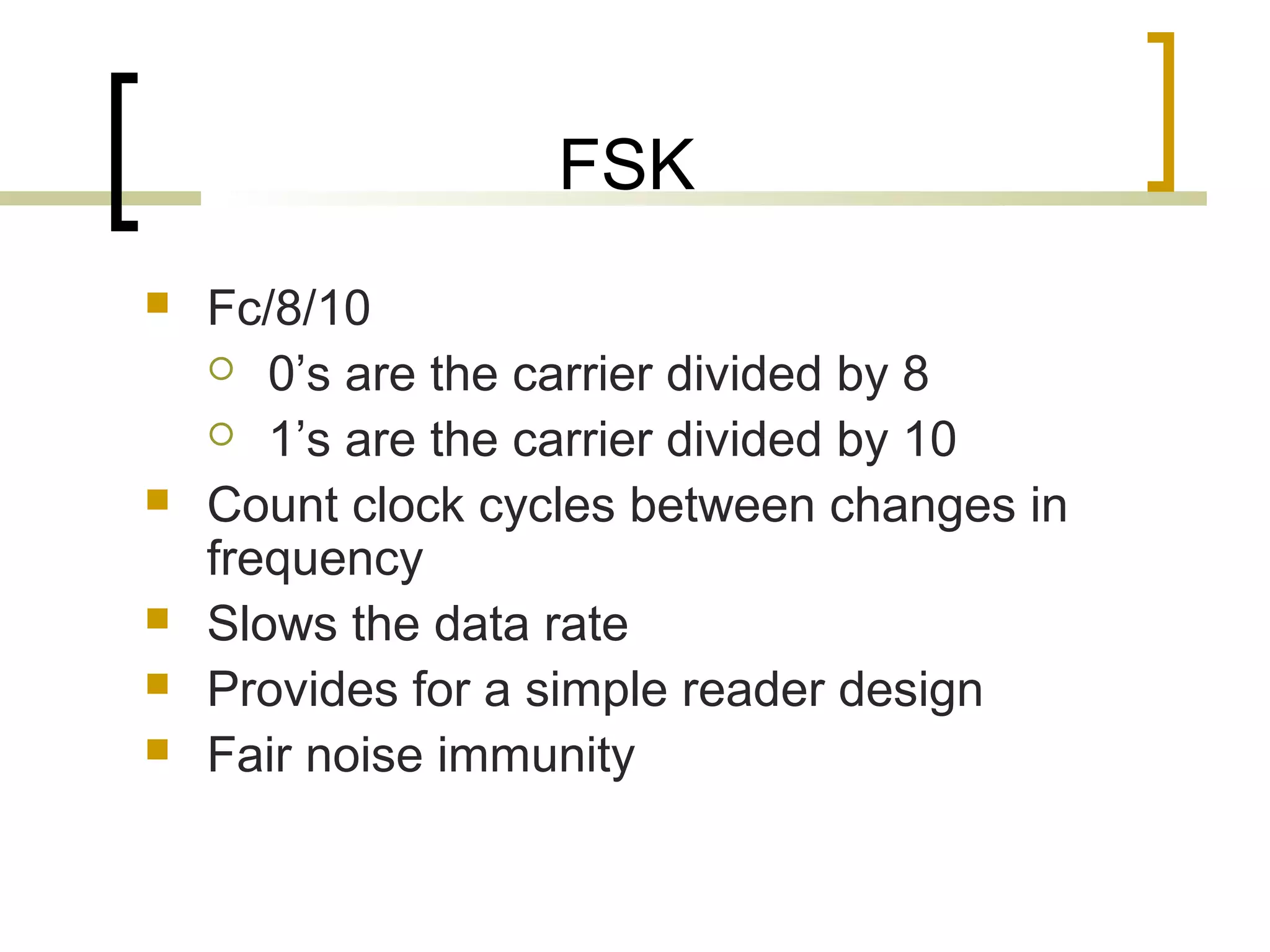
FSK







Fc/8/10
 0’s are the carrier divided by 8
 1’s are the carrier divided by 10
Count clock cycles between changes in
frequency
Slows the data rate
Provides for a simple reader design
Fair noise immunity
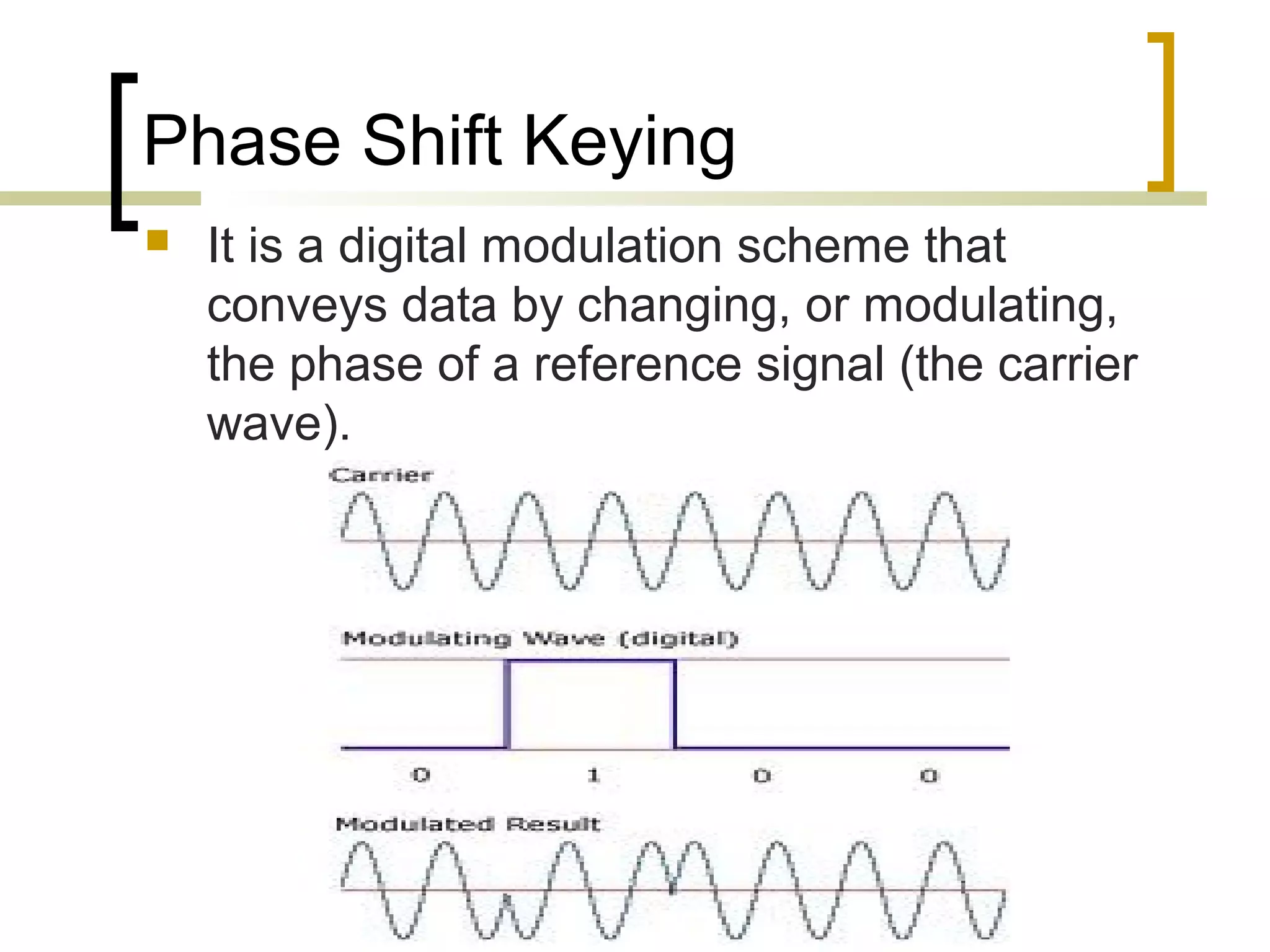
Phase Shift Keying


It is a digital modulation scheme that
conveys data by changing, or modulating,
the phase of a reference signal (the carrier
wave).
PSK


One frequency






Change the phase on the transition
between a 0 to 1 or 1 to 0

Faster data rate than FSK
Noise immunity
Slightly more difficult to build a reader
than FSK
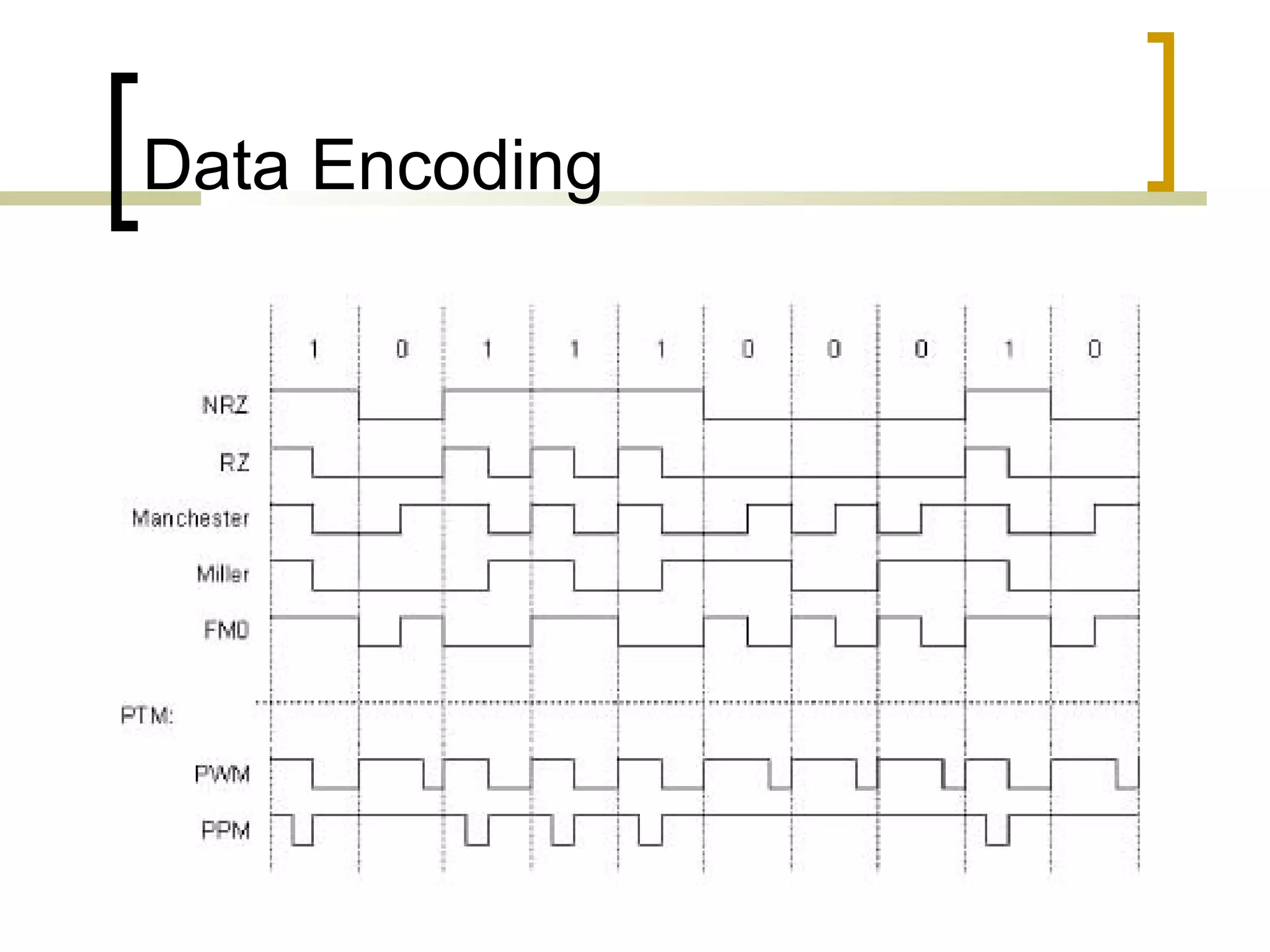
Data Encoding
Multiple Tags?






What happens when multiple tags are
in range of the transceiver?
All the tags will be excited at the same
time.
Makes it very difficult to distinguish
between the tags.
Collision Avoidance



Similar to network collision avoidance
Probabilistic




Tags return at random times
Deterministic


Reader searches for specific tags
General Applications used in our
Day-to-Day Life




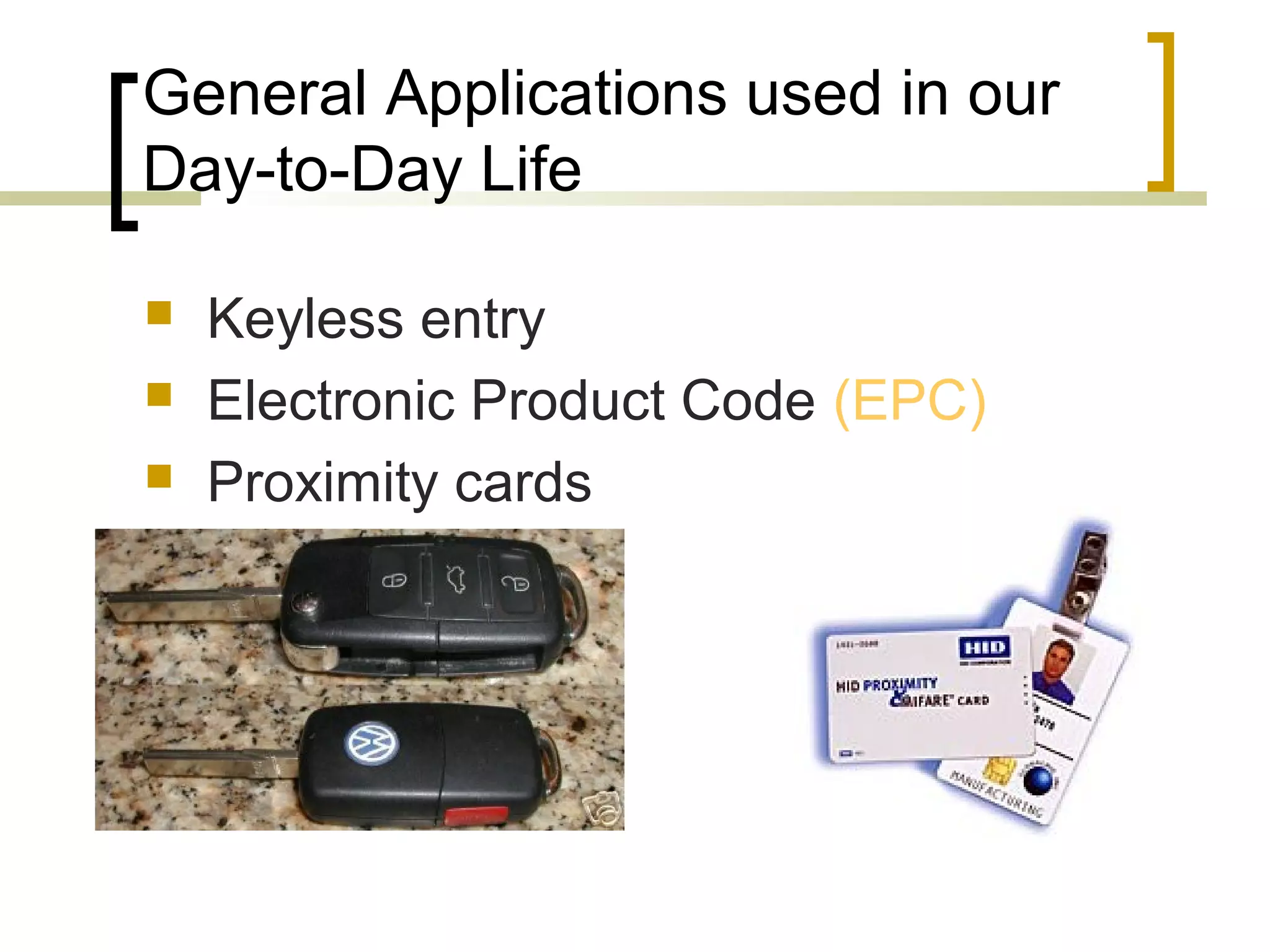
Keyless entry
Electronic Product Code (EPC)
Proximity cards
General Applications (cont’d)


Payment tokens






Contact-less credit cards
Automatic toll-payment

Euro banknotes
Passports
General Applications (cont’d)



Libraries
Security device


Bookstores
Current Applications







Livestock Tagging
Wild Animal Tracking
Electronic Article Surveillance (EAS)
Automated Toll Collection
Animal Husbandry
Vehicle Anti-Theft
More Applications





Passive / Secure Entry
Airline Baggage Tracking
Postal Package Tracking
Time and Attendance
Security Applications






RFID used to grant entry to secure
areas
Tracks time and movement of people
Dynamically change access codes
Provide automated entry
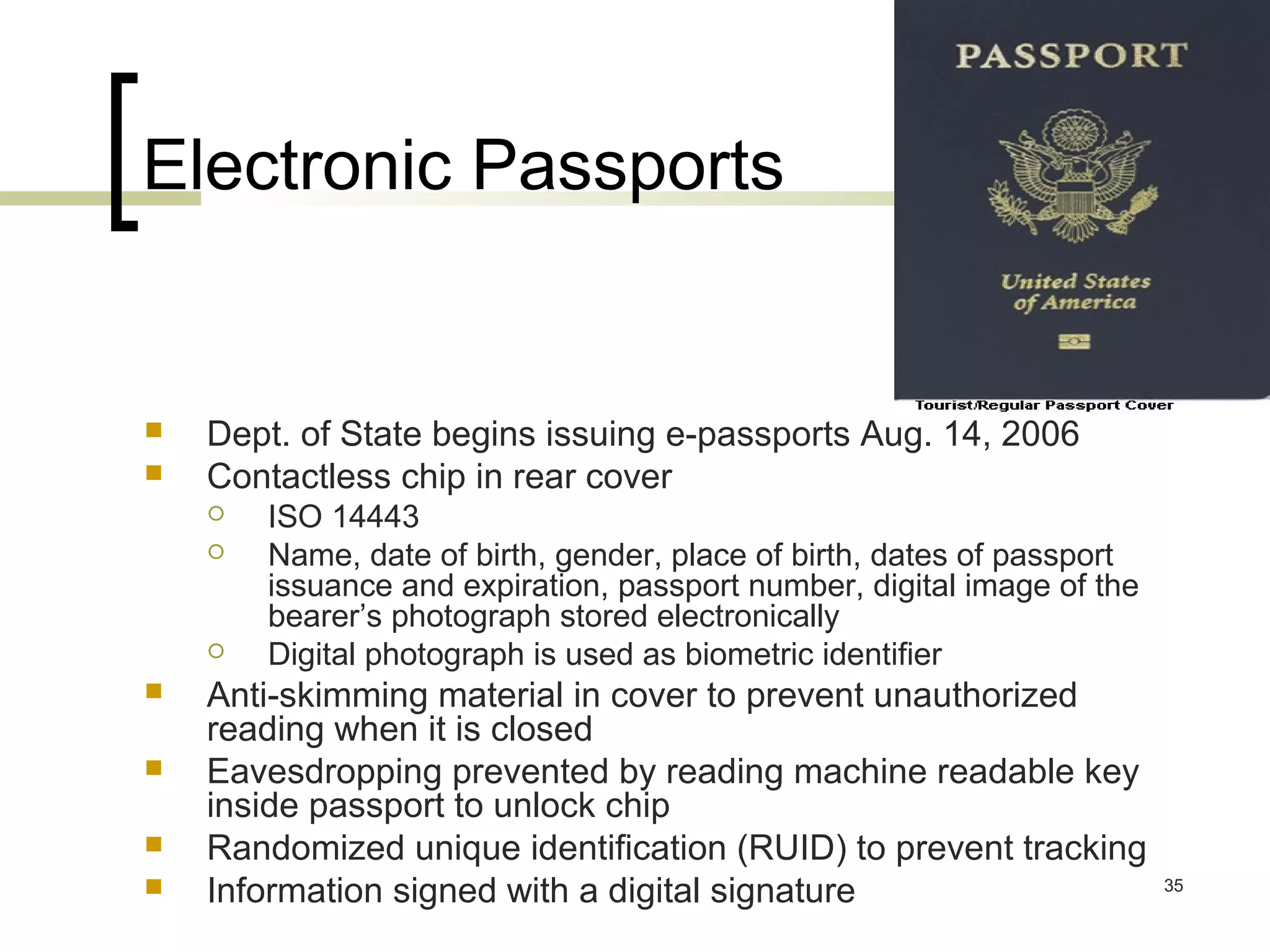
Electronic Passports




Dept. of State begins issuing e-passports Aug. 14, 2006
Contactless chip in rear cover










ISO 14443
Name, date of birth, gender, place of birth, dates of passport
issuance and expiration, passport number, digital image of the
bearer’s photograph stored electronically
Digital photograph is used as biometric identifier

Anti-skimming material in cover to prevent unauthorized
reading when it is closed
Eavesdropping prevented by reading machine readable key
inside passport to unlock chip
Randomized unique identification (RUID) to prevent tracking
Information signed with a digital signature

35
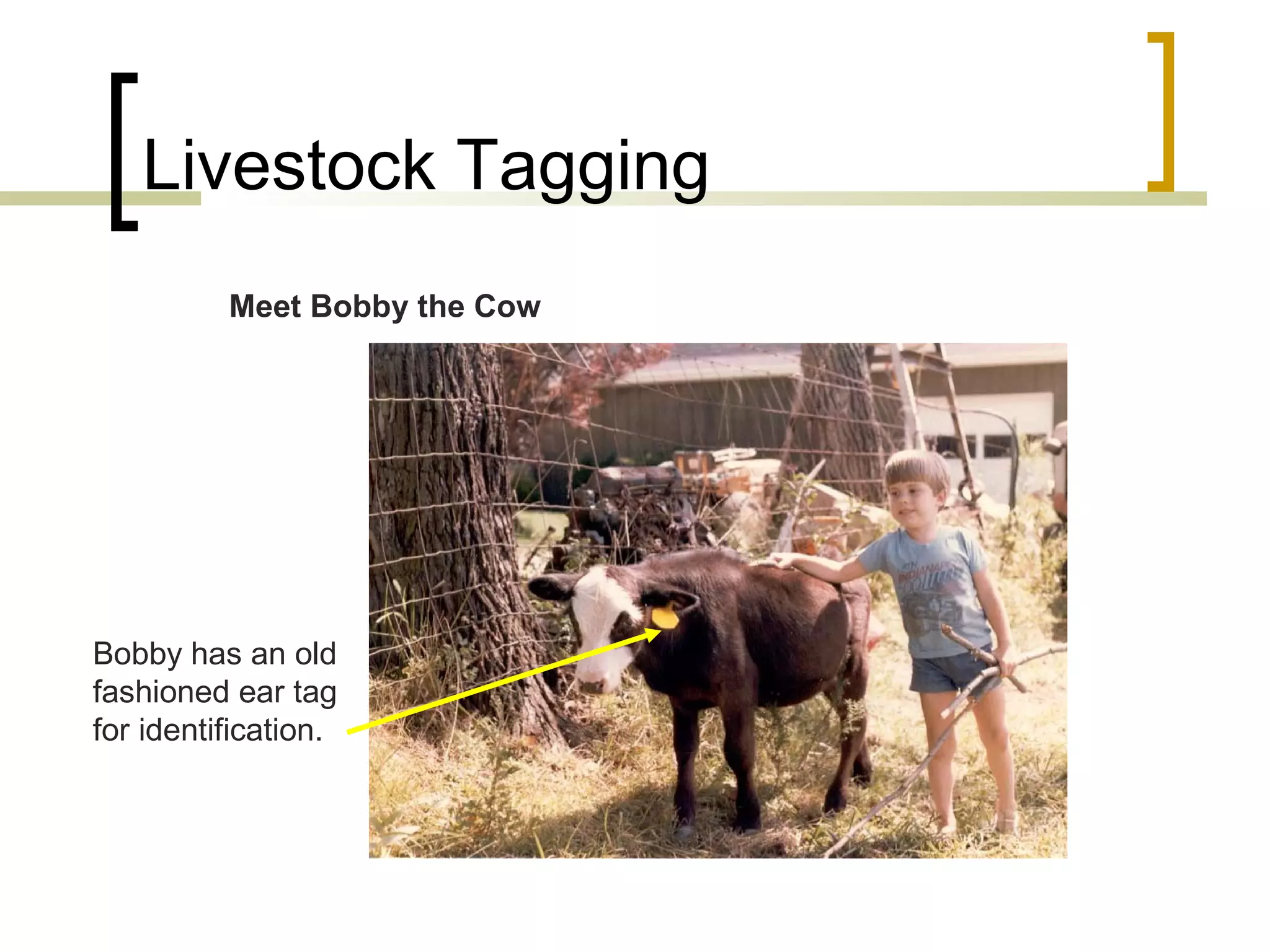
Livestock Tagging
Meet Bobby the Cow

Bobby has an old
fashioned ear tag
for identification.
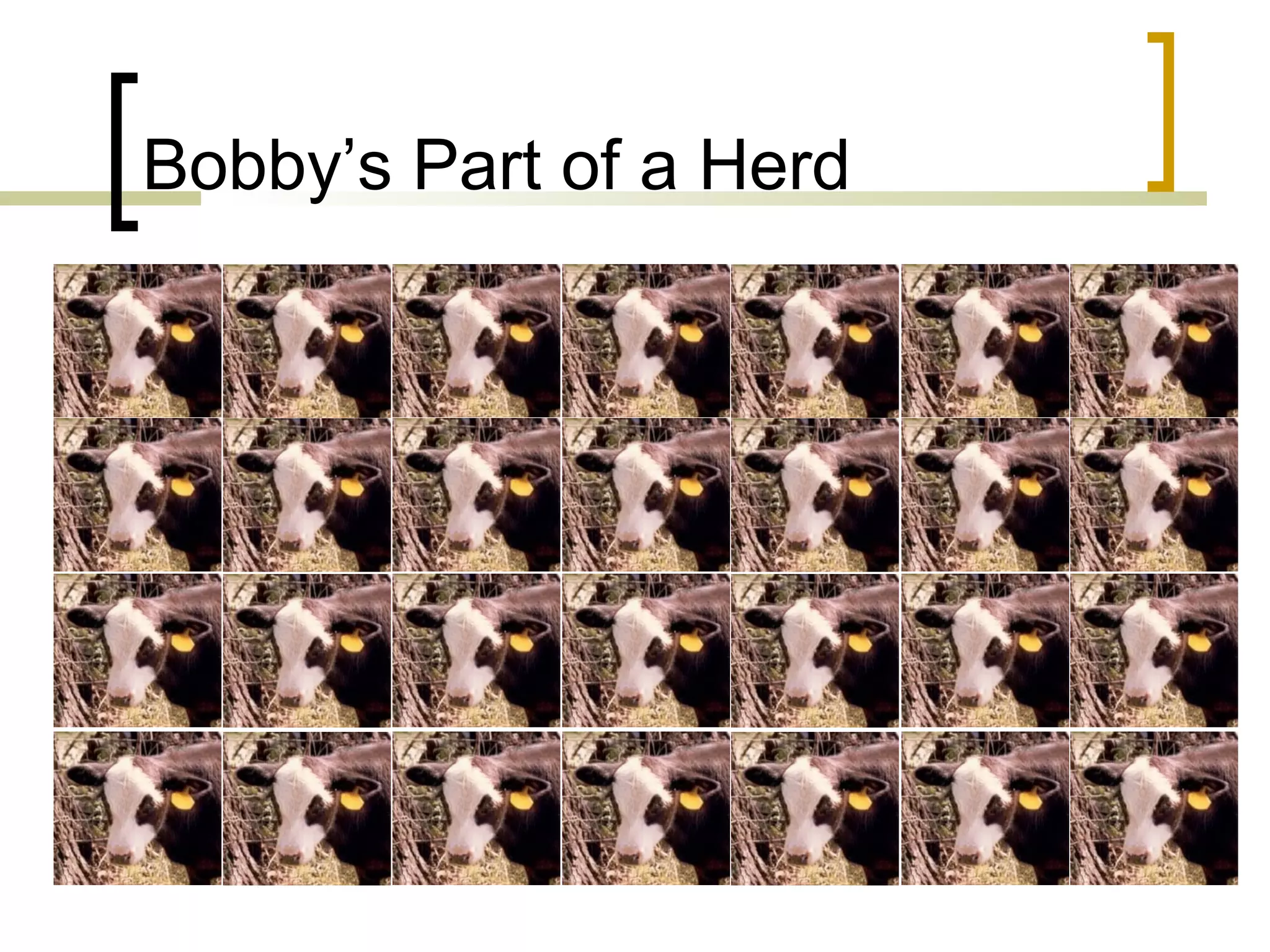
Bobby’s Part of a Herd
Benefits in Livestock Tagging



Each one needs to be recorded
Why use RFID tags instead of the oldfashioned tags?



cows get dirty
herds can be large
Animal Identification Standards




Pets such as dogs and cats
Livestock such as cattle, pigs, etc.
International standard 134.2 kHz






ISO 11784: “Radio-frequency identification of
animals” – code structure
ISO 11785: “Radio-frequency identification of
animals” – Technical concept
ISO 14223: “Radio-frequency identification of
animals” – Advanced transponders

At these frequencies the RF can
penetrate mud, blood, and water
VeriChip







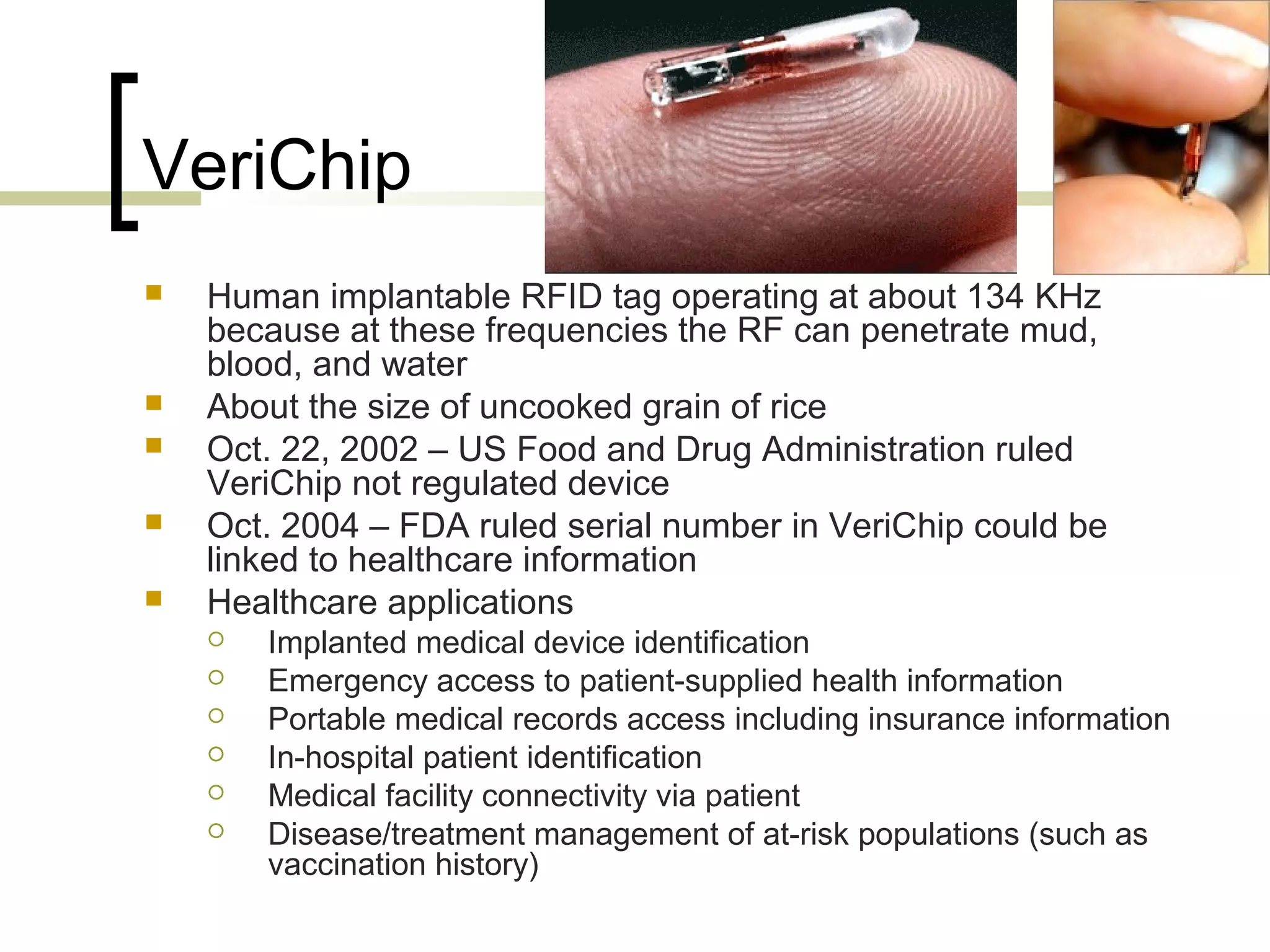
Human implantable RFID tag operating at about 134 KHz
because at these frequencies the RF can penetrate mud,
blood, and water
About the size of uncooked grain of rice
Oct. 22, 2002 – US Food and Drug Administration ruled
VeriChip not regulated device
Oct. 2004 – FDA ruled serial number in VeriChip could be
linked to healthcare information
Healthcare applications







Implanted medical device identification
Emergency access to patient-supplied health information
Portable medical records access including insurance information
In-hospital patient identification
Medical facility connectivity via patient
Disease/treatment management of at-risk populations (such as
vaccination history)
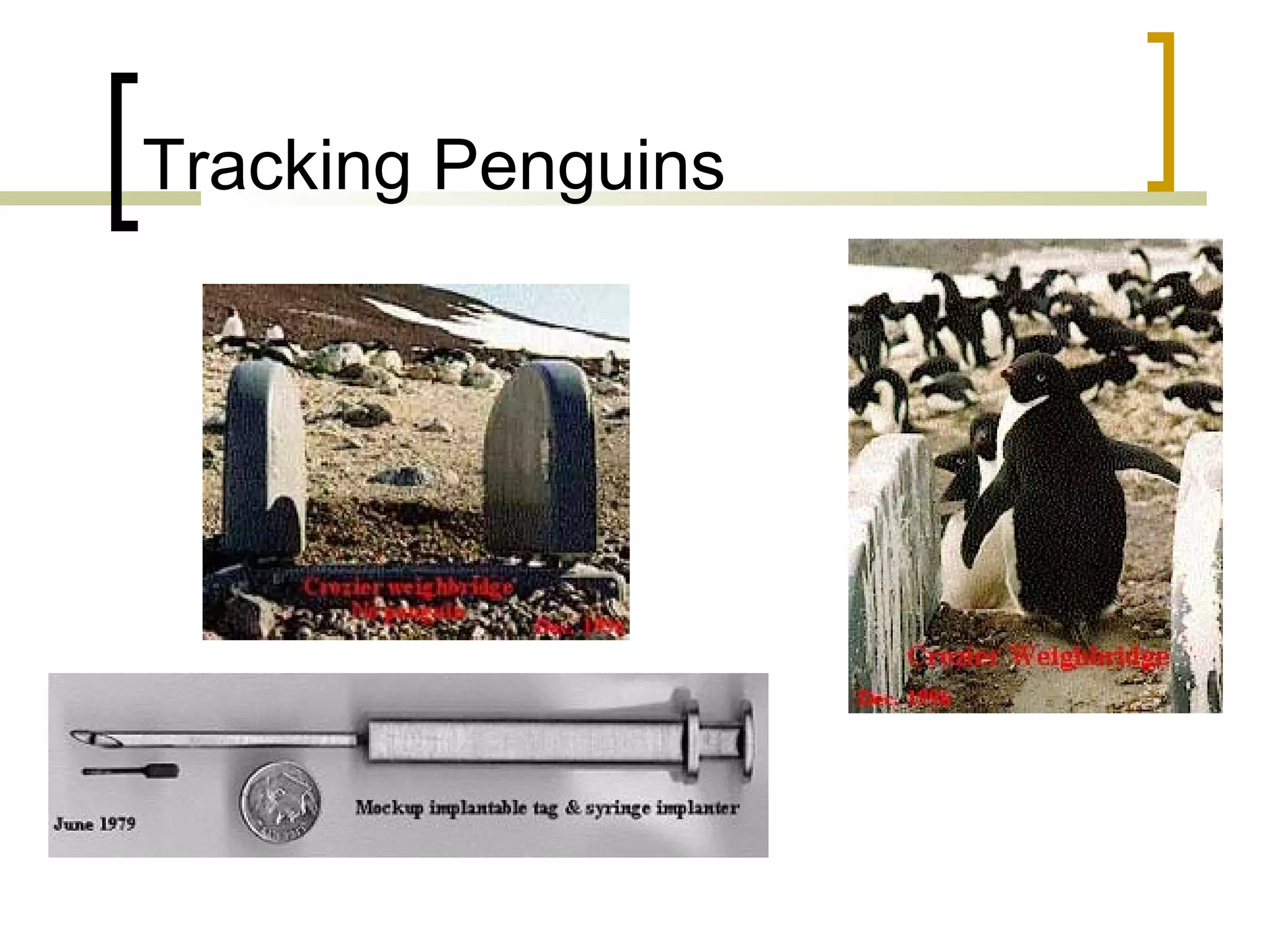
Tracking Penguins
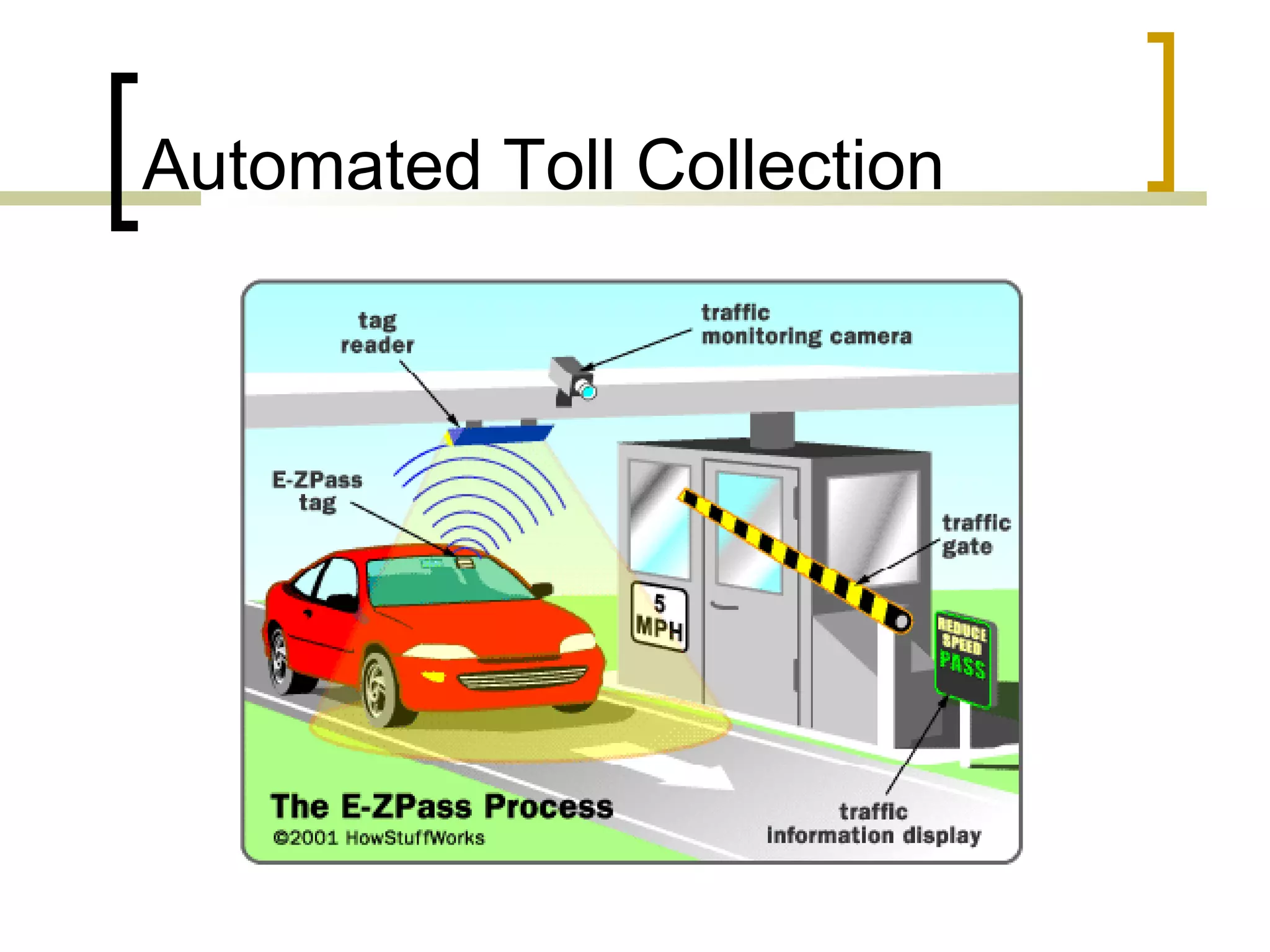
Automated Toll Collection
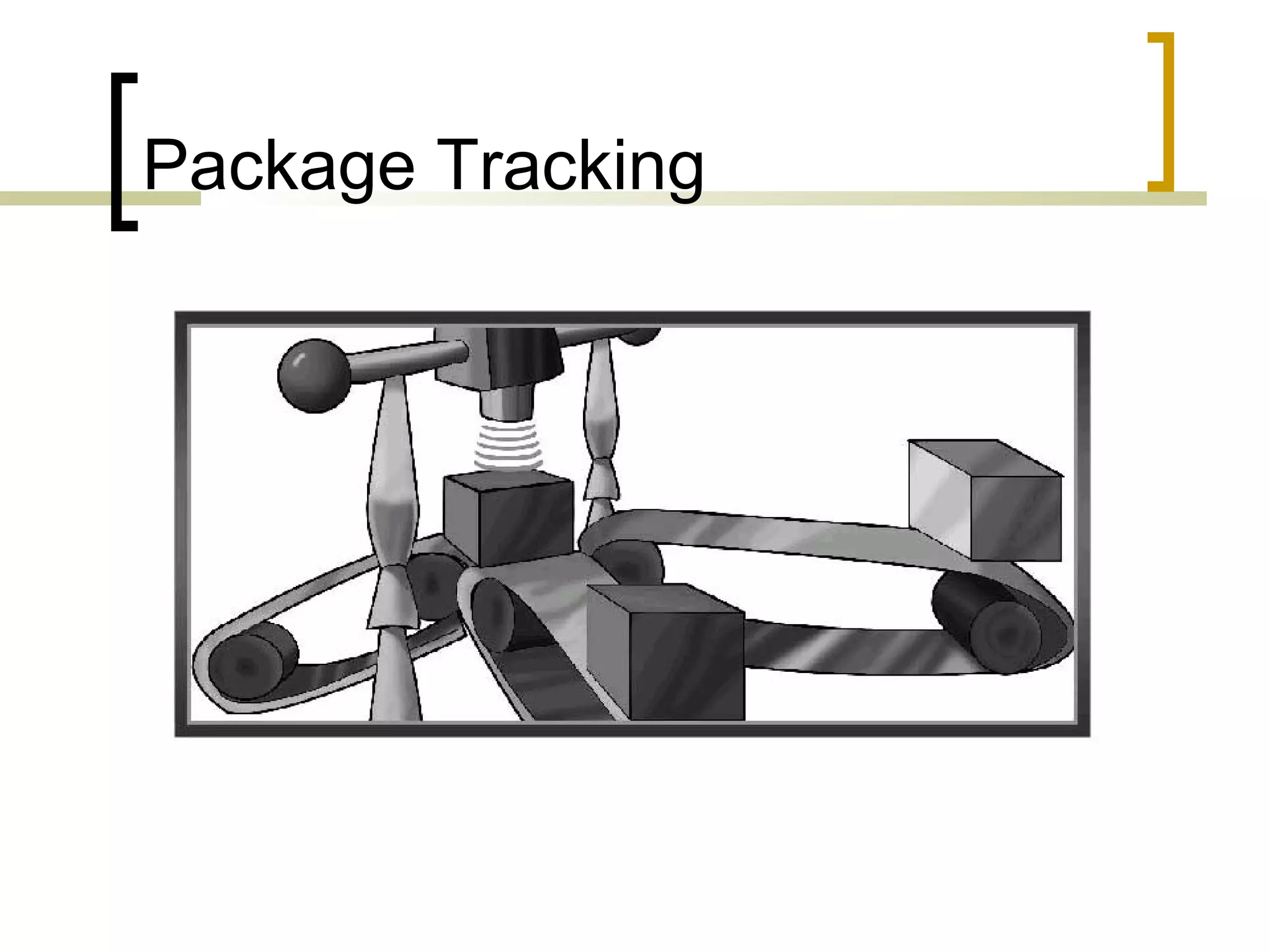
Package Tracking
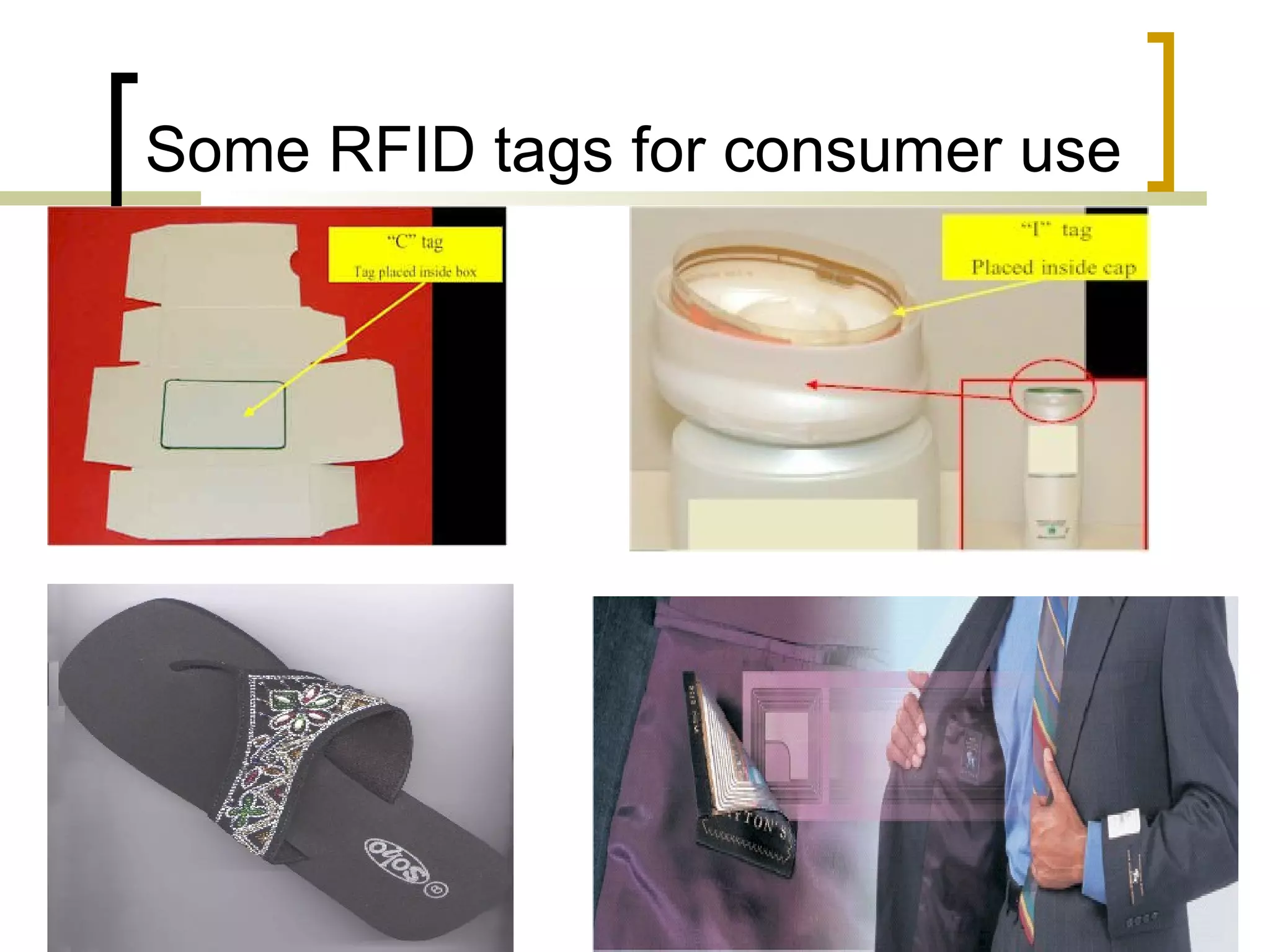
Some RFID tags for consumer use
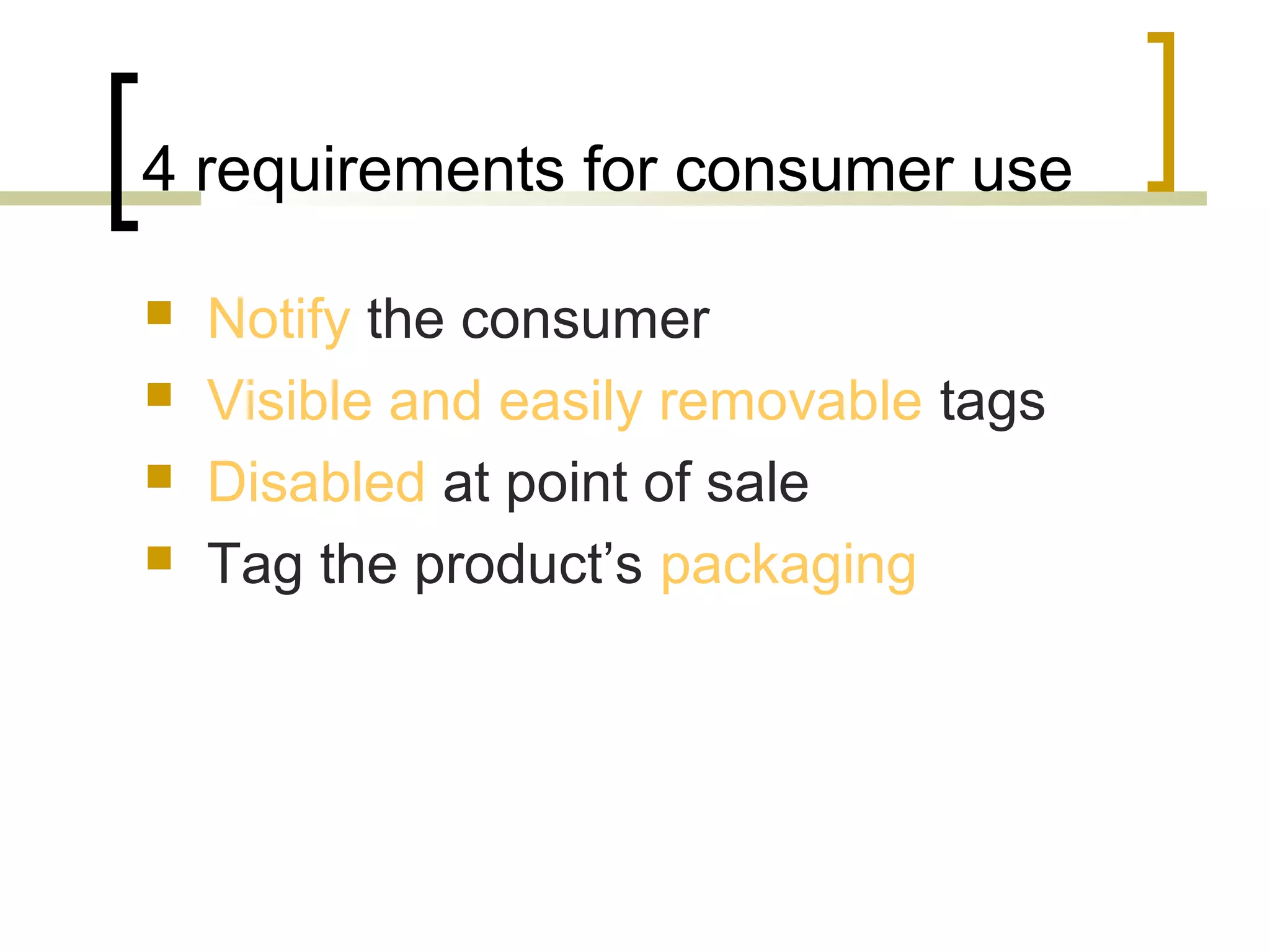
4 requirements for consumer use





Notify the consumer
Visible and easily removable tags
Disabled at point of sale
Tag the product’s packaging
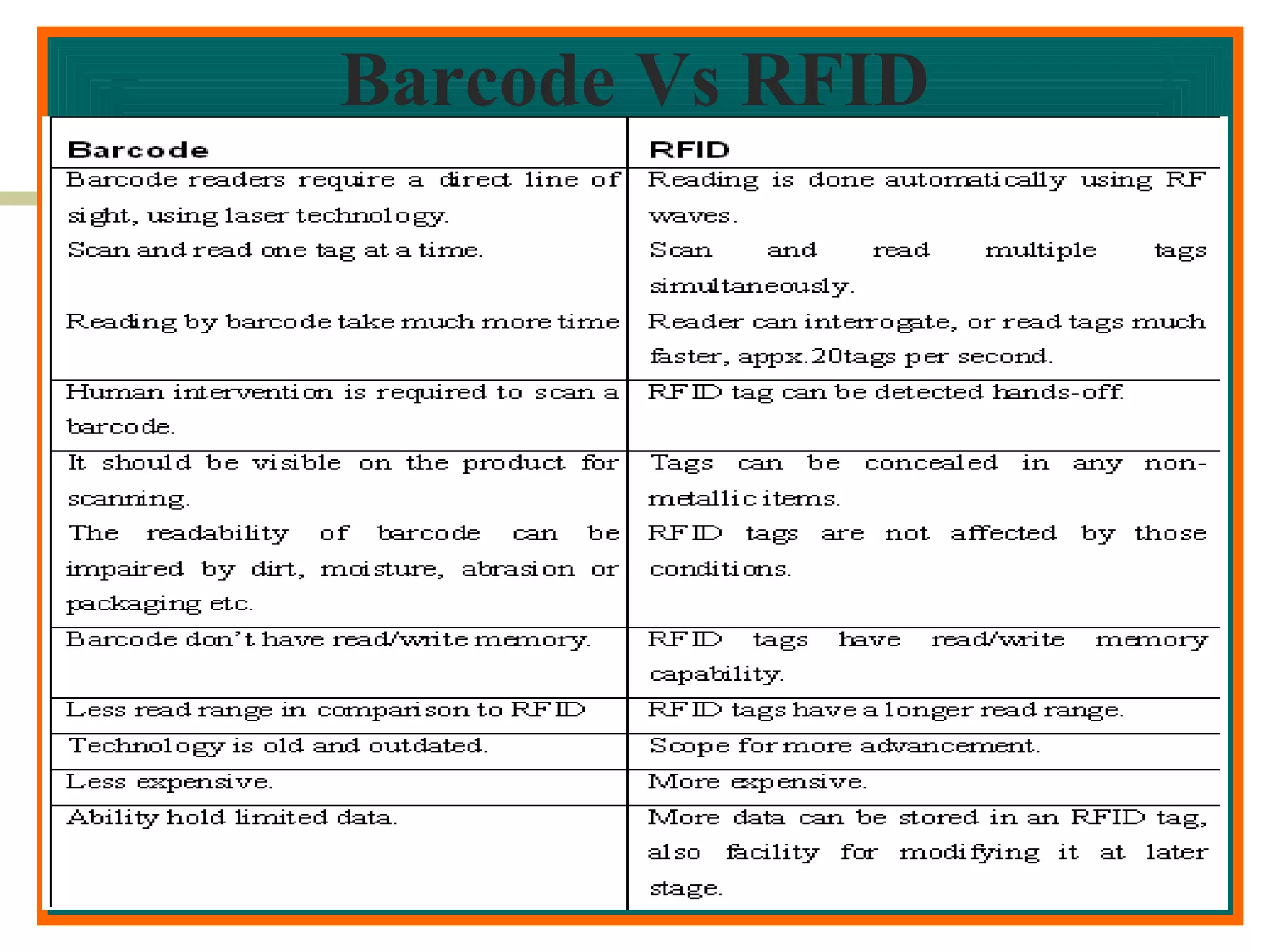
Barcode Vs RFID
Potential Applications




Smart Grocery Store
Smart Kitchen
Smart Sitterson
Smart Grocery Store





Every item in the store already has a
bar code.
Why not use an RFID tag?
Speed up checkouts
Smart Grocery Store




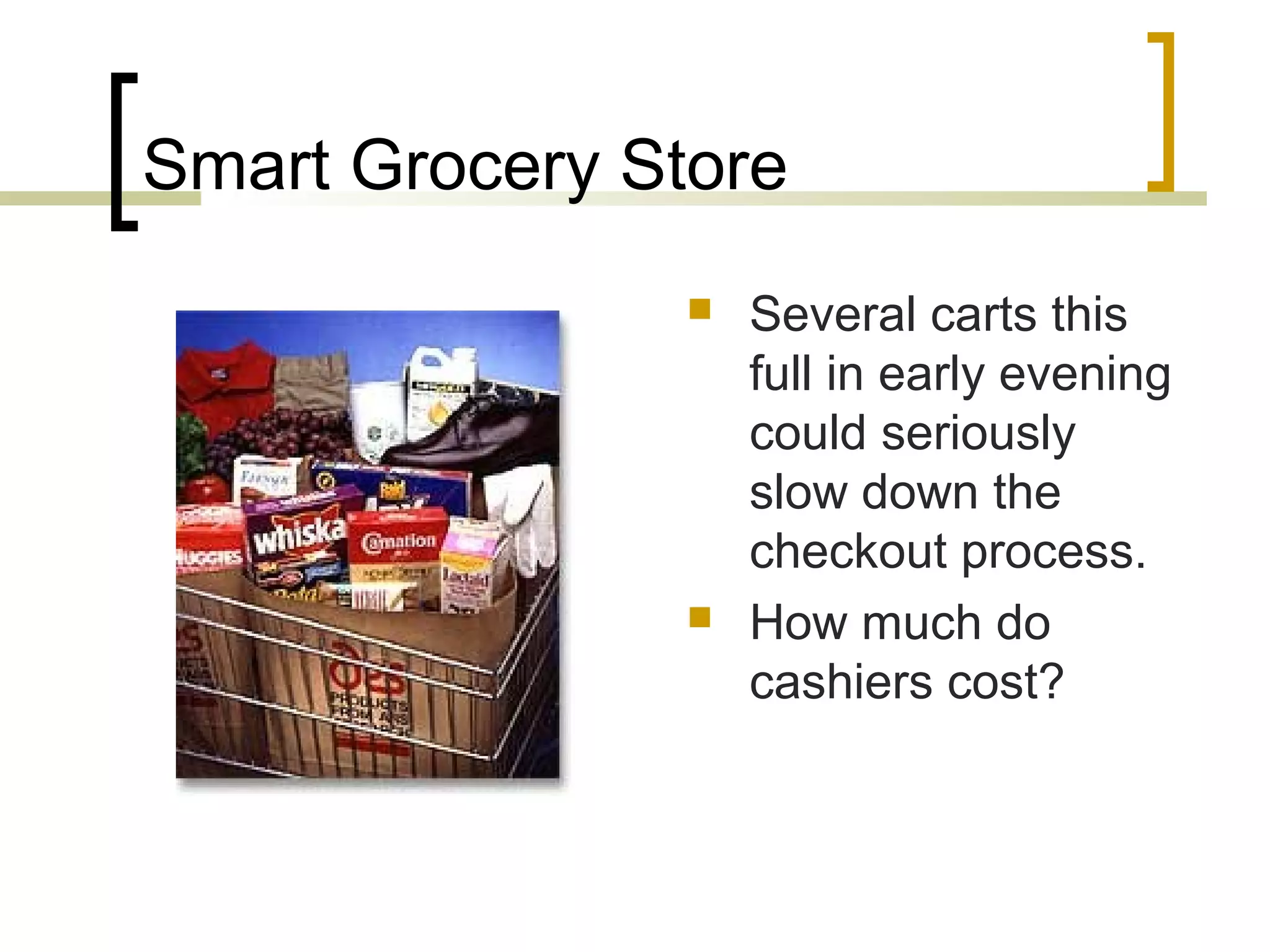
Several carts this
full in early evening
could seriously
slow down the
checkout process.
How much do
cashiers cost?
Smart Grocery Store






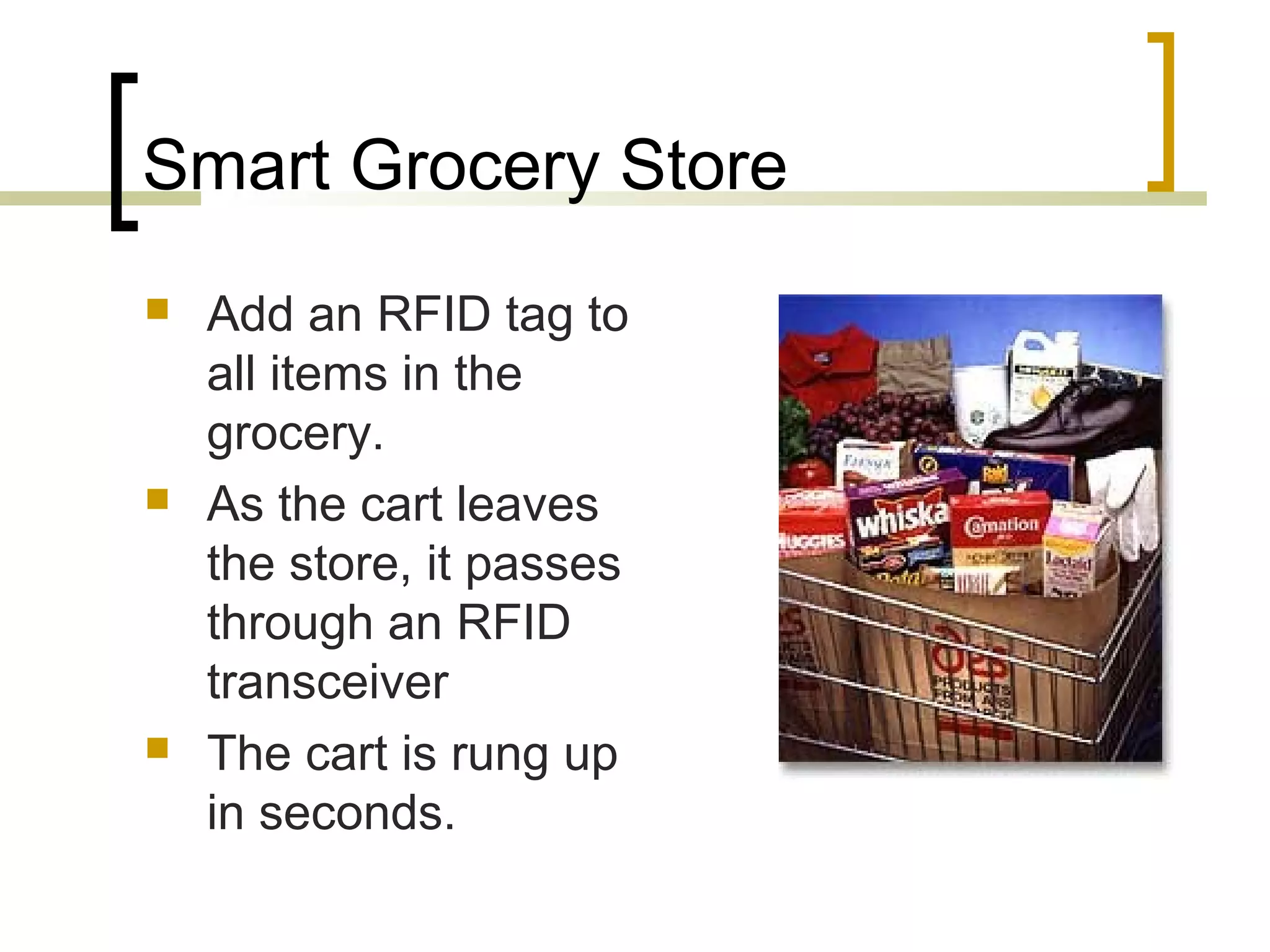
Add an RFID tag to
all items in the
grocery.
As the cart leaves
the store, it passes
through an RFID
transceiver
The cart is rung up
in seconds.
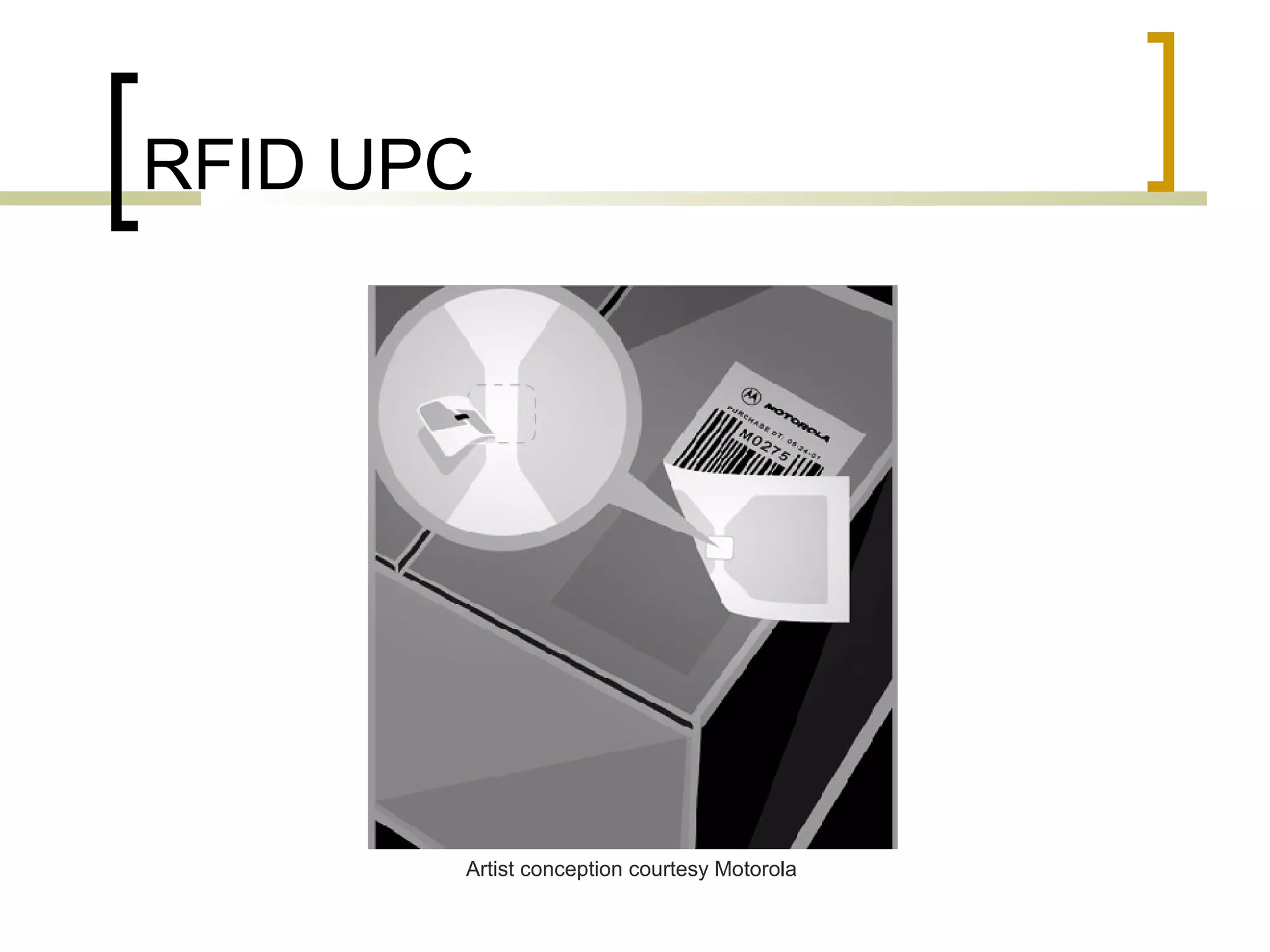
RFID UPC

Artist conception courtesy Motorola
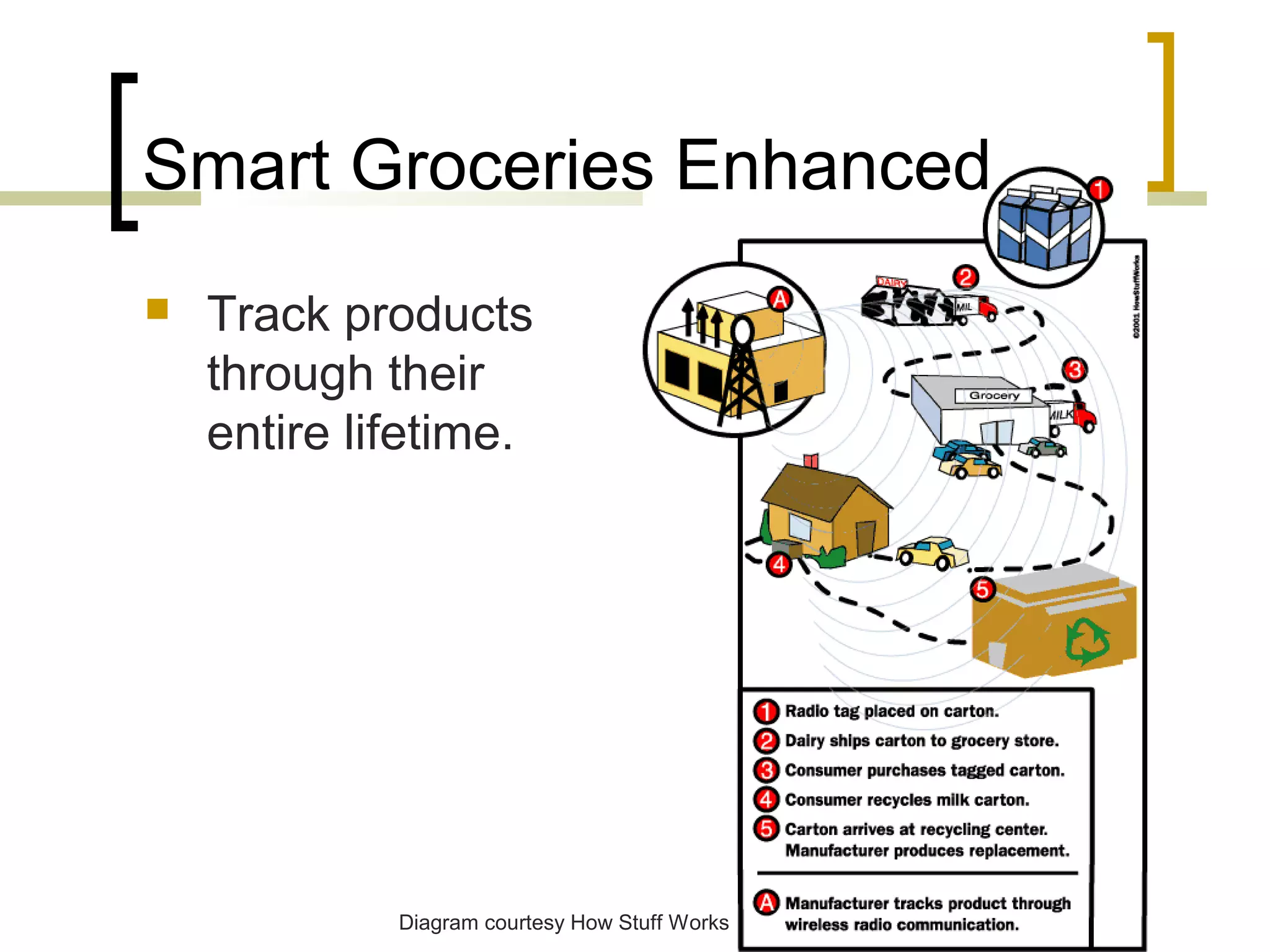
Smart Groceries Enhanced


Track products
through their
entire lifetime.

Diagram courtesy How Stuff Works
Smart Fridge





Recognizes what’s been put in it
Recognizes when things are removed
Creates automatic shopping lists
Notifies you when things are past their
expiration
RFID Chef




Uses RFID tags to recognize food in
your kitchen
Shows you the recipes that most
closely match what is available
Smart Sitterson





Tag locations throughout Sitterson
User walks around with handheld and
transceiver
RFID tags point the handheld to a
webpage with more information about
their location or the object of interest
RFID’s Advantages


Passive







wireless

Store data on a tag
Can be hidden
Work in harsh environments
Low cost?
RFID’s Disadvantages







Lack of standards!
Short range
Cost
Authentication
Denial of service
More open research issues
 Nominal read range
 Rogue scanning range
 Tag-to-reader eavesdropping
 Reader-to-tag eavesdropping
Conclusion






RFID has many potential uses
Likely to play a key technological role
Perceptions of privacy and security
vary
Privacy and security concerns must be
addressed
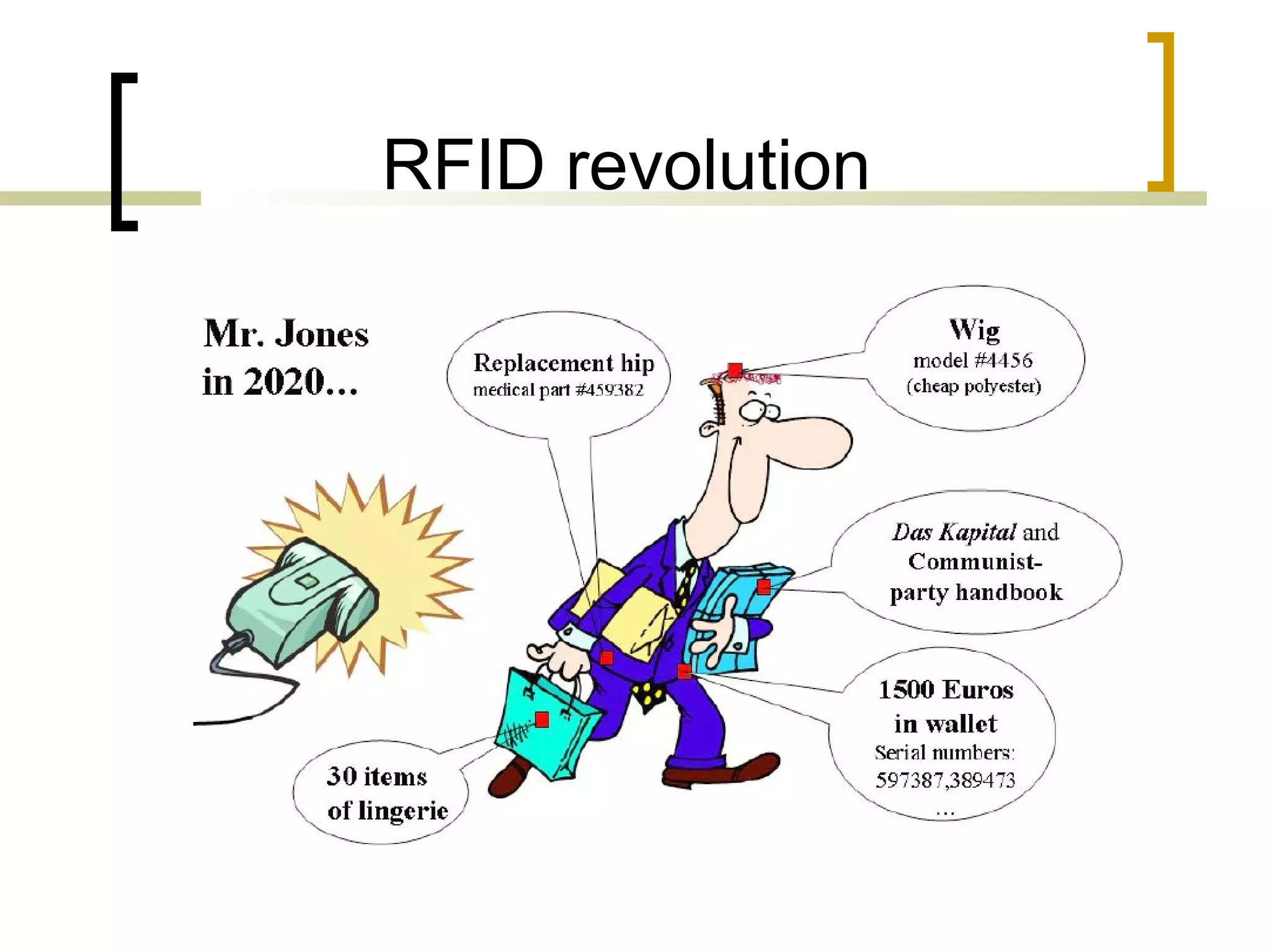
RFID revolution
THANKS FOR
SHOWING INTEREST
…

RFID (Radio Frequency Identification)