COLLEGE OF APPLIED SCIENCE AND PROFESSIONAL STUDIES, CHIKHLI
VEER NARMAD SOUTH GUJARAT UNIVERSITY, SURAT
BACHLOR OF COMPUTER APPLICATION(B.C.A.)
3rd YEAR
SEMINAR REPORT
ON
“SMART CARDS”
GUIDED BY: SUBMITTED BY:
ASS. PROF. PRAGNESH B. DESAI SAHRE AJAY S.
Introduction
In 1968 German inventors patent
combination of plastic cards with micro
chips.
History
 1968
German inventor Jurgen Dethloff along with Helmet Grotrupp filed a
patent for using plastic as a carrier for microchips.
 1970
Dr. Kunitaka Arimura of Japan filed the first and only patent on the
smart card concept
 1974
Roland Moreno of France files the original patent for the IC card, later
dubbed the “smart card.”
 1977
Three commercial manufacturers, Bull CP8, SGS Thomson, and
Schlumberger began developing the IC card product.
History
 1979
Motorola developed first single chip Microcontroller for French
Banking
 1982
World's first major IC card testing
 1992
Nationwide prepaid card project started in Denmark
 1999
Federal Government began a Federal employee smart card
identification
What is a Smart Card?
 Standard credit card-sized with microchip embedded on it
 Two types
 Memory-only chips
 Microprocessor chips
What is a Smart Card?
 Can hold up to 32,000 bytes
 Newer smart cards have math co-processors
 Perform complex encryption routines quickly
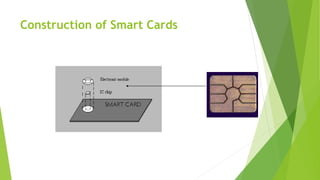
Construction of Smart Cards
Examples of Smart Cards
Applications
 Payment System
 Smart Networking
 National ID / Authentication
 University Identification
 Financial Applications
 Retail & Loyalty
 Communication Applications
 Transportation
Types of Smart Cards
 Contact Cards
 Contactless Cards
 Dual Interface / Combi cards
Contact Cards
 The contact cards need to be in physical contact with the
card reader in order for information to be exchanged. The
integrated circuit on the chip is connected to a contact plate
(typically a gold plate) on the surface of the card.
 Contact cards make up 91.92% of the total smart card market
as of 2002
Contactless Cards
 Contact-less smart cards contain an embedded antenna,
instead of contact pads attached to the chip, for reading and
writing information contained in the chip's memory. Contact-
less cards do not have to be inserted into a card acceptor
device.
 Student identification, electronic passport, vending ,parking
and tolls are common applications for contact-less cards.
Dual Interface cards
 In more recent developments, there are now cards with both a
contact and a contact less interface (dual interface or combi-cards).
 These may incorporate two non-communicating chips - one for each
interface - but preferably have a single, dual interface chip
providing the many advantages of a single e-purse, single operating
architecture, etc.
Parts of Smart Card
 Generally, it is made up of three
elements. The plastic card, a
printed circuit or contact disc and
an integrated circuit chip are
embedded on the card.
Advantages
 Flexibility
 Security
 Portability
 Increasing data storage capacity
 Reliability.
Disadvantages
• NOT tamper proof
• Can be lost/stolen
• Lack of user mobility – only possible if user has smart card
reader every he goes
• Has to use the same reader technology
• Can be expensive
• Working from PC – software based token will be better
• No benefits to using a token on multiple PCs to using a smart
card
• Still working on bugs
Why Smart Cards?
 Enhanced security
 Offline transactions
 Multifunctional
 Customization
 Economical
 Portable
Future
 Health Services
 Education
 Transportation
 Welfare
 Entitlement Documents
 Telecommunications
Thanks

Smart Cards.pptx

  • 1.
    COLLEGE OF APPLIEDSCIENCE AND PROFESSIONAL STUDIES, CHIKHLI VEER NARMAD SOUTH GUJARAT UNIVERSITY, SURAT BACHLOR OF COMPUTER APPLICATION(B.C.A.) 3rd YEAR SEMINAR REPORT ON “SMART CARDS” GUIDED BY: SUBMITTED BY: ASS. PROF. PRAGNESH B. DESAI SAHRE AJAY S.
  • 2.
    Introduction In 1968 Germaninventors patent combination of plastic cards with micro chips.
  • 3.
    History  1968 German inventorJurgen Dethloff along with Helmet Grotrupp filed a patent for using plastic as a carrier for microchips.  1970 Dr. Kunitaka Arimura of Japan filed the first and only patent on the smart card concept  1974 Roland Moreno of France files the original patent for the IC card, later dubbed the “smart card.”  1977 Three commercial manufacturers, Bull CP8, SGS Thomson, and Schlumberger began developing the IC card product.
  • 4.
    History  1979 Motorola developedfirst single chip Microcontroller for French Banking  1982 World's first major IC card testing  1992 Nationwide prepaid card project started in Denmark  1999 Federal Government began a Federal employee smart card identification
  • 5.
    What is aSmart Card?  Standard credit card-sized with microchip embedded on it  Two types  Memory-only chips  Microprocessor chips
  • 6.
    What is aSmart Card?  Can hold up to 32,000 bytes  Newer smart cards have math co-processors  Perform complex encryption routines quickly
  • 7.
  • 8.
  • 9.
    Applications  Payment System Smart Networking  National ID / Authentication  University Identification  Financial Applications  Retail & Loyalty  Communication Applications  Transportation
  • 10.
    Types of SmartCards  Contact Cards  Contactless Cards  Dual Interface / Combi cards
  • 11.
    Contact Cards  Thecontact cards need to be in physical contact with the card reader in order for information to be exchanged. The integrated circuit on the chip is connected to a contact plate (typically a gold plate) on the surface of the card.  Contact cards make up 91.92% of the total smart card market as of 2002
  • 12.
    Contactless Cards  Contact-lesssmart cards contain an embedded antenna, instead of contact pads attached to the chip, for reading and writing information contained in the chip's memory. Contact- less cards do not have to be inserted into a card acceptor device.  Student identification, electronic passport, vending ,parking and tolls are common applications for contact-less cards.
  • 13.
    Dual Interface cards In more recent developments, there are now cards with both a contact and a contact less interface (dual interface or combi-cards).  These may incorporate two non-communicating chips - one for each interface - but preferably have a single, dual interface chip providing the many advantages of a single e-purse, single operating architecture, etc.
  • 14.
    Parts of SmartCard  Generally, it is made up of three elements. The plastic card, a printed circuit or contact disc and an integrated circuit chip are embedded on the card.
  • 15.
    Advantages  Flexibility  Security Portability  Increasing data storage capacity  Reliability.
  • 16.
    Disadvantages • NOT tamperproof • Can be lost/stolen • Lack of user mobility – only possible if user has smart card reader every he goes • Has to use the same reader technology • Can be expensive • Working from PC – software based token will be better • No benefits to using a token on multiple PCs to using a smart card • Still working on bugs
  • 17.
    Why Smart Cards? Enhanced security  Offline transactions  Multifunctional  Customization  Economical  Portable
  • 18.
    Future  Health Services Education  Transportation  Welfare  Entitlement Documents  Telecommunications
  • 19.