Presented By: -
Ravisha Sethi
   Smart Cards
   Benefits of Smart Cards
   What’s in a Smart Card?
   History of Smart Cards
   Types of Smart Cards
   Applications of Smart Cards
   Uses of Smart Cards
   Advantages and Disadvantages
    of Smart Cards
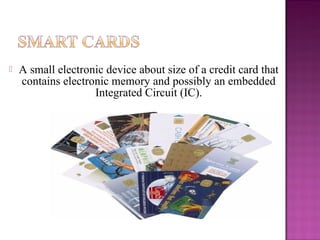
   A small electronic device about size of a credit card that
    contains electronic memory and possibly an embedded
                    Integrated Circuit (IC).
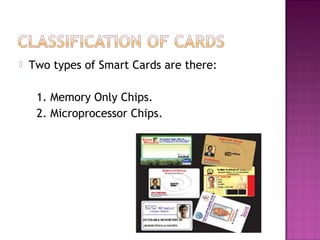
   Two types of Smart Cards are there:

     1. Memory Only Chips.
     2. Microprocessor Chips.
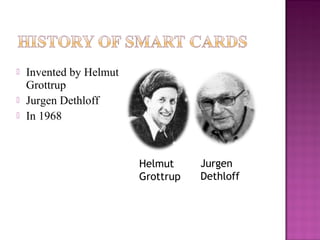
   Invented by Helmut
    Grottrup
   Jurgen Dethloff
   In 1968


                         Helmut     Jurgen
                         Grottrup   Dethloff
 1968-  German inventors patent combination of plastic
  cards with micro chips.
 1970- Japan patent different version.
 1974- Roland Moreno invents integrated chip card and
  patents it in France.
 1977- Motorola produces first smart card microchip.
 1979- Motorola develops first single chip
  microcontroller for bank in France.
 1982- ATM cards with smart chips tested and smart
  chips placed on telephone cards.
 1991- AT&T declared its contact less smart card.
 1992- Germany uses smart card for health care.
 1996- First university campus deployment of chip
  cards.
   Cost
   Reliability
   Error correction
   Storage capability
   Ease of use
   Security
   Identification
   Authentication
   Data Storage
   Portability
   Easy to use
   Improve the convenience and security of any
    transaction.

   Provide tamper proof storage of user and
    account identity.

   Provide vital components of system security.

   Protect against a full range of security
    threat.
   Typical Configuration: -
   256 byte to 4kb RAM
   8kb to 32 kb ROM
   1kb to 32kb EEPROM
   Crypto-coprocessors
    (implementing 3DES,RSA etc; in
    Hardware) are optional
   8-bit to 16-bit CPU. 8051 based
    designs are common.
   CPU

   ROM

   RAM

 EEPROM
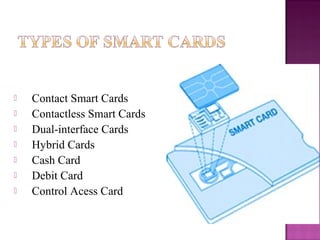
   Contact Smart Cards
   Contactless Smart Cards
   Dual-interface Cards
   Hybrid Cards
   Cash Card
   Debit Card
   Control Acess Card
Contact Smart Card
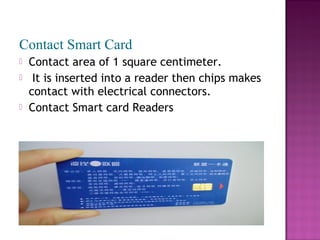
   Contact area of 1 square centimeter.
    It is inserted into a reader then chips makes
    contact with electrical connectors.
   Contact Smart card Readers
Contactless Smart Card

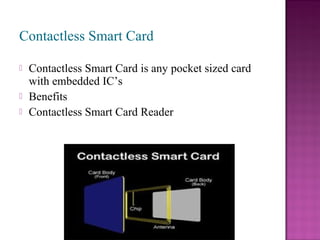
   Contactless Smart Card is any pocket sized card
    with embedded IC’s
   Benefits
   Contactless Smart Card Reader
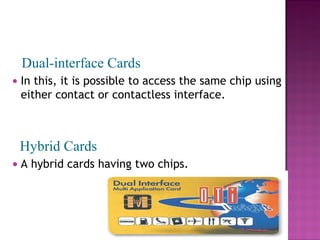
Dual-interface Cards
• In this, it is possible to access the same chip using
 either contact or contactless interface.


 Hybrid Cards
• A hybrid cards having two chips.
Cash Card

 “An embossed plastic card bearing the name
 and account details of a bank ,used with a
 personal identification number to obtain
 money.”
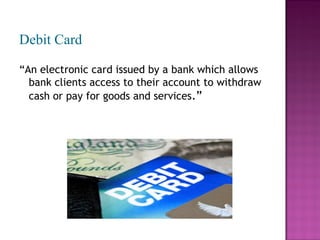
Debit Card

“An electronic card issued by a bank which allows
  bank clients access to their account to withdraw
  cash or pay for goods and services.”
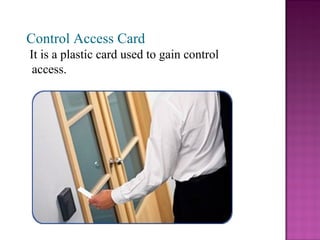
Control Access Card
It is a plastic card used to gain control
 access.
Applications Of Smart Cards

1.Banking & Retail:-
  Smart banking cards can be used as credit, direct debit
  cards. The microchip on the card and the card readers
  use mutual authentication procedures .

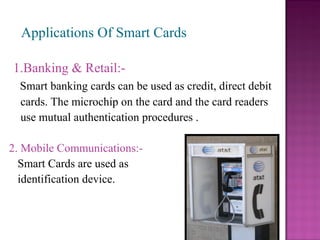
2. Mobile Communications:-
  Smart Cards are used as
  identification device.
3. Electronic Purse:-
   Card readers retrieve the amount currently stored, and subtract
   the amount for the goods or services being purchased.


4. Payphones:-
  The first card technology was used in 1983 in payphones in
  France. Its advanced features are like phone banking, on-line
  services.
5. Health Care
   Smart cards allow the information for a patient's
   history to be safely stored .


6. ID Verification
   A smart card is a device to store such information
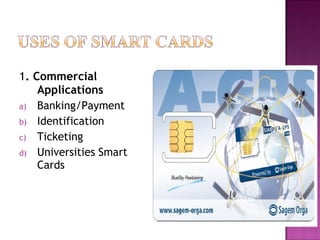
   as a user's picture or fingerprints
1. Commercial
    Applications
a) Banking/Payment
b) Identification
c) Ticketing
d) Universities Smart
    Cards
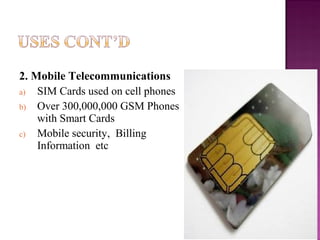
2. Mobile Telecommunications
a) SIM Cards used on cell phones
b) Over 300,000,000 GSM Phones
    with Smart Cards
c) Mobile security, Billing
    Information etc
3. Information Technology
a) Secure logon and
   authentification of users to
   PCs & Networks
b) Encryption of Sensitive Data
Some Facts of Smart Cards

   The first card was issued in India by Visa in
    1981.

   The country's first Gold Card was also issued
    from Visa in 1986.

   The first international credit card was issued
    to a restricted number of customers by
    Andhra Bank in 1987.
Advantages: -
1. Flexibility
2. Cost & Availability
3. Security
4. Data Integrity
5. Safety
6. Easy to Use
    Disadvantages: -
1.   Fees applied with the use of a card
2.   It gives liability issues if stolen or lost
3.   The accuracy of information is small
4.   Lack of technology to support users
5.   It is potential for too much data on one card if lost or
     stolen
   http://www.smartcardbasics.com/smart-card-
    types.html
   http://www.mobilein.com/smart_cards.htm
   http://www.smartcardbasics.com/smart-card-
    overview.html
   http://people.cs.uchicago.edu/~dinoj/smartcar
    d/applications.html
   http://web.mit.edu/ecom/Spring1997/gr12/2US
    ES.HTM
   http://www.ehow.com/facts_4843889_advantag
    es-disadvantages-using-smart-cards.html
Smart cards

Smart cards

  • 1.
  • 2.
    Smart Cards  Benefits of Smart Cards  What’s in a Smart Card?  History of Smart Cards  Types of Smart Cards  Applications of Smart Cards  Uses of Smart Cards  Advantages and Disadvantages of Smart Cards
  • 3.
    A small electronic device about size of a credit card that contains electronic memory and possibly an embedded Integrated Circuit (IC).
  • 4.
    Two types of Smart Cards are there: 1. Memory Only Chips. 2. Microprocessor Chips.
  • 5.
    Invented by Helmut Grottrup  Jurgen Dethloff  In 1968 Helmut Jurgen Grottrup Dethloff
  • 6.
     1968- German inventors patent combination of plastic cards with micro chips.  1970- Japan patent different version.  1974- Roland Moreno invents integrated chip card and patents it in France.  1977- Motorola produces first smart card microchip.  1979- Motorola develops first single chip microcontroller for bank in France.  1982- ATM cards with smart chips tested and smart chips placed on telephone cards.  1991- AT&T declared its contact less smart card.  1992- Germany uses smart card for health care.  1996- First university campus deployment of chip cards.
  • 7.
    Cost  Reliability  Error correction  Storage capability  Ease of use  Security
  • 8.
    Identification  Authentication  Data Storage  Portability  Easy to use
  • 9.
    Improve the convenience and security of any transaction.  Provide tamper proof storage of user and account identity.  Provide vital components of system security.  Protect against a full range of security threat.
  • 10.
    Typical Configuration: -  256 byte to 4kb RAM  8kb to 32 kb ROM  1kb to 32kb EEPROM  Crypto-coprocessors (implementing 3DES,RSA etc; in Hardware) are optional  8-bit to 16-bit CPU. 8051 based designs are common.
  • 11.
    CPU  ROM  RAM  EEPROM
  • 12.
    Contact Smart Cards  Contactless Smart Cards  Dual-interface Cards  Hybrid Cards  Cash Card  Debit Card  Control Acess Card
  • 13.
    Contact Smart Card  Contact area of 1 square centimeter.  It is inserted into a reader then chips makes contact with electrical connectors.  Contact Smart card Readers
  • 14.
    Contactless Smart Card  Contactless Smart Card is any pocket sized card with embedded IC’s  Benefits  Contactless Smart Card Reader
  • 15.
    Dual-interface Cards • Inthis, it is possible to access the same chip using either contact or contactless interface. Hybrid Cards • A hybrid cards having two chips.
  • 16.
    Cash Card “Anembossed plastic card bearing the name and account details of a bank ,used with a personal identification number to obtain money.”
  • 17.
    Debit Card “An electroniccard issued by a bank which allows bank clients access to their account to withdraw cash or pay for goods and services.”
  • 18.
    Control Access Card Itis a plastic card used to gain control access.
  • 19.
    Applications Of SmartCards 1.Banking & Retail:- Smart banking cards can be used as credit, direct debit cards. The microchip on the card and the card readers use mutual authentication procedures . 2. Mobile Communications:- Smart Cards are used as identification device.
  • 20.
    3. Electronic Purse:- Card readers retrieve the amount currently stored, and subtract the amount for the goods or services being purchased. 4. Payphones:- The first card technology was used in 1983 in payphones in France. Its advanced features are like phone banking, on-line services.
  • 21.
    5. Health Care Smart cards allow the information for a patient's history to be safely stored . 6. ID Verification A smart card is a device to store such information as a user's picture or fingerprints
  • 22.
    1. Commercial Applications a) Banking/Payment b) Identification c) Ticketing d) Universities Smart Cards
  • 23.
    2. Mobile Telecommunications a)SIM Cards used on cell phones b) Over 300,000,000 GSM Phones with Smart Cards c) Mobile security, Billing Information etc
  • 24.
    3. Information Technology a)Secure logon and authentification of users to PCs & Networks b) Encryption of Sensitive Data
  • 25.
    Some Facts ofSmart Cards  The first card was issued in India by Visa in 1981.  The country's first Gold Card was also issued from Visa in 1986.  The first international credit card was issued to a restricted number of customers by Andhra Bank in 1987.
  • 26.
    Advantages: - 1. Flexibility 2.Cost & Availability 3. Security 4. Data Integrity 5. Safety 6. Easy to Use
  • 27.
    Disadvantages: - 1. Fees applied with the use of a card 2. It gives liability issues if stolen or lost 3. The accuracy of information is small 4. Lack of technology to support users 5. It is potential for too much data on one card if lost or stolen
  • 28.
    http://www.smartcardbasics.com/smart-card- types.html  http://www.mobilein.com/smart_cards.htm  http://www.smartcardbasics.com/smart-card- overview.html  http://people.cs.uchicago.edu/~dinoj/smartcar d/applications.html  http://web.mit.edu/ecom/Spring1997/gr12/2US ES.HTM  http://www.ehow.com/facts_4843889_advantag es-disadvantages-using-smart-cards.html

Editor's Notes

  • #5 Memory Cards: These cards just store data and have no data processing capabilities. Often made with I2C or serial flash semiconductors, these cards were traditionally the lowest cost per bit for user memory. This has now changed with the larger quantities of processors being built for the GSM market. This has dramatically cut into the advantage of these types of devices. They should be regarded as floppy disks of varying sizes without the lock mechanism. These cards cannot identify themselves to the reader, so your host system has to know what type of card is being inserted into a reader. These cards are easily duplicated and cannot be tracked by on-card identifiers. Microporcessor Cards: Generally referred as chip crds.it offer greater memory storage and security of data.The microprocessor card can add,delete and manipulate information on the cards.
  • #9 The benefits of smart cards are directly related to the volume of information and applications that are programmed for use on a card. A single contact/contactless smart card can be programmed with multiple banking credentials, medical entitlement, driver’s license/public transport entitlement, loyalty programs and club memberships to name just a few. Multi-factor and proximity authentication can and has been embedded into smart cards to increase the security of all services on the card. For example, a smart card can be programmed to only allow a contactless transaction if it is also within range of another device like a uniquely paired mobile phone. This can significantly increase the security of the smart card. Governments gain a significant enhancement to the provision of publicly funded services through the increased security offered by smart cards. These savings are passed onto society through a reduction in the necessary funding or enhanced public services.
  • #12 Card Material Smart cards are made up of as many as six layers of plastic material laminated together. Common choices for the primary materials are polyester, PVC and polycarbonate. Large sheets of the materials that make up the various layers are printed with any markings, then combined with each other in a press. The sheets are then stamped into card "blanks" with a die. After this the chip is embedded into the card. The card appears to the user as a single, simple rectangle of plastic, but in reality it can take as many as 30 distinct steps to create it.
  • #17 This lets you get cash from cash machines by using a PIN (personal identity number). Your PIN should be kept secret; if you lose it or it is stolen, inform your bank immediately. If someone else withdraws cash with your card and PIN before you report it, you may have to pay for any amount that they took out. Keeping your card separate from your PIN reduces the risk of someone else being able to use it.
  • #18 Debit cards, also known as check cards look like credit cards or ATM cards (automated teller machine card). It operates like cash or a personal check. Debit cards are different from credit cards. Credit card is a way to "pay later," whereas debit card is a way to "pay now." When you use it, the amount of your purchase is "debited to" (taken from) your account, usually two or three days later. Your bank statement will often show which supplier you bought the goods from.
  • #19 Control Access Cards: It is a plastic card used to gain control access or enter restricted areas. Usually associated with magnetic or chip card and proximity cards with or without photo. When you use Zebra card printers to create your ID cards, authorized users can access your security system right away.