PRESENTED BY:
REBEN DALSHAD IBRAHIM
SMART CARD SECURITY
introduction
Smart card is a small plastic
that is embedded with either a
microprocessor or a memory
chip.
provides cryptographic services
(e.g. authentication,
confidentiality, integrity)
is small and personal
is a secure device
History of Smart Cards
• In the early 1950s Diners club produced the first all-plastic card to
be used for payment applications.
• Smart card has its origin in 1970s by inventors from Germany,
Japan and France.
• First mass use was for payment in french payphones.
• The manufacturer of Smart Cards are Gemplus, IBM, Siemens,
Telesec and many more.
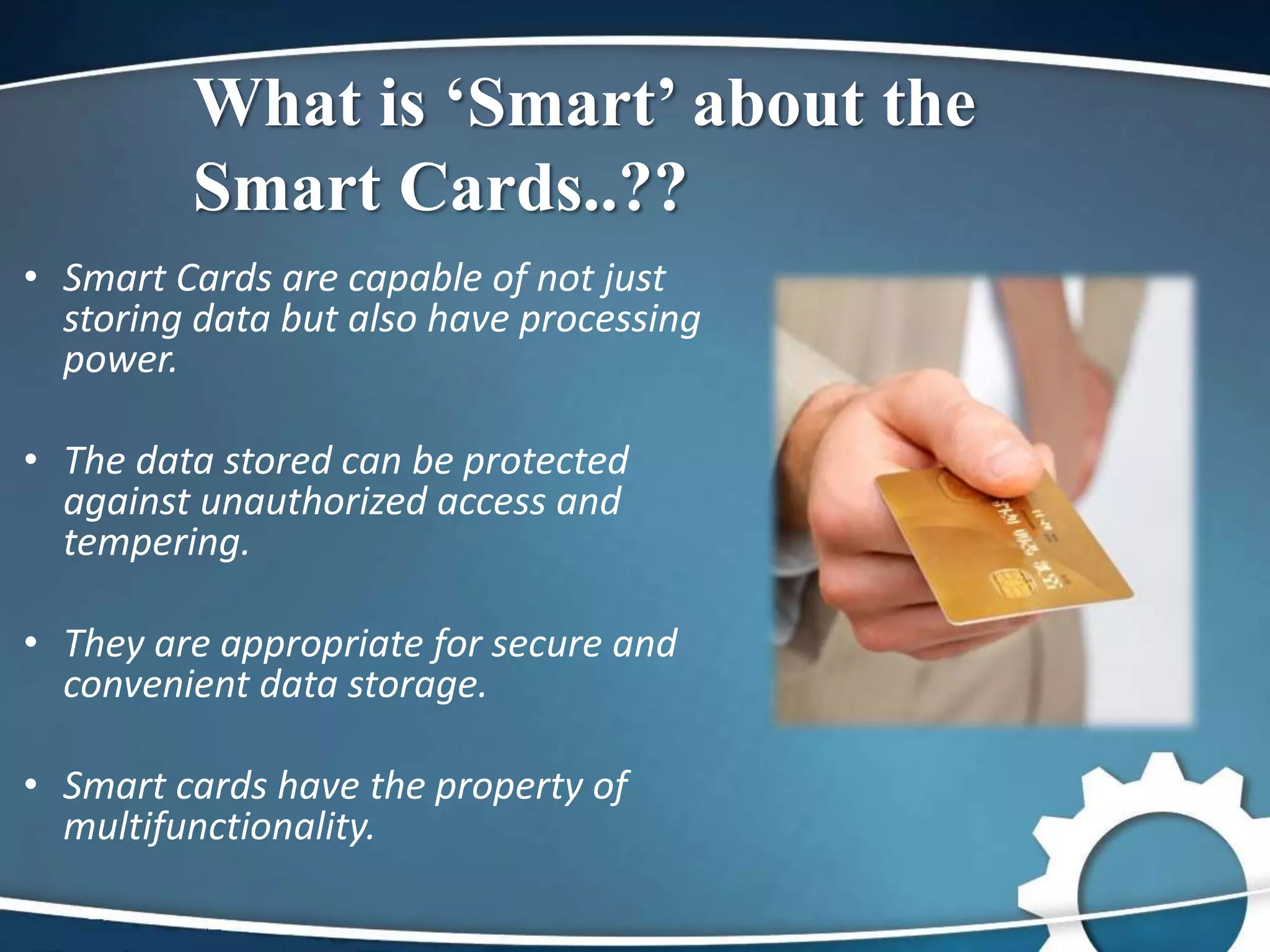
What is ‘Smart’ about the
Smart Cards..??
• Smart Cards are capable of not just
storing data but also have processing
power.
• The data stored can be protected
against unauthorized access and
tempering.
• They are appropriate for secure and
convenient data storage.
• Smart cards have the property of
multifunctionality.
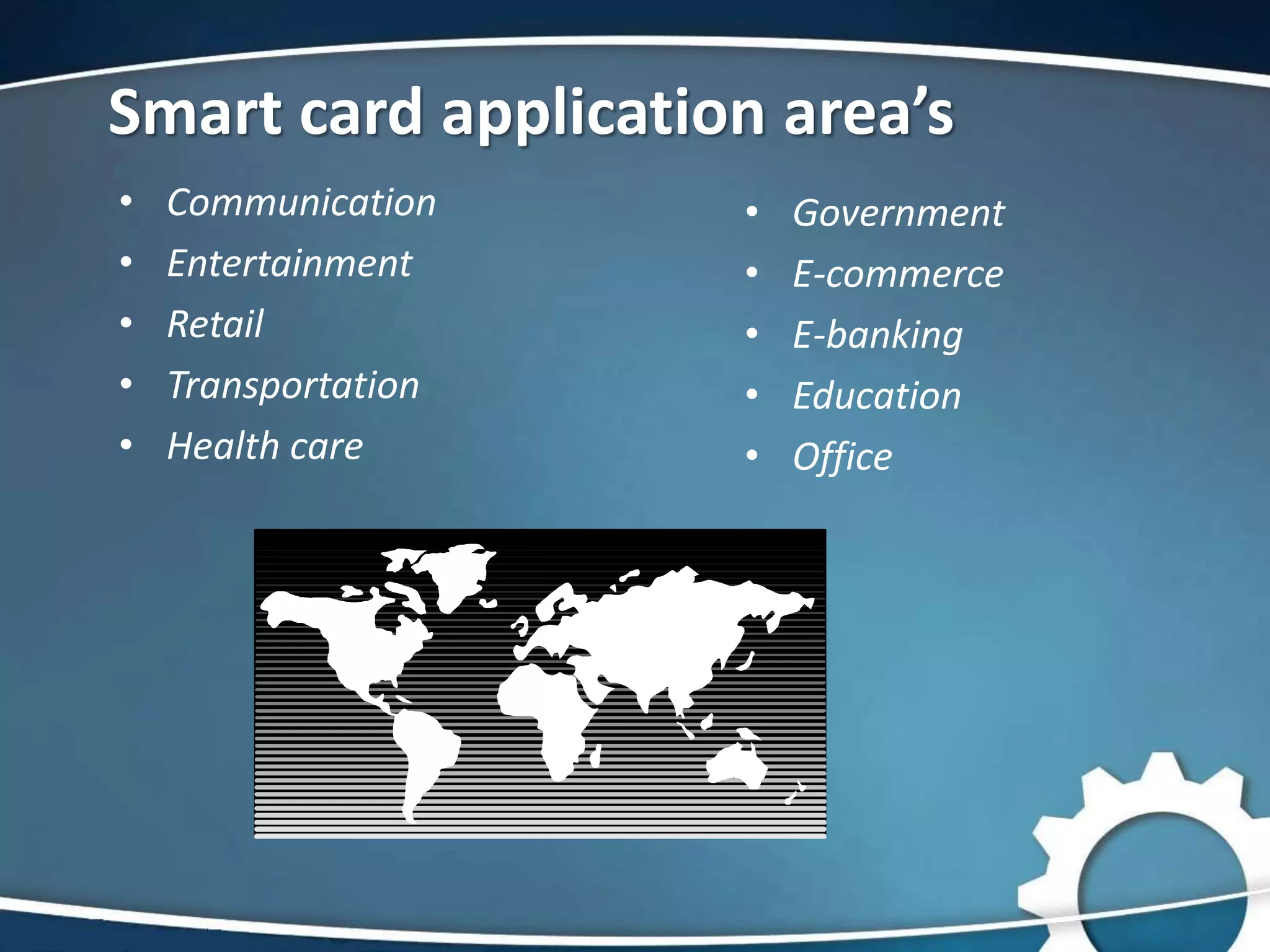
Smart card application area’s
• Government
• E-commerce
• E-banking
• Education
• Office
• Communication
• Entertainment
• Retail
• Transportation
• Health care
What’s inside a smart card ?
microprocessor
Microprocesor:
heart of the chip
What’s inside a smart card ?
security
logic
security logic:
detecting abnormal
conditions,
e.g. low voltage
microprocessor
What’s inside a smart card ?
microprocessor
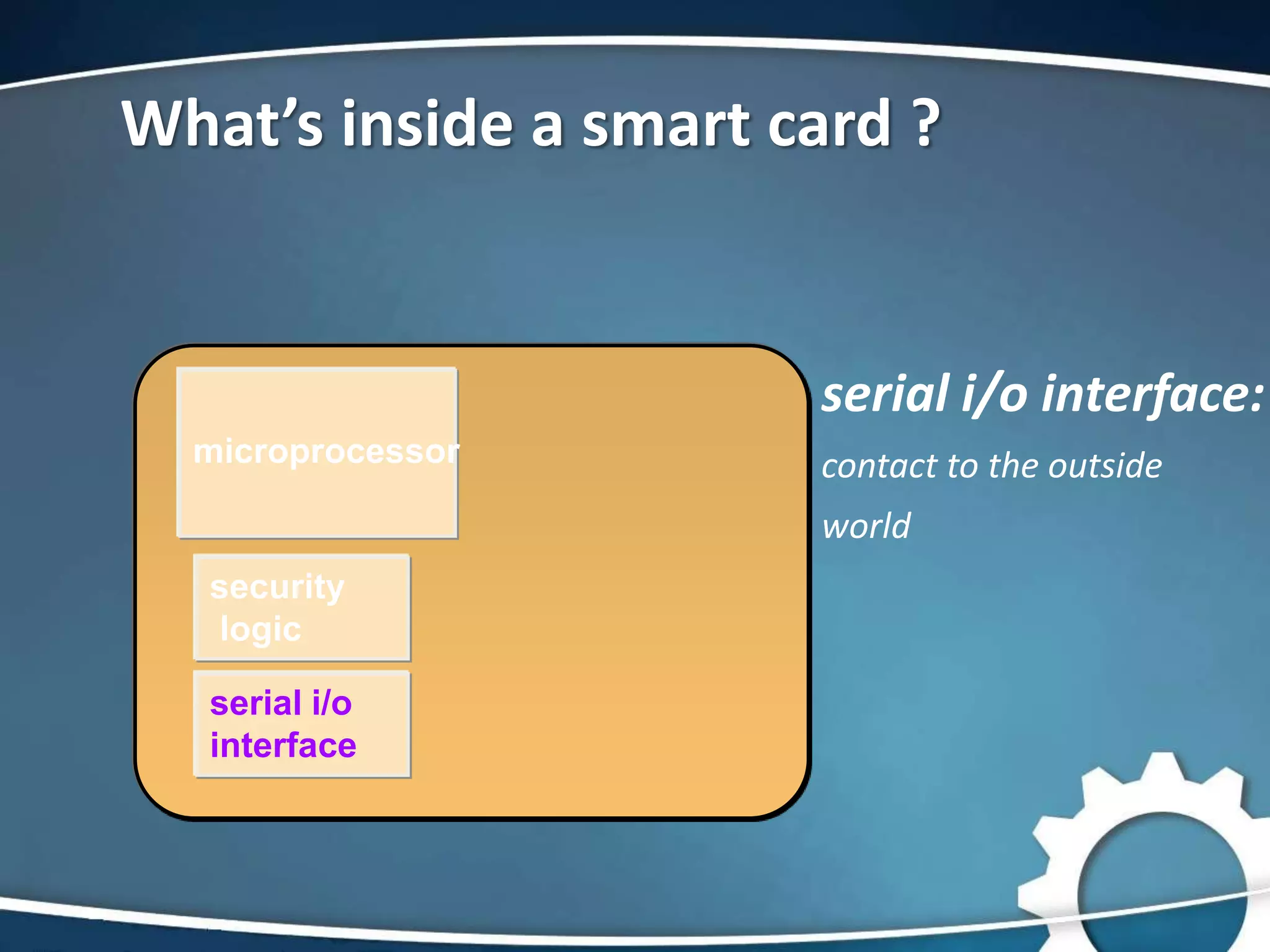
serial i/o
interface
security
logic
serial i/o interface:
contact to the outside
world
What’s inside a smart card ?
test logic
serial i/o
interface
security
logic
test logic:
self-test proceduresmicroprocessor
What’s inside a smart card ?
test logic
ROM
serial i/o
interface
security
logic
ROM:
– card operating system
– self-test procedures
– typically 16 kbytes
– future 32/64 kbytes
microprocessor
What’s inside a smart card ?
RAM
test logic
ROM
serial i/o
interface
security
logic
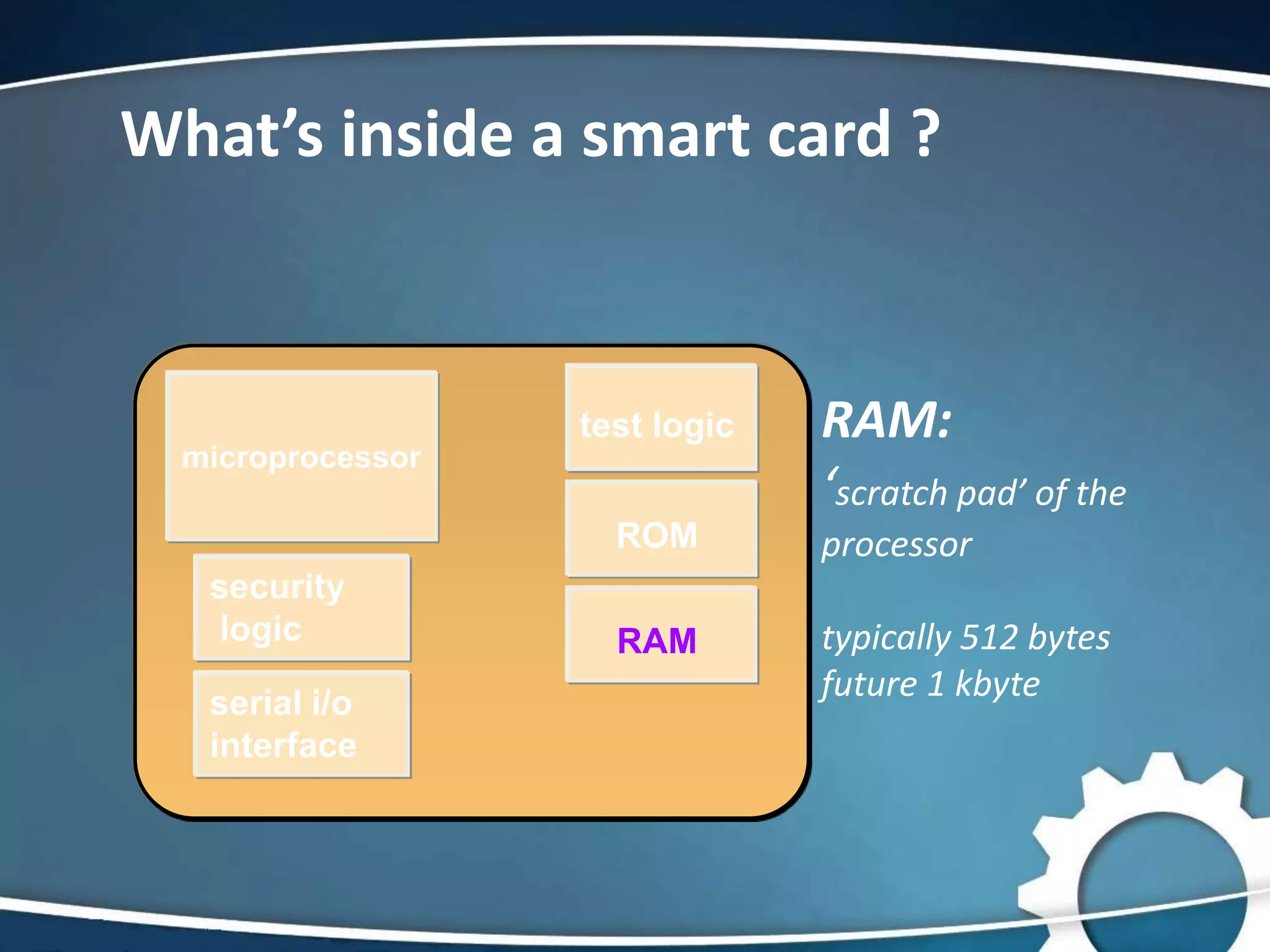
RAM:
‘scratch pad’ of the
processor
typically 512 bytes
future 1 kbyte
microprocessor
What’s inside a smart card ?
RAM
test logic
ROM
EEPROM
serial i/o
interface
security
logic
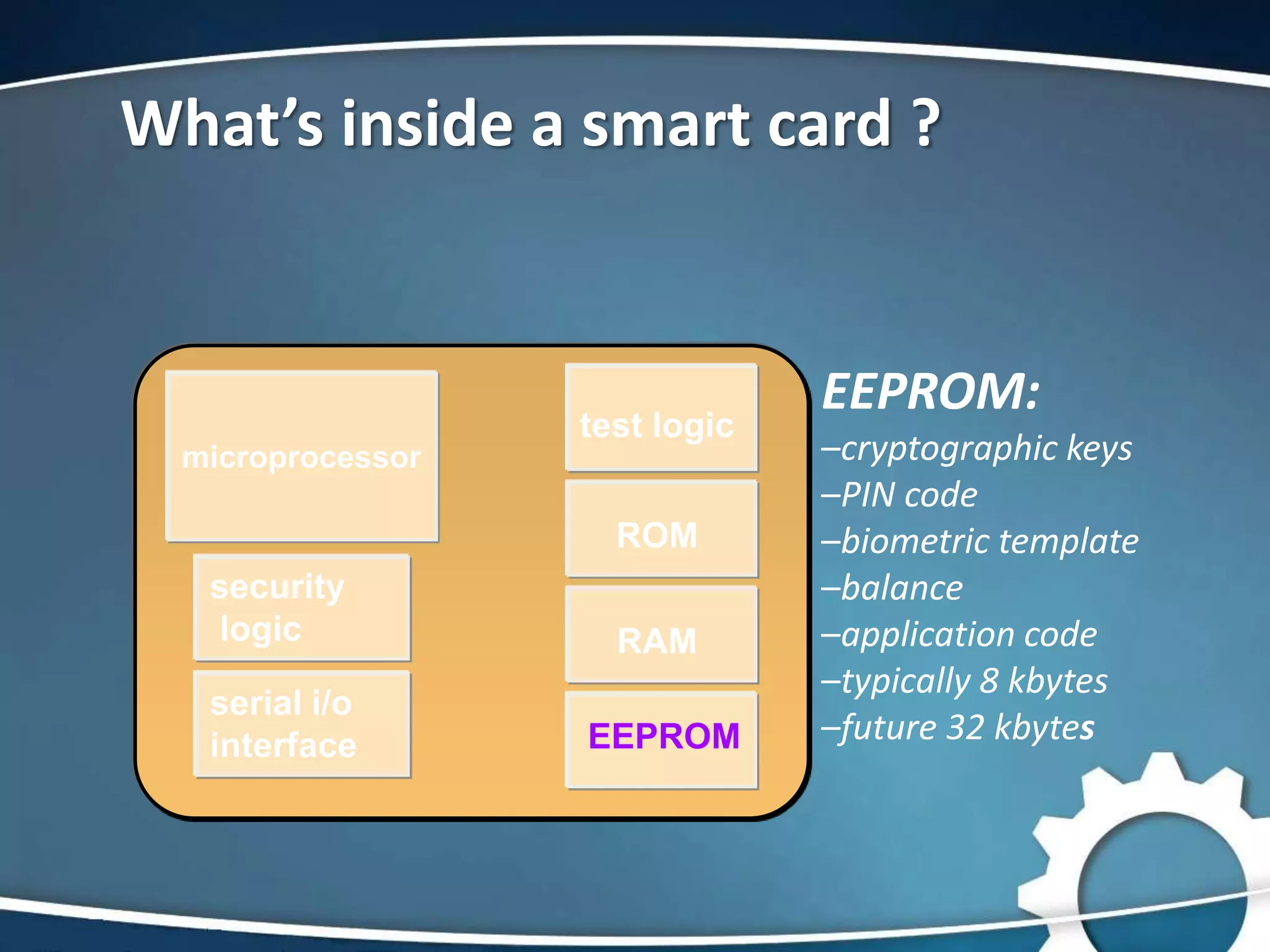
EEPROM:
–cryptographic keys
–PIN code
–biometric template
–balance
–application code
–typically 8 kbytes
–future 32 kbytes
microprocessor
What’s inside a smart card ?
RAM
test logic
ROM
EEPROM
serial i/o
interface
security
logic
databus databus:
connection between
elements of the chip.
8 or 16 bits wide
microprocessor
Basic smart card security features
Hardware
• closed package
• memory encapsulation
• security logic (sensors)
• cryptographic coprocessors and random generator
Software
• decoupling applications and operating system
• restricted file access
• life cycle control
• various cryptographic algorithms and protocols
Cryptographic algorithms
 Smart cards and intelligent token
uses different types of encryption
systems.
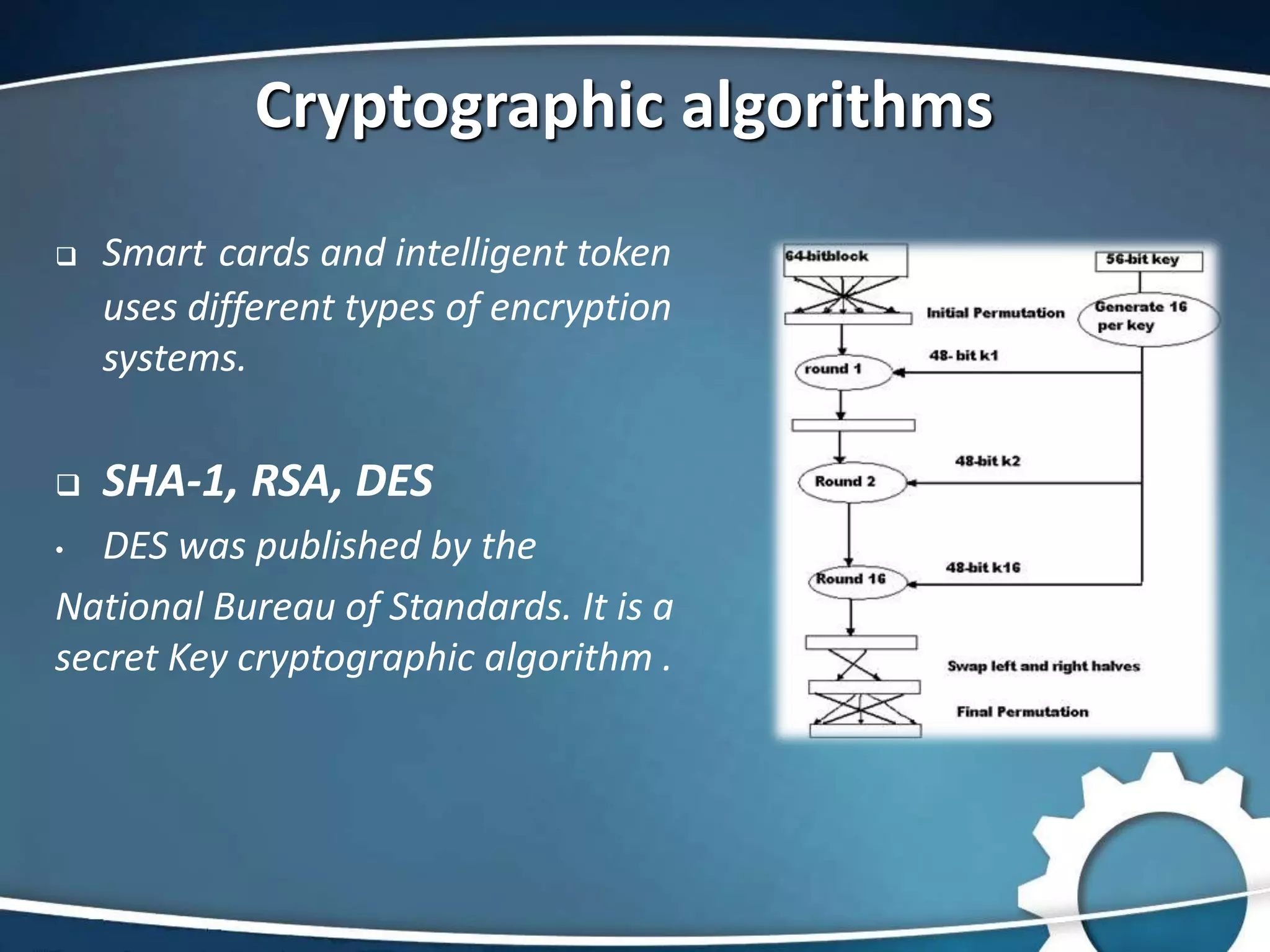
 SHA-1, RSA, DES
• DES was published by the
National Bureau of Standards. It is a
secret Key cryptographic algorithm .
Smart card attacks
Internal
Attacks
Side
Channel
Attacks
Logical Attacks
Internal attack
• Alarm (sensors)
– light
– active grid
• Hide
– feature size
– multi-layer
• Confuse
– glue logic
– redundant logic
Logical attacks
Communication
Command scan
File system scan
Invalid / inopportune requests
Crypt-analysis and protocol abuse
Side channel attack
• Signal analysis
– reduce processor signal by balancing or equalising the power
and/or shielding the emission
– variable ordering of processes
– retry counters
• Signal insertion
– use sensors for supply voltage, light and temperature
– double implementation path (for verification)
– check for runtime parameter validity
Advantages
• A chip is tamper resistant.
• Information stored on the card can be PIN protected and read
write protected.
• Capable of performing data encryption.
• Capable of processing information.
Disadvantages
• The accuracy of information is small.
• It gives liability issues if stolen or lost.
• It is potential for too much data on one card if lost or stolen.
• It is a potential area for computer hacker and computer
viruses.
• Lack of technology to support user.
Conclusions
• Smart card is an excellent technology to secure storage and
authentication
• Smart card technology is emerging, applications are everywhere
• Smart cards enhance service and security
• Perfect security does not exist, even not for smart cards
• A smart world is the future
References
• http://www.smartcardbasics.com /
• https://www.riscure.com/
• History of Smart Cards
http://www.ehow.com/about_5468404_history_smart_cards.ht
ml
THANK
YOU

Smart Card Security

  • 1.
    PRESENTED BY: REBEN DALSHADIBRAHIM SMART CARD SECURITY
  • 2.
    introduction Smart card isa small plastic that is embedded with either a microprocessor or a memory chip. provides cryptographic services (e.g. authentication, confidentiality, integrity) is small and personal is a secure device
  • 3.
    History of SmartCards • In the early 1950s Diners club produced the first all-plastic card to be used for payment applications. • Smart card has its origin in 1970s by inventors from Germany, Japan and France. • First mass use was for payment in french payphones. • The manufacturer of Smart Cards are Gemplus, IBM, Siemens, Telesec and many more.
  • 4.
    What is ‘Smart’about the Smart Cards..?? • Smart Cards are capable of not just storing data but also have processing power. • The data stored can be protected against unauthorized access and tempering. • They are appropriate for secure and convenient data storage. • Smart cards have the property of multifunctionality.
  • 5.
    Smart card applicationarea’s • Government • E-commerce • E-banking • Education • Office • Communication • Entertainment • Retail • Transportation • Health care
  • 6.
    What’s inside asmart card ? microprocessor Microprocesor: heart of the chip
  • 7.
    What’s inside asmart card ? security logic security logic: detecting abnormal conditions, e.g. low voltage microprocessor
  • 8.
    What’s inside asmart card ? microprocessor serial i/o interface security logic serial i/o interface: contact to the outside world
  • 9.
    What’s inside asmart card ? test logic serial i/o interface security logic test logic: self-test proceduresmicroprocessor
  • 10.
    What’s inside asmart card ? test logic ROM serial i/o interface security logic ROM: – card operating system – self-test procedures – typically 16 kbytes – future 32/64 kbytes microprocessor
  • 11.
    What’s inside asmart card ? RAM test logic ROM serial i/o interface security logic RAM: ‘scratch pad’ of the processor typically 512 bytes future 1 kbyte microprocessor
  • 12.
    What’s inside asmart card ? RAM test logic ROM EEPROM serial i/o interface security logic EEPROM: –cryptographic keys –PIN code –biometric template –balance –application code –typically 8 kbytes –future 32 kbytes microprocessor
  • 13.
    What’s inside asmart card ? RAM test logic ROM EEPROM serial i/o interface security logic databus databus: connection between elements of the chip. 8 or 16 bits wide microprocessor
  • 14.
    Basic smart cardsecurity features Hardware • closed package • memory encapsulation • security logic (sensors) • cryptographic coprocessors and random generator Software • decoupling applications and operating system • restricted file access • life cycle control • various cryptographic algorithms and protocols
  • 15.
    Cryptographic algorithms  Smartcards and intelligent token uses different types of encryption systems.  SHA-1, RSA, DES • DES was published by the National Bureau of Standards. It is a secret Key cryptographic algorithm .
  • 16.
  • 17.
    Internal attack • Alarm(sensors) – light – active grid • Hide – feature size – multi-layer • Confuse – glue logic – redundant logic
  • 18.
    Logical attacks Communication Command scan Filesystem scan Invalid / inopportune requests Crypt-analysis and protocol abuse
  • 19.
    Side channel attack •Signal analysis – reduce processor signal by balancing or equalising the power and/or shielding the emission – variable ordering of processes – retry counters • Signal insertion – use sensors for supply voltage, light and temperature – double implementation path (for verification) – check for runtime parameter validity
  • 20.
    Advantages • A chipis tamper resistant. • Information stored on the card can be PIN protected and read write protected. • Capable of performing data encryption. • Capable of processing information.
  • 21.
    Disadvantages • The accuracyof information is small. • It gives liability issues if stolen or lost. • It is potential for too much data on one card if lost or stolen. • It is a potential area for computer hacker and computer viruses. • Lack of technology to support user.
  • 22.
    Conclusions • Smart cardis an excellent technology to secure storage and authentication • Smart card technology is emerging, applications are everywhere • Smart cards enhance service and security • Perfect security does not exist, even not for smart cards • A smart world is the future
  • 23.
    References • http://www.smartcardbasics.com / •https://www.riscure.com/ • History of Smart Cards http://www.ehow.com/about_5468404_history_smart_cards.ht ml
  • 24.