ET-4167 Wireless Security
Praveen Kalyanasundaram
         4118863
Introduction: Understanding Smart Cards
Classification
Relevance of Security in Smart Cards
Analysis :- Security Threats and Countermeasures
   Physical Attacks
   Side Channel Attacks
   Attacks on Contactless Smart Cards
Conclusion
Questions
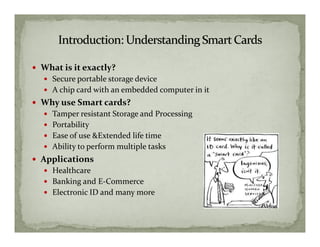
What is it exactly?
  Secure portable storage device
  A chip card with an embedded computer in it
Why use Smart cards?
  Tamper resistant Storage and Processing
  Portability
  Ease of use &Extended life time
  Ability to perform multiple tasks
Applications
  Healthcare
  Banking and E-Commerce
  Electronic ID and many more
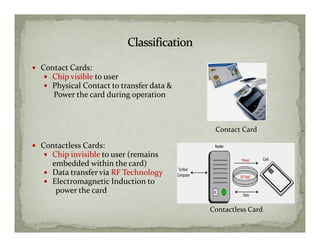
Contact Cards:
  Chip visible to user
  Physical Contact to transfer data &
   Power the card during operation


                                         Contact Card

Contactless Cards:
  Chip invisible to user (remains
  embedded within the card)
  Data transfer via RF Technology
  Electromagnetic Induction to
   power the card

                                        Contactless Card
Confusion between Contactless smart cards and RFID

Similarities
   Both provide convenience to users
   RF technology to communicate with the reader
   Used for Identification purposes
Differences
   Smart Card requires higher level of security and privacy and contains
   highly sensitive data (Financial Details, Personal Information etc. )
   RFID is only used for identification purposes (Track and Trace, Human
   Identification ) and thus information contained is not as significant
Enormous benefits are provided!!!! Increase in Complexity?????
Easy possession due to its low cost & hence sufficient training
Business model for easier future attacks
Transaction involves wired and wireless transmission of data.
Sensitive data within the chip requires Confidentiality, and Integrity
Surface of the chip is exposed manually
Chip is observed using powerful microscope
Internal blocks are tampered with to study the design

Methods include:
   Etching (Staining)
   Microscopes
   Probe Stations
   FIB (Focused Ion Beam)
Etching Materials include CH4, HF and other dangerous chemicals
De-Layering of Smart card chip
Optical and Electrical Analysis of internal blocks
“Staining” : Etching done in different speeds to reveal differences in
materials that define the ones and the zeroes.


                      Etched Smart Card Chip
Probing Needles:
Tiny Probe Needles creates New Channels
to the outside world
Extraction of program code and data including
the key when the chip is actively operating
Data can also be forced into the chip to
overwrite the original data

Microscopes:-Scanning Electron Microscope
Reverse Engineering performed by viewing chips of sizes even below
one micron.
Capable of visualizing live operations in the circuitry.
SEM can inject ions (instead of electrons) to make changes in the
circuitry apart from viewing them in detail
Different gasses in the ion beam can :
   Re-wire the circuitry
   Add extra probe pads
   Cut an existing track


   Addition of Cross-shaped            Addition of a Track
          probe pad                   courtesy: Gemplus Ltd
On-board Sensors
Protective Layers
“Glue Logic” :- Randomly placing internal blocks to avoid easy
tampering
Bus Scrambling to confuse attacker

Summary
Requires sophisticated equipments     Glue Logic        Structured Chip
Expensive
Destructive
Time Consuming
Not opted by normal hackers

                                                   Bus Scrambling
Use of ‘physical phenomena’
   Electromagnetic emission
   Power consumption
   Timing
Non-Invasive unlike Physical
Attacks

Subdivided into:
  Side Channel Analysis :
      DFA (Differential Fault Analysis)
   Side Channel Manipulation
      Power Glitches
Analysis:
   Passive in nature (only analysis)
   Extracting detailed information by observing the power consumption and/
   or electromagnetic radiation.
   Amount of power consumed is related to data being processed
   EM radiation is different for different components in the chip
   Cryptanalysis : Statistical analysis of the cryptosystem’s inputs and outputs
   to obtain the secret key


                     Information leaks in Cryptosystems
Power traces are observed and compared
 Exact key of the cryptographic algorithm can be extracted

 Process involved:
     Keen observation of power levels for various bit value
     Measurement of many power traces is done
     As a result of which the attackers arrive at exact data being
     processed (bit level)

Overlapping Power traces for
  two different inputs


Differential Power trace for
   two different inputs
Manipulation by disruption of physical phenomena
Chip damaged when excess Radiation imposed on it
Affecting the behavior of the chip by disrupting the Supply Voltage
known as “Power Glitches”
Others factors include temperature, light (x-ray), etc


 Causes misinterpretation of actual value


Change a read value from memory to another by manipulating the supply power
Introducing Timing Noise prevents good alignment of power traces
Metal Shields against injection of EM radiation
Lowering Power signal by balancing circuits
Sensors


Summary
Attacks are non-invasive unlike Physical attacks
Comparatively inexpensive to achieve these attacks
Threats can be subdued but cannot be eliminated completely
Lower Time consumption and low cost
Similar functions as of Contact cards, hence equivalent efforts to
maintain Security
Susceptible to over-the-air attacks
Attacks without possession of the card

List of threats include:
    Eavesdropping
    Man in the middle attack
    Denial of Service
    Covert Transactions (exclusive to contactless cards)
Eavesdropping:
Can be performed from a distance by triggering the card
Example : Digital Passport using contactless technology
           Active or Passive access of personal information without users
           knowledge
Can be avoided by strong cryptographic algorithms (SMS4, AES etc.)

Man in the Middle:
Portion of the encrypted data is taken, modified and the injected back
into the channel
Example: Commonly found in Financial Transactions
           Credit cards, ATM cards etc .
Can be avoided by introducing randomness in data encryption

Denial of Service:
Interfering by sending malicious requests over and over again.
Difficult threat to counteract
Covert Transactions:
Most serious threat
Malicious user communicates using fake readers triggering fake
transactions
User will never know if the transaction is genuine
Example: Primarily in Financial Transactions
            modifications or hiding of data

Countermeasure:
Must have strong authentication between the card, user and the reader.
User authentication by suitable mechanisms can be a solution
Positives:
Has had tremendous growth recently
Offers better and affordable security solutions

Negatives:
Though designed to provide security there is always a trade-off
No Perfect Security exists

Suggestions:
Can only subdue the threats
Minimize Financial Attractiveness
Analyze possible threats beforehand
Smart Card Security

Smart Card Security

  • 1.
    ET-4167 Wireless Security PraveenKalyanasundaram 4118863
  • 2.
    Introduction: Understanding SmartCards Classification Relevance of Security in Smart Cards Analysis :- Security Threats and Countermeasures Physical Attacks Side Channel Attacks Attacks on Contactless Smart Cards Conclusion Questions
  • 3.
    What is itexactly? Secure portable storage device A chip card with an embedded computer in it Why use Smart cards? Tamper resistant Storage and Processing Portability Ease of use &Extended life time Ability to perform multiple tasks Applications Healthcare Banking and E-Commerce Electronic ID and many more
  • 4.
    Contact Cards: Chip visible to user Physical Contact to transfer data & Power the card during operation Contact Card Contactless Cards: Chip invisible to user (remains embedded within the card) Data transfer via RF Technology Electromagnetic Induction to power the card Contactless Card
  • 5.
    Confusion between Contactlesssmart cards and RFID Similarities Both provide convenience to users RF technology to communicate with the reader Used for Identification purposes Differences Smart Card requires higher level of security and privacy and contains highly sensitive data (Financial Details, Personal Information etc. ) RFID is only used for identification purposes (Track and Trace, Human Identification ) and thus information contained is not as significant
  • 6.
    Enormous benefits areprovided!!!! Increase in Complexity????? Easy possession due to its low cost & hence sufficient training Business model for easier future attacks Transaction involves wired and wireless transmission of data. Sensitive data within the chip requires Confidentiality, and Integrity
  • 7.
    Surface of thechip is exposed manually Chip is observed using powerful microscope Internal blocks are tampered with to study the design Methods include: Etching (Staining) Microscopes Probe Stations FIB (Focused Ion Beam)
  • 8.
    Etching Materials includeCH4, HF and other dangerous chemicals De-Layering of Smart card chip Optical and Electrical Analysis of internal blocks “Staining” : Etching done in different speeds to reveal differences in materials that define the ones and the zeroes. Etched Smart Card Chip
  • 9.
    Probing Needles: Tiny ProbeNeedles creates New Channels to the outside world Extraction of program code and data including the key when the chip is actively operating Data can also be forced into the chip to overwrite the original data Microscopes:-Scanning Electron Microscope Reverse Engineering performed by viewing chips of sizes even below one micron. Capable of visualizing live operations in the circuitry.
  • 10.
    SEM can injections (instead of electrons) to make changes in the circuitry apart from viewing them in detail Different gasses in the ion beam can : Re-wire the circuitry Add extra probe pads Cut an existing track Addition of Cross-shaped Addition of a Track probe pad courtesy: Gemplus Ltd
  • 11.
    On-board Sensors Protective Layers “GlueLogic” :- Randomly placing internal blocks to avoid easy tampering Bus Scrambling to confuse attacker Summary Requires sophisticated equipments Glue Logic Structured Chip Expensive Destructive Time Consuming Not opted by normal hackers Bus Scrambling
  • 12.
    Use of ‘physicalphenomena’ Electromagnetic emission Power consumption Timing Non-Invasive unlike Physical Attacks Subdivided into: Side Channel Analysis : DFA (Differential Fault Analysis) Side Channel Manipulation Power Glitches
  • 13.
    Analysis: Passive in nature (only analysis) Extracting detailed information by observing the power consumption and/ or electromagnetic radiation. Amount of power consumed is related to data being processed EM radiation is different for different components in the chip Cryptanalysis : Statistical analysis of the cryptosystem’s inputs and outputs to obtain the secret key Information leaks in Cryptosystems
  • 14.
    Power traces areobserved and compared Exact key of the cryptographic algorithm can be extracted Process involved: Keen observation of power levels for various bit value Measurement of many power traces is done As a result of which the attackers arrive at exact data being processed (bit level) Overlapping Power traces for two different inputs Differential Power trace for two different inputs
  • 15.
    Manipulation by disruptionof physical phenomena Chip damaged when excess Radiation imposed on it Affecting the behavior of the chip by disrupting the Supply Voltage known as “Power Glitches” Others factors include temperature, light (x-ray), etc Causes misinterpretation of actual value Change a read value from memory to another by manipulating the supply power
  • 16.
    Introducing Timing Noiseprevents good alignment of power traces Metal Shields against injection of EM radiation Lowering Power signal by balancing circuits Sensors Summary Attacks are non-invasive unlike Physical attacks Comparatively inexpensive to achieve these attacks Threats can be subdued but cannot be eliminated completely Lower Time consumption and low cost
  • 17.
    Similar functions asof Contact cards, hence equivalent efforts to maintain Security Susceptible to over-the-air attacks Attacks without possession of the card List of threats include: Eavesdropping Man in the middle attack Denial of Service Covert Transactions (exclusive to contactless cards)
  • 18.
    Eavesdropping: Can be performedfrom a distance by triggering the card Example : Digital Passport using contactless technology Active or Passive access of personal information without users knowledge Can be avoided by strong cryptographic algorithms (SMS4, AES etc.) Man in the Middle: Portion of the encrypted data is taken, modified and the injected back into the channel Example: Commonly found in Financial Transactions Credit cards, ATM cards etc . Can be avoided by introducing randomness in data encryption Denial of Service: Interfering by sending malicious requests over and over again. Difficult threat to counteract
  • 19.
    Covert Transactions: Most seriousthreat Malicious user communicates using fake readers triggering fake transactions User will never know if the transaction is genuine Example: Primarily in Financial Transactions modifications or hiding of data Countermeasure: Must have strong authentication between the card, user and the reader. User authentication by suitable mechanisms can be a solution
  • 20.
    Positives: Has had tremendousgrowth recently Offers better and affordable security solutions Negatives: Though designed to provide security there is always a trade-off No Perfect Security exists Suggestions: Can only subdue the threats Minimize Financial Attractiveness Analyze possible threats beforehand