 Introduction
 Components in RFID technology
 Electronic Product Code [EPC]
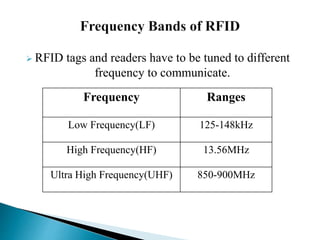
 Frequency Bands of RFID
 Working of RFID System
 Advantages of RFID technology
 Applications Of RFID
 Conclusion
 RFID [Radio Frequency Identification] is a
technology to electronically record the presence of an
object using radio signals.
 This technology is used for automatically identifying
a person, a package or an item.
 RFID is not a replacement for the bar coding, but a
complement for distant reading of codes.
 Tag (contains the ID, or serial number)
 Reader with an antenna (reads the information from
the tag)
 Computer (gets the information from the reader and
stores it)
RFID Tags
RFID tag is a transponder that will transmit, identity
information over a distance, when asked.
It is an object that can be incorporated into a
product, animal for identification and tracking using
radio waves.
These tags can be read without the line of sight from
the reader.
The tag information is stored in non-volatile
memory
The RFID tag contains two parts
 An integrated circuit for storing and processing
information, modulating and de-modulating a RF
signal.
 An antenna for receiving and transmitting the signal.
An Electronic Product Code (EPC) is one common
type of data stored in a tag.
When written into the tag by an RFID printer, the tag
contains a 96-bit string of data.
 The first 8 bits are a header which identifies the
version of the protocol.
Electronic Product Code [EPC]
 The next 28 bits identify the organization that
manages the data for this tag.
 The next 24 bits identifies the kind of product.
 The last 36 bits are a unique serial number for a
particular tag.
 The last 2 fields are set by the organization that issued
the tag
EPC [Contd…]
1. Active Tag
Have their own internal power source
Many operate at fixed intervals
Large, Much larger memories, Longer
range
TAG TYPES
2. Passive Tag
Have no internal power supply
Electrical current induced in antenna by the
incoming signal provides power for integrated
circuit in tag to power up and transmit response
Very Small i.e.Thinner than a sheet of paper,
Limited Range, Unlimited Life
TAG TYPES [Contd..]
3. Semi Passive Tag
Similar to passive tags, with the
addition of a small battery
Battery powers the integrated circuit
Bigger, Longer Range, Limited Life
TAG TYPES [Contd…]
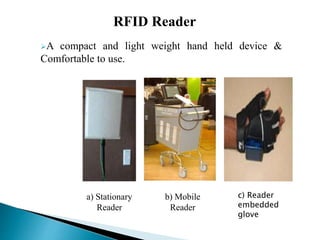
RFID Reader
A compact and light weight hand held device &
Comfortable to use.
a) Stationary
Reader
b) Mobile
Reader
c) Reader
embedded
glove
Frequency Ranges
Low Frequency(LF) 125-148kHz
High Frequency(HF) 13.56MHz
Ultra High Frequency(UHF) 850-900MHz
 RFID tags and readers have to be tuned to different
frequency to communicate.
Working of RFID System
An RFID reader transmits radio signal to the tag.
The reader broadcast the RF signal through antenna.
The tag receives the signal and get charged up if it
is a passive tag and then responses to the reader.
While it is a active tag it will respond after
receiving the signal from the reader.
 The RFID tag receives the message and then
responds with its identification and other
information.
Working of RFID System[contd..]
 The information may be serial number, or
product-related information such as a stock
number, lot or batch number, production date, or
other specific information
Then the antenna reads the data and sends to
reader.
The reader sends the information to computer for
processing the information
Working of RFID [contd…]
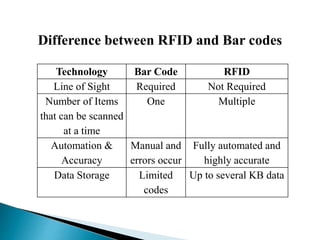
Difference between RFID and Bar codes
Technology Bar Code RFID
Line of Sight Required Not Required
Number of Items
that can be scanned
at a time
One Multiple
Automation &
Accuracy
Manual and
errors occur
Fully automated and
highly accurate
Data Storage Limited
codes
Up to several KB data
 Not require line of sight
 Greater durability
 Can be used many times
 Multiple reads
 Memory space
 Very small (0.05mm × 0.05mm).
Advantages of RFID technology
 In Hospitals
 In Libraries
 Airport
 Animal Traceability
 Defence applications
 Document Tracking
 Tracking Prisoners
 Manufacturing
 Automatic toll collections
 RFID system can be used to track patients, doctors and
expensive equipment in hospitals in real time.
 RFID tags can be attached to the ID bracelets of the
patients requiring special attention, so their location can
be tracked continuously.
21
 Human implantable RFID tag operating at about 134 KHz
because at these frequencies the RF can penetrate mud, blood,
and water
 About the size of uncooked grain of rice
 Used in Healthcare applications
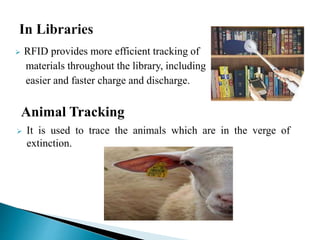
 RFID provides more efficient tracking of
materials throughout the library, including
easier and faster charge and discharge.
Animal Tracking
 It is used to trace the animals which are in the verge of
extinction.
Airports
 RFID in airports can save time for both passengers and
airport personnel and increase customer satisfaction.
 Bags provided with RFID Tags speed up baggage
check-in for passengers at check-in stations.
 The technology also allows airport workers to more
easily sort and track baggage, leading to faster delivery
of luggage to travelers.
 Vehicles will hold a RFID tag which contains unique identification number
assigned by RTO.
 In accordance with that number all basic information as well as the amount
which has been paid in advance for Toll collection.
 The amount will be deducted from his prepaid balance.
 Incase of insufficient balance, an alarm will be set up externally in this case
which is used to trap the vehicle.
 By using RFID, vehicles don’t have to stop in queue, it assures time saving
and fuel conservation.
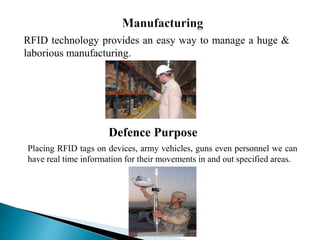
RFID technology provides an easy way to manage a huge &
laborious manufacturing.
Defence Purpose
Placing RFID tags on devices, army vehicles, guns even personnel we can
have real time information for their movements in and out specified areas.
 RFID, is an emerging technology which can be used for a
variety of applications.
 Though there are many firms employing this technology
today, but due to its continuing improvement various
communities are beginning to get involved in its
development.
RFID

RFID

  • 2.
     Introduction  Componentsin RFID technology  Electronic Product Code [EPC]  Frequency Bands of RFID  Working of RFID System  Advantages of RFID technology  Applications Of RFID  Conclusion
  • 3.
     RFID [RadioFrequency Identification] is a technology to electronically record the presence of an object using radio signals.  This technology is used for automatically identifying a person, a package or an item.  RFID is not a replacement for the bar coding, but a complement for distant reading of codes.
  • 4.
     Tag (containsthe ID, or serial number)  Reader with an antenna (reads the information from the tag)  Computer (gets the information from the reader and stores it)
  • 5.
    RFID Tags RFID tagis a transponder that will transmit, identity information over a distance, when asked. It is an object that can be incorporated into a product, animal for identification and tracking using radio waves. These tags can be read without the line of sight from the reader. The tag information is stored in non-volatile memory
  • 6.
    The RFID tagcontains two parts  An integrated circuit for storing and processing information, modulating and de-modulating a RF signal.  An antenna for receiving and transmitting the signal.
  • 7.
    An Electronic ProductCode (EPC) is one common type of data stored in a tag. When written into the tag by an RFID printer, the tag contains a 96-bit string of data.  The first 8 bits are a header which identifies the version of the protocol. Electronic Product Code [EPC]
  • 8.
     The next28 bits identify the organization that manages the data for this tag.  The next 24 bits identifies the kind of product.  The last 36 bits are a unique serial number for a particular tag.  The last 2 fields are set by the organization that issued the tag EPC [Contd…]
  • 9.
    1. Active Tag Havetheir own internal power source Many operate at fixed intervals Large, Much larger memories, Longer range TAG TYPES
  • 10.
    2. Passive Tag Haveno internal power supply Electrical current induced in antenna by the incoming signal provides power for integrated circuit in tag to power up and transmit response Very Small i.e.Thinner than a sheet of paper, Limited Range, Unlimited Life TAG TYPES [Contd..]
  • 11.
    3. Semi PassiveTag Similar to passive tags, with the addition of a small battery Battery powers the integrated circuit Bigger, Longer Range, Limited Life TAG TYPES [Contd…]
  • 12.
    RFID Reader A compactand light weight hand held device & Comfortable to use. a) Stationary Reader b) Mobile Reader c) Reader embedded glove
  • 13.
    Frequency Ranges Low Frequency(LF)125-148kHz High Frequency(HF) 13.56MHz Ultra High Frequency(UHF) 850-900MHz  RFID tags and readers have to be tuned to different frequency to communicate.
  • 14.
  • 15.
    An RFID readertransmits radio signal to the tag. The reader broadcast the RF signal through antenna. The tag receives the signal and get charged up if it is a passive tag and then responses to the reader. While it is a active tag it will respond after receiving the signal from the reader.  The RFID tag receives the message and then responds with its identification and other information. Working of RFID System[contd..]
  • 16.
     The informationmay be serial number, or product-related information such as a stock number, lot or batch number, production date, or other specific information Then the antenna reads the data and sends to reader. The reader sends the information to computer for processing the information Working of RFID [contd…]
  • 17.
    Difference between RFIDand Bar codes Technology Bar Code RFID Line of Sight Required Not Required Number of Items that can be scanned at a time One Multiple Automation & Accuracy Manual and errors occur Fully automated and highly accurate Data Storage Limited codes Up to several KB data
  • 18.
     Not requireline of sight  Greater durability  Can be used many times  Multiple reads  Memory space  Very small (0.05mm × 0.05mm). Advantages of RFID technology
  • 19.
     In Hospitals In Libraries  Airport  Animal Traceability  Defence applications  Document Tracking  Tracking Prisoners  Manufacturing  Automatic toll collections
  • 20.
     RFID systemcan be used to track patients, doctors and expensive equipment in hospitals in real time.  RFID tags can be attached to the ID bracelets of the patients requiring special attention, so their location can be tracked continuously.
  • 21.
    21  Human implantableRFID tag operating at about 134 KHz because at these frequencies the RF can penetrate mud, blood, and water  About the size of uncooked grain of rice  Used in Healthcare applications
  • 22.
     RFID providesmore efficient tracking of materials throughout the library, including easier and faster charge and discharge. Animal Tracking  It is used to trace the animals which are in the verge of extinction.
  • 23.
    Airports  RFID inairports can save time for both passengers and airport personnel and increase customer satisfaction.  Bags provided with RFID Tags speed up baggage check-in for passengers at check-in stations.  The technology also allows airport workers to more easily sort and track baggage, leading to faster delivery of luggage to travelers.
  • 24.
     Vehicles willhold a RFID tag which contains unique identification number assigned by RTO.  In accordance with that number all basic information as well as the amount which has been paid in advance for Toll collection.  The amount will be deducted from his prepaid balance.  Incase of insufficient balance, an alarm will be set up externally in this case which is used to trap the vehicle.  By using RFID, vehicles don’t have to stop in queue, it assures time saving and fuel conservation.
  • 25.
    RFID technology providesan easy way to manage a huge & laborious manufacturing. Defence Purpose Placing RFID tags on devices, army vehicles, guns even personnel we can have real time information for their movements in and out specified areas.
  • 26.
     RFID, isan emerging technology which can be used for a variety of applications.  Though there are many firms employing this technology today, but due to its continuing improvement various communities are beginning to get involved in its development.