A
SEMINAR REPORT
ON
SMART CARDS
Submitted in partial fulfilment of
The requirements for the award of the degree
Of
BACHELOR OF TECHNOLOGY
IN
ELECTRONICS & COMMUNICATION ENGINEERING
By
S.SAI SREE
(14761A04B1)
DEPARTMENT OF ELECTRONICS & COMMUNICATION ENGINEERING
LAKIREDDY BALI REDDY COLLEGE OF ENGINEERING
(Autonomous &Affiliated to JNTUK, Kakinada & Approved by AICTE, New Delhi)
(Accredited by NBA of AICTE & Certified by ISO 9001:2000)
L B REDDY NAGAR, MYLAVARAM-521 230
Krishna District, Andhra Pradesh 2016-2017
LAKIREDDY BALI REDDY COLLEGE OF ENGINEERING
(Autonomous &Affiliated to JNTUK, Kakinada & Approved by AICTE, New Delhi)
(Accredited by NBA of AICTE & Certified by ISO 9001:2000)
L B REDDY NAGAR, MYLAVARAM-521 230
Krishna District, Andhra Pradesh
DEPARTMENT OF ELECTRONICS& COMMUNICATION ENGINEERING
CERTIFICATE
This is certify that S.SAI SREE(14761A04B1), student of B. tech,V
semester (ELECTRONICS AND COMMUNICATION ENGINEERING) have
successfully completed his Seminar titled “SMART CARDS” at Lakireddy Bali
Reddy College of Engineering during the academic year 2016-2017. This seminar
Report is submitted in partial fulfilment for the award of degree B. Tech
(Electronics And Communication Engineering).
SEMINAR CO-ORDINATOR HEADOF THE DEPARTMENT
Prof.B. RAMESH REDDY
Date:
Place:
ACKNOWLEDGEMENTS
First and foremost we sincerely thank our institution LakiReddy BaliReddy
College of Engineering for giving this opportunity for fulfilling our dreams of
becoming engineers. We express our special gratitude to our Director Dr.E.V.Prasad
who made this endeavour possible.
We have the immense pleasure in expressing our thanks and deep sense of
gratitude of Prof B. Ramesh Reddy, Head of the Department of Electronics &
Communication Engineering for extending necessary facilities for the completion of
project.
We are highly thankful to our seminar coordinators Mr. Ch. V. Naga Bhaskar,
Smt.K. Lakshmi for providing the knowledge to deal with the problem at every phase
of our seminar in a systematic manner.
We would like to extend our deepest gratitude to the support rendering by the
Teaching and Non-Teaching staff of Electronics and Communication Engineering
department during the course of this work. Finally we thank each and every one who
indirectly contributed his or her help to complete this project.
S.SAI SREE
(14761A04B1)
SMART CARDS
CONTENTS
ABSTRACT
TOPIC PAGE
NO.
I .INTRODUCTION
I .HISTORY
III. Smart Card Overviews
1. Easing LogisticalIssues
2. Providing Value-Added Services
3. Smart Card
4. Classification of Smart Cards
5. PC cards
6. Operating Systems
7. scas
8. smartcard
9. ssh-smart
10. Smart Card Uses
11.CITI Projects
12.Technology and Players
13. Interface betweenCard and Terminal (API)
IV.ADVANTAGES & DISADAVNTAGES
V.APPLICATIONS
VI.CONCLUSION
VII.REFERENCES
TABULAR FORMS & FIGURES
FIGURES:
Figure: Easing Logistical Issues
Figure: SMART CARD
Figure Card Manufacturers
Figure: SERVICE BUILDING WITH SMART CARDS
Figure: PORATABILITY OF SMART CARDS
:
:
Abstract
Internet technologies, through intranet and extranet applications, have proven
themselves
to be efficient and effective in streamlining existing processes from supply chain
management to manufacturing logistics, from marketing to customer asset management,
and by creating new value chains and businesses. Nevertheless, these changes and
benefits signal only an evolutionary shift in the way we do business. The Internet-
enabled
economy resembles the conventional physical market in many aspects. Some of the new
technologies and applications may even be unnecessary. American consumers, for
example, regard smart cards as a redundant payment mechanism when checks, credit
cards and ATM cards do an adequate job for current needs. What is the use of smart
cards? Do we really need them? Will they ever take off?
Today, the SIM card’s basic functionality in wireless communications is subscriber
authentication and roaming. Although such features may be achieved via a centralized
intelligent network (IN) solution or a smarter handset, there are several key benefits that
could not be realized without the use of a SIM card, which is external to a mobile
handset. These benefits—enhanced security, improved logistics, and new marketing
opportunities—are key factors for effectively differentiating wireless service offerings.
This tutorial assumes a basic knowledge of the wireless communications industry and
will discuss the security benefits, logistical issues, marketing opportunities, and
customer
benefits associated with smart cards.
Share
Introduction
Internet technologies, through intranet and extranet applications, have proven
themselves to be efficient and effective in streamlining existing processes from supply
chain management to manufacturing logistics, from marketing to customer asset
management, and by creating new value chains and businesses. Nevertheless, these
changes and benefits signal only an evolutionary shift in the way we do business. The
Internet-enabled economy resembles the conventional physical market in many aspects.
Some of the new technologies and applications may even be unnecessary. American
consumers, for example, regard smart cards as a redundant payment mechanism when
checks, credit cards and ATM cards do an adequate job for current needs. What is the
use of smart cards? Do we really need them? Will they ever take off?
Introduction to Smart Cards in Wireless Communications
Smart cards provide secure user authentication, secure roaming, and a platform for value-
added services in wireless communications. Presently, smart cards are used mainly in the
Global System for Mobile Communications (GSM) standard in the form of a SIM
card.GSM is an established standard first developed in Europe. In 1998, the GSM
Association announced that there are now more than 100 million GSM subscribers. In the
last few years, GSM has made significant inroads into the wireless markets of the Americas.
Initially, the SIM was specified as a part of the GSM standard to secure access to the
mobile network and store basic network information. As the years have passed, the role of
the SIM card has become increasingly important in the wireless service chain. Today,
SIM cards can be used to customize mobile phones regardless of the standard (GSM,
personal communications service [PCS], satellite, digital cellular system [DCS], etc.).
Today, the SIM is the major component of the wireless market, paving the way to
value-added services. SIM cards now offer new menus, prerecorded numbers for speed
dialing, and the ability to send presorted short messages to query a database or secure
transactions. The cards also enable greeting messages and company logotypes to be
displayed.
Other wireless communications technologies rely on smart cards for their operations.
Satellite communications networks (Iridium and Globalstar) are chief examples.
Eventually, new networks will have a common smart object and a universal
identification module (UIM), performing functions similar to SIM cards.
Smart Card OvervieS
The smart card is one of the latest additions to the world of information technology
(IT). The size of a credit card, it has an embedded silicon chip that enables it to store
data and communicate via a reader with a workstation or network. The chip also
contains advanced security features that protect the card’s data.
Smart cards come in two varieties: microprocessor and memory. Memory cards
simply store data and can be viewed as small floppy disks with optional security.
Memory cards depend on the security of a card reader for their processing. A
microprocessor card can add, delete, and manipulate information in its memory on the
card. It is like a miniature computer with an input and output port, operating system,
and hard disk with built- in security features.
Smart cards have two different types of interfaces. Contact smart cards must be
inserted into a smart-card reader. The reader makes contact with the card module’s
electrical connectors that transfer data to and from the chip. Contactless smart cards
are passed near a reader with an antenna to carry out a transaction. They have a n
electronic microchip and an antenna embedded inside the card, which allow it to
communicate physical contact. Contactless cards are an ideal solution when
transactions must be processed quickly, as in mass transit or toll collection.
A third category now emerging is a dual interface card. It features a single chip
that enables a contact and contactless interface with a high level of security.
Two characteristics make smart cards especially well suited for applications in which
security-sensitive or personal data is involved. First, because a smart card contains both
the data and the means to process it, information can be processed to and from a
network without divulging the card’s data. Secondly, because smart cards are portable,
users can carry data with them on the smart card rather than entrusting that information
on network storage or a backend server where the information could be sold or accessed
by unknown persons (see Figure).
Easing Logistical Issues
All subscribers may easily personalize and depersonalize their mobile phone by simply
inserting or removing their smart cards. The card’s functions are automatically enabled
by the electronic data interchange (EDI) links already set between carriers and secure
personalization centers. No sophisticated programming of the handset is necessa
By placing subscription information on a SIM card, as opposed to a mobile handset, it
becomes easier to create a global market and a distribution network of phones. These
noncarrier-specific phones can increase the diversity, number, and competition in the
distribution channel, which can ultimately help lower the cost of customer acquisition.
Smart cards make it easier for households and companies to increase the number of
subscriptions, thereby increasing usage. They also help to create a market for ready-
to-use preowned handsets that require no programming before use.
Additionally, managing fraud is also eased by smart cards. In a handset-centric system,
if a phone is cloned, the customer must go to a service center to have the handset
reprogrammed, or a new phone must be issued to the customer. In a smart card–based
system, the situation can be handled by merely issuing a new card; customers can
continue using their current phones. The savings in terms of cost and convenience to
both carrier and customer can be substantial.
Providing Value-Added Services
One of the most compelling benefits of smart cards is the potential for packaging and
bundling various complementary services around basic mobile telephony services. These
services can greatly reduce churn and increase usage and brand recognition (see Figure).
The SIM card’s chip can be programmed to carry multiple applications. The activation of
new applications can be downloaded to the card over the air, in real time,
thereby reducing the time (and cost) to market.
Providing value-added services such as mobile banking, Web browsing, or travel services
creates a high cost of exit for the customer. Long-distance companies have successfully
identification programs for its defense department and recently announced that it
will further explore the nationwide use of smart cards for electronic benefit
transfers as a fraud reduction tool.
In the financial industry, large players such as Barclays and Citibank currently use
SIM cards to provide banking information to mobile users via their GSM phones.
Electronic purse systems based on VisaCash, Mondex, Proton, and other schemes are
deployed around the world and account for tens of millions of cards in Asia, Europe,
and Latin America. Major U.S. banks are considering or conducting trials of smart
card-based systems. The push by these major financial services firms will serve to
accelerate consumer acceptance.
Consumers Primed to Use Smart Cards
Research conducted by the Smart Card Forum, an interindustry association dedicated
to advancing multiapplication smart cards, has generated the following statistics:
45 percent of consumers are favorably disposed to using smart cards
25 percent of households would actually obtain these smart cards
44 percent of consumers are likely to use identification-type smart cards
(telephone cards, gas cards, automated teller machine [ATM] cards, etc.)
Smart Card?
A smart card is a credit-card sized plastic card embedded with an integrated circuit chip
that makes it "smart". This marriage between a convenient plastic card and a
microprocessor allows an immense amount of information to be stored, accessed and
processed either online or offline. Smart cards can store several hundred times more
data than a conventional card with a magnetic
stripe. The information or application stored in the IC chip is transferred through an
electronic module that interconnects with a terminal or a card reader. A contactless smart
card has an antenna coil which communicates with a receiving antenna to transfer
information. Depending on the type of the embedded chip, smart cards can be
either memory cards or processor cards.
Classification of Smart Cards
Due to the communication with the reader and functionality of smart cards, they
are classified differently
.Contact vs Contactless
As smart cards have embedded microprocessors, they need energy to function and
some mechanism to communicate, receiving and sending the data. Some smart cards
have golden plates, contact pads, at one corner of the card. This type of smart cards are
called Contact Smart Cards. The plates are used to supply the necessary energy and to
communicate via direct electrical contact with the reader. When you insert the card
into the reader, the contacts in the reader sit on the plates. According to ISO7816
standards the PIN connections are below:
,----, ,----,
| C1 | | C5 | C1 : Vcc = 5V C5 : Gnd
'----' '----' C2 : Reset C6 : Vpp
,----, ,----, C3 : Clock C7 : I/O
| C2 | | C6 | C4 : RFU C8 : RFU
'----' '----'
,----, ,----,
| C3 | | C7 |
'----' '----'
,----, ,----,
| C4 | | C8 |
'----' '----'
I/O : Input or Output for serial data to the integrated circuit inside the card.
Vpp : Programing voltage input (optional use by the card).
Gnd : Ground (reference voltage).
CLK : Clocking or timing signal (optional use by the card).
RST: Either used itself (reset signal supplied from the interface device) or in
combination with an internal reset control circuit (optional use by the card).
If internal reset is implemented, the voltage supply on Vcc is mandatory.
Vcc : Power supply input (optional use by the card).
The readers for contact smart cards are generally a separate device plugged into serial
or USB port. There are keyboards, PCs or PDAs which have built- in readers like
GSM cell phones. They also have embedded readers for GSM style mini smart cards
Some smart cards do not have a contact pad on their surface.The connection between
the reader and the card is done via radio frequency (RF). But they have small wire
loop embedded inside the card. This wire loop is used as an inductor to supply the
energy to the card and communicate with the reader. When you insert the card into the
readers RF field, an induced current is created in the wire loop and used as an energy
source. With the modulation of the RF field, the current in the inductor, the
communication takes place.
The readers of smart cards usually connected to the computer via USB or serial port. As
the contactless cards are not needed to be inserted into the reader, usually they are only
composed of a serial interface for the computer and an antenna to connect to the card.
The readers for contactless smart cards may or may not have a slot. The reason is
some smart cards can be read upto 1.5 meters away from the reader but some needs
to be positioned a few millimeters from the reader to be read accurately.
There is one another type of smart card, combo card. A combo card has a contact pad
for the transaction of large data, like PKI credentials, and a wire loop for mutual
authentication. Contact smart cards are mainly used in electronic security whereas
contactless cards are used in transportation and/or door locks.
Memory vs Microprocessor
The most common and least expensive smart cards are memory cards. This type of smart
cards, contains EEPROM(Electrically Erasable Programmable Read-Only Memory), non-
volatile memory. Because it is non-volatile when you remove the card from the reader,
power is cut off, card stores the data. You can think of EEPROM, inside, just like a normal
data storage device which has a file system and managed via a microcontroller (mostly 8
bit). This microcontroller is responsible for accessing the files and accepting the
communication. The data can be locked with a PIN (Personal Identification Number), your
password. PIN's are normally 3 to 8 digit numbers those are written to a special file on the
card. Because this type is not capable of cryptography, memory cards are used in storing
telephone credits, transportation tickets or electronic cash.
Microprocessor cards, are more like the computers we use on our desktops. They have
RAM, ROM and EEPROM with a 8 or 16 bit microprocessor. In ROM there is an
operating system to manage the file system in EEPROM and run desired
| 8 or 16 bit |
Reader <===| microprocessor |----- +
---------------- |
|
|--- > RAM
NON-
CRYPTOGRAPHIC |
CARD |--- > ROM
|
+--- >
EEPRO
M
As seen in the diagram above all communication is done over the microprocessor,
There is no direct connection between the memory and the contacts. The operating
system is responsible for the security of the data in memory because the access
conditions are controlled by the OS.
---------------- --------
| 8 or 16 bit | | Crypto |
Reader <===| microprocessor |----------- | Module |
---------------- | --------
|
|--- > RAM
CRYPTOGRAPHI
C |
CARD |--- > ROM
|
+--- > EEPROM
With the addition of a crypto module our smart card can now handle complex
mathematical computations regarding to PKI. Because the internal clock rate of
microcontrollers are 3 to 5 MHz, there is a need to add a component, accelerator for
the cryptographic functions. The crypto-cards are more expensive than non-crypto
smart cards and so do microprocessor card than memory cards.
Depending on your application you should choose right card.
PC cards
While any IC-embedded card may be called a smart card, its distinguishing feature is its
use for personal activities. For example, PC cards (also known as PCMCIA cards) have the
same characteristics as a smart card but they are used as peripheral devices such as modems
or game cartridges. These PC cards are seldom called smart cards since they are extension
devices without personalization. In this sense, a smart card is a processor card
that allows persons to interact with others digitally to conduct transactions and
other personal activities.
Operating Systems
New trend in smart card operating systems is JavaCard Operating System. JavaCard
OS was developed by Sun Microsystems and than promoted to JavaCard Forum. Java
Card OS is popular because it gives independence to the programmers over
architecture. And Java OS based applications could be used on any vendor of smart
card that support JavaCard OS.
Most of the smart cards today use their own OS for underlying communication and
functions. But to give true support for the applications smart cards operating systems go
beyond the simple functions supplied by ISO7816 standards. As a result porting your
application, developed on one vendor, to another vendor of smart card becomes very
hard work.Another advantage of JavaCard OS is, it allows the concept of post- issuance
application loading. This allows you to upgrade the applications on smart card after
delivering the card to the end-user. The importance is, when someone needs a smart
card he/she is in need of a specific application to run. But later the demand can change
and more applications could be necessary.
Another operating system for smart cards is MULTOS (Multi-application Operating
System). As the name suggests MULTOS also supports multi-applications. But
MULTOS was specifically designed for high-security needs. And in many countries
MULTOS has achieved "ITSec E6 High" in many countries.
And also Microsoft is on the smart card highway with Smart Card for Windows.
In a point of view the above Operating Systems are Card-Side API's to develop
cardlets or small programs that run on the card. Also there is Reader-Side API's like
OpenCard Framework and GlobalPlatform.
scas
SCAS is a simple program that checks the code inside the card with the code inside the
computer. As an example of showing a way of authentication with memory cards scas
is very good.
smartcard
smartcard is a general smart card utility in Linux which uses CT-API. With smartcard
utility you can read/write data from/into smart cards. As long as your reader can be
accessed via CT-API, smartcard can be used to control the reader. Currently smartcard
could only be used with memory cards using I2C or 3W protocols. There is also a
GTK+/Gnome graphical front end which support all functions of smartcard utility.
ssh-smart
ssh-smart is a basic proof-of-concept of ssh identity on smart card, as the author says.
ssh-smart uses smartcard utility to communicate with the smart card. Basically, ssh-
smart-add tool (perl script) call ssh-keygen to generate RSA public and private keys.
Than puts the private key on the memory card. Later the ssh-smart-addagent tool can
be used to extract the private key from the card to use with ssh-agent.
smarttools-rsa
This is another PAM Module for Unix systems but supports RSA authentication
through your private key on the smart card. You must have a Schlumberger Cyberflex
Access card or Schlumberger Cryptoflex for Windows Card and a working reader to
use this tool.
smartsign
This utility is some-complete PKI integration with the smart cards. To use you must
establish a working OpenCA and have Schlumberger's "Cyberflex Access 16K" smart
cards. During the certification process of OpenCA, private key and public certificate can
be stored on the smart card and private key, later, could be used with Netscape to sign
outgoing mails and news. Also smartsign supports authentication of local users via a PAM
Module through a public key authentication. Smartsign comes with gpkcs11, a PKCS#11
implementation, smastsh, a command line shell that allows browsing smart card contents,
sign_sc/verify_sc to sign and verify any file with smart card.
CITI Projects
At CITI, Center for Information Technology Integration of Michigan University, there
are some new projects. For example, Webcard is a web server running on a
Schlumberger Cyberflex Access Java Card. Features a stripped TCP/IP stack that
supports HTTP only. The system is designed to have a router which frames IP packets
in ISO7816 and a Java Virtual Machine in the card. Detailed technical report can be
found at http://www.citi.umich.edu/projects/smartcard/webcard/citi- tr-99-3.html
Smart Card Uses
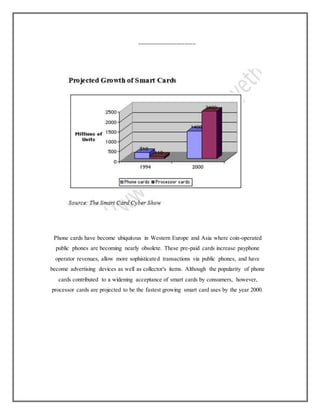
Literally, billions of smart cards are already in use. Worldwide smart card sales could
reach 1.6 billion units in 1998, up 23% from 1.3 billion units in 1997. Western Europe
accounts for about 70% of the current smart card uses, followed by South America and
Asia with about 10% each, while North America languishes at less than 5%. However,
most smart cards issued today are memory cards (see Table) with limited processing
capabilities. Still, hundreds of millions of processor cards are already in use today.
Smart Cards Issued in 1996 (in million units)
Phone cards 605
Health cards 70
Banking 40
ID/access cards 20
Pay
T
V cards 20
GS
M cards (mobile phone) 20
Transportation 15
Metering/vending 10
Others 10
Smart cards in wireless
------------------------------------
Phone cards have become ubiquitous in Western Europe and Asia where coin-operated
public phones are becoming nearly obsolete. These pre-paid cards increase payphone
operator revenues, allow more sophisticated transactions via public phones, and have
become advertising devices as well as collector's items. Although the popularity of phone
cards contributed to a widening acceptance of smart cards by consumers, however,
processor cards are projected to be the fastest growing smart card uses by the year 2000.
Technology and Players
For smart cards to carry out applications, several components must come together.
The technology of smart cards include four critical segments.
Card Manufacturers
A smart card begins with a micro-controller produced by semiconductor manufacturers
such as Siemens, Motorola and Thomson. This integrated circuit chip is attached to an
electronic module by inserting into a cavity on the module. Then, terminals between
the chip and the electronic module are interconnected. Finally, the chip-embedded
electronic module is glued to a plastic card. The global leader in card manufacturing is
Schlumberger who sold about half of all smart cards in use in 1997. A close second is
Gemplus followed by Bull and De La Rue of France.
23
Card Terminals and Readesr
Smart cards may be read by conventional card reader or by wireless terminals.
New devices similar to a floppy disk allow smart cards to be read by PC disk drive.
Suppliers of POS and ATM card readers have expanded into smart card readers for
their product lines, where some worldwide consolidation is occurring. For
example, a market leader Grupe Ingenico is buying another player De La Rue of
France.
Interface between Card and Terminal (API)
Electronic modules embedded in smart cards have contacts by which messages are
exchanged between the card's IC chip and the card reader. International standards
such as ISO 7816 have specified which contact handles what type of data but
applications must be programmed to manage message exchanges that can be used by
networked processors. An interoperable and multi-platform application programming
interface (API) is critical for smart cards to carry out diverse functions. Open
standards such as Java smart card API provides one of several proposed interfaces.
Java Card API in particular offers a development tool for flexible, multi-platform
applications–"Write Once, Run Anywhere"–for devices ranging from Network
Computers, Web TV, smart phones and other consumer appliances. The industry
leader Schlumberger, for example, has introduced EasyFlex and FastOS based on
Java API.
24
Smart Networking
A smart card as an interoperable computing device has become the ultimate
utility of processor cards. Today's networked societies revolve around accessing
the worldwide information superhighways. As more people log- in to the network
and more and more activities take place through networks, online security is of
utmost importance. Smart card technologies provide strong security through
encryption as well as access control based on identification technologies such as
biometrics. Information kiosks and phone booths equipped with smart card
readers will become network centers. Smart cards are the world’s smallest mobile
computers.
Mobile Communications By the year 2000, global mobile networks will enable a real
time connection to anywhere, anytime. Global networks based on low earth orbiting
satellites such as Teledesic and Iridium are in the works or already in operation.
Mobile phones are gearing up to be a truly global communications network via
Global Services for Mobiles (GSM) system. Phones come equipped with a smart card
slot to enable integrated services. For example, Schlumberger's SIM (Subscriber
Identification Module) card can take care of call personalization, payment, security
and other services such as linking your phone with your PC using a GSM phone. A
smart network can also operate through a reader terminal installed at home or in
offices, at a convenient store or a gas station, at an information kiosk in libraries or a
phone center at airports or eve n on a remote hiking trail.
25
Integrated and Customized Services
Smart cards go beyond replacing existing cards. Smart cards are interface devices
that allow users to digitally interact with firms, consumers and products in the
networked world. Smart cards are closer to a personal mobile computer.
Electronic Ticketing Traffic management and fare collection systems often impose
heavy operating costs in public transit systems and toll highways. Prepaid cards have
proven to be very effective and popular in saving time and resources in managing
traffic and passenger flows and improving services. Contactless smart cards send data
via radio frequency waves eliminating long lines. The amount of information on
smart cards also allow new type of services which are customized for specific groups
of users, and the user data can be collected and analyzed by a central server further
improving services. Such ticketing systems can also be used in sports arenas, concert
halls, amusement parks and other venues processing Smart Vending Smart card
vending systems are used for petroleum dispensors, various vending machines and
parking meters. Smart card-based vending systems not only simplify payment
processes but also enable customized services. For example, a smart parking meter
can charge a fraction of a minute or levy different amounts depending on the
customer profile, time of day or zones. Smart vendors also provide marketing
incentives such as discounts and coupons to reward loyal customers based on
purchasing behaviors. Smart vending thus allows a total integration of payment,
marketing and services in a networked enterprise.
26
Example: "The Smart Village"
The Smart Village envisioned by Schlumberger, the largest smart card seller,
illustrates the vision of a networked world where smart card-based services and
products inhabit our every day lives. This smart marketplace includes: GSM
payphones and mobile telecommunication, private site smart pay phones, smart ticket
vending machines at transit terminals, smart pay and display units at parking lots,
smart fuel dispenser at gas stations, contactless, remote and prepaid card terminals in
retail locations, smart health care management and network access based on secured,
personalized smart cards. Ample: Resort and Park Management
Smart resort cards issued and managed by Leapfrog Smart Products Inc. are smart cards
that allow cashless transactions in RV parks for in-park transactions that include
admission and usage fees as well as vending and laundry services. Cards are also used
to record annual membership payments, to grant physical access to the park, and to store
information such as medical records for emergency usage. Several loyalty programs
such as coupons and reward vouchers are also stored and managed on the cards.
The infrastructure required for such an integrated service is relatively simple: doors
and gates, POS terminals in each RV park, vending machines and washers are
retrofitted to accept 8K Gemplus cards which cost about $10.75 each. Operational
benefits, as elaborated by Leapfrog, include:
increased gross revenues
decreased pilfering and fraud
decreased administrative cost
increased security
streamlined accounting procedures
increased overall profit
27
Example: Performance Art Revue
When customer profiles, product information and payment data are combined, a simple
smart card becomes a versatile operating, marketing and management tool. One
Yellow
Rabbit Performance Theatre of Calgary, Canada, has introduced smart card-based
season tickets. Using StarGenix smart cards, the season pass is a convenient and cost-
saving ticketing and stored- value system. The card contains ticket, performance,
reservation and cardholder information as well as a stored- value component
redeemable for bar service and the theatre's products sold at its stores. Will
Smart Cards Take Off?
Unlike European and Asian consumers, Americans seem to be reluctant to swap
their credit cards and ATM cards with smart cards. An average consumer in the U.S.
uses his or her ATM cards 15 times per month according to a Star Systems, Inc.,
survey, and the increased use of cards at POS terminals is the single most important
factor in this trend. Compared to this growing trend toward using plastic cards, the
reluctance in using sma rt cards stems primarily from the public's perception of
smart cards as an electronic payment system. Although ATM card holders report
"some interest" in using smart cards, security is the primary concern in storing
money on their cards. Several pilot programs, however, are introducing the
versatility of smart cards to consumers.
Smart Card Pilots
Several large scale pilot projects are aimed at testing the future acceptance of smart
cards. The most publicized try-out during the 1996 Atlanta Summer Olympics had a
mixed result. Regardless, transit authorities in San Francisco, Washington, D.C., and
Finland are rolling out smart card systems for transit management. 120,000 members
of Quebec Soccer Federation of Canada will soon be using smart cards for
registration at tournaments, at McDonald's restaurants, and for several promotional
and reward programs. States of Ohio and Wyoming are testing smart card
technologies to deliver government benefit payments.
28
Long-Term Benefits of Smart Cards
Despite growing interests, smart card-based systems are not entirely cost effective
compared to many alternatives when one considers only the immediate costs and
benefits. For example, a welfare benefit distribution program using magnetic-stripe
cards cost less than smart card-based systems due to initial capital investment and
the cost of cards. Nevertheless, long-term benefits are substantial. Ohio expects to
reduce its monthly cost of benefit distribution from $3.84 to $2.89 per household by
using smart cards. In addition, transaction data associated with smart cards allow the
state to cut down benefit frauds and abuses substantially.
Larger and more important benefits are less obvious at this stage of smart card
technologies. Most smart card applications available today seem only to duplicate
functions carried out successfully and effectively by existing methods. The advanced
banking and financial systems and efficient communications networks in the U.S. work
against adopting smart cards. Like cellular phones which may be useful in less developed
countries with limited phone lines and high communications costs, smart cards are
readily accepted in countries where consumers and businesses do not trust checks and
other debt instruments, or there is a high incidence of inflation, fraud, crime and other
factors favoring cash. For smart cards to gain a wider acceptance, interoperable
hardware, simple user interface and more applications must appear to satisfy consumers
who expect to use the same card in different retail outlets and for different purposes.
Considering that Java smart card API was introduced in 1996, smart card technologies do
have enormous potential to become the next killer application for the digital economy.
Looking Ahead
The future prospect for smart cards critically depends on introducing
multifunctional cards and overcoming the simplistic view of smart cards as a
payment medium. The Internet as a distributed and interoperable computing
network provides a perfect setting for smart cards to become the ultimate network
computing platform. Further developments in mobile networks and digitally-
interfaced consumer appliances all point to smart cards playing the role of the
ultimate personal computing and communications devices. In the networked
29
economy where smart cards provide a smart infrastructure, physical products
become smart products.
Opportunities largely depend on the developments in applications and a standardized
user interface that allow users to interact with smart products over a network.
Smart Products
Smart products, like smart cards, are made smart by marrying physical products with
computing power. However, the nature of smart products is changing from a product
with a lot of computing power embedded within the product itself to a product with a
smart interface. For example, a smart highway is equipped with sensors that interact with
smart automobiles which come with their own on-board computers and sensors.
Nevertheless, this involves a significant cost to upgrade millions of miles of highways.
The marriage between information superinfrastructure and physical highways seems
impractical.
The solution is not to equip highways and automobiles with powerful computers but to
engineer them to interact with smart devices. With an accurate global positioning
system,
sensors need not be embedded in highways. The location of a vehicle can be determined
by interfacing an automobile's computer with a satellite. Much of the automobile's
computing is done through smart cards and remotely connected servers. Similarly,
consumer appliances can be equipped with smart card readers instead of installing
product-specific computers. For example, cellular phones interact with smart cards to
access personal information instead of storing it in each phone. In essence, smart
network computers and smart products can be less powerful and more standardized
when interfaced with smart cards
30
Portfolio Products
The future of production and consumption is based on customization which often
involves unbundling and re-bundling different products, changing contents and
pricing individually. Unlike the economy where mass produced goods help reduce
production costs, the economy of customization is concerned with increasing choices
for consumers. Managing such an economy is challenging as the number of products
explodes and transactions become extremely complex.
A smart card-enabled system offers a versatile management tool in such an economy.
For example, smart credit cards issued by American Express can be loaded up with
airline tickets and hotel reservations. A travel plan may also include rental cars,
admissions to concerts and amusement parks, long distance phone bills, food and
drinks. Arrangements may change in real time necessitating coordination and
adjustments among different vendors. Such an integrated product or service has to be
managed by computers and requires spontaneous interactions with all parties
involved. Instead of carrying a personal computer to do the job, all transactions
within such an integra ted (‘portfolio’) service plan can be managed through a single
smart card by inserting it into a public or mobile phone or a network terminal at
business locations
The Relation of Smart Cards with PKI
As we already know smart cards are secure place to hold sensitive data, such as
money and identity. And if the identity is the subject we should talk about PKI,
Public Key Infrastructure, and smart cards.
Think that, you are working in a company with many branch offices and many
facilities. In such large companies often employers have access permissions to
different physical places. Also you access the servers inside the company for various
purposes like sending mail, uploading the web pages and accessing the databases of
the company. Just think, one password for each server and one key for each door and
some money in your wallet to buy food or drink from the local restaurant.Actually
you could just use a smart card. If you use a microprocessor card and a the cards
operating software or Java cardlets permit, you could use only one card for all these. For
this scenario to work, the company must establish a local CA, Certificate Authority.
31
Smart Card Advantages
Compared to conventional data transmission devices such as magnetic-stripe cards,
smart cards offer enhanced security, convenience and economic benefits. In addition,
smart card-based systems are highly configurable to suit individual needs. Finally,
the multifunctionality as payment, application and networking devices renders a
smart card as a perfect user interface in a mobile, networked economy.
Customer Benefits
Full Portability of Services
The smart card effectively breaks the link between the subscriber and the terminal,
allowing the use of any properly equipped terminal and helping to realize the wireless
promise of any-time, anywhere communications. In fact, subscribers need not be
constrained to using voice terminals only. A variety of other mobile communications
devices such as personal digital assistants (PDAs) and personal intelligent
communicators (PICs) are available that may have voice communicatio ns added as an
integral part of their capabilities. If these other devices are equipped for smart cards, the
potential for communications is increased. Similarly, data communications
applications could benefit from the security features inherent in smart cards.
International Roaming
Wireless customers often require the ability to place and receive calls when traveling
abroad. For these customers, international roaming enabled by smart cards is quite
valuable. For example, Ameritech, AT&T, and GTE ha ve all instituted international
roaming programs using GSM phones and smart cards. The program uses co-branded
smart cards, which corporate customers bring with them when they travel abroad.
Customers are given a telephone number from a GSM carrier, which allows them to
be contacted in any of the countries that have international roaming agreements.
Intersystem Roaming
The incompatibility of different communications radio interfaces and authentication
protocols (time division multiple access [TDMA], code division multiple access
[CDMA], GSM, personal digital cellular [PDC], mobile satellite systems, etc.) requires
subscribers to make choices that constrain them to use only one particular type of
handset that works with only one radio interface. With a smart card, it becomes possible
for subscribers to use one handset for different interfaces and protocols. This feature is
32
already implemented among the three frequencies used by the GSM platform (900,
1800, and 1900 MHz). American National Standards Institute (ANSI) telephone industry
price index (T1P1).3 has recommended standards for a user identity module, a smart
card that can be used with the major radio access methods. Thus, it becomes conceivable
to have current GSM smart cards modified so that they can work with a CDMA handset.
For example, North American GSM operators have designed a process to which the SIM
holds both the GSM and advanced mobile phone service (AMPS) authentication
algorithm and data to provide authentication on both networks in interroaming
situations.
Multiple Services on a Single Card
As mentioned earlier, maximum value is realized by the subscriber when multiple
applications are stored on a single card (see Figure). A multiapplication smart card
could provide access to airline reservation and ticketing systems and information
networks, as well as a mobile telephone service. Considering the many cards that the
average person carries these days (i.e., numerous credit cards, debit cards, employee
ID cards), integrating more applications into a single card (or at least fewer cards)
has obvious appeal and benefits. It is important to note that there is clear interest on
the part other industries to package their services with mobile telephony. For
example, research by Citibank indicates clearly that a substantial percentage of the
company's customers would like to be able to conduct its banking on a variety of
platforms, including wireless. Such services are already available using a
standardized toolbox for smart-card application creation.
Business and Personal Calls
The smart card allows customers to be billed separately for personal and business calls
made on a single phone. For example, Airtel, a Spanish GSM operator, uses a SIM
card with two sets of subscription information—one for corporate and the other for
personal use. Airtel’s dual SIM cards have been well received in the corporate market.
33
Security Benefits
SIM cards have several features that enhance security for wireless communications
networks. Smart-card supporters point to the potential of limiting or eliminating
fraud as one of their strongest selling points.
SIM cards provide a secure authentication key transport container from the carrier’s
authentication center to the end-user’s terminal. Their superior fraud protection is
enabled by hosting the cryptographic authentication algorithm and data on the card’s
microprocessor chip. SIM cards can be personal identification number (PIN) protected
and include additional protection against logical attacks. With added PIN code security,
SIM cards offer the same level of security used by banks for sec uring off- line
payments.
Because the home network–authentication algorithm also resides in the card, SIM
cards make secure roaming possible. They can also include various authentication
mechanisms for internetwork roaming of different types.
Complete fraud protection (with the exclusion of subscription fraud) can only be
provided in the context of a complete security framework that includes terminal
authentication, an authentication center, and authentication key management. Smart
cards are an essential piece of this environment, but only the complete architecture
can allow fraud reduction and secure roaming.
Finally, it should be noted that biometric smart-card applications such as voice or
fingerprint recognition could be added to provide maximum fraud preventio
34
Applications
The ultimate utility of smart cards is in the functions they carry out–for example,
payment process, identification, network computing, health care management, benefits
distribution and so on. Application programs hand le data read by smart card readers and
forward them to central computers located at the other end of the smart card
infrastructure such as payment servers in banks, traffic control centers or mobile phone
centers, creditcompanies, transit authorities, governments, Microsoft and other service
providers. Market players and stake holders in this end game for smart cards include a
wide variety of firms and institutions including card issuers, content providers, Visa and
MasterCard, banks, government agencies, security implementers such as Lucent
Technologies, electronics manufacturers such as NEC, and service providers who
want to exploit advantages of smart card technologies
35
CONCLUSION
By the year 2000, an estimated 2.8 billion smart cards will be issued annually in the
world. But 70% of these cards will be in use in Western Europe and Asia while North
America will account for only about 12% of the business. Nevertheless, even in
North America, the prospect for processor cards is not as gloomy as phone cards. If
the current trend will persist, there will be over 100 million processor cards in use in
North America. These smart cards allow merchants to integrate products, payment
and customer service and customize pricing and marketing efforts based on real user
behaviors in real time. Smart cards as a secure payment system has garnered the
keenest attention in the marketplace. However, smart cards are an indispensable
commercial infrastructure in a networked marketplace which combine the functions
of purses, credit cards, ID cards, tickets, coupons and tokens with data for
personalized settings. The electronic persona in the digital world will be indeed in the
form of a smart card and no enterprise solutions should ignore its potential impacts
on business
36
REFERENCES
1. Books
Smart Card handbook by Wolfgang Rankl
Smart Cards : A guide to building and managing Smart Card applications by J.
Thomas Monk
Java Card technology for Smart Cards : Architecture and Programmer’s by Zhiqun
Chen
2. Websites
www.iec.org
www.bitpipe.com
www.MoTechno.com
www.iosoftware.com
www.cryptocard.com
www.Globalcard2000.com
www.digitcrypto.com
.

SMART CARDS

  • 1.
    A SEMINAR REPORT ON SMART CARDS Submittedin partial fulfilment of The requirements for the award of the degree Of BACHELOR OF TECHNOLOGY IN ELECTRONICS & COMMUNICATION ENGINEERING By S.SAI SREE (14761A04B1) DEPARTMENT OF ELECTRONICS & COMMUNICATION ENGINEERING LAKIREDDY BALI REDDY COLLEGE OF ENGINEERING (Autonomous &Affiliated to JNTUK, Kakinada & Approved by AICTE, New Delhi) (Accredited by NBA of AICTE & Certified by ISO 9001:2000) L B REDDY NAGAR, MYLAVARAM-521 230 Krishna District, Andhra Pradesh 2016-2017
  • 2.
    LAKIREDDY BALI REDDYCOLLEGE OF ENGINEERING (Autonomous &Affiliated to JNTUK, Kakinada & Approved by AICTE, New Delhi) (Accredited by NBA of AICTE & Certified by ISO 9001:2000) L B REDDY NAGAR, MYLAVARAM-521 230 Krishna District, Andhra Pradesh DEPARTMENT OF ELECTRONICS& COMMUNICATION ENGINEERING CERTIFICATE This is certify that S.SAI SREE(14761A04B1), student of B. tech,V semester (ELECTRONICS AND COMMUNICATION ENGINEERING) have successfully completed his Seminar titled “SMART CARDS” at Lakireddy Bali Reddy College of Engineering during the academic year 2016-2017. This seminar Report is submitted in partial fulfilment for the award of degree B. Tech (Electronics And Communication Engineering). SEMINAR CO-ORDINATOR HEADOF THE DEPARTMENT Prof.B. RAMESH REDDY Date: Place:
  • 3.
    ACKNOWLEDGEMENTS First and foremostwe sincerely thank our institution LakiReddy BaliReddy College of Engineering for giving this opportunity for fulfilling our dreams of becoming engineers. We express our special gratitude to our Director Dr.E.V.Prasad who made this endeavour possible. We have the immense pleasure in expressing our thanks and deep sense of gratitude of Prof B. Ramesh Reddy, Head of the Department of Electronics & Communication Engineering for extending necessary facilities for the completion of project. We are highly thankful to our seminar coordinators Mr. Ch. V. Naga Bhaskar, Smt.K. Lakshmi for providing the knowledge to deal with the problem at every phase of our seminar in a systematic manner. We would like to extend our deepest gratitude to the support rendering by the Teaching and Non-Teaching staff of Electronics and Communication Engineering department during the course of this work. Finally we thank each and every one who indirectly contributed his or her help to complete this project. S.SAI SREE (14761A04B1)
  • 4.
  • 5.
    CONTENTS ABSTRACT TOPIC PAGE NO. I .INTRODUCTION I.HISTORY III. Smart Card Overviews 1. Easing LogisticalIssues 2. Providing Value-Added Services 3. Smart Card 4. Classification of Smart Cards 5. PC cards 6. Operating Systems 7. scas 8. smartcard 9. ssh-smart 10. Smart Card Uses 11.CITI Projects 12.Technology and Players 13. Interface betweenCard and Terminal (API) IV.ADVANTAGES & DISADAVNTAGES V.APPLICATIONS VI.CONCLUSION VII.REFERENCES
  • 6.
    TABULAR FORMS &FIGURES FIGURES: Figure: Easing Logistical Issues Figure: SMART CARD Figure Card Manufacturers Figure: SERVICE BUILDING WITH SMART CARDS Figure: PORATABILITY OF SMART CARDS : :
  • 7.
    Abstract Internet technologies, throughintranet and extranet applications, have proven themselves to be efficient and effective in streamlining existing processes from supply chain management to manufacturing logistics, from marketing to customer asset management, and by creating new value chains and businesses. Nevertheless, these changes and benefits signal only an evolutionary shift in the way we do business. The Internet- enabled economy resembles the conventional physical market in many aspects. Some of the new technologies and applications may even be unnecessary. American consumers, for example, regard smart cards as a redundant payment mechanism when checks, credit cards and ATM cards do an adequate job for current needs. What is the use of smart cards? Do we really need them? Will they ever take off? Today, the SIM card’s basic functionality in wireless communications is subscriber authentication and roaming. Although such features may be achieved via a centralized intelligent network (IN) solution or a smarter handset, there are several key benefits that could not be realized without the use of a SIM card, which is external to a mobile handset. These benefits—enhanced security, improved logistics, and new marketing opportunities—are key factors for effectively differentiating wireless service offerings. This tutorial assumes a basic knowledge of the wireless communications industry and will discuss the security benefits, logistical issues, marketing opportunities, and customer benefits associated with smart cards. Share
  • 8.
    Introduction Internet technologies, throughintranet and extranet applications, have proven themselves to be efficient and effective in streamlining existing processes from supply chain management to manufacturing logistics, from marketing to customer asset management, and by creating new value chains and businesses. Nevertheless, these changes and benefits signal only an evolutionary shift in the way we do business. The Internet-enabled economy resembles the conventional physical market in many aspects. Some of the new technologies and applications may even be unnecessary. American consumers, for example, regard smart cards as a redundant payment mechanism when checks, credit cards and ATM cards do an adequate job for current needs. What is the use of smart cards? Do we really need them? Will they ever take off? Introduction to Smart Cards in Wireless Communications Smart cards provide secure user authentication, secure roaming, and a platform for value- added services in wireless communications. Presently, smart cards are used mainly in the Global System for Mobile Communications (GSM) standard in the form of a SIM card.GSM is an established standard first developed in Europe. In 1998, the GSM Association announced that there are now more than 100 million GSM subscribers. In the last few years, GSM has made significant inroads into the wireless markets of the Americas. Initially, the SIM was specified as a part of the GSM standard to secure access to the mobile network and store basic network information. As the years have passed, the role of the SIM card has become increasingly important in the wireless service chain. Today, SIM cards can be used to customize mobile phones regardless of the standard (GSM, personal communications service [PCS], satellite, digital cellular system [DCS], etc.). Today, the SIM is the major component of the wireless market, paving the way to value-added services. SIM cards now offer new menus, prerecorded numbers for speed dialing, and the ability to send presorted short messages to query a database or secure transactions. The cards also enable greeting messages and company logotypes to be displayed. Other wireless communications technologies rely on smart cards for their operations. Satellite communications networks (Iridium and Globalstar) are chief examples. Eventually, new networks will have a common smart object and a universal identification module (UIM), performing functions similar to SIM cards.
  • 9.
    Smart Card OvervieS Thesmart card is one of the latest additions to the world of information technology (IT). The size of a credit card, it has an embedded silicon chip that enables it to store data and communicate via a reader with a workstation or network. The chip also contains advanced security features that protect the card’s data. Smart cards come in two varieties: microprocessor and memory. Memory cards simply store data and can be viewed as small floppy disks with optional security. Memory cards depend on the security of a card reader for their processing. A microprocessor card can add, delete, and manipulate information in its memory on the card. It is like a miniature computer with an input and output port, operating system, and hard disk with built- in security features. Smart cards have two different types of interfaces. Contact smart cards must be inserted into a smart-card reader. The reader makes contact with the card module’s electrical connectors that transfer data to and from the chip. Contactless smart cards are passed near a reader with an antenna to carry out a transaction. They have a n electronic microchip and an antenna embedded inside the card, which allow it to communicate physical contact. Contactless cards are an ideal solution when transactions must be processed quickly, as in mass transit or toll collection. A third category now emerging is a dual interface card. It features a single chip that enables a contact and contactless interface with a high level of security. Two characteristics make smart cards especially well suited for applications in which security-sensitive or personal data is involved. First, because a smart card contains both the data and the means to process it, information can be processed to and from a network without divulging the card’s data. Secondly, because smart cards are portable, users can carry data with them on the smart card rather than entrusting that information on network storage or a backend server where the information could be sold or accessed by unknown persons (see Figure).
  • 10.
    Easing Logistical Issues Allsubscribers may easily personalize and depersonalize their mobile phone by simply inserting or removing their smart cards. The card’s functions are automatically enabled by the electronic data interchange (EDI) links already set between carriers and secure personalization centers. No sophisticated programming of the handset is necessa By placing subscription information on a SIM card, as opposed to a mobile handset, it becomes easier to create a global market and a distribution network of phones. These noncarrier-specific phones can increase the diversity, number, and competition in the distribution channel, which can ultimately help lower the cost of customer acquisition. Smart cards make it easier for households and companies to increase the number of subscriptions, thereby increasing usage. They also help to create a market for ready- to-use preowned handsets that require no programming before use. Additionally, managing fraud is also eased by smart cards. In a handset-centric system, if a phone is cloned, the customer must go to a service center to have the handset reprogrammed, or a new phone must be issued to the customer. In a smart card–based system, the situation can be handled by merely issuing a new card; customers can continue using their current phones. The savings in terms of cost and convenience to both carrier and customer can be substantial.
  • 11.
    Providing Value-Added Services Oneof the most compelling benefits of smart cards is the potential for packaging and bundling various complementary services around basic mobile telephony services. These services can greatly reduce churn and increase usage and brand recognition (see Figure). The SIM card’s chip can be programmed to carry multiple applications. The activation of new applications can be downloaded to the card over the air, in real time, thereby reducing the time (and cost) to market. Providing value-added services such as mobile banking, Web browsing, or travel services creates a high cost of exit for the customer. Long-distance companies have successfully identification programs for its defense department and recently announced that it will further explore the nationwide use of smart cards for electronic benefit transfers as a fraud reduction tool. In the financial industry, large players such as Barclays and Citibank currently use SIM cards to provide banking information to mobile users via their GSM phones. Electronic purse systems based on VisaCash, Mondex, Proton, and other schemes are deployed around the world and account for tens of millions of cards in Asia, Europe, and Latin America. Major U.S. banks are considering or conducting trials of smart card-based systems. The push by these major financial services firms will serve to accelerate consumer acceptance.
  • 12.
    Consumers Primed toUse Smart Cards Research conducted by the Smart Card Forum, an interindustry association dedicated to advancing multiapplication smart cards, has generated the following statistics: 45 percent of consumers are favorably disposed to using smart cards 25 percent of households would actually obtain these smart cards 44 percent of consumers are likely to use identification-type smart cards (telephone cards, gas cards, automated teller machine [ATM] cards, etc.)
  • 13.
    Smart Card? A smartcard is a credit-card sized plastic card embedded with an integrated circuit chip that makes it "smart". This marriage between a convenient plastic card and a microprocessor allows an immense amount of information to be stored, accessed and processed either online or offline. Smart cards can store several hundred times more data than a conventional card with a magnetic stripe. The information or application stored in the IC chip is transferred through an electronic module that interconnects with a terminal or a card reader. A contactless smart card has an antenna coil which communicates with a receiving antenna to transfer information. Depending on the type of the embedded chip, smart cards can be either memory cards or processor cards.
  • 14.
    Classification of SmartCards Due to the communication with the reader and functionality of smart cards, they are classified differently .Contact vs Contactless As smart cards have embedded microprocessors, they need energy to function and some mechanism to communicate, receiving and sending the data. Some smart cards have golden plates, contact pads, at one corner of the card. This type of smart cards are called Contact Smart Cards. The plates are used to supply the necessary energy and to communicate via direct electrical contact with the reader. When you insert the card into the reader, the contacts in the reader sit on the plates. According to ISO7816 standards the PIN connections are below: ,----, ,----, | C1 | | C5 | C1 : Vcc = 5V C5 : Gnd '----' '----' C2 : Reset C6 : Vpp ,----, ,----, C3 : Clock C7 : I/O | C2 | | C6 | C4 : RFU C8 : RFU '----' '----' ,----, ,----, | C3 | | C7 | '----' '----' ,----, ,----, | C4 | | C8 | '----' '----'
  • 15.
    I/O : Inputor Output for serial data to the integrated circuit inside the card. Vpp : Programing voltage input (optional use by the card). Gnd : Ground (reference voltage). CLK : Clocking or timing signal (optional use by the card). RST: Either used itself (reset signal supplied from the interface device) or in combination with an internal reset control circuit (optional use by the card). If internal reset is implemented, the voltage supply on Vcc is mandatory. Vcc : Power supply input (optional use by the card). The readers for contact smart cards are generally a separate device plugged into serial or USB port. There are keyboards, PCs or PDAs which have built- in readers like GSM cell phones. They also have embedded readers for GSM style mini smart cards Some smart cards do not have a contact pad on their surface.The connection between the reader and the card is done via radio frequency (RF). But they have small wire loop embedded inside the card. This wire loop is used as an inductor to supply the energy to the card and communicate with the reader. When you insert the card into the readers RF field, an induced current is created in the wire loop and used as an energy source. With the modulation of the RF field, the current in the inductor, the communication takes place. The readers of smart cards usually connected to the computer via USB or serial port. As the contactless cards are not needed to be inserted into the reader, usually they are only composed of a serial interface for the computer and an antenna to connect to the card. The readers for contactless smart cards may or may not have a slot. The reason is some smart cards can be read upto 1.5 meters away from the reader but some needs to be positioned a few millimeters from the reader to be read accurately. There is one another type of smart card, combo card. A combo card has a contact pad for the transaction of large data, like PKI credentials, and a wire loop for mutual authentication. Contact smart cards are mainly used in electronic security whereas contactless cards are used in transportation and/or door locks.
  • 16.
    Memory vs Microprocessor Themost common and least expensive smart cards are memory cards. This type of smart cards, contains EEPROM(Electrically Erasable Programmable Read-Only Memory), non- volatile memory. Because it is non-volatile when you remove the card from the reader, power is cut off, card stores the data. You can think of EEPROM, inside, just like a normal data storage device which has a file system and managed via a microcontroller (mostly 8 bit). This microcontroller is responsible for accessing the files and accepting the communication. The data can be locked with a PIN (Personal Identification Number), your password. PIN's are normally 3 to 8 digit numbers those are written to a special file on the card. Because this type is not capable of cryptography, memory cards are used in storing telephone credits, transportation tickets or electronic cash. Microprocessor cards, are more like the computers we use on our desktops. They have RAM, ROM and EEPROM with a 8 or 16 bit microprocessor. In ROM there is an operating system to manage the file system in EEPROM and run desired | 8 or 16 bit | Reader <===| microprocessor |----- + ---------------- | | |--- > RAM NON- CRYPTOGRAPHIC | CARD |--- > ROM | +--- > EEPRO M As seen in the diagram above all communication is done over the microprocessor, There is no direct connection between the memory and the contacts. The operating system is responsible for the security of the data in memory because the access conditions are controlled by the OS.
  • 17.
    ---------------- -------- | 8or 16 bit | | Crypto | Reader <===| microprocessor |----------- | Module | ---------------- | -------- | |--- > RAM CRYPTOGRAPHI C | CARD |--- > ROM | +--- > EEPROM With the addition of a crypto module our smart card can now handle complex mathematical computations regarding to PKI. Because the internal clock rate of microcontrollers are 3 to 5 MHz, there is a need to add a component, accelerator for the cryptographic functions. The crypto-cards are more expensive than non-crypto smart cards and so do microprocessor card than memory cards. Depending on your application you should choose right card. PC cards While any IC-embedded card may be called a smart card, its distinguishing feature is its use for personal activities. For example, PC cards (also known as PCMCIA cards) have the same characteristics as a smart card but they are used as peripheral devices such as modems or game cartridges. These PC cards are seldom called smart cards since they are extension devices without personalization. In this sense, a smart card is a processor card that allows persons to interact with others digitally to conduct transactions and other personal activities.
  • 18.
    Operating Systems New trendin smart card operating systems is JavaCard Operating System. JavaCard OS was developed by Sun Microsystems and than promoted to JavaCard Forum. Java Card OS is popular because it gives independence to the programmers over architecture. And Java OS based applications could be used on any vendor of smart card that support JavaCard OS. Most of the smart cards today use their own OS for underlying communication and functions. But to give true support for the applications smart cards operating systems go beyond the simple functions supplied by ISO7816 standards. As a result porting your application, developed on one vendor, to another vendor of smart card becomes very hard work.Another advantage of JavaCard OS is, it allows the concept of post- issuance application loading. This allows you to upgrade the applications on smart card after delivering the card to the end-user. The importance is, when someone needs a smart card he/she is in need of a specific application to run. But later the demand can change and more applications could be necessary. Another operating system for smart cards is MULTOS (Multi-application Operating System). As the name suggests MULTOS also supports multi-applications. But MULTOS was specifically designed for high-security needs. And in many countries MULTOS has achieved "ITSec E6 High" in many countries. And also Microsoft is on the smart card highway with Smart Card for Windows. In a point of view the above Operating Systems are Card-Side API's to develop cardlets or small programs that run on the card. Also there is Reader-Side API's like OpenCard Framework and GlobalPlatform. scas SCAS is a simple program that checks the code inside the card with the code inside the computer. As an example of showing a way of authentication with memory cards scas is very good.
  • 19.
    smartcard smartcard is ageneral smart card utility in Linux which uses CT-API. With smartcard utility you can read/write data from/into smart cards. As long as your reader can be accessed via CT-API, smartcard can be used to control the reader. Currently smartcard could only be used with memory cards using I2C or 3W protocols. There is also a GTK+/Gnome graphical front end which support all functions of smartcard utility. ssh-smart ssh-smart is a basic proof-of-concept of ssh identity on smart card, as the author says. ssh-smart uses smartcard utility to communicate with the smart card. Basically, ssh- smart-add tool (perl script) call ssh-keygen to generate RSA public and private keys. Than puts the private key on the memory card. Later the ssh-smart-addagent tool can be used to extract the private key from the card to use with ssh-agent. smarttools-rsa This is another PAM Module for Unix systems but supports RSA authentication through your private key on the smart card. You must have a Schlumberger Cyberflex Access card or Schlumberger Cryptoflex for Windows Card and a working reader to use this tool. smartsign This utility is some-complete PKI integration with the smart cards. To use you must establish a working OpenCA and have Schlumberger's "Cyberflex Access 16K" smart cards. During the certification process of OpenCA, private key and public certificate can be stored on the smart card and private key, later, could be used with Netscape to sign outgoing mails and news. Also smartsign supports authentication of local users via a PAM Module through a public key authentication. Smartsign comes with gpkcs11, a PKCS#11 implementation, smastsh, a command line shell that allows browsing smart card contents, sign_sc/verify_sc to sign and verify any file with smart card.
  • 20.
    CITI Projects At CITI,Center for Information Technology Integration of Michigan University, there are some new projects. For example, Webcard is a web server running on a Schlumberger Cyberflex Access Java Card. Features a stripped TCP/IP stack that supports HTTP only. The system is designed to have a router which frames IP packets in ISO7816 and a Java Virtual Machine in the card. Detailed technical report can be found at http://www.citi.umich.edu/projects/smartcard/webcard/citi- tr-99-3.html Smart Card Uses Literally, billions of smart cards are already in use. Worldwide smart card sales could reach 1.6 billion units in 1998, up 23% from 1.3 billion units in 1997. Western Europe accounts for about 70% of the current smart card uses, followed by South America and Asia with about 10% each, while North America languishes at less than 5%. However, most smart cards issued today are memory cards (see Table) with limited processing capabilities. Still, hundreds of millions of processor cards are already in use today. Smart Cards Issued in 1996 (in million units) Phone cards 605 Health cards 70 Banking 40 ID/access cards 20 Pay T V cards 20 GS M cards (mobile phone) 20 Transportation 15 Metering/vending 10 Others 10 Smart cards in wireless
  • 21.
    ------------------------------------ Phone cards havebecome ubiquitous in Western Europe and Asia where coin-operated public phones are becoming nearly obsolete. These pre-paid cards increase payphone operator revenues, allow more sophisticated transactions via public phones, and have become advertising devices as well as collector's items. Although the popularity of phone cards contributed to a widening acceptance of smart cards by consumers, however, processor cards are projected to be the fastest growing smart card uses by the year 2000.
  • 22.
    Technology and Players Forsmart cards to carry out applications, several components must come together. The technology of smart cards include four critical segments. Card Manufacturers A smart card begins with a micro-controller produced by semiconductor manufacturers such as Siemens, Motorola and Thomson. This integrated circuit chip is attached to an electronic module by inserting into a cavity on the module. Then, terminals between the chip and the electronic module are interconnected. Finally, the chip-embedded electronic module is glued to a plastic card. The global leader in card manufacturing is Schlumberger who sold about half of all smart cards in use in 1997. A close second is Gemplus followed by Bull and De La Rue of France.
  • 23.
    23 Card Terminals andReadesr Smart cards may be read by conventional card reader or by wireless terminals. New devices similar to a floppy disk allow smart cards to be read by PC disk drive. Suppliers of POS and ATM card readers have expanded into smart card readers for their product lines, where some worldwide consolidation is occurring. For example, a market leader Grupe Ingenico is buying another player De La Rue of France. Interface between Card and Terminal (API) Electronic modules embedded in smart cards have contacts by which messages are exchanged between the card's IC chip and the card reader. International standards such as ISO 7816 have specified which contact handles what type of data but applications must be programmed to manage message exchanges that can be used by networked processors. An interoperable and multi-platform application programming interface (API) is critical for smart cards to carry out diverse functions. Open standards such as Java smart card API provides one of several proposed interfaces. Java Card API in particular offers a development tool for flexible, multi-platform applications–"Write Once, Run Anywhere"–for devices ranging from Network Computers, Web TV, smart phones and other consumer appliances. The industry leader Schlumberger, for example, has introduced EasyFlex and FastOS based on Java API.
  • 24.
    24 Smart Networking A smartcard as an interoperable computing device has become the ultimate utility of processor cards. Today's networked societies revolve around accessing the worldwide information superhighways. As more people log- in to the network and more and more activities take place through networks, online security is of utmost importance. Smart card technologies provide strong security through encryption as well as access control based on identification technologies such as biometrics. Information kiosks and phone booths equipped with smart card readers will become network centers. Smart cards are the world’s smallest mobile computers. Mobile Communications By the year 2000, global mobile networks will enable a real time connection to anywhere, anytime. Global networks based on low earth orbiting satellites such as Teledesic and Iridium are in the works or already in operation. Mobile phones are gearing up to be a truly global communications network via Global Services for Mobiles (GSM) system. Phones come equipped with a smart card slot to enable integrated services. For example, Schlumberger's SIM (Subscriber Identification Module) card can take care of call personalization, payment, security and other services such as linking your phone with your PC using a GSM phone. A smart network can also operate through a reader terminal installed at home or in offices, at a convenient store or a gas station, at an information kiosk in libraries or a phone center at airports or eve n on a remote hiking trail.
  • 25.
    25 Integrated and CustomizedServices Smart cards go beyond replacing existing cards. Smart cards are interface devices that allow users to digitally interact with firms, consumers and products in the networked world. Smart cards are closer to a personal mobile computer. Electronic Ticketing Traffic management and fare collection systems often impose heavy operating costs in public transit systems and toll highways. Prepaid cards have proven to be very effective and popular in saving time and resources in managing traffic and passenger flows and improving services. Contactless smart cards send data via radio frequency waves eliminating long lines. The amount of information on smart cards also allow new type of services which are customized for specific groups of users, and the user data can be collected and analyzed by a central server further improving services. Such ticketing systems can also be used in sports arenas, concert halls, amusement parks and other venues processing Smart Vending Smart card vending systems are used for petroleum dispensors, various vending machines and parking meters. Smart card-based vending systems not only simplify payment processes but also enable customized services. For example, a smart parking meter can charge a fraction of a minute or levy different amounts depending on the customer profile, time of day or zones. Smart vendors also provide marketing incentives such as discounts and coupons to reward loyal customers based on purchasing behaviors. Smart vending thus allows a total integration of payment, marketing and services in a networked enterprise.
  • 26.
    26 Example: "The SmartVillage" The Smart Village envisioned by Schlumberger, the largest smart card seller, illustrates the vision of a networked world where smart card-based services and products inhabit our every day lives. This smart marketplace includes: GSM payphones and mobile telecommunication, private site smart pay phones, smart ticket vending machines at transit terminals, smart pay and display units at parking lots, smart fuel dispenser at gas stations, contactless, remote and prepaid card terminals in retail locations, smart health care management and network access based on secured, personalized smart cards. Ample: Resort and Park Management Smart resort cards issued and managed by Leapfrog Smart Products Inc. are smart cards that allow cashless transactions in RV parks for in-park transactions that include admission and usage fees as well as vending and laundry services. Cards are also used to record annual membership payments, to grant physical access to the park, and to store information such as medical records for emergency usage. Several loyalty programs such as coupons and reward vouchers are also stored and managed on the cards. The infrastructure required for such an integrated service is relatively simple: doors and gates, POS terminals in each RV park, vending machines and washers are retrofitted to accept 8K Gemplus cards which cost about $10.75 each. Operational benefits, as elaborated by Leapfrog, include: increased gross revenues decreased pilfering and fraud decreased administrative cost increased security streamlined accounting procedures increased overall profit
  • 27.
    27 Example: Performance ArtRevue When customer profiles, product information and payment data are combined, a simple smart card becomes a versatile operating, marketing and management tool. One Yellow Rabbit Performance Theatre of Calgary, Canada, has introduced smart card-based season tickets. Using StarGenix smart cards, the season pass is a convenient and cost- saving ticketing and stored- value system. The card contains ticket, performance, reservation and cardholder information as well as a stored- value component redeemable for bar service and the theatre's products sold at its stores. Will Smart Cards Take Off? Unlike European and Asian consumers, Americans seem to be reluctant to swap their credit cards and ATM cards with smart cards. An average consumer in the U.S. uses his or her ATM cards 15 times per month according to a Star Systems, Inc., survey, and the increased use of cards at POS terminals is the single most important factor in this trend. Compared to this growing trend toward using plastic cards, the reluctance in using sma rt cards stems primarily from the public's perception of smart cards as an electronic payment system. Although ATM card holders report "some interest" in using smart cards, security is the primary concern in storing money on their cards. Several pilot programs, however, are introducing the versatility of smart cards to consumers. Smart Card Pilots Several large scale pilot projects are aimed at testing the future acceptance of smart cards. The most publicized try-out during the 1996 Atlanta Summer Olympics had a mixed result. Regardless, transit authorities in San Francisco, Washington, D.C., and Finland are rolling out smart card systems for transit management. 120,000 members of Quebec Soccer Federation of Canada will soon be using smart cards for registration at tournaments, at McDonald's restaurants, and for several promotional and reward programs. States of Ohio and Wyoming are testing smart card technologies to deliver government benefit payments.
  • 28.
    28 Long-Term Benefits ofSmart Cards Despite growing interests, smart card-based systems are not entirely cost effective compared to many alternatives when one considers only the immediate costs and benefits. For example, a welfare benefit distribution program using magnetic-stripe cards cost less than smart card-based systems due to initial capital investment and the cost of cards. Nevertheless, long-term benefits are substantial. Ohio expects to reduce its monthly cost of benefit distribution from $3.84 to $2.89 per household by using smart cards. In addition, transaction data associated with smart cards allow the state to cut down benefit frauds and abuses substantially. Larger and more important benefits are less obvious at this stage of smart card technologies. Most smart card applications available today seem only to duplicate functions carried out successfully and effectively by existing methods. The advanced banking and financial systems and efficient communications networks in the U.S. work against adopting smart cards. Like cellular phones which may be useful in less developed countries with limited phone lines and high communications costs, smart cards are readily accepted in countries where consumers and businesses do not trust checks and other debt instruments, or there is a high incidence of inflation, fraud, crime and other factors favoring cash. For smart cards to gain a wider acceptance, interoperable hardware, simple user interface and more applications must appear to satisfy consumers who expect to use the same card in different retail outlets and for different purposes. Considering that Java smart card API was introduced in 1996, smart card technologies do have enormous potential to become the next killer application for the digital economy. Looking Ahead The future prospect for smart cards critically depends on introducing multifunctional cards and overcoming the simplistic view of smart cards as a payment medium. The Internet as a distributed and interoperable computing network provides a perfect setting for smart cards to become the ultimate network computing platform. Further developments in mobile networks and digitally- interfaced consumer appliances all point to smart cards playing the role of the ultimate personal computing and communications devices. In the networked
  • 29.
    29 economy where smartcards provide a smart infrastructure, physical products become smart products. Opportunities largely depend on the developments in applications and a standardized user interface that allow users to interact with smart products over a network. Smart Products Smart products, like smart cards, are made smart by marrying physical products with computing power. However, the nature of smart products is changing from a product with a lot of computing power embedded within the product itself to a product with a smart interface. For example, a smart highway is equipped with sensors that interact with smart automobiles which come with their own on-board computers and sensors. Nevertheless, this involves a significant cost to upgrade millions of miles of highways. The marriage between information superinfrastructure and physical highways seems impractical. The solution is not to equip highways and automobiles with powerful computers but to engineer them to interact with smart devices. With an accurate global positioning system, sensors need not be embedded in highways. The location of a vehicle can be determined by interfacing an automobile's computer with a satellite. Much of the automobile's computing is done through smart cards and remotely connected servers. Similarly, consumer appliances can be equipped with smart card readers instead of installing product-specific computers. For example, cellular phones interact with smart cards to access personal information instead of storing it in each phone. In essence, smart network computers and smart products can be less powerful and more standardized when interfaced with smart cards
  • 30.
    30 Portfolio Products The futureof production and consumption is based on customization which often involves unbundling and re-bundling different products, changing contents and pricing individually. Unlike the economy where mass produced goods help reduce production costs, the economy of customization is concerned with increasing choices for consumers. Managing such an economy is challenging as the number of products explodes and transactions become extremely complex. A smart card-enabled system offers a versatile management tool in such an economy. For example, smart credit cards issued by American Express can be loaded up with airline tickets and hotel reservations. A travel plan may also include rental cars, admissions to concerts and amusement parks, long distance phone bills, food and drinks. Arrangements may change in real time necessitating coordination and adjustments among different vendors. Such an integrated product or service has to be managed by computers and requires spontaneous interactions with all parties involved. Instead of carrying a personal computer to do the job, all transactions within such an integra ted (‘portfolio’) service plan can be managed through a single smart card by inserting it into a public or mobile phone or a network terminal at business locations The Relation of Smart Cards with PKI As we already know smart cards are secure place to hold sensitive data, such as money and identity. And if the identity is the subject we should talk about PKI, Public Key Infrastructure, and smart cards. Think that, you are working in a company with many branch offices and many facilities. In such large companies often employers have access permissions to different physical places. Also you access the servers inside the company for various purposes like sending mail, uploading the web pages and accessing the databases of the company. Just think, one password for each server and one key for each door and some money in your wallet to buy food or drink from the local restaurant.Actually you could just use a smart card. If you use a microprocessor card and a the cards operating software or Java cardlets permit, you could use only one card for all these. For this scenario to work, the company must establish a local CA, Certificate Authority.
  • 31.
    31 Smart Card Advantages Comparedto conventional data transmission devices such as magnetic-stripe cards, smart cards offer enhanced security, convenience and economic benefits. In addition, smart card-based systems are highly configurable to suit individual needs. Finally, the multifunctionality as payment, application and networking devices renders a smart card as a perfect user interface in a mobile, networked economy. Customer Benefits Full Portability of Services The smart card effectively breaks the link between the subscriber and the terminal, allowing the use of any properly equipped terminal and helping to realize the wireless promise of any-time, anywhere communications. In fact, subscribers need not be constrained to using voice terminals only. A variety of other mobile communications devices such as personal digital assistants (PDAs) and personal intelligent communicators (PICs) are available that may have voice communicatio ns added as an integral part of their capabilities. If these other devices are equipped for smart cards, the potential for communications is increased. Similarly, data communications applications could benefit from the security features inherent in smart cards. International Roaming Wireless customers often require the ability to place and receive calls when traveling abroad. For these customers, international roaming enabled by smart cards is quite valuable. For example, Ameritech, AT&T, and GTE ha ve all instituted international roaming programs using GSM phones and smart cards. The program uses co-branded smart cards, which corporate customers bring with them when they travel abroad. Customers are given a telephone number from a GSM carrier, which allows them to be contacted in any of the countries that have international roaming agreements. Intersystem Roaming The incompatibility of different communications radio interfaces and authentication protocols (time division multiple access [TDMA], code division multiple access [CDMA], GSM, personal digital cellular [PDC], mobile satellite systems, etc.) requires subscribers to make choices that constrain them to use only one particular type of handset that works with only one radio interface. With a smart card, it becomes possible for subscribers to use one handset for different interfaces and protocols. This feature is
  • 32.
    32 already implemented amongthe three frequencies used by the GSM platform (900, 1800, and 1900 MHz). American National Standards Institute (ANSI) telephone industry price index (T1P1).3 has recommended standards for a user identity module, a smart card that can be used with the major radio access methods. Thus, it becomes conceivable to have current GSM smart cards modified so that they can work with a CDMA handset. For example, North American GSM operators have designed a process to which the SIM holds both the GSM and advanced mobile phone service (AMPS) authentication algorithm and data to provide authentication on both networks in interroaming situations. Multiple Services on a Single Card As mentioned earlier, maximum value is realized by the subscriber when multiple applications are stored on a single card (see Figure). A multiapplication smart card could provide access to airline reservation and ticketing systems and information networks, as well as a mobile telephone service. Considering the many cards that the average person carries these days (i.e., numerous credit cards, debit cards, employee ID cards), integrating more applications into a single card (or at least fewer cards) has obvious appeal and benefits. It is important to note that there is clear interest on the part other industries to package their services with mobile telephony. For example, research by Citibank indicates clearly that a substantial percentage of the company's customers would like to be able to conduct its banking on a variety of platforms, including wireless. Such services are already available using a standardized toolbox for smart-card application creation. Business and Personal Calls The smart card allows customers to be billed separately for personal and business calls made on a single phone. For example, Airtel, a Spanish GSM operator, uses a SIM card with two sets of subscription information—one for corporate and the other for personal use. Airtel’s dual SIM cards have been well received in the corporate market.
  • 33.
    33 Security Benefits SIM cardshave several features that enhance security for wireless communications networks. Smart-card supporters point to the potential of limiting or eliminating fraud as one of their strongest selling points. SIM cards provide a secure authentication key transport container from the carrier’s authentication center to the end-user’s terminal. Their superior fraud protection is enabled by hosting the cryptographic authentication algorithm and data on the card’s microprocessor chip. SIM cards can be personal identification number (PIN) protected and include additional protection against logical attacks. With added PIN code security, SIM cards offer the same level of security used by banks for sec uring off- line payments. Because the home network–authentication algorithm also resides in the card, SIM cards make secure roaming possible. They can also include various authentication mechanisms for internetwork roaming of different types. Complete fraud protection (with the exclusion of subscription fraud) can only be provided in the context of a complete security framework that includes terminal authentication, an authentication center, and authentication key management. Smart cards are an essential piece of this environment, but only the complete architecture can allow fraud reduction and secure roaming. Finally, it should be noted that biometric smart-card applications such as voice or fingerprint recognition could be added to provide maximum fraud preventio
  • 34.
    34 Applications The ultimate utilityof smart cards is in the functions they carry out–for example, payment process, identification, network computing, health care management, benefits distribution and so on. Application programs hand le data read by smart card readers and forward them to central computers located at the other end of the smart card infrastructure such as payment servers in banks, traffic control centers or mobile phone centers, creditcompanies, transit authorities, governments, Microsoft and other service providers. Market players and stake holders in this end game for smart cards include a wide variety of firms and institutions including card issuers, content providers, Visa and MasterCard, banks, government agencies, security implementers such as Lucent Technologies, electronics manufacturers such as NEC, and service providers who want to exploit advantages of smart card technologies
  • 35.
    35 CONCLUSION By the year2000, an estimated 2.8 billion smart cards will be issued annually in the world. But 70% of these cards will be in use in Western Europe and Asia while North America will account for only about 12% of the business. Nevertheless, even in North America, the prospect for processor cards is not as gloomy as phone cards. If the current trend will persist, there will be over 100 million processor cards in use in North America. These smart cards allow merchants to integrate products, payment and customer service and customize pricing and marketing efforts based on real user behaviors in real time. Smart cards as a secure payment system has garnered the keenest attention in the marketplace. However, smart cards are an indispensable commercial infrastructure in a networked marketplace which combine the functions of purses, credit cards, ID cards, tickets, coupons and tokens with data for personalized settings. The electronic persona in the digital world will be indeed in the form of a smart card and no enterprise solutions should ignore its potential impacts on business
  • 36.
    36 REFERENCES 1. Books Smart Cardhandbook by Wolfgang Rankl Smart Cards : A guide to building and managing Smart Card applications by J. Thomas Monk Java Card technology for Smart Cards : Architecture and Programmer’s by Zhiqun Chen 2. Websites www.iec.org www.bitpipe.com www.MoTechno.com www.iosoftware.com www.cryptocard.com www.Globalcard2000.com www.digitcrypto.com .