CS416 Compiler Design


 CS416 Compiler Design   1
Course Information
• Instructor : Dr. Ilyas Cicekli
   – Office: EA504,
   – Phone: 2901589,
   – Email: ilyas@cs.bilkent.edu.tr


• Course Web Page: http://www.cs.bilkent.edu.tr/~ilyas/Courses/CS416


                         CS416 Compiler Design        2
Preliminaries Required
• Basic knowledge of programming languages.
• Basic knowledge of FSA and CFG.
• Knowledge of a high programming language for the programming
  assignments.


Textbook:
  Alfred V. Aho, Ravi Sethi, and Jeffrey D. Ullman,
  “Compilers: Principles, Techniques, and Tools”
  Addison-Wesley, 1986.


                    CS416 Compiler Design             3
Grading


•   Midterm      : 30%
•   Homeworks : 20%
•   Pop-quizzes : 10%
•   Final       : 40%


                    CS416 Compiler Design   4
Course Outline
• Introduction to Compiling
• Lexical Analysis
• Syntax Analysis
   – Context Free Grammars
   – Top-Down Parsing, LL Parsing
   – Bottom-Up Parsing, LR Parsing
• Syntax-Directed Translation
   – Attribute Definitions
   – Evaluation of Attribute Definitions
• Semantic Analysis, Type Checking
• Run-Time Organization
• Intermediate Code Generation


                          CS416 Compiler Design   5
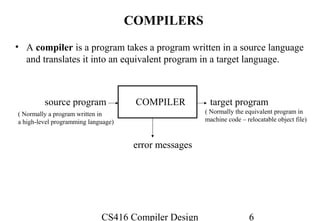
COMPILERS
• A compiler is a program takes a program written in a source language
  and translates it into an equivalent program in a target language.


         source program               COMPILER          target program
( Normally a program written in                        ( Normally the equivalent program in
a high-level programming language)                     machine code – relocatable object file)


                                      error messages


                             CS416 Compiler Design                     6
Other Applications
• In addition to the development of a compiler, the techniques used in
  compiler design can be applicable to many problems in computer
  science.
   – Techniques used in a lexical analyzer can be used in text editors, information retrieval
     system, and pattern recognition programs.
   – Techniques used in a parser can be used in a query processing system such as SQL.
   – Many software having a complex front-end may need techniques used in compiler design.
       • A symbolic equation solver which takes an equation as input. That program should parse   the
         given input equation.
   – Most of the techniques used in compiler design can be used in Natural Language
     Processing (NLP) systems.


                           CS416 Compiler Design                                 7
Major Parts of Compilers
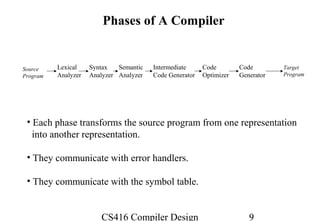
• There are two major parts of a compiler: Analysis and Synthesis

• In analysis phase, an intermediate representation is created from the
  given source program.
   – Lexical Analyzer, Syntax Analyzer and Semantic Analyzer are the parts of this phase.
• In synthesis phase, the equivalent target program is created from this
  intermediate representation.
   – Intermediate Code Generator, Code Generator, and Code Optimizer are the parts of this
     phase.


                          CS416 Compiler Design                           8
Phases of A Compiler


Source    Lexical    Syntax   Semantic   Intermediate     Code        Code        Target
Program   Analyzer   Analyzer Analyzer   Code Generator   Optimizer   Generator   Program


 • Each phase transforms the source program from one representation
   into another representation.

 • They communicate with error handlers.

 • They communicate with the symbol table.


                        CS416 Compiler Design                            9
Lexical Analyzer
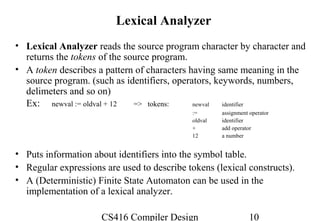
• Lexical Analyzer reads the source program character by character and
  returns the tokens of the source program.
• A token describes a pattern of characters having same meaning in the
  source program. (such as identifiers, operators, keywords, numbers,
  delimeters and so on)
  Ex: newval := oldval + 12   => tokens:     newval  identifier
                                             :=       assignment operator
                                             oldval   identifier
                                             +        add operator
                                             12       a number


• Puts information about identifiers into the symbol table.
• Regular expressions are used to describe tokens (lexical constructs).
• A (Deterministic) Finite State Automaton can be used in the
  implementation of a lexical analyzer.

                     CS416 Compiler Design                       10
Syntax Analyzer
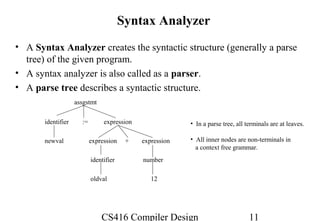
• A Syntax Analyzer creates the syntactic structure (generally a parse
  tree) of the given program.
• A syntax analyzer is also called as a parser.
• A parse tree describes a syntactic structure.
                    assgstmt


       identifier     :=        expression                • In a parse tree, all terminals are at leaves.

       newval              expression    +   expression   • All inner nodes are non-terminals in
                                                            a context free grammar.
                           identifier        number

                           oldval               12


                               CS416 Compiler Design                              11
Syntax Analyzer (CFG)
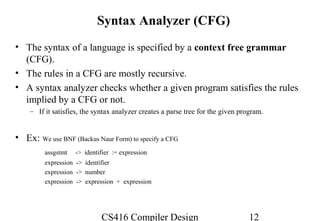
• The syntax of a language is specified by a context free grammar
  (CFG).
• The rules in a CFG are mostly recursive.
• A syntax analyzer checks whether a given program satisfies the rules
  implied by a CFG or not.
    – If it satisfies, the syntax analyzer creates a parse tree for the given program.


• Ex: We use BNF (Backus Naur Form) to specify a CFG
         assgstmt   -> identifier := expression
         expression -> identifier
         expression -> number
         expression -> expression + expression


                             CS416 Compiler Design                               12
Syntax Analyzer versus Lexical Analyzer
• Which constructs of a program should be recognized by the lexical
  analyzer, and which ones by the syntax analyzer?
   – Both of them do similar things; But the lexical analyzer deals with simple non-recursive
     constructs of the language.
   – The syntax analyzer deals with recursive constructs of the language.
   – The lexical analyzer simplifies the job of the syntax analyzer.
   – The lexical analyzer recognizes the smallest meaningful units (tokens) in a source program.
   – The syntax analyzer works on the smallest meaningful units (tokens) in a source program to
     recognize meaningful structures in our programming language.


                          CS416 Compiler Design                            13
Parsing Techniques
• Depending on how the parse tree is created, there are different parsing
  techniques.
• These parsing techniques are categorized into two groups:
   – Top-Down Parsing,
   – Bottom-Up Parsing
• Top-Down Parsing:
   – Construction of the parse tree starts at the root, and proceeds towards the leaves.
   – Efficient top-down parsers can be easily constructed by hand.
   – Recursive Predictive Parsing, Non-Recursive Predictive Parsing (LL Parsing).
• Bottom-Up Parsing:
   –   Construction of the parse tree starts at the leaves, and proceeds towards the root.
   –   Normally efficient bottom-up parsers are created with the help of some software tools.
   –   Bottom-up parsing is also known as shift-reduce parsing.
   –   Operator-Precedence Parsing – simple, restrictive, easy to implement
   –   LR Parsing – much general form of shift-reduce parsing, LR, SLR, LALR

                           CS416 Compiler Design                              14
Semantic Analyzer
• A semantic analyzer checks the source program for semantic errors and
  collects the type information for the code generation.
• Type-checking is an important part of semantic analyzer.
• Normally semantic information cannot be represented by a context-free
  language used in syntax analyzers.
• Context-free grammars used in the syntax analysis are integrated with
  attributes (semantic rules)
   – the result is a syntax-directed translation,
   – Attribute grammars
• Ex:
      newval := oldval + 12

        • The type of the identifier newval must match with type of the expression (oldval+12)


                             CS416 Compiler Design                                 15
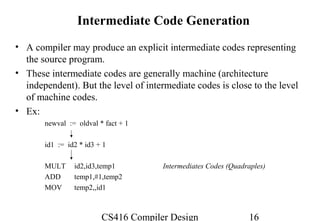
Intermediate Code Generation
• A compiler may produce an explicit intermediate codes representing
  the source program.
• These intermediate codes are generally machine (architecture
  independent). But the level of intermediate codes is close to the level
  of machine codes.
• Ex:
       newval := oldval * fact + 1

       id1 := id2 * id3 + 1

       MULT     id2,id3,temp1         Intermediates Codes (Quadraples)
       ADD      temp1,#1,temp2
       MOV      temp2,,id1


                         CS416 Compiler Design                  16
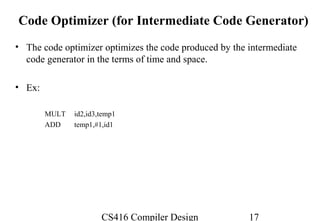
Code Optimizer (for Intermediate Code Generator)
• The code optimizer optimizes the code produced by the intermediate
  code generator in the terms of time and space.

• Ex:

        MULT   id2,id3,temp1
        ADD    temp1,#1,id1


                       CS416 Compiler Design            17
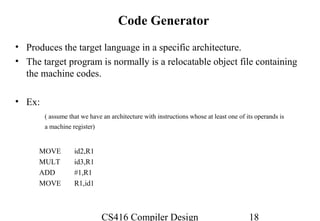
Code Generator
• Produces the target language in a specific architecture.
• The target program is normally is a relocatable object file containing
  the machine codes.

• Ex:
        ( assume that we have an architecture with instructions whose at least one of its operands is
        a machine register)


      MOVE         id2,R1
      MULT         id3,R1
      ADD          #1,R1
      MOVE         R1,id1


                              CS416 Compiler Design                                    18

Compiler Design

  • 1.
    CS416 Compiler Design CS416 Compiler Design 1
  • 2.
    Course Information • Instructor: Dr. Ilyas Cicekli – Office: EA504, – Phone: 2901589, – Email: ilyas@cs.bilkent.edu.tr • Course Web Page: http://www.cs.bilkent.edu.tr/~ilyas/Courses/CS416 CS416 Compiler Design 2
  • 3.
    Preliminaries Required • Basicknowledge of programming languages. • Basic knowledge of FSA and CFG. • Knowledge of a high programming language for the programming assignments. Textbook: Alfred V. Aho, Ravi Sethi, and Jeffrey D. Ullman, “Compilers: Principles, Techniques, and Tools” Addison-Wesley, 1986. CS416 Compiler Design 3
  • 4.
    Grading • Midterm : 30% • Homeworks : 20% • Pop-quizzes : 10% • Final : 40% CS416 Compiler Design 4
  • 5.
    Course Outline • Introductionto Compiling • Lexical Analysis • Syntax Analysis – Context Free Grammars – Top-Down Parsing, LL Parsing – Bottom-Up Parsing, LR Parsing • Syntax-Directed Translation – Attribute Definitions – Evaluation of Attribute Definitions • Semantic Analysis, Type Checking • Run-Time Organization • Intermediate Code Generation CS416 Compiler Design 5
  • 6.
    COMPILERS • A compileris a program takes a program written in a source language and translates it into an equivalent program in a target language. source program COMPILER target program ( Normally a program written in ( Normally the equivalent program in a high-level programming language) machine code – relocatable object file) error messages CS416 Compiler Design 6
  • 7.
    Other Applications • Inaddition to the development of a compiler, the techniques used in compiler design can be applicable to many problems in computer science. – Techniques used in a lexical analyzer can be used in text editors, information retrieval system, and pattern recognition programs. – Techniques used in a parser can be used in a query processing system such as SQL. – Many software having a complex front-end may need techniques used in compiler design. • A symbolic equation solver which takes an equation as input. That program should parse the given input equation. – Most of the techniques used in compiler design can be used in Natural Language Processing (NLP) systems. CS416 Compiler Design 7
  • 8.
    Major Parts ofCompilers • There are two major parts of a compiler: Analysis and Synthesis • In analysis phase, an intermediate representation is created from the given source program. – Lexical Analyzer, Syntax Analyzer and Semantic Analyzer are the parts of this phase. • In synthesis phase, the equivalent target program is created from this intermediate representation. – Intermediate Code Generator, Code Generator, and Code Optimizer are the parts of this phase. CS416 Compiler Design 8
  • 9.
    Phases of ACompiler Source Lexical Syntax Semantic Intermediate Code Code Target Program Analyzer Analyzer Analyzer Code Generator Optimizer Generator Program • Each phase transforms the source program from one representation into another representation. • They communicate with error handlers. • They communicate with the symbol table. CS416 Compiler Design 9
  • 10.
    Lexical Analyzer • LexicalAnalyzer reads the source program character by character and returns the tokens of the source program. • A token describes a pattern of characters having same meaning in the source program. (such as identifiers, operators, keywords, numbers, delimeters and so on) Ex: newval := oldval + 12 => tokens: newval identifier := assignment operator oldval identifier + add operator 12 a number • Puts information about identifiers into the symbol table. • Regular expressions are used to describe tokens (lexical constructs). • A (Deterministic) Finite State Automaton can be used in the implementation of a lexical analyzer. CS416 Compiler Design 10
  • 11.
    Syntax Analyzer • ASyntax Analyzer creates the syntactic structure (generally a parse tree) of the given program. • A syntax analyzer is also called as a parser. • A parse tree describes a syntactic structure. assgstmt identifier := expression • In a parse tree, all terminals are at leaves. newval expression + expression • All inner nodes are non-terminals in a context free grammar. identifier number oldval 12 CS416 Compiler Design 11
  • 12.
    Syntax Analyzer (CFG) •The syntax of a language is specified by a context free grammar (CFG). • The rules in a CFG are mostly recursive. • A syntax analyzer checks whether a given program satisfies the rules implied by a CFG or not. – If it satisfies, the syntax analyzer creates a parse tree for the given program. • Ex: We use BNF (Backus Naur Form) to specify a CFG assgstmt -> identifier := expression expression -> identifier expression -> number expression -> expression + expression CS416 Compiler Design 12
  • 13.
    Syntax Analyzer versusLexical Analyzer • Which constructs of a program should be recognized by the lexical analyzer, and which ones by the syntax analyzer? – Both of them do similar things; But the lexical analyzer deals with simple non-recursive constructs of the language. – The syntax analyzer deals with recursive constructs of the language. – The lexical analyzer simplifies the job of the syntax analyzer. – The lexical analyzer recognizes the smallest meaningful units (tokens) in a source program. – The syntax analyzer works on the smallest meaningful units (tokens) in a source program to recognize meaningful structures in our programming language. CS416 Compiler Design 13
  • 14.
    Parsing Techniques • Dependingon how the parse tree is created, there are different parsing techniques. • These parsing techniques are categorized into two groups: – Top-Down Parsing, – Bottom-Up Parsing • Top-Down Parsing: – Construction of the parse tree starts at the root, and proceeds towards the leaves. – Efficient top-down parsers can be easily constructed by hand. – Recursive Predictive Parsing, Non-Recursive Predictive Parsing (LL Parsing). • Bottom-Up Parsing: – Construction of the parse tree starts at the leaves, and proceeds towards the root. – Normally efficient bottom-up parsers are created with the help of some software tools. – Bottom-up parsing is also known as shift-reduce parsing. – Operator-Precedence Parsing – simple, restrictive, easy to implement – LR Parsing – much general form of shift-reduce parsing, LR, SLR, LALR CS416 Compiler Design 14
  • 15.
    Semantic Analyzer • Asemantic analyzer checks the source program for semantic errors and collects the type information for the code generation. • Type-checking is an important part of semantic analyzer. • Normally semantic information cannot be represented by a context-free language used in syntax analyzers. • Context-free grammars used in the syntax analysis are integrated with attributes (semantic rules) – the result is a syntax-directed translation, – Attribute grammars • Ex: newval := oldval + 12 • The type of the identifier newval must match with type of the expression (oldval+12) CS416 Compiler Design 15
  • 16.
    Intermediate Code Generation •A compiler may produce an explicit intermediate codes representing the source program. • These intermediate codes are generally machine (architecture independent). But the level of intermediate codes is close to the level of machine codes. • Ex: newval := oldval * fact + 1 id1 := id2 * id3 + 1 MULT id2,id3,temp1 Intermediates Codes (Quadraples) ADD temp1,#1,temp2 MOV temp2,,id1 CS416 Compiler Design 16
  • 17.
    Code Optimizer (forIntermediate Code Generator) • The code optimizer optimizes the code produced by the intermediate code generator in the terms of time and space. • Ex: MULT id2,id3,temp1 ADD temp1,#1,id1 CS416 Compiler Design 17
  • 18.
    Code Generator • Producesthe target language in a specific architecture. • The target program is normally is a relocatable object file containing the machine codes. • Ex: ( assume that we have an architecture with instructions whose at least one of its operands is a machine register) MOVE id2,R1 MULT id3,R1 ADD #1,R1 MOVE R1,id1 CS416 Compiler Design 18