Presentation on :
Credit Cards
Presented to :
Prof. MS Thuran
Presented by :
Sahil 14104002
Anuj 14104009
Jyoti 14104014
Sumit 14104024
Preety 14104030
Credit Card
Also known as plastic money, it is a means of
deferred payment.
A credit card is a payment card
issued to users as a system of
payment. It allows the cardholder
to pay for goods and services
based on the holder's promise to
pay for them.
Brief History
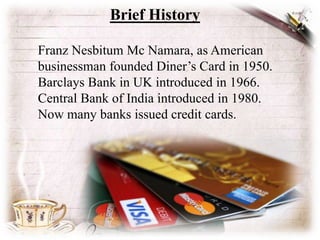
Franz Nesbitum Mc Namara, as American
businessman founded Diner’s Card in 1950.
Barclays Bank in UK introduced in 1966.
Central Bank of India introduced in 1980.
Now many banks issued credit cards.
Working Mechanism
 Three Parties :
1. Issuing organization or bank-agreements
with merchant establishments, makes
payments after deducing commission.
2. Card Holders: Buys goods/services from
establishments without immediate cash
payment.
3. Member Establishment: Sends bills to
issuing organization/bank.
Eligibility: different card are issued depending on
income of person.
• Standard Card is basic without any frills.
• Gold card/executive card offers higher
line of credit.
• Platinum Card: higher credit limit and
additional perks.
• Titanium Card provides higher credit
limit.
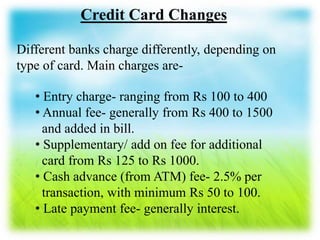
Credit Card Changes
Different banks charge differently, depending on
type of card. Main charges are-
• Entry charge- ranging from Rs 100 to 400
• Annual fee- generally from Rs 400 to 1500
and added in bill.
• Supplementary/ add on fee for additional
card from Rs 125 to Rs 1000.
• Cash advance (from ATM) fee- 2.5% per
transaction, with minimum Rs 50 to 100.
• Late payment fee- generally interest.
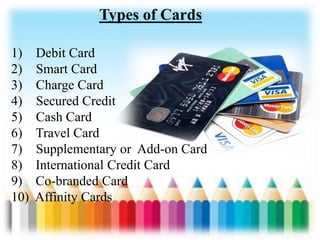
Types of Cards
1) Debit Card
2) Smart Card
3) Charge Card
4) Secured Credit
5) Cash Card
6) Travel Card
7) Supplementary or Add-on Card
8) International Credit Card
9) Co-branded Card
10) Affinity Cards
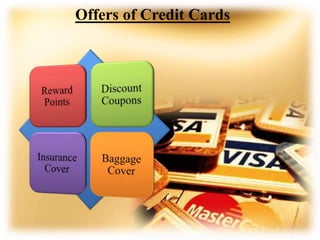
Offers of Credit Cards
Advantages of credit cards
For card holders :
 Purchase without immediate payment
 Overdraft/ credit facility
 Security as less cash carried
 Freebies and discount facility
 Status symbol
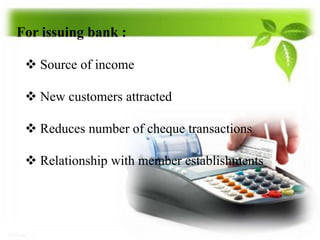
For issuing bank :
 Source of income
 New customers attracted
 Reduces number of cheque transactions
 Relationship with member establishments
For member establishments :
 Payments guaranteed, when charge slip
sent to member establishment.
 Speedy settlement of bills by banks
 Burden of credit facility taken by bank.
 Increase in volume of business transactions.
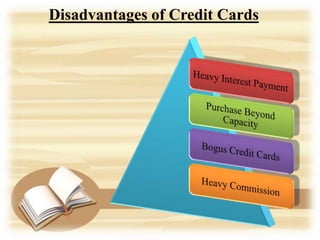
Disadvantages of Credit Cards
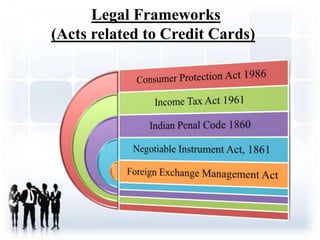
Legal Frameworks
(Acts related to Credit Cards)
Credit cards ppt
Credit cards ppt

Credit cards ppt

  • 1.
    Presentation on : CreditCards Presented to : Prof. MS Thuran Presented by : Sahil 14104002 Anuj 14104009 Jyoti 14104014 Sumit 14104024 Preety 14104030
  • 2.
    Credit Card Also knownas plastic money, it is a means of deferred payment. A credit card is a payment card issued to users as a system of payment. It allows the cardholder to pay for goods and services based on the holder's promise to pay for them.
  • 3.
    Brief History Franz NesbitumMc Namara, as American businessman founded Diner’s Card in 1950. Barclays Bank in UK introduced in 1966. Central Bank of India introduced in 1980. Now many banks issued credit cards.
  • 4.
    Working Mechanism  ThreeParties : 1. Issuing organization or bank-agreements with merchant establishments, makes payments after deducing commission. 2. Card Holders: Buys goods/services from establishments without immediate cash payment. 3. Member Establishment: Sends bills to issuing organization/bank.
  • 5.
    Eligibility: different cardare issued depending on income of person. • Standard Card is basic without any frills. • Gold card/executive card offers higher line of credit. • Platinum Card: higher credit limit and additional perks. • Titanium Card provides higher credit limit.
  • 6.
    Credit Card Changes Differentbanks charge differently, depending on type of card. Main charges are- • Entry charge- ranging from Rs 100 to 400 • Annual fee- generally from Rs 400 to 1500 and added in bill. • Supplementary/ add on fee for additional card from Rs 125 to Rs 1000. • Cash advance (from ATM) fee- 2.5% per transaction, with minimum Rs 50 to 100. • Late payment fee- generally interest.
  • 7.
    Types of Cards 1)Debit Card 2) Smart Card 3) Charge Card 4) Secured Credit 5) Cash Card 6) Travel Card 7) Supplementary or Add-on Card 8) International Credit Card 9) Co-branded Card 10) Affinity Cards
  • 8.
  • 9.
    Advantages of creditcards For card holders :  Purchase without immediate payment  Overdraft/ credit facility  Security as less cash carried  Freebies and discount facility  Status symbol
  • 10.
    For issuing bank:  Source of income  New customers attracted  Reduces number of cheque transactions  Relationship with member establishments
  • 11.
    For member establishments:  Payments guaranteed, when charge slip sent to member establishment.  Speedy settlement of bills by banks  Burden of credit facility taken by bank.  Increase in volume of business transactions.
  • 12.
  • 13.