Introduction to 8086 Assembly
Language
   Assembly Language Programming
                     University of Akron
                       Dr. Tim Margush
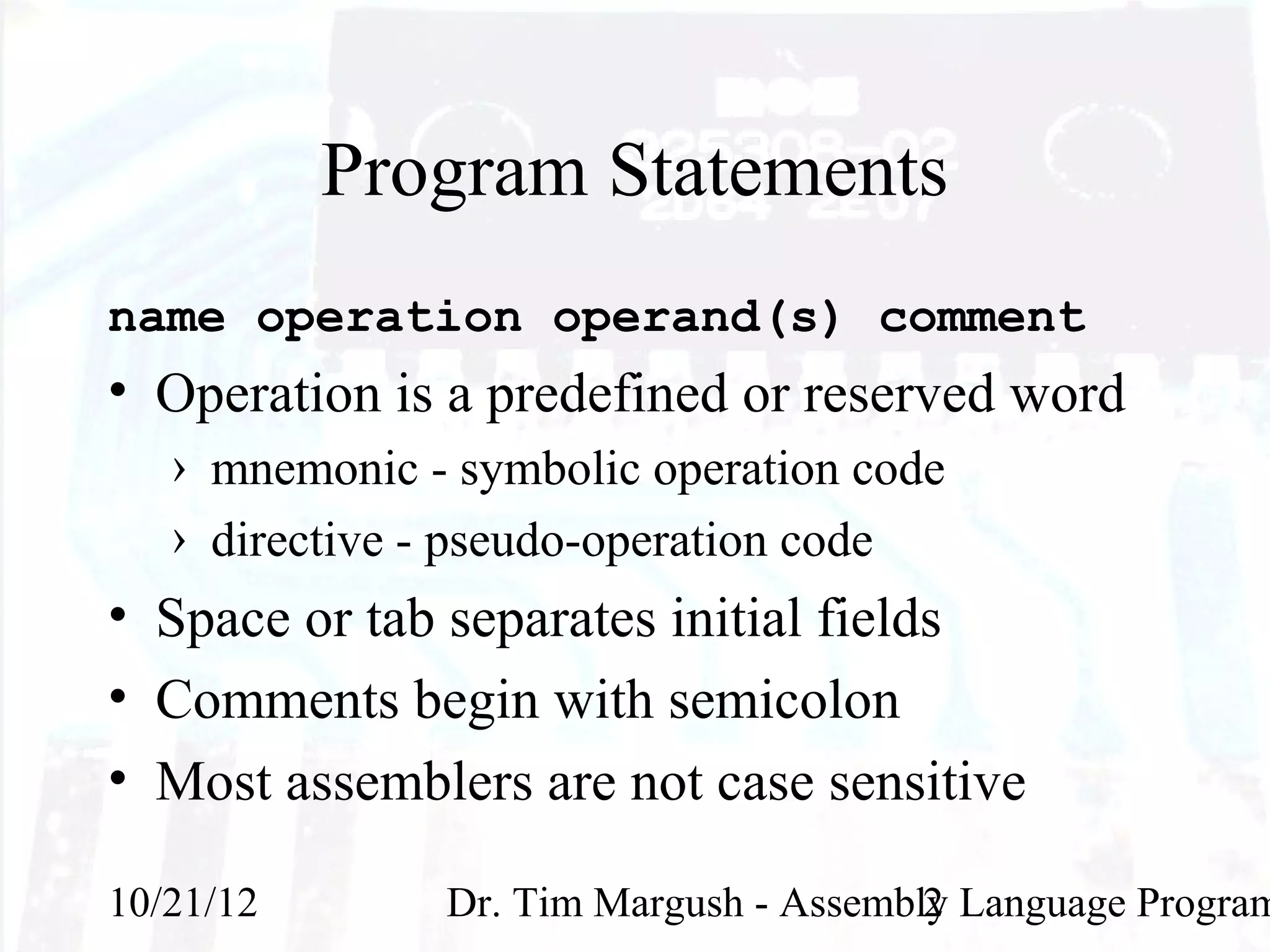
Program Statements
name operation operand(s) comment
• Operation is a predefined or reserved word
   › mnemonic - symbolic operation code
   › directive - pseudo-operation code
• Space or tab separates initial fields
• Comments begin with semicolon
• Most assemblers are not case sensitive

10/21/12       Dr. Tim Margush - Assembly Language Program
                                        2
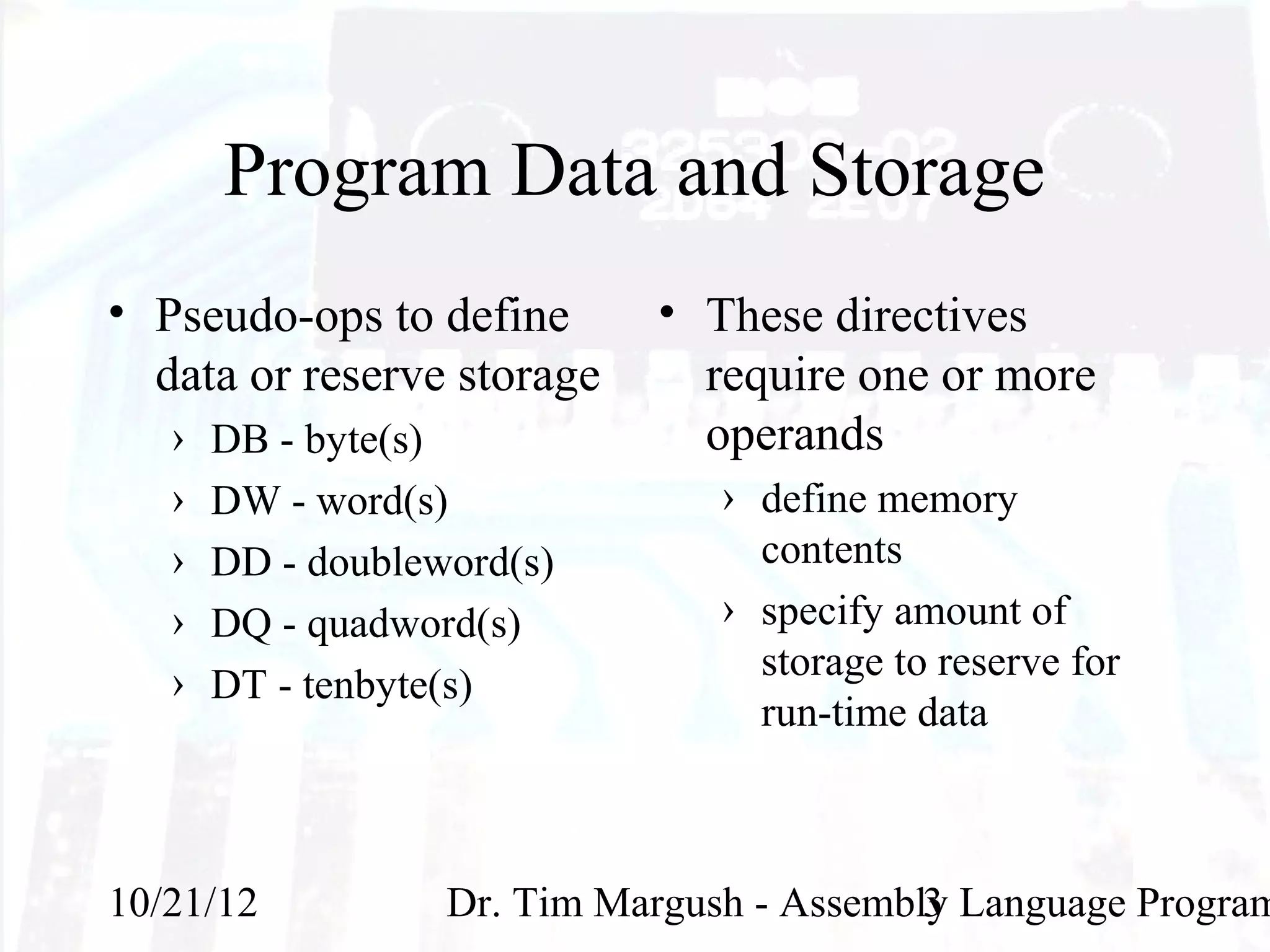
Program Data and Storage
• Pseudo-ops to define       • These directives
  data or reserve storage      require one or more
   ›   DB - byte(s)            operands
   ›   DW - word(s)              › define memory
   ›   DD - doubleword(s)          contents
   ›   DQ - quadword(s)          › specify amount of
   ›                               storage to reserve for
       DT - tenbyte(s)
                                   run-time data


10/21/12           Dr. Tim Margush - Assembly Language Program
                                            3
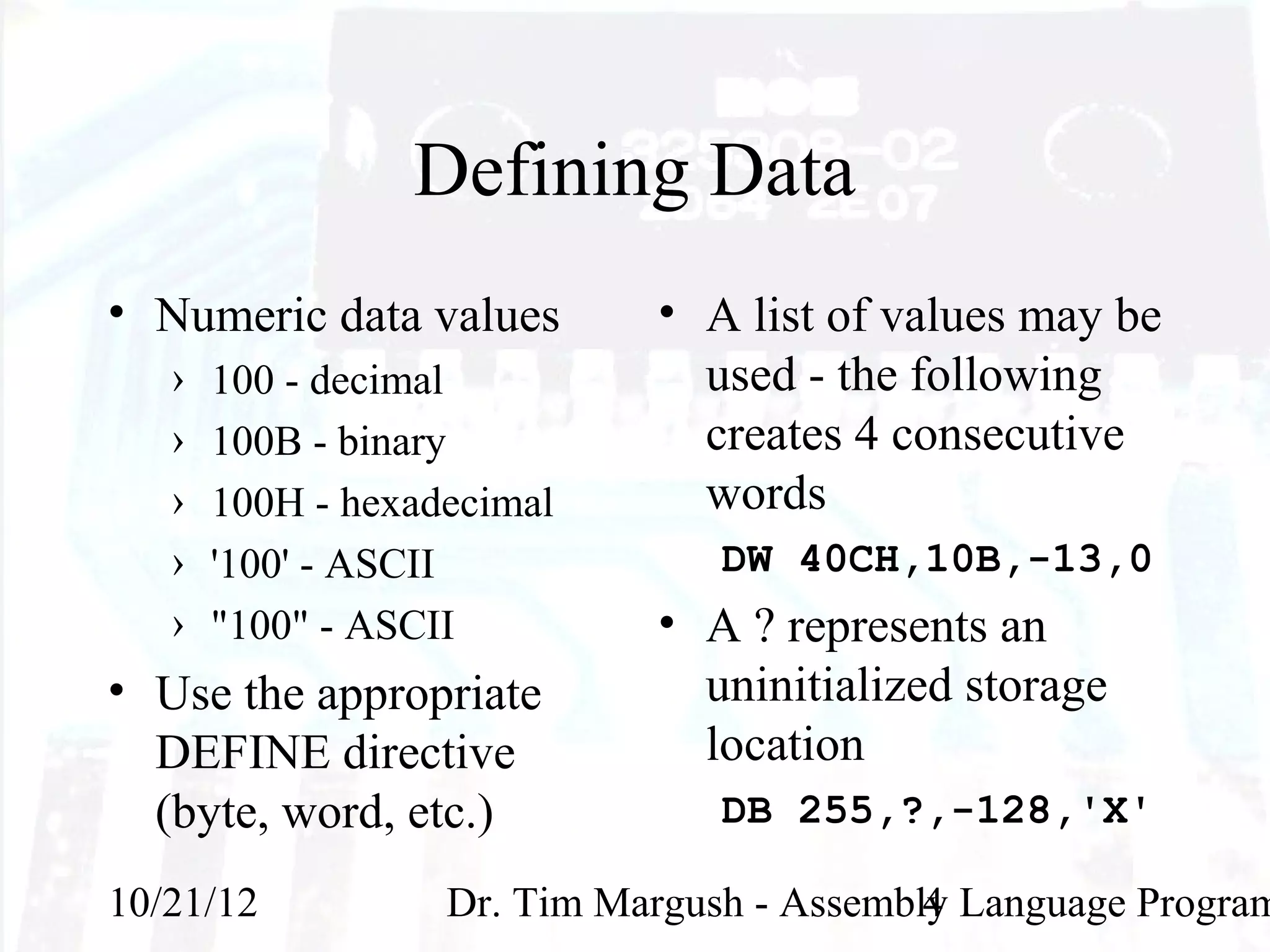
Defining Data
• Numeric data values        • A list of values may be
   ›   100 - decimal           used - the following
   ›   100B - binary           creates 4 consecutive
   ›   100H - hexadecimal      words
   ›   '100' - ASCII             DW 40CH,10B,-13,0
   ›   "100" - ASCII         • A ? represents an
• Use the appropriate          uninitialized storage
  DEFINE directive             location
  (byte, word, etc.)             DB 255,?,-128,'X'

10/21/12           Dr. Tim Margush - Assembly Language Program
                                            4
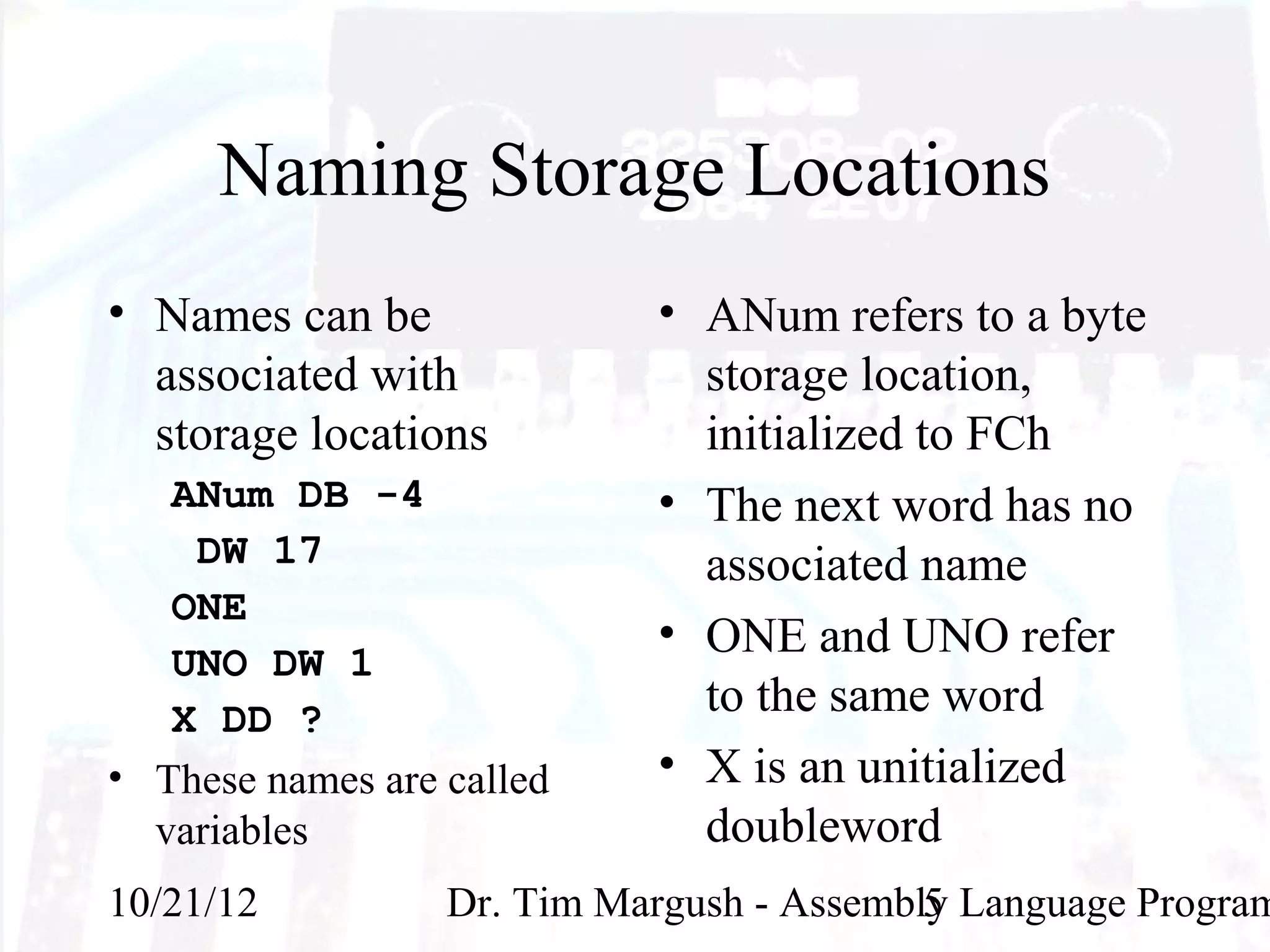
Naming Storage Locations
• Names can be              • ANum refers to a byte
  associated with             storage location,
  storage locations           initialized to FCh
   ANum DB -4               • The next word has no
    DW 17                     associated name
   ONE
                            • ONE and UNO refer
   UNO DW 1
   X DD ?                     to the same word
• These names are called    • X is an unitialized
  variables                   doubleword
10/21/12          Dr. Tim Margush - Assembly Language Program
                                           5
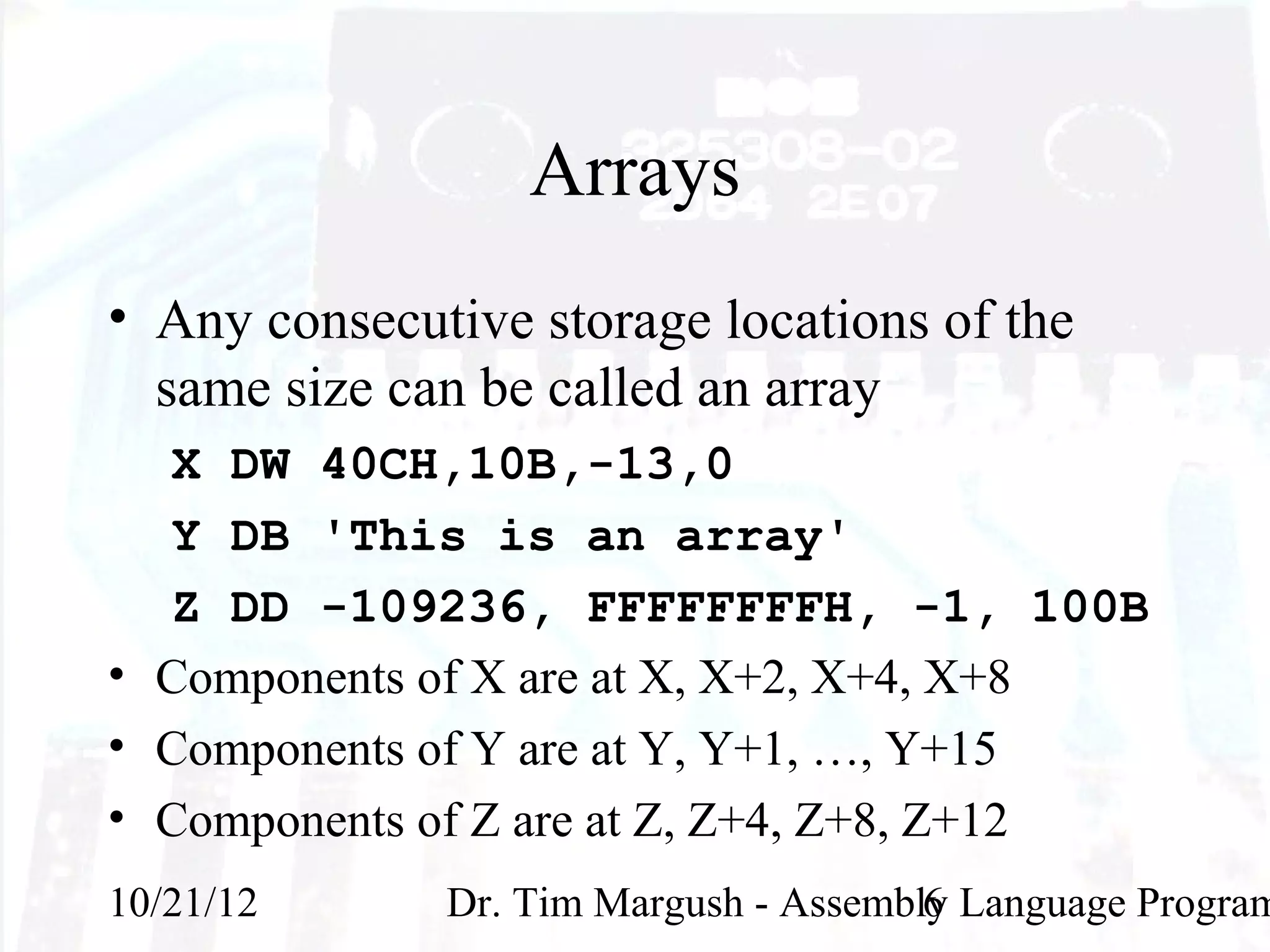
Arrays
• Any consecutive storage locations of the
  same size can be called an array
  X DW 40CH,10B,-13,0
  Y DB 'This is an array'
  Z DD -109236, FFFFFFFFH, -1, 100B
• Components of X are at X, X+2, X+4, X+8
• Components of Y are at Y, Y+1, …, Y+15
• Components of Z are at Z, Z+4, Z+8, Z+12
10/21/12      Dr. Tim Margush - Assembly Language Program
                                       6
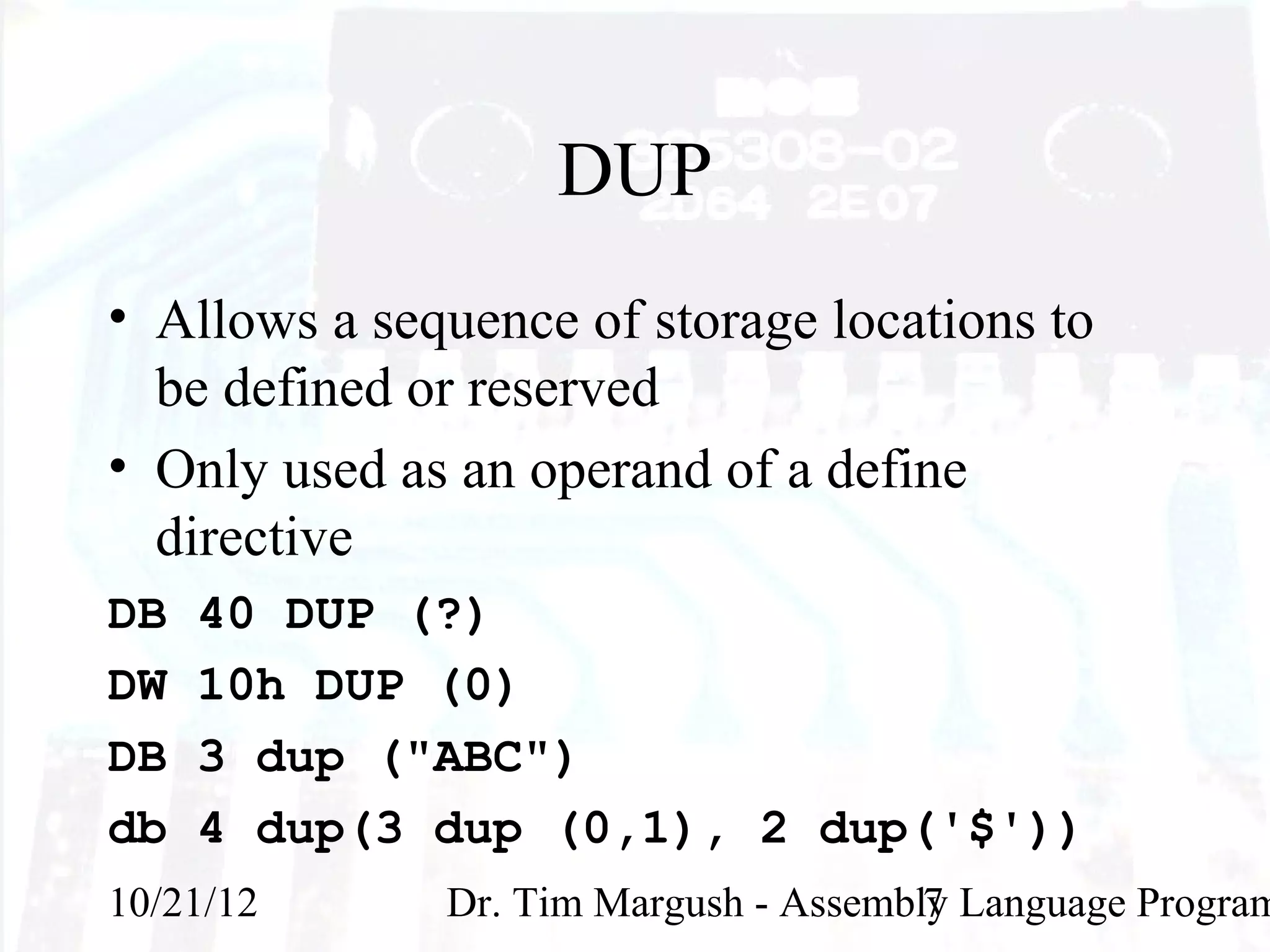
DUP
• Allows a sequence of storage locations to
  be defined or reserved
• Only used as an operand of a define
  directive
DB   40 DUP (?)
DW   10h DUP (0)
DB   3 dup ("ABC")
db   4 dup(3 dup (0,1), 2 dup('$'))
10/21/12      Dr. Tim Margush - Assembly Language Program
                                       7
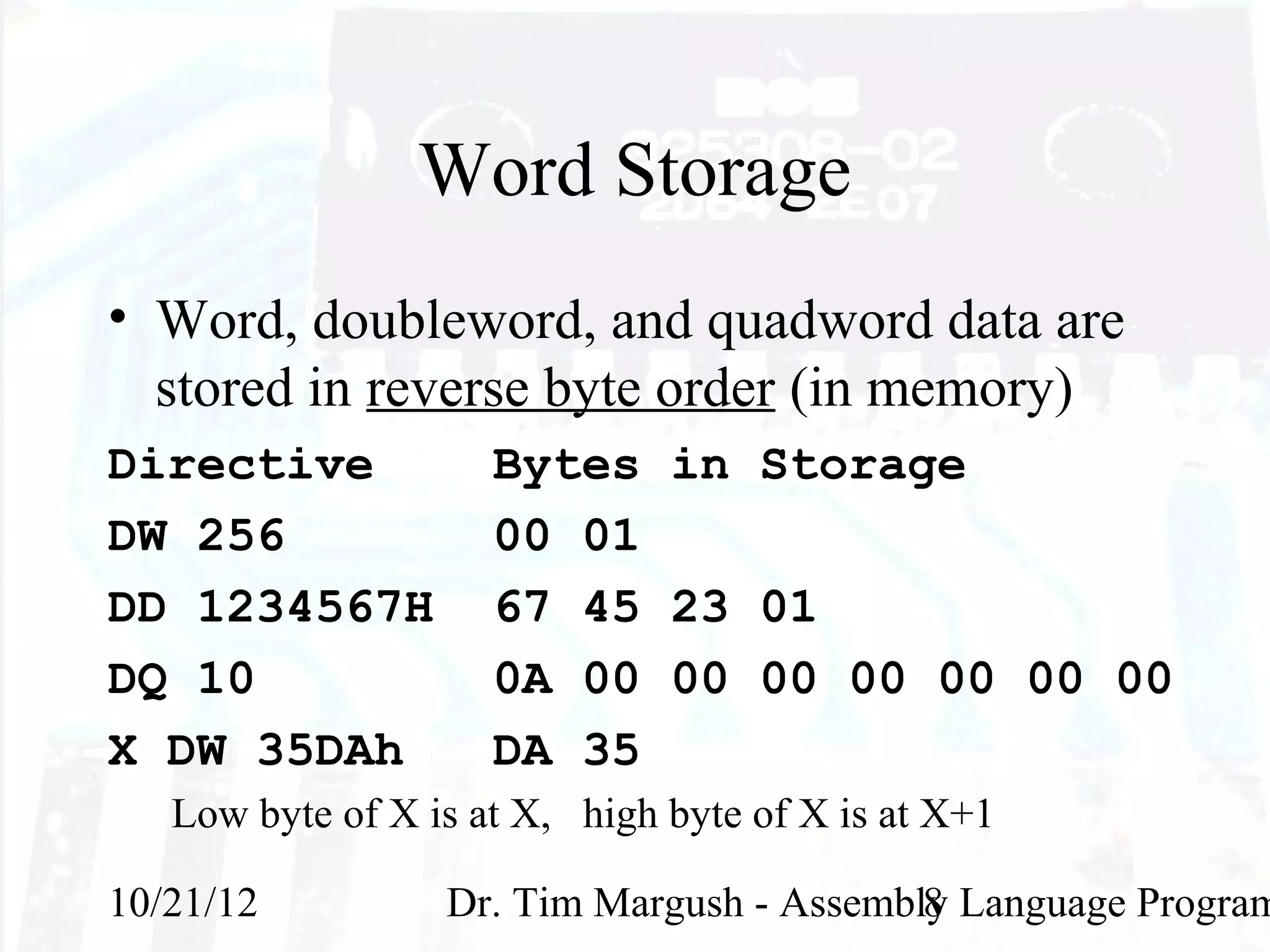
Word Storage
• Word, doubleword, and quadword data are
  stored in reverse byte order (in memory)
Directive            Bytes in Storage
DW 256               00 01
DD 1234567H          67 45 23 01
DQ 10                0A 00 00 00 00 00 00 00
X DW 35DAh           DA 35
   Low byte of X is at X, high byte of X is at X+1

10/21/12          Dr. Tim Margush - Assembly Language Program
                                           8
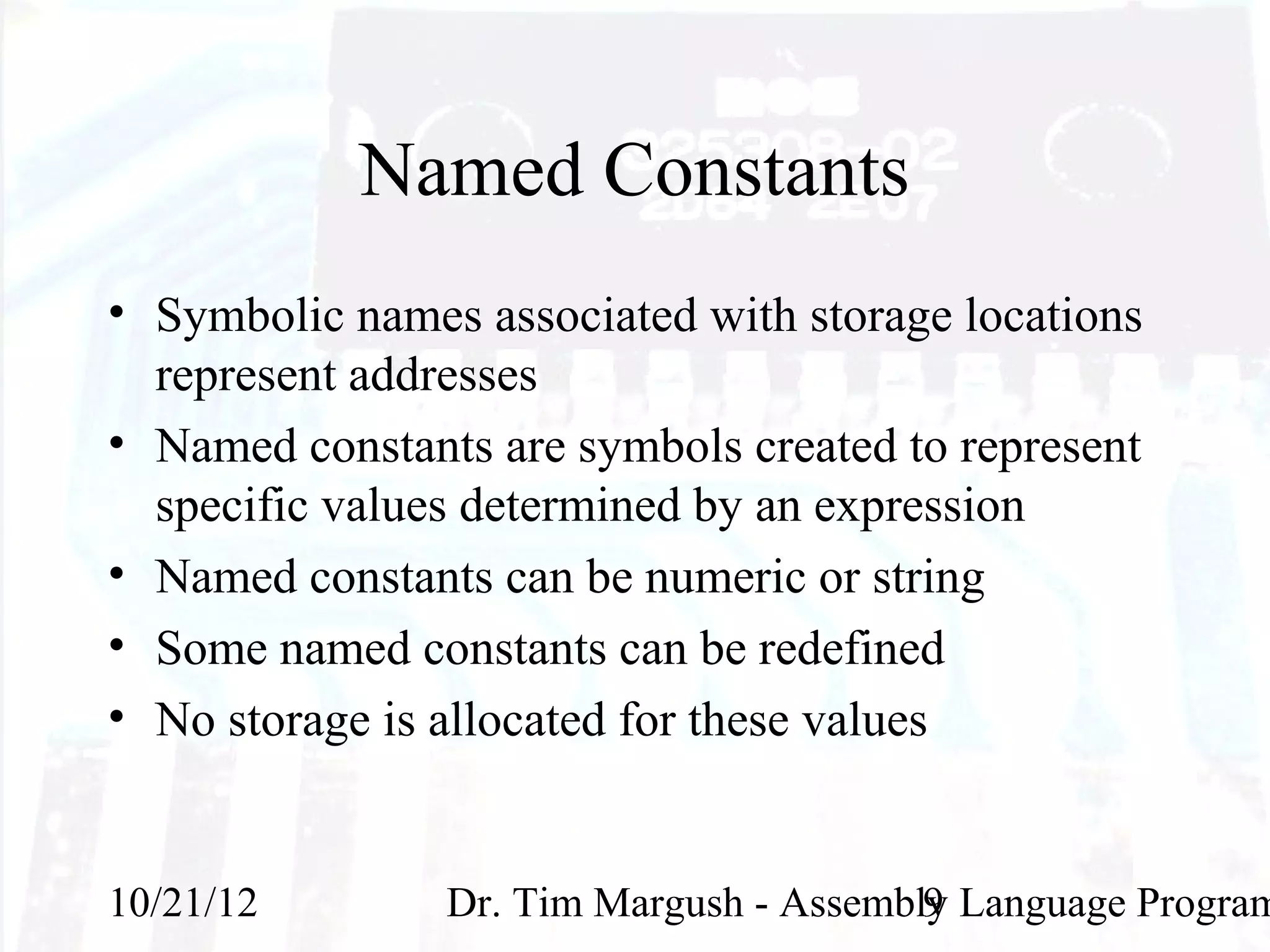
Named Constants
• Symbolic names associated with storage locations
  represent addresses
• Named constants are symbols created to represent
  specific values determined by an expression
• Named constants can be numeric or string
• Some named constants can be redefined
• No storage is allocated for these values


10/21/12        Dr. Tim Margush - Assembly Language Program
                                         9
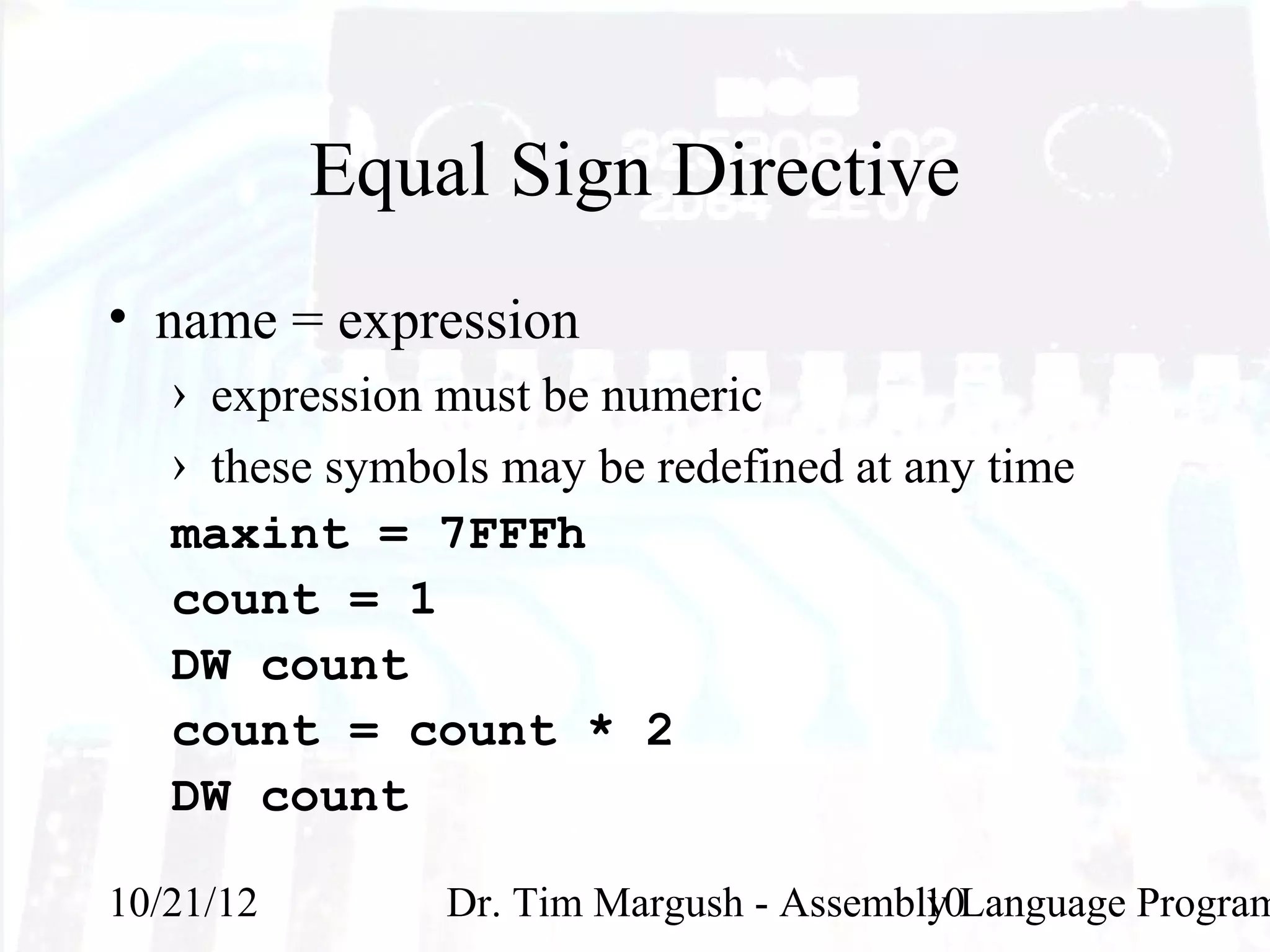
Equal Sign Directive
• name = expression
   › expression must be numeric
   › these symbols may be redefined at any time
   maxint = 7FFFh
   count = 1
   DW count
   count = count * 2
   DW count

10/21/12        Dr. Tim Margush - Assembly Language Program
                                         10
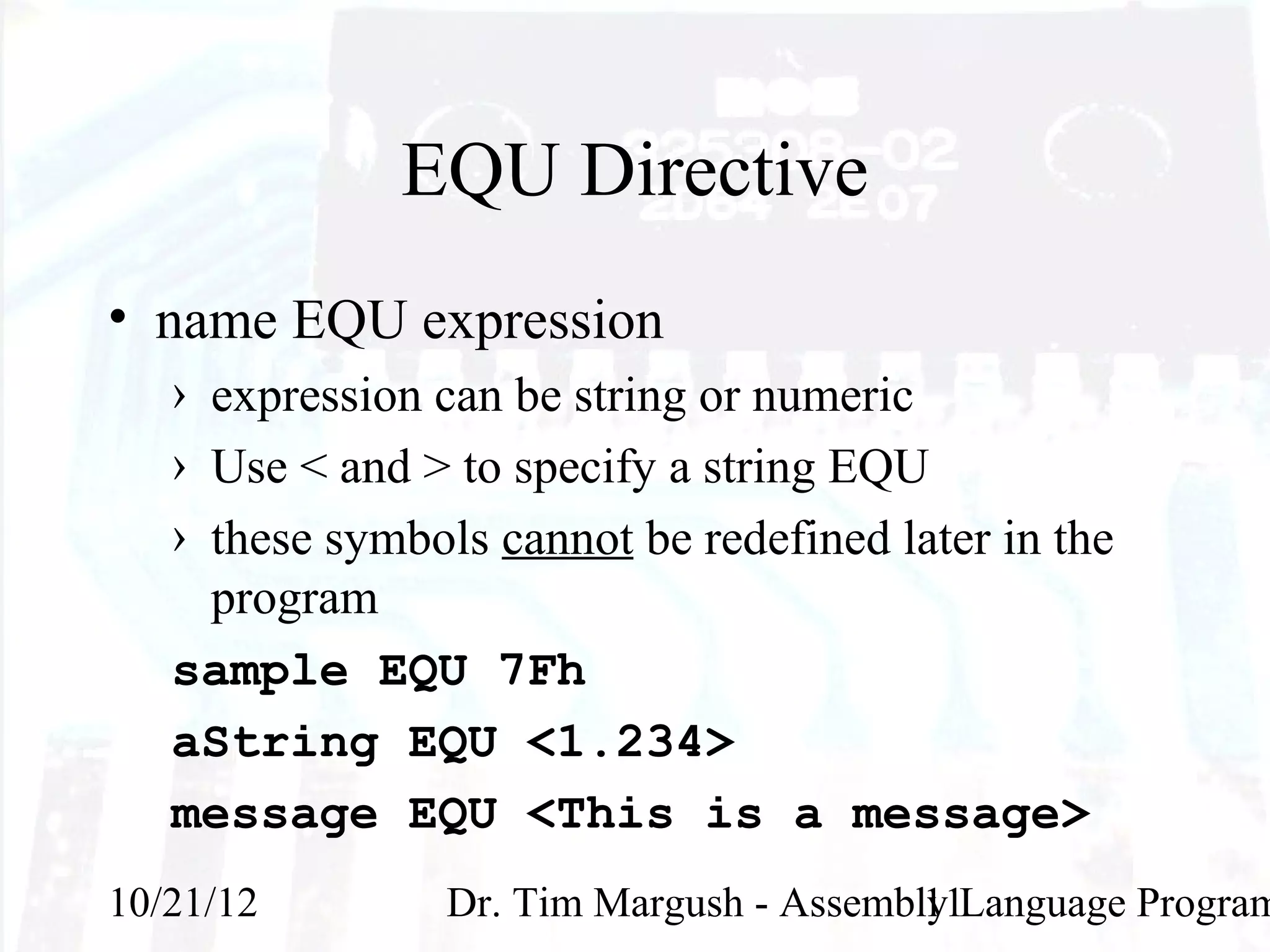
EQU Directive
• name EQU expression
   › expression can be string or numeric
   › Use < and > to specify a string EQU
   › these symbols cannot be redefined later in the
     program
   sample EQU 7Fh
   aString EQU <1.234>
   message EQU <This is a message>
10/21/12         Dr. Tim Margush - Assembly Language Program
                                          11
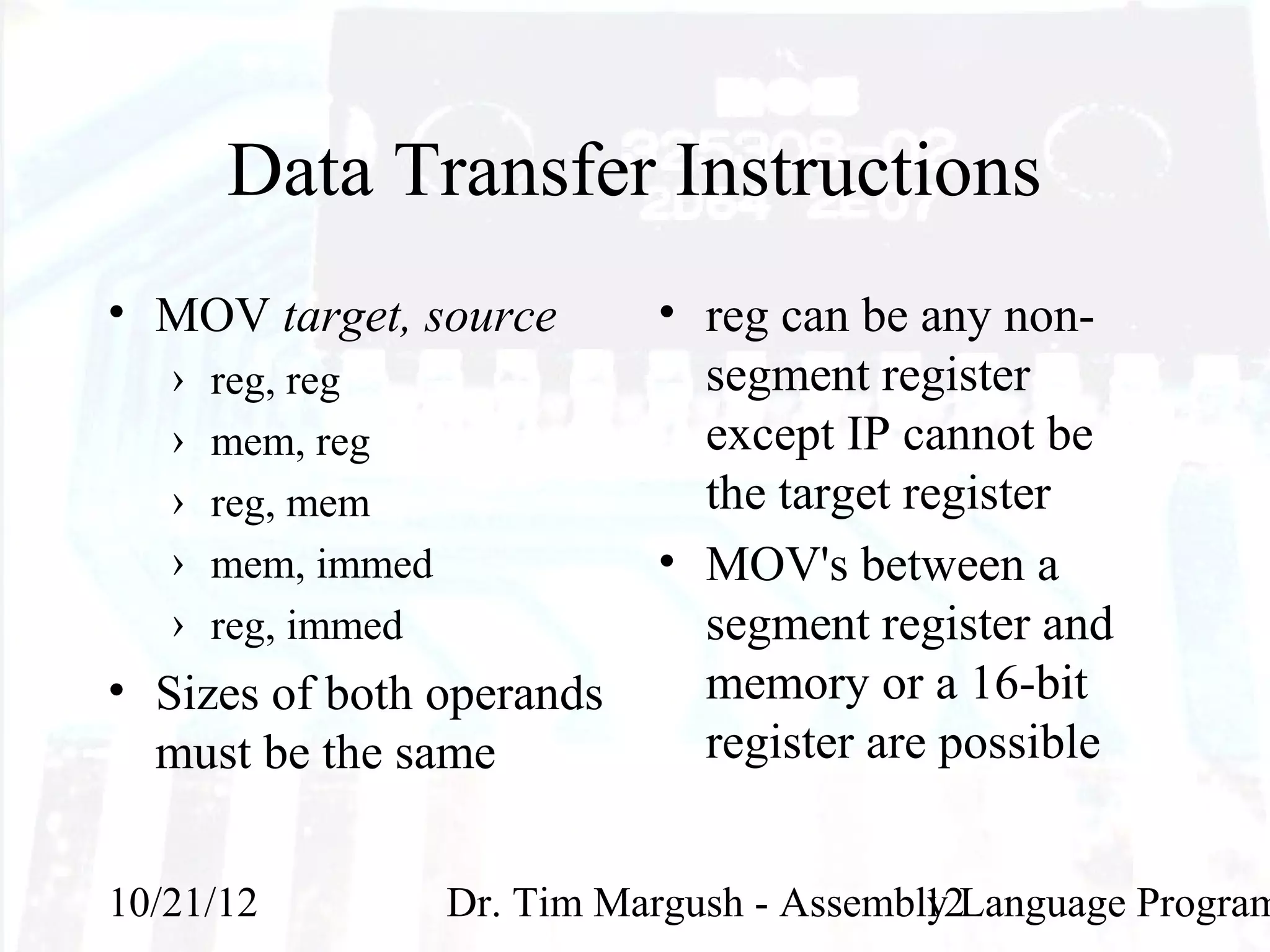
Data Transfer Instructions
• MOV target, source          • reg can be any non-
   ›   reg, reg                 segment register
   ›   mem, reg                 except IP cannot be
   ›   reg, mem                 the target register
   ›   mem, immed             • MOV's between a
   ›   reg, immed               segment register and
• Sizes of both operands        memory or a 16-bit
  must be the same              register are possible


10/21/12            Dr. Tim Margush - Assembly Language Program
                                             12
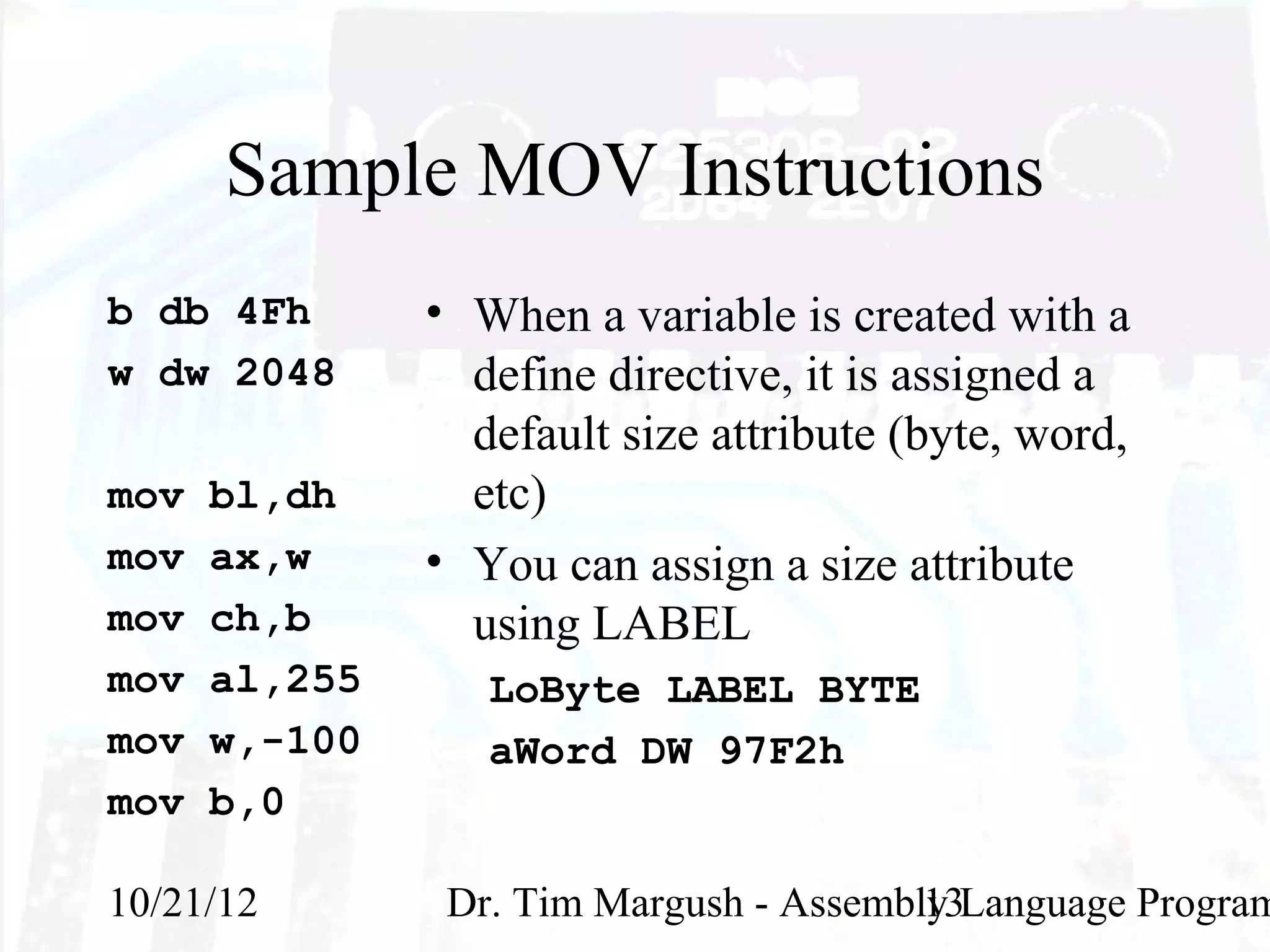
Sample MOV Instructions
b db 4Fh       • When a variable is created with a
w dw 2048        define directive, it is assigned a
                 default size attribute (byte, word,
mov   bl,dh      etc)
mov   ax,w     • You can assign a size attribute
mov   ch,b       using LABEL
mov   al,255      LoByte LABEL BYTE
mov   w,-100      aWord DW 97F2h
mov   b,0

10/21/12        Dr. Tim Margush - Assembly Language Program
                                         13
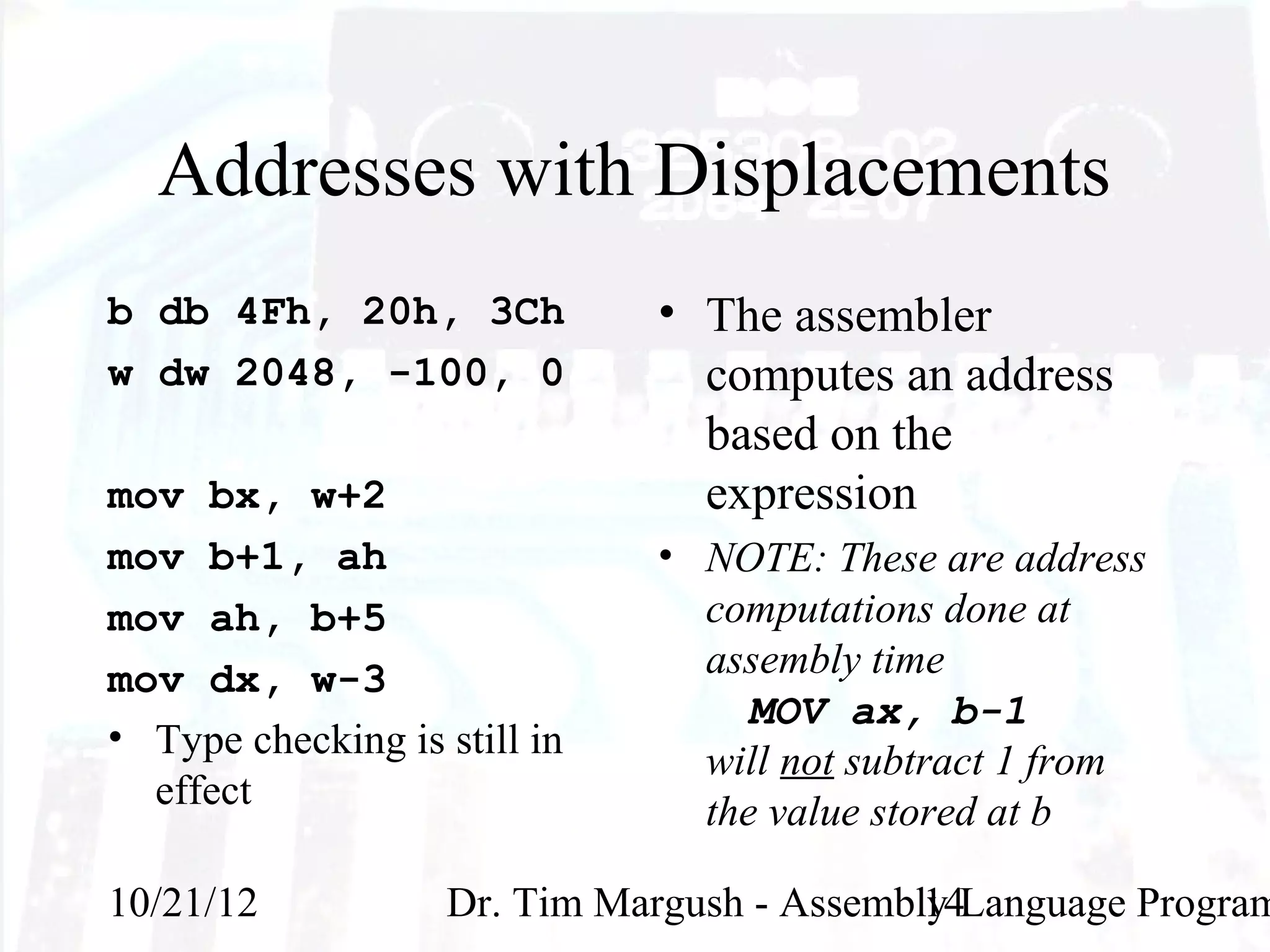
Addresses with Displacements
b db 4Fh, 20h, 3Ch            • The assembler
w dw 2048, -100, 0              computes an address
                                based on the
mov bx, w+2                     expression
mov b+1, ah                   • NOTE: These are address
mov ah, b+5                     computations done at
mov dx, w-3                     assembly time
                                   MOV ax, b-1
• Type checking is still in
                                will not subtract 1 from
  effect                        the value stored at b

10/21/12            Dr. Tim Margush - Assembly Language Program
                                             14
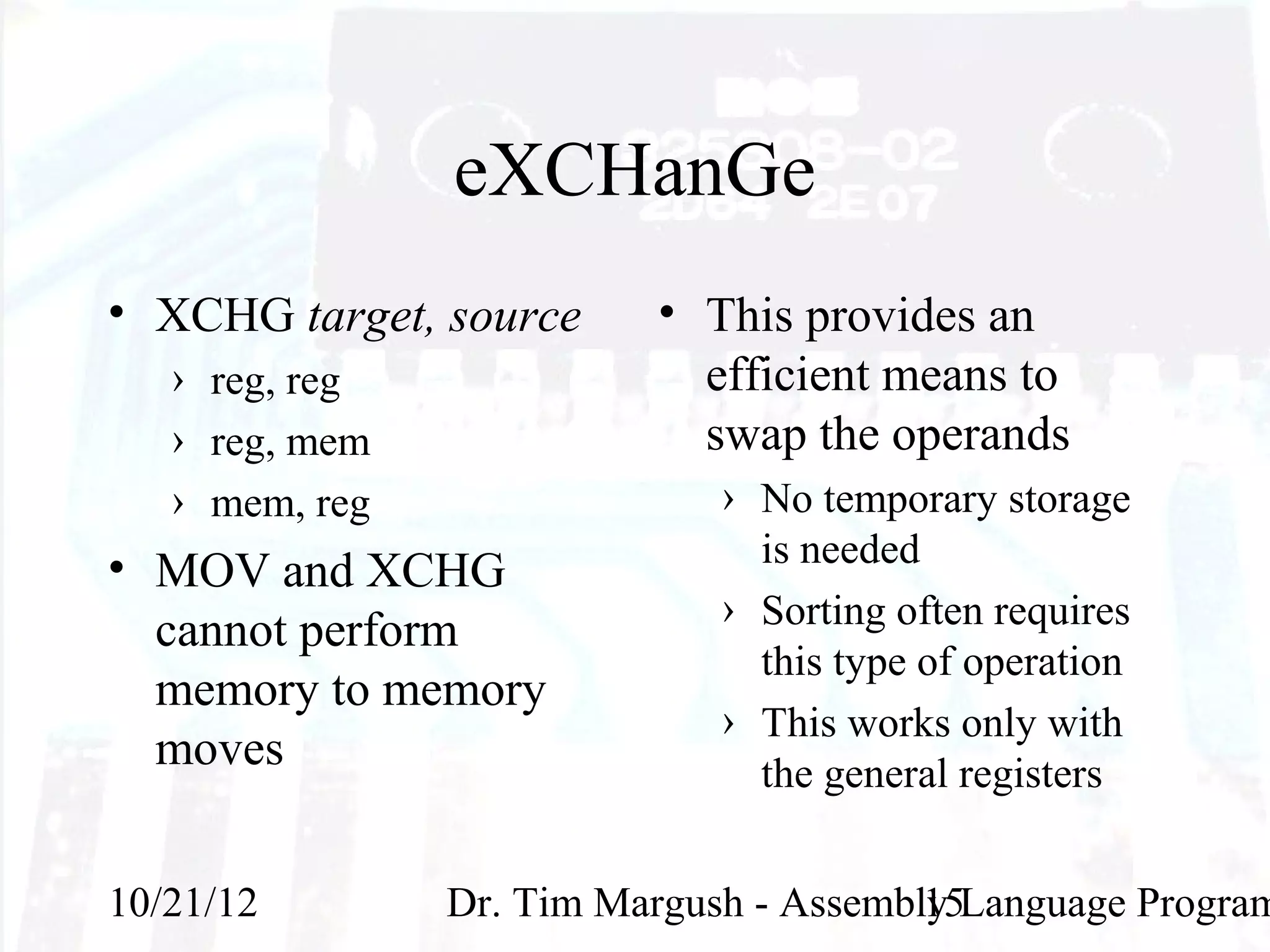
eXCHanGe
• XCHG target, source     • This provides an
   › reg, reg               efficient means to
   › reg, mem               swap the operands
   › mem, reg                 › No temporary storage
• MOV and XCHG                  is needed
                              › Sorting often requires
  cannot perform
                                this type of operation
  memory to memory
                              › This works only with
  moves                         the general registers


10/21/12        Dr. Tim Margush - Assembly Language Program
                                         15
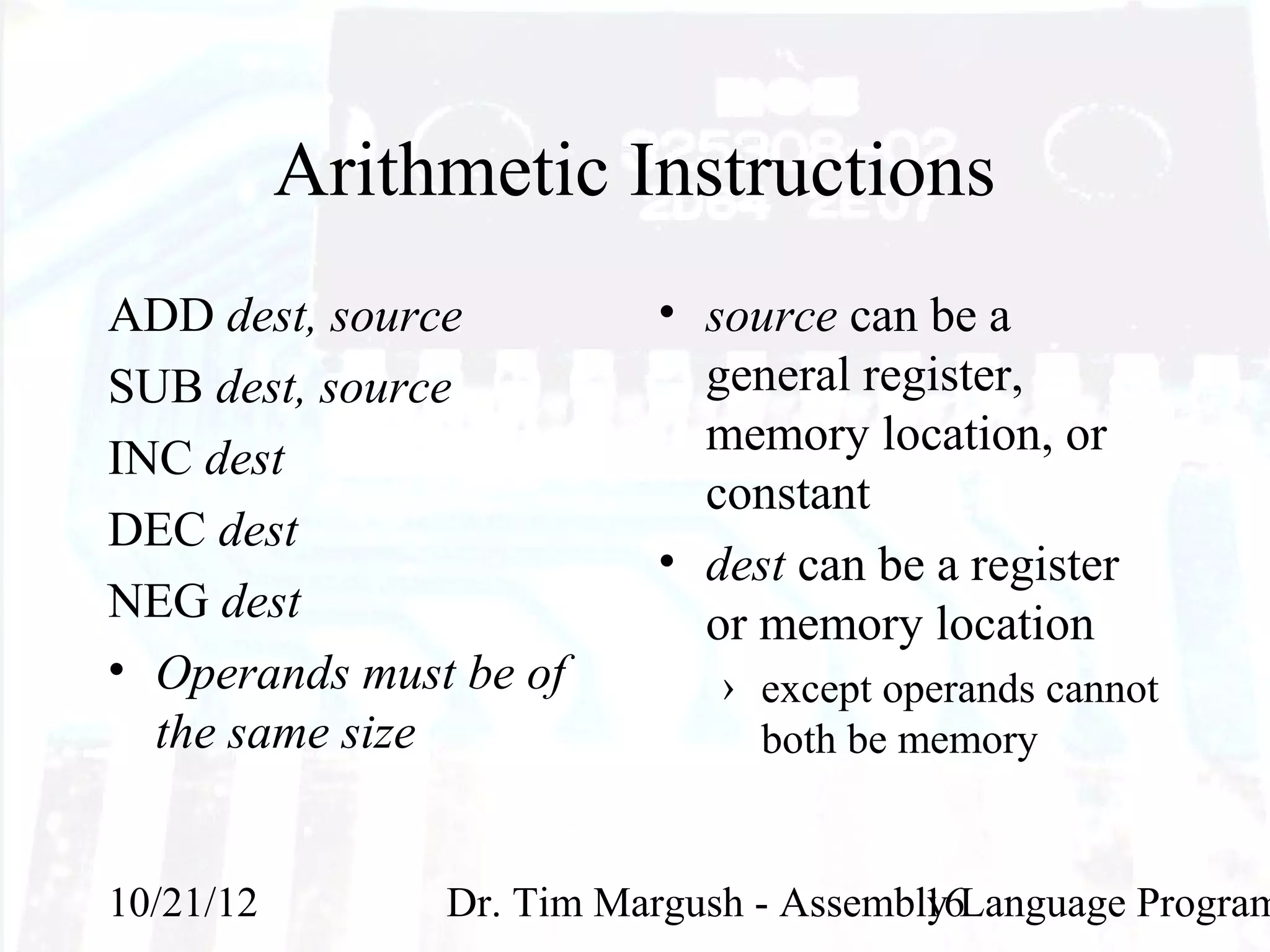
Arithmetic Instructions
ADD dest, source          • source can be a
SUB dest, source            general register,
INC dest                    memory location, or
                            constant
DEC dest
                          • dest can be a register
NEG dest                    or memory location
• Operands must be of         › except operands cannot
  the same size                 both be memory


10/21/12        Dr. Tim Margush - Assembly Language Program
                                         16
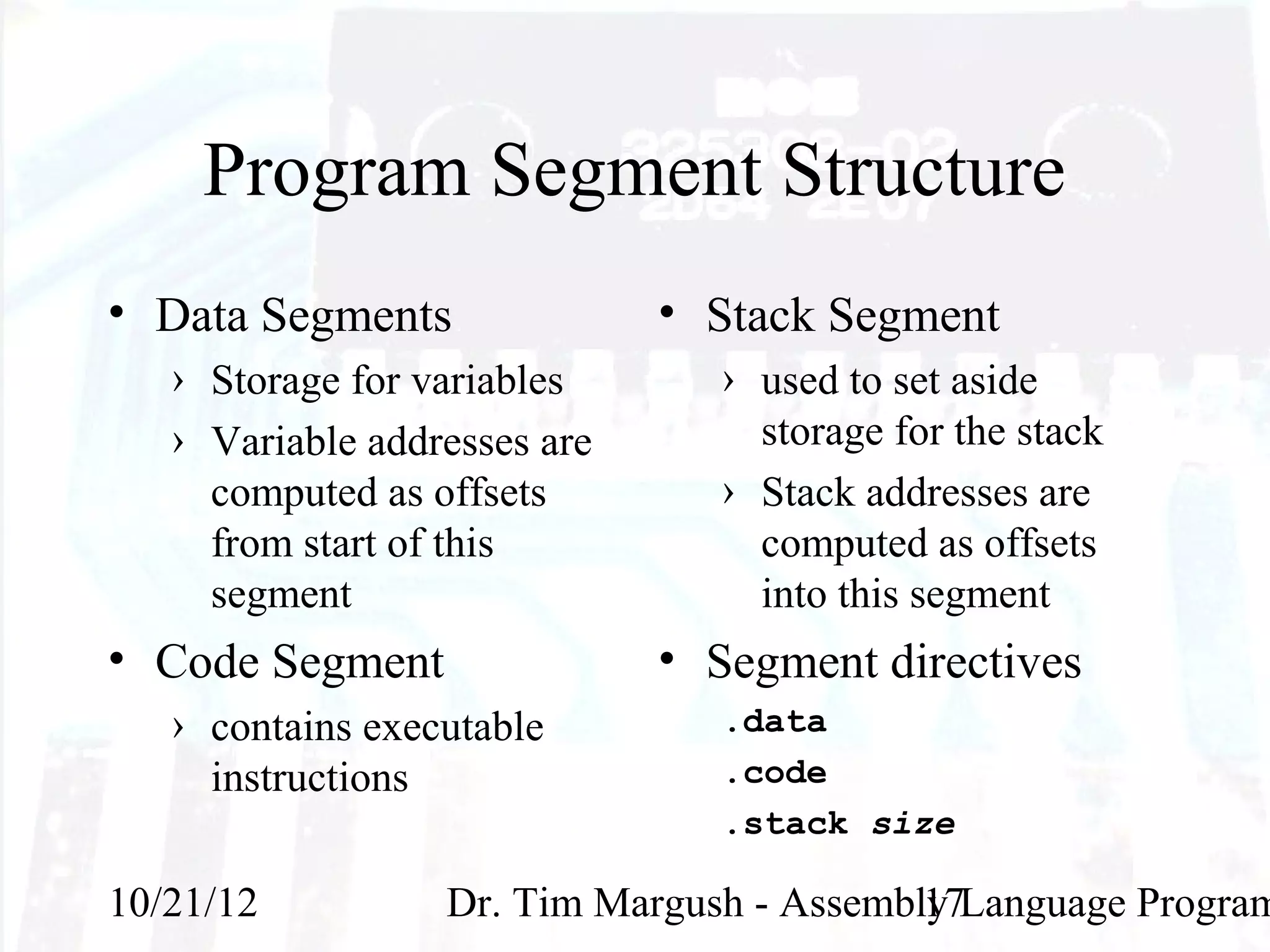
Program Segment Structure
• Data Segments               • Stack Segment
   › Storage for variables      › used to set aside
   › Variable addresses are       storage for the stack
     computed as offsets        › Stack addresses are
     from start of this           computed as offsets
     segment                      into this segment
• Code Segment                • Segment directives
   › contains executable        .data
     instructions               .code
                                .stack size

10/21/12          Dr. Tim Margush - Assembly Language Program
                                           17
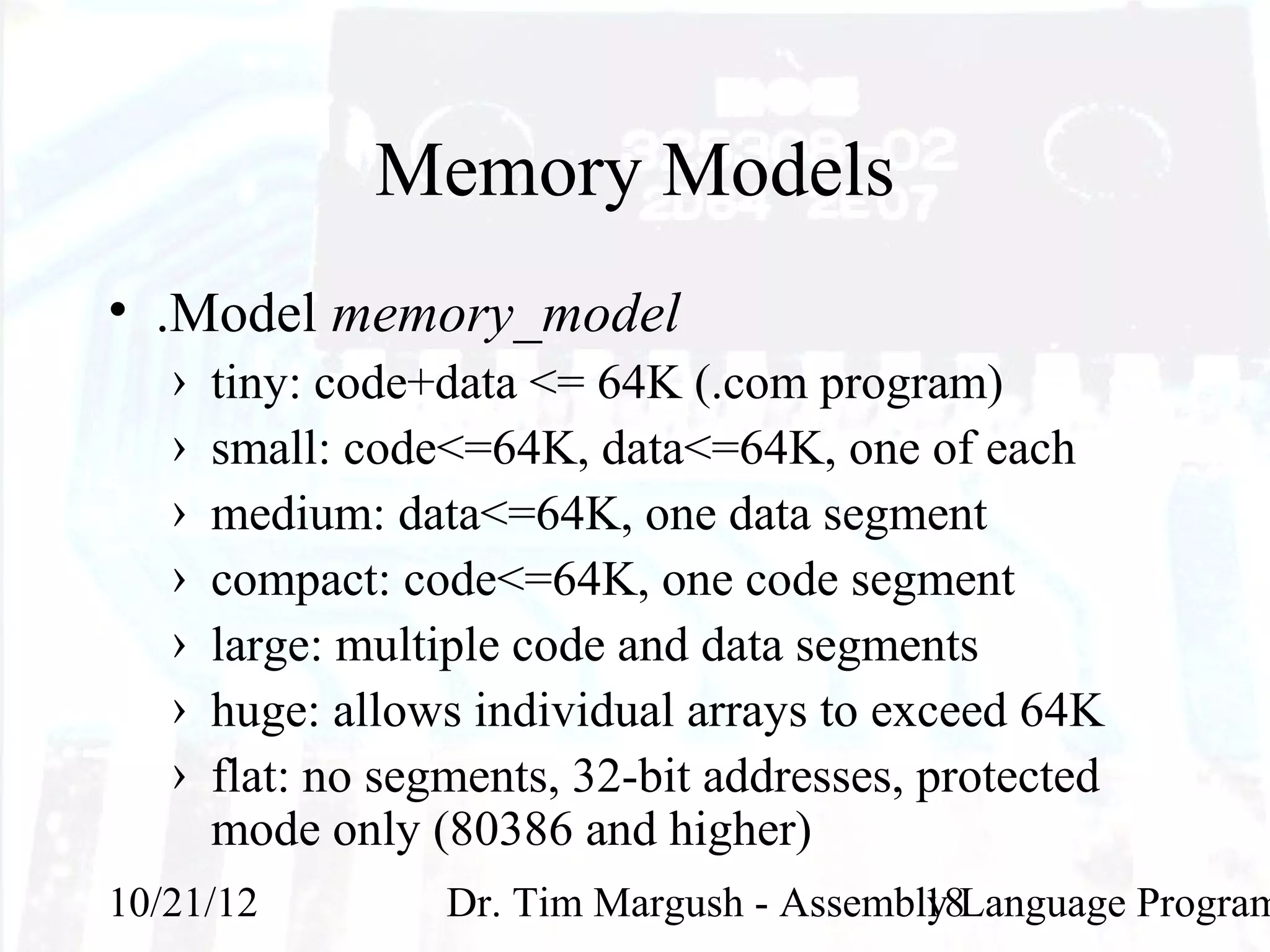
Memory Models
• .Model memory_model
   ›   tiny: code+data <= 64K (.com program)
   ›   small: code<=64K, data<=64K, one of each
   ›   medium: data<=64K, one data segment
   ›   compact: code<=64K, one code segment
   ›   large: multiple code and data segments
   ›   huge: allows individual arrays to exceed 64K
   ›   flat: no segments, 32-bit addresses, protected
       mode only (80386 and higher)
10/21/12           Dr. Tim Margush - Assembly Language Program
                                            18
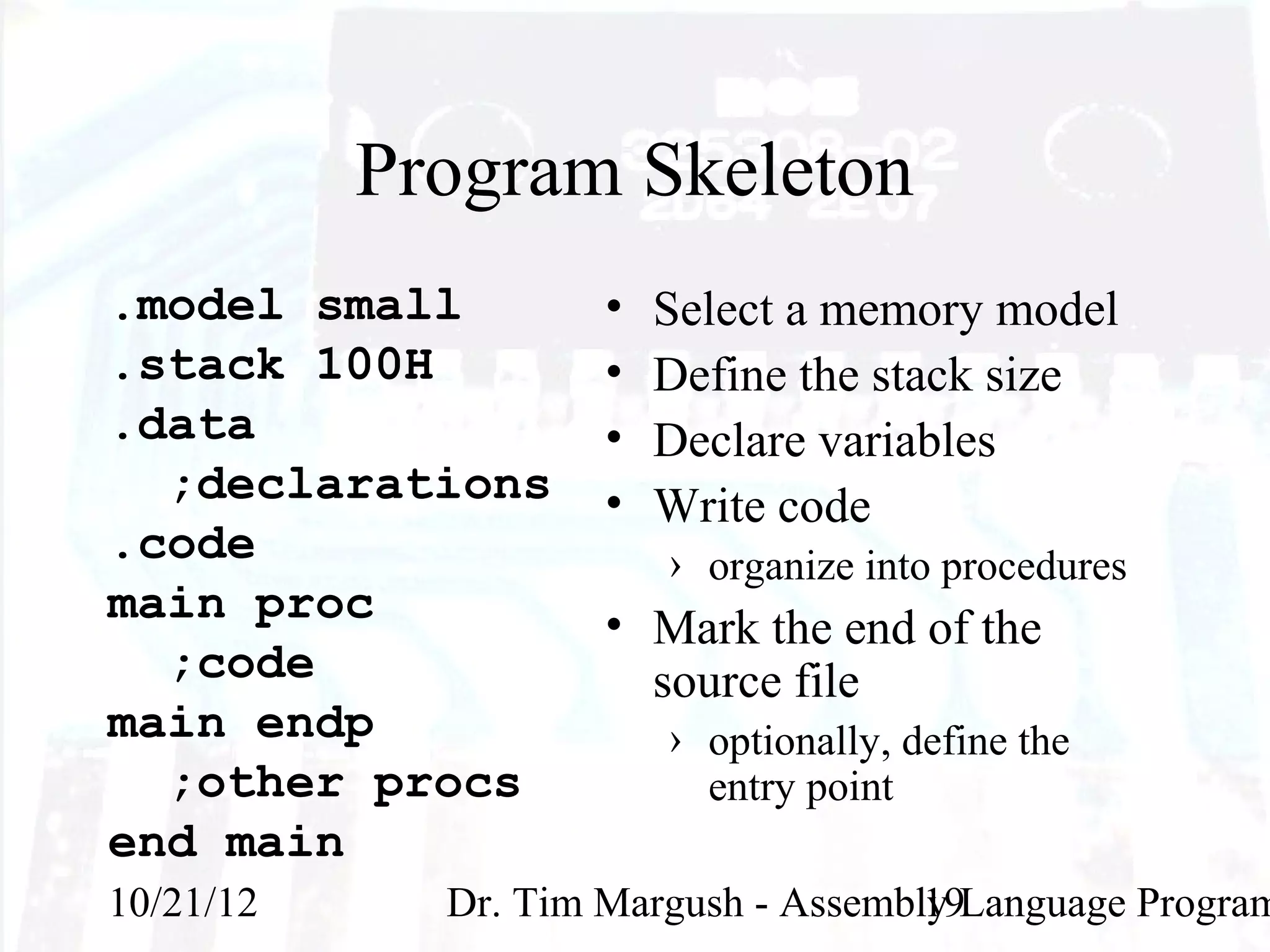
Program Skeleton
.model small         •   Select a memory model
.stack 100H          •   Define the stack size
.data                •   Declare variables
  ;declarations      •   Write code
.code                    › organize into procedures
main proc            • Mark the end of the
  ;code                source file
main endp                › optionally, define the
  ;other procs             entry point
end main
10/21/12     Dr. Tim Margush - Assembly Language Program
                                      19

8086 assembly language

  • 1.
    Introduction to 8086Assembly Language Assembly Language Programming University of Akron Dr. Tim Margush
  • 2.
    Program Statements name operationoperand(s) comment • Operation is a predefined or reserved word › mnemonic - symbolic operation code › directive - pseudo-operation code • Space or tab separates initial fields • Comments begin with semicolon • Most assemblers are not case sensitive 10/21/12 Dr. Tim Margush - Assembly Language Program 2
  • 3.
    Program Data andStorage • Pseudo-ops to define • These directives data or reserve storage require one or more › DB - byte(s) operands › DW - word(s) › define memory › DD - doubleword(s) contents › DQ - quadword(s) › specify amount of › storage to reserve for DT - tenbyte(s) run-time data 10/21/12 Dr. Tim Margush - Assembly Language Program 3
  • 4.
    Defining Data • Numericdata values • A list of values may be › 100 - decimal used - the following › 100B - binary creates 4 consecutive › 100H - hexadecimal words › '100' - ASCII DW 40CH,10B,-13,0 › "100" - ASCII • A ? represents an • Use the appropriate uninitialized storage DEFINE directive location (byte, word, etc.) DB 255,?,-128,'X' 10/21/12 Dr. Tim Margush - Assembly Language Program 4
  • 5.
    Naming Storage Locations •Names can be • ANum refers to a byte associated with storage location, storage locations initialized to FCh ANum DB -4 • The next word has no DW 17 associated name ONE • ONE and UNO refer UNO DW 1 X DD ? to the same word • These names are called • X is an unitialized variables doubleword 10/21/12 Dr. Tim Margush - Assembly Language Program 5
  • 6.
    Arrays • Any consecutivestorage locations of the same size can be called an array X DW 40CH,10B,-13,0 Y DB 'This is an array' Z DD -109236, FFFFFFFFH, -1, 100B • Components of X are at X, X+2, X+4, X+8 • Components of Y are at Y, Y+1, …, Y+15 • Components of Z are at Z, Z+4, Z+8, Z+12 10/21/12 Dr. Tim Margush - Assembly Language Program 6
  • 7.
    DUP • Allows asequence of storage locations to be defined or reserved • Only used as an operand of a define directive DB 40 DUP (?) DW 10h DUP (0) DB 3 dup ("ABC") db 4 dup(3 dup (0,1), 2 dup('$')) 10/21/12 Dr. Tim Margush - Assembly Language Program 7
  • 8.
    Word Storage • Word,doubleword, and quadword data are stored in reverse byte order (in memory) Directive Bytes in Storage DW 256 00 01 DD 1234567H 67 45 23 01 DQ 10 0A 00 00 00 00 00 00 00 X DW 35DAh DA 35 Low byte of X is at X, high byte of X is at X+1 10/21/12 Dr. Tim Margush - Assembly Language Program 8
  • 9.
    Named Constants • Symbolicnames associated with storage locations represent addresses • Named constants are symbols created to represent specific values determined by an expression • Named constants can be numeric or string • Some named constants can be redefined • No storage is allocated for these values 10/21/12 Dr. Tim Margush - Assembly Language Program 9
  • 10.
    Equal Sign Directive •name = expression › expression must be numeric › these symbols may be redefined at any time maxint = 7FFFh count = 1 DW count count = count * 2 DW count 10/21/12 Dr. Tim Margush - Assembly Language Program 10
  • 11.
    EQU Directive • nameEQU expression › expression can be string or numeric › Use < and > to specify a string EQU › these symbols cannot be redefined later in the program sample EQU 7Fh aString EQU <1.234> message EQU <This is a message> 10/21/12 Dr. Tim Margush - Assembly Language Program 11
  • 12.
    Data Transfer Instructions •MOV target, source • reg can be any non- › reg, reg segment register › mem, reg except IP cannot be › reg, mem the target register › mem, immed • MOV's between a › reg, immed segment register and • Sizes of both operands memory or a 16-bit must be the same register are possible 10/21/12 Dr. Tim Margush - Assembly Language Program 12
  • 13.
    Sample MOV Instructions bdb 4Fh • When a variable is created with a w dw 2048 define directive, it is assigned a default size attribute (byte, word, mov bl,dh etc) mov ax,w • You can assign a size attribute mov ch,b using LABEL mov al,255 LoByte LABEL BYTE mov w,-100 aWord DW 97F2h mov b,0 10/21/12 Dr. Tim Margush - Assembly Language Program 13
  • 14.
    Addresses with Displacements bdb 4Fh, 20h, 3Ch • The assembler w dw 2048, -100, 0 computes an address based on the mov bx, w+2 expression mov b+1, ah • NOTE: These are address mov ah, b+5 computations done at mov dx, w-3 assembly time MOV ax, b-1 • Type checking is still in will not subtract 1 from effect the value stored at b 10/21/12 Dr. Tim Margush - Assembly Language Program 14
  • 15.
    eXCHanGe • XCHG target,source • This provides an › reg, reg efficient means to › reg, mem swap the operands › mem, reg › No temporary storage • MOV and XCHG is needed › Sorting often requires cannot perform this type of operation memory to memory › This works only with moves the general registers 10/21/12 Dr. Tim Margush - Assembly Language Program 15
  • 16.
    Arithmetic Instructions ADD dest,source • source can be a SUB dest, source general register, INC dest memory location, or constant DEC dest • dest can be a register NEG dest or memory location • Operands must be of › except operands cannot the same size both be memory 10/21/12 Dr. Tim Margush - Assembly Language Program 16
  • 17.
    Program Segment Structure •Data Segments • Stack Segment › Storage for variables › used to set aside › Variable addresses are storage for the stack computed as offsets › Stack addresses are from start of this computed as offsets segment into this segment • Code Segment • Segment directives › contains executable .data instructions .code .stack size 10/21/12 Dr. Tim Margush - Assembly Language Program 17
  • 18.
    Memory Models • .Modelmemory_model › tiny: code+data <= 64K (.com program) › small: code<=64K, data<=64K, one of each › medium: data<=64K, one data segment › compact: code<=64K, one code segment › large: multiple code and data segments › huge: allows individual arrays to exceed 64K › flat: no segments, 32-bit addresses, protected mode only (80386 and higher) 10/21/12 Dr. Tim Margush - Assembly Language Program 18
  • 19.
    Program Skeleton .model small • Select a memory model .stack 100H • Define the stack size .data • Declare variables ;declarations • Write code .code › organize into procedures main proc • Mark the end of the ;code source file main endp › optionally, define the ;other procs entry point end main 10/21/12 Dr. Tim Margush - Assembly Language Program 19