LANGUAGE
Skyline, Psych 100, Meghan Fraley, PhD
What is Language?
¨  A system of symbols used to communicate ideas
among two or more individuals.
¨  Must be learnable by children, spoken and
understood by adults, and capable of expressing
ideas that people normally communicate in a social
and cultural context.
https://www.youtube.com/watch?
v=s9shPouRWCs
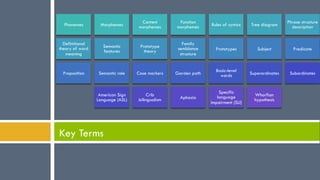
Phonemes Morphemes
Content
morphemes
Function
morphemes Rules of syntax Tree diagram
Phrase structure
description
Definitional
theory of word
meaning
Semantic
features
Prototype
theory
Family
semblance
structure
Prototypes Subject Predicate
Proposition Semantic role Case markers Garden path
Basic-level
words Superordinates Subordinates
American Sign
Language (ASL)
Crib
bilingualism Aphasia
Specific
language
impairment (SLI)
Whorfian
hypothesis
Key Terms
1.  Sound Units
2.  Morphemes and Words
3.  Phrases and Sentences
The Building Blocks of Language
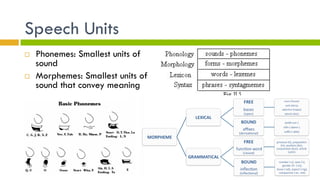
Speech Units
¨  Phonemes: Smallest units of
sound
¨  Morphemes: Smallest units of
sound that convey meaning
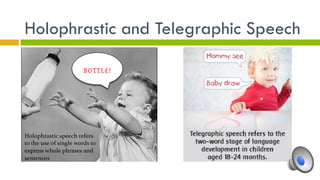
Holophrastic and Telegraphic Speech
Bottle!
Holophrastic speech refers
to the use of single words to
express whole phrases and
sentences!
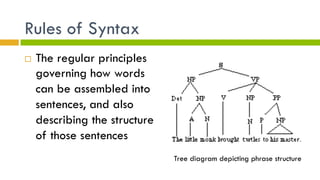
Rules of Syntax
¨  The regular principles
governing how words
can be assembled into
sentences, and also
describing the structure
of those sentences
Tree diagram depicting phrase structure
1.  The Meaning of Words
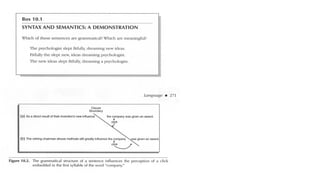
2.  The Meaning of Sentences
3.  How We Understand
How Language Conveys Meaning
1.  Language Acquisition Rates
2.  The Social Origins of Language Learning
3.  Discovering the Building Blocks of Language
4.  The Growth of Word Meaning
5.  The Progression of Adult Language
How We Learn a Language
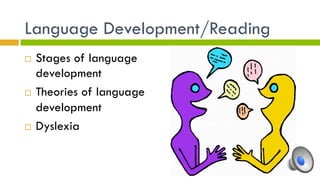
Language Development/Reading
¨  Stages of language
development
¨  Theories of language
development
¨  Dyslexia
©John Wiley & Sons, Inc. 2007 Huffman: Psychology in
Action (8e)
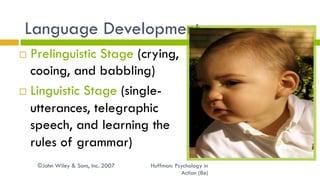
Language Development
¨  Prelinguistic Stage (crying,
cooing, and babbling)
¨  Linguistic Stage (single-
utterances, telegraphic
speech, and learning the
rules of grammar)
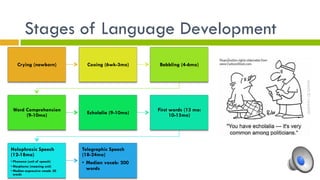
Stages of Language Development
Crying (newborn) Cooing (6wk-3mo) Babbling (4-6mo)
Word Comprehension
(9-10mo) Echolalia (9-10mo)
First words (13 mo:
10-15mo)
Holophrasic Speech
(12-18mo)
• Phoneme (unit of speech)
• Morpheme (meaning unit)
• Median expressive vocab: 50
words
Telegraphic Speech
(18-24mo)
•  Median vocab: 200
words
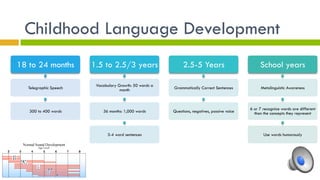
Childhood Language Development
18 to 24 months
Telegraphic Speech
300 to 400 words
1.5 to 2.5/3 years
Vocabulary Growth: 50 words a
month
36 months: 1,000 words
3-4 word sentences
2.5-5 Years
Grammatically Correct Sentences
Questions, negatives, passive voice
School years
Metalinguistic Awareness
6 or 7 recognize words are different
than the concepts they represent
Use words humorously
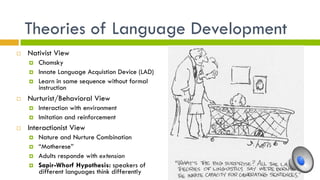
Theories of Language Development
¨  Nativist View
¤  Chomsky
¤  Innate Language Acquistion Device (LAD)
¤  Learn in same sequence without formal
instruction
¨  Nurturist/Behavioral View
¤  Interaction with environment
¤  Imitation and reinforcement
¨  Interactionist View
¤  Nature and Nurture Combination
¤  “Motherese”
¤  Adults responde with extension
¤  Sapir-Whorf Hypothesis: speakers of
different languages think differently
Universal Grammar
¨  Language Acquisition
Device
¨  Chomsky
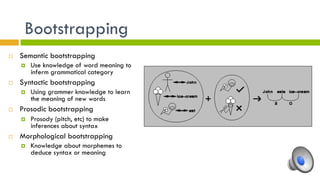
Bootstrapping
¨  Semantic bootstrapping
¤  Use knowledge of word meaning to
inferm grammatical category
¨  Syntactic bootstrapping
¤  Using grammer knowledge to learn
the meaning of new words
¨  Prosodic bootstrapping
¤  Prosody (pitch, etc) to make
inferences about syntax
¨  Morphological bootstrapping
¤  Knowledge about morphemes to
deduce syntax or meaning
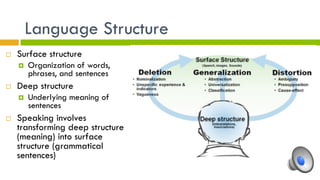
Language Structure
¨  Surface structure
¤  Organization of words,
phrases, and sentences
¨  Deep structure
¤  Underlying meaning of
sentences
¨  Speaking involves
transforming deep structure
(meaning) into surface
structure (grammatical
sentences)
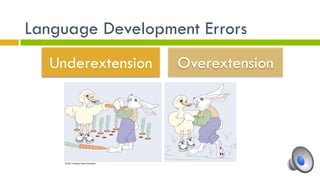
Language Development Errors
Underextension Overextension
1.  Wild Children
2.  Isolated Children
3.  Language without Sound
4.  Language without a model
5.  Children Deprived of Access to Some of the
Meanings
6.  Children Exposed to More than One Language:
Bilingualism
Alternative Language Learning
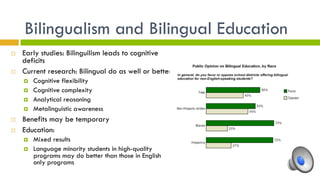
Bilingualism and Bilingual Education
¨  Early studies: Bilinguilism leads to cognitive
deficits
¨  Current research: Bilingual do as well or better
¤  Cognitive flexibility
¤  Cognitive complexity
¤  Analytical reasoning
¤  Metalinguistic awareness
¨  Benefits may be temporary
¨  Education:
¤  Mixed results
¤  Language minority students in high-quality
programs may do better than those in English
only programs
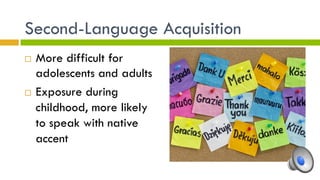
Second-Language Acquisition
¨  More difficult for
adolescents and adults
¨  Exposure during
childhood, more likely
to speak with native
accent
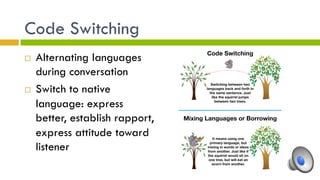
Code Switching
¨  Alternating languages
during conversation
¨  Switch to native
language: express
better, establish rapport,
express attitude toward
listener
1.  When the Nature and State of the Brain is Changed
2.  The Sensitive Period
3.  Language in Nonhumans
Changed Endowments
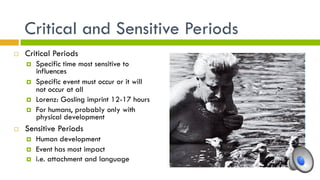
Critical and Sensitive Periods
¨  Critical Periods
¤  Specific time most sensitive to
influences
¤  Specific event must occur or it will
not occur at all
¤  Lorenz: Gosling imprint 12-17 hours
¤  For humans, probably only with
physical development
¨  Sensitive Periods
¤  Human development
¤  Event has most impact
¤  i.e. attachment and language
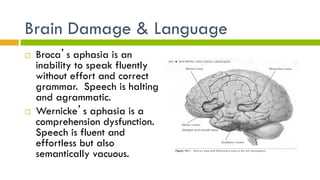
Brain Damage & Language
¨  Broca’s aphasia is an
inability to speak fluently
without effort and correct
grammar. Speech is halting
and agrammatic.
¨  Wernicke’s aphasia is a
comprehension dysfunction.
Speech is fluent and
effortless but also
semantically vacuous.
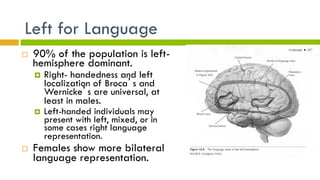
Left for Language
¨  90% of the population is left-
hemisphere dominant.
¤  Right- handedness and left
localization of Broca’s and
Wernicke’s are universal, at
least in males.
¤  Left-handed individuals may
present with left, mixed, or in
some cases right language
representation.
¨  Females show more bilateral
language representation.
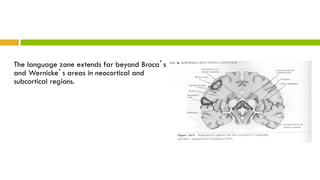
The language zone extends far beyond Broca’s
and Wernicke’s areas in neocortical and
subcortical regions.
Contrasts to Animal Communication
¨  Only language uses symbols to represent objects. Words
are detached from their referents unlike the calls of a
bird or chimpanzee. Displacement in space and time is
thus possible with language.
¨  Productivity is ability to create novel sentences that can
be understood by other speakers of the language.
Although chimps can learn ASL and sign novel expressions,
there is a vast difference in productivity.
1.  Languages have many similarities and differences
2.  How Language Connects to Thought
3.  Do People Who Talk Differently Come to
Understand the World Differently?
4.  How Can We Study Language and Thought?
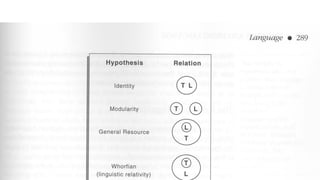
Language and Thought
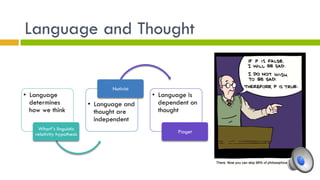
•  Language
determines
how we think
Whorf’s linguistic
relativity hypothesis
•  Language and
thought are
independent
Nativist
•  Language is
dependent on
thought
Piaget
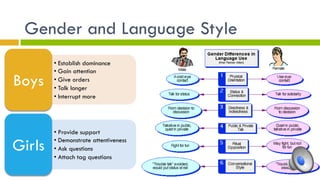
Gender and Language Style
• Establish dominance
• Gain attention
• Give orders
• Talk longer
• Interrupt more
Boys
• Provide support
• Demonstrate attentiveness
• Ask questions
• Attach tag questions
Girls
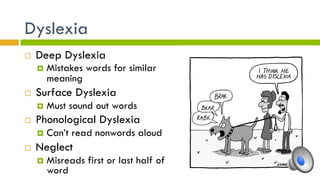
Dyslexia
¨  Deep Dyslexia
¤  Mistakes words for similar
meaning
¨  Surface Dyslexia
¤  Must sound out words
¨  Phonological Dyslexia
¤  Can’t read nonwords aloud
¨  Neglect
¤  Misreads first or last half of
word
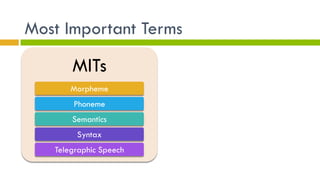
Most Important Terms
MITs
Morpheme
Phoneme
Semantics
Syntax
Telegraphic Speech
Applications: Semantics & Pragmatics
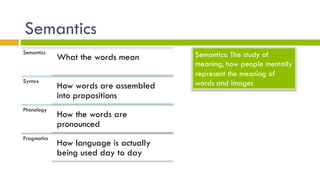
Semantics
Semantics
What the words mean
Syntax
How words are assembled
into propositions
Phonology
How the words are
pronounced
Pragmatics
How language is actually
being used day to day
Semantics: The study of
meaning, how people mentally
represent the meaning of
words and images
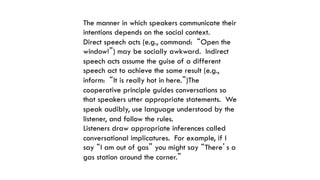
The manner in which speakers communicate their
intentions depends on the social context.
Direct speech acts (e.g., command: “Open the
window!”) may be socially awkward. Indirect
speech acts assume the guise of a different
speech act to achieve the same result (e.g.,
inform: “It is really hot in here.”)The
cooperative principle guides conversations so
that speakers utter appropriate statements. We
speak audibly, use language understood by the
listener, and follow the rules.
Listeners draw appropriate inferences called
conversational implicatures. For example, if I
say “I am out of gas” you might say “There’s a
gas station around the corner.”
Nonviolent Communication
https://www.youtube.com/watch?
v=SX4N0VryiC4

Skyline Language

  • 1.
    LANGUAGE Skyline, Psych 100,Meghan Fraley, PhD
  • 2.
    What is Language? ¨ A system of symbols used to communicate ideas among two or more individuals. ¨  Must be learnable by children, spoken and understood by adults, and capable of expressing ideas that people normally communicate in a social and cultural context.
  • 3.
  • 4.
    Phonemes Morphemes Content morphemes Function morphemes Rulesof syntax Tree diagram Phrase structure description Definitional theory of word meaning Semantic features Prototype theory Family semblance structure Prototypes Subject Predicate Proposition Semantic role Case markers Garden path Basic-level words Superordinates Subordinates American Sign Language (ASL) Crib bilingualism Aphasia Specific language impairment (SLI) Whorfian hypothesis Key Terms
  • 5.
    1.  Sound Units 2. Morphemes and Words 3.  Phrases and Sentences The Building Blocks of Language
  • 6.
    Speech Units ¨  Phonemes:Smallest units of sound ¨  Morphemes: Smallest units of sound that convey meaning
  • 7.
    Holophrastic and TelegraphicSpeech Bottle! Holophrastic speech refers to the use of single words to express whole phrases and sentences!
  • 8.
    Rules of Syntax ¨ The regular principles governing how words can be assembled into sentences, and also describing the structure of those sentences Tree diagram depicting phrase structure
  • 9.
    1.  The Meaningof Words 2.  The Meaning of Sentences 3.  How We Understand How Language Conveys Meaning
  • 10.
    1.  Language AcquisitionRates 2.  The Social Origins of Language Learning 3.  Discovering the Building Blocks of Language 4.  The Growth of Word Meaning 5.  The Progression of Adult Language How We Learn a Language
  • 11.
    Language Development/Reading ¨  Stagesof language development ¨  Theories of language development ¨  Dyslexia
  • 12.
    ©John Wiley &Sons, Inc. 2007 Huffman: Psychology in Action (8e) Language Development ¨  Prelinguistic Stage (crying, cooing, and babbling) ¨  Linguistic Stage (single- utterances, telegraphic speech, and learning the rules of grammar)
  • 13.
    Stages of LanguageDevelopment Crying (newborn) Cooing (6wk-3mo) Babbling (4-6mo) Word Comprehension (9-10mo) Echolalia (9-10mo) First words (13 mo: 10-15mo) Holophrasic Speech (12-18mo) • Phoneme (unit of speech) • Morpheme (meaning unit) • Median expressive vocab: 50 words Telegraphic Speech (18-24mo) •  Median vocab: 200 words
  • 14.
    Childhood Language Development 18to 24 months Telegraphic Speech 300 to 400 words 1.5 to 2.5/3 years Vocabulary Growth: 50 words a month 36 months: 1,000 words 3-4 word sentences 2.5-5 Years Grammatically Correct Sentences Questions, negatives, passive voice School years Metalinguistic Awareness 6 or 7 recognize words are different than the concepts they represent Use words humorously
  • 15.
    Theories of LanguageDevelopment ¨  Nativist View ¤  Chomsky ¤  Innate Language Acquistion Device (LAD) ¤  Learn in same sequence without formal instruction ¨  Nurturist/Behavioral View ¤  Interaction with environment ¤  Imitation and reinforcement ¨  Interactionist View ¤  Nature and Nurture Combination ¤  “Motherese” ¤  Adults responde with extension ¤  Sapir-Whorf Hypothesis: speakers of different languages think differently
  • 16.
    Universal Grammar ¨  LanguageAcquisition Device ¨  Chomsky
  • 17.
    Bootstrapping ¨  Semantic bootstrapping ¤ Use knowledge of word meaning to inferm grammatical category ¨  Syntactic bootstrapping ¤  Using grammer knowledge to learn the meaning of new words ¨  Prosodic bootstrapping ¤  Prosody (pitch, etc) to make inferences about syntax ¨  Morphological bootstrapping ¤  Knowledge about morphemes to deduce syntax or meaning
  • 18.
    Language Structure ¨  Surfacestructure ¤  Organization of words, phrases, and sentences ¨  Deep structure ¤  Underlying meaning of sentences ¨  Speaking involves transforming deep structure (meaning) into surface structure (grammatical sentences)
  • 19.
  • 20.
    1.  Wild Children 2. Isolated Children 3.  Language without Sound 4.  Language without a model 5.  Children Deprived of Access to Some of the Meanings 6.  Children Exposed to More than One Language: Bilingualism Alternative Language Learning
  • 21.
    Bilingualism and BilingualEducation ¨  Early studies: Bilinguilism leads to cognitive deficits ¨  Current research: Bilingual do as well or better ¤  Cognitive flexibility ¤  Cognitive complexity ¤  Analytical reasoning ¤  Metalinguistic awareness ¨  Benefits may be temporary ¨  Education: ¤  Mixed results ¤  Language minority students in high-quality programs may do better than those in English only programs
  • 22.
    Second-Language Acquisition ¨  Moredifficult for adolescents and adults ¨  Exposure during childhood, more likely to speak with native accent
  • 23.
    Code Switching ¨  Alternatinglanguages during conversation ¨  Switch to native language: express better, establish rapport, express attitude toward listener
  • 24.
    1.  When theNature and State of the Brain is Changed 2.  The Sensitive Period 3.  Language in Nonhumans Changed Endowments
  • 25.
    Critical and SensitivePeriods ¨  Critical Periods ¤  Specific time most sensitive to influences ¤  Specific event must occur or it will not occur at all ¤  Lorenz: Gosling imprint 12-17 hours ¤  For humans, probably only with physical development ¨  Sensitive Periods ¤  Human development ¤  Event has most impact ¤  i.e. attachment and language
  • 26.
    Brain Damage &Language ¨  Broca’s aphasia is an inability to speak fluently without effort and correct grammar. Speech is halting and agrammatic. ¨  Wernicke’s aphasia is a comprehension dysfunction. Speech is fluent and effortless but also semantically vacuous.
  • 27.
    Left for Language ¨ 90% of the population is left- hemisphere dominant. ¤  Right- handedness and left localization of Broca’s and Wernicke’s are universal, at least in males. ¤  Left-handed individuals may present with left, mixed, or in some cases right language representation. ¨  Females show more bilateral language representation.
  • 28.
    The language zoneextends far beyond Broca’s and Wernicke’s areas in neocortical and subcortical regions.
  • 29.
    Contrasts to AnimalCommunication ¨  Only language uses symbols to represent objects. Words are detached from their referents unlike the calls of a bird or chimpanzee. Displacement in space and time is thus possible with language. ¨  Productivity is ability to create novel sentences that can be understood by other speakers of the language. Although chimps can learn ASL and sign novel expressions, there is a vast difference in productivity.
  • 30.
    1.  Languages havemany similarities and differences 2.  How Language Connects to Thought 3.  Do People Who Talk Differently Come to Understand the World Differently? 4.  How Can We Study Language and Thought? Language and Thought
  • 31.
    Language and Thought • Language determines how we think Whorf’s linguistic relativity hypothesis •  Language and thought are independent Nativist •  Language is dependent on thought Piaget
  • 33.
    Gender and LanguageStyle • Establish dominance • Gain attention • Give orders • Talk longer • Interrupt more Boys • Provide support • Demonstrate attentiveness • Ask questions • Attach tag questions Girls
  • 34.
    Dyslexia ¨  Deep Dyslexia ¤ Mistakes words for similar meaning ¨  Surface Dyslexia ¤  Must sound out words ¨  Phonological Dyslexia ¤  Can’t read nonwords aloud ¨  Neglect ¤  Misreads first or last half of word
  • 35.
  • 36.
  • 37.
    Semantics Semantics What the wordsmean Syntax How words are assembled into propositions Phonology How the words are pronounced Pragmatics How language is actually being used day to day Semantics: The study of meaning, how people mentally represent the meaning of words and images
  • 39.
    The manner inwhich speakers communicate their intentions depends on the social context. Direct speech acts (e.g., command: “Open the window!”) may be socially awkward. Indirect speech acts assume the guise of a different speech act to achieve the same result (e.g., inform: “It is really hot in here.”)The cooperative principle guides conversations so that speakers utter appropriate statements. We speak audibly, use language understood by the listener, and follow the rules. Listeners draw appropriate inferences called conversational implicatures. For example, if I say “I am out of gas” you might say “There’s a gas station around the corner.”
  • 40.