Language
Images
Concepts
Fatma Tuba Aydın
http://www.psikoterapi.info.tr/
The Building Blocks of Thought
LANGUAGE
• It is essential for communication.►
• A flexible system of symbols that enables us to
communicate our ideas, thoughts, and feelings.
• Distinguishing features of human language;
• Human language is semantic, or meaningful, unlike non-
humans we can exchange detailed information about all
kinds of object, understand each other.
• It is productive, we can combine sounds to make new
words, arrange words into phrases, and string phrases
into sentences.
• It is also characterized by displacement in that it is
not limited to the here-and-now.
LANGUAGE
• In 1866 Linguistic Society of Paris banned the
discussion of the origins of language.
• Adam In Eden task assigning names to all
animals and plants.
• In Tower of Babel, confusion of tongues. (Bible)
• In mythologies language of Gods.
• Chomsky, Kant humans born with a language
instinct.
• Imitating animals, sounds, sight pleasure moans.
• Selective advantage of words rather than visual,
ability to deceive.
Origins of Language
• Language represents oral gestures already in
use
• Aroused from rhythmic chants and vocalism.
• Linguistic monogenesis, protolanguage all
other.
• Spontaneous emergence (wolf children) out of
human contact. Grace, Virginia twins.
J.R.R.Tolkien
• Nature& Nurture
• Child learns how to speak through reward,
punishment. ”wa-wa” water comes.
Origins of Language
• Phonemes
– Basic sounds (ph, t) exp; zip, sip
• Morphemes
– smallest meaning unit (words, prefixes) exp; red, calm
• Grammar
– Rules of how sounds combine
• Syntax; rules for arranging words. SOV, SVO ►
• Semantic; criteria for assigning meaning to morphemes
• Surface structure
– Phrases of sentence
• Deep structure
– Underlying meaning of a sentence
Structure of Language
• There are about 45 phonemes in English, and
as many as 85 in some languages.
Phonemes
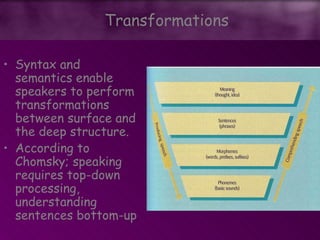
• Syntax and
semantics enable
speakers to perform
transformations
between surface and
the deep structure.
• According to
Chomsky; speaking
requires top-down
processing,
understanding
sentences bottom-up
Transformations
• Gesture,More elaborate manual
• Baby sign, six sense.
• Necesseriy for religious,scuba diving,stock
exchanges,baseball,dumb people
• Variations within a nation,international
Gestuno;Vineyard S.L. in USA, Kata Kolok in a
village in Bali
• Rich, complex grammars of their own
• Independent of oral language,USA, Britian
Sign Language
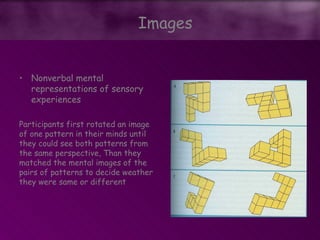
• Nonverbal mental
representations of sensory
experiences
Participants first rotated an image
of one pattern in their minds until
they could see both patterns from
the same perspective, Than they
matched the mental images of the
pairs of patterns to decide weather
they were same or different
Images
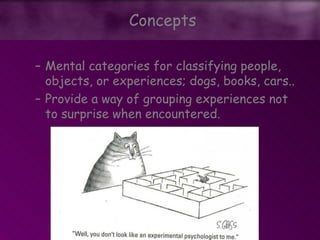
– Mental categories for classifying people,
objects, or experiences; dogs, books, cars..
– Provide a way of grouping experiences not
to surprise when encountered.
Concepts
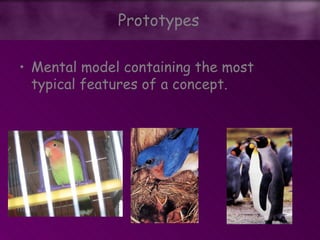
• Mental model containing the most
typical features of a concept.
Prototypes
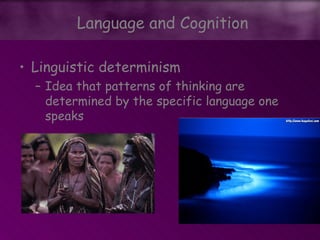
• Linguistic determinism
– Idea that patterns of thinking are
determined by the specific language one
speaks
Language and Cognition
• Eliminating words. (Rebel, Protest)
• Unpopular wars called “Pacification programs”.
• American War Department coined “Defense
Department”.
• Tuna did not become popular before labeling it
“Chicken of the sea”.
• Cola Turka, Zemzem Cola
How does Language affect what we think?
A father and a son, had a traffic
accident. They were brought to hospital,
in a bad situation. A surgeon, who comes
to operation room, exclaims after seeing
them. “This is my son!!!!”. Who is the
surgeon?
• All known cultures use categories to form concepts
• Culture has an effect on
– What information is included in a category
– How categories are shaped by experience
• In Alaska they have 20 words for different types of
snow.
• There is a relationship between a society's customs
and values and the grammatical characteristics of its
language.
– -"Who is preparing dinner?” "The being her-mine." Inuit
social life in which one's position within the group is much
more important that one's characteristic as an individual.
– In Eng. "I made him go home”, in Navajo; "Even though he did
not want to go home, when I asked him to, he did.“ In Navajo
social values, coercion is strongly rejected.
Culture and Cognition
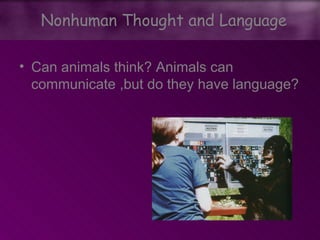
• Can animals think? Animals can
communicate ,but do they have language?
Nonhuman Thought and Language
• Animal language is modeling human
language in non human animal system.
• Animal language is not very complex. Bee
dances, bird songs, whale songs.
• If a chimpanzee sees a snake, he makes
noise, or hides food.
• Technical term for such messages is
signs, about animal’s current state.
Nonhuman Thought and Language
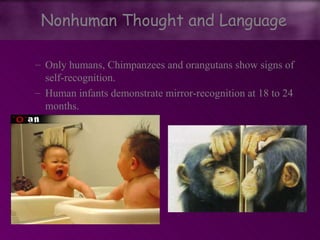
– Only humans, Chimpanzees and orangutans show signs of
self-recognition.
– Human infants demonstrate mirror-recognition at 18 to 24
months.
Nonhuman Thought and Language
– Telegraphic speech is early speech stage of one and two
years old that omits words that are not essential to the
meaning of a phrase
Nonhuman Thought and Language
– Some chimps have learned to use keyboard symbols to
communicate even without formal training
– Chimpanzees have been taught to use American Sign
Language
–Chimpanzees have been observed using telegraphic speech
(two-word combinations)
Fatma Tuba Aydın

Language,

  • 1.
  • 2.
    LANGUAGE • It isessential for communication.► • A flexible system of symbols that enables us to communicate our ideas, thoughts, and feelings. • Distinguishing features of human language; • Human language is semantic, or meaningful, unlike non- humans we can exchange detailed information about all kinds of object, understand each other. • It is productive, we can combine sounds to make new words, arrange words into phrases, and string phrases into sentences. • It is also characterized by displacement in that it is not limited to the here-and-now. LANGUAGE
  • 3.
    • In 1866Linguistic Society of Paris banned the discussion of the origins of language. • Adam In Eden task assigning names to all animals and plants. • In Tower of Babel, confusion of tongues. (Bible) • In mythologies language of Gods. • Chomsky, Kant humans born with a language instinct. • Imitating animals, sounds, sight pleasure moans. • Selective advantage of words rather than visual, ability to deceive. Origins of Language
  • 4.
    • Language representsoral gestures already in use • Aroused from rhythmic chants and vocalism. • Linguistic monogenesis, protolanguage all other. • Spontaneous emergence (wolf children) out of human contact. Grace, Virginia twins. J.R.R.Tolkien • Nature& Nurture • Child learns how to speak through reward, punishment. ”wa-wa” water comes. Origins of Language
  • 5.
    • Phonemes – Basicsounds (ph, t) exp; zip, sip • Morphemes – smallest meaning unit (words, prefixes) exp; red, calm • Grammar – Rules of how sounds combine • Syntax; rules for arranging words. SOV, SVO ► • Semantic; criteria for assigning meaning to morphemes • Surface structure – Phrases of sentence • Deep structure – Underlying meaning of a sentence Structure of Language
  • 6.
    • There areabout 45 phonemes in English, and as many as 85 in some languages. Phonemes
  • 7.
    • Syntax and semanticsenable speakers to perform transformations between surface and the deep structure. • According to Chomsky; speaking requires top-down processing, understanding sentences bottom-up Transformations
  • 8.
    • Gesture,More elaboratemanual • Baby sign, six sense. • Necesseriy for religious,scuba diving,stock exchanges,baseball,dumb people • Variations within a nation,international Gestuno;Vineyard S.L. in USA, Kata Kolok in a village in Bali • Rich, complex grammars of their own • Independent of oral language,USA, Britian Sign Language
  • 9.
    • Nonverbal mental representationsof sensory experiences Participants first rotated an image of one pattern in their minds until they could see both patterns from the same perspective, Than they matched the mental images of the pairs of patterns to decide weather they were same or different Images
  • 10.
    – Mental categoriesfor classifying people, objects, or experiences; dogs, books, cars.. – Provide a way of grouping experiences not to surprise when encountered. Concepts
  • 11.
    • Mental modelcontaining the most typical features of a concept. Prototypes
  • 12.
    • Linguistic determinism –Idea that patterns of thinking are determined by the specific language one speaks Language and Cognition
  • 13.
    • Eliminating words.(Rebel, Protest) • Unpopular wars called “Pacification programs”. • American War Department coined “Defense Department”. • Tuna did not become popular before labeling it “Chicken of the sea”. • Cola Turka, Zemzem Cola How does Language affect what we think?
  • 14.
    A father anda son, had a traffic accident. They were brought to hospital, in a bad situation. A surgeon, who comes to operation room, exclaims after seeing them. “This is my son!!!!”. Who is the surgeon?
  • 15.
    • All knowncultures use categories to form concepts • Culture has an effect on – What information is included in a category – How categories are shaped by experience • In Alaska they have 20 words for different types of snow. • There is a relationship between a society's customs and values and the grammatical characteristics of its language. – -"Who is preparing dinner?” "The being her-mine." Inuit social life in which one's position within the group is much more important that one's characteristic as an individual. – In Eng. "I made him go home”, in Navajo; "Even though he did not want to go home, when I asked him to, he did.“ In Navajo social values, coercion is strongly rejected. Culture and Cognition
  • 16.
    • Can animalsthink? Animals can communicate ,but do they have language? Nonhuman Thought and Language
  • 17.
    • Animal languageis modeling human language in non human animal system. • Animal language is not very complex. Bee dances, bird songs, whale songs. • If a chimpanzee sees a snake, he makes noise, or hides food. • Technical term for such messages is signs, about animal’s current state. Nonhuman Thought and Language
  • 18.
    – Only humans,Chimpanzees and orangutans show signs of self-recognition. – Human infants demonstrate mirror-recognition at 18 to 24 months. Nonhuman Thought and Language
  • 19.
    – Telegraphic speechis early speech stage of one and two years old that omits words that are not essential to the meaning of a phrase Nonhuman Thought and Language – Some chimps have learned to use keyboard symbols to communicate even without formal training – Chimpanzees have been taught to use American Sign Language –Chimpanzees have been observed using telegraphic speech (two-word combinations)
  • 20.