Psychopathology
& Treatment
Psychopathology
v  The study of mental disorders or a mental disorder
v  What can go wrong?
v  How do you treat it?
v  Where do we draw the line?
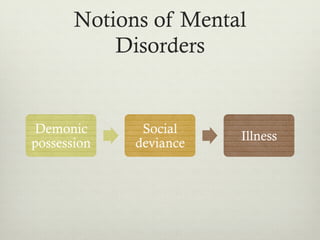
Notions of Mental
Disorders
Demonic
possession
Social
deviance
Illness
Main Areas of
Psychopathology
v  Neurodevelopmental
v  Mood disorders
v  Schizophrenia
v  Anxiety disorders
v  Dissociative disorders
v  Personality disorders
Neurodevelopmental
v  Autism
v  ADHD
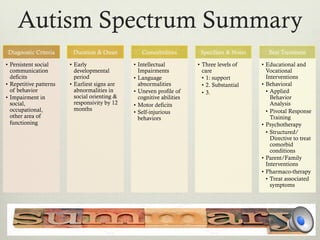
Autism Spectrum Summary
Diagnostic Criteria
•  Persistent social
communication
deficits
•  Repetitive patterns
of behavior
•  Impairment in
social,
occupational,
other area of
functioning
Duration & Onset
•  Early
developmental
period
•  Earliest signs are
abnormalities in
social orienting &
responsivity by 12
months
Comorbidities
•  Intellectual
Impairments
•  Language
abnormalities
•  Uneven profile of
cognitive abilities
•  Motor deficits
•  Self-injurious
behaviors
Specifiers & Notes
•  Three levels of
care
•  1: support
•  2. Substantial
•  3.
Best Treatment
•  Educational and
Vocational
Interventions
•  Behavioral
•  Applied
Behavior
Analysis
•  Pivotal Response
Training
•  Psychotherapy
•  Structured/
Directive to treat
comorbid
conditions
•  Parent/Family
Interventions
•  Pharmaco-therapy
•  Treat associated
symptoms
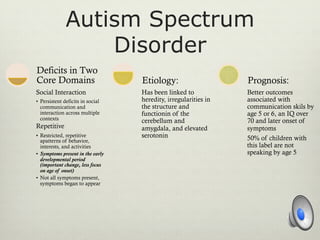
Autism Spectrum
Disorder
Social Interaction
•  Persistent deficits in social
communication and
interaction across multiple
contexts
Repetitive
•  Restricted, repetitive
apatterns of behavior,
interests, and activities
•  Symptoms present in the early
developmental period
(important change, less focus
on age of onset)
•  Not all symptoms present,
symptoms began to appear
Deficits in Two
Core Domains
Has been linked to
heredity, irregularities in
the structure and
functionin of the
cerebellum and
amygdala, and elevated
serotonin
Etiology:
Better outcomes
associated with
communication skils by
age 5 or 6, an IQ over
70 and later onset of
symptoms
50% of children with
this label are not
speaking by age 5
Prognosis:
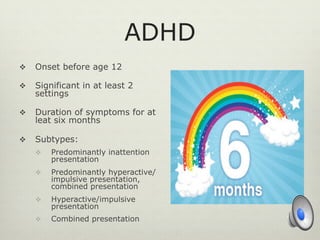
ADHD
v  Onset before age 12
v  Significant in at least 2
settings
v  Duration of symptoms for at
leat six months
v  Subtypes:
v  Predominantly inattention
presentation
v  Predominantly hyperactive/
impulsive presentation,
combined presentation
v  Hyperactive/impulsive
presentation
v  Combined presentation
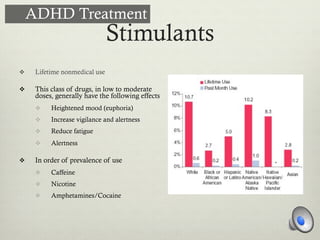
Stimulants
v  Lifetime nonmedical use
v  This class of drugs, in low to moderate
doses, generally have the following effects
v  Heightened mood (euphoria)
v  Increase vigilance and alertness
v  Reduce fatigue
v  Alertness
v  In order of prevalence of use
v  Caffeine
v  Nicotine
v  Amphetamines/Cocaine
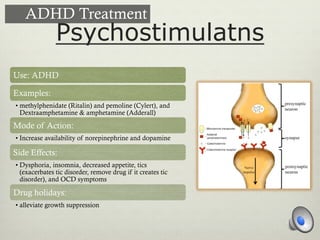
ADHD Treatment
Psychostimulatns
Use: ADHD
Examples:
• methylphenidate (Ritalin) and pemoline (Cylert), and
Dextraamphetamine & amphetamine (Adderall)
Mode of Action:
• Increase availability of norepinephrine and dopamine
Side Effects:
• Dysphoria, insomnia, decreased appetite, tics
(exacerbates tic disorder, remove drug if it creates tic
disorder), and OCD symptoms
Drug holidays:
• alleviate growth suppression
ADHD Treatment
Schizophrenia
v  Split-mind
v  A split from reality
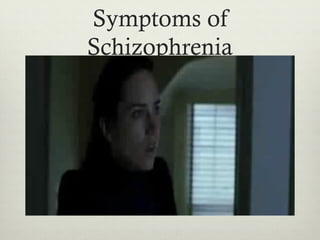
Symptoms of
Schizophrenia
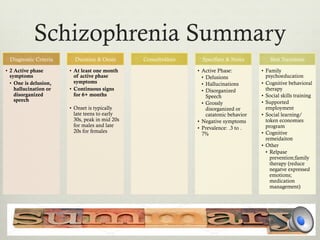
Schizophrenia Summary
Diagnostic Criteria
•  2 Active phase
symptoms
•  One is delusion,
hallucination or
disorganized
speech
Duration & Onset
•  At least one month
of active phase
symptoms
•  Continuous signs
for 6+ months
•  Onset is typically
late teens to early
30s, peak in mid 20s
for males and late
20s for females
Comorbidities Specifiers & Notes
•  Active Phase:
•  Delusions
•  Hallucinations
•  Disorganized
Speech
•  Grossly
disorganized or
catatonic behavior
•  Negative symptoms
•  Prevalence: .3 to .
7%
Best Treatment
•  Family
psychoeducation
•  Cognitive behavioral
therapy
•  Social skills training
•  Supported
employment
•  Social learning/
token economies
program
•  Cognitive
remeidaiton
•  Other
•  Relpase
prevention;family
therapy (reduce
negatve expressed
emotions;
medication
management)
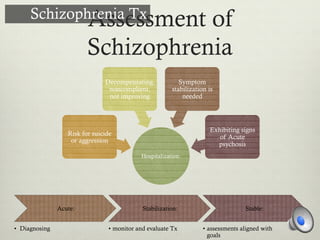
Assessment of
Schizophrenia
Acute:
•  Diagnosing
Stabilization:
• monitor and evaluate Tx
Stable:
• assessments aligned with
goals
Hospitalization:
Risk for suicide
or aggression
Decompensating,
noncomplient,
not improving
Symptom
stabilization is
needed
Exhibiting signs
of Acute
psychosis
Schizophrenia Tx
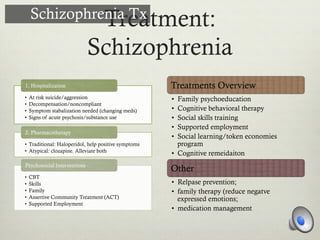
Treatment:
Schizophrenia
•  At risk suicide/aggression
•  Decompensation/noncompliant
•  Symptom stabalization needed (changing meds)
•  Signs of acute psychosis/substance use
1. Hospitalization
•  Traditional: Haloperidol, help positive symptoms
•  Atypical: clozapine. Alleviate both
2. Pharmacotherapy
•  CBT
•  Skills
•  Family
•  Assertive Community Treatment (ACT)
•  Supported Employment
Psychosocial Interventions
Treatments Overview
•  Family psychoeducation
•  Cognitive behavioral therapy
•  Social skills training
•  Supported employment
•  Social learning/token economies
program
•  Cognitive remeidaiton
Other
•  Relpase prevention;
•  family therapy (reduce negatve
expressed emotions;
•  medication management
Schizophrenia Tx
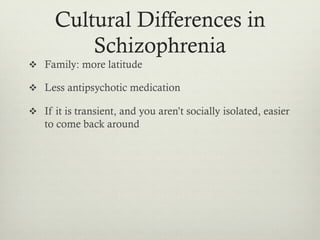
Cultural Differences in
Schizophrenia
v  Family: more latitude
v  Less antipsychotic medication
v  If it is transient, and you aren’t socially isolated, easier
to come back around
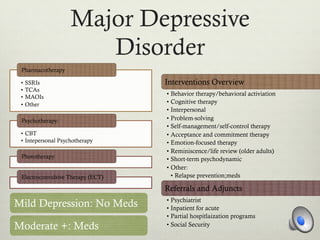
Major Depressive
Disorder
•  SSRIs
•  TCAs
•  MAOIs
•  Other
Pharmacotherapy
•  CBT
•  Intepersonal Psychotherapy
Psychotherapy:
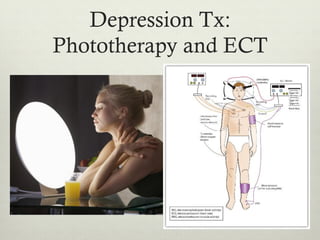
Phototherapy
Electroconvulsive Therapy (ECT)
Mild Depression: No Meds
Moderate +: Meds
Interventions Overview
• Behavior therapy/behavioral activiation
• Cognitive therapy
• Interpersonal
• Problem-solving
• Self-management/self-control therapy
• Acceptance and commitment therapy
• Emotion-focused therapy
• Reminiscence/life review (older adults)
• Short-term psychodynamic
• Other:
• Relapse prevention;meds
Referrals and Adjuncts
• Psychiatrist
• Inpatient for acute
• Partial hospitlaization programs
• Social Security
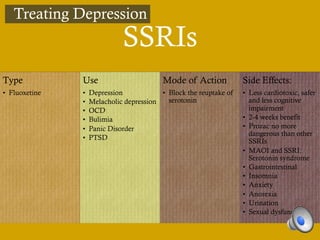
SSRIs
Type
•  Fluoxetine
Use
•  Depression
•  Melacholic depression
•  OCD
•  Bulimia
•  Panic Disorder
•  PTSD
Mode of Action
•  Block the reuptake of
serotonin
Side Effects:
•  Less cardiotoxic, safer
and less cognitive
impairment
•  2-4 weeks benefit
•  Prozac no more
dangerous than other
SSRIs
•  MAOI and SSRI:
Serotonin syndrome
•  Gastrointestinal
•  Insomnia
•  Anxiety
•  Anorexia
•  Urination
•  Sexual dysfunction
Treating Depression
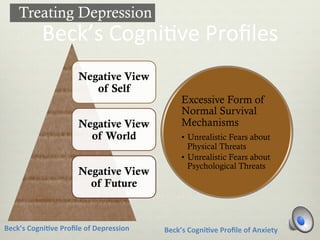
Beck’s	
  Cogni-ve	
  Profiles
Negative View
of Self
Negative View
of World
Negative View
of Future
Beck’s	
  Cogni-ve	
  Profile	
  of	
  Depression Beck’s	
  Cogni-ve	
  Profile	
  of	
  Anxiety
Excessive Form of
Normal Survival
Mechanisms
•  Unrealistic Fears about
Physical Threats
•  Unrealistic Fears about
Psychological Threats
Treating Depression
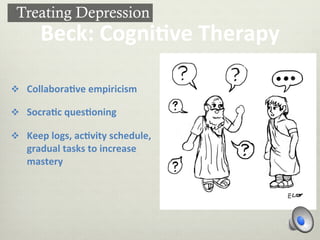
Beck:	
  Cogni-ve	
  Therapy	
  
v  Collabora-ve	
  empiricism	
  
v  Socra-c	
  ques-oning	
  
v  Keep	
  logs,	
  ac-vity	
  schedule,	
  
gradual	
  tasks	
  to	
  increase	
  
mastery	
  
Treating Depression
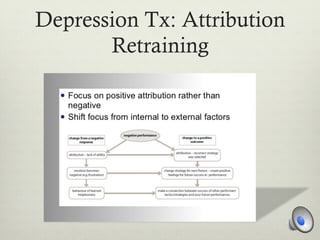
Depression Tx: Attribution
Retraining
Treating Depression:
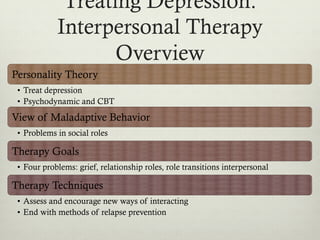
Interpersonal Therapy
Overview
Personality Theory
•  Treat depression
•  Psychodynamic and CBT
View of Maladaptive Behavior
•  Problems in social roles
Therapy Goals
•  Four problems: grief, relationship roles, role transitions interpersonal
Therapy Techniques
•  Assess and encourage new ways of interacting
•  End with methods of relapse prevention
Depression Tx:
Phototherapy and ECT
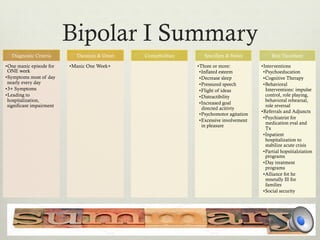
Bipolar I Summary
Diagnostic Criteria
• One manic episode for
ONE week
• Symptoms most of day
nearly every day
• 3+ Symptoms
• Leading to
hospitalization,
significant impairment
Duration & Onset
• Manic One Week+
Comorbidities Specifiers & Notes
• Three or more:
• Inflated esteem
• Decrease sleep
• Pressured speech
• Flight of ideas
• Distractibility
• Increased goal
directed acitivty
• Psychomotor agitation
• Excessive involvement
in pleasure
Best Treatment
• Interventions
• Psychoeducation
• Cognitive Therapy
• Behavioral
Interventions: impulse
control, role playing,
behavioral rehearsal,
role reversal
• Referrals and Adjuncts
• Psychiatrist for
medication eval and
Tx
• Inpatient
hospitalization to
stabilize acute crisis
• Partial hopsitialziation
programs
• Day treatment
programs
• Alliance fot he
mnetally Ill for
families
• Social security
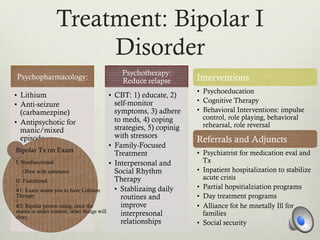
Treatment: Bipolar I
Disorder
Psychopharmacology:
•  Lithium
•  Anti-seizure
(carbamezpine)
•  Antipsychotic for
manic/mixed
episode
Psychotherapy:
Reduce relapse
•  CBT: 1) educate, 2)
self-monitor
symptoms, 3) adhere
to meds, 4) coping
strategies, 5) copinig
with stressors
•  Family-Focused
Treatment
•  Interpersonal and
Social Rhythm
Therapy
•  Stablizaing daily
routines and
improve
interpresonal
relationships
Bipolar Tx on Exam
I: Nonfunctional
Often with substance
II: Functional
#1: Exam wants you to have Lithium
Therapy
#2: Bipolar person using, once the
mania is under control, other things will
clear.
Interventions
•  Psychoeducation
•  Cognitive Therapy
•  Behavioral Interventions: impulse
control, role playing, behavioral
rehearsal, role reversal
Referrals and Adjuncts
•  Psychiatrist for medication eval and
Tx
•  Inpatient hospitalization to stabilize
acute crisis
•  Partial hopsitialziation programs
•  Day treatment programs
•  Alliance fot he mnetally Ill for
families
•  Social security
Hypomania
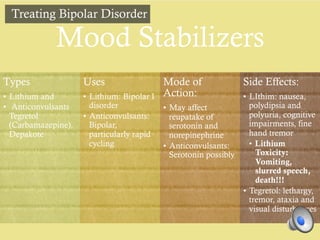
Mood StabilizersMood Stabilizers
Types
•  Lithium and
•  Anticonvulsants
Tegretol
(Carbamazepine),
Depakote
Uses
•  Lithium: Bipolar I
disorder
•  Anticonvulsants:
Bipolar,
particularly rapid
cycling
Mode of
Action:
•  May affect
reupatake of
serotonin and
norepinephrine
•  Anticonvulsants:
Serotonin possibly
Side Effects:
•  LIthim: nausea,
polydipsia and
polyuria, cognitive
impairments, fine
hand tremor
•  Lithium
Toxicity:
Vomiting,
slurred speech,
death!!!
•  Tegretol: lethargy,
tremor, ataxia and
visual disturbances
Treating Bipolar Disorder
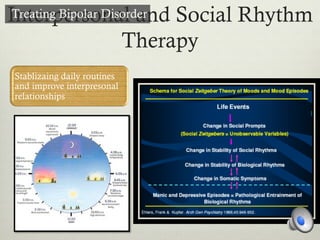
Interpersonal and Social Rhythm
Therapy
Stablizaing daily routines
and improve interpresonal
relationships
Treating Bipolar Disorder
Anxiety Disorders
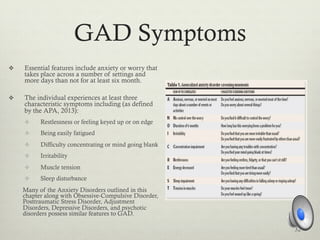
GAD Symptoms
v  Essential features include anxiety or worry that
takes place across a number of settings and
more days than not for at least six month.
v  The individual experiences at least three
characteristic symptoms including (as defined
by the APA, 2013):
v  Restlessness or feeling keyed up or on edge
v  Being easily fatigued
v  Difficulty concentrating or mind going blank
v  Irritability
v  Muscle tension
v  Sleep disturbance
Many of the Anxiety Disorders outlined in this
chapter along with Obsessive-Compulsive Disorder,
Posttraumatic Stress Disorder, Adjustment
Disorders, Depressive Disorders, and psychotic
disorders possess similar features to GAD.
32
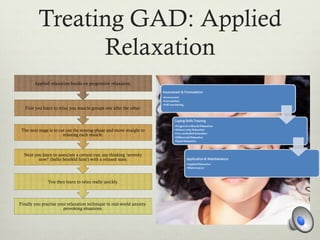
Treating GAD: Applied
Relaxation
Finally you practise your relaxation technique in real-world anxiety-
provoking situations.
You then learn to relax really quickly.
Next you learn to associate a certain cue, say thinking ‘serenity
now!’ (hello Seinfeld fans!) with a relaxed state.
The next stage is to cut out the tensing phase and move straight to
relaxing each muscle.
First you learn to relax you muscle groups one after the other.
Applied relaxation builds on progressive relaxation.
Phobias
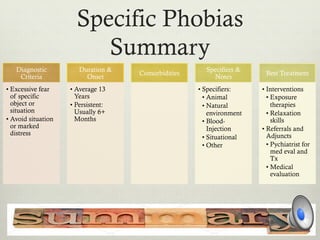
Specific Phobias
Summary
Diagnostic
Criteria
• Excessive fear
of specific
object or
situation
• Avoid situation
or marked
distress
Duration &
Onset
• Average 13
Years
• Persistent:
Usually 6+
Months
Comorbidities
Specifiers &
Notes
• Specifiers:
• Animal
• Natural
environment
• Blood-
Injection
• Situational
• Other
Best Treatment
• Interventions
• Exposure
therapies
• Relaxation
skills
• Referrals and
Adjuncts
• Pychiatrist for
med eval and
Tx
• Medical
evaluation
Development of Phobias
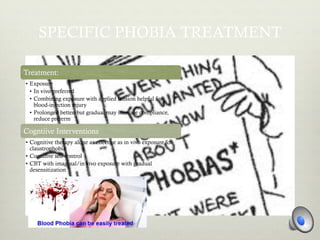
SPECIFIC PHOBIA TREATMENT
Treatment:
•  Exposure
•  In vivo preferred
•  Combining exposure with applied tension helpful for
blood-injection injury
•  Prolonged better, but gradual may increase compliance,
reduce preterm
Cogntiive Interventions
•  Cognitive therapy alone as effective as in vivo exposure for
claustrophobia
•  Cognitive self-control
•  CBT with imaginal/in vivo exposure with gradual
desensitization
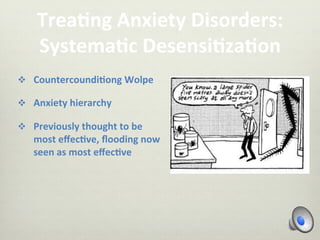
Trea-ng	
  Anxiety	
  Disorders:	
  
Systema-c	
  Desensi-za-on	
  
v  Countercoundi-ong	
  Wolpe	
  
v  Anxiety	
  hierarchy	
  
v  Previously	
  thought	
  to	
  be	
  
most	
  effec-ve,	
  flooding	
  now	
  
seen	
  as	
  most	
  effec-ve	
  
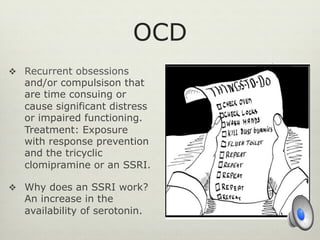
OCD
v  Recurrent obsessions
and/or compulsison that
are time consuing or
cause significant distress
or impaired functioning.
Treatment: Exposure
with response prevention
and the tricyclic
clomipramine or an SSRI.
v  Why does an SSRI work?
An increase in the
availability of serotonin.
Obsessive-Compulsive
Disorders
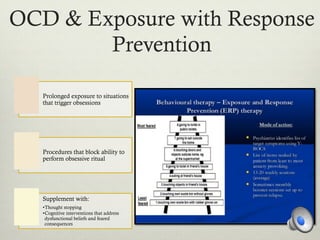
OCD & Exposure with Response
Prevention
Prolonged exposure to situations
that trigger obsessions
Procedures that block ability to
perform obsessive ritual
Supplement with:
• Thought stopping
• Cognitive interventions that address
dysfunctional beliefs and feared
consequences
Trauma- and Stressor-
related disorders
Reactive Attachment Disorder
Disinhibited Social Engagement Disorder
Posttraumatic Stress Disorder
Acute Stress Disorder
Adjustment Disorders
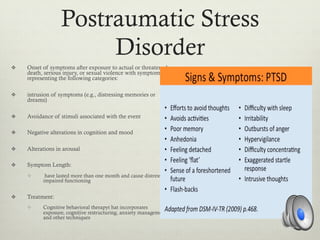
Postraumatic Stress
Disorder
v  Onset of symptoms after exposure to actual or threatened
death, serious injury, or sexual violence with symptoms
representing the following categories:
v  intrusion of symptoms (e.g., distressing memories or
dreams)
v  Avoidance of stimuli associated with the event
v  Negative alterations in cognition and mood
v  Alterations in arousal
v  Symptom Length:
v  have lasted more than one month and cause distress or
impaired functioning
v  Treatment:
v  Cognitive behavioral therapyt hat incorporates
exposure, cognitive restructuring, anxiety management
and other techniques
VI. Dissociative disorders,
somatic symptom and related
disorders, elimination
disorders, and sleep-wake
disorders
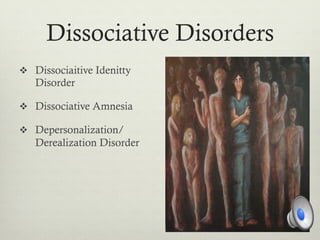
Dissociative Disorders
v  Dissociaitive Idenitty
Disorder
v  Dissociative Amnesia
v  Depersonalization/
Derealization Disorder
Causes of Dissociative
Disorders?
v  Abuse +[Plus]
v  Abuse plus an ability to put onself in a hypnotic
trance to cope with abusive situations
The DID Controversy
v  Is it real?
v  Fewer than ¼ of psychiatrists believe it is real
v  Changes over time:
v  1930-1960: 2 cases per decade
v  1960: Famous case of Sybil made into movie
v  1980s: 20,000 cases reported (mostly in US)
v  Is DID the result of suggestion by therapist and acting by
patient?
v  To what extent is DID an extreme version of normal
psychology?
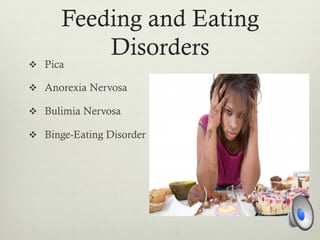
Feeding and Eating
Disorders
v  Pica
v  Anorexia Nervosa
v  Bulimia Nervosa
v  Binge-Eating Disorder
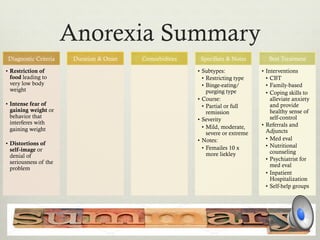
Anorexia Summary
Diagnostic Criteria
•  Restriction of
food leading to
very low body
weight
•  Intense fear of
gaining weight or
behavior that
interferes with
gaining weight
•  Distortions of
self-image or
denial of
seriousness of the
problem
Duration & Onset Comorbidities Specifiers & Notes
•  Subtypes:
•  Restricting type
•  Binge-eating/
purging type
•  Course:
•  Partial or full
remission
•  Severity
•  Mild, moderate,
severe or extreme
•  Notes:
•  Femailes 10 x
more liekley
Best Treatment
•  Interventions
•  CBT
•  Family-based
•  Coping skills to
alleviate anxiety
and provide
healthy sense of
self-control
•  Referrals and
Adjuncts
•  Med eval
•  Nutritional
counseling
•  Psychiatrist for
med eval
•  Inpatient
Hospitalization
•  Self-help groups
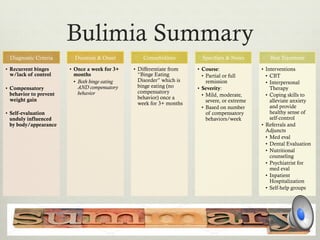
Bulimia Summary
Diagnostic Criteria
•  Recurrent binges
w/lack of control
•  Compensatory
behavior to prevent
weight gain
•  Self-evaluation
unduly influenced
by body/appearance
Duration & Onset
•  Once a week for 3+
months
•  Both binge eating
AND compensatory
behavior
Comorbidities
•  Differentiate from
“Binge Eating
Disorder” which is
binge eating (no
compensatory
behavior) once a
week for 3+ months
Specifiers & Notes
•  Course:
•  Partial or full
remission
•  Severity:
•  Mild, moderate,
severe, or extreme
•  Based on number
of compensatory
behaviors/week
Best Treatment
•  Interventions
•  CBT
•  Interpersonal
Therapy
•  Coping skills to
alleviate anxiety
and provide
healthy sense of
self-control
•  Referrals and
Adjuncts
•  Med eval
•  Dental Evaluation
•  Nutritional
counseling
•  Psychiatrist for
med eval
•  Inpatient
Hospitalization
•  Self-help groups
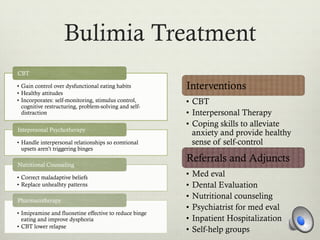
Bulimia Treatment
•  Gain control over dysfunctional eating habits
•  Healthy attitudes
•  Incorporates: self-monitoring, stimulus control,
cognitive restructuring, problem-solving and self-
distraction
CBT
•  Handle interpersonal relationships so eomtional
upsets aren’t triggering binges
Intepresonal Psychotherapy
•  Correct maladaptive beliefs
•  Replace unhealhty patterns
Nutritional Counseling
•  Imipramine and fluoxetine effective to reduce binge
eating and improve dysphoria
•  CBT lower relapse
Pharmacotherapy
Interventions
•  CBT
•  Interpersonal Therapy
•  Coping skills to alleviate
anxiety and provide healthy
sense of self-control
Referrals and Adjuncts
•  Med eval
•  Dental Evaluation
•  Nutritional counseling
•  Psychiatrist for med eval
•  Inpatient Hospitalization
•  Self-help groups
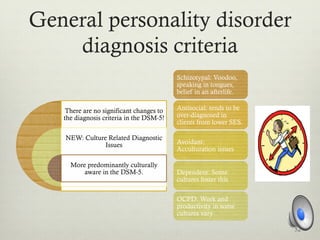
General personality disorder
diagnosis criteria
There are no significant changes to
the diagnosis criteria in the DSM-5!
NEW: Culture Related Diagnostic
Issues
More predominantly culturally
aware in the DSM-5.
52
Schizotypal: Voodoo,
speaking in tongues,
belief in an afterlife.
Antisocial: tends to be
over-diagnosed in
clients from lower SES.
Avoidant:
Acculturation issues
Dependent: Some
cultures foster this
OCPD: Work and
productivity in some
cultures vary
Personality Disorders
Most murderers are not
mentally ill in the usual
sense
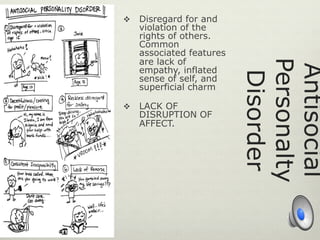
Antisocial
Personalty
Disorder
v  Disregard for and
violation of the
rights of others.
Common
associated features
are lack of
empathy, inflated
sense of self, and
superficial charm
v  LACK OF
DISRUPTION OF
AFFECT.
Antisocial Personality
Disorderv  • “Moral insantiy” or
“Psychopathy” •
v  Typically male •
v  Selfish, callous, impulsive,
promiscuous •
v  Deficit in love, loyalty, guilt,
anxiety •
v  Easily bored, seeks out
stimulation
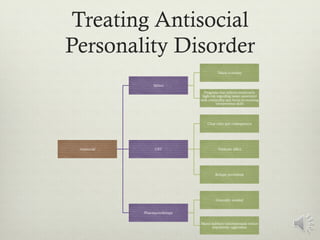
Treating Antisocial
Personality Disorder
Anitsocial
Milieu
Token economy
Programs that address moderately
high-risk regarding issues associated
with criminality and focus on teaching
interpresonal skills
CBT
Clear rules and consequences
Tolderate affect
Relapse prevention
Pharmacotoherapy
Generally avoided
Mood stablizer/antidepressant reduce
impulsivity/aggression
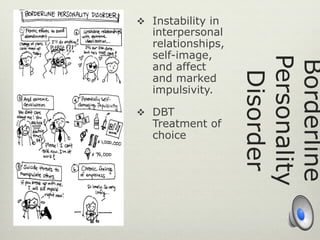
Borderline
Personality
Disorder
v  Instability in
interpersonal
relationships,
self-image,
and affect
and marked
impulsivity.
v  DBT
Treatment of
choice
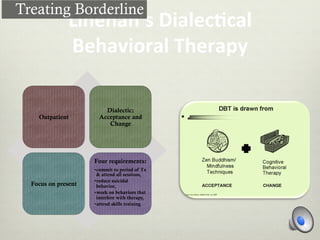
Linehan’s	
  Dialec-cal	
  
Behavioral	
  Therapy	
  
Outpatient
Dialectic:
Acceptance and
Change
Focus on present
Four requirements:
• commit to period of Tx
& attend all sessions,
• reduce suicidal
behavior,
• work on behaviors that
interfere with therapy,
• attend skills training
Treating Borderline
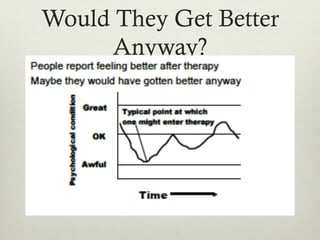
Would They Get Better
Anyway?
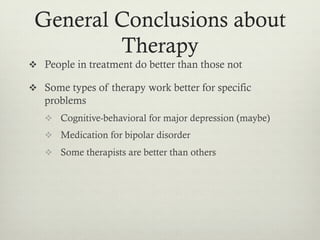
General Conclusions about
Therapy
v  People in treatment do better than those not
v  Some types of therapy work better for specific
problems
v  Cognitive-behavioral for major depression (maybe)
v  Medication for bipolar disorder
v  Some therapists are better than others
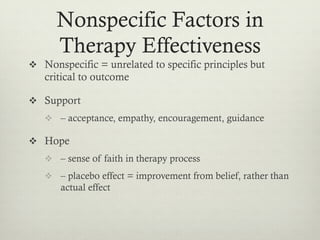
Nonspecific Factors in
Therapy Effectiveness
v  Nonspecific = unrelated to specific principles but
critical to outcome
v  Support
v  – acceptance, empathy, encouragement, guidance
v  Hope
v  – sense of faith in therapy process
v  – placebo effect = improvement from belief, rather than
actual effect

Psychopathology

  • 1.
  • 2.
    Psychopathology v  The studyof mental disorders or a mental disorder v  What can go wrong? v  How do you treat it? v  Where do we draw the line?
  • 3.
  • 4.
    Main Areas of Psychopathology v Neurodevelopmental v  Mood disorders v  Schizophrenia v  Anxiety disorders v  Dissociative disorders v  Personality disorders
  • 5.
  • 6.
    Autism Spectrum Summary DiagnosticCriteria •  Persistent social communication deficits •  Repetitive patterns of behavior •  Impairment in social, occupational, other area of functioning Duration & Onset •  Early developmental period •  Earliest signs are abnormalities in social orienting & responsivity by 12 months Comorbidities •  Intellectual Impairments •  Language abnormalities •  Uneven profile of cognitive abilities •  Motor deficits •  Self-injurious behaviors Specifiers & Notes •  Three levels of care •  1: support •  2. Substantial •  3. Best Treatment •  Educational and Vocational Interventions •  Behavioral •  Applied Behavior Analysis •  Pivotal Response Training •  Psychotherapy •  Structured/ Directive to treat comorbid conditions •  Parent/Family Interventions •  Pharmaco-therapy •  Treat associated symptoms
  • 7.
    Autism Spectrum Disorder Social Interaction • Persistent deficits in social communication and interaction across multiple contexts Repetitive •  Restricted, repetitive apatterns of behavior, interests, and activities •  Symptoms present in the early developmental period (important change, less focus on age of onset) •  Not all symptoms present, symptoms began to appear Deficits in Two Core Domains Has been linked to heredity, irregularities in the structure and functionin of the cerebellum and amygdala, and elevated serotonin Etiology: Better outcomes associated with communication skils by age 5 or 6, an IQ over 70 and later onset of symptoms 50% of children with this label are not speaking by age 5 Prognosis:
  • 8.
    ADHD v  Onset beforeage 12 v  Significant in at least 2 settings v  Duration of symptoms for at leat six months v  Subtypes: v  Predominantly inattention presentation v  Predominantly hyperactive/ impulsive presentation, combined presentation v  Hyperactive/impulsive presentation v  Combined presentation
  • 9.
    Stimulants v  Lifetime nonmedicaluse v  This class of drugs, in low to moderate doses, generally have the following effects v  Heightened mood (euphoria) v  Increase vigilance and alertness v  Reduce fatigue v  Alertness v  In order of prevalence of use v  Caffeine v  Nicotine v  Amphetamines/Cocaine ADHD Treatment
  • 10.
    Psychostimulatns Use: ADHD Examples: • methylphenidate (Ritalin)and pemoline (Cylert), and Dextraamphetamine & amphetamine (Adderall) Mode of Action: • Increase availability of norepinephrine and dopamine Side Effects: • Dysphoria, insomnia, decreased appetite, tics (exacerbates tic disorder, remove drug if it creates tic disorder), and OCD symptoms Drug holidays: • alleviate growth suppression ADHD Treatment
  • 11.
  • 12.
  • 13.
    Schizophrenia Summary Diagnostic Criteria • 2 Active phase symptoms •  One is delusion, hallucination or disorganized speech Duration & Onset •  At least one month of active phase symptoms •  Continuous signs for 6+ months •  Onset is typically late teens to early 30s, peak in mid 20s for males and late 20s for females Comorbidities Specifiers & Notes •  Active Phase: •  Delusions •  Hallucinations •  Disorganized Speech •  Grossly disorganized or catatonic behavior •  Negative symptoms •  Prevalence: .3 to . 7% Best Treatment •  Family psychoeducation •  Cognitive behavioral therapy •  Social skills training •  Supported employment •  Social learning/ token economies program •  Cognitive remeidaiton •  Other •  Relpase prevention;family therapy (reduce negatve expressed emotions; medication management)
  • 14.
    Assessment of Schizophrenia Acute: •  Diagnosing Stabilization: • monitorand evaluate Tx Stable: • assessments aligned with goals Hospitalization: Risk for suicide or aggression Decompensating, noncomplient, not improving Symptom stabilization is needed Exhibiting signs of Acute psychosis Schizophrenia Tx
  • 15.
    Treatment: Schizophrenia •  At risksuicide/aggression •  Decompensation/noncompliant •  Symptom stabalization needed (changing meds) •  Signs of acute psychosis/substance use 1. Hospitalization •  Traditional: Haloperidol, help positive symptoms •  Atypical: clozapine. Alleviate both 2. Pharmacotherapy •  CBT •  Skills •  Family •  Assertive Community Treatment (ACT) •  Supported Employment Psychosocial Interventions Treatments Overview •  Family psychoeducation •  Cognitive behavioral therapy •  Social skills training •  Supported employment •  Social learning/token economies program •  Cognitive remeidaiton Other •  Relpase prevention; •  family therapy (reduce negatve expressed emotions; •  medication management Schizophrenia Tx
  • 16.
    Cultural Differences in Schizophrenia v Family: more latitude v  Less antipsychotic medication v  If it is transient, and you aren’t socially isolated, easier to come back around
  • 17.
    Major Depressive Disorder •  SSRIs • TCAs •  MAOIs •  Other Pharmacotherapy •  CBT •  Intepersonal Psychotherapy Psychotherapy: Phototherapy Electroconvulsive Therapy (ECT) Mild Depression: No Meds Moderate +: Meds Interventions Overview • Behavior therapy/behavioral activiation • Cognitive therapy • Interpersonal • Problem-solving • Self-management/self-control therapy • Acceptance and commitment therapy • Emotion-focused therapy • Reminiscence/life review (older adults) • Short-term psychodynamic • Other: • Relapse prevention;meds Referrals and Adjuncts • Psychiatrist • Inpatient for acute • Partial hospitlaization programs • Social Security
  • 19.
    SSRIs Type •  Fluoxetine Use •  Depression • Melacholic depression •  OCD •  Bulimia •  Panic Disorder •  PTSD Mode of Action •  Block the reuptake of serotonin Side Effects: •  Less cardiotoxic, safer and less cognitive impairment •  2-4 weeks benefit •  Prozac no more dangerous than other SSRIs •  MAOI and SSRI: Serotonin syndrome •  Gastrointestinal •  Insomnia •  Anxiety •  Anorexia •  Urination •  Sexual dysfunction Treating Depression
  • 20.
    Beck’s  Cogni-ve  Profiles NegativeView of Self Negative View of World Negative View of Future Beck’s  Cogni-ve  Profile  of  Depression Beck’s  Cogni-ve  Profile  of  Anxiety Excessive Form of Normal Survival Mechanisms •  Unrealistic Fears about Physical Threats •  Unrealistic Fears about Psychological Threats Treating Depression
  • 21.
    Beck:  Cogni-ve  Therapy   v  Collabora-ve  empiricism   v  Socra-c  ques-oning   v  Keep  logs,  ac-vity  schedule,   gradual  tasks  to  increase   mastery   Treating Depression
  • 22.
  • 23.
    Treating Depression: Interpersonal Therapy Overview PersonalityTheory •  Treat depression •  Psychodynamic and CBT View of Maladaptive Behavior •  Problems in social roles Therapy Goals •  Four problems: grief, relationship roles, role transitions interpersonal Therapy Techniques •  Assess and encourage new ways of interacting •  End with methods of relapse prevention
  • 24.
  • 26.
    Bipolar I Summary DiagnosticCriteria • One manic episode for ONE week • Symptoms most of day nearly every day • 3+ Symptoms • Leading to hospitalization, significant impairment Duration & Onset • Manic One Week+ Comorbidities Specifiers & Notes • Three or more: • Inflated esteem • Decrease sleep • Pressured speech • Flight of ideas • Distractibility • Increased goal directed acitivty • Psychomotor agitation • Excessive involvement in pleasure Best Treatment • Interventions • Psychoeducation • Cognitive Therapy • Behavioral Interventions: impulse control, role playing, behavioral rehearsal, role reversal • Referrals and Adjuncts • Psychiatrist for medication eval and Tx • Inpatient hospitalization to stabilize acute crisis • Partial hopsitialziation programs • Day treatment programs • Alliance fot he mnetally Ill for families • Social security
  • 27.
    Treatment: Bipolar I Disorder Psychopharmacology: • Lithium •  Anti-seizure (carbamezpine) •  Antipsychotic for manic/mixed episode Psychotherapy: Reduce relapse •  CBT: 1) educate, 2) self-monitor symptoms, 3) adhere to meds, 4) coping strategies, 5) copinig with stressors •  Family-Focused Treatment •  Interpersonal and Social Rhythm Therapy •  Stablizaing daily routines and improve interpresonal relationships Bipolar Tx on Exam I: Nonfunctional Often with substance II: Functional #1: Exam wants you to have Lithium Therapy #2: Bipolar person using, once the mania is under control, other things will clear. Interventions •  Psychoeducation •  Cognitive Therapy •  Behavioral Interventions: impulse control, role playing, behavioral rehearsal, role reversal Referrals and Adjuncts •  Psychiatrist for medication eval and Tx •  Inpatient hospitalization to stabilize acute crisis •  Partial hopsitialziation programs •  Day treatment programs •  Alliance fot he mnetally Ill for families •  Social security
  • 28.
  • 29.
    Mood StabilizersMood Stabilizers Types • Lithium and •  Anticonvulsants Tegretol (Carbamazepine), Depakote Uses •  Lithium: Bipolar I disorder •  Anticonvulsants: Bipolar, particularly rapid cycling Mode of Action: •  May affect reupatake of serotonin and norepinephrine •  Anticonvulsants: Serotonin possibly Side Effects: •  LIthim: nausea, polydipsia and polyuria, cognitive impairments, fine hand tremor •  Lithium Toxicity: Vomiting, slurred speech, death!!! •  Tegretol: lethargy, tremor, ataxia and visual disturbances Treating Bipolar Disorder
  • 30.
    Interpersonal and SocialRhythm Therapy Stablizaing daily routines and improve interpresonal relationships Treating Bipolar Disorder
  • 31.
  • 32.
    GAD Symptoms v  Essentialfeatures include anxiety or worry that takes place across a number of settings and more days than not for at least six month. v  The individual experiences at least three characteristic symptoms including (as defined by the APA, 2013): v  Restlessness or feeling keyed up or on edge v  Being easily fatigued v  Difficulty concentrating or mind going blank v  Irritability v  Muscle tension v  Sleep disturbance Many of the Anxiety Disorders outlined in this chapter along with Obsessive-Compulsive Disorder, Posttraumatic Stress Disorder, Adjustment Disorders, Depressive Disorders, and psychotic disorders possess similar features to GAD. 32
  • 33.
    Treating GAD: Applied Relaxation Finallyyou practise your relaxation technique in real-world anxiety- provoking situations. You then learn to relax really quickly. Next you learn to associate a certain cue, say thinking ‘serenity now!’ (hello Seinfeld fans!) with a relaxed state. The next stage is to cut out the tensing phase and move straight to relaxing each muscle. First you learn to relax you muscle groups one after the other. Applied relaxation builds on progressive relaxation.
  • 34.
  • 35.
    Specific Phobias Summary Diagnostic Criteria • Excessive fear ofspecific object or situation • Avoid situation or marked distress Duration & Onset • Average 13 Years • Persistent: Usually 6+ Months Comorbidities Specifiers & Notes • Specifiers: • Animal • Natural environment • Blood- Injection • Situational • Other Best Treatment • Interventions • Exposure therapies • Relaxation skills • Referrals and Adjuncts • Pychiatrist for med eval and Tx • Medical evaluation
  • 36.
  • 37.
    SPECIFIC PHOBIA TREATMENT Treatment: • Exposure •  In vivo preferred •  Combining exposure with applied tension helpful for blood-injection injury •  Prolonged better, but gradual may increase compliance, reduce preterm Cogntiive Interventions •  Cognitive therapy alone as effective as in vivo exposure for claustrophobia •  Cognitive self-control •  CBT with imaginal/in vivo exposure with gradual desensitization
  • 38.
    Trea-ng  Anxiety  Disorders:   Systema-c  Desensi-za-on   v  Countercoundi-ong  Wolpe   v  Anxiety  hierarchy   v  Previously  thought  to  be   most  effec-ve,  flooding  now   seen  as  most  effec-ve  
  • 39.
    OCD v  Recurrent obsessions and/orcompulsison that are time consuing or cause significant distress or impaired functioning. Treatment: Exposure with response prevention and the tricyclic clomipramine or an SSRI. v  Why does an SSRI work? An increase in the availability of serotonin.
  • 40.
  • 41.
    OCD & Exposurewith Response Prevention Prolonged exposure to situations that trigger obsessions Procedures that block ability to perform obsessive ritual Supplement with: • Thought stopping • Cognitive interventions that address dysfunctional beliefs and feared consequences
  • 42.
    Trauma- and Stressor- relateddisorders Reactive Attachment Disorder Disinhibited Social Engagement Disorder Posttraumatic Stress Disorder Acute Stress Disorder Adjustment Disorders
  • 43.
    Postraumatic Stress Disorder v  Onsetof symptoms after exposure to actual or threatened death, serious injury, or sexual violence with symptoms representing the following categories: v  intrusion of symptoms (e.g., distressing memories or dreams) v  Avoidance of stimuli associated with the event v  Negative alterations in cognition and mood v  Alterations in arousal v  Symptom Length: v  have lasted more than one month and cause distress or impaired functioning v  Treatment: v  Cognitive behavioral therapyt hat incorporates exposure, cognitive restructuring, anxiety management and other techniques
  • 44.
    VI. Dissociative disorders, somaticsymptom and related disorders, elimination disorders, and sleep-wake disorders
  • 45.
    Dissociative Disorders v  DissociaitiveIdenitty Disorder v  Dissociative Amnesia v  Depersonalization/ Derealization Disorder
  • 46.
    Causes of Dissociative Disorders? v Abuse +[Plus] v  Abuse plus an ability to put onself in a hypnotic trance to cope with abusive situations
  • 47.
    The DID Controversy v Is it real? v  Fewer than ¼ of psychiatrists believe it is real v  Changes over time: v  1930-1960: 2 cases per decade v  1960: Famous case of Sybil made into movie v  1980s: 20,000 cases reported (mostly in US) v  Is DID the result of suggestion by therapist and acting by patient? v  To what extent is DID an extreme version of normal psychology?
  • 48.
    Feeding and Eating Disorders v Pica v  Anorexia Nervosa v  Bulimia Nervosa v  Binge-Eating Disorder
  • 49.
    Anorexia Summary Diagnostic Criteria • Restriction of food leading to very low body weight •  Intense fear of gaining weight or behavior that interferes with gaining weight •  Distortions of self-image or denial of seriousness of the problem Duration & Onset Comorbidities Specifiers & Notes •  Subtypes: •  Restricting type •  Binge-eating/ purging type •  Course: •  Partial or full remission •  Severity •  Mild, moderate, severe or extreme •  Notes: •  Femailes 10 x more liekley Best Treatment •  Interventions •  CBT •  Family-based •  Coping skills to alleviate anxiety and provide healthy sense of self-control •  Referrals and Adjuncts •  Med eval •  Nutritional counseling •  Psychiatrist for med eval •  Inpatient Hospitalization •  Self-help groups
  • 50.
    Bulimia Summary Diagnostic Criteria • Recurrent binges w/lack of control •  Compensatory behavior to prevent weight gain •  Self-evaluation unduly influenced by body/appearance Duration & Onset •  Once a week for 3+ months •  Both binge eating AND compensatory behavior Comorbidities •  Differentiate from “Binge Eating Disorder” which is binge eating (no compensatory behavior) once a week for 3+ months Specifiers & Notes •  Course: •  Partial or full remission •  Severity: •  Mild, moderate, severe, or extreme •  Based on number of compensatory behaviors/week Best Treatment •  Interventions •  CBT •  Interpersonal Therapy •  Coping skills to alleviate anxiety and provide healthy sense of self-control •  Referrals and Adjuncts •  Med eval •  Dental Evaluation •  Nutritional counseling •  Psychiatrist for med eval •  Inpatient Hospitalization •  Self-help groups
  • 51.
    Bulimia Treatment •  Gaincontrol over dysfunctional eating habits •  Healthy attitudes •  Incorporates: self-monitoring, stimulus control, cognitive restructuring, problem-solving and self- distraction CBT •  Handle interpersonal relationships so eomtional upsets aren’t triggering binges Intepresonal Psychotherapy •  Correct maladaptive beliefs •  Replace unhealhty patterns Nutritional Counseling •  Imipramine and fluoxetine effective to reduce binge eating and improve dysphoria •  CBT lower relapse Pharmacotherapy Interventions •  CBT •  Interpersonal Therapy •  Coping skills to alleviate anxiety and provide healthy sense of self-control Referrals and Adjuncts •  Med eval •  Dental Evaluation •  Nutritional counseling •  Psychiatrist for med eval •  Inpatient Hospitalization •  Self-help groups
  • 52.
    General personality disorder diagnosiscriteria There are no significant changes to the diagnosis criteria in the DSM-5! NEW: Culture Related Diagnostic Issues More predominantly culturally aware in the DSM-5. 52 Schizotypal: Voodoo, speaking in tongues, belief in an afterlife. Antisocial: tends to be over-diagnosed in clients from lower SES. Avoidant: Acculturation issues Dependent: Some cultures foster this OCPD: Work and productivity in some cultures vary
  • 53.
  • 54.
    Most murderers arenot mentally ill in the usual sense
  • 55.
    Antisocial Personalty Disorder v  Disregard forand violation of the rights of others. Common associated features are lack of empathy, inflated sense of self, and superficial charm v  LACK OF DISRUPTION OF AFFECT.
  • 56.
    Antisocial Personality Disorderv  •“Moral insantiy” or “Psychopathy” • v  Typically male • v  Selfish, callous, impulsive, promiscuous • v  Deficit in love, loyalty, guilt, anxiety • v  Easily bored, seeks out stimulation
  • 57.
    Treating Antisocial Personality Disorder Anitsocial Milieu Tokeneconomy Programs that address moderately high-risk regarding issues associated with criminality and focus on teaching interpresonal skills CBT Clear rules and consequences Tolderate affect Relapse prevention Pharmacotoherapy Generally avoided Mood stablizer/antidepressant reduce impulsivity/aggression
  • 58.
  • 59.
    Linehan’s  Dialec-cal   Behavioral  Therapy   Outpatient Dialectic: Acceptance and Change Focus on present Four requirements: • commit to period of Tx & attend all sessions, • reduce suicidal behavior, • work on behaviors that interfere with therapy, • attend skills training Treating Borderline
  • 60.
    Would They GetBetter Anyway?
  • 61.
    General Conclusions about Therapy v People in treatment do better than those not v  Some types of therapy work better for specific problems v  Cognitive-behavioral for major depression (maybe) v  Medication for bipolar disorder v  Some therapists are better than others
  • 62.
    Nonspecific Factors in TherapyEffectiveness v  Nonspecific = unrelated to specific principles but critical to outcome v  Support v  – acceptance, empathy, encouragement, guidance v  Hope v  – sense of faith in therapy process v  – placebo effect = improvement from belief, rather than actual effect