










Human Development
Skyline College
Psych 100
Meghan Fraley, PhD
Objectives for Day
• Review & Reflect on Social Psychology Topics
• Community Psychology & Psychology in Action
Project
• Human Development
– What interests you about human development?
REVIEW & REFLECT
Social Psychology
Group Check-In
1. Discuss Assignments:
1. Journal on implicit bias
2. Articles on Milgram and Zimbardo
2. Review Social Psychology Key Terms
1. Help each other complete the main list
2. Strategize way to complete and master key term
list with group
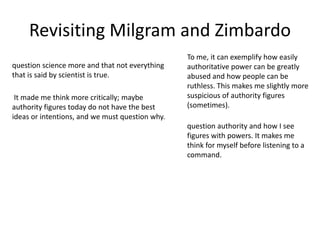
Revisiting Milgram and Zimbardo
question science more and that not everything
that is said by scientist is true.
question authority and how I see
figures with powers. It makes me
think for myself before listening to a
command.
It made me think more critically; maybe
authority figures today do not have the best
ideas or intentions, and we must question why.
To me, it can exemplify how easily
authoritative power can be greatly
abused and how people can be
ruthless. This makes me slightly more
suspicious of authority figures
(sometimes).
COMMUNITY PSYCHOLOGY
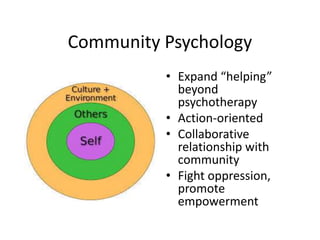
Community Psychology
• Expand “helping”
beyond
psychotherapy
• Action-oriented
• Collaborative
relationship with
community
• Fight oppression,
promote
empowerment
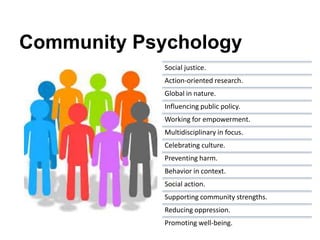
Community Psychology
Social justice.
Action-oriented research.
Global in nature.
Influencing public policy.
Working for empowerment.
Multidisciplinary in focus.
Celebrating culture.
Preventing harm.
Behavior in context.
Social action.
Supporting community strengths.
Reducing oppression.
Promoting well-being.
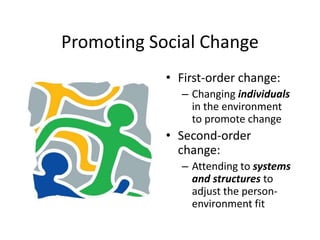
Promoting Social Change
• First-order change:
– Changing individuals
in the environment
to promote change
• Second-order
change:
– Attending to systems
and structures to
adjust the person-
environment fit
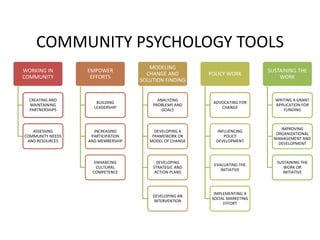
WORKING IN
COMMUNITY
CREATING AND
MAINTAINING
PARTNERSHIPS
ASSESSING
COMMUNITY NEEDS
AND RESOURCES
EMPOWER
EFFORTS
BUILDING
LEADERSHIP
INCREASING
PARTICIPATION
AND MEMBERSHIP
ENHANCING
CULTURAL
COMPETENCE
MODELING
CHANGE AND
SOLUTION FINDING
ANALYZING
PROBLEMS AND
GOALS
DEVELOPING A
FRAMEWORK OR
MODEL OF CHANGE
DEVELOPING
STRATEGIC AND
ACTION PLANS
DEVELOPING AN
INTERVENTION
POLICY WORK
ADVOCATING FOR
CHANGE
INFLUENCING
POLICY
DEVELOPMENT
EVALUATING THE
INITIATIVE
IMPLEMENTING A
SOCIAL MARKETING
EFFORT
SUSTAINING THE
WORK
WRITING A GRANT
APPLICATION FOR
FUNDING
IMPROVING
ORGANIZATIONAL
MANAGEMENT AND
DEVELOPMENT
SUSTAINING THE
WORK OR
INITIATIVE
COMMUNITY PSYCHOLOGY TOOLS
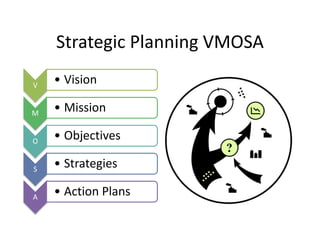
Strategic Planning VMOSA
V
• Vision
M
• Mission
O
• Objectives
S
• Strategies
A
• Action Plans
HUMAN DEVELOPMENT
What’s so Interesting about Human
Development?
• 1. Studying development helps you better
understand yourself.
• 2. It also helps you learn more about your
children.
• 3. You'll better understand how to interact with
kids.
• 4. And you'll gain a greater appreciation of
development throughout life.
• 5. It allows us to understand what's normal, and
what's not.
MILESTONES
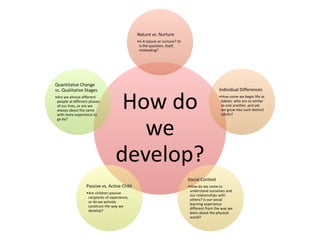
How do
we
develop?
Nature vs. Nurture
•Is it nature or nurture? Or
is the question, itself,
misleading?
Individual Differences
•How come we begin life as
babies, who are so similar
to one another, and yet
we grow into such distinct
adults?
Social Context
•How do we come to
understand ourselves and
our relationships with
others? Is our social
learning experience
different from the way we
learn about the physical
world?
Passive vs. Active Child
•Are children passive
recipients of experience,
or do we actively
construct the way we
develop?
Quantitatve Change
vs. Qualitative Stages
•Are we almost different
people at different phases
of our lives, or are we
always about the same
with more experience to
go by?
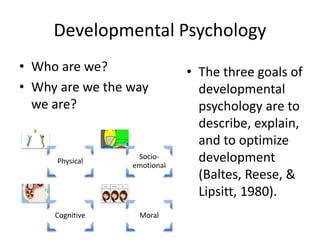
Developmental Psychology
• Who are we?
• Why are we the way
we are?
Physical
Socio-
emotional
Cognitive Moral
• The three goals of
developmental
psychology are to
describe, explain,
and to optimize
development
(Baltes, Reese, &
Lipsitt, 1980).
Physical Development
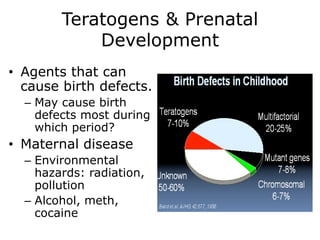
Teratogens & Prenatal
Development
• Agents that can
cause birth defects.
– May cause birth
defects most during
which period?
• Maternal disease
– Environmental
hazards: radiation,
pollution
– Alcohol, meth,
cocaine
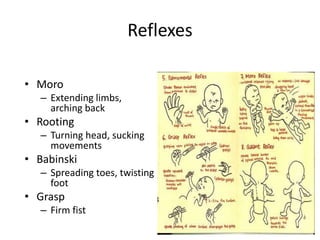
Reflexes
• Moro
– Extending limbs,
arching back
• Rooting
– Turning head, sucking
movements
• Babinski
– Spreading toes, twisting
foot
• Grasp
– Firm fist
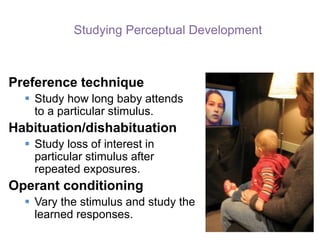
Studying Perceptual Development
Preference technique
 Study how long baby attends
to a particular stimulus.
Habituation/dishabituation
 Study loss of interest in
particular stimulus after
repeated exposures.
Operant conditioning
 Vary the stimulus and study the
learned responses.
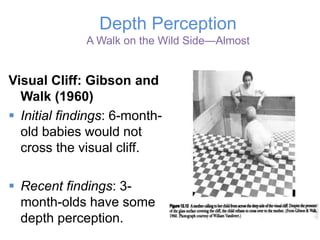
Depth Perception
A Walk on the Wild Side—Almost
Visual Cliff: Gibson and
Walk (1960)
 Initial findings: 6-month-
old babies would not
cross the visual cliff.
 Recent findings: 3-
month-olds have some
depth perception.
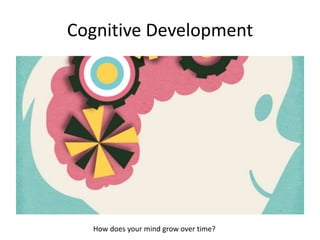
Cognitive Development
How does your mind grow over time?
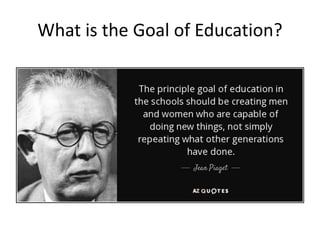
What is the Goal of Education?
The Growth of Knowledge
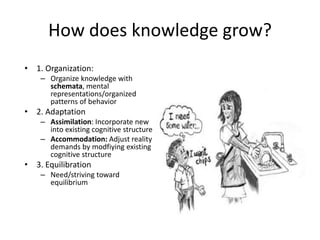
How does knowledge grow?
• 1. Organization:
– Organize knowledge with
schemata, mental
representations/organized
patterns of behavior
• 2. Adaptation
– Assimilation: Incorporate new
into existing cognitive structure
– Accommodation: Adjust reality
demands by modfiying existing
cognitive structure
• 3. Equilibration
– Need/striving toward
equilibrium
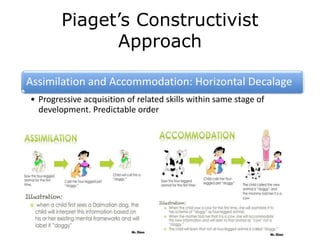
Piaget’s Constructivist
Approach
Assimilation and Accommodation: Horizontal Decalage
• Progressive acquisition of related skills within same stage of
development. Predictable order
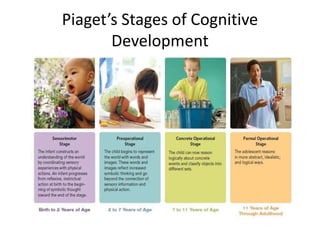
Piaget’s Stages of Cognitive
Development
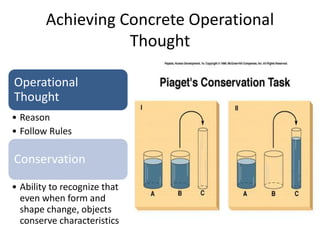
Achieving Concrete Operational
Thought
Operational
Thought
• Reason
• Follow Rules
Conservation
• Ability to recognize that
even when form and
shape change, objects
conserve characteristics
Theory of Mind
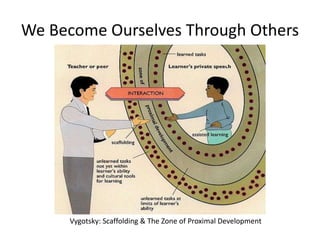
We Become Ourselves Through Others
Vygotsky: Scaffolding & The Zone of Proximal Development
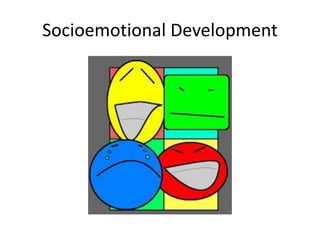
Socioemotional Development
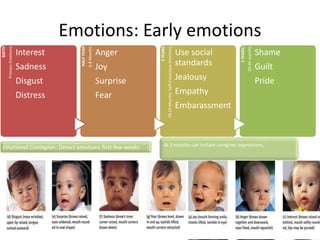
Emotions: Early emotions
BIRTH
PrimaryEmotions
Interest
Sadness
Disgust
Distress
HALFYEAR
6-8Months
Anger
Joy
Surprise
Fear
2YEARS
18-24Months:Self-ConsciousEmotions
Use social
standards
Jealousy
Empathy
Embarassment
3YEARS:
30-36months
Shame
Guilt
Pride
At 3 months can imitate caregiver expressions,Emotional Contagion: Detect emotions first few weeks
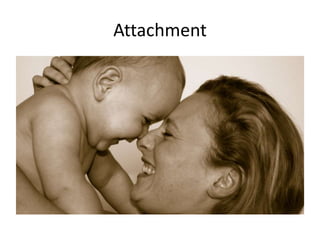
Attachment
How important is attachment?
Early Bonds are an Integral Part of
Human Nature
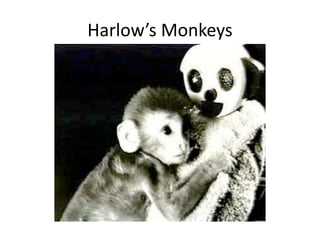
Harlow’s Monkeys
Important for development of attachment
Infant monkeys attached to terrycloth mums
over mother that produced food
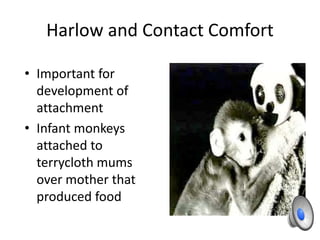
Harlow and Contact Comfort
• Important for
development of
attachment
• Infant monkeys
attached to
terrycloth mums
over mother that
produced food
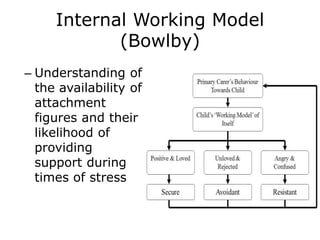
Internal Working Model
(Bowlby)
– Understanding of
the availability of
attachment
figures and their
likelihood of
providing
support during
times of stress
What Creates Secure Attachment?
The Strange Situation
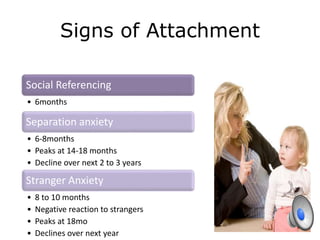
Signs of Attachment
Social Referencing
• 6months
Separation anxiety
• 6-8months
• Peaks at 14-18 months
• Decline over next 2 to 3 years
Stranger Anxiety
• 8 to 10 months
• Negative reaction to strangers
• Peaks at 18mo
• Declines over next year
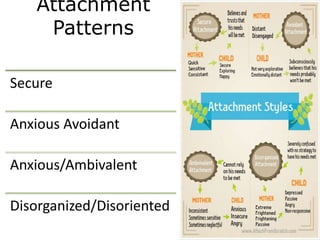
Attachment
Patterns
Secure
Anxious Avoidant
Anxious/Ambivalent
Disorganized/Disoriented
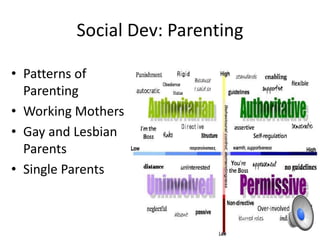
Social Dev: Parenting
• Patterns of
Parenting
• Working Mothers
• Gay and Lesbian
Parents
• Single Parents
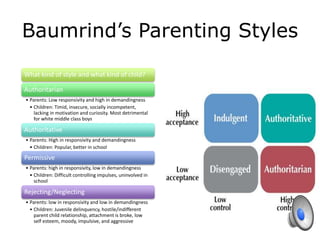
Baumrind’s Parenting Styles
What kind of style and what kind of child?
Authoritarian
• Parents: Low responsivity and high in demandingness
• Children: Timid, insecure, socially incompetent,
lacking in motivation and curiosity. Most detrimental
for white middle class boys
Authoritative
• Parents: High in responsivity and demandingness
• Children: Popular, better in school
Permissive
• Parents: high in responsivity, low in demandingness
• Children: Difficult controlling impulses, uninvolved in
school
Rejecting/Neglecting
• Parents: low in responsivity and low in demandingness
• Children: Juvenile delinquency, hostile/indifferent
parent child relationship, attachment is broke, low
self esteem, moody, impulsive, and aggressive
Perfect
Parents,
Perfect
Kids?
Which of the following factors do you think would show a
strong correlation (positive OR negative!) with academic test
scores between kindergarten and fifth grade?
•From Freakonomics by Steven D. Levitt and Stephen J. Dubner, William
Morrow, 2005)
Which correlate with academic scores?
•The child has highly educated parents.
•The child’s family is intact.
•The child’s parents have high socioeconomic status.
•The child’s parents recently moved into a better neighborhood.
•The child’s mother was thirty or older at the time of her first child’s birth.
•The child’s mother didn’t work between birth and kindergarten.
•The child had low birthweight.
•The child attended Head Start.
•The child’s parents speak English in the home.
•The child’s parents regularly take him to museums.
•The child is adopted.
•The child is regularly spanked.
•The child’s parents are involved in the PTA.
•The child frequently watches television.
•The child has many books in his home.
•The child’s parents read to him nearly every day.
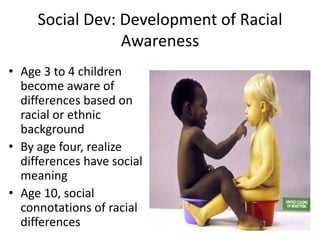
Social Dev: Development of Racial
Awareness
• Age 3 to 4 children
become aware of
differences based on
racial or ethnic
background
• By age four, realize
differences have social
meaning
• Age 10, social
connotations of racial
differences
Who Teaches Prejudice?
Morality
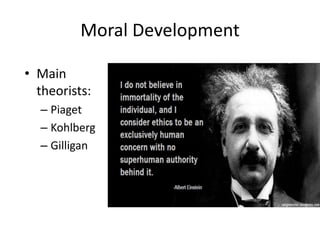
Moral Development
• Main
theorists:
– Piaget
– Kohlberg
– Gilligan
The Heinz Dilemma
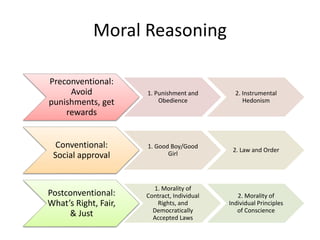
Moral Reasoning
Preconventional:
Avoid
punishments, get
rewards
1. Punishment and
Obedience
2. Instrumental
Hedonism
Conventional:
Social approval
1. Good Boy/Good
Girl
2. Law and Order
Postconventional:
What’s Right, Fair,
& Just
1. Morality of
Contract, Individual
Rights, and
Democratically
Accepted Laws
2. Morality of
Individual Principles
of Conscience
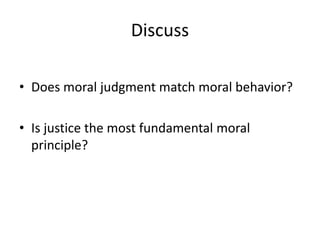
Discuss
• Does moral judgment match moral behavior?
• Is justice the most fundamental moral
principle?
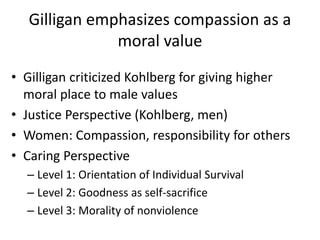
Gilligan emphasizes compassion as a
moral value
• Gilligan criticized Kohlberg for giving higher
moral place to male values
• Justice Perspective (Kohlberg, men)
• Women: Compassion, responsibility for others
• Caring Perspective
– Level 1: Orientation of Individual Survival
– Level 2: Goodness as self-sacrifice
– Level 3: Morality of nonviolence
FAMILY AND PEERS
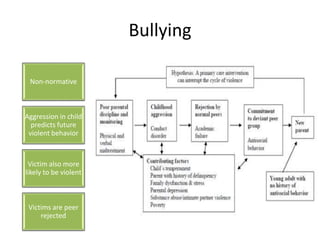
Bullying
Non-normative
Aggression in child
predicts future
violent behavior
Victim also more
likely to be violent
Victims are peer
rejected
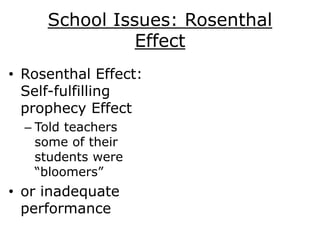
School Issues: Rosenthal
Effect
• Rosenthal Effect:
Self-fulfilling
prophecy Effect
– Told teachers
some of their
students were
“bloomers”
• or inadequate
performance
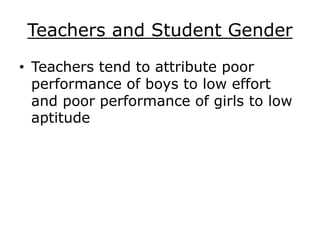
Teachers and Student Gender
• Teachers tend to attribute poor
performance of boys to low effort
and poor performance of girls to low
aptitude
THE END

Human development 2

  • 1.
  • 2.
    Objectives for Day •Review & Reflect on Social Psychology Topics • Community Psychology & Psychology in Action Project • Human Development – What interests you about human development?
  • 3.
  • 4.
    Group Check-In 1. DiscussAssignments: 1. Journal on implicit bias 2. Articles on Milgram and Zimbardo 2. Review Social Psychology Key Terms 1. Help each other complete the main list 2. Strategize way to complete and master key term list with group
  • 5.
    Revisiting Milgram andZimbardo question science more and that not everything that is said by scientist is true. question authority and how I see figures with powers. It makes me think for myself before listening to a command. It made me think more critically; maybe authority figures today do not have the best ideas or intentions, and we must question why. To me, it can exemplify how easily authoritative power can be greatly abused and how people can be ruthless. This makes me slightly more suspicious of authority figures (sometimes).
  • 6.
  • 7.
    Community Psychology • Expand“helping” beyond psychotherapy • Action-oriented • Collaborative relationship with community • Fight oppression, promote empowerment
  • 8.
    Community Psychology Social justice. Action-orientedresearch. Global in nature. Influencing public policy. Working for empowerment. Multidisciplinary in focus. Celebrating culture. Preventing harm. Behavior in context. Social action. Supporting community strengths. Reducing oppression. Promoting well-being.
  • 9.
    Promoting Social Change •First-order change: – Changing individuals in the environment to promote change • Second-order change: – Attending to systems and structures to adjust the person- environment fit
  • 10.
    WORKING IN COMMUNITY CREATING AND MAINTAINING PARTNERSHIPS ASSESSING COMMUNITYNEEDS AND RESOURCES EMPOWER EFFORTS BUILDING LEADERSHIP INCREASING PARTICIPATION AND MEMBERSHIP ENHANCING CULTURAL COMPETENCE MODELING CHANGE AND SOLUTION FINDING ANALYZING PROBLEMS AND GOALS DEVELOPING A FRAMEWORK OR MODEL OF CHANGE DEVELOPING STRATEGIC AND ACTION PLANS DEVELOPING AN INTERVENTION POLICY WORK ADVOCATING FOR CHANGE INFLUENCING POLICY DEVELOPMENT EVALUATING THE INITIATIVE IMPLEMENTING A SOCIAL MARKETING EFFORT SUSTAINING THE WORK WRITING A GRANT APPLICATION FOR FUNDING IMPROVING ORGANIZATIONAL MANAGEMENT AND DEVELOPMENT SUSTAINING THE WORK OR INITIATIVE COMMUNITY PSYCHOLOGY TOOLS
  • 11.
    Strategic Planning VMOSA V •Vision M • Mission O • Objectives S • Strategies A • Action Plans
  • 12.
  • 13.
    What’s so Interestingabout Human Development? • 1. Studying development helps you better understand yourself. • 2. It also helps you learn more about your children. • 3. You'll better understand how to interact with kids. • 4. And you'll gain a greater appreciation of development throughout life. • 5. It allows us to understand what's normal, and what's not.
  • 14.
  • 15.
    How do we develop? Nature vs.Nurture •Is it nature or nurture? Or is the question, itself, misleading? Individual Differences •How come we begin life as babies, who are so similar to one another, and yet we grow into such distinct adults? Social Context •How do we come to understand ourselves and our relationships with others? Is our social learning experience different from the way we learn about the physical world? Passive vs. Active Child •Are children passive recipients of experience, or do we actively construct the way we develop? Quantitatve Change vs. Qualitative Stages •Are we almost different people at different phases of our lives, or are we always about the same with more experience to go by?
  • 16.
    Developmental Psychology • Whoare we? • Why are we the way we are? Physical Socio- emotional Cognitive Moral • The three goals of developmental psychology are to describe, explain, and to optimize development (Baltes, Reese, & Lipsitt, 1980).
  • 17.
  • 18.
    Teratogens & Prenatal Development •Agents that can cause birth defects. – May cause birth defects most during which period? • Maternal disease – Environmental hazards: radiation, pollution – Alcohol, meth, cocaine
  • 19.
    Reflexes • Moro – Extendinglimbs, arching back • Rooting – Turning head, sucking movements • Babinski – Spreading toes, twisting foot • Grasp – Firm fist
  • 20.
    Studying Perceptual Development Preferencetechnique  Study how long baby attends to a particular stimulus. Habituation/dishabituation  Study loss of interest in particular stimulus after repeated exposures. Operant conditioning  Vary the stimulus and study the learned responses.
  • 21.
    Depth Perception A Walkon the Wild Side—Almost Visual Cliff: Gibson and Walk (1960)  Initial findings: 6-month- old babies would not cross the visual cliff.  Recent findings: 3- month-olds have some depth perception.
  • 22.
    Cognitive Development How doesyour mind grow over time?
  • 23.
    What is theGoal of Education?
  • 24.
    The Growth ofKnowledge
  • 25.
    How does knowledgegrow? • 1. Organization: – Organize knowledge with schemata, mental representations/organized patterns of behavior • 2. Adaptation – Assimilation: Incorporate new into existing cognitive structure – Accommodation: Adjust reality demands by modfiying existing cognitive structure • 3. Equilibration – Need/striving toward equilibrium
  • 26.
    Piaget’s Constructivist Approach Assimilation andAccommodation: Horizontal Decalage • Progressive acquisition of related skills within same stage of development. Predictable order
  • 27.
    Piaget’s Stages ofCognitive Development
  • 28.
    Achieving Concrete Operational Thought Operational Thought •Reason • Follow Rules Conservation • Ability to recognize that even when form and shape change, objects conserve characteristics
  • 29.
  • 30.
    We Become OurselvesThrough Others Vygotsky: Scaffolding & The Zone of Proximal Development
  • 31.
  • 32.
    Emotions: Early emotions BIRTH PrimaryEmotions Interest Sadness Disgust Distress HALFYEAR 6-8Months Anger Joy Surprise Fear 2YEARS 18-24Months:Self-ConsciousEmotions Usesocial standards Jealousy Empathy Embarassment 3YEARS: 30-36months Shame Guilt Pride At 3 months can imitate caregiver expressions,Emotional Contagion: Detect emotions first few weeks
  • 33.
  • 34.
    How important isattachment?
  • 35.
    Early Bonds arean Integral Part of Human Nature
  • 36.
    Harlow’s Monkeys Important fordevelopment of attachment Infant monkeys attached to terrycloth mums over mother that produced food
  • 37.
    Harlow and ContactComfort • Important for development of attachment • Infant monkeys attached to terrycloth mums over mother that produced food
  • 38.
    Internal Working Model (Bowlby) –Understanding of the availability of attachment figures and their likelihood of providing support during times of stress
  • 39.
    What Creates SecureAttachment? The Strange Situation
  • 40.
    Signs of Attachment SocialReferencing • 6months Separation anxiety • 6-8months • Peaks at 14-18 months • Decline over next 2 to 3 years Stranger Anxiety • 8 to 10 months • Negative reaction to strangers • Peaks at 18mo • Declines over next year
  • 41.
  • 42.
    Social Dev: Parenting •Patterns of Parenting • Working Mothers • Gay and Lesbian Parents • Single Parents
  • 43.
    Baumrind’s Parenting Styles Whatkind of style and what kind of child? Authoritarian • Parents: Low responsivity and high in demandingness • Children: Timid, insecure, socially incompetent, lacking in motivation and curiosity. Most detrimental for white middle class boys Authoritative • Parents: High in responsivity and demandingness • Children: Popular, better in school Permissive • Parents: high in responsivity, low in demandingness • Children: Difficult controlling impulses, uninvolved in school Rejecting/Neglecting • Parents: low in responsivity and low in demandingness • Children: Juvenile delinquency, hostile/indifferent parent child relationship, attachment is broke, low self esteem, moody, impulsive, and aggressive
  • 44.
    Perfect Parents, Perfect Kids? Which of thefollowing factors do you think would show a strong correlation (positive OR negative!) with academic test scores between kindergarten and fifth grade? •From Freakonomics by Steven D. Levitt and Stephen J. Dubner, William Morrow, 2005) Which correlate with academic scores? •The child has highly educated parents. •The child’s family is intact. •The child’s parents have high socioeconomic status. •The child’s parents recently moved into a better neighborhood. •The child’s mother was thirty or older at the time of her first child’s birth. •The child’s mother didn’t work between birth and kindergarten. •The child had low birthweight. •The child attended Head Start. •The child’s parents speak English in the home. •The child’s parents regularly take him to museums. •The child is adopted. •The child is regularly spanked. •The child’s parents are involved in the PTA. •The child frequently watches television. •The child has many books in his home. •The child’s parents read to him nearly every day.
  • 45.
    Social Dev: Developmentof Racial Awareness • Age 3 to 4 children become aware of differences based on racial or ethnic background • By age four, realize differences have social meaning • Age 10, social connotations of racial differences
  • 46.
  • 47.
  • 48.
    Moral Development • Main theorists: –Piaget – Kohlberg – Gilligan
  • 49.
  • 50.
    Moral Reasoning Preconventional: Avoid punishments, get rewards 1.Punishment and Obedience 2. Instrumental Hedonism Conventional: Social approval 1. Good Boy/Good Girl 2. Law and Order Postconventional: What’s Right, Fair, & Just 1. Morality of Contract, Individual Rights, and Democratically Accepted Laws 2. Morality of Individual Principles of Conscience
  • 51.
    Discuss • Does moraljudgment match moral behavior? • Is justice the most fundamental moral principle?
  • 52.
    Gilligan emphasizes compassionas a moral value • Gilligan criticized Kohlberg for giving higher moral place to male values • Justice Perspective (Kohlberg, men) • Women: Compassion, responsibility for others • Caring Perspective – Level 1: Orientation of Individual Survival – Level 2: Goodness as self-sacrifice – Level 3: Morality of nonviolence
  • 53.
  • 54.
    Bullying Non-normative Aggression in child predictsfuture violent behavior Victim also more likely to be violent Victims are peer rejected
  • 55.
    School Issues: Rosenthal Effect •Rosenthal Effect: Self-fulfilling prophecy Effect – Told teachers some of their students were “bloomers” • or inadequate performance
  • 56.
    Teachers and StudentGender • Teachers tend to attribute poor performance of boys to low effort and poor performance of girls to low aptitude
  • 57.