Language and Thought
        m30
Review
Turn to a neighbor and explain to them how you
would find your lost keys using

   • an algorithm,

   • a heuristic, and

   • insight,
With your neighbor, make up examples of

• Mental Set

• Functional Fixedness

• Representativeness Heuristic

• Availability Heuristic
Language Structure
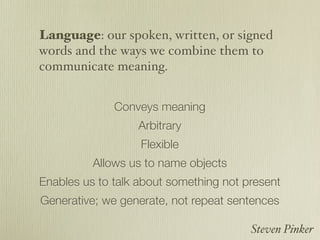
Language: our spoken, written, or signed
words and the ways we combine them to
communicate meaning.


              Conveys meaning
                  Arbitrary
                   Flexible
          Allows us to name objects
Enables us to talk about something not present
Generative; we generate, not repeat sentences

                                        Steven Pinker
Phoneme – a sound

   • B, P, and Th

Morpheme — the smallest unit with meaning

   • “-ed”, “-ing”, “anti-”, “pre”
Grammar — rules of a language

Syntax — rules for combining words into
grammatically correct sentences

• “The yellow chair is lovely”
• “She skated elegantly”
• “My son has grown another foot”
Semantics — rules of meaning

• “I sawed the chair”
• “That depends on what the meaning of ‘is’ is”
Language Development
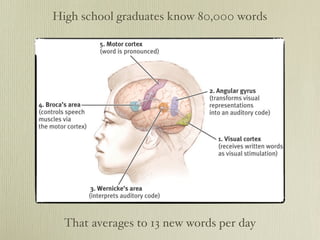
High school graduates know 80,000 words


  That averages to 13 new words per day
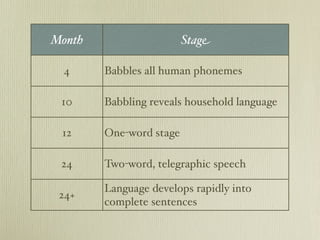
Month                    Stage

  4     Babbles all human phonemes

 10     Babbling reveals household language

 12     One-word stage

 24     Two-word, telegraphic speech

        Language develops rapidly into
 24+
        complete sentences
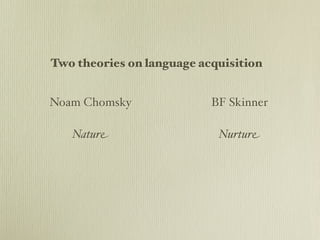
Two theories on language acquisition


Noam Chomsky               BF Skinner

   Nature                   Nurture
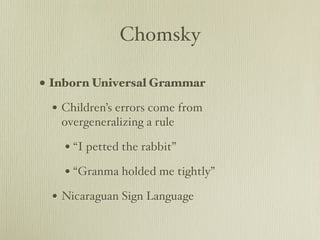
Chomsky

• Inborn Universal Grammar
 • Children’s errors come from
   overgeneralizing a rule

   • “I petted the rabbit”
   • “Granma holded me tightly”
 • Nicaraguan Sign Language
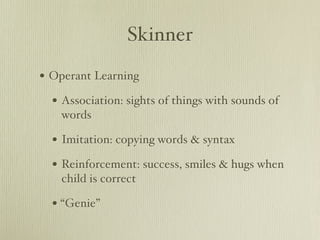
Skinner

• Operant Learning
  • Association: sights of things with sounds of
   words

  • Imitation: copying words & syntax
  • Reinforcement: success, smiles & hugs when
   child is correct

  • “Genie”
Thinking & Language
Linguistic Relativity (Sapir-Whorf
hypothesis): a culture’s linguistic concepts
affect the perception and cognition of
members of that culture


    In the extreme: linguistic determinism
• Thinking in nonlinguistic animals

• Thinking in nonlinguistic adults

• Nonlinguistic thinking in linguistic adults
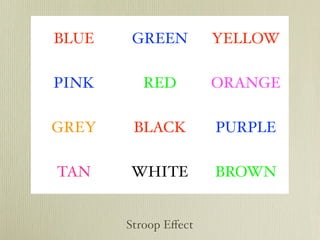
Do not read the word, just say the
     name of the color . . .
BLUE    GREEN         YELLOW

PINK      RED         ORANGE

GREY    BLACK         PURPLE

TAN    WHITE          BROWN


       Stroop Effect
Animal Thinking & Language
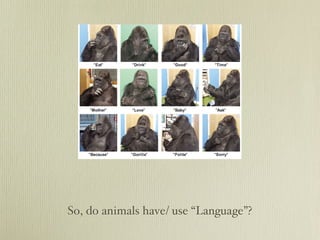
So, do animals have/ use “Language”?
Language: our spoken, written, or signed
words and the ways we combine them to
communicate meaning.


              Conveys meaning
                  Arbitrary
                   Flexible
          Allows us to name objects
Enables us to talk about something not present
Generative; we generate, not repeat sentences

                                        Steven Pinker

M30 language slides

  • 1.
  • 2.
  • 3.
    Turn to aneighbor and explain to them how you would find your lost keys using • an algorithm, • a heuristic, and • insight,
  • 4.
    With your neighbor,make up examples of • Mental Set • Functional Fixedness • Representativeness Heuristic • Availability Heuristic
  • 5.
  • 6.
    Language: our spoken,written, or signed words and the ways we combine them to communicate meaning. Conveys meaning Arbitrary Flexible Allows us to name objects Enables us to talk about something not present Generative; we generate, not repeat sentences Steven Pinker
  • 7.
    Phoneme – asound • B, P, and Th Morpheme — the smallest unit with meaning • “-ed”, “-ing”, “anti-”, “pre”
  • 8.
    Grammar — rulesof a language Syntax — rules for combining words into grammatically correct sentences • “The yellow chair is lovely” • “She skated elegantly” • “My son has grown another foot” Semantics — rules of meaning • “I sawed the chair” • “That depends on what the meaning of ‘is’ is”
  • 9.
  • 10.
    High school graduatesknow 80,000 words That averages to 13 new words per day
  • 11.
    Month Stage 4 Babbles all human phonemes 10 Babbling reveals household language 12 One-word stage 24 Two-word, telegraphic speech Language develops rapidly into 24+ complete sentences
  • 12.
    Two theories onlanguage acquisition Noam Chomsky BF Skinner Nature Nurture
  • 13.
    Chomsky • Inborn UniversalGrammar • Children’s errors come from overgeneralizing a rule • “I petted the rabbit” • “Granma holded me tightly” • Nicaraguan Sign Language
  • 14.
    Skinner • Operant Learning • Association: sights of things with sounds of words • Imitation: copying words & syntax • Reinforcement: success, smiles & hugs when child is correct • “Genie”
  • 15.
  • 16.
    Linguistic Relativity (Sapir-Whorf hypothesis):a culture’s linguistic concepts affect the perception and cognition of members of that culture In the extreme: linguistic determinism
  • 18.
    • Thinking innonlinguistic animals • Thinking in nonlinguistic adults • Nonlinguistic thinking in linguistic adults
  • 19.
    Do not readthe word, just say the name of the color . . .
  • 20.
    BLUE GREEN YELLOW PINK RED ORANGE GREY BLACK PURPLE TAN WHITE BROWN Stroop Effect
  • 21.
  • 22.
    So, do animalshave/ use “Language”?
  • 23.
    Language: our spoken,written, or signed words and the ways we combine them to communicate meaning. Conveys meaning Arbitrary Flexible Allows us to name objects Enables us to talk about something not present Generative; we generate, not repeat sentences Steven Pinker