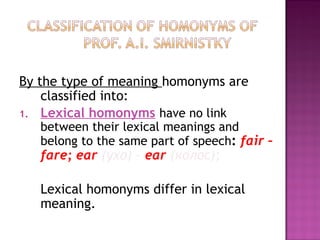
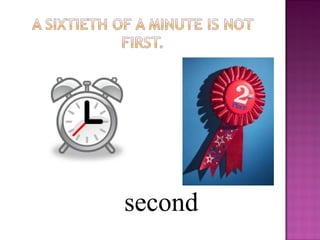
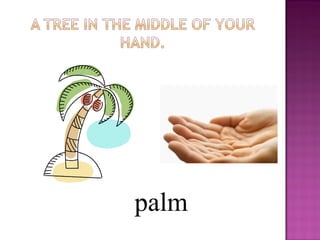
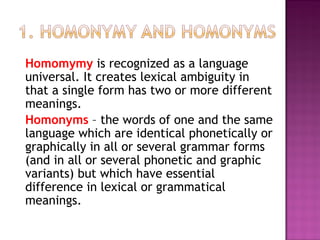
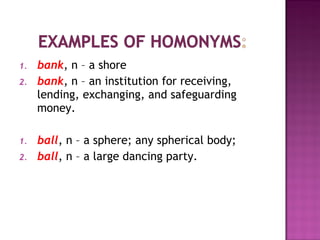
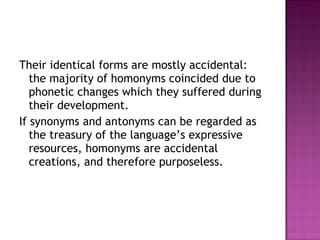
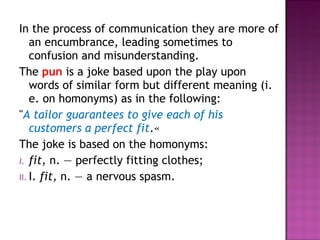
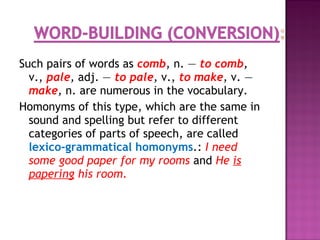
The document discusses homonyms, which are words that are identical in sound or spelling but have different meanings. It provides examples of different types of homonyms in English, such as lexical homonyms which differ only in meaning (e.g. fair-fare), grammatical homonyms which also differ in part of speech (e.g. milk-to milk), and lexico-grammatical homonyms which differ in both meaning and part of speech (e.g. tear-to tear). The document also examines how homonyms can arise through processes like sound changes, borrowings, shortenings, and the diverging or converging development of word meanings over time.

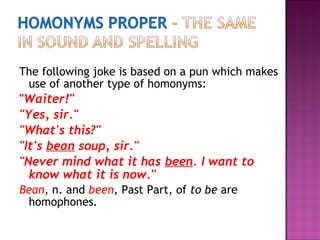
![night, n. — knight, n.;
piece, n. — peace, n.;
scent, n. — cent, n. — sent, v. (Past Indef.,
Past Part, of to send);
rite, n. — to write, v. — right, adj.;
sea, n. — to see, v. — С [si:] (the name of a
letter).](https://image.slidesharecdn.com/homonymy-170209104747/85/Homonymy-8-320.jpg)
![to bow [bau], v. - to incline the head or
body in salutation
bow [bou], n. - a flexible strip of wood for
propelling arrows
to lead [li:d],v. - to conduct on the way,
go before to show the way
lead [led], n - a heavy, rather soft metal;
to tear [teэ], v.- to pull apart or in pieces
by force
tear [tiэ], n.- a drop of the fluid secreted
by the lacrinial glands of the eye](https://image.slidesharecdn.com/homonymy-170209104747/85/Homonymy-9-320.jpg)
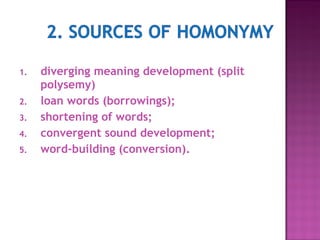


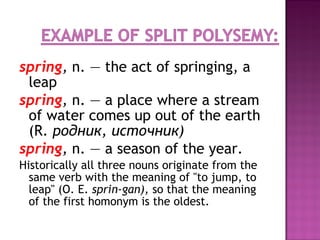

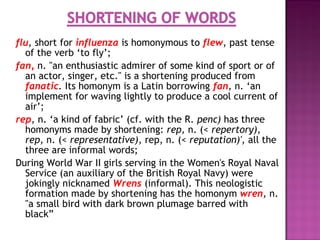

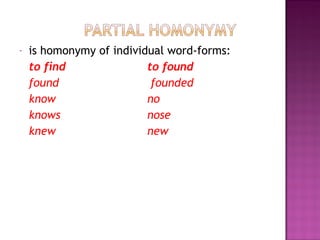
![Lie (lay, lain) — ‘to be in a horizontal or
resting position’ and lie — ‘to make an
untrue statement‘.
It is partial homonymy as only two word-
forms [lai], [laiz] are homonymous, all other
forms of the two verbs are different.](https://image.slidesharecdn.com/homonymy-170209104747/85/Homonymy-19-320.jpg)
![E.g. for [fo:] — preposition,
for [fo:] — conjunction,
four [fo:] — numeral,
These parts of speech have no other word-
forms.](https://image.slidesharecdn.com/homonymy-170209104747/85/Homonymy-20-320.jpg)