
Section 1: Learning
Meghan Fraley, PhD
Theories and Principles of Learning and
Behavior
Review
What were your independent and dependent variables?
Questions & Insights from Yesterday?
Discuss: Would this be an experiment you would enjoy
conducting? Why or why not?
Learning Autobiography
Difficulties
Joys
Passions
Future
How did you learn?
Are you a self-motivated learner?
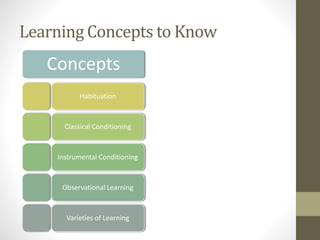
Learning Concepts to Know
Concepts
Habituation
Classical Conditioning
Instrumental Conditioning
Observational Learning
Varieties of Learning
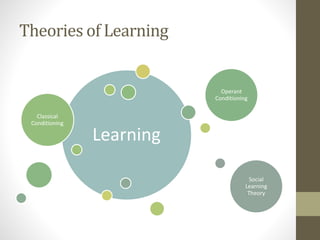
Theories of Learning
Learning
Classical
Conditioning
Operant
Conditioning
Social
Learning
Theory
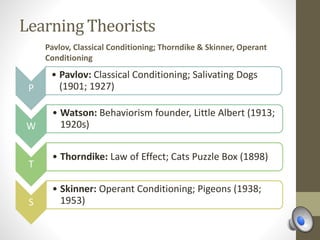
Learning Theorists
P
• Pavlov: Classical Conditioning; Salivating Dogs
(1901; 1927)
W
• Watson: Behaviorism founder, Little Albert (1913;
1920s)
T
• Thorndike: Law of Effect; Cats Puzzle Box (1898)
S
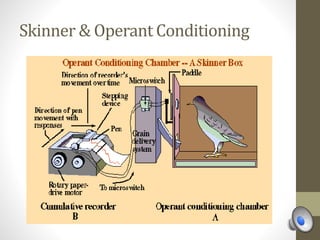
• Skinner: Operant Conditioning; Pigeons (1938;
1953)
Pavlov, Classical Conditioning; Thorndike & Skinner, Operant
Conditioning
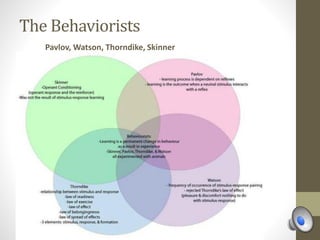
The Behaviorists
Pavlov, Watson, Thorndike, Skinner
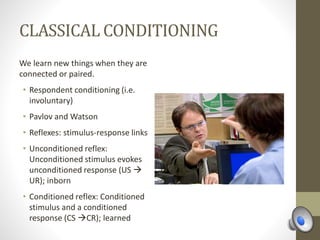
CLASSICAL CONDITIONING
We learn new things when they are
connected or paired.
• Respondent conditioning (i.e.
involuntary)
• Pavlov and Watson
• Reflexes: stimulus-response links
• Unconditioned reflex:
Unconditioned stimulus evokes
unconditioned response (US 
UR); inborn
• Conditioned reflex: Conditioned
stimulus and a conditioned
response (CS CR); learned
Altoid?
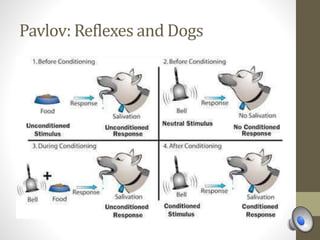
Pavlov: Reflexes and Dogs
Pavlov and Classical Conditioning
Essentials
PAIRING! 
The CS might precede the US
½ Second and Overlapping is Best!
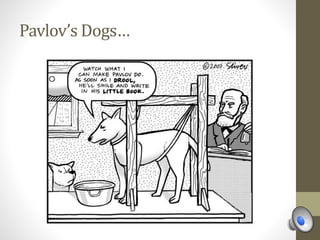
Pavlov’s Dogs…
Unconditioned Stimulus and
Response
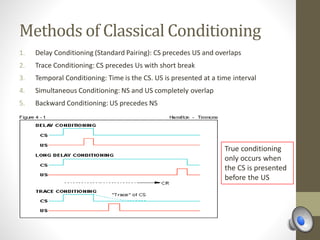
Methods of Classical Conditioning
1. Delay Conditioning (Standard Pairing): CS precedes US and overlaps
2. Trace Conditioning: CS precedes Us with short break
3. Temporal Conditioning: Time is the CS. US is presented at a time interval
4. Simultaneous Conditioning: NS and US completely overlap
5. Backward Conditioning: US precedes NS
True conditioning
only occurs when
the CS is presented
before the US
Key Concepts of Classical
Conditioning
1. Stimulus Generalization
2. Higher Order Conditioning
3. Classical Extinction
4. Spontaneous Recovery
5. Stimulus Discrimination
6. Pseudoconditioning
7. Habituation
S R
A stimulus is
presented
in order to get
a response:
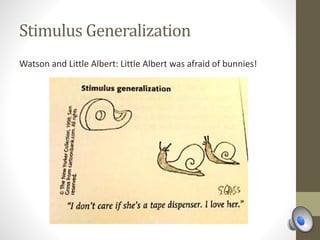
Stimulus Generalization
Watson and Little Albert: Little Albert was afraid of bunnies!
Stimulus Generalization
Occurs when the stimuli similar to the CS also elicits
the CR
Strength of the CR diminishes as the similarity
between the stimuli and the original CS decreases
Higher-Order Conditioning
Two Steps
• 1) Ordinary classical conditioning
• 2) Original CS is treated like a US and paired with
neutral, so neutral begins to also stimulate CR.
i.e. opening the cabinet door to get the food out for
the kitties
2 order works, 3rd doesn’t
Bio-preparedism: Why animals will respond to the
CS prior to the US
CR elicited
Higher Order Conditioning
Deliberate process where CS are paired with NS up to three
levels.
An animal might first learn to associate a bell with food (first-order conditioning),
but then learn to associate a light with the bell (second-order conditioning).
Honeybees show second-order conditioning during proboscis extension reflex
conditioning.[1]
Is Fear a Conditioned Response?
Watson and Baby Albert
Discuss: Phobias
Based on classical conditioning, why do objects become more
fearful over time?
Does anyone have a phobia that
How does this discussion map on to the research projects?
What might be problems with our study?
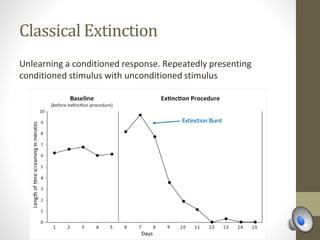
Classical Extinction
Unlearning a conditioned response. Repeatedly presenting
conditioned stimulus with unconditioned stimulus
Extinction
CS ALONE = EXTINCTION
Once the conditioned response has been
established, it will eventually disappear when the CS
is repeatedly presented without the US.
Ahhh… but the behavior is inhibited, not eliminated
Inhibited Extinction
You still remember the former pairing… which sets
the stage for spontaneous recovery.
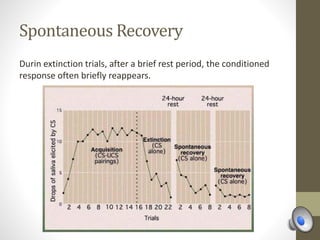
Spontaneous Recovery
Durin extinction trials, after a brief rest period, the conditioned
response often briefly reappears.
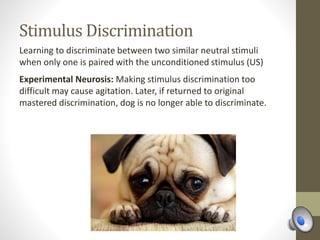
Stimulus Discrimination
Learning to discriminate between two similar neutral stimuli
when only one is paired with the unconditioned stimulus (US)
Experimental Neurosis: Making stimulus discrimination too
difficult may cause agitation. Later, if returned to original
mastered discrimination, dog is no longer able to discriminate.
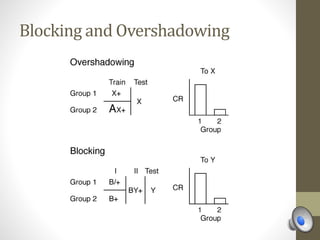
Blocking and Overshadowing
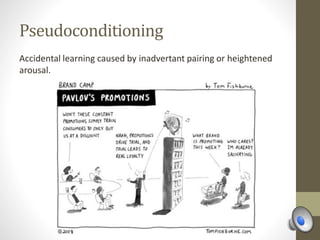
Pseudoconditioning
Accidental learning caused by inadvertant pairing or heightened
arousal.
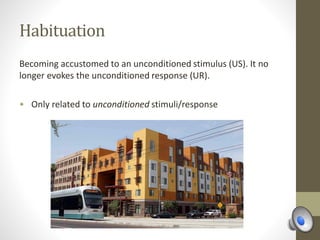
Habituation
Becoming accustomed to an unconditioned stimulus (US). It no
longer evokes the unconditioned response (UR).
• Only related to unconditioned stimuli/response
Wolpe: Reciprocal Inhibition
Although Wolpe originally
developed systematic
desenstiziation as an application
of reciprocal inhibition.
Research using the “dismantling
strategy” found that repeated
exposure to the CS without the
US (extinction) is responsible
for th reduction of the anxiety
response
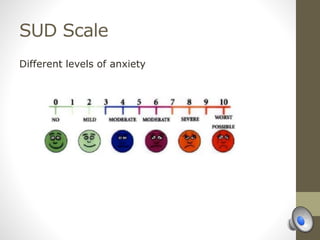
SUD Scale
Different levels of anxiety
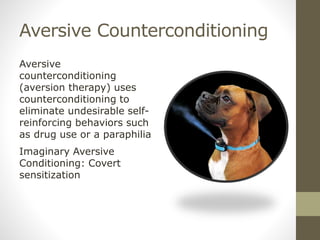
Aversive Counterconditioning
Aversive
counterconditioning
(aversion therapy) uses
counterconditioning to
eliminate undesirable self-
reinforcing behaviors such
as drug use or a paraphilia
Imaginary Aversive
Conditioning: Covert
sensitization
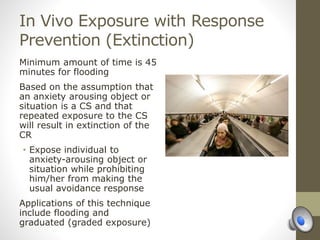
In Vivo Exposure with Response
Prevention (Extinction)
Minimum amount of time is 45
minutes for flooding
Based on the assumption that
an anxiety arousing object or
situation is a CS and that
repeated exposure to the CS
will result in extinction of the
CR
• Expose individual to
anxiety-arousing object or
situation while prohibiting
him/her from making the
usual avoidance response
Applications of this technique
include flooding and
graduated (graded exposure)
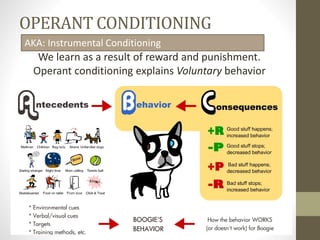
OPERANT CONDITIONING
We learn as a result of reward and punishment.
Operant conditioning explains Voluntary behavior
AKA: Instrumental Conditioning
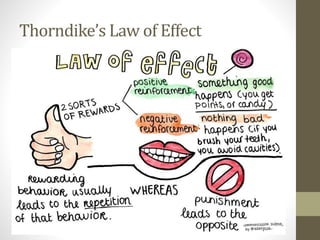
Thorndike’s Law of Effect
Thorndike: Law of Effect
How is a new skill learned?
Skinner & Operant Conditioning
How Pigeons Learn Self Control
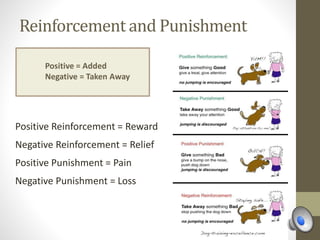
Reinforcement and Punishment
Positive Reinforcement = Reward
Negative Reinforcement = Relief
Positive Punishment = Pain
Negative Punishment = Loss
Positive = Added
Negative = Taken Away
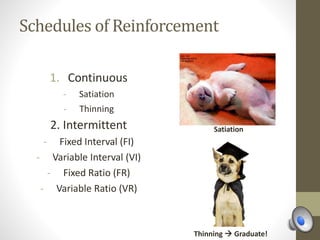
Schedules of Reinforcement
1. Continuous
- Satiation
- Thinning
2. Intermittent
- Fixed Interval (FI)
- Variable Interval (VI)
- Fixed Ratio (FR)
- Variable Ratio (VR)
Satiation
Thinning  Graduate!
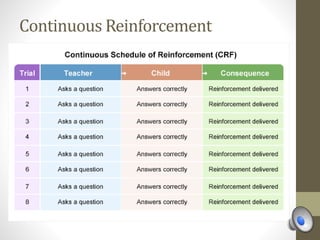
Continuous Reinforcement
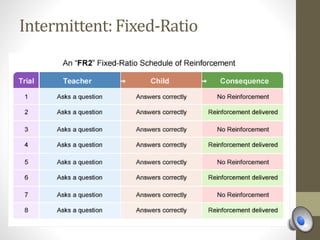
Intermittent: Fixed-Ratio
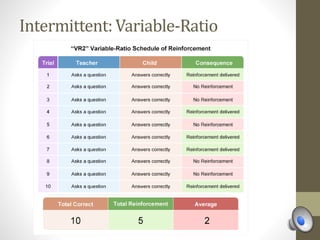
Intermittent: Variable-Ratio
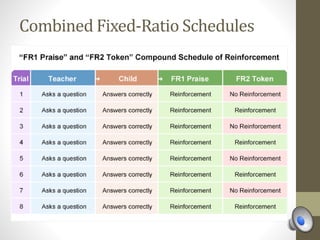
Combined Fixed-Ratio Schedules
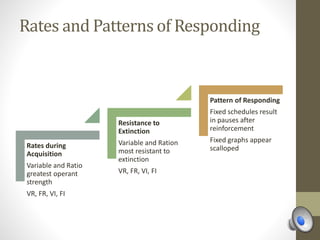
Rates and Patterns of Responding
Rates during
Acquisition
Variable and Ratio
greatest operant
strength
VR, FR, VI, FI
Resistance to
Extinction
Variable and Ration
most resistant to
extinction
VR, FR, VI, FI
Pattern of Responding
Fixed schedules result
in pauses after
reinforcement
Fixed graphs appear
scalloped
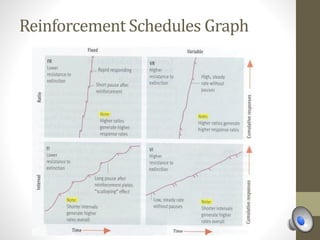
Reinforcement Schedules Graph
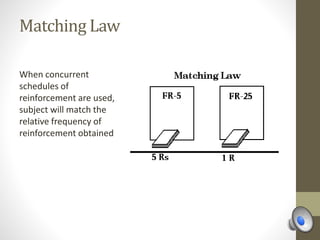
Matching Law
When concurrent
schedules of
reinforcement are used,
subject will match the
relative frequency of
reinforcement obtained
Key Concepts of Operant
Conditioning
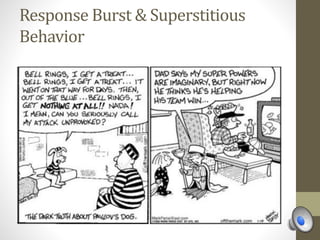
Operant Extinction (response burst)
Superstitious Behavior (accidental/non-contigent reinforcement)
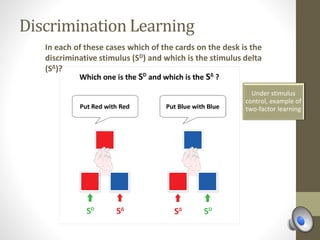
Discrimination Learning (Discriminate stimulus and S Delta)
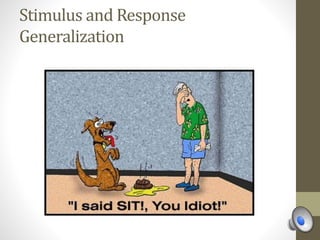
Stimulus Generalization
Response Generalization
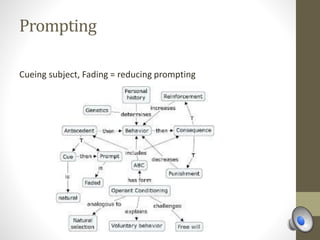
Prompting (cueing subject, fading = reducing prompting)
Shaping by Successive Approximations (
Chaining (stringing behaviors to accomplish goal)
Premack Principle (Pairing high frequency and low frequency)
Behavioral Contrast (increasing reinforced behavior of previously equally reinforced)
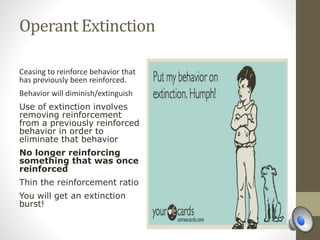
Operant Extinction
Ceasing to reinforce behavior that
has previously been reinforced.
Behavior will diminish/extinguish
Use of extinction involves
removing reinforcement
from a previously reinforced
behavior in order to
eliminate that behavior
No longer reinforcing
something that was once
reinforced
Thin the reinforcement ratio
You will get an extinction
burst!
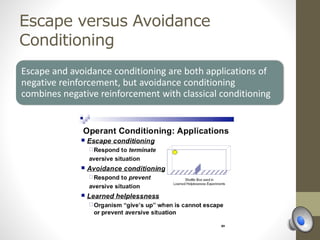
Escape versus Avoidance
Conditioning
Escape and avoidance conditioning are both applications of
negative reinforcement, but avoidance conditioning
combines negative reinforcement with classical conditioning
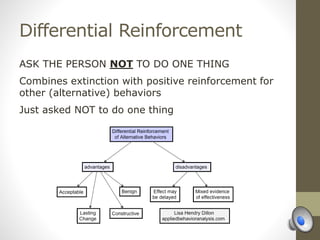
Differential Reinforcement
ASK THE PERSON NOT TO DO ONE THING
Combines extinction with positive reinforcement for
other (alternative) behaviors
Just asked NOT to do one thing
Response Burst & Superstitious
Behavior
Discrimination Learning
In each of these cases which of the cards on the desk is the
discriminative stimulus (SD) and which is the stimulus delta
(SΔ)?
Under stimulus
control, example of
two-factor learning
Stimulus and Response
Generalization
Prompting
Cueing subject, Fading = reducing prompting
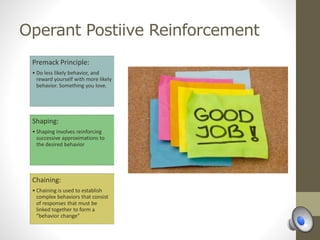
Operant Postiive Reinforcement
Premack Principle:
• Do less likely behavior, and
reward yourself with more likely
behavior. Something you love.
Shaping:
• Shaping involves reinforcing
successive approximations to
the desired behavior
Chaining:
• Chaining is used to establish
complex behaviors that consist
of responses that must be
linked together to form a
“behavior change”
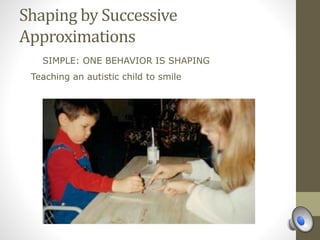
Shaping by Successive
Approximations
SIMPLE: ONE BEHAVIOR IS SHAPING
Teaching an autistic child to smile
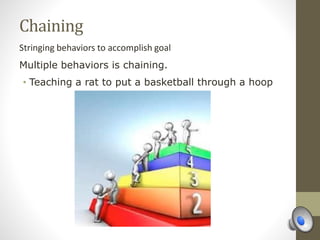
Chaining
Stringing behaviors to accomplish goal
Multiple behaviors is chaining.
• Teaching a rat to put a basketball through a hoop
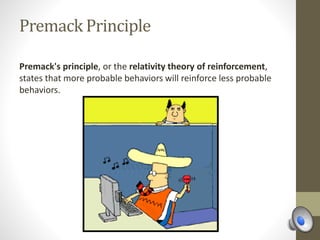
Premack Principle
Premack's principle, or the relativity theory of reinforcement,
states that more probable behaviors will reinforce less probable
behaviors.
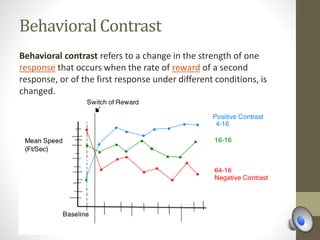
Behavioral Contrast
Behavioral contrast refers to a change in the strength of one
response that occurs when the rate of reward of a second
response, or of the first response under different conditions, is
changed.
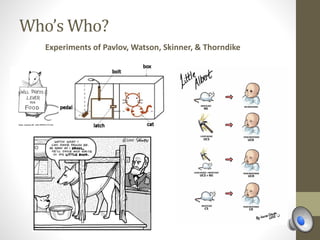
Who’s Who?
Experiments of Pavlov, Watson, Skinner, & Thorndike
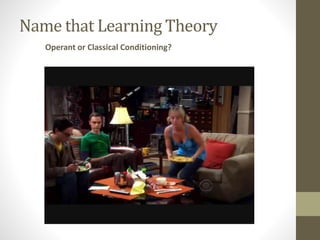
Name that Learning Theory
Operant or Classical Conditioning?
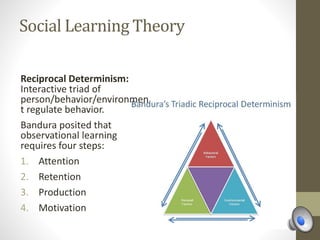
Social Learning Theory
Reciprocal Determinism:
Interactive triad of
person/behavior/environmen
t regulate behavior.
Bandura posited that
observational learning
requires four steps:
1. Attention
2. Retention
3. Production
4. Motivation
The Bobo doll experiment
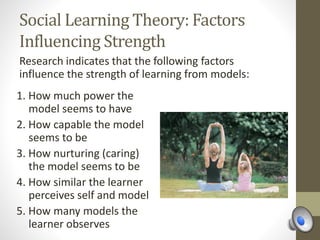
Social Learning Theory: Factors
Influencing Strength
Research indicates that the following factors
influence the strength of learning from models:
1. How much power the
model seems to have
2. How capable the model
seems to be
3. How nurturing (caring)
the model seems to be
4. How similar the learner
perceives self and model
5. How many models the
learner observes
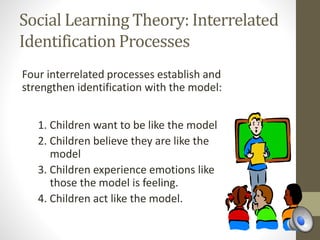
Social Learning Theory: Interrelated
Identification Processes
Four interrelated processes establish and
strengthen identification with the model:
1. Children want to be like the model
2. Children believe they are like the
model
3. Children experience emotions like
those the model is feeling.
4. Children act like the model.
Discuss: Where has social learning
impacted you?
Learning Theory Applied
What motivates us to learn?
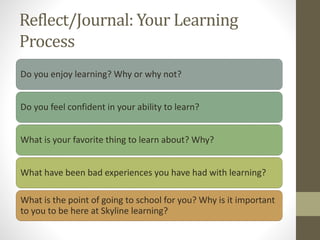
Reflect/Journal: Your Learning
Process
Do you enjoy learning? Why or why not?
Do you feel confident in your ability to learn?
What is your favorite thing to learn about? Why?
What have been bad experiences you have had with learning?
What is the point of going to school for you? Why is it important
to you to be here at Skyline learning?
Teaching
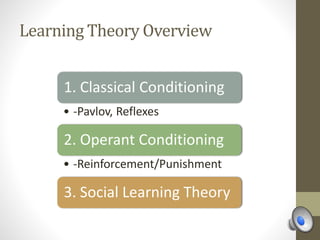
Learning Theory Overview
1. Classical Conditioning
• -Pavlov, Reflexes
2. Operant Conditioning
• -Reinforcement/Punishment
3. Social Learning Theory
Are these experiments ethical?
What ever happened to Baby Albert?

Ch 7 learning

  • 1.
    Section 1: Learning MeghanFraley, PhD Theories and Principles of Learning and Behavior
  • 2.
    Review What were yourindependent and dependent variables? Questions & Insights from Yesterday? Discuss: Would this be an experiment you would enjoy conducting? Why or why not?
  • 3.
    Learning Autobiography Difficulties Joys Passions Future How didyou learn? Are you a self-motivated learner?
  • 4.
    Learning Concepts toKnow Concepts Habituation Classical Conditioning Instrumental Conditioning Observational Learning Varieties of Learning
  • 5.
  • 6.
    Learning Theorists P • Pavlov:Classical Conditioning; Salivating Dogs (1901; 1927) W • Watson: Behaviorism founder, Little Albert (1913; 1920s) T • Thorndike: Law of Effect; Cats Puzzle Box (1898) S • Skinner: Operant Conditioning; Pigeons (1938; 1953) Pavlov, Classical Conditioning; Thorndike & Skinner, Operant Conditioning
  • 7.
  • 8.
    CLASSICAL CONDITIONING We learnnew things when they are connected or paired. • Respondent conditioning (i.e. involuntary) • Pavlov and Watson • Reflexes: stimulus-response links • Unconditioned reflex: Unconditioned stimulus evokes unconditioned response (US  UR); inborn • Conditioned reflex: Conditioned stimulus and a conditioned response (CS CR); learned
  • 9.
  • 10.
  • 11.
    Pavlov and ClassicalConditioning Essentials PAIRING!  The CS might precede the US ½ Second and Overlapping is Best!
  • 12.
  • 13.
  • 14.
    Methods of ClassicalConditioning 1. Delay Conditioning (Standard Pairing): CS precedes US and overlaps 2. Trace Conditioning: CS precedes Us with short break 3. Temporal Conditioning: Time is the CS. US is presented at a time interval 4. Simultaneous Conditioning: NS and US completely overlap 5. Backward Conditioning: US precedes NS True conditioning only occurs when the CS is presented before the US
  • 15.
    Key Concepts ofClassical Conditioning 1. Stimulus Generalization 2. Higher Order Conditioning 3. Classical Extinction 4. Spontaneous Recovery 5. Stimulus Discrimination 6. Pseudoconditioning 7. Habituation S R A stimulus is presented in order to get a response:
  • 16.
    Stimulus Generalization Watson andLittle Albert: Little Albert was afraid of bunnies!
  • 17.
    Stimulus Generalization Occurs whenthe stimuli similar to the CS also elicits the CR Strength of the CR diminishes as the similarity between the stimuli and the original CS decreases
  • 18.
    Higher-Order Conditioning Two Steps •1) Ordinary classical conditioning • 2) Original CS is treated like a US and paired with neutral, so neutral begins to also stimulate CR. i.e. opening the cabinet door to get the food out for the kitties 2 order works, 3rd doesn’t Bio-preparedism: Why animals will respond to the CS prior to the US CR elicited
  • 19.
    Higher Order Conditioning Deliberateprocess where CS are paired with NS up to three levels. An animal might first learn to associate a bell with food (first-order conditioning), but then learn to associate a light with the bell (second-order conditioning). Honeybees show second-order conditioning during proboscis extension reflex conditioning.[1]
  • 20.
    Is Fear aConditioned Response? Watson and Baby Albert
  • 21.
    Discuss: Phobias Based onclassical conditioning, why do objects become more fearful over time? Does anyone have a phobia that How does this discussion map on to the research projects? What might be problems with our study?
  • 22.
    Classical Extinction Unlearning aconditioned response. Repeatedly presenting conditioned stimulus with unconditioned stimulus
  • 23.
    Extinction CS ALONE =EXTINCTION Once the conditioned response has been established, it will eventually disappear when the CS is repeatedly presented without the US. Ahhh… but the behavior is inhibited, not eliminated
  • 24.
    Inhibited Extinction You stillremember the former pairing… which sets the stage for spontaneous recovery.
  • 25.
    Spontaneous Recovery Durin extinctiontrials, after a brief rest period, the conditioned response often briefly reappears.
  • 26.
    Stimulus Discrimination Learning todiscriminate between two similar neutral stimuli when only one is paired with the unconditioned stimulus (US) Experimental Neurosis: Making stimulus discrimination too difficult may cause agitation. Later, if returned to original mastered discrimination, dog is no longer able to discriminate.
  • 27.
  • 28.
    Pseudoconditioning Accidental learning causedby inadvertant pairing or heightened arousal.
  • 29.
    Habituation Becoming accustomed toan unconditioned stimulus (US). It no longer evokes the unconditioned response (UR). • Only related to unconditioned stimuli/response
  • 30.
    Wolpe: Reciprocal Inhibition AlthoughWolpe originally developed systematic desenstiziation as an application of reciprocal inhibition. Research using the “dismantling strategy” found that repeated exposure to the CS without the US (extinction) is responsible for th reduction of the anxiety response
  • 31.
  • 32.
    Aversive Counterconditioning Aversive counterconditioning (aversion therapy)uses counterconditioning to eliminate undesirable self- reinforcing behaviors such as drug use or a paraphilia Imaginary Aversive Conditioning: Covert sensitization
  • 33.
    In Vivo Exposurewith Response Prevention (Extinction) Minimum amount of time is 45 minutes for flooding Based on the assumption that an anxiety arousing object or situation is a CS and that repeated exposure to the CS will result in extinction of the CR • Expose individual to anxiety-arousing object or situation while prohibiting him/her from making the usual avoidance response Applications of this technique include flooding and graduated (graded exposure)
  • 34.
    OPERANT CONDITIONING We learnas a result of reward and punishment. Operant conditioning explains Voluntary behavior AKA: Instrumental Conditioning
  • 35.
  • 36.
    Thorndike: Law ofEffect How is a new skill learned?
  • 37.
    Skinner & OperantConditioning
  • 38.
    How Pigeons LearnSelf Control
  • 39.
    Reinforcement and Punishment PositiveReinforcement = Reward Negative Reinforcement = Relief Positive Punishment = Pain Negative Punishment = Loss Positive = Added Negative = Taken Away
  • 40.
    Schedules of Reinforcement 1.Continuous - Satiation - Thinning 2. Intermittent - Fixed Interval (FI) - Variable Interval (VI) - Fixed Ratio (FR) - Variable Ratio (VR) Satiation Thinning  Graduate!
  • 41.
  • 42.
  • 43.
  • 44.
  • 45.
    Rates and Patternsof Responding Rates during Acquisition Variable and Ratio greatest operant strength VR, FR, VI, FI Resistance to Extinction Variable and Ration most resistant to extinction VR, FR, VI, FI Pattern of Responding Fixed schedules result in pauses after reinforcement Fixed graphs appear scalloped
  • 46.
  • 47.
    Matching Law When concurrent schedulesof reinforcement are used, subject will match the relative frequency of reinforcement obtained
  • 48.
    Key Concepts ofOperant Conditioning Operant Extinction (response burst) Superstitious Behavior (accidental/non-contigent reinforcement) Discrimination Learning (Discriminate stimulus and S Delta) Stimulus Generalization Response Generalization Prompting (cueing subject, fading = reducing prompting) Shaping by Successive Approximations ( Chaining (stringing behaviors to accomplish goal) Premack Principle (Pairing high frequency and low frequency) Behavioral Contrast (increasing reinforced behavior of previously equally reinforced)
  • 49.
    Operant Extinction Ceasing toreinforce behavior that has previously been reinforced. Behavior will diminish/extinguish Use of extinction involves removing reinforcement from a previously reinforced behavior in order to eliminate that behavior No longer reinforcing something that was once reinforced Thin the reinforcement ratio You will get an extinction burst!
  • 50.
    Escape versus Avoidance Conditioning Escapeand avoidance conditioning are both applications of negative reinforcement, but avoidance conditioning combines negative reinforcement with classical conditioning
  • 51.
    Differential Reinforcement ASK THEPERSON NOT TO DO ONE THING Combines extinction with positive reinforcement for other (alternative) behaviors Just asked NOT to do one thing
  • 52.
    Response Burst &Superstitious Behavior
  • 53.
    Discrimination Learning In eachof these cases which of the cards on the desk is the discriminative stimulus (SD) and which is the stimulus delta (SΔ)? Under stimulus control, example of two-factor learning
  • 54.
  • 55.
  • 56.
    Operant Postiive Reinforcement PremackPrinciple: • Do less likely behavior, and reward yourself with more likely behavior. Something you love. Shaping: • Shaping involves reinforcing successive approximations to the desired behavior Chaining: • Chaining is used to establish complex behaviors that consist of responses that must be linked together to form a “behavior change”
  • 57.
    Shaping by Successive Approximations SIMPLE:ONE BEHAVIOR IS SHAPING Teaching an autistic child to smile
  • 58.
    Chaining Stringing behaviors toaccomplish goal Multiple behaviors is chaining. • Teaching a rat to put a basketball through a hoop
  • 59.
    Premack Principle Premack's principle,or the relativity theory of reinforcement, states that more probable behaviors will reinforce less probable behaviors.
  • 60.
    Behavioral Contrast Behavioral contrastrefers to a change in the strength of one response that occurs when the rate of reward of a second response, or of the first response under different conditions, is changed.
  • 61.
    Who’s Who? Experiments ofPavlov, Watson, Skinner, & Thorndike
  • 62.
    Name that LearningTheory Operant or Classical Conditioning?
  • 63.
    Social Learning Theory ReciprocalDeterminism: Interactive triad of person/behavior/environmen t regulate behavior. Bandura posited that observational learning requires four steps: 1. Attention 2. Retention 3. Production 4. Motivation
  • 64.
    The Bobo dollexperiment
  • 65.
    Social Learning Theory:Factors Influencing Strength Research indicates that the following factors influence the strength of learning from models: 1. How much power the model seems to have 2. How capable the model seems to be 3. How nurturing (caring) the model seems to be 4. How similar the learner perceives self and model 5. How many models the learner observes
  • 66.
    Social Learning Theory:Interrelated Identification Processes Four interrelated processes establish and strengthen identification with the model: 1. Children want to be like the model 2. Children believe they are like the model 3. Children experience emotions like those the model is feeling. 4. Children act like the model.
  • 67.
    Discuss: Where hassocial learning impacted you?
  • 68.
  • 69.
  • 70.
    Reflect/Journal: Your Learning Process Doyou enjoy learning? Why or why not? Do you feel confident in your ability to learn? What is your favorite thing to learn about? Why? What have been bad experiences you have had with learning? What is the point of going to school for you? Why is it important to you to be here at Skyline learning?
  • 71.
  • 72.
    Learning Theory Overview 1.Classical Conditioning • -Pavlov, Reflexes 2. Operant Conditioning • -Reinforcement/Punishment 3. Social Learning Theory
  • 73.
    Are these experimentsethical? What ever happened to Baby Albert?