Genetic Roots of Behavior
Meghan Fraley, PhD
Skyline College, Summer 2015
Memory Review
If you could wave a magic wand that would
eliminate your ability to forget, would you do it?
Should we allow eyewitness
testimony? Why or why not?
Genetic and Evolutionary
Psychology
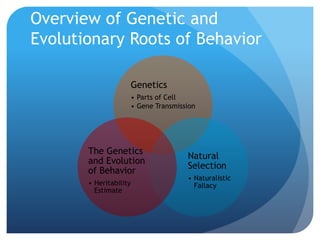
Overview of Genetic and
Evolutionary Roots of Behavior
Genetics
• Parts of Cell
• Gene Transmission
Natural
Selection
• Naturalistic
Fallacy
The Genetics
and Evolution
of Behavior
• Heritability
Estimate
Heredity Crash Course
I. Genetics
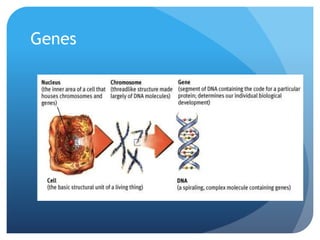
Genes
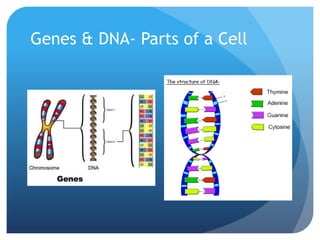
Genes & DNA- Parts of a Cell
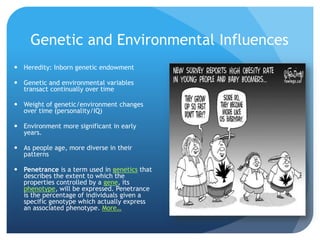
Genetic and Environmental Influences
ď‚— Heredity: Inborn genetic endowment
ď‚— Genetic and environmental variables
transact continually over time
ď‚— Weight of genetic/environment changes
over time (personality/IQ)
ď‚— Environment more significant in early
years.
ď‚— As people age, more diverse in their
patterns
ď‚— Penetrance is a term used in genetics that
describes the extent to which the
properties controlled by a gene, its
phenotype, will be expressed. Penetrance
is the percentage of individuals given a
specific genotype which actually express
an associated phenotype. More…
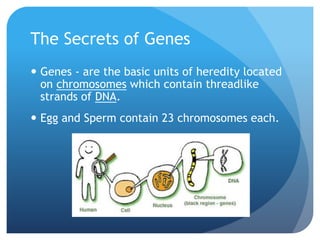
The Secrets of Genes
ď‚— Genes - are the basic units of heredity located
on chromosomes which contain threadlike
strands of DNA.
ď‚— Egg and Sperm contain 23 chromosomes each.
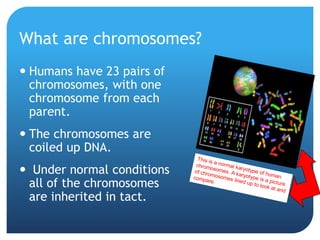
What are chromosomes?
ď‚— Humans have 23 pairs of
chromosomes, with one
chromosome from each
parent.
ď‚— The chromosomes are
coiled up DNA.
ď‚— Under normal conditions
all of the chromosomes
are inherited in tact.
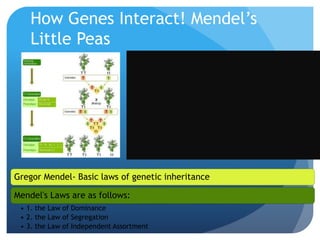
How Genes Interact! Mendel’s
Little Peas
Gregor Mendel- Basic laws of genetic inheritance
Mendel's Laws are as follows:
• 1. the Law of Dominance
• 2. the Law of Segregation
• 3. the Law of Independent Assortment
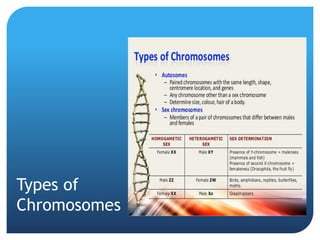
Types of
Chromosomes
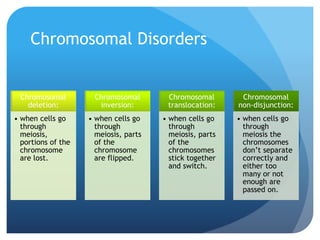
Chromosomal Disorders
Chromosomal
deletion:
• when cells go
through
meiosis,
portions of the
chromosome
are lost.
Chromosomal
inversion:
• when cells go
through
meiosis, parts
of the
chromosome
are flipped.
Chromosomal
translocation:
• when cells go
through
meiosis, parts
of the
chromosomes
stick together
and switch.
Chromosomal
non-disjunction:
• when cells go
through
meiosis the
chromosomes
don’t separate
correctly and
either too
many or not
enough are
passed on.
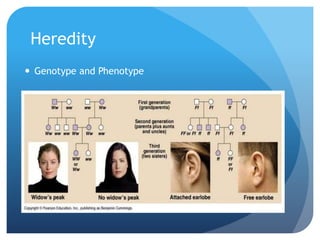
Heredity
ď‚— Genotype and Phenotype
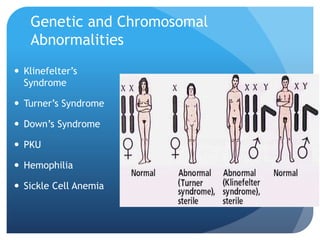
Genetic and Chromosomal
Abnormalities
 Klinefelter’s
Syndrome
 Turner’s Syndrome
 Down’s Syndrome
ď‚— PKU
ď‚— Hemophilia
ď‚— Sickle Cell Anemia
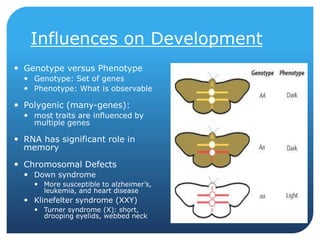
Influences on Development
ď‚— Genotype versus Phenotype
ď‚— Genotype: Set of genes
ď‚— Phenotype: What is observable
ď‚— Polygenic (many-genes):
ď‚— most traits are influenced by
multiple genes
ď‚— RNA has significant role in
memory
ď‚— Chromosomal Defects
ď‚— Down syndrome
 More susceptible to alzheimer’s,
leukemia, and heart disease
ď‚— Klinefelter syndrome (XXY)
ď‚— Turner syndrome (X): short,
drooping eyelids, webbed neck
II. Evolution by Natural
Selection
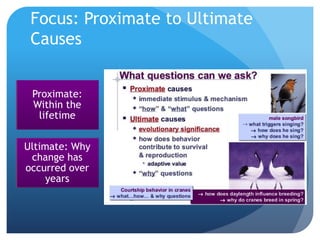
Focus: Proximate to Ultimate
Causes
Proximate:
Within the
lifetime
Ultimate: Why
change has
occurred over
years
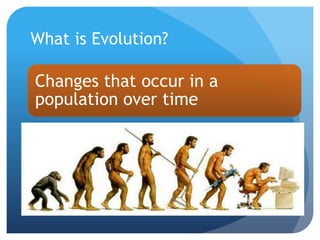
What is Evolution?
Changes that occur in a
population over time
Theory of Evolution
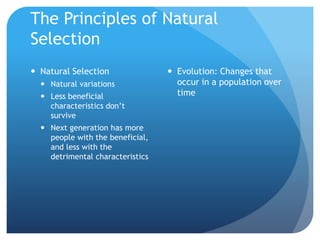
The Principles of Natural
Selection
ď‚— Natural Selection
ď‚— Natural variations
ď‚— Less beneficial
characteristics don’t
survive
ď‚— Next generation has more
people with the beneficial,
and less with the
detrimental characteristics
ď‚— Evolution: Changes that
occur in a population over
time
Myths & Misconceptions about
Evolution
Evolution Misconceptions
Naturalistic Fallacy
ď‚— The idea that anything
“natural” is “good” or the
more recent traits are
“better”
ď‚— The process of evolution
has no foresight
ď‚— Discuss: Where do you see
the naturalistic fallacy
referenced?
“Survival of the
Fittest”
ď‚— Why is this not entirely
accurate?
III. The Genetics &
Evolution of Behavior
The Genetics of Behavior
ď‚— Both genes and environment
interact to shape human
behavior.
ď‚— The fundamental issue is
how much a role genetics
do play in shaping human
behaviors.
ď‚— Examples: psychological
disorders, weight gain,
personality, sexual
orientation?
The Genetics of Behavior
Both genes and environment
interact to shape human behavior.
The fundamental issue is how
much a role genetics do play in
shaping human behaviors.
• Examples: psychological disorders, weight
gain, personality, sexual orientation?
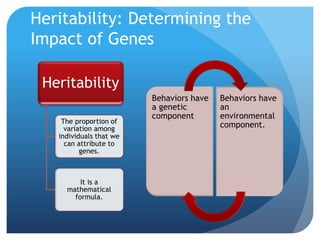
Heritability
The proportion of
variation among
individuals that we
can attribute to
genes.
It is a
mathematical
formula.
Heritability: Determining the
Impact of Genes
Behaviors have
a genetic
component
Behaviors have
an
environmental
component.
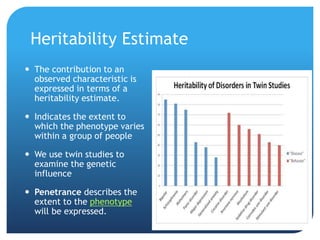
Heritability Estimate
ď‚— The contribution to an
observed characteristic is
expressed in terms of a
heritability estimate.
ď‚— Indicates the extent to
which the phenotype varies
within a group of people
ď‚— We use twin studies to
examine the genetic
influence
ď‚— Penetrance describes the
extent to the phenotype
will be expressed.
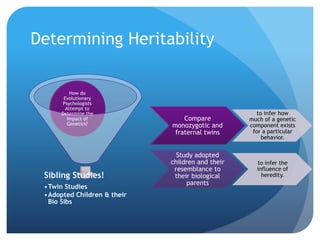
Determining Heritability
Sibling Studies!
•Twin Studies
•Adopted Children & their
Bio Sibs
How do
Evolutionary
Psychologists
Attempt to
Determine the
Impact of
Genetics?
Compare
monozygotic and
fraternal twins
to infer how
much of a genetic
component exists
for a particular
behavior.
Study adopted
children and their
resemblance to
their biological
parents
to infer the
influence of
heredity.
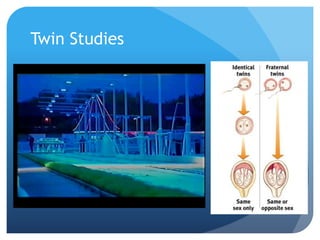
Twin Studies
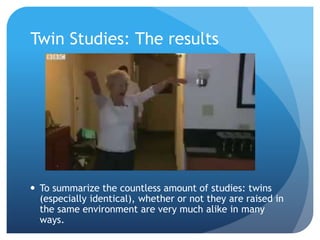
Twin Studies: The results
ď‚— To summarize the countless amount of studies: twins
(especially identical), whether or not they are raised in
the same environment are very much alike in many
ways.
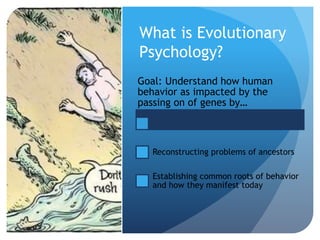
What is Evolutionary
Psychology?
Goal: Understand how human
behavior as impacted by the
passing on of genes by…
Reconstructing problems of ancestors
Establishing common roots of behavior
and how they manifest today
Evolutionary Psychology: A Brief
Overview
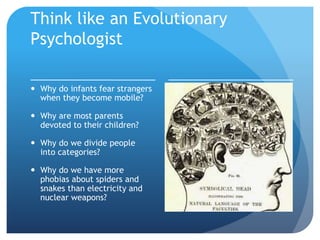
Think like an Evolutionary
Psychologist
ď‚— Why do infants fear strangers
when they become mobile?
ď‚— Why are most parents
devoted to their children?
ď‚— Why do we divide people
into categories?
ď‚— Why do we have more
phobias about spiders and
snakes than electricity and
nuclear weapons?
Break: Discuss ideas you have
about how our behavior now
is influenced by our ancestors
Genetics & Evolutionary
Psychology Applied
Intelligence and Sexuality
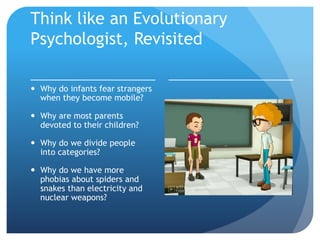
Think like an Evolutionary
Psychologist, Revisited
ď‚— Why do infants fear strangers
when they become mobile?
ď‚— Why are most parents
devoted to their children?
ď‚— Why do we divide people
into categories?
ď‚— Why do we have more
phobias about spiders and
snakes than electricity and
nuclear weapons?
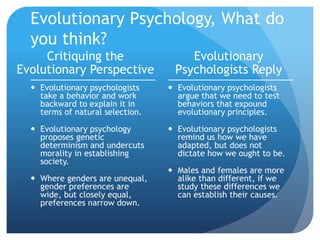
Evolutionary Psychology, What do
you think?
Critiquing the
Evolutionary Perspective
ď‚— Evolutionary psychologists
take a behavior and work
backward to explain it in
terms of natural selection.
ď‚— Evolutionary psychology
proposes genetic
determinism and undercuts
morality in establishing
society.
ď‚— Where genders are unequal,
gender preferences are
wide, but closely equal,
preferences narrow down.
Evolutionary
Psychologists Reply
ď‚— Evolutionary psychologists
argue that we need to test
behaviors that expound
evolutionary principles.
ď‚— Evolutionary psychologists
remind us how we have
adapted, but does not
dictate how we ought to be.
ď‚— Males and females are more
alike than different, if we
study these differences we
can establish their causes.
Discussion the Impact of Low SES
on Intelligence
ď‚— Genes have a weaker effect
on intelligence without
adequate health care,
stimulation, and
nourishment.
ď‚— Potential may not ever be
realized
Love & Lust: Sexuality, the Brain,
& Evolutionary Psychology
Types of Mating Systems
Attitudes toward Mating
Humans & Other Mammals
Jealousy between the
Genders & Evolutionary
Perspective
Describe the Differences in
the way human males and
females view paternity
Why are genes not everything?
ď‚— Not all traits are equally heritable or
unaffected by shared environments
ď‚— Some studies may underestimate the impact
of the environment
ď‚— Even traits that are highly heritable are not
rigidly fixed and can be modified by
experience.
Genetics & Evolution Review:
Concepts to Know
Structure of DNA
Natural Selection
• Ultimate & Proximal Cause
The scientific study of evolution
Intelligence & Genetics
Genes, Sex, and Mating Behavior
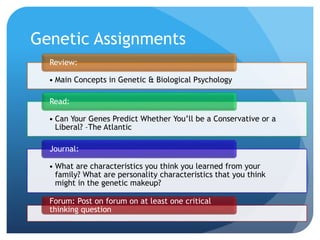
Genetic Assignments
• Main Concepts in Genetic & Biological Psychology
Review:
• Can Your Genes Predict Whether You’ll be a Conservative or a
Liberal? –The Atlantic
Read:
• What are characteristics you think you learned from your
family? What are personality characteristics that you think
might in the genetic makeup?
Journal:
Forum: Post on forum on at least one critical
thinking question

Ch 2 genetics & evolutionary roots of behavior

  • 1.
    Genetic Roots ofBehavior Meghan Fraley, PhD Skyline College, Summer 2015
  • 2.
  • 3.
    If you couldwave a magic wand that would eliminate your ability to forget, would you do it?
  • 4.
    Should we alloweyewitness testimony? Why or why not?
  • 5.
  • 6.
    Overview of Geneticand Evolutionary Roots of Behavior Genetics • Parts of Cell • Gene Transmission Natural Selection • Naturalistic Fallacy The Genetics and Evolution of Behavior • Heritability Estimate
  • 7.
  • 8.
  • 9.
  • 10.
    Genes & DNA-Parts of a Cell
  • 11.
    Genetic and EnvironmentalInfluences  Heredity: Inborn genetic endowment  Genetic and environmental variables transact continually over time  Weight of genetic/environment changes over time (personality/IQ)  Environment more significant in early years.  As people age, more diverse in their patterns  Penetrance is a term used in genetics that describes the extent to which the properties controlled by a gene, its phenotype, will be expressed. Penetrance is the percentage of individuals given a specific genotype which actually express an associated phenotype. More…
  • 12.
    The Secrets ofGenes ď‚— Genes - are the basic units of heredity located on chromosomes which contain threadlike strands of DNA. ď‚— Egg and Sperm contain 23 chromosomes each.
  • 13.
    What are chromosomes? ď‚—Humans have 23 pairs of chromosomes, with one chromosome from each parent. ď‚— The chromosomes are coiled up DNA. ď‚— Under normal conditions all of the chromosomes are inherited in tact.
  • 14.
    How Genes Interact!Mendel’s Little Peas Gregor Mendel- Basic laws of genetic inheritance Mendel's Laws are as follows: • 1. the Law of Dominance • 2. the Law of Segregation • 3. the Law of Independent Assortment
  • 15.
  • 16.
    Chromosomal Disorders Chromosomal deletion: • whencells go through meiosis, portions of the chromosome are lost. Chromosomal inversion: • when cells go through meiosis, parts of the chromosome are flipped. Chromosomal translocation: • when cells go through meiosis, parts of the chromosomes stick together and switch. Chromosomal non-disjunction: • when cells go through meiosis the chromosomes don’t separate correctly and either too many or not enough are passed on.
  • 17.
  • 18.
    Genetic and Chromosomal Abnormalities Klinefelter’s Syndrome  Turner’s Syndrome  Down’s Syndrome  PKU  Hemophilia  Sickle Cell Anemia
  • 19.
    Influences on Development Genotype versus Phenotype  Genotype: Set of genes  Phenotype: What is observable  Polygenic (many-genes):  most traits are influenced by multiple genes  RNA has significant role in memory  Chromosomal Defects  Down syndrome  More susceptible to alzheimer’s, leukemia, and heart disease  Klinefelter syndrome (XXY)  Turner syndrome (X): short, drooping eyelids, webbed neck
  • 20.
    II. Evolution byNatural Selection
  • 21.
    Focus: Proximate toUltimate Causes Proximate: Within the lifetime Ultimate: Why change has occurred over years
  • 22.
    What is Evolution? Changesthat occur in a population over time
  • 23.
  • 24.
    The Principles ofNatural Selection  Natural Selection  Natural variations  Less beneficial characteristics don’t survive  Next generation has more people with the beneficial, and less with the detrimental characteristics  Evolution: Changes that occur in a population over time
  • 25.
    Myths & Misconceptionsabout Evolution
  • 26.
    Evolution Misconceptions Naturalistic Fallacy The idea that anything “natural” is “good” or the more recent traits are “better”  The process of evolution has no foresight  Discuss: Where do you see the naturalistic fallacy referenced? “Survival of the Fittest”  Why is this not entirely accurate?
  • 27.
    III. The Genetics& Evolution of Behavior
  • 28.
    The Genetics ofBehavior ď‚— Both genes and environment interact to shape human behavior. ď‚— The fundamental issue is how much a role genetics do play in shaping human behaviors. ď‚— Examples: psychological disorders, weight gain, personality, sexual orientation?
  • 29.
    The Genetics ofBehavior Both genes and environment interact to shape human behavior. The fundamental issue is how much a role genetics do play in shaping human behaviors. • Examples: psychological disorders, weight gain, personality, sexual orientation?
  • 30.
    Heritability The proportion of variationamong individuals that we can attribute to genes. It is a mathematical formula. Heritability: Determining the Impact of Genes Behaviors have a genetic component Behaviors have an environmental component.
  • 31.
    Heritability Estimate ď‚— Thecontribution to an observed characteristic is expressed in terms of a heritability estimate. ď‚— Indicates the extent to which the phenotype varies within a group of people ď‚— We use twin studies to examine the genetic influence ď‚— Penetrance describes the extent to the phenotype will be expressed.
  • 32.
    Determining Heritability Sibling Studies! •TwinStudies •Adopted Children & their Bio Sibs How do Evolutionary Psychologists Attempt to Determine the Impact of Genetics? Compare monozygotic and fraternal twins to infer how much of a genetic component exists for a particular behavior. Study adopted children and their resemblance to their biological parents to infer the influence of heredity.
  • 33.
  • 34.
    Twin Studies: Theresults ď‚— To summarize the countless amount of studies: twins (especially identical), whether or not they are raised in the same environment are very much alike in many ways.
  • 35.
    What is Evolutionary Psychology? Goal:Understand how human behavior as impacted by the passing on of genes by… Reconstructing problems of ancestors Establishing common roots of behavior and how they manifest today
  • 36.
  • 37.
    Think like anEvolutionary Psychologist ď‚— Why do infants fear strangers when they become mobile? ď‚— Why are most parents devoted to their children? ď‚— Why do we divide people into categories? ď‚— Why do we have more phobias about spiders and snakes than electricity and nuclear weapons?
  • 38.
    Break: Discuss ideasyou have about how our behavior now is influenced by our ancestors
  • 39.
    Genetics & Evolutionary PsychologyApplied Intelligence and Sexuality
  • 40.
    Think like anEvolutionary Psychologist, Revisited ď‚— Why do infants fear strangers when they become mobile? ď‚— Why are most parents devoted to their children? ď‚— Why do we divide people into categories? ď‚— Why do we have more phobias about spiders and snakes than electricity and nuclear weapons?
  • 41.
    Evolutionary Psychology, Whatdo you think? Critiquing the Evolutionary Perspective ď‚— Evolutionary psychologists take a behavior and work backward to explain it in terms of natural selection. ď‚— Evolutionary psychology proposes genetic determinism and undercuts morality in establishing society. ď‚— Where genders are unequal, gender preferences are wide, but closely equal, preferences narrow down. Evolutionary Psychologists Reply ď‚— Evolutionary psychologists argue that we need to test behaviors that expound evolutionary principles. ď‚— Evolutionary psychologists remind us how we have adapted, but does not dictate how we ought to be. ď‚— Males and females are more alike than different, if we study these differences we can establish their causes.
  • 42.
    Discussion the Impactof Low SES on Intelligence ď‚— Genes have a weaker effect on intelligence without adequate health care, stimulation, and nourishment. ď‚— Potential may not ever be realized
  • 43.
    Love & Lust:Sexuality, the Brain, & Evolutionary Psychology Types of Mating Systems Attitudes toward Mating Humans & Other Mammals Jealousy between the Genders & Evolutionary Perspective Describe the Differences in the way human males and females view paternity
  • 44.
    Why are genesnot everything? ď‚— Not all traits are equally heritable or unaffected by shared environments ď‚— Some studies may underestimate the impact of the environment ď‚— Even traits that are highly heritable are not rigidly fixed and can be modified by experience.
  • 45.
    Genetics & EvolutionReview: Concepts to Know Structure of DNA Natural Selection • Ultimate & Proximal Cause The scientific study of evolution Intelligence & Genetics Genes, Sex, and Mating Behavior
  • 46.
    Genetic Assignments • MainConcepts in Genetic & Biological Psychology Review: • Can Your Genes Predict Whether You’ll be a Conservative or a Liberal? –The Atlantic Read: • What are characteristics you think you learned from your family? What are personality characteristics that you think might in the genetic makeup? Journal: Forum: Post on forum on at least one critical thinking question