Systemic Functional
Grammar/Linguistics
By Shumail Arif
Roll no. 2606
M.phil 2nd Semester
Applied Linguistics
Chapter no. 1
Genre and Grammar,
Text and Context
In this chapter, we will discuss:
 Grammar
Traditional Grammar
Formal Grammar
Functional Grammar
 The Context – Text Connection
 Genre
 What is Grammar?
“Grammar is a theory of language, of how language is put together and how it works.”
More particularly, it is the study of wordings.
The meaning is accessible through the wording, that is, the words and their orders.
The words and their orders are:
Folk terminology : meaning --- wording --- letters/sounds
Linguistic terminology : semantics --- lexicogrammar --- orthography/phonology
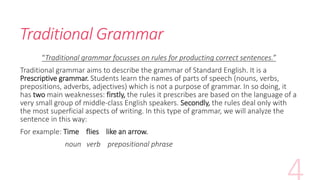
Traditional Grammar
“Traditional grammar focusses on rules for producting correct sentences.”
Traditional grammar aims to describe the grammar of Standard English. It is a
Prescriptive grammar. Students learn the names of parts of speech (nouns, verbs,
prepositions, adverbs, adjectives) which is not a purpose of grammar. In so doing, it
has two main weaknesses: firstly, the rules it prescribes are based on the language of a
very small group of middle-class English speakers. Secondly, the rules deal only with
the most superficial aspects of writing. In this type of grammar, we will analyze the
sentence in this way:
For example: Time flies like an arrow.
noun verb prepositional phrase
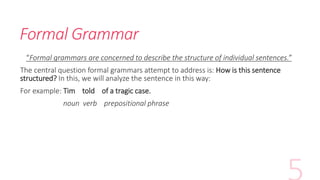
Formal Grammar
“Formal grammars are concerned to describe the structure of individual sentences.”
The central question formal grammars attempt to address is: How is this sentence
structured? In this, we will analyze the sentence in this way:
For example: Tim told of a tragic case.
noun verb prepositional phrase
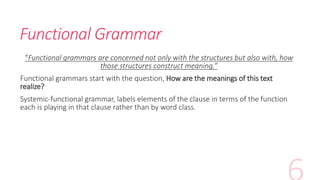
Functional Grammar
“Functional grammars are concerned not only with the structures but also with, how
those structures construct meaning.”
Functional grammars start with the question, How are the meanings of this text
realize?
Systemic-functional grammar, labels elements of the clause in terms of the function
each is playing in that clause rather than by word class.
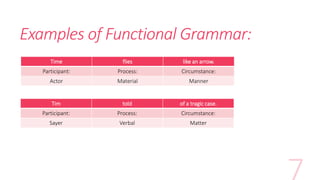
Examples of Functional Grammar:
Time flies like an arrow.
Participant: Process: Circumstance:
Actor Material Manner
Tim told of a tragic case.
Participant: Process: Circumstance:
Sayer Verbal Matter
 The Context – Text Connection
We’d like to begin explaining the context – text connection with a proportion:
All meaning is situated
 In a context of situation
 In a context of culture
Context of Culture determines what we can mean through
• Being ‘who are we’
• Doing ‘what we do’
• Saying ‘what we say’
Context of situation can be specified through use of the register variables: field, tenor
and mode.
 Field refers to what is going on, including
Activity focus (nature of social activity)
Object focus (subject matter)
 Tenor refers to social relationships between those taking part. These are specifiable
in terms of:
Status or power (agent roles, peer or hierarchic relations)
Affect (degree of like, dislike or neutrality)
Contact (frequency, duration and intimacy of social contact)
 Mode refers to how language is being used,
The channel of communication is spoken or written.
Language is being used as a mode of action or reflection.
Note: When language moves from action to reflection, it is known as Progressive
distancing. In mode, language also used as reflection.
Understanding Texts – Reconstructing
the Context
When we hear or read a text, we can reconstruct its context of situation. For example:
We are able to reconstruct this context of situation because there is a systematic
relationship between context and text. The wordings of texts simultaneously encode
three types of meaning: ideational, interpersonal and textual.
What is the topic of the above text? Field
Whom/what kind of person produced this
text? For whom?
Tenor
Do you think the original was written or
spoken?
Mode
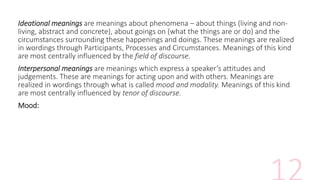
Ideational meanings are meanings about phenomena – about things (living and non-
living, abstract and concrete), about goings on (what the things are or do) and the
circumstances surrounding these happenings and doings. These meanings are realized
in wordings through Participants, Processes and Circumstances. Meanings of this kind
are most centrally influenced by the field of discourse.
Interpersonal meanings are meanings which express a speaker’s attitudes and
judgements. These are meanings for acting upon and with others. Meanings are
realized in wordings through what is called mood and modality. Meanings of this kind
are most centrally influenced by tenor of discourse.
Mood:
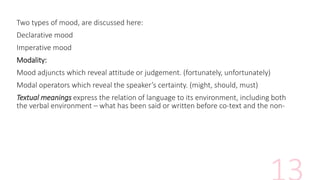
Two types of mood, are discussed here:
Declarative mood
Imperative mood
Modality:
Mood adjuncts which reveal attitude or judgement. (fortunately, unfortunately)
Modal operators which reveal the speaker’s certainty. (might, should, must)
Textual meanings express the relation of language to its environment, including both
the verbal environment – what has been said or written before co-text and the non-
-verbal, situational environment (context). These meanings are realized through
patterns of the Theme and Cohesion. Textual meanings are most centrally influenced
by mode of discourse.
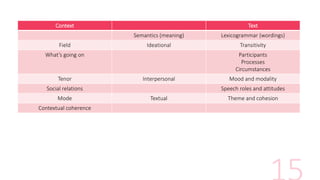
The relationship between context, meanings and wordings can be summarized as
shown on the following:
Context Text
Semantics (meaning) Lexicogrammar (wordings)
Field Ideational Transitivity
What’s going on Participants
Processes
Circumstances
Tenor Interpersonal Mood and modality
Social relations Speech roles and attitudes
Mode Textual Theme and cohesion
Contextual coherence
 Genre
“A genre can defined as a culturally specific text-type which results from using
language (written or spoken) to (help) accomplish something.”
So genre are culture specific, and have associated with them:
 Particular purposes
 Particular stages: distinctive beginnings, middles and ends
 Particular linguistic features
Thank you

Systemic functional grammar

  • 1.
    Systemic Functional Grammar/Linguistics By ShumailArif Roll no. 2606 M.phil 2nd Semester Applied Linguistics
  • 2.
    Chapter no. 1 Genreand Grammar, Text and Context In this chapter, we will discuss:  Grammar Traditional Grammar Formal Grammar Functional Grammar  The Context – Text Connection  Genre
  • 3.
     What isGrammar? “Grammar is a theory of language, of how language is put together and how it works.” More particularly, it is the study of wordings. The meaning is accessible through the wording, that is, the words and their orders. The words and their orders are: Folk terminology : meaning --- wording --- letters/sounds Linguistic terminology : semantics --- lexicogrammar --- orthography/phonology
  • 4.
    Traditional Grammar “Traditional grammarfocusses on rules for producting correct sentences.” Traditional grammar aims to describe the grammar of Standard English. It is a Prescriptive grammar. Students learn the names of parts of speech (nouns, verbs, prepositions, adverbs, adjectives) which is not a purpose of grammar. In so doing, it has two main weaknesses: firstly, the rules it prescribes are based on the language of a very small group of middle-class English speakers. Secondly, the rules deal only with the most superficial aspects of writing. In this type of grammar, we will analyze the sentence in this way: For example: Time flies like an arrow. noun verb prepositional phrase
  • 5.
    Formal Grammar “Formal grammarsare concerned to describe the structure of individual sentences.” The central question formal grammars attempt to address is: How is this sentence structured? In this, we will analyze the sentence in this way: For example: Tim told of a tragic case. noun verb prepositional phrase
  • 6.
    Functional Grammar “Functional grammarsare concerned not only with the structures but also with, how those structures construct meaning.” Functional grammars start with the question, How are the meanings of this text realize? Systemic-functional grammar, labels elements of the clause in terms of the function each is playing in that clause rather than by word class.
  • 7.
    Examples of FunctionalGrammar: Time flies like an arrow. Participant: Process: Circumstance: Actor Material Manner Tim told of a tragic case. Participant: Process: Circumstance: Sayer Verbal Matter
  • 8.
     The Context– Text Connection We’d like to begin explaining the context – text connection with a proportion: All meaning is situated  In a context of situation  In a context of culture Context of Culture determines what we can mean through • Being ‘who are we’ • Doing ‘what we do’ • Saying ‘what we say’
  • 9.
    Context of situationcan be specified through use of the register variables: field, tenor and mode.  Field refers to what is going on, including Activity focus (nature of social activity) Object focus (subject matter)  Tenor refers to social relationships between those taking part. These are specifiable in terms of:
  • 10.
    Status or power(agent roles, peer or hierarchic relations) Affect (degree of like, dislike or neutrality) Contact (frequency, duration and intimacy of social contact)  Mode refers to how language is being used, The channel of communication is spoken or written. Language is being used as a mode of action or reflection. Note: When language moves from action to reflection, it is known as Progressive distancing. In mode, language also used as reflection.
  • 11.
    Understanding Texts –Reconstructing the Context When we hear or read a text, we can reconstruct its context of situation. For example: We are able to reconstruct this context of situation because there is a systematic relationship between context and text. The wordings of texts simultaneously encode three types of meaning: ideational, interpersonal and textual. What is the topic of the above text? Field Whom/what kind of person produced this text? For whom? Tenor Do you think the original was written or spoken? Mode
  • 12.
    Ideational meanings aremeanings about phenomena – about things (living and non- living, abstract and concrete), about goings on (what the things are or do) and the circumstances surrounding these happenings and doings. These meanings are realized in wordings through Participants, Processes and Circumstances. Meanings of this kind are most centrally influenced by the field of discourse. Interpersonal meanings are meanings which express a speaker’s attitudes and judgements. These are meanings for acting upon and with others. Meanings are realized in wordings through what is called mood and modality. Meanings of this kind are most centrally influenced by tenor of discourse. Mood:
  • 13.
    Two types ofmood, are discussed here: Declarative mood Imperative mood Modality: Mood adjuncts which reveal attitude or judgement. (fortunately, unfortunately) Modal operators which reveal the speaker’s certainty. (might, should, must) Textual meanings express the relation of language to its environment, including both the verbal environment – what has been said or written before co-text and the non-
  • 14.
    -verbal, situational environment(context). These meanings are realized through patterns of the Theme and Cohesion. Textual meanings are most centrally influenced by mode of discourse. The relationship between context, meanings and wordings can be summarized as shown on the following:
  • 15.
    Context Text Semantics (meaning)Lexicogrammar (wordings) Field Ideational Transitivity What’s going on Participants Processes Circumstances Tenor Interpersonal Mood and modality Social relations Speech roles and attitudes Mode Textual Theme and cohesion Contextual coherence
  • 16.
     Genre “A genrecan defined as a culturally specific text-type which results from using language (written or spoken) to (help) accomplish something.” So genre are culture specific, and have associated with them:  Particular purposes  Particular stages: distinctive beginnings, middles and ends  Particular linguistic features
  • 17.