WHAT IS
PSYCHOLOGY?
PSYCH 100, FALL 2015
SKYLINE COLLEGE
DR. MEGHAN FRALEY
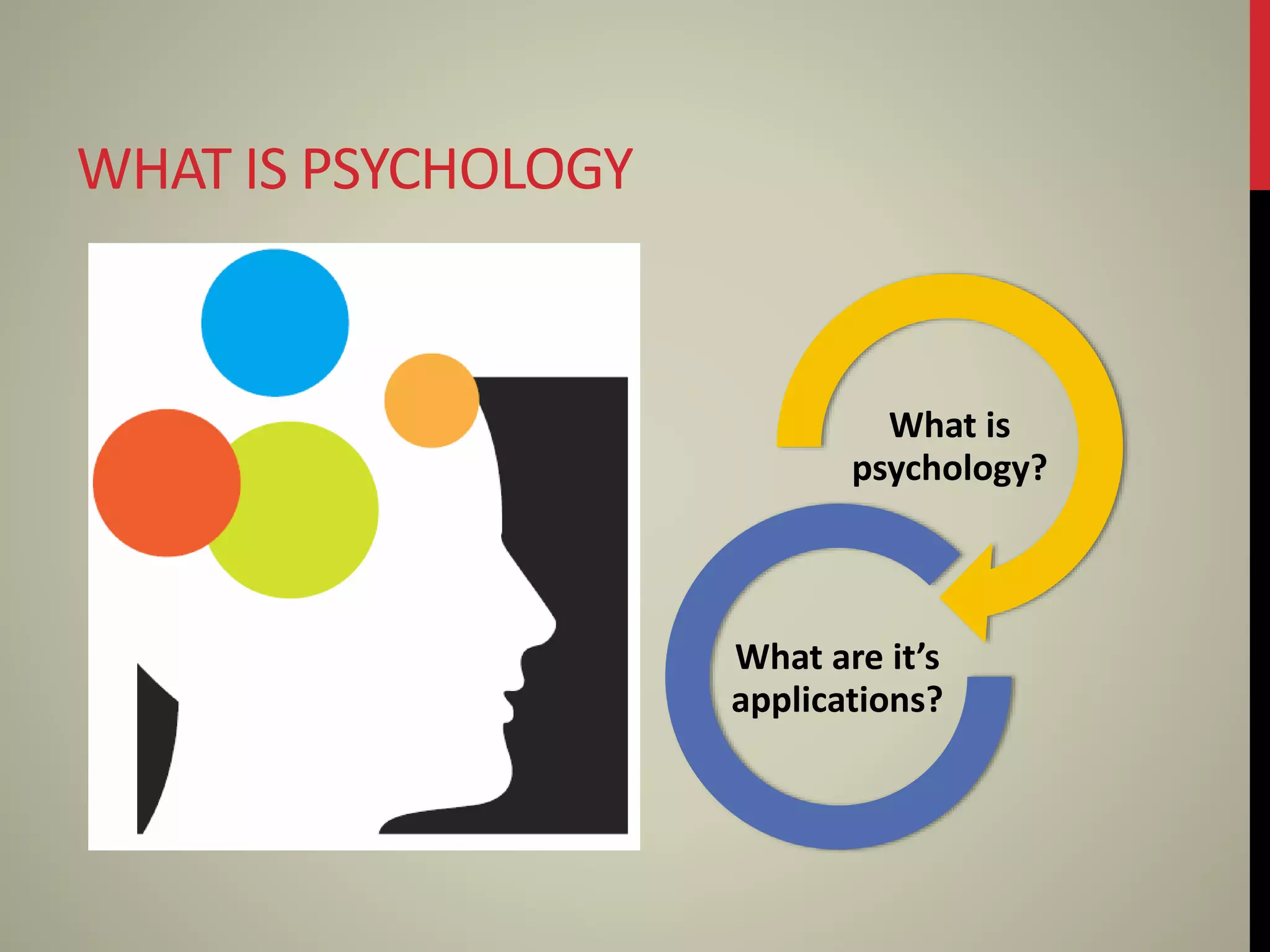
WHAT IS PSYCHOLOGY
What is
psychology?
What are it’s
applications?
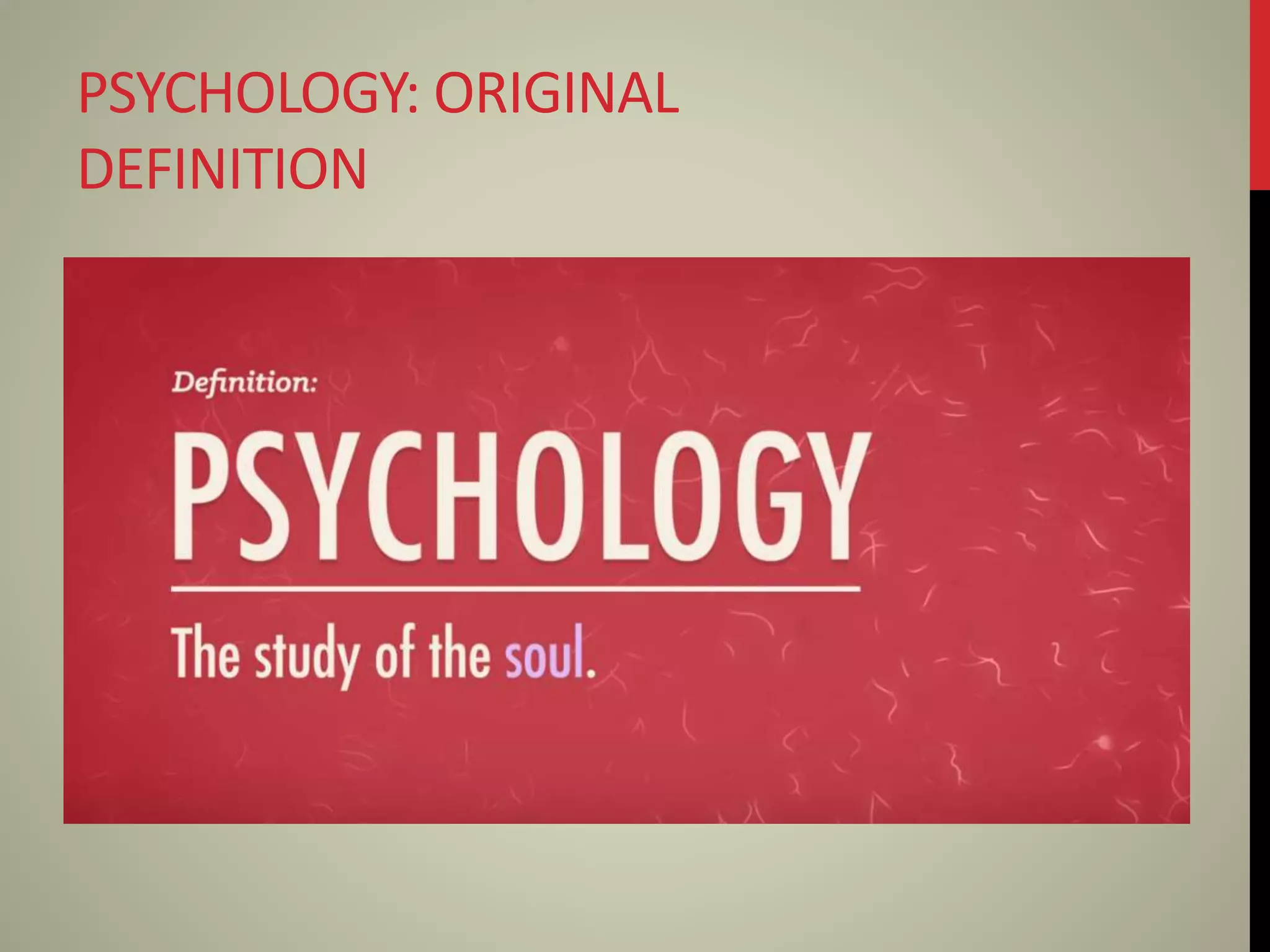
PSYCHOLOGY: ORIGINAL
DEFINITION
HISTORY OF PSYCHOLOGY
Soul
Mind
Brain
Plato and Democritus theorized
about the relationship between
thought and behavior
Wundt: Enter
the Scientific
Method!
Psychology as a science is Born!
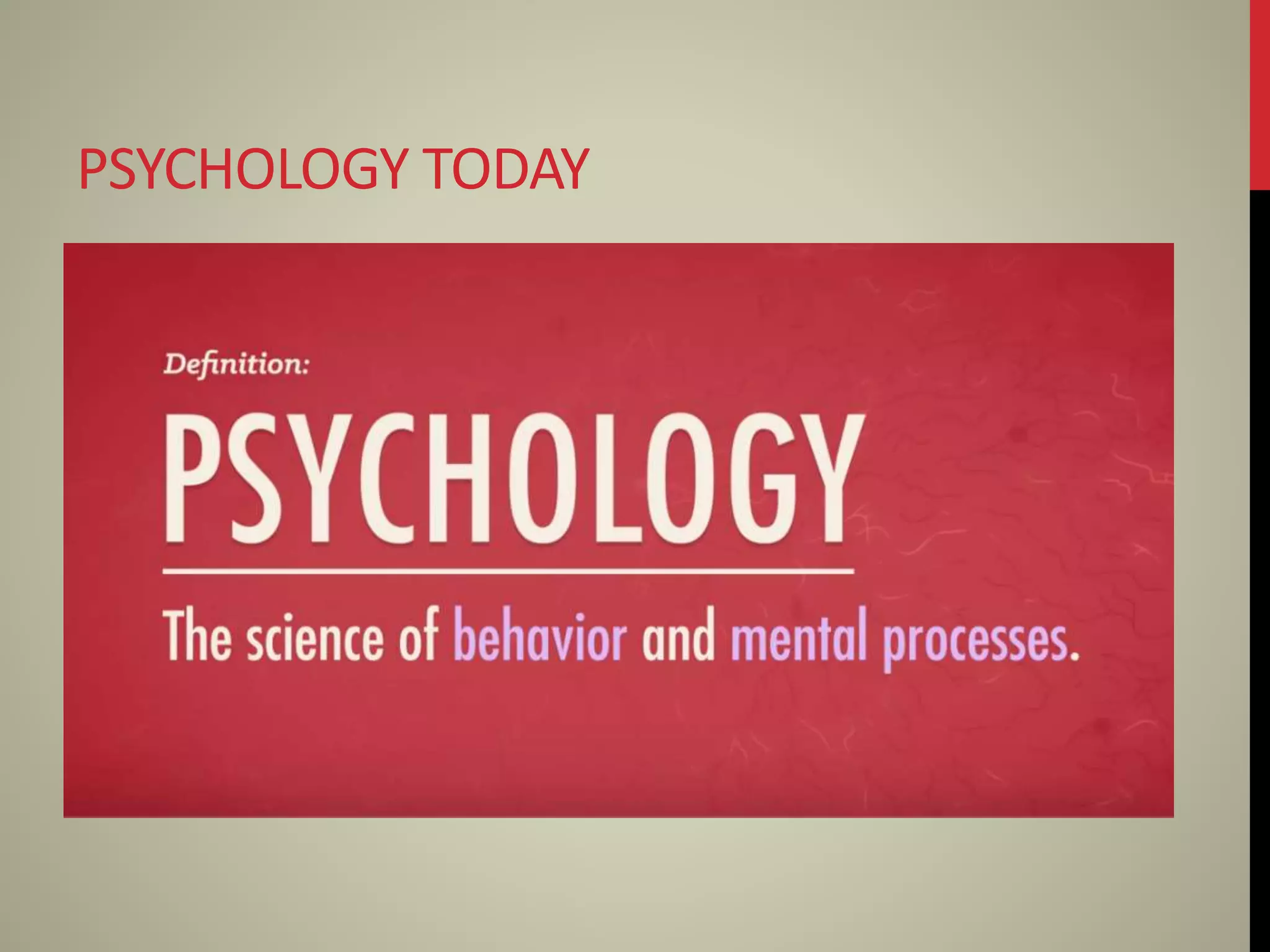
PSYCHOLOGY TODAY
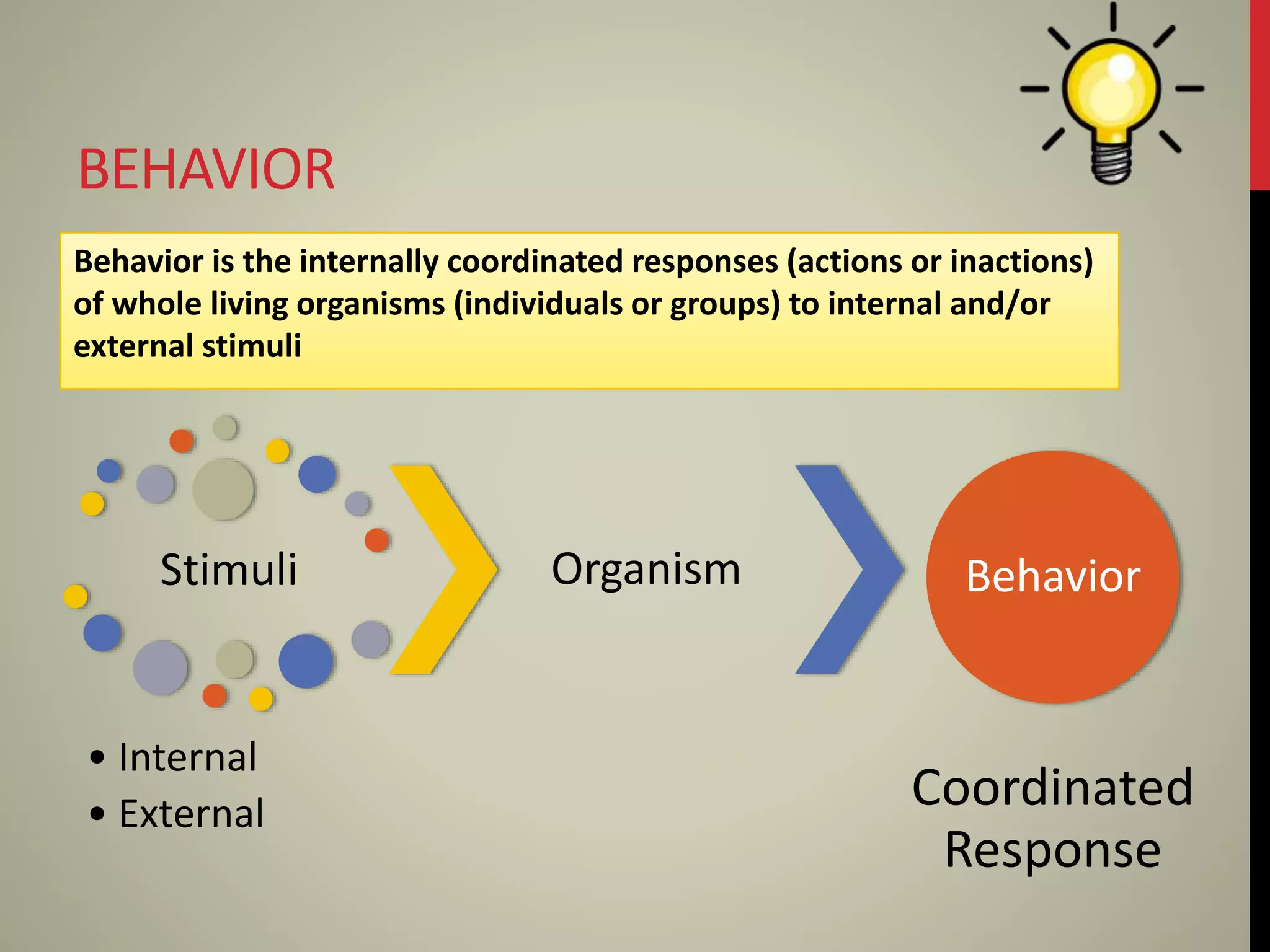
BEHAVIOR
Behavior is the internally coordinated responses (actions or inactions)
of whole living organisms (individuals or groups) to internal and/or
external stimuli
Stimuli
• Internal
• External
Organism Behavior
Coordinated
Response
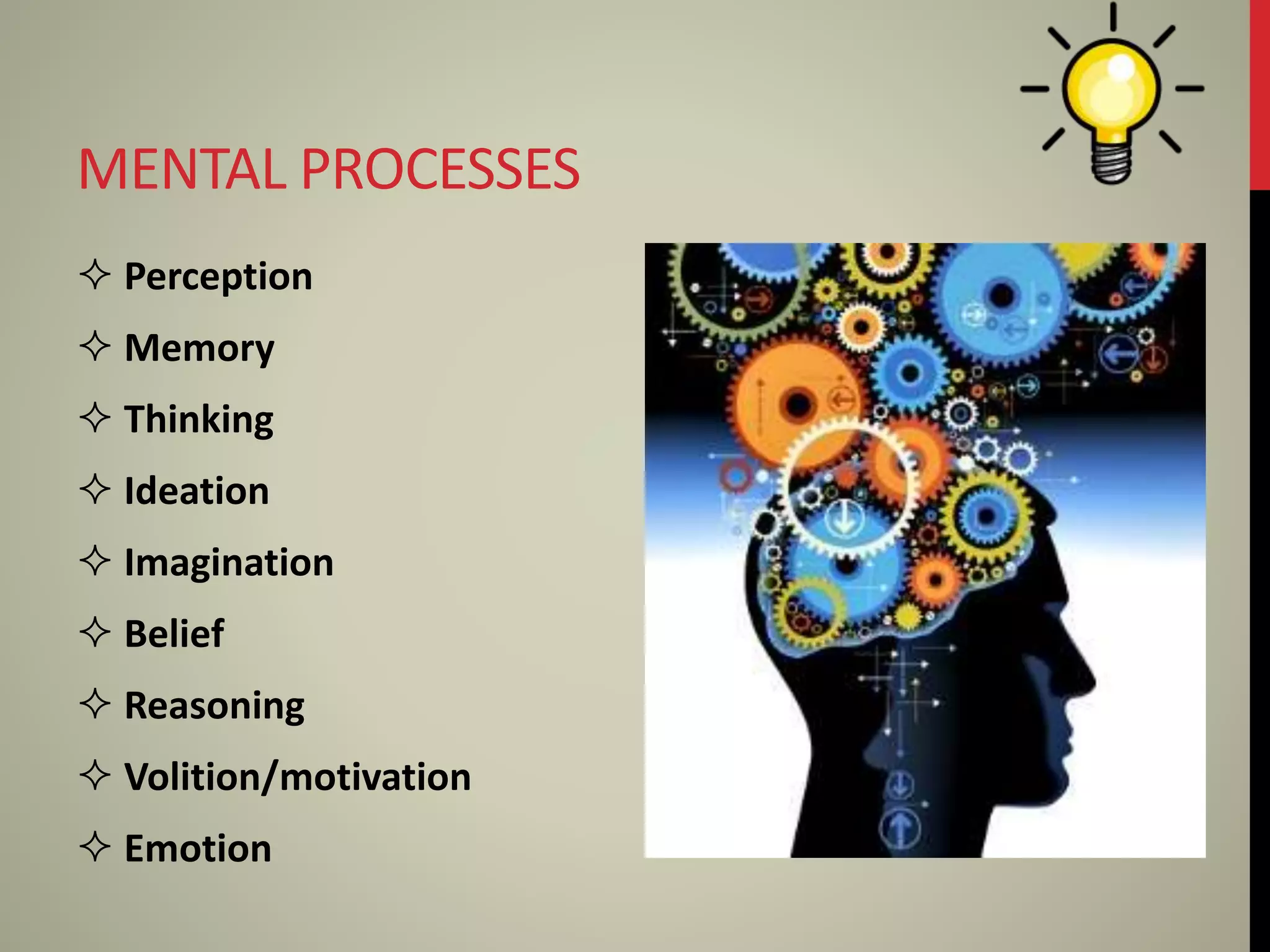
MENTAL PROCESSES
 Perception
 Memory
 Thinking
 Ideation
 Imagination
 Belief
 Reasoning
 Volition/motivation
 Emotion
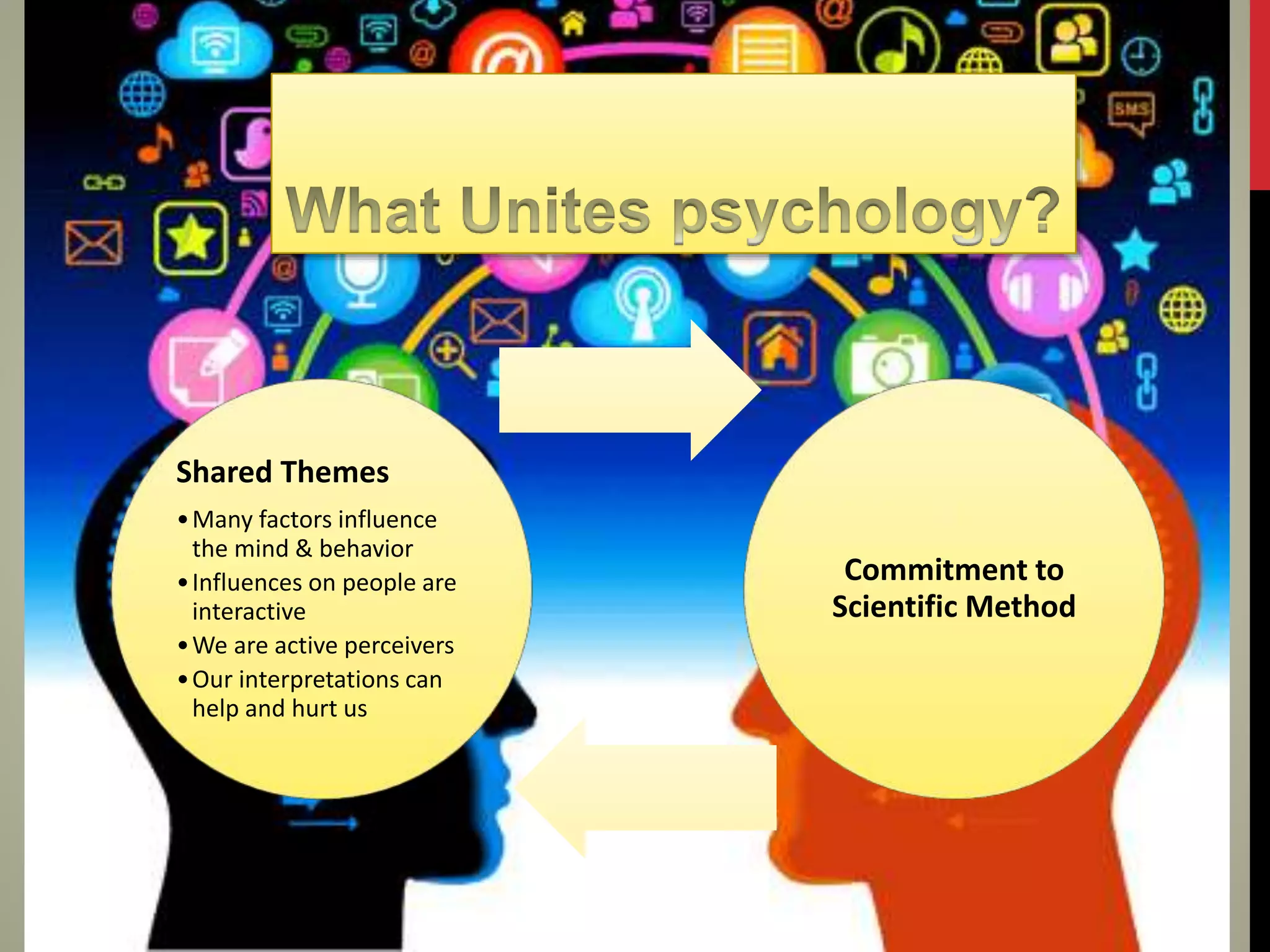
Shared Themes
•Many factors influence
the mind & behavior
•Influences on people are
interactive
•We are active perceivers
•Our interpretations can
help and hurt us
Commitment to
Scientific Method
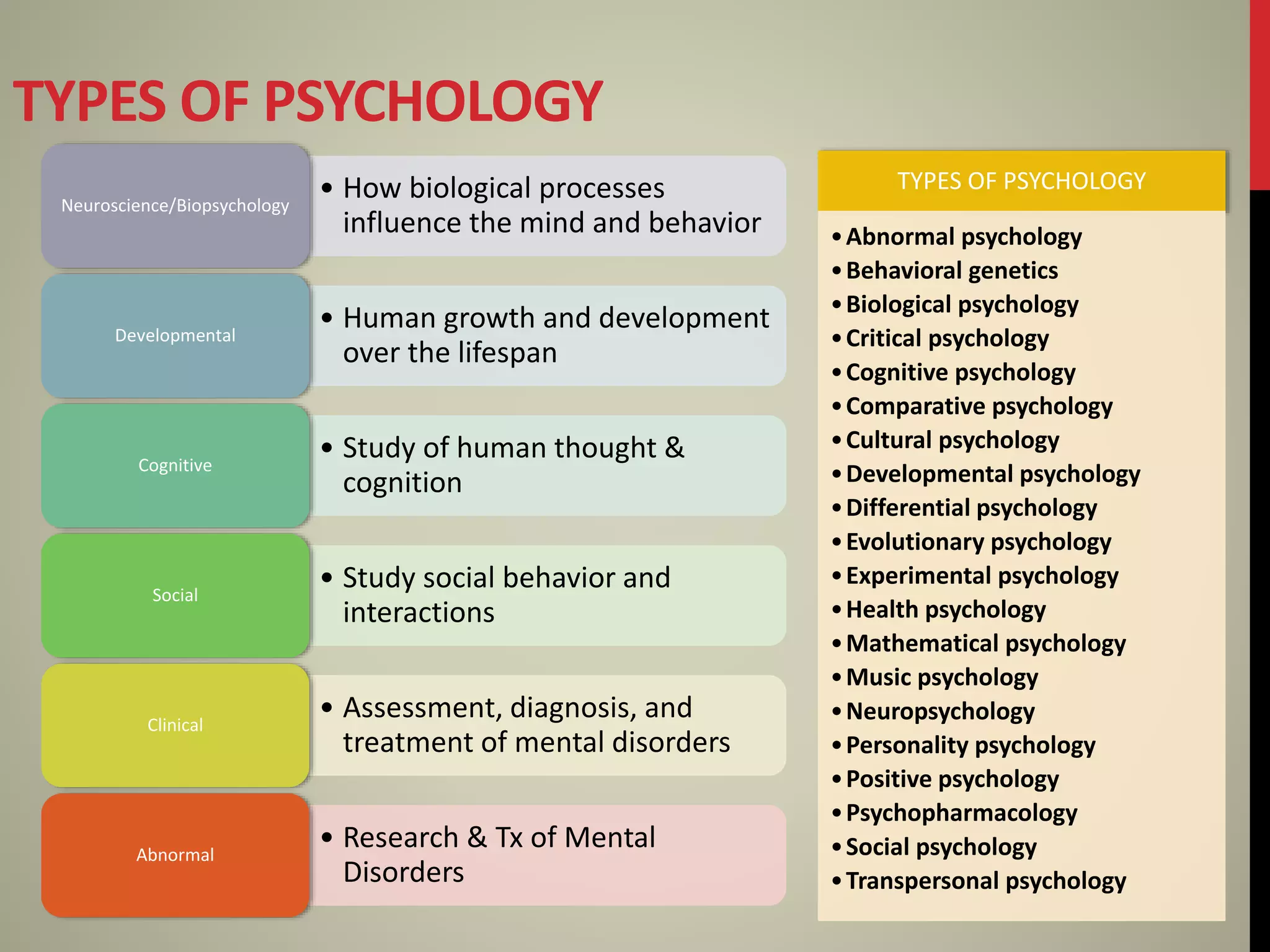
TYPES OF PSYCHOLOGY
TYPES OF PSYCHOLOGY
•Abnormal psychology
•Behavioral genetics
•Biological psychology
•Critical psychology
•Cognitive psychology
•Comparative psychology
•Cultural psychology
•Developmental psychology
•Differential psychology
•Evolutionary psychology
•Experimental psychology
•Health psychology
•Mathematical psychology
•Music psychology
•Neuropsychology
•Personality psychology
•Positive psychology
•Psychopharmacology
•Social psychology
•Transpersonal psychology
• How biological processes
influence the mind and behavior
Neuroscience/Biopsychology
• Human growth and development
over the lifespan
Developmental
• Study of human thought &
cognition
Cognitive
• Study social behavior and
interactions
Social
• Assessment, diagnosis, and
treatment of mental disorders
Clinical
• Research & Tx of Mental
Disorders
Abnormal
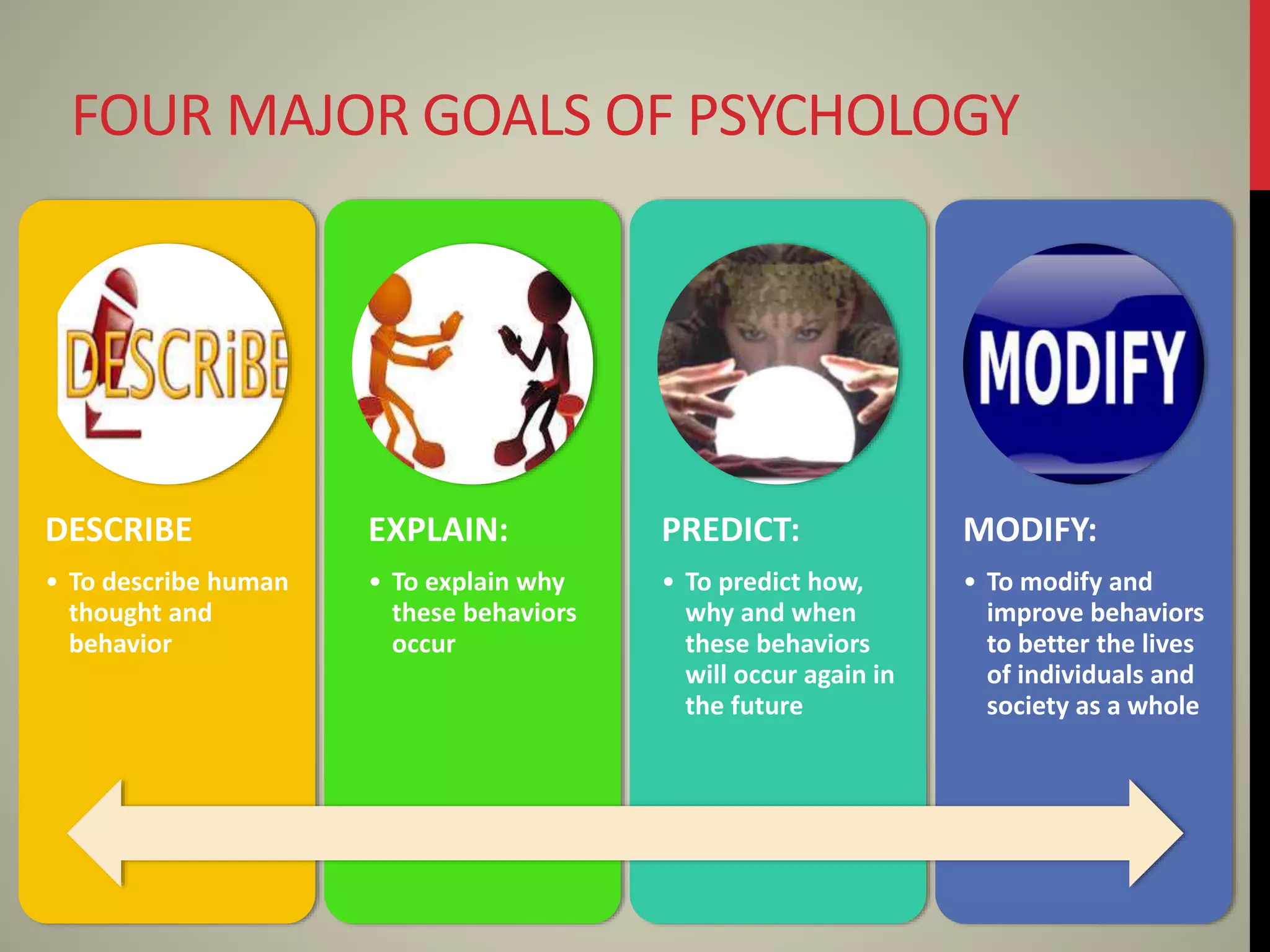
FOUR MAJOR GOALS OF PSYCHOLOGY
DESCRIBE
• To describe human
thought and
behavior
EXPLAIN:
• To explain why
these behaviors
occur
PREDICT:
• To predict how,
why and when
these behaviors
will occur again in
the future
MODIFY:
• To modify and
improve behaviors
to better the lives
of individuals and
society as a whole
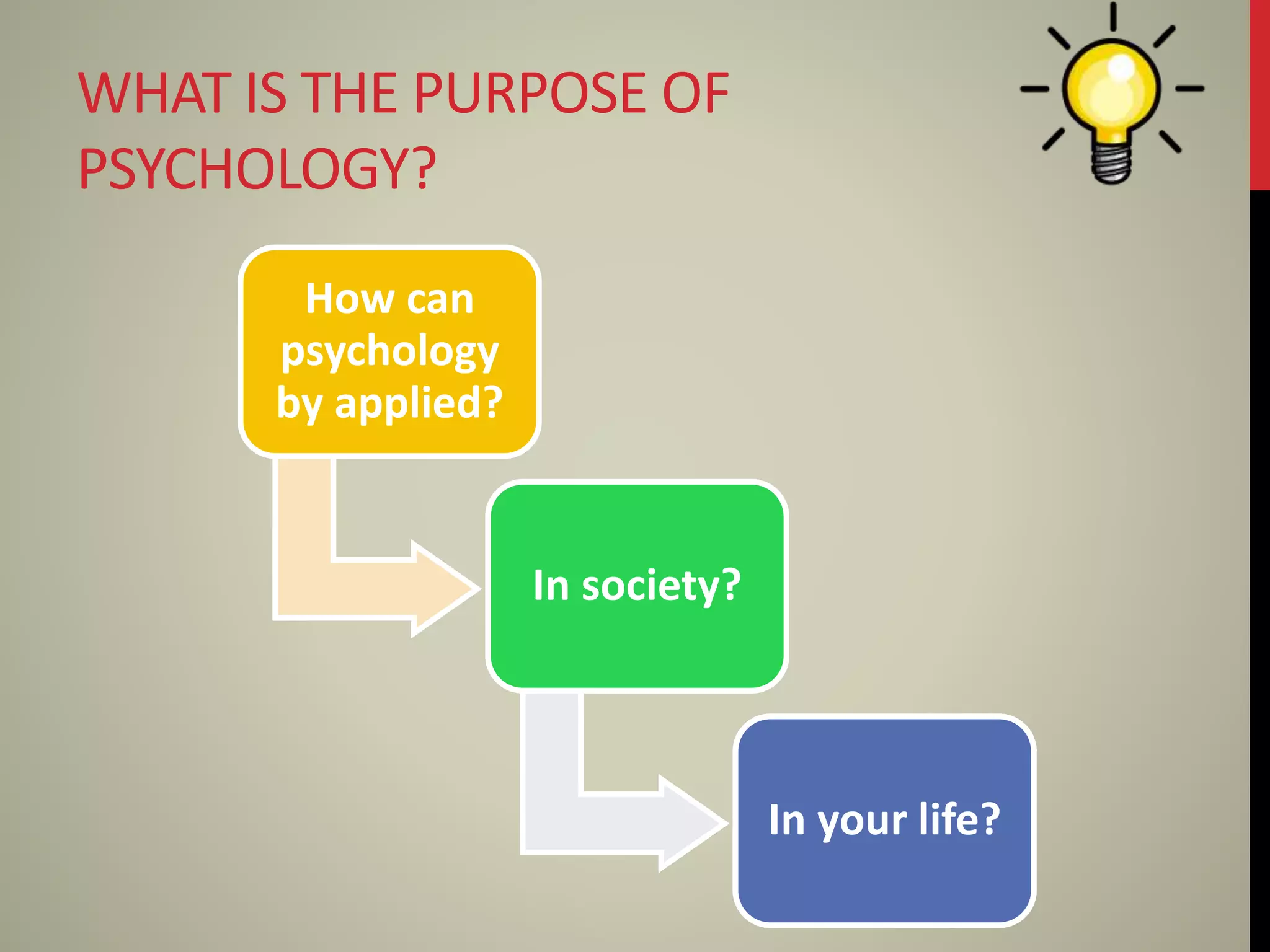
WHAT IS THE PURPOSE OF
PSYCHOLOGY?
How can
psychology
by applied?
In society?
In your life?
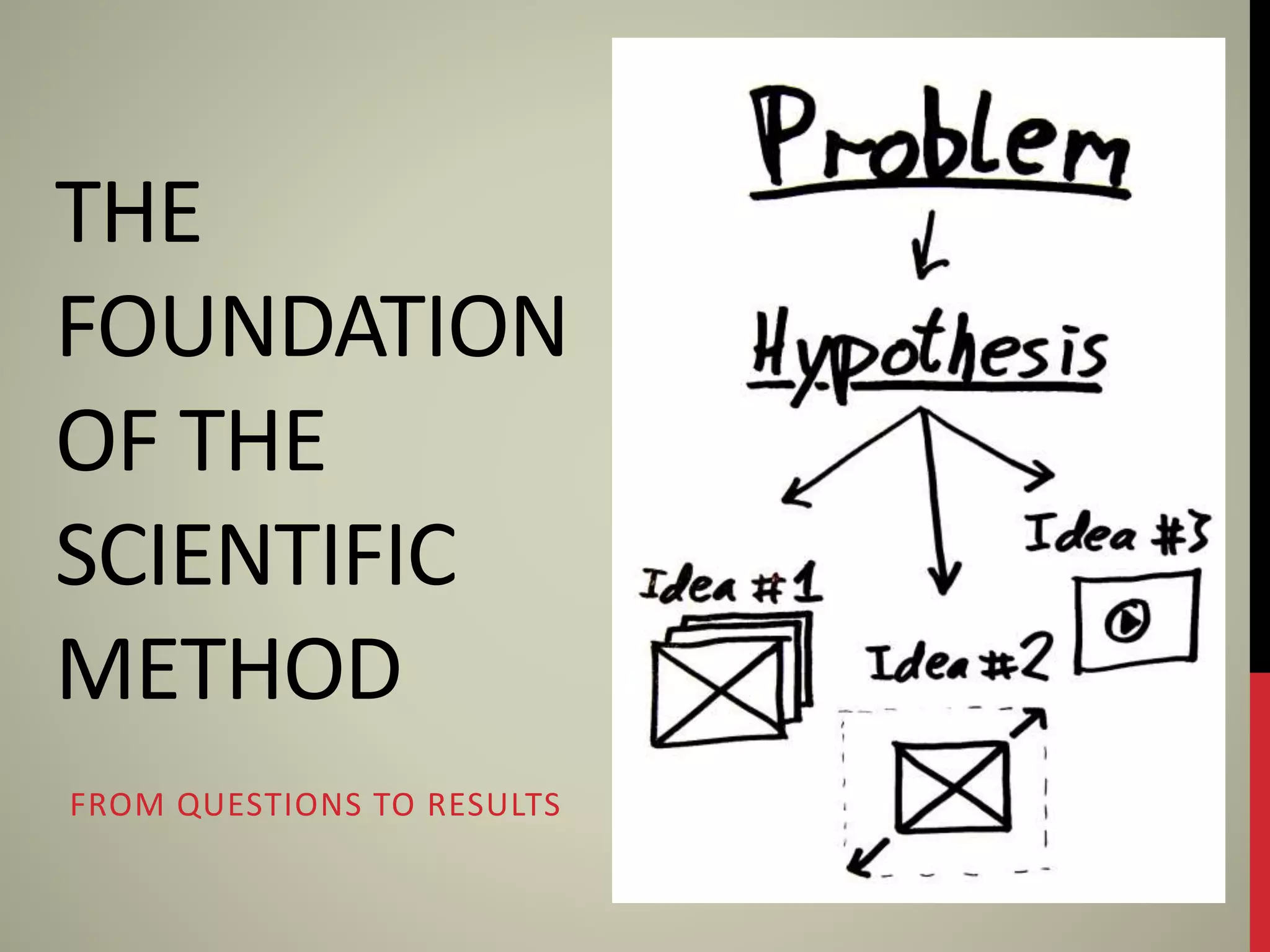
THE
FOUNDATION
OF THE
SCIENTIFIC
METHOD
FROM QUESTIONS TO RESULTS
QUESTIONS & HYPOTHESES
REFLECT: WHAT ARE YOUR
QUESTIONS?
5 Seminal Psychological Studies
CAN PSYCHOLOGY CHANGE HOW YOU UNDERSTAND
YOURSELF AND THE WORLD?
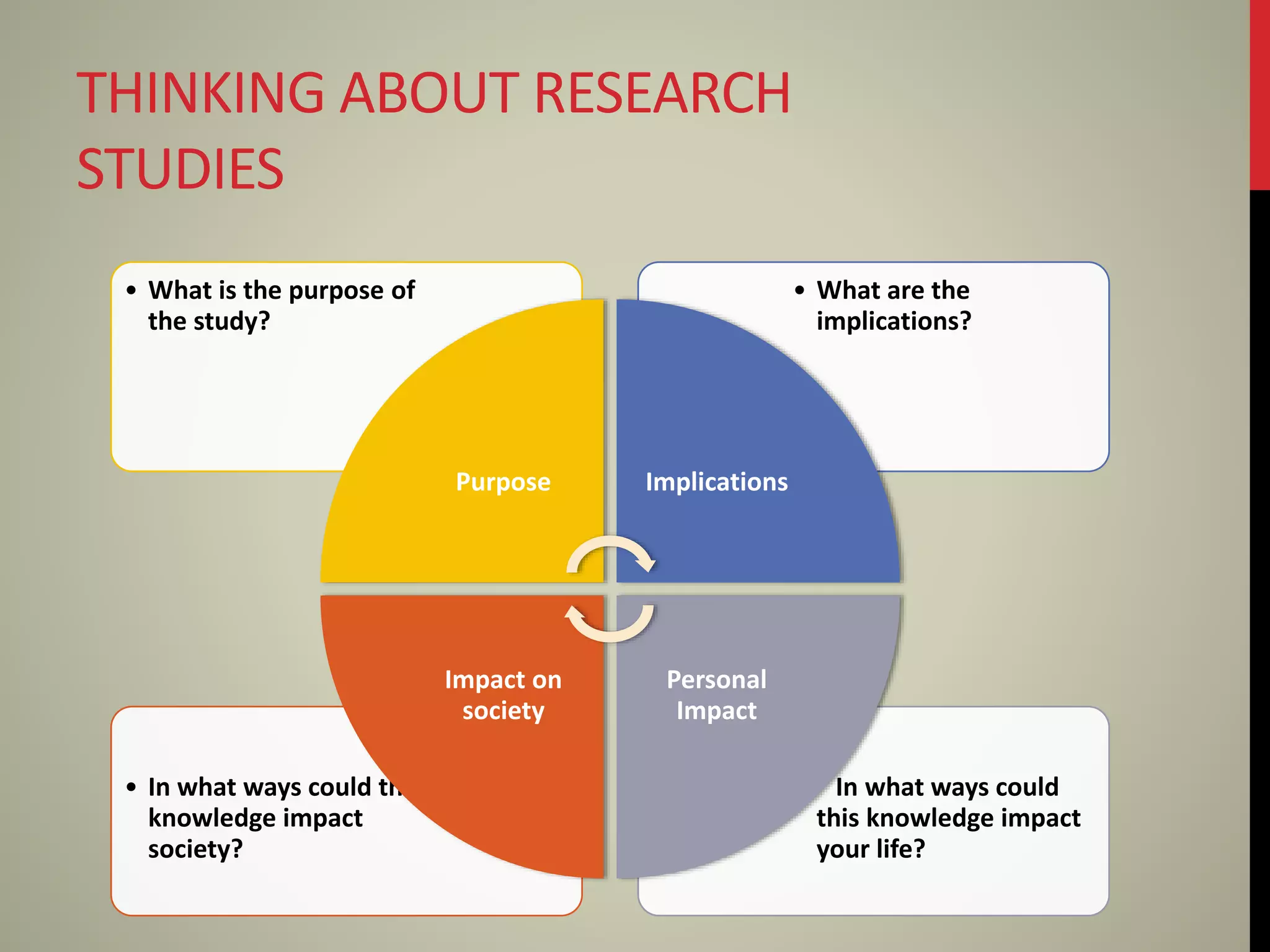
THINKING ABOUT RESEARCH
STUDIES
• In what ways could
this knowledge impact
your life?
• In what ways could this
knowledge impact
society?
• What are the
implications?
• What is the purpose of
the study?
Purpose Implications
Personal
Impact
Impact on
society
What Makes People Evil?
Inside each of us, there is the seed of both good and evil. It's a constant struggle as to which one will win. And
one cannot exist without the other. -Eric Burdon
1. THE STANFORD PRISON STUDY
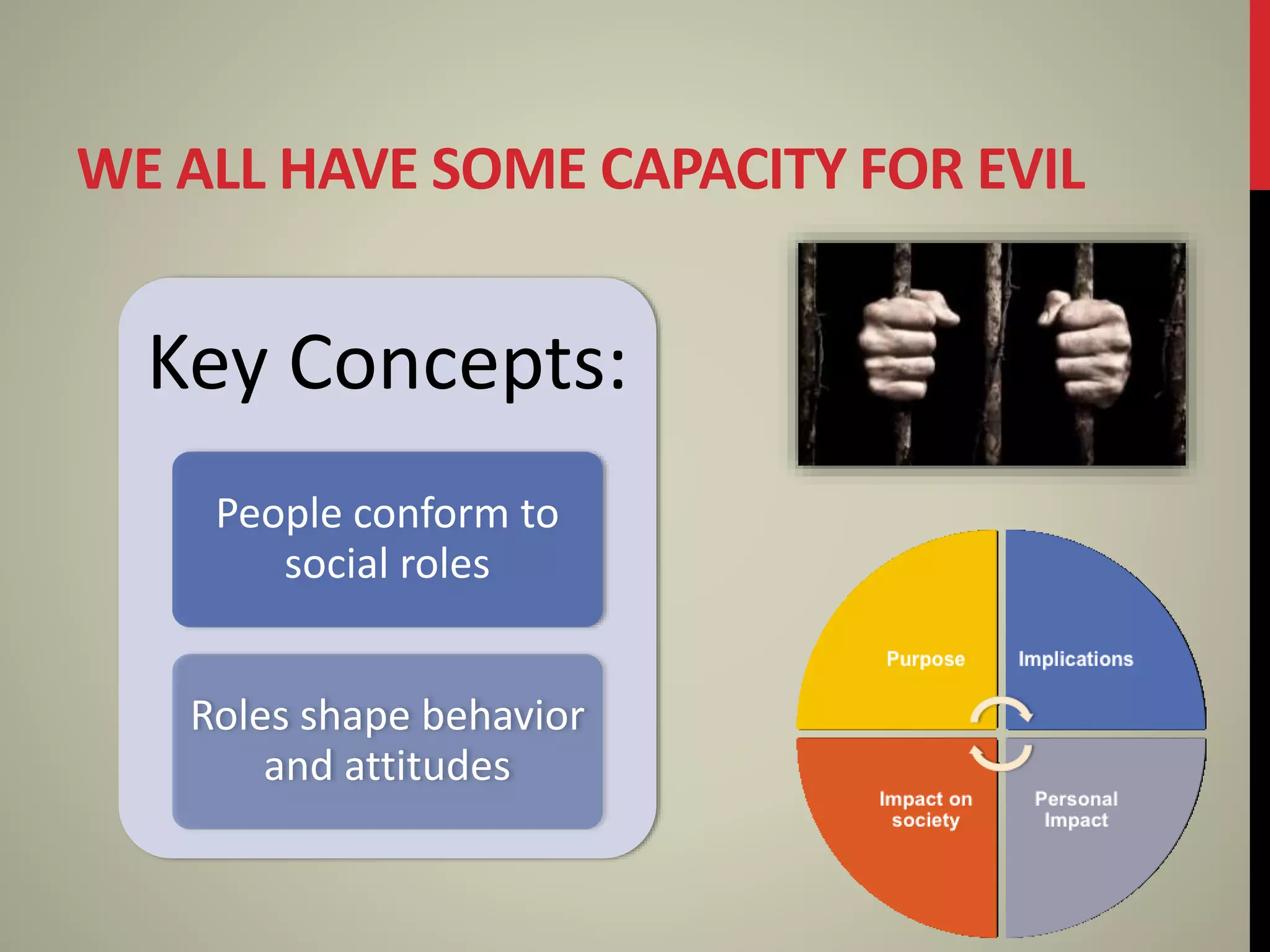
WE ALL HAVE SOME CAPACITY FOR EVIL
Key Concepts:
People conform to
social roles
Roles shape behavior
and attitudes
Do we notice what is right in front of us?
2. THE “DOOR” STUDY
How many passes does the team in white make?
YOUR TURN: TEST YOUR AWARENESS
WE DON'T NOTICE WHAT'S
RIGHT IN FRONT OF US!
Key Concepts
Change
Blindness
Inattentional
Blindness
A famous Stanford experiment from the late 1960s tested preschool children's ability to resist
the lure of instant gratification -- and it yielded some powerful insights about willpower and self-
discipline.
3. THE MARSHMALLOW TEST
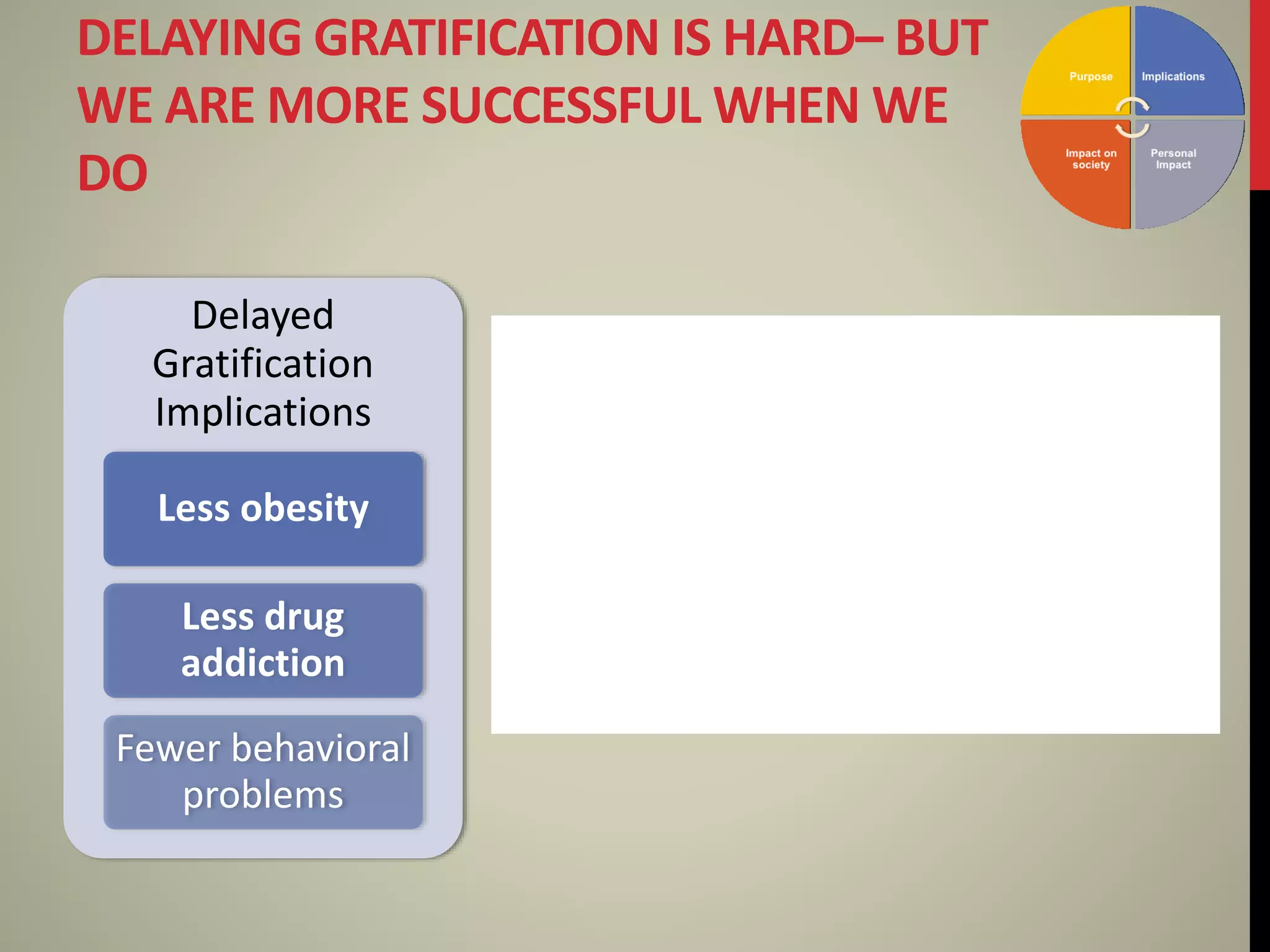
DELAYING GRATIFICATION IS HARD– BUT
WE ARE MORE SUCCESSFUL WHEN WE
DO
Delayed
Gratification
Implications
Less obesity
Less drug
addiction
Fewer behavioral
problems
How far will people go to obey authority?
4. MILGRAM’S OBEDIENCE STUDY
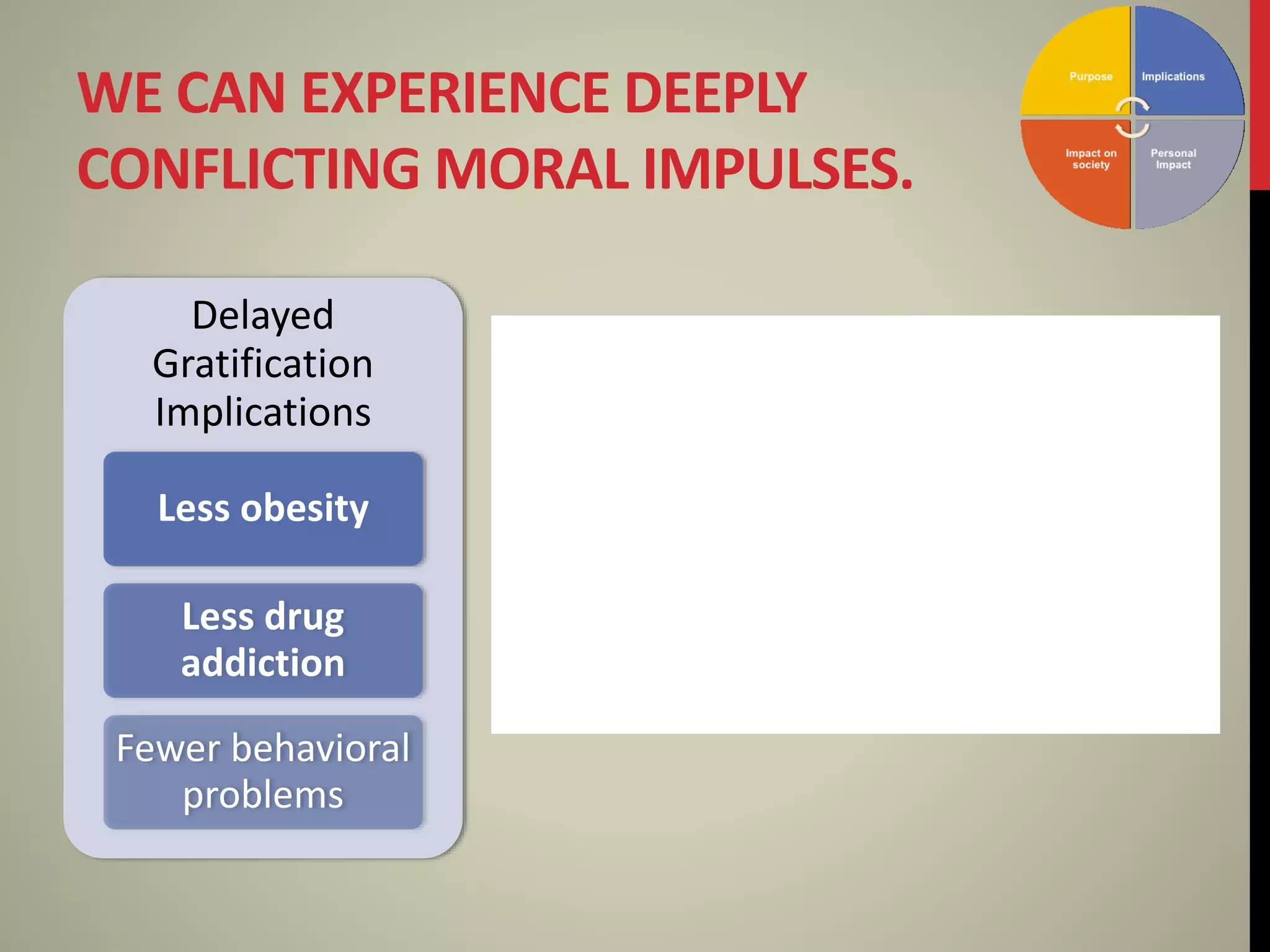
WE CAN EXPERIENCE DEEPLY
CONFLICTING MORAL IMPULSES.
Delayed
Gratification
Implications
Less obesity
Less drug
addiction
Fewer behavioral
problems
Does Power corrupt?
“Power tends to corrupt; absolute power corrupts absolutely,” said the British historian Lord
Acton.
5. THE COOKIE MONSTER STUDY
WE'RE EASILY CORRUPTED BY
POWER
Power Corrupts:
Physically Inappropriate
touching
More direct flirting
Riskier choices & gambles
Eating sloppily
REFLECTION
What do you hope to learn
about psychology?
In what ways could the
study of psychology
develop self knowledge?
What do you hope is
different between now and
the end of the course?
HOW COULD KNOWLEDGE OF
PSYCHOLOGY CHANGE YOUR LIFE?

What is Psychology? An Introduction

  • 1.
    WHAT IS PSYCHOLOGY? PSYCH 100,FALL 2015 SKYLINE COLLEGE DR. MEGHAN FRALEY
  • 2.
    WHAT IS PSYCHOLOGY Whatis psychology? What are it’s applications?
  • 3.
  • 4.
    HISTORY OF PSYCHOLOGY Soul Mind Brain Platoand Democritus theorized about the relationship between thought and behavior Wundt: Enter the Scientific Method! Psychology as a science is Born!
  • 5.
  • 6.
    BEHAVIOR Behavior is theinternally coordinated responses (actions or inactions) of whole living organisms (individuals or groups) to internal and/or external stimuli Stimuli • Internal • External Organism Behavior Coordinated Response
  • 7.
    MENTAL PROCESSES  Perception Memory  Thinking  Ideation  Imagination  Belief  Reasoning  Volition/motivation  Emotion
  • 8.
    Shared Themes •Many factorsinfluence the mind & behavior •Influences on people are interactive •We are active perceivers •Our interpretations can help and hurt us Commitment to Scientific Method
  • 9.
    TYPES OF PSYCHOLOGY TYPESOF PSYCHOLOGY •Abnormal psychology •Behavioral genetics •Biological psychology •Critical psychology •Cognitive psychology •Comparative psychology •Cultural psychology •Developmental psychology •Differential psychology •Evolutionary psychology •Experimental psychology •Health psychology •Mathematical psychology •Music psychology •Neuropsychology •Personality psychology •Positive psychology •Psychopharmacology •Social psychology •Transpersonal psychology • How biological processes influence the mind and behavior Neuroscience/Biopsychology • Human growth and development over the lifespan Developmental • Study of human thought & cognition Cognitive • Study social behavior and interactions Social • Assessment, diagnosis, and treatment of mental disorders Clinical • Research & Tx of Mental Disorders Abnormal
  • 10.
    FOUR MAJOR GOALSOF PSYCHOLOGY DESCRIBE • To describe human thought and behavior EXPLAIN: • To explain why these behaviors occur PREDICT: • To predict how, why and when these behaviors will occur again in the future MODIFY: • To modify and improve behaviors to better the lives of individuals and society as a whole
  • 11.
    WHAT IS THEPURPOSE OF PSYCHOLOGY? How can psychology by applied? In society? In your life?
  • 12.
  • 13.
  • 17.
    REFLECT: WHAT AREYOUR QUESTIONS?
  • 18.
    5 Seminal PsychologicalStudies CAN PSYCHOLOGY CHANGE HOW YOU UNDERSTAND YOURSELF AND THE WORLD?
  • 19.
    THINKING ABOUT RESEARCH STUDIES •In what ways could this knowledge impact your life? • In what ways could this knowledge impact society? • What are the implications? • What is the purpose of the study? Purpose Implications Personal Impact Impact on society
  • 20.
    What Makes PeopleEvil? Inside each of us, there is the seed of both good and evil. It's a constant struggle as to which one will win. And one cannot exist without the other. -Eric Burdon 1. THE STANFORD PRISON STUDY
  • 21.
    WE ALL HAVESOME CAPACITY FOR EVIL Key Concepts: People conform to social roles Roles shape behavior and attitudes
  • 22.
    Do we noticewhat is right in front of us? 2. THE “DOOR” STUDY
  • 23.
    How many passesdoes the team in white make? YOUR TURN: TEST YOUR AWARENESS
  • 24.
    WE DON'T NOTICEWHAT'S RIGHT IN FRONT OF US! Key Concepts Change Blindness Inattentional Blindness
  • 25.
    A famous Stanfordexperiment from the late 1960s tested preschool children's ability to resist the lure of instant gratification -- and it yielded some powerful insights about willpower and self- discipline. 3. THE MARSHMALLOW TEST
  • 26.
    DELAYING GRATIFICATION ISHARD– BUT WE ARE MORE SUCCESSFUL WHEN WE DO Delayed Gratification Implications Less obesity Less drug addiction Fewer behavioral problems
  • 27.
    How far willpeople go to obey authority? 4. MILGRAM’S OBEDIENCE STUDY
  • 28.
    WE CAN EXPERIENCEDEEPLY CONFLICTING MORAL IMPULSES. Delayed Gratification Implications Less obesity Less drug addiction Fewer behavioral problems
  • 29.
    Does Power corrupt? “Powertends to corrupt; absolute power corrupts absolutely,” said the British historian Lord Acton. 5. THE COOKIE MONSTER STUDY
  • 30.
    WE'RE EASILY CORRUPTEDBY POWER Power Corrupts: Physically Inappropriate touching More direct flirting Riskier choices & gambles Eating sloppily
  • 31.
    REFLECTION What do youhope to learn about psychology? In what ways could the study of psychology develop self knowledge? What do you hope is different between now and the end of the course?
  • 32.
    HOW COULD KNOWLEDGEOF PSYCHOLOGY CHANGE YOUR LIFE?

Editor's Notes

  • #5 William James (January 11, 1842 – August 26, 1910) was an American philosopher and psychologist who was also trained as a physician. The first educator to offer a psychology course in the United States,[2] James was one of the leading thinkers of the late nineteenth century and is believed by many to be one of the most influential philosophers the United States has ever produced, while others have labelled him the "Father of American psychology".[3][4][5] the human mind as inherently purposive and selective. “"Anything short of God is not rational, anything more than God is not possible" he wrote.” ”For James, the spiritual self was who we are at our core. The spiritual self is more concrete or permanent than the other two selves. The spiritual self is our subjective and most intimate self. Aspects of an individual's spiritual self include things like their personality, core values, and conscience that do not typically change throughout their lifetime. The spiritual self involves introspection, or looking inward to deeper spiritual, moral, or intellectual questions without the influence of objective thoughts.[50] For James, achieving a high level of understanding of who we are at our core, or understanding our spiritual selves is more rewarding than satisfying the needs of the social and material selves.” OTTO RANK Unlike many other intellectuals of the twentieth century, Rank maintains a place for the soul rather than dismissing it as a fantasy. The soul and the beliefs about it, he argues, set forth the foundation for psychology, with its complex analyses of consciousness, self-consciousness, and personality.
  • #6 What exactly is psychology? “the study of the mind and behavior” The simplest definition of psychology is that it is the study of the mind and behavior. Research in psychology seeks to understand and explain thought, emotion, and behavior. Applications of psychology include mental health treatment, performance enhancement, self-help, ergonomics, and many other areas affecting health and daily life. It's difficult to capture everything that psychology encompasses in just a brief definition, but topics such as development, personality, thoughts, feelings, emotions, motivations, and social behaviors represent just a portion of what psychology seeks to understand and explain. Answer: Psychology is both an applied and academic field that studies the human mind and behavior. Research in psychology seeks to understand and explain how we think, act and feel. As most people already realize, a large part of psychology is devoted to the diagnosis and treatment of mental health issues, but that's just the tip of the iceberg when it comes to applications for psychology. In addition to mental health, psychology can be applied to a variety of issues that impact health and daily life including performance enhancement, self-help, ergonomics, motivation, productivity, and much more.
  • #7 Behavior is the range of actions and mannerisms made by individuals in conjunction with themselves or their environment, which includes the other systems or organisms around as well as the (inanimate) physical environment. It is the response of to various stimuli or inputs, whether internal or external, conscious or subconscious, overt or covert, and voluntary or involuntary.[1]
  • #8 Mental process or mental function are terms often used interchangeably for all the things that individuals can do with their minds. These include perception, memory, thinking (such as ideation, imagination, belief, reasoning, etc.), volition, and emotion. Sometimes the term cognitive function is used instead.
  • #10 The five main branches of psychology are presented: neuroscience, which is a study of the mind by looking at the brain; developmental, which focuses on how people grow and learn; cognitive, which refers to the computational approach to studying the mind; social, which studies how people interact; and clinical, which examines mental health and mental illnesses. Areas of Psychology Psychology is a broad and diverse field. Some different subfields and specialty areas have emerged. The following are some of the major areas of research and application within psychology: Abnormal Psychology is the study of abnormal behavior and psychopathology. This specialty area is focused on research and treatment of a variety of mental disorders and is linked to psychotherapy and clinical psychology. Biological Psychology, also known as biopsychology, studies how biological processes influence the mind and behavior. This area is closely linked to neuroscience and utilizes tools such as MRI and PET scans to look at brain injury or brain abnormalities. Clinical Psychology is focused on the assessment, diagnosis, and treatment of mental disorders. It is also considered the largest employment area within psychology. Cognitive Psychology is the study of human thought processes and cognitions. Cognitive psychologists study topics such as attention, memory, perception, decision-making, problem-solving, and language acquisition. Comparative Psychology is the branch of psychology concerned with the study of animal behavior. This type of research can lead to a deeper and broader understanding of human psychology. Developmental Psychology is an area that looks at human growth and development over the lifespan. Theories often focus on the development of cognitive abilities, morality, social functioning, identity, and other life areas. Forensic Psychology is an applied field focused on using psychological research and principles in the legal and criminal justice system. Industrial-Organizational Psychology is a field that uses psychological research to enhance work performance, select employee, improve product design, and enhance usability. Personality Psychology looks at the various elements that make up individual personalities. Well-known personality theories include Freud's structural model of personality and the "Big Five" theory of personality. School Psychology is the branch of psychology that works within the educational system to help children with emotional, social, and academic issues. Social Psychology is a discipline that uses scientific methods to study social influence, social perception, and social interaction. Social psychology studies diverse subjects including group behavior, social perception, leadership, nonverbal behavior, conformity, aggression, and prejudice.
  • #12 In addition to mental health, psychology can be applied to a variety of issues that impact health and daily life including performance enhancement, self-help, ergonomics, motivation, productivity, and much more. Journal & Share in Dyad
  • #13 Psychologists use the scientific method to conduct their research. The scientific method is a standardized way of making observations, gathering data, forming theories, testing predictions, and interpreting results. Researchers make observations in order to describe and measure behavior. After observing certain events repeatedly, researchers come up with a theory that explains these observations. A theory is an explanation that organizes separate pieces of information in a coherent way. Researchers generally develop a theory only after they have collected a lot of evidence and made sure their research results can be reproduced by others. Key Info The scientific method is a way to ask and answer scientific questions by making observations and doing experiments. The steps of the scientific method are to: Ask a Question Do Background Research Construct a Hypothesis Test Your Hypothesis by Doing an Experiment Analyze Your Data and Draw a Conclusion Communicate Your Results It is important for your experiment to be a fair test. A "fair test" occurs when you change only one factor (variable) and keep all other conditions the same.
  • #14 Tips for Writing Research Questions Be as specific as possible. In some cases, you may make two or more research questions to cover a complex topic. Be flexible. For example, if you are studying the effects of sleep on reflexes, you might formulate the following research question: What are the effects of sleep on reflexes? A similar question might be: Does sleep have an effect on reflexes? OR Is maximum reflex efficiency achieved after eight hours of sleep? Remember: The goal of your research is to find the answer to the research question. Make sure that the question reflects your goals in its words and phrasing. Use this tutorial if you are writing research questions for a qualitative design. Tips for Writing Hypotheses When you state your hypotheses, be sure that the content of the hypothesis matches the experimental procedure. What you write should be the best estimation of the outcome of the lab procedure. Along with the hypothesis, you should write several sentences which explain the scientific reasoning that led you to that hypothesis.
  • #15 2. Theory 3. How might you test it?
  • #17 Any other questions anyone wants to add? And anyone else want to form a hypothesis?
  • #19 http://www.huffingtonpost.com/2013/10/18/20-psychological-studies-_n_4098779.html Psychologists have long sought insights into how we perceive the world and what motivates our behavior, and they've made enormous strides in lifting that veil of mystery. Aside from providing fodder for stimulating cocktail-party conversations, some of the most famous psychological experiments of the past century reveal universal and often surprising truths about human nature. Here are 5 classic psychological studies that may change the way you understand yourself.
  • #20 Arguably the most famous experiment in the history of psychology, the 1971 Stanford prison study put a microscope on how social situations can affect human behavior. The researchers, led by psychologist Philip Zimbardo, set up a mock prison in the basement of the Stanford psych building and selected 24 undergraduates (who had no criminal record and were deemed psychologically healthy) to act as prisoners and guards. Researchers then observed the prisoners (who had to stay in the cells 24 hours a day) and guards (who shared eight-hour shifts) using hidden cameras. The experiment, which was scheduled to last for two weeks, had to be cut short after just six days due to the guards' abusive behavior -- in some cases they even inflicted psychological torture -- and the extreme emotional stress and anxiety exhibited by the prisoners. "The guards escalated their aggression against the prisoners, stripping them naked, putting bags over their heads, and then finally had them engage in increasingly humiliating sexual activities," Zimbardo told American Scientist. "After six days I had to end it because it was out of control -- I couldn't really go to sleep at night without worrying what the guards could do to the prisoners."
  • #21 Aim: To investigate how readily people would conform to the roles of guard and prisoner in a role-playing exercise that simulated prison life. Zimbardo (1973) was interested in finding out whether the brutality reported among guards in American prisons was due to the sadistic personalities of the guards or had more to do with the prison environment. Arguably the most famous experiment in the history of psychology, the 1971 Stanford prison study put a microscope on how social situations can affect human behavior. The researchers, led by psychologist Philip Zimbardo, set up a mock prison in the basement of the Stanford psych building and selected 24 undergraduates (who had no criminal record and were deemed psychologically healthy) to act as prisoners and guards. Researchers then observed the prisoners (who had to stay in the cells 24 hours a day) and guards (who shared eight-hour shifts) using hidden cameras. Inside each of us, there is the seed of both good and evil. It's a constant struggle as to which one will win. And one cannot exist without the other. Eric Burdon
  • #22 The experiment, which was scheduled to last for two weeks, had to be cut short after just six days due to the guards' abusive behavior -- in some cases they even inflicted psychological torture -- and the extreme emotional stress and anxiety exhibited by the prisoners. "The guards escalated their aggression against the prisoners, stripping them naked, putting bags over their heads, and then finally had them engage in increasingly humiliating sexual activities," Zimbardo told American Scientist. "After six days I had to end it because it was out of control -- I couldn't really go to sleep at night without worrying what the guards could do to the prisoners." Ethics: The study has received many ethical criticisms, including lack of fully informed consent by participants and the level of humiliation and distress experienced by those who acted as prisoners. The consent could not be fully informed as Zimbardo himself did not know what would happen in the experiment (it was unpredictable). Also, participants playing the role of prisoners were not protected from psychological and physical harm. For example, one prisoner had to be released after 36 hours because of uncontrollable bursts of screaming, crying and anger.
  • #23  1:45min: How many people do expect will notice the difference? 0, a quarter, half, majority over 75?
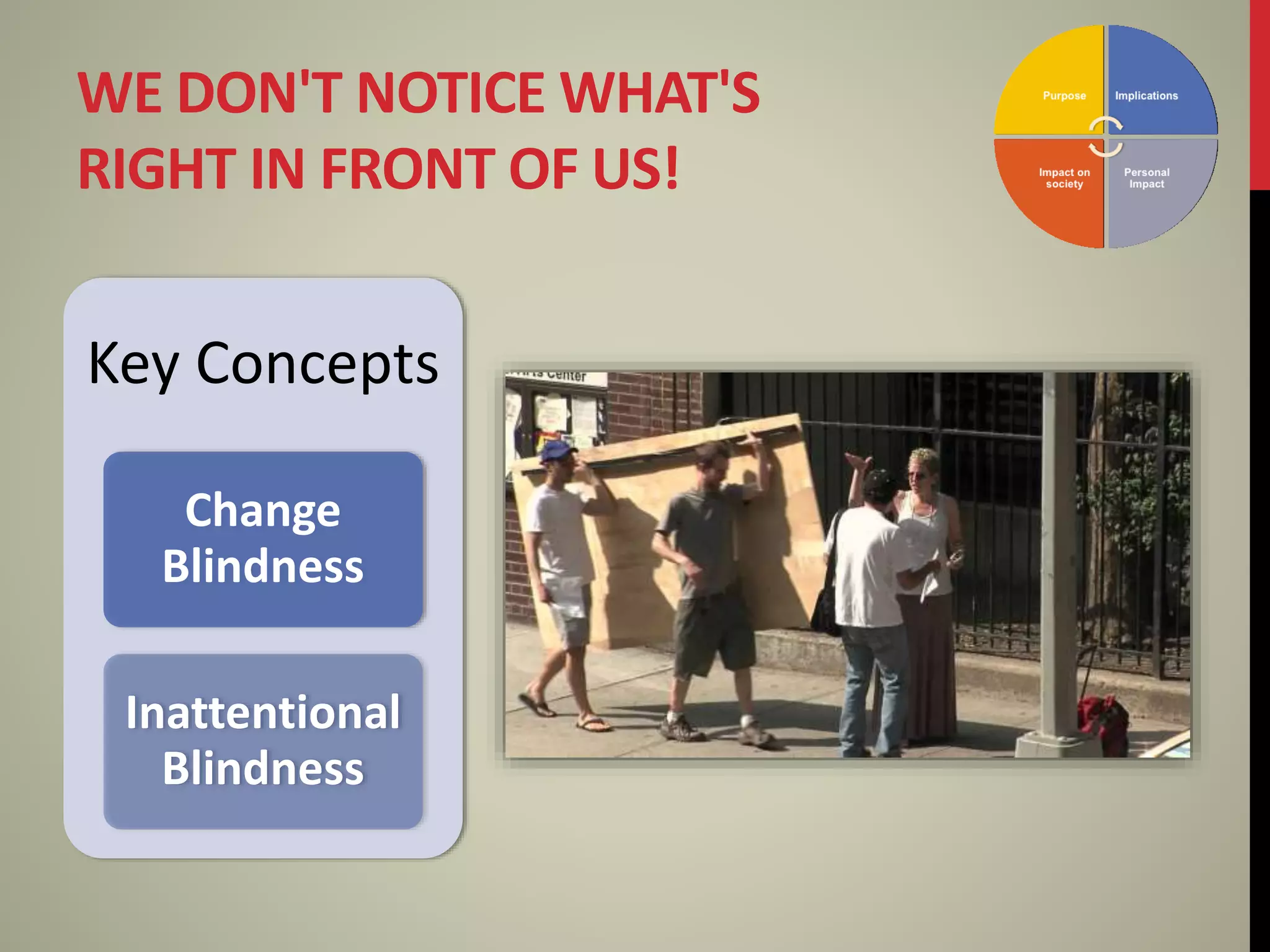
  • #25 Think you know what's going on around you? You might not be nearly as aware as you think. In 1998, researchers from Harvard and Kent State University targeted pedestrians on a college campus to determine how much people notice about their immediate environments. In the experiment, an actor came up to a pedestrian and asked for directions. While the pedestrian was giving the directions, two men carrying a large wooden door walked between the actor and the pedestrian, completely blocking their view of each other for several seconds. During that time, the actor was replaced by another actor, one of a different height and build, and with a different outfit, haircut and voice. A full half of the participants didn't notice the substitution. The experiment was one of the first to illustrate the phenomenon of "change blindness," which shows just how selective we are about what we take in from any given visual scene -- and it seems that we rely on memory and pattern-recognition significantly more than we might think. Impact: Fights with friends Juries Driving with cell phone Inattentional blindness, also known as perceptual blindness, is a psychological lack of attention and is not associated with any vision defects or deficits. It may be further defined as the event in which an individual fails to recognize an unexpected stimulus that is in plain sight. http://www.huffingtonpost.com/2013/10/18/20-psychological-studies-_n_4098779.html
  • #26 A famous Stanford experiment from the late 1960s tested preschool children's ability to resist the lure of instant gratification -- and it yielded some powerful insights about willpower and self-discipline. In the experiment, four-year-olds were put in a room by themselves with a marshmallow on a plate in front of them, and told that they could either eat the treat now, or if they waited until the researcher returned 15 minutes later, they could have two marshmallows. While most of the children said they'd wait, they often struggled to resist and then gave in, eating the treat before the researcher returned, TIME reports. The children who did manage to hold off for the full 15 minutes generally used avoidance tactics, like turning away or covering their eyes.
  • #27 The implications of the children's behavior were significant: Those who were able to delay gratification were much less likely to be obese, or to have drug addiction or behavioral problems by the time they were teenagers, and were more successful later in life.
  • #28 A famous 1961 study by Yale psychologist Stanley Milgram tested (rather alarmingly) how far people would go to obey authority figures when asked to harm others, and the intense internal conflict between personal morals and the obligation to obey authority figures. Milgram wanted to conduct the experiment to provide insight into how Nazi war criminals could have perpetuated unspeakable acts during the Holocaust. To do so, he tested a pair of participants, one deemed the "teacher" and the other deemed the "learner." The teacher was instructed to administer electric shocks to the learner (who was supposedly sitting in another room, but in reality was not being shocked) each time they got questions wrong. Milgram instead played recordings which made it sound like the learner was in pain, and if the "teacher" subject expressed a desire to stop, the experimenter prodded him to go on. During the first experiment, 65 percent of participants administered a painful, final 450-volt shock (labeled "XXX"), although many were visibly stressed and uncomfortable about doing so.
  • #29 While the study has commonly been seen as a warning of blind obedience to authority, Scientific American recently revisited it, arguing that the results were more suggestive of deep moral conflict. "Human moral nature includes a propensity to be empathetic, kind and good to our fellow kin and group members, plus an inclination to be xenophobic, cruel and evil to tribal others," journalist Michael Shermer wrote. "The shock experiments reveal not blind obedience but conflicting moral tendencies that lie deep within." Recently, some commenters have called Milgram's methodology into question, and one critic noted that records of the experiment performed at Yale suggested that 60 percent of participants actually disobeyed orders to administer the highest-dosage shock.
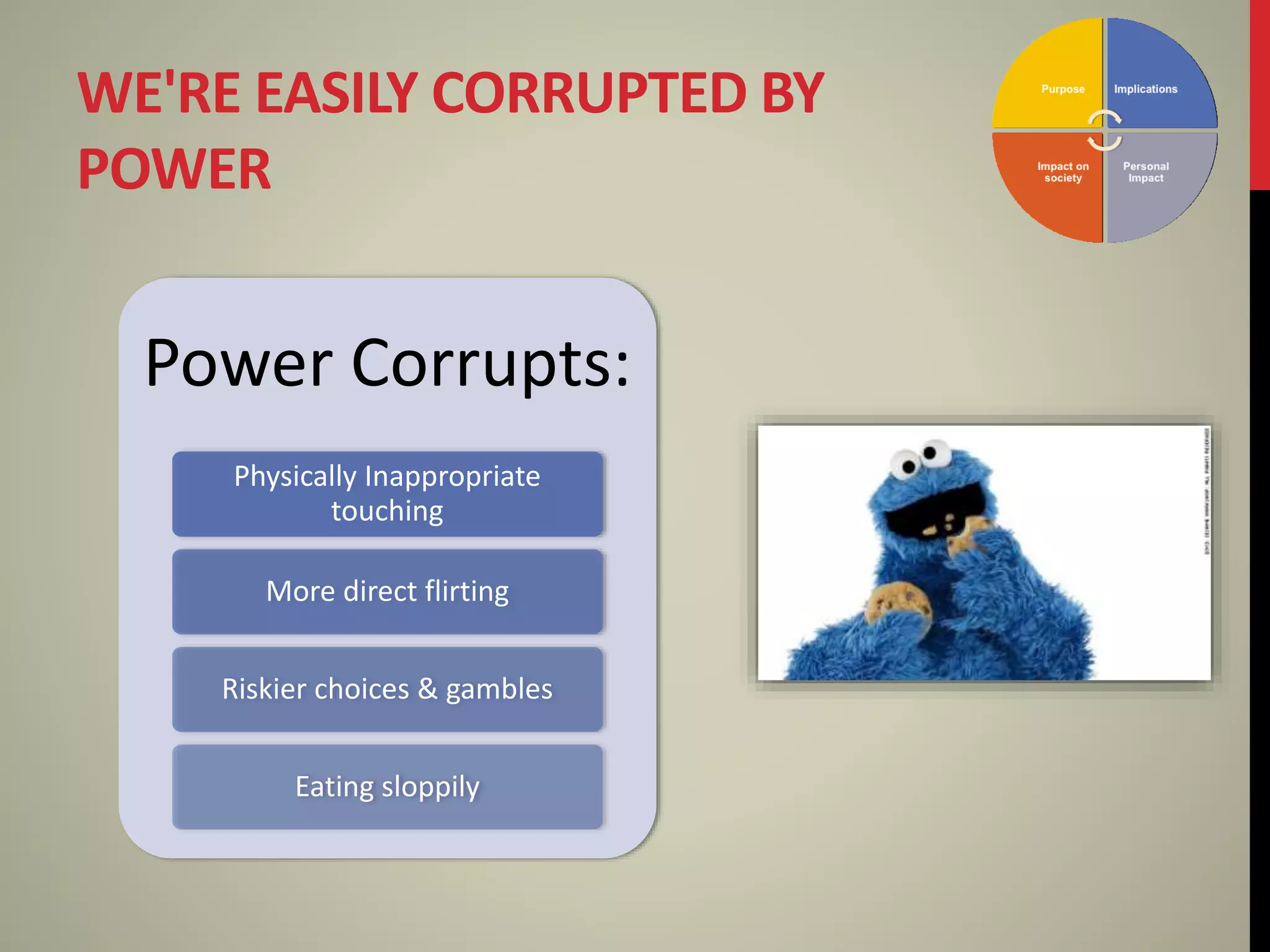
  • #30 There's a psychological reason behind the fact that those in power sometimes act towards others with a sense of entitlement and disrespect. A 2003 study published in the journal Psychological Review put students into groups of three to write a short paper together. Two students were instructed to write the paper, while the other was told to evaluate the paper and determine how much each student would be paid. In the middle of their work, a researcher brought in a plate of five cookies. Although generally the last cookie was never eaten, the "boss" almost always ate the fourth cookie -- and ate it sloppily, mouth open. "When researchers give people power in scientific experiments, they are more likely to physically touch others in potentially inappropriate ways, to flirt in more direct fashion, to make risky choices and gambles, to make first offers in negotiations, to speak their mind, and to eat cookies like the Cookie Monster, with crumbs all over their chins and chests," psychologist Dacher Keltner, one of the study's leaders, wrote in an article for UC Berkeley's Greater Good Science Center.
  • #31 There's a psychological reason behind the fact that those in power sometimes act towards others with a sense of entitlement and disrespect. A 2003 study published in the journal Psychological Review put students into groups of three to write a short paper together. Two students were instructed to write the paper, while the other was told to evaluate the paper and determine how much each student would be paid. In the middle of their work, a researcher brought in a plate of five cookies. Although generally the last cookie was never eaten, the "boss" almost always ate the fourth cookie -- and ate it sloppily, mouth open. "When researchers give people power in scientific experiments, they are more likely to physically touch others in potentially inappropriate ways, to flirt in more direct fashion, to make risky choices and gambles, to make first offers in negotiations, to speak their mind, and to eat cookies like the Cookie Monster, with crumbs all over their chins and chests," psychologist Dacher Keltner, one of the study's leaders, wrote in an article for UC Berkeley's Greater Good Science Center.
  • #32  Guided meditation: 3. What do you hope is different? -Greater knowledge of psychology -Closer to degree? 2. Journal 3. Discuss in Dyads 4.