9/24/2014 1
Submitted by 
Premnath R 
Ist year MSc Nursing 
Govt CON Kottayam 
9/24/2014 2
Theory of cognitive development is a 
comprehensive theory about the nature and 
development of human intelligence. 
 Known as Developmental Stage Theory. 
9/24/2014 3
 It deals with the nature of knowledge 
itself and how humans come 
gradually to acquire it, construct it, 
and use it. 
9/24/2014 4
 Piaget’s Cognitive Developmental Theory. 
 Vygotsky’s Cognitive Developmental 
Theory. 
9/24/2014 5
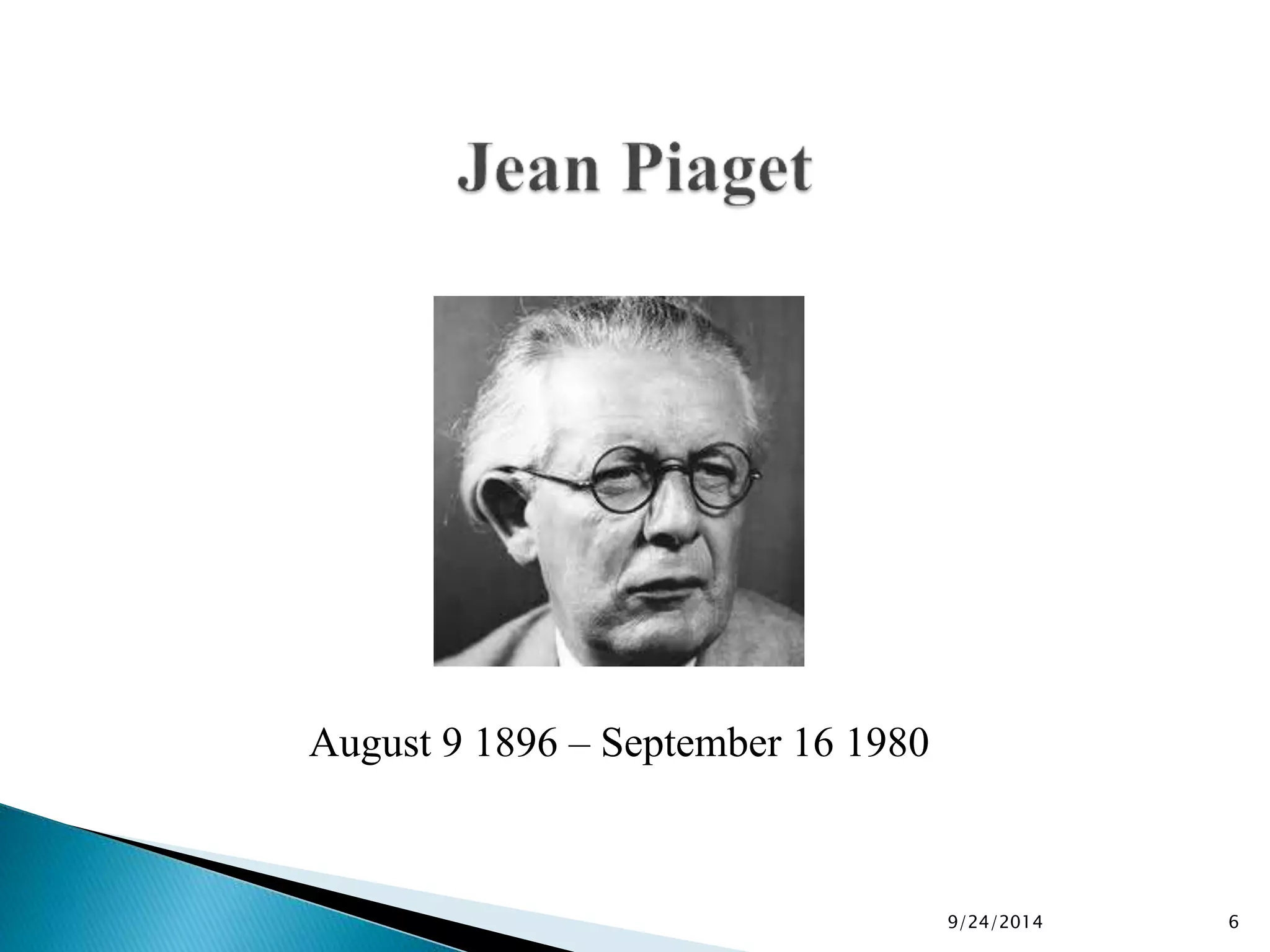
August 9 1896 – September 16 1980 
9/24/2014 6
 Reality is a dynamic system of continuous change. 
 He argued that reality involves transformations and states. 
Transformations refer to all manners of changes that a thing or 
person can undergo. States refer to the conditions or the 
appearances in which things or persons can be found between 
transformations. 
 Human intelligence is adaptive. Two types of intelligence, 
namely 
Operative intelligence 
Figurative intelligence 
9/24/2014 7
 Operative intelligence involves all actions, overt or 
covert, undertaken in order to follow, recover, or 
anticipate the transformations of the objects or persons 
of interest. 
 Figurative intelligence is the more or less static 
aspect of intelligence, involving all means of 
representation used to retain in mind the states (i.e., 
successive forms, shapes, or locations) that intervene 
between transformations. That is, it involves perception, 
imitation, mental imagery, drawing, and language. 
9/24/2014 8
 Piaget believed that this process of 
understanding and change involves two 
basic functions: Assimilation and 
accommodation: 
 Assimilation is the process of taking 
one’s environment and new information 
and fitting it into pre-existing cognitive 
schemas. 
 Accommodation, unlike assimilation is 
the process of taking one's environment 
and new information, and altering one's 
pre-existing schemas in order to fit in the 
new information. 
9/24/2014 9
Key concepts are, 
Schema 
Assimilation 
Accommodation 
Adaptation 
Equilibrium 
9/24/2014 10
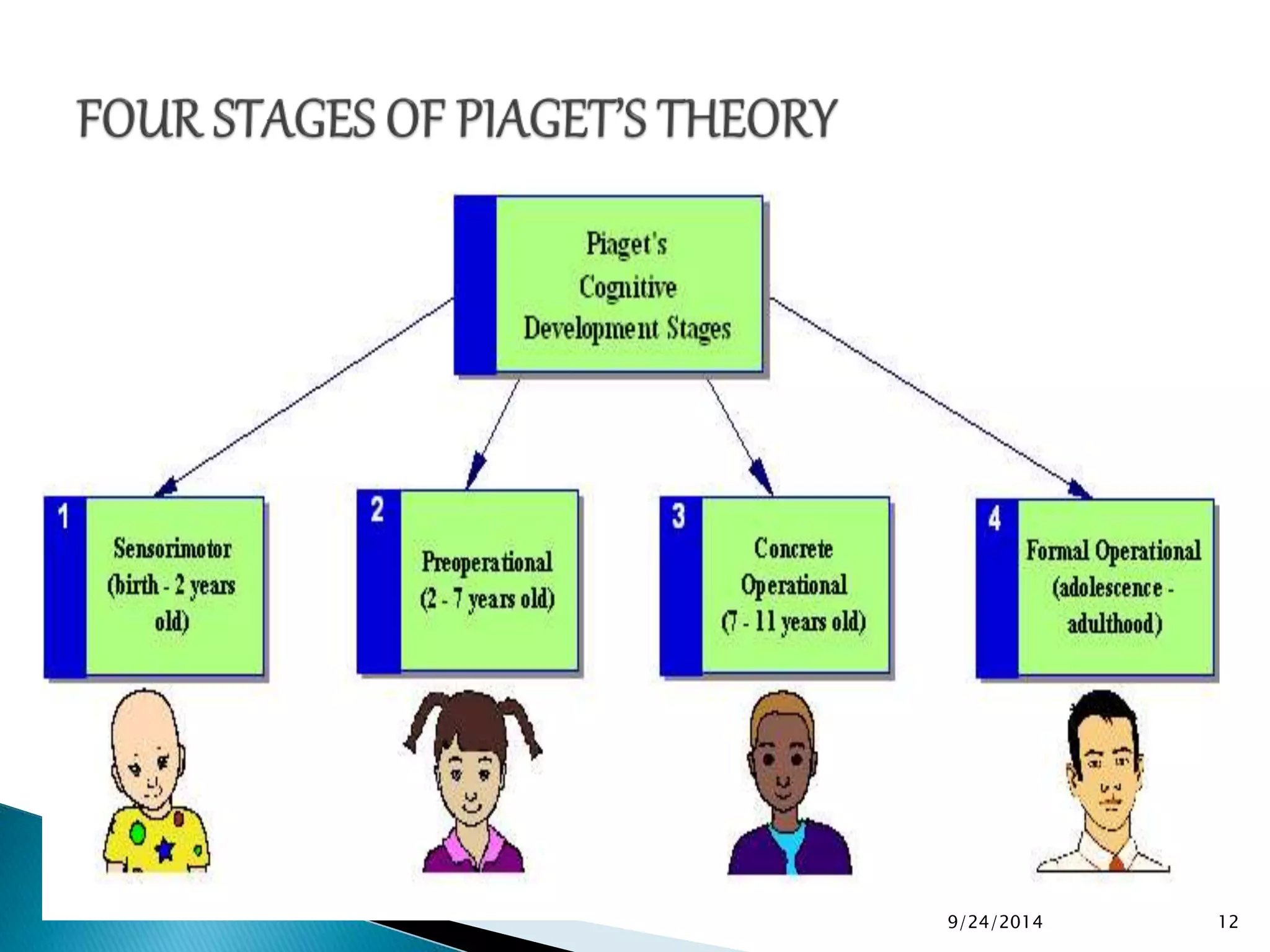
 STAGE I: THE SENSORIMOTOR STAGE 
 STAGE II: PREOPERATIONAL STAGE 
 STAGE III: CONCRETE OPERATIONAL STAGE 
 STAGE IV: FORMAL OPERATIONAL STAGE 
9/24/2014 11
9/24/2014 12
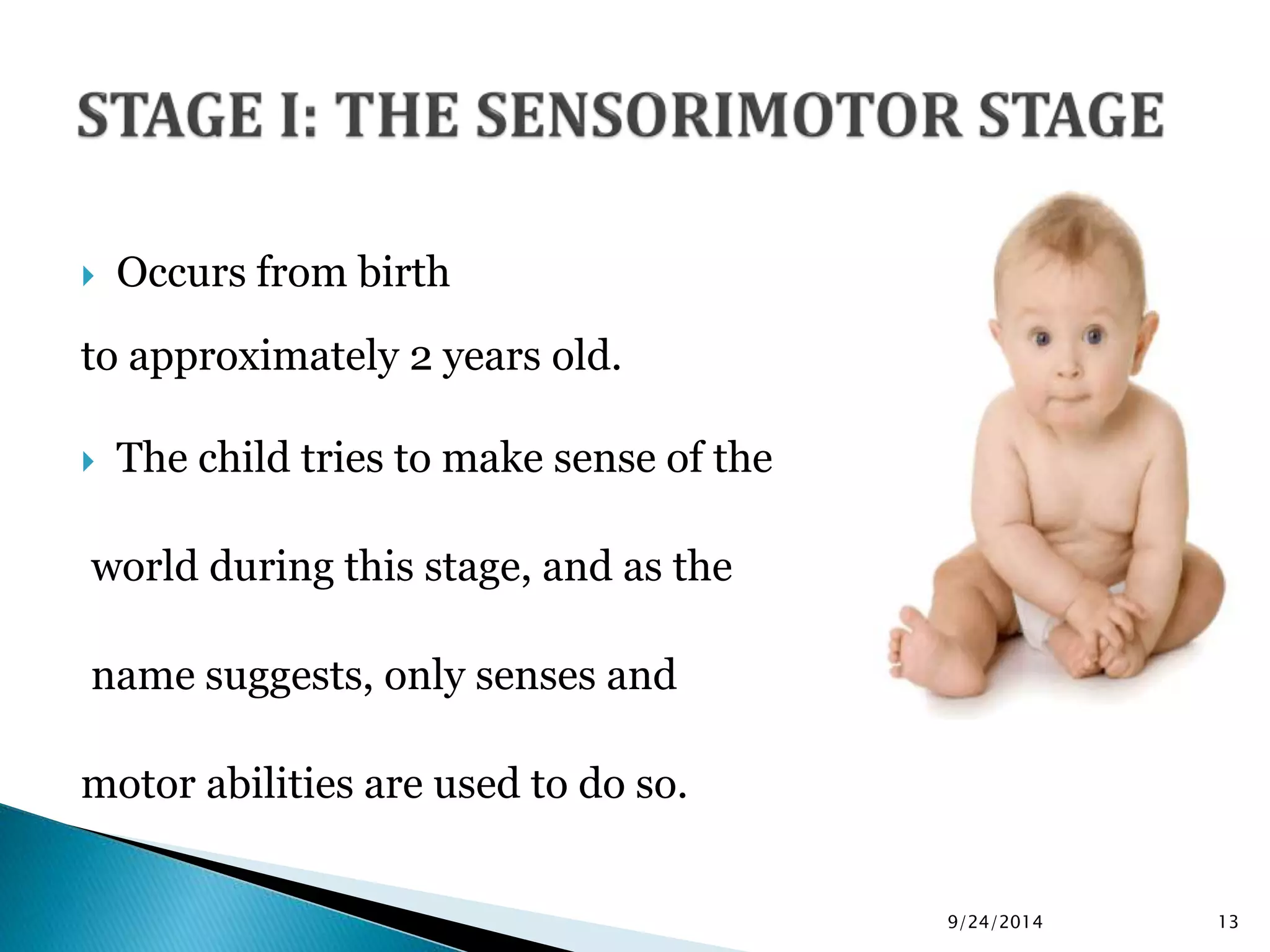
 Occurs from birth 
to approximately 2 years old. 
 The child tries to make sense of the 
world during this stage, and as the 
name suggests, only senses and 
motor abilities are used to do so. 
9/24/2014 13
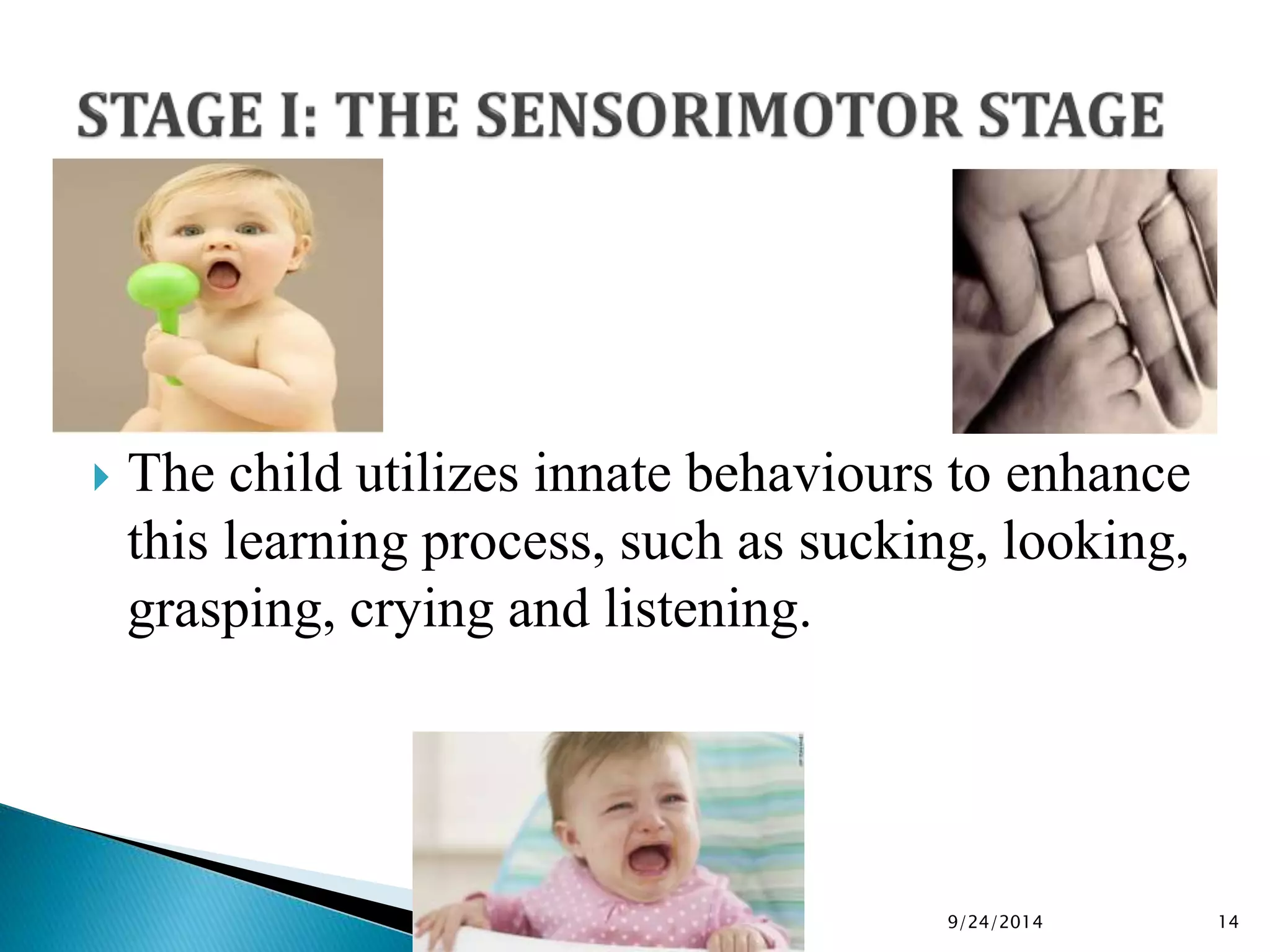
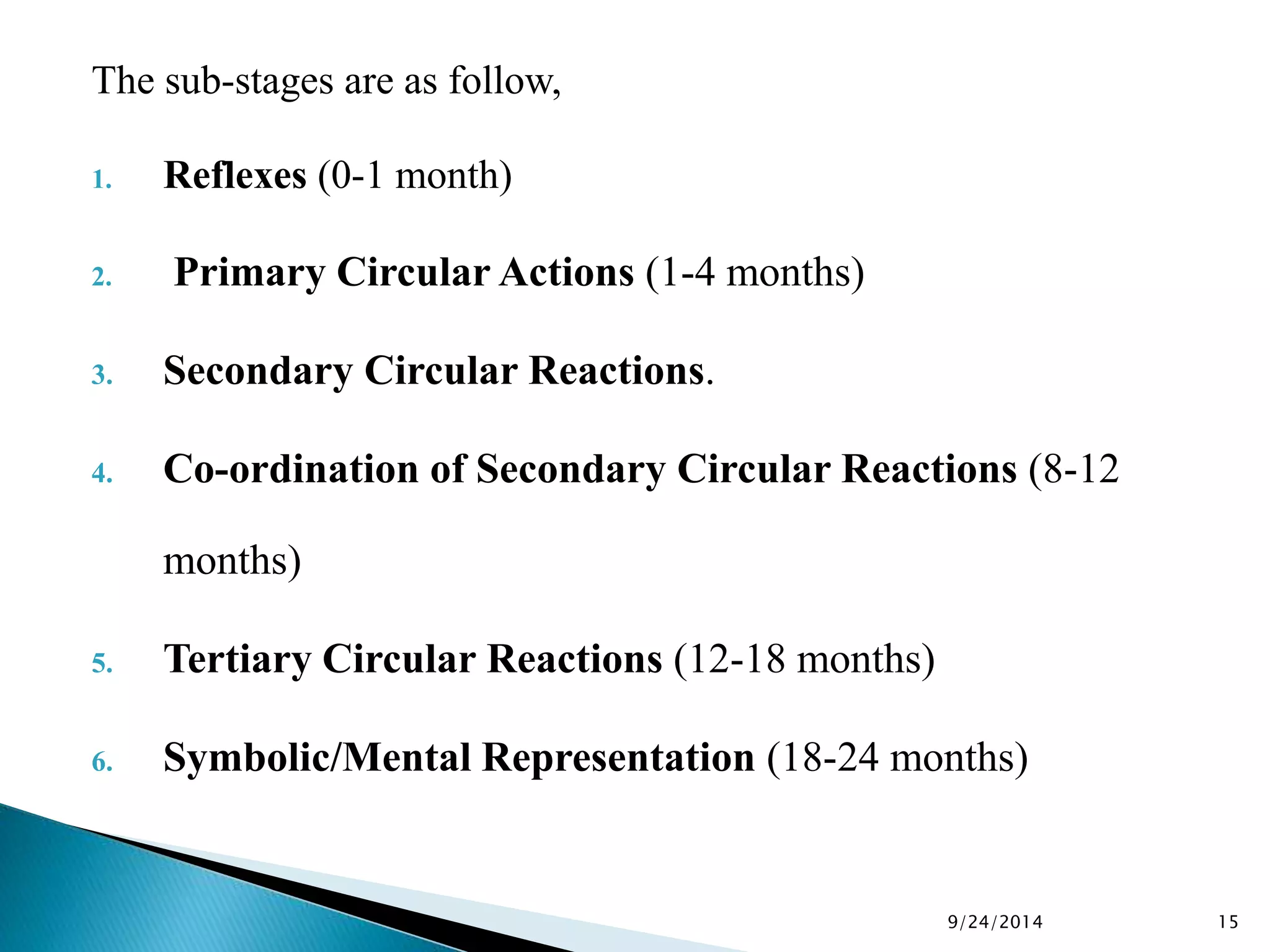
 The child utilizes innate behaviours to enhance 
this learning process, such as sucking, looking, 
grasping, crying and listening. 
9/24/2014 14
The sub-stages are as follow, 
1. Reflexes (0-1 month) 
2. Primary Circular Actions (1-4 months) 
3. Secondary Circular Reactions. 
4. Co-ordination of Secondary Circular Reactions (8-12 
months) 
5. Tertiary Circular Reactions (12-18 months) 
6. Symbolic/Mental Representation (18-24 months) 
9/24/2014 15
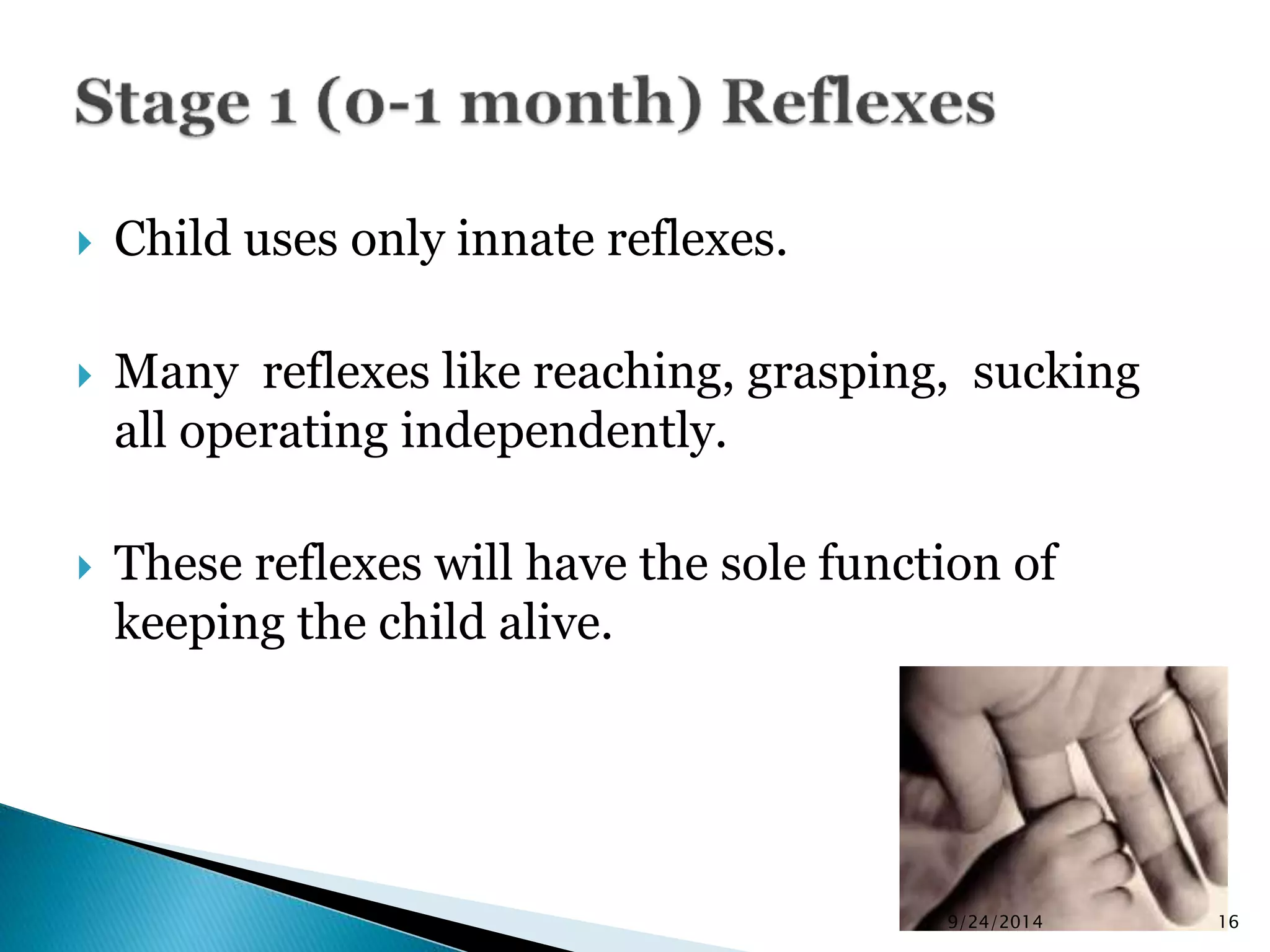
 Child uses only innate reflexes. 
 Many reflexes like reaching, grasping, sucking 
all operating independently. 
 These reflexes will have the sole function of 
keeping the child alive. 
9/24/2014 16
 Stage of Primary Circular Reactions. 
Circular- repetition. 
Primary- centre on infant's own body 
 Child now has a fixation with it’s own body with regards 
to behaviour. 
 They will perform actions repeatedly on themselves 
 They also begin to refine reflexes here to form more 
complex versions of them. 
Example: thumb-sucking. 
9/24/2014 17
 Stage of Secondary Circular Reactions 
 Child begins to take an interest in 
their environment 
 They notice that they can actually influence events 
in their world. 
 Infant will not make conscious connections between 
what they do and the consequences, they merely 
observe that their actions have interesting effects. 
9/24/2014 18
 Co-ordination of Secondary Circular 
Reactions 
 Child begins to engage in goal-directed 
behavior. 
 Begin to develop cause-effect relationships. 
 The child effectively knows that their behavior 
will have a certain consequence. 
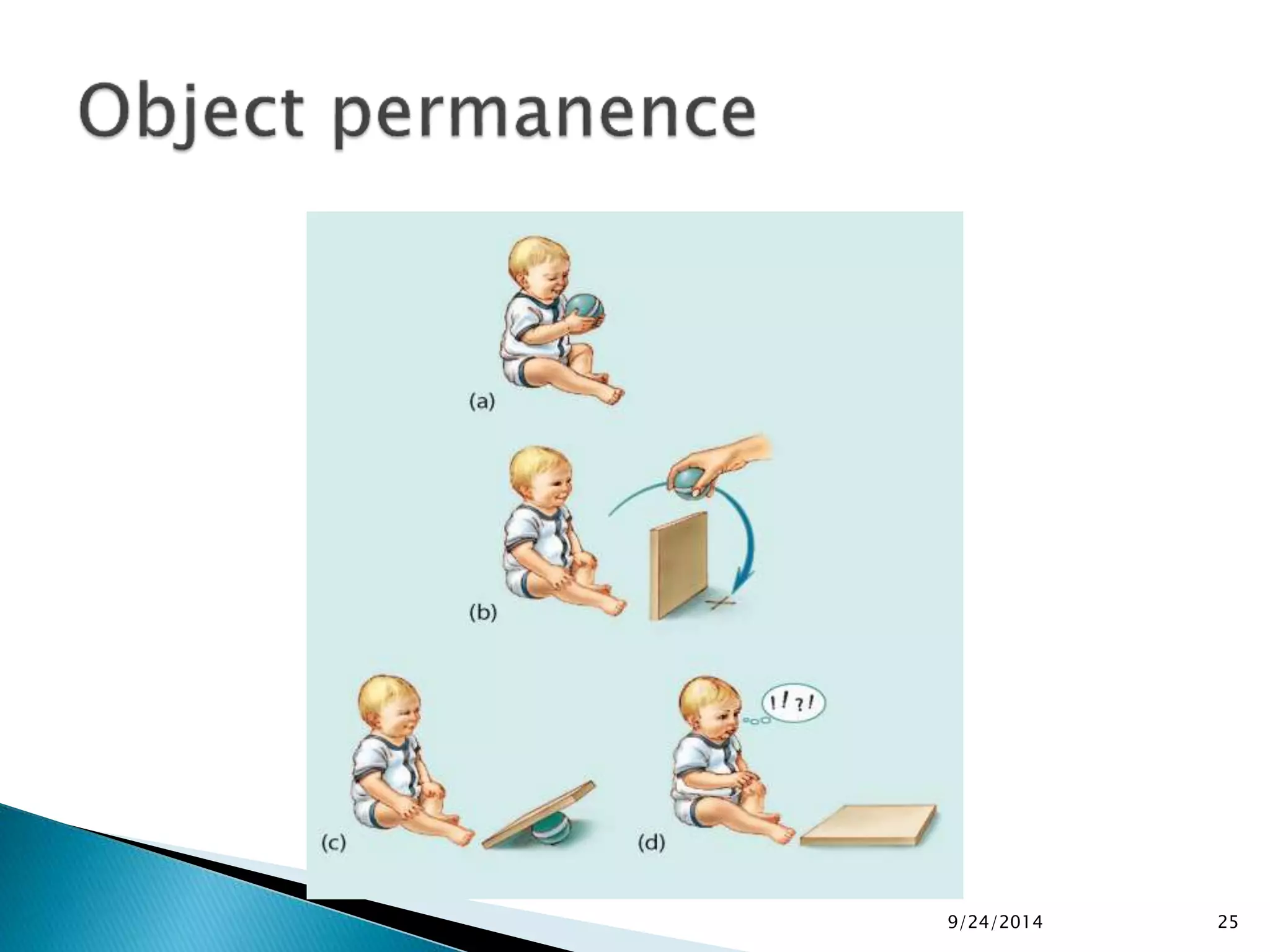
 At this stage, object permanence is acquired. 
9/24/2014 19
 Stage of Tertiary Circular Reactions. 
 At this stage, children like to use creativity and 
flexibility with their previous behaviors. 
 Result of their experimentation often leads to 
different outcomes. 
9/24/2014 20
 Symbolic/Mental Representation. 
 At this stage, the child develops symbolic thought and 
the ability to mentally represent objects in their head. 
 Normally, the child would need to resort to trial-and-error 
to achieve a desired effect. 
 Child can ‘plan’ to some extent and mentally construct 
the consequences of an action in their head. 
 Predictions are not always accurate, but it is a step up 
from trial-and-error. 
9/24/2014 21
 Sensory-motor period culminates with the 
emergence of the Symbolic function. 
 An idea or mental image is used to stand-in 
for a perceptually absent object. 
 Trial-and-error problem solving does not 
need to enacted but can undertaken through 
mental combination. 
9/24/2014 22
MENTAL REPRESENTATION IN 
CHILDREN 
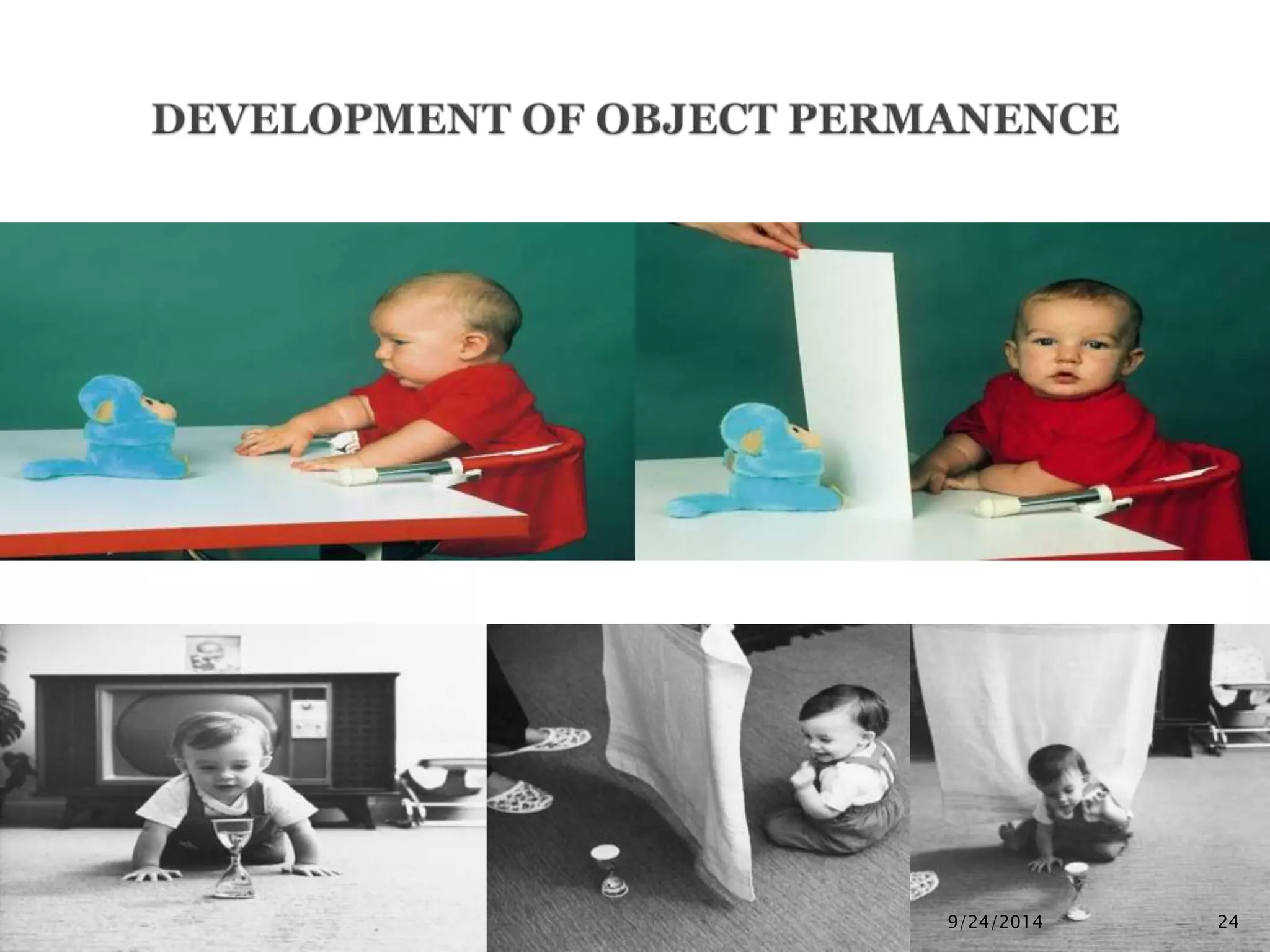
 Object permanence 
Object permanence is when objects 
exist even when out of sight. 
9/24/2014 23
9/24/2014 24
9/24/2014 25
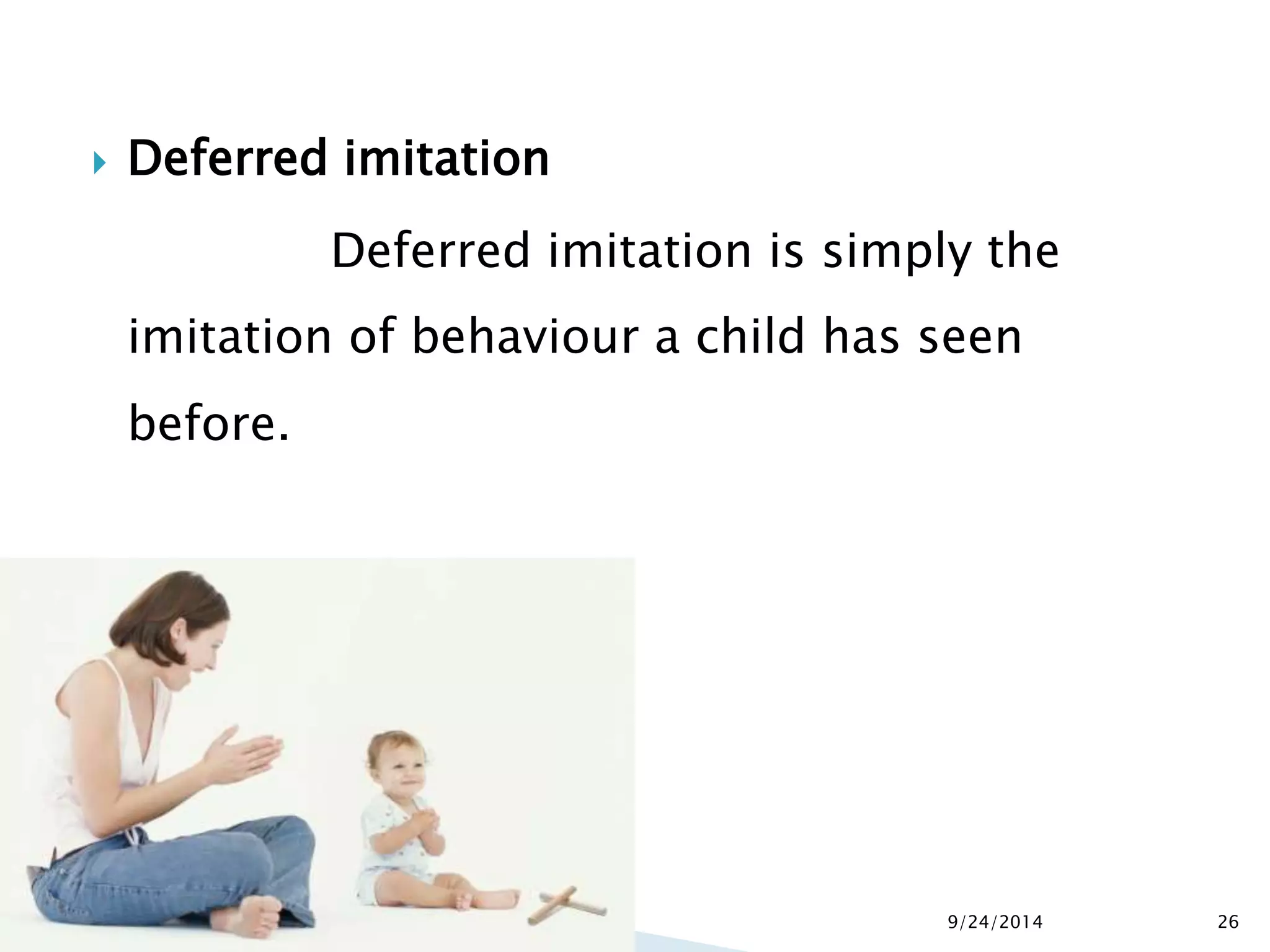
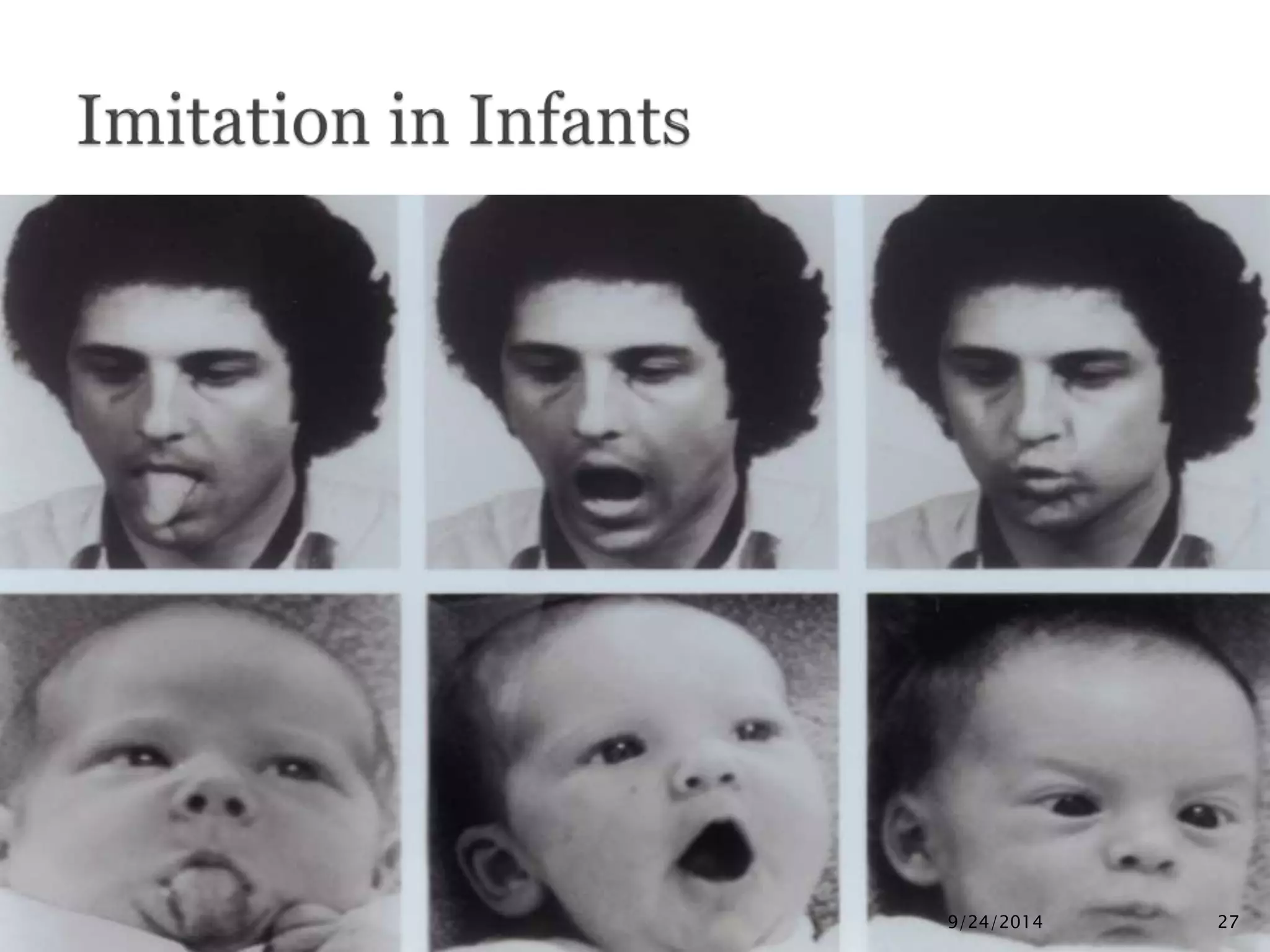
 Deferred imitation 
Deferred imitation is simply the 
imitation of behaviour a child has seen 
before. 
9/24/2014 26
9/24/2014 27
 (Pre)Operatory Thought is any procedure for 
mentally acting on objects. The hallmark of the 
preoperational stage is sparse and logically 
inadequate mental operations. 
9/24/2014 28
 Child learns to use and to represent objects by images, 
words, and drawings. 
 Child is able to form stable concepts as well as mental 
reasoning and magical beliefs. 
 Child however is still not able to perform operations; 
tasks that the child can do mentally rather than 
physically. 
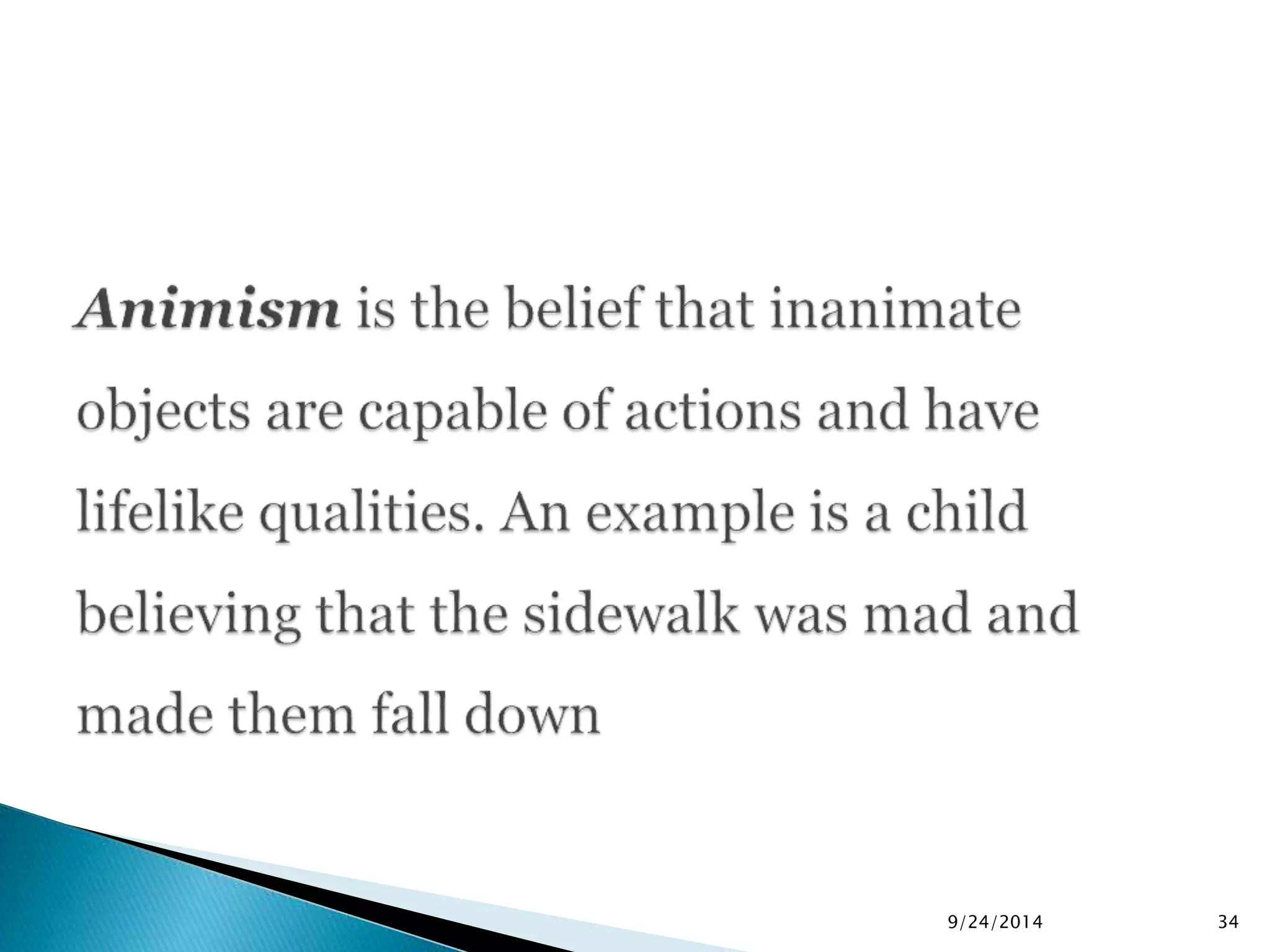
 Thinking is egocentric 
 Child has difficulty taking the viewpoint of others. 
9/24/2014 29
Two substages are, 
1. The symbolic function substage. 
2. The intuitive thought substage. 
9/24/2014 30
 Occurs between about the ages of 2 and 7. 
 During 2-4 years old, kids cannot yet manipulate and 
transform information in logical ways, but they now 
can think in images and symbols. 
 The child is able to formulate designs of objects that 
are not present. 
 Although there is an advancement in progress, there 
are still limitations such as egocentrism and animism. 
9/24/2014 31
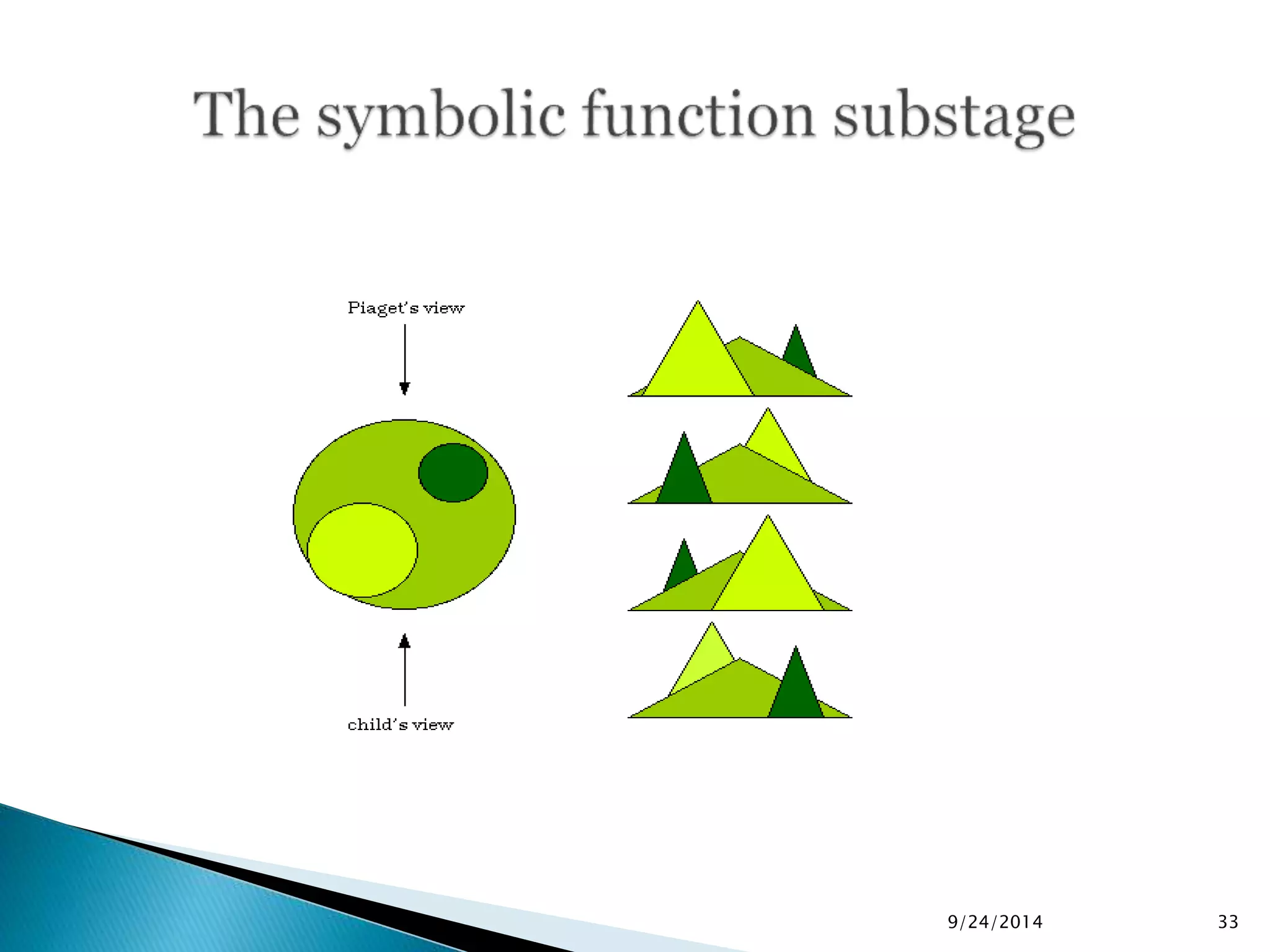
 Egocentrism occurs when a child is unable to 
distinguish between their own perspective and 
that of another person's. 
 Children tend to pick their own view of what they 
see rather than the actual view shown to others. 
 An example is an experiment performed by Piaget 
and Barbel Inhelder. Three views of a mountain 
are shown and the child is asked what a traveling 
doll would see at the various angles; the child 
picks their own view compared to the actual view 
of the doll. 
9/24/2014 32
9/24/2014 33
9/24/2014 34
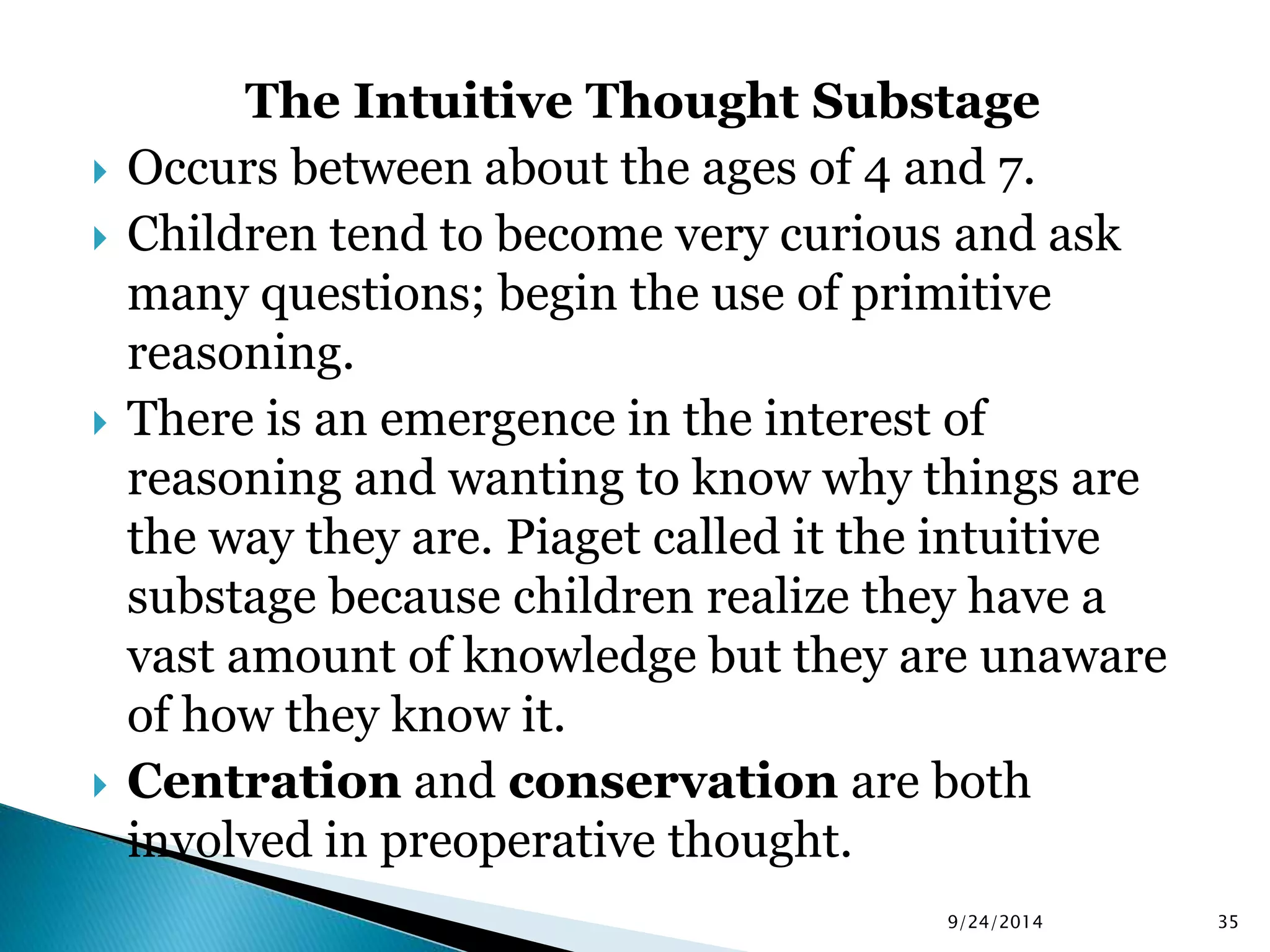
The Intuitive Thought Substage 
 Occurs between about the ages of 4 and 7. 
 Children tend to become very curious and ask 
many questions; begin the use of primitive 
reasoning. 
 There is an emergence in the interest of 
reasoning and wanting to know why things are 
the way they are. Piaget called it the intuitive 
substage because children realize they have a 
vast amount of knowledge but they are unaware 
of how they know it. 
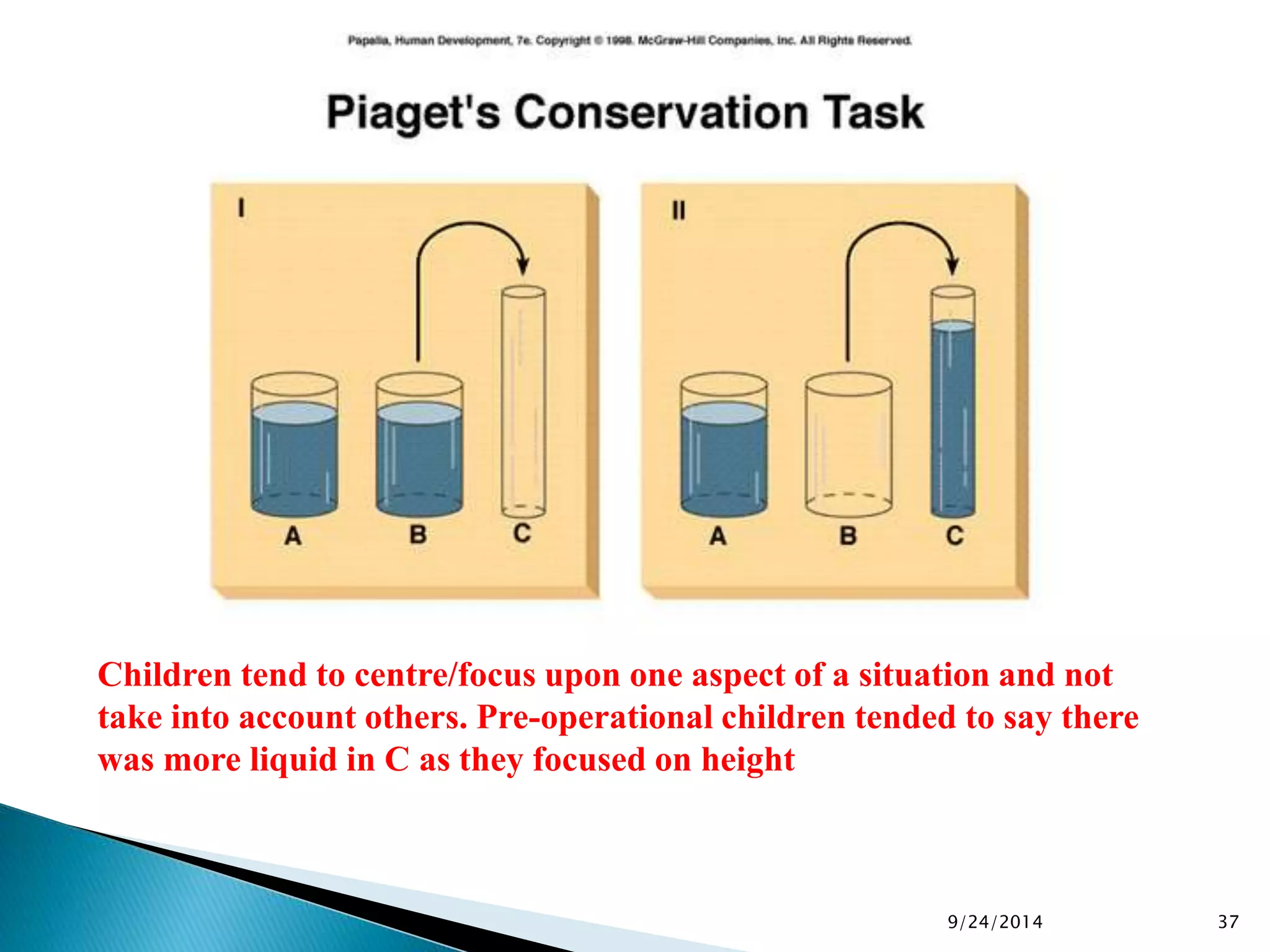
 Centration and conservation are both 
involved in preoperative thought. 
9/24/2014 35
9/24/2014 36
Children tend to centre/focus upon one aspect of a situation and not 
take into account others. Pre-operational children tended to say there 
was more liquid in C as they focused on height 
9/24/2014 37
 Occurs between the ages of 7 and 11 years 
 Characterized by the appropriate use of logic. 
 During this stage, a child's thought processes 
become more mature and "adult like." 
9/24/2014 38
 Conservation 
 Decentering 
 Reversibilty 
 Serriation 
 Transitivity 
 Classification 
 Elimination of egocentrism 
 Logic 
9/24/2014 39
 Conservation 
The understanding that although an object’s 
appearance changes, it still stays the same in quantity. 
Redistributing an object does not affect its mass, 
number, or volume. For example, a child understands 
that when you pour a liquid into a different shaped 
glass, the amount of liquid stays the same. 
 Decentering 
The child now takes into account multiple aspects of 
a problem to solve it. For example, the child will no 
longer perceive an exceptionally wide but short cup to 
contain less than a normally wide, taller cup. 
9/24/2014 40
 Reversibility 
The child now understands that numbers or 
objects can be changed and then returned to their 
original state. For example, during this stage, a 
child understands that his or her favorite ball that 
deflates is not gone and can be filled with air and 
put back into play again. Another example would 
be that the child realizes that a ball of clay, once 
flattened, can be made into a ball of clay again. 
 Serriation 
The ability to sort objects in an order 
according to size, shape, or any other 
characteristic. For example, if given different-shaded 
objects they may make a color gradient. 
9/24/2014 41
 Transitivity 
Transitivity, which refers to the ability to 
recognize relationships among various things in a 
serial order. For example, when told to put away 
his books according to height, the child recognizes 
that he starts with placing the tallest one on one 
end of the bookshelf and the shortest one ends up 
at the other end. 
 Classification 
The ability to name and identify sets of objects 
according to appearance, size or other 
characteristic, including the idea that one set of 
objects can include another. 
9/24/2014 42
 Elimination of Egocentrism 
The ability to view things from another's 
perspective (even if they think incorrectly). Children 
in this stage can, however, only solve problems that 
apply to actual (concrete) objects or events, and not 
abstract concepts or hypothetical tasks. 
Understanding and knowing how to use full 
common sense has not been completely adapted yet. 
9/24/2014 43
 They start solving problems in a more logical fashion. 
 Children can only solve problems that apply to 
concrete events or objects. 
 Children in this stage commonly experience 
difficulties with figuring out logic in their heads. 
9/24/2014 44
 Children are able to incorporate inductive reasoning. 
Inductive reasoning involves drawing inferences from 
observations in order to make a generalization. 
 Deductive reasoning, which involves using a 
generalized principle in order to try to predict the 
outcome of an event. 
 
9/24/2014 45
Milestones of the concrete operational stage 
 Ability to distinguish between their own thoughts 
and the thoughts of others. 
 Increased classification skills 
 Ability to think logically about objects and events. 
 Ability to fluently perform mathematical problems 
in both addition and subtraction. 
9/24/2014 46
 Commences at around 11 years of age (puberty) 
continues into adulthood. 
 Individuals move beyond concrete experiences 
and begin to think abstractly, reason logically and 
draw conclusions from the information available, 
as well as apply all these processes to hypothetical 
situations. 
9/24/2014 47
 Solve problems in a trial-and-error fashion. 
 Adolescents begin to think more as a 
scientist thinks, devising plans to solve 
problems and systematically testing 
solutions. 
9/24/2014 48
•They use hypothetical-deductive reasoning, 
which means that they develop hypotheses or 
best guesses, and systematically deduce, or 
conclude, which is the best path to follow in 
solving the problem. 
9/24/2014 49
 During this stage the adolescent is able to 
understand such things as love, "shades of 
gray", logical proofs and values. 
 During this stage the young person begins to 
entertain possibilities for the future and is 
fascinated with what they can be. 
9/24/2014 50
 Adolescent Egocentrism governs the way that 
adolescents think about social matters and is the 
heightened self-consciousness in them as they are 
which is reflected in their sense of personal 
uniqueness and invincibility. 
 Adolescent egocentrism can be dissected into two 
types of social thinking. 
◦ Imaginary audience that involves attention getting 
behavio 
◦ Personal fable which involves an adolescent's sense of 
personal uniqueness and invincibility. 
9/24/2014 51
PRACTICAL APPLICATIONS 
 Parents can use Piaget's theory when deciding how 
to support what to buy in order to support their 
child's growth. 
 Teachers can use this when discussing whether the 
syllabus subjects are suitable for the level of 
students or not. 
9/24/2014 52
 Teacher who work with children in both the 
preoperational and the concrete operational levels of 
cognitive development should adopt suitable academic 
expectations with regard to children's cognitive 
developmental abilities. 
 The need for educators to individualize and adopt 
appropriate academic expectations appears to be most 
relevant for children at the first-grade level. 
9/24/2014 53
STRENGTHS OF PIAGET’S THEORY 
 Piaget was an inspiration to many who came after and 
took up his ideas. 
 Piaget's ideas have generated a huge amount of 
research which has increased our understanding of 
cognitive development. 
 His ideas have been of practical use in understanding 
and communicating with children, particularly in the 
field of education (re: Discovery Learning). 
9/24/2014 54
Weaknesses 
 Progress to the formal operational stage is 
not guaranteed. 
 Piaget failed to consider the effect that the 
social setting and culture may have on 
cognitive development. 
 Piaget’s methods (observation and clinical 
interviews) are more open to biased 
interpretation than other methods. Because 
Piaget conducted the observations alone data 
collect are based on his own subjective 
interpretation of events. 
9/24/2014 55
 Piaget underestimated the abilities of children 
because his tests were sometimes confusing 
or difficult to understand. 
 The concept of schema is incompatible with 
the theories of Bruner and Vygotsky. 
 Behaviorism would also refute Piaget’s 
schema theory because is cannot be directly 
observed as it is an internal process. 
 Piaget carried out his studies with a handful 
of participants. This sample is biased, and 
accordingly the results of these studies 
cannot be generalized to children from 
different cultures. 
9/24/2014 56
 Kohlberg 
 Gilligan 
 Youniss 
 Anne Nelley & Perret Clermont 
9/24/2014 57
 Children’s thinking is affected by their knowledge of the 
social community (which is learnt from either technical or 
psychological cultural tools). 
 Language is the most important tool for gaining this social 
knowledge; the child can be taught this from other people via 
language. 
 Intelligence as “the capacity to learn from instruction”. 
 Need for a more knowledgable other person or ‘teacher’. He 
referred to them as just that: the More Knowledgable 
Other (MKO). MKO’s can be parents, adults, teachers, 
coaches, experts/professionals, other children, friends and 
computers. 
9/24/2014 58
 He described zone of proximal 
development (ZPD), as a key feature of his 
theory. There are two levels of attainment for 
the ZPD: 
◦ Level 1 – the ‘present level of development’. This 
describes what the child is capable of doing without 
any help from others. 
◦ Level 2 – the ‘potential level of development’. This 
means what the child could potentially be capable 
of with help from other people or ‘teachers’. 
◦ The gap between level 1 and 2 (the present and 
potential development) is what Vygotsky described 
as this zone of proximal development. 
9/24/2014 59
 Vygotsky looked at the role of egocentric/private 
speech. This is, for example, when a child will sit 
on their own and speak their thoughts out loud 
as they play. 
 This verbal thinking forms the basis for higher 
level, more abstract thinking (planning, 
reasoning, memorising, evaluating). 
9/24/2014 60
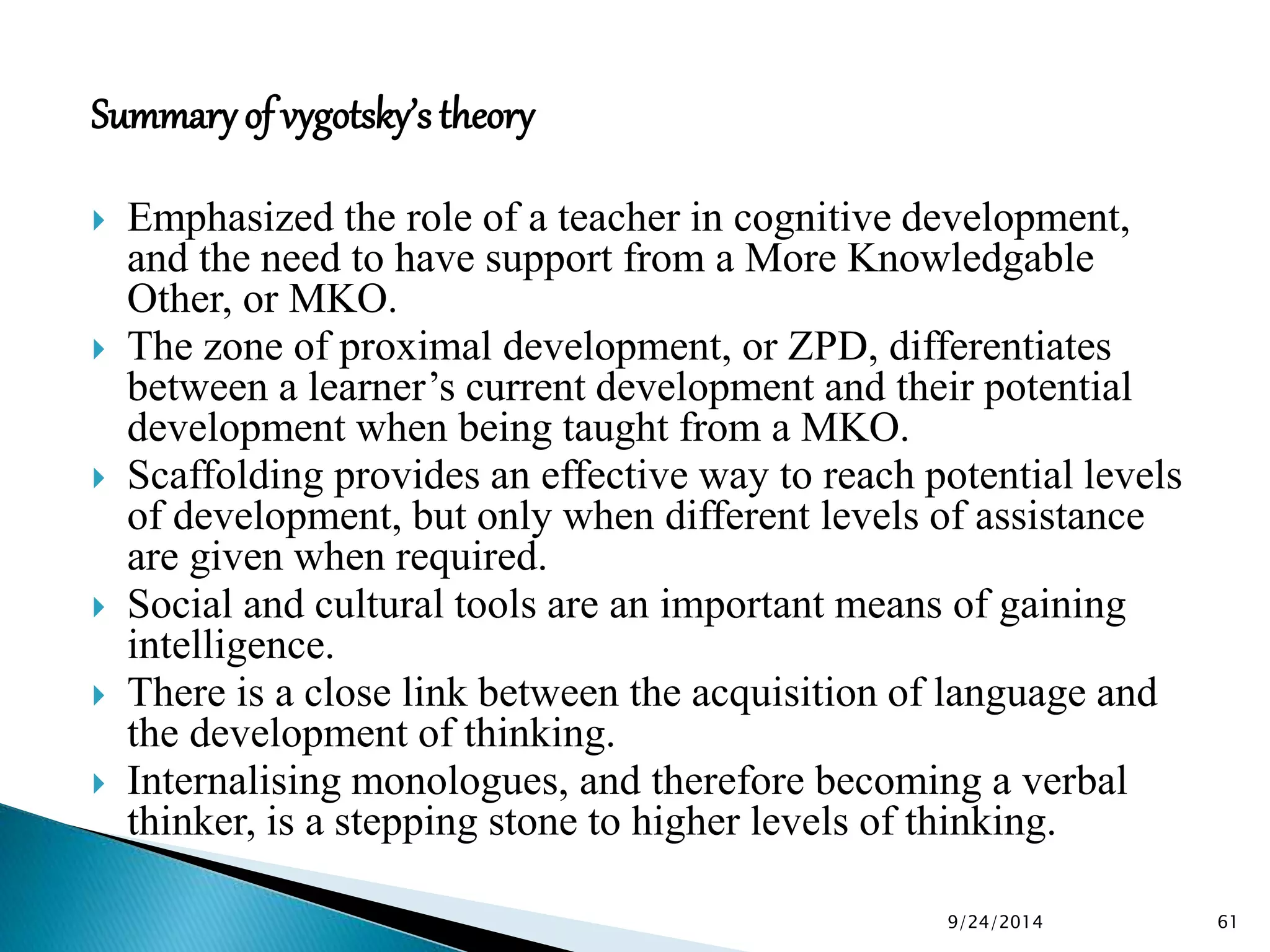
Summary of vygotsky’s theory 
 Emphasized the role of a teacher in cognitive development, 
and the need to have support from a More Knowledgable 
Other, or MKO. 
 The zone of proximal development, or ZPD, differentiates 
between a learner’s current development and their potential 
development when being taught from a MKO. 
 Scaffolding provides an effective way to reach potential levels 
of development, but only when different levels of assistance 
are given when required. 
 Social and cultural tools are an important means of gaining 
intelligence. 
 There is a close link between the acquisition of language and 
the development of thinking. 
 Internalising monologues, and therefore becoming a verbal 
thinker, is a stepping stone to higher levels of thinking. 
9/24/2014 61
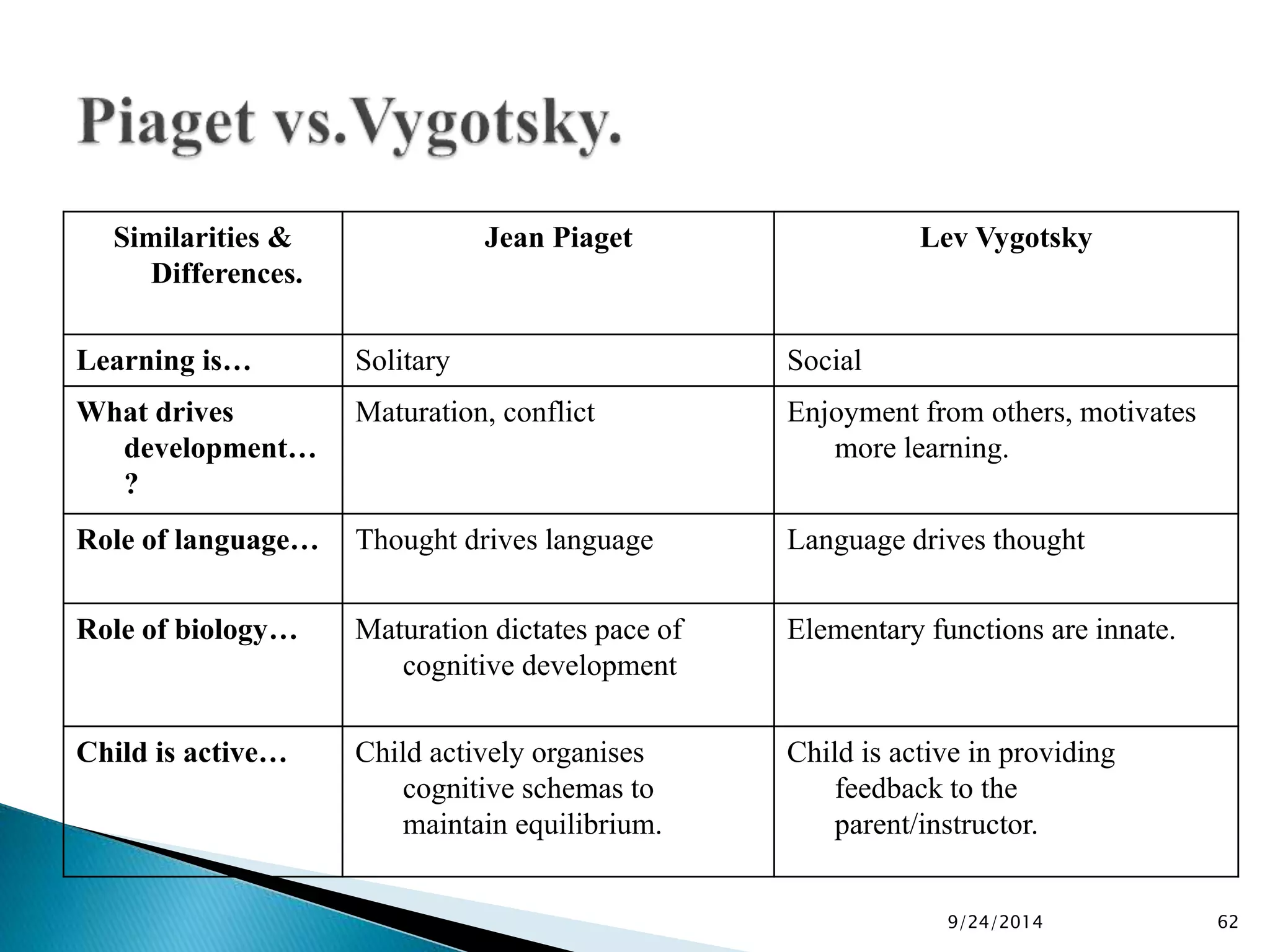
Similarities & 
Differences. 
Jean Piaget Lev Vygotsky 
Learning is… Solitary Social 
What drives 
development… 
? 
Maturation, conflict Enjoyment from others, motivates 
more learning. 
Role of language… Thought drives language Language drives thought 
Role of biology… Maturation dictates pace of 
cognitive development 
Elementary functions are innate. 
Child is active… Child actively organises 
cognitive schemas to 
maintain equilibrium. 
Child is active in providing 
feedback to the 
parent/instructor. 
9/24/2014 62
Cognitive developmental theory 
& 
Nurses 
9/24/2014 63
9/24/2014 64 
THANK YOU

Cognitive developmental theory Jean Piaget

  • 1.
  • 2.
    Submitted by PremnathR Ist year MSc Nursing Govt CON Kottayam 9/24/2014 2
  • 3.
    Theory of cognitivedevelopment is a comprehensive theory about the nature and development of human intelligence.  Known as Developmental Stage Theory. 9/24/2014 3
  • 4.
     It dealswith the nature of knowledge itself and how humans come gradually to acquire it, construct it, and use it. 9/24/2014 4
  • 5.
     Piaget’s CognitiveDevelopmental Theory.  Vygotsky’s Cognitive Developmental Theory. 9/24/2014 5
  • 6.
    August 9 1896– September 16 1980 9/24/2014 6
  • 7.
     Reality isa dynamic system of continuous change.  He argued that reality involves transformations and states. Transformations refer to all manners of changes that a thing or person can undergo. States refer to the conditions or the appearances in which things or persons can be found between transformations.  Human intelligence is adaptive. Two types of intelligence, namely Operative intelligence Figurative intelligence 9/24/2014 7
  • 8.
     Operative intelligenceinvolves all actions, overt or covert, undertaken in order to follow, recover, or anticipate the transformations of the objects or persons of interest.  Figurative intelligence is the more or less static aspect of intelligence, involving all means of representation used to retain in mind the states (i.e., successive forms, shapes, or locations) that intervene between transformations. That is, it involves perception, imitation, mental imagery, drawing, and language. 9/24/2014 8
  • 9.
     Piaget believedthat this process of understanding and change involves two basic functions: Assimilation and accommodation:  Assimilation is the process of taking one’s environment and new information and fitting it into pre-existing cognitive schemas.  Accommodation, unlike assimilation is the process of taking one's environment and new information, and altering one's pre-existing schemas in order to fit in the new information. 9/24/2014 9
  • 10.
    Key concepts are, Schema Assimilation Accommodation Adaptation Equilibrium 9/24/2014 10
  • 11.
     STAGE I:THE SENSORIMOTOR STAGE  STAGE II: PREOPERATIONAL STAGE  STAGE III: CONCRETE OPERATIONAL STAGE  STAGE IV: FORMAL OPERATIONAL STAGE 9/24/2014 11
  • 12.
  • 13.
     Occurs frombirth to approximately 2 years old.  The child tries to make sense of the world during this stage, and as the name suggests, only senses and motor abilities are used to do so. 9/24/2014 13
  • 14.
     The childutilizes innate behaviours to enhance this learning process, such as sucking, looking, grasping, crying and listening. 9/24/2014 14
  • 15.
    The sub-stages areas follow, 1. Reflexes (0-1 month) 2. Primary Circular Actions (1-4 months) 3. Secondary Circular Reactions. 4. Co-ordination of Secondary Circular Reactions (8-12 months) 5. Tertiary Circular Reactions (12-18 months) 6. Symbolic/Mental Representation (18-24 months) 9/24/2014 15
  • 16.
     Child usesonly innate reflexes.  Many reflexes like reaching, grasping, sucking all operating independently.  These reflexes will have the sole function of keeping the child alive. 9/24/2014 16
  • 17.
     Stage ofPrimary Circular Reactions. Circular- repetition. Primary- centre on infant's own body  Child now has a fixation with it’s own body with regards to behaviour.  They will perform actions repeatedly on themselves  They also begin to refine reflexes here to form more complex versions of them. Example: thumb-sucking. 9/24/2014 17
  • 18.
     Stage ofSecondary Circular Reactions  Child begins to take an interest in their environment  They notice that they can actually influence events in their world.  Infant will not make conscious connections between what they do and the consequences, they merely observe that their actions have interesting effects. 9/24/2014 18
  • 19.
     Co-ordination ofSecondary Circular Reactions  Child begins to engage in goal-directed behavior.  Begin to develop cause-effect relationships.  The child effectively knows that their behavior will have a certain consequence.  At this stage, object permanence is acquired. 9/24/2014 19
  • 20.
     Stage ofTertiary Circular Reactions.  At this stage, children like to use creativity and flexibility with their previous behaviors.  Result of their experimentation often leads to different outcomes. 9/24/2014 20
  • 21.
     Symbolic/Mental Representation.  At this stage, the child develops symbolic thought and the ability to mentally represent objects in their head.  Normally, the child would need to resort to trial-and-error to achieve a desired effect.  Child can ‘plan’ to some extent and mentally construct the consequences of an action in their head.  Predictions are not always accurate, but it is a step up from trial-and-error. 9/24/2014 21
  • 22.
     Sensory-motor periodculminates with the emergence of the Symbolic function.  An idea or mental image is used to stand-in for a perceptually absent object.  Trial-and-error problem solving does not need to enacted but can undertaken through mental combination. 9/24/2014 22
  • 23.
    MENTAL REPRESENTATION IN CHILDREN  Object permanence Object permanence is when objects exist even when out of sight. 9/24/2014 23
  • 24.
  • 25.
  • 26.
     Deferred imitation Deferred imitation is simply the imitation of behaviour a child has seen before. 9/24/2014 26
  • 27.
  • 28.
     (Pre)Operatory Thoughtis any procedure for mentally acting on objects. The hallmark of the preoperational stage is sparse and logically inadequate mental operations. 9/24/2014 28
  • 29.
     Child learnsto use and to represent objects by images, words, and drawings.  Child is able to form stable concepts as well as mental reasoning and magical beliefs.  Child however is still not able to perform operations; tasks that the child can do mentally rather than physically.  Thinking is egocentric  Child has difficulty taking the viewpoint of others. 9/24/2014 29
  • 30.
    Two substages are, 1. The symbolic function substage. 2. The intuitive thought substage. 9/24/2014 30
  • 31.
     Occurs betweenabout the ages of 2 and 7.  During 2-4 years old, kids cannot yet manipulate and transform information in logical ways, but they now can think in images and symbols.  The child is able to formulate designs of objects that are not present.  Although there is an advancement in progress, there are still limitations such as egocentrism and animism. 9/24/2014 31
  • 32.
     Egocentrism occurswhen a child is unable to distinguish between their own perspective and that of another person's.  Children tend to pick their own view of what they see rather than the actual view shown to others.  An example is an experiment performed by Piaget and Barbel Inhelder. Three views of a mountain are shown and the child is asked what a traveling doll would see at the various angles; the child picks their own view compared to the actual view of the doll. 9/24/2014 32
  • 33.
  • 34.
  • 35.
    The Intuitive ThoughtSubstage  Occurs between about the ages of 4 and 7.  Children tend to become very curious and ask many questions; begin the use of primitive reasoning.  There is an emergence in the interest of reasoning and wanting to know why things are the way they are. Piaget called it the intuitive substage because children realize they have a vast amount of knowledge but they are unaware of how they know it.  Centration and conservation are both involved in preoperative thought. 9/24/2014 35
  • 36.
  • 37.
    Children tend tocentre/focus upon one aspect of a situation and not take into account others. Pre-operational children tended to say there was more liquid in C as they focused on height 9/24/2014 37
  • 38.
     Occurs betweenthe ages of 7 and 11 years  Characterized by the appropriate use of logic.  During this stage, a child's thought processes become more mature and "adult like." 9/24/2014 38
  • 39.
     Conservation Decentering  Reversibilty  Serriation  Transitivity  Classification  Elimination of egocentrism  Logic 9/24/2014 39
  • 40.
     Conservation Theunderstanding that although an object’s appearance changes, it still stays the same in quantity. Redistributing an object does not affect its mass, number, or volume. For example, a child understands that when you pour a liquid into a different shaped glass, the amount of liquid stays the same.  Decentering The child now takes into account multiple aspects of a problem to solve it. For example, the child will no longer perceive an exceptionally wide but short cup to contain less than a normally wide, taller cup. 9/24/2014 40
  • 41.
     Reversibility Thechild now understands that numbers or objects can be changed and then returned to their original state. For example, during this stage, a child understands that his or her favorite ball that deflates is not gone and can be filled with air and put back into play again. Another example would be that the child realizes that a ball of clay, once flattened, can be made into a ball of clay again.  Serriation The ability to sort objects in an order according to size, shape, or any other characteristic. For example, if given different-shaded objects they may make a color gradient. 9/24/2014 41
  • 42.
     Transitivity Transitivity,which refers to the ability to recognize relationships among various things in a serial order. For example, when told to put away his books according to height, the child recognizes that he starts with placing the tallest one on one end of the bookshelf and the shortest one ends up at the other end.  Classification The ability to name and identify sets of objects according to appearance, size or other characteristic, including the idea that one set of objects can include another. 9/24/2014 42
  • 43.
     Elimination ofEgocentrism The ability to view things from another's perspective (even if they think incorrectly). Children in this stage can, however, only solve problems that apply to actual (concrete) objects or events, and not abstract concepts or hypothetical tasks. Understanding and knowing how to use full common sense has not been completely adapted yet. 9/24/2014 43
  • 44.
     They startsolving problems in a more logical fashion.  Children can only solve problems that apply to concrete events or objects.  Children in this stage commonly experience difficulties with figuring out logic in their heads. 9/24/2014 44
  • 45.
     Children areable to incorporate inductive reasoning. Inductive reasoning involves drawing inferences from observations in order to make a generalization.  Deductive reasoning, which involves using a generalized principle in order to try to predict the outcome of an event.  9/24/2014 45
  • 46.
    Milestones of theconcrete operational stage  Ability to distinguish between their own thoughts and the thoughts of others.  Increased classification skills  Ability to think logically about objects and events.  Ability to fluently perform mathematical problems in both addition and subtraction. 9/24/2014 46
  • 47.
     Commences ataround 11 years of age (puberty) continues into adulthood.  Individuals move beyond concrete experiences and begin to think abstractly, reason logically and draw conclusions from the information available, as well as apply all these processes to hypothetical situations. 9/24/2014 47
  • 48.
     Solve problemsin a trial-and-error fashion.  Adolescents begin to think more as a scientist thinks, devising plans to solve problems and systematically testing solutions. 9/24/2014 48
  • 49.
    •They use hypothetical-deductivereasoning, which means that they develop hypotheses or best guesses, and systematically deduce, or conclude, which is the best path to follow in solving the problem. 9/24/2014 49
  • 50.
     During thisstage the adolescent is able to understand such things as love, "shades of gray", logical proofs and values.  During this stage the young person begins to entertain possibilities for the future and is fascinated with what they can be. 9/24/2014 50
  • 51.
     Adolescent Egocentrismgoverns the way that adolescents think about social matters and is the heightened self-consciousness in them as they are which is reflected in their sense of personal uniqueness and invincibility.  Adolescent egocentrism can be dissected into two types of social thinking. ◦ Imaginary audience that involves attention getting behavio ◦ Personal fable which involves an adolescent's sense of personal uniqueness and invincibility. 9/24/2014 51
  • 52.
    PRACTICAL APPLICATIONS Parents can use Piaget's theory when deciding how to support what to buy in order to support their child's growth.  Teachers can use this when discussing whether the syllabus subjects are suitable for the level of students or not. 9/24/2014 52
  • 53.
     Teacher whowork with children in both the preoperational and the concrete operational levels of cognitive development should adopt suitable academic expectations with regard to children's cognitive developmental abilities.  The need for educators to individualize and adopt appropriate academic expectations appears to be most relevant for children at the first-grade level. 9/24/2014 53
  • 54.
    STRENGTHS OF PIAGET’STHEORY  Piaget was an inspiration to many who came after and took up his ideas.  Piaget's ideas have generated a huge amount of research which has increased our understanding of cognitive development.  His ideas have been of practical use in understanding and communicating with children, particularly in the field of education (re: Discovery Learning). 9/24/2014 54
  • 55.
    Weaknesses  Progressto the formal operational stage is not guaranteed.  Piaget failed to consider the effect that the social setting and culture may have on cognitive development.  Piaget’s methods (observation and clinical interviews) are more open to biased interpretation than other methods. Because Piaget conducted the observations alone data collect are based on his own subjective interpretation of events. 9/24/2014 55
  • 56.
     Piaget underestimatedthe abilities of children because his tests were sometimes confusing or difficult to understand.  The concept of schema is incompatible with the theories of Bruner and Vygotsky.  Behaviorism would also refute Piaget’s schema theory because is cannot be directly observed as it is an internal process.  Piaget carried out his studies with a handful of participants. This sample is biased, and accordingly the results of these studies cannot be generalized to children from different cultures. 9/24/2014 56

  • 57.
     Kohlberg Gilligan  Youniss  Anne Nelley & Perret Clermont 9/24/2014 57
  • 58.
     Children’s thinkingis affected by their knowledge of the social community (which is learnt from either technical or psychological cultural tools).  Language is the most important tool for gaining this social knowledge; the child can be taught this from other people via language.  Intelligence as “the capacity to learn from instruction”.  Need for a more knowledgable other person or ‘teacher’. He referred to them as just that: the More Knowledgable Other (MKO). MKO’s can be parents, adults, teachers, coaches, experts/professionals, other children, friends and computers. 9/24/2014 58
  • 59.
     He describedzone of proximal development (ZPD), as a key feature of his theory. There are two levels of attainment for the ZPD: ◦ Level 1 – the ‘present level of development’. This describes what the child is capable of doing without any help from others. ◦ Level 2 – the ‘potential level of development’. This means what the child could potentially be capable of with help from other people or ‘teachers’. ◦ The gap between level 1 and 2 (the present and potential development) is what Vygotsky described as this zone of proximal development. 9/24/2014 59
  • 60.
     Vygotsky lookedat the role of egocentric/private speech. This is, for example, when a child will sit on their own and speak their thoughts out loud as they play.  This verbal thinking forms the basis for higher level, more abstract thinking (planning, reasoning, memorising, evaluating). 9/24/2014 60
  • 61.
    Summary of vygotsky’stheory  Emphasized the role of a teacher in cognitive development, and the need to have support from a More Knowledgable Other, or MKO.  The zone of proximal development, or ZPD, differentiates between a learner’s current development and their potential development when being taught from a MKO.  Scaffolding provides an effective way to reach potential levels of development, but only when different levels of assistance are given when required.  Social and cultural tools are an important means of gaining intelligence.  There is a close link between the acquisition of language and the development of thinking.  Internalising monologues, and therefore becoming a verbal thinker, is a stepping stone to higher levels of thinking. 9/24/2014 61
  • 62.
    Similarities & Differences. Jean Piaget Lev Vygotsky Learning is… Solitary Social What drives development… ? Maturation, conflict Enjoyment from others, motivates more learning. Role of language… Thought drives language Language drives thought Role of biology… Maturation dictates pace of cognitive development Elementary functions are innate. Child is active… Child actively organises cognitive schemas to maintain equilibrium. Child is active in providing feedback to the parent/instructor. 9/24/2014 62
  • 63.
    Cognitive developmental theory & Nurses 9/24/2014 63
  • 64.

Editor's Notes