A Topical Approach to   LIFE-SPAN DEVELOPMENT Chapter Nine: Language Development John W. Santrock
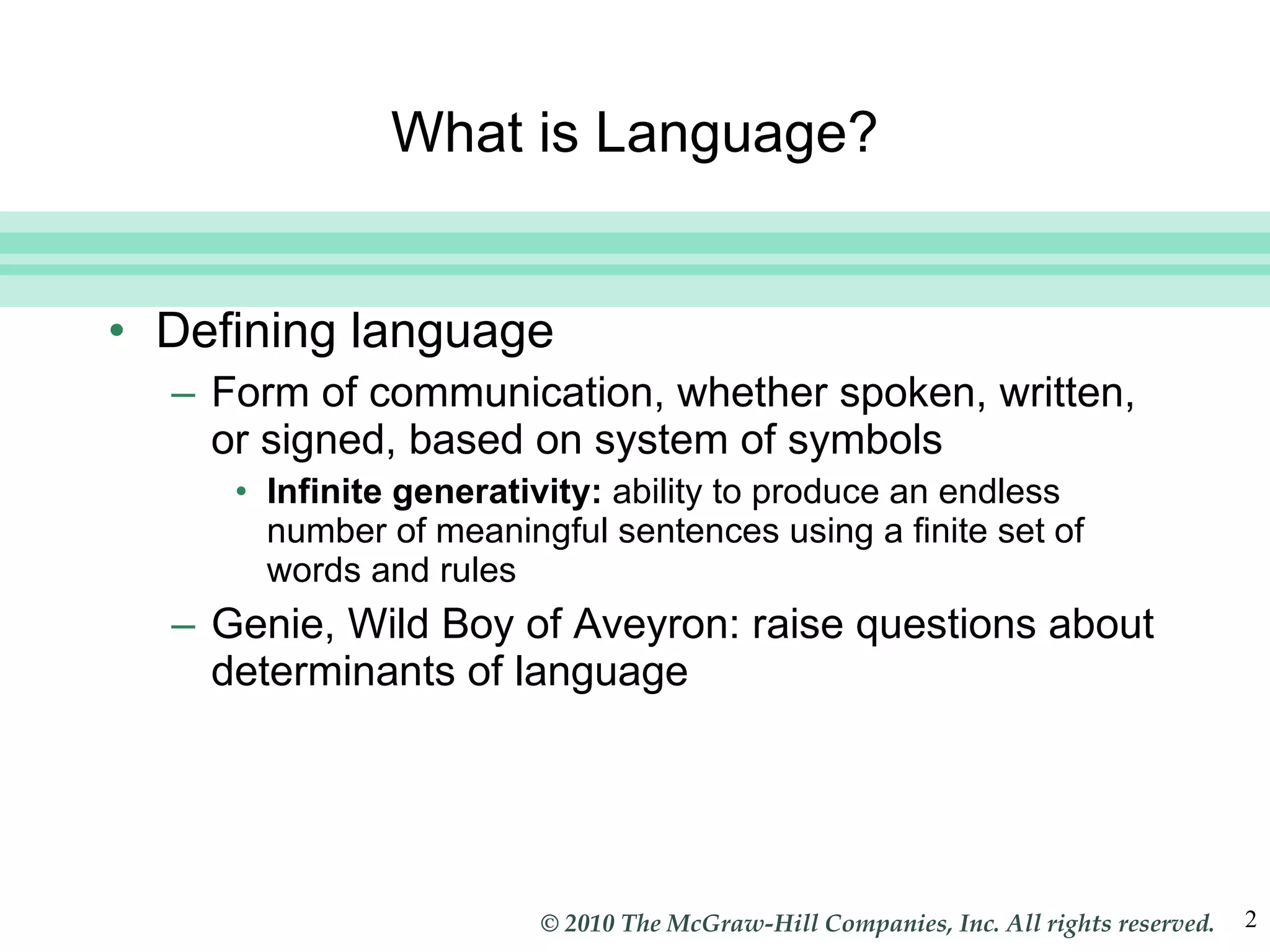
What is Language? Defining language Form of communication, whether spoken, written, or signed, based on system of symbols Infinite generativity:  ability to produce an endless number of meaningful sentences using a finite set of words and rules Genie, Wild Boy of Aveyron: raise questions about determinants of language
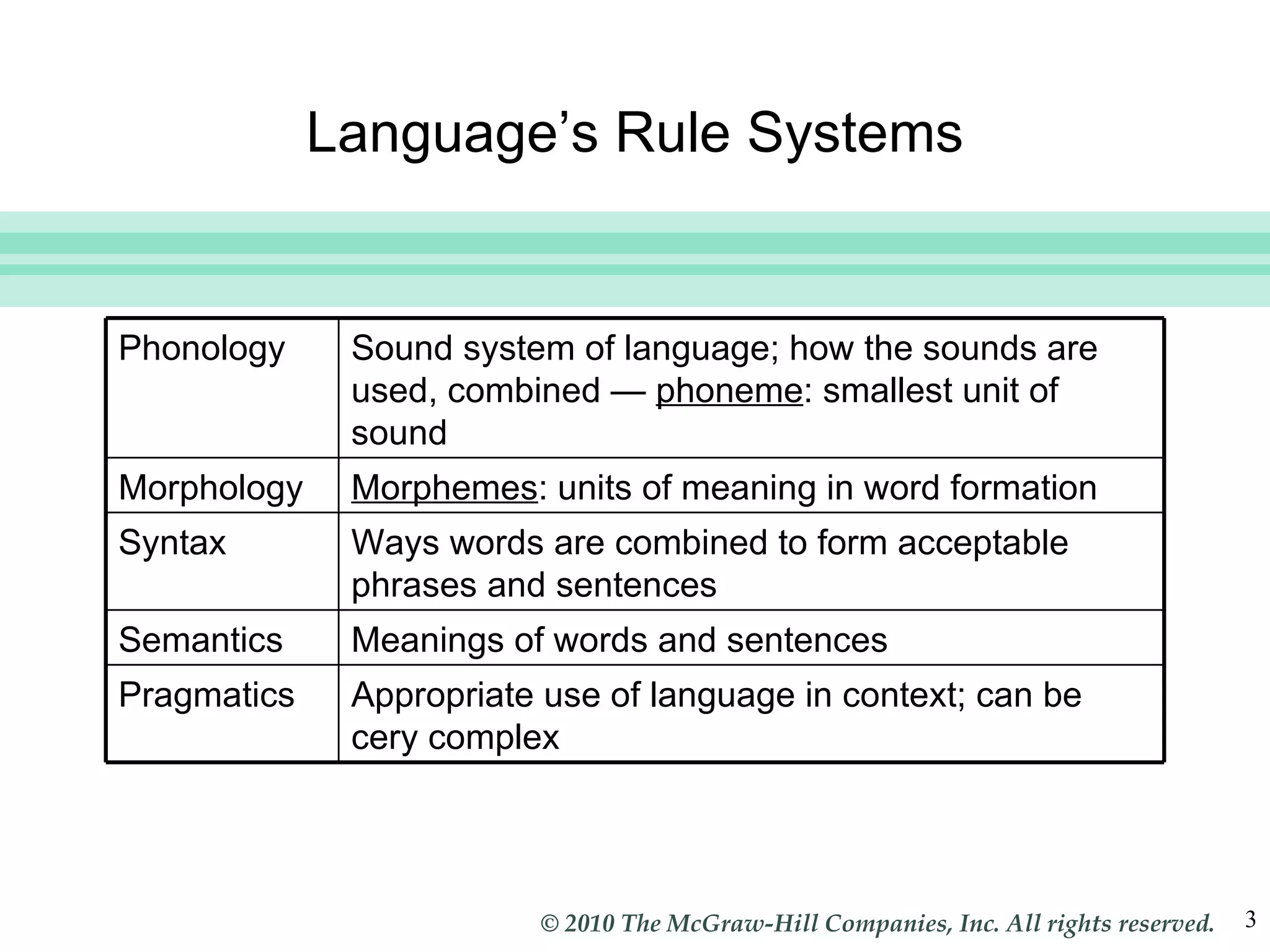
Language’s Rule Systems Phonology Sound system of language; how the sounds are used, combined —  phoneme : smallest unit of sound Morphology Morphemes : units of meaning in word formation Syntax  Ways words are combined to form acceptable phrases and sentences  Semantics Meanings of words and sentences Pragmatics Appropriate use of language in context; can be cery complex
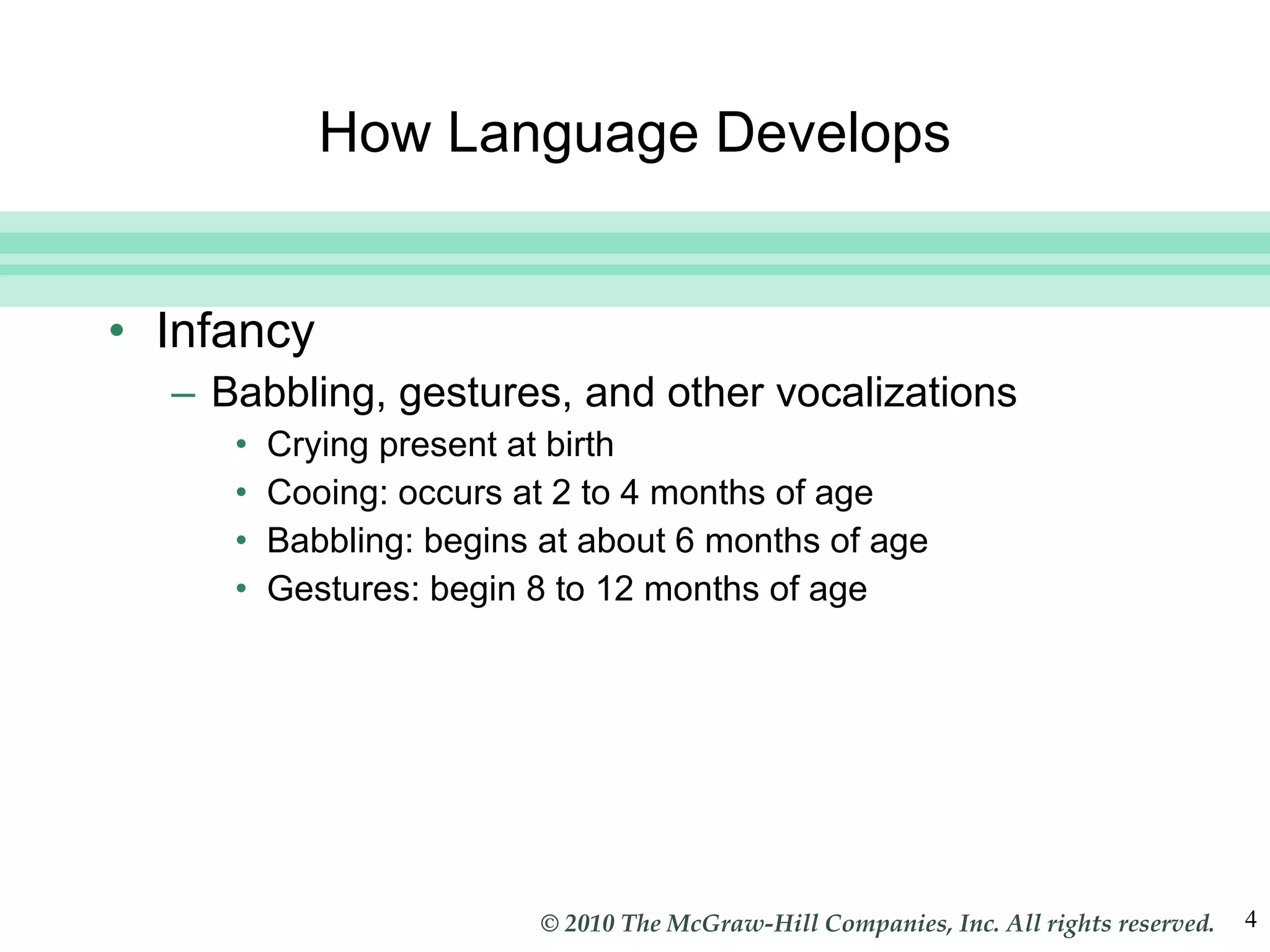
How Language Develops Infancy Babbling, gestures, and other vocalizations Crying present at birth Cooing: occurs at 2 to 4 months of age Babbling: begins at about 6 months of age Gestures: begin 8 to 12 months of age
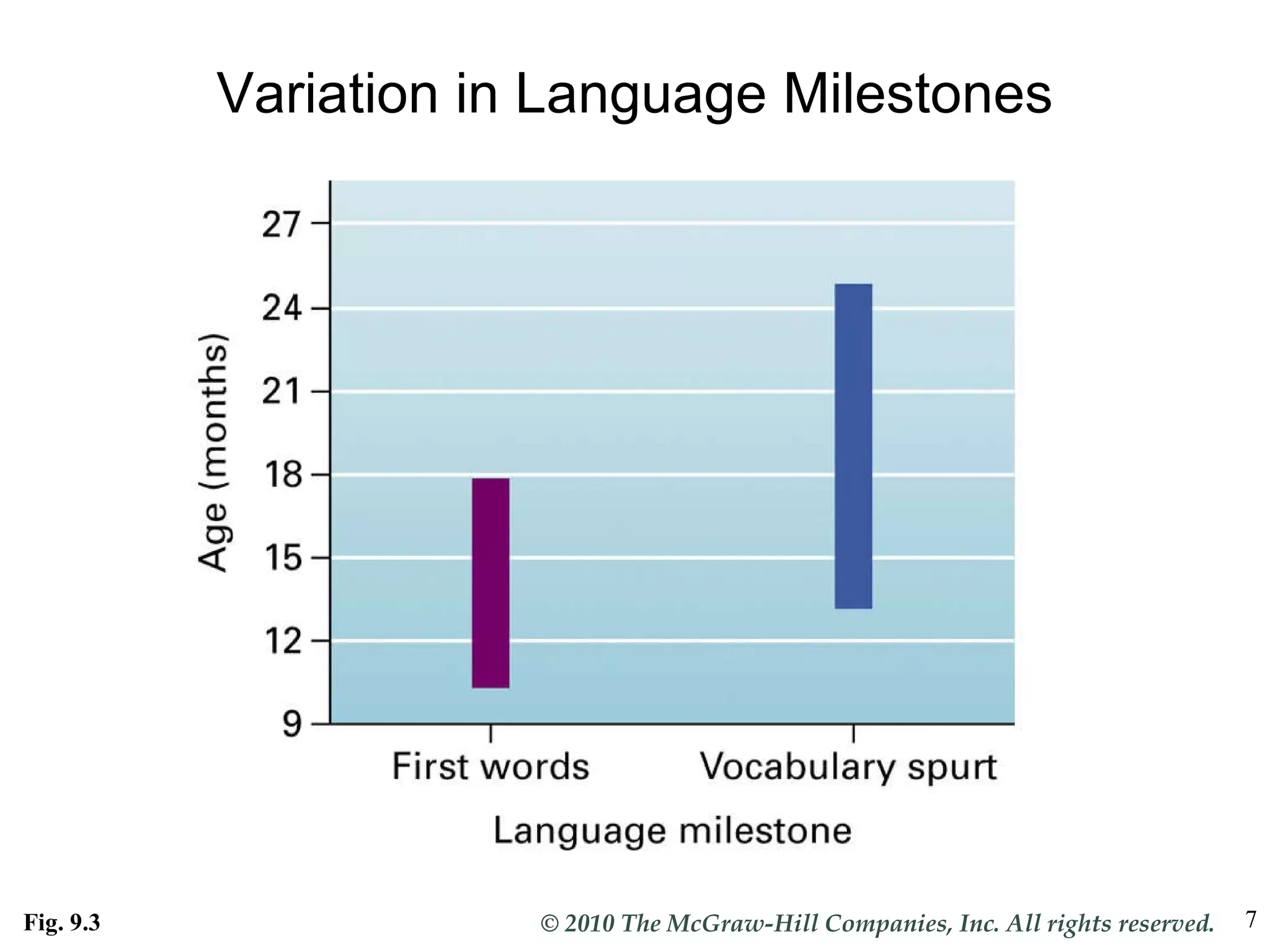
How Language Develops Infants recognizing language sounds “Citizens of the world” Newborns recognize sound changes Recognize  own  language sounds at 6 months First words Receptive  exceeds  spoken vocabulary Timing of first word, vocabulary spurt varies
How Language Develops Infants recognizing language sounds Asian child learns verbs earlier than child learning English Referential  and  expressive  styles Overextension  and  underextension  of words Two-word utterances (18-24 months of age) Telegraphic speech
Variation in Language Milestones Fig. 9.3
How Language Develops Early childhood Complex sentences at 2 to 3 years of age Become more sensitive to language sounds; morphology rules, some overgeneralizations Learn and apply syntax rules; auxillary-inversion rule takes longer
How Language Develops Early childhood Vocabulary development is dramatic to age 6 Fast mapping Many hypotheses why this occurs Give novel labels to novel objects Use of mutual exclusivity Benefit from hearing mature speakers
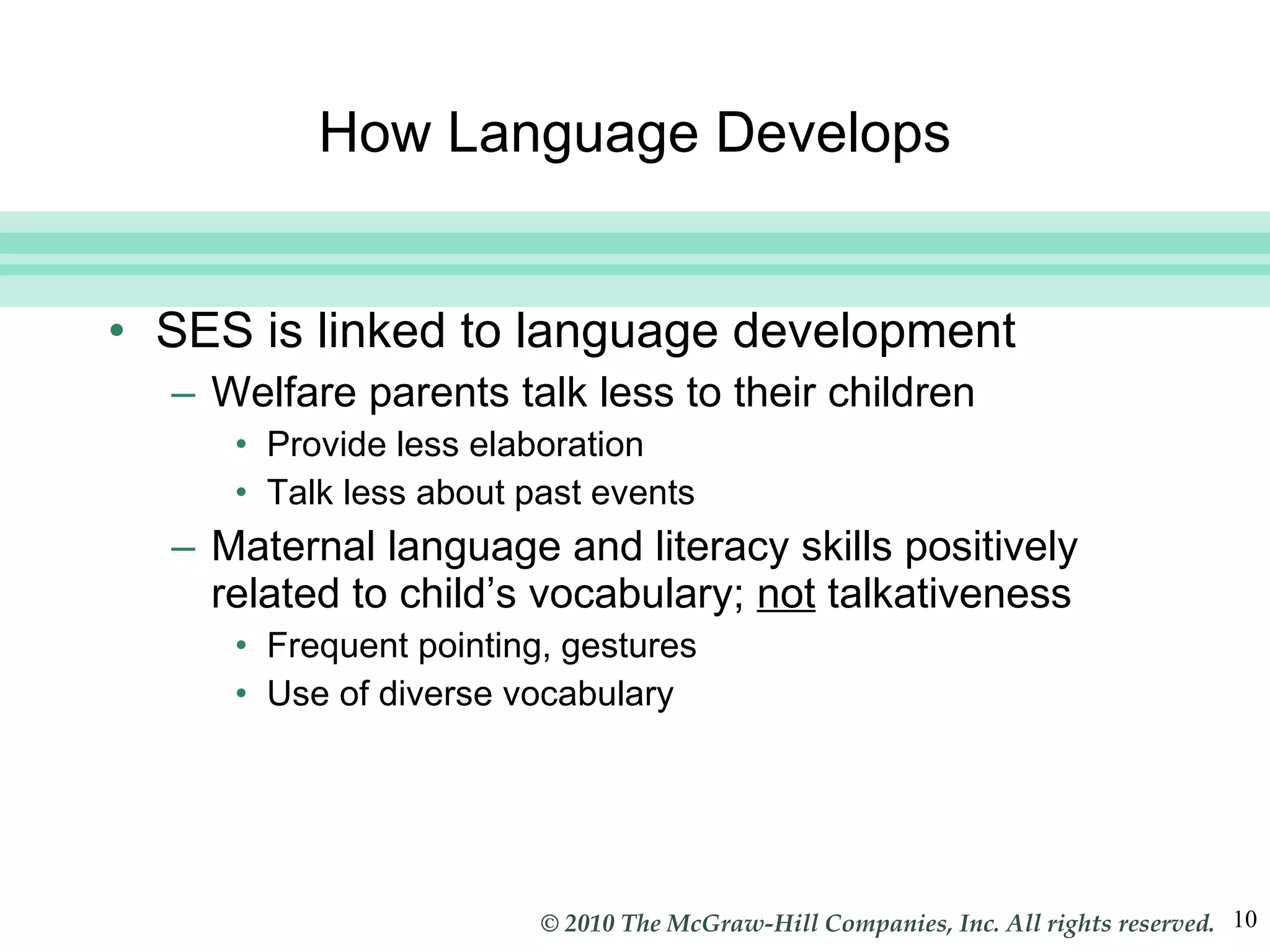
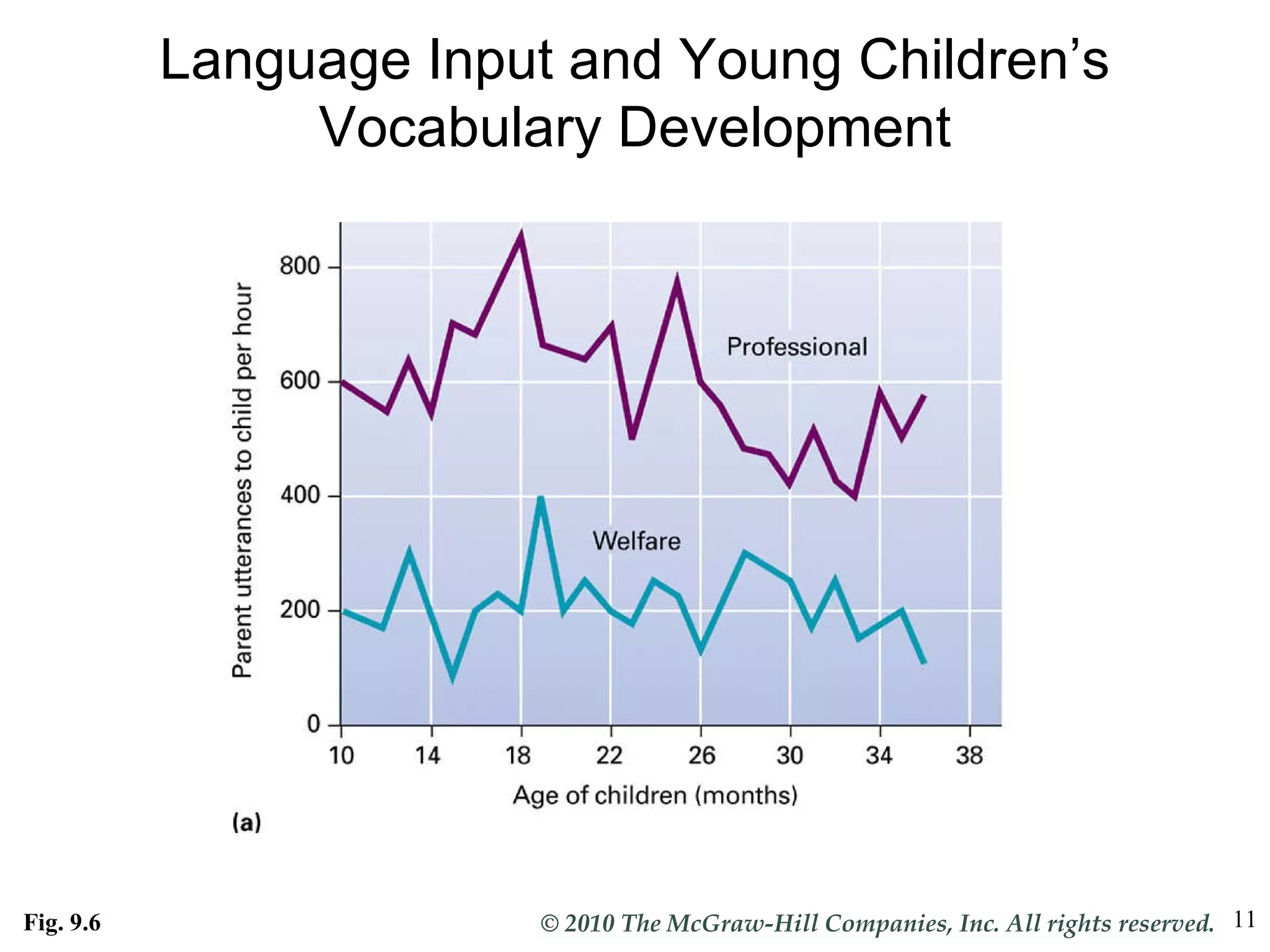
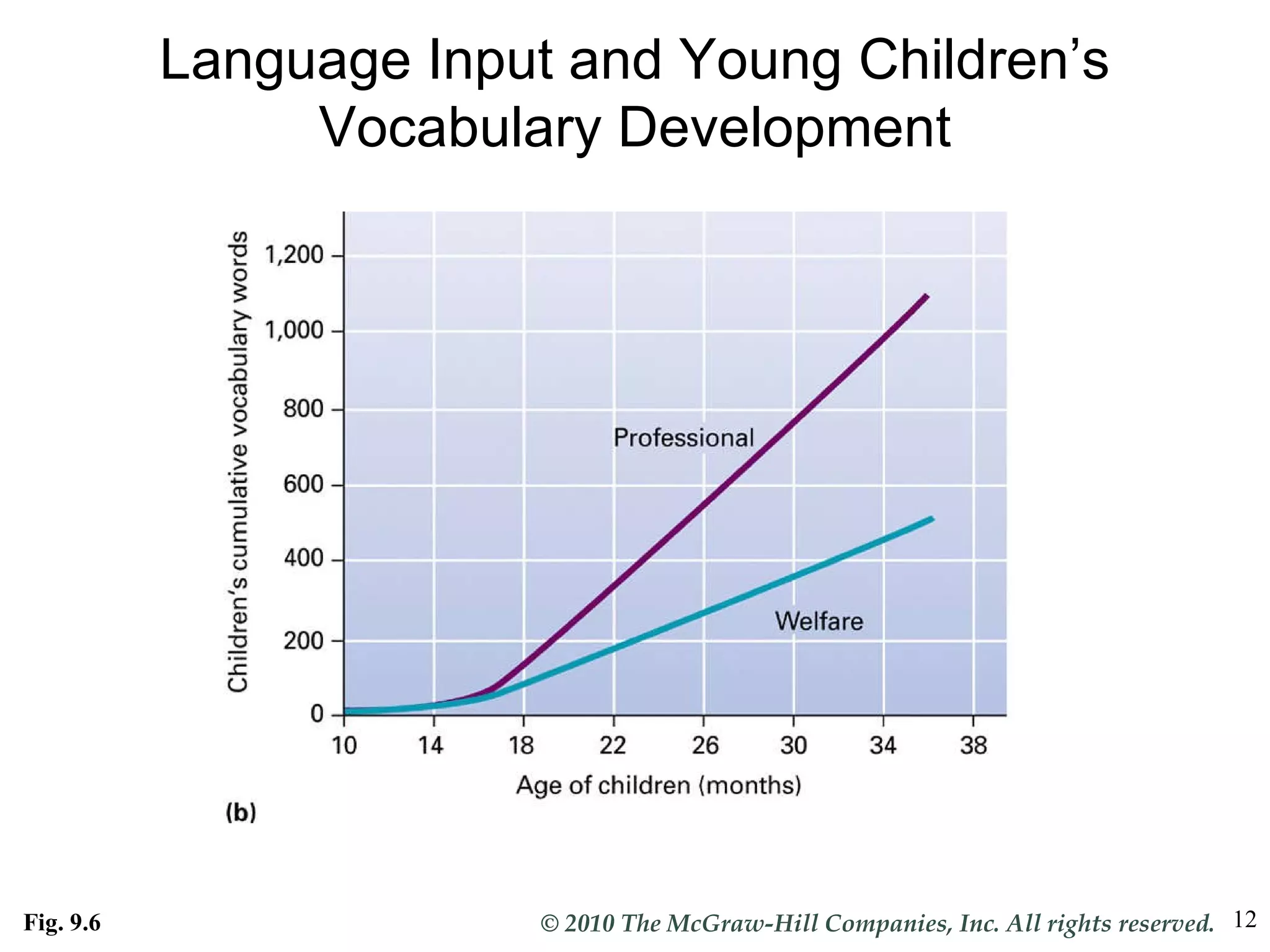
How Language Develops SES is linked to language development Welfare parents talk less to their children Provide less elaboration Talk less about past events Maternal language and literacy skills positively related to child’s vocabulary;  not  talkativeness Frequent pointing, gestures Use of diverse vocabulary
Language Input and Young Children’s Vocabulary Development Fig. 9.6
Fig. 9.6 Language Input and Young Children’s Vocabulary Development
How Language Develops Advances in pragmatics 6-year-old is better conversationalist Young children start using extended discourse Learn cultural rules, politeness, and become sensitive to adapting their speech to the setting Age 4 to 5: can change speech style at will More polite, formal when with adults
How Language Develops Middle and late childhood New skills learned when entering school Alphabetic principle Learning diverse uses of language, sounds Vocabulary and grammar Process of categorizing becomes easier From age 6 to 11 — 14,000 to 40,000 words Improved logical reasoning, analytic skills
How Language Develops Middle and late childhood Development of metalingusitic awareness Knowledge about language; improves considerably during elementary school years In adolescence: most know rules for appropriate language use Child with large vocabulary learns to read easier Vocabulary development linked to comprehension
How Language Develops Middle and late childhood Whole language approach Instruction to parallel child’s natural language Learning; reading should be whole, meaningful Basic-skills-and-phonics approach Instruction should teach phonics and its basic rules  Reading should involve simplified materials
How Language Develops Middle and late childhood Writing 2- to 3-year-olds emerge from scribbling to begin printing letters Most 4-year-olds can print their names; most 5-year-olds can reproduce letters, words Reversed letters are normal  Adults should encourage early writing
How Language Develops Middle and late childhood Years of practice needed for good writing Linked to cognitive and language skills Concerns about students’ writing competence Grades 4 to 12: about 70% are low-achieving High school grads: 50% not ready for college-level writing Good writing results from good teaching efforts
How Language Develops Bilingualism and second language learning Sensitive periods vary across different language systems Native-like accent best learned before age 12 Adults learn faster than children, attainment not as high as children’s U.S. students lag behind students in developed countries in learning a second language United States: many miss out on benefits of  bilingualism
How Language Develops Adolescence Increased use and understanding of Sophisticated words Analysis and abstract thinking Metaphors : implied comparison of unlike things Satire : use of irony, derision, or wit to expose  folly or wickedness
How Language Develops Adolescence Much better at organizing ideas and writing Dialect : variety of language distinguished by vocabulary, grammar, or pronunciation Adolescent dialect with peers often uses jargon or slang Usually used to indicate group membership
How Language Develops Adulthood and aging Distinct personal linguistic style is part of identity Vocabulary often continues to increase throughout adult years until late adulthood Most common complaint: retrieving words, hard to hear in less than ideal listening conditions Tip-of-the-tongue  phenomenon Non-language factors may be cause of decline in language skills in older adults
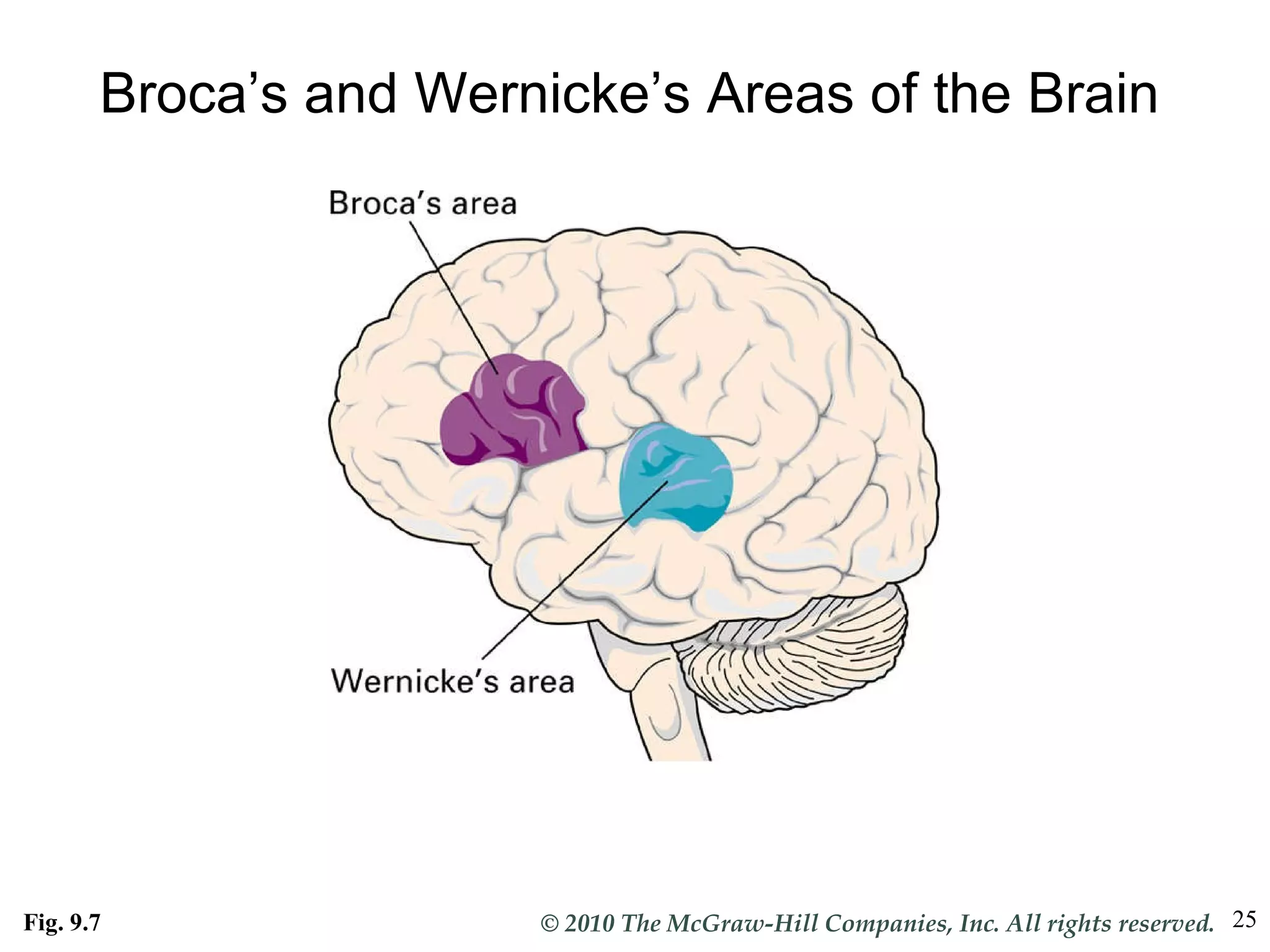
Biological and Environmental Influences Biological influences Evolution and the brain’s role in language Human language acquired 100,000 years ago Specific brain regions predisposed to language Wernicke’s area:  in   brain’s left hemisphere involved in language comprehension
Biological and Environmental Influences Biological influences Broca’s area:  in brain’s left frontal lobe involved in speech production If damaged  —  fluent incomprehensible speech produced Aphasia : language disorder resulting from  brain damage; loss of ability to use words
Broca’s and Wernicke’s Areas of the Brain Fig. 9.7
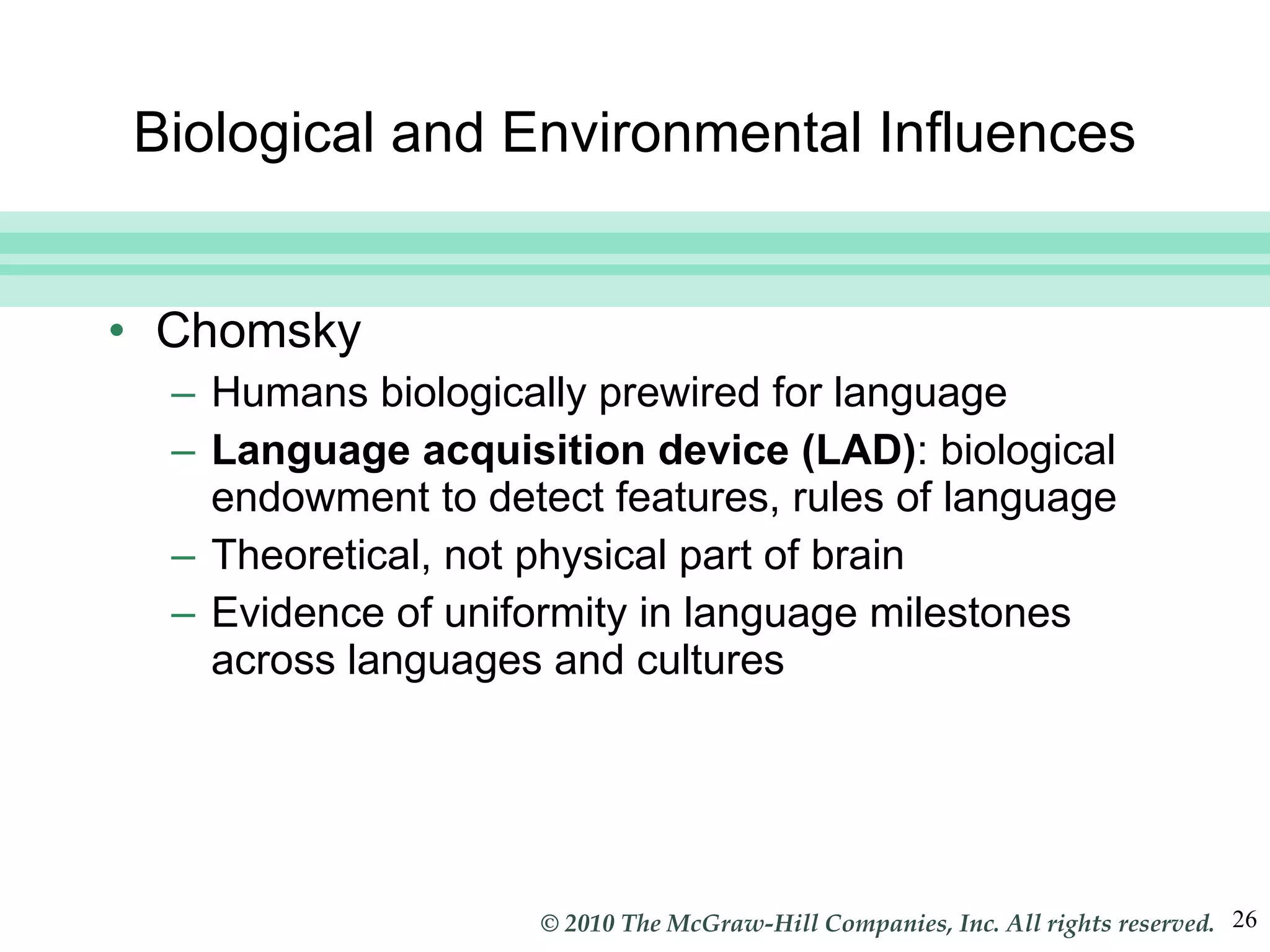
Biological and Environmental Influences Chomsky Humans biologically prewired for language Language acquisition device (LAD) : biological endowment to detect features, rules of language Theoretical, not physical part of brain Evidence of uniformity in language milestones across languages and cultures
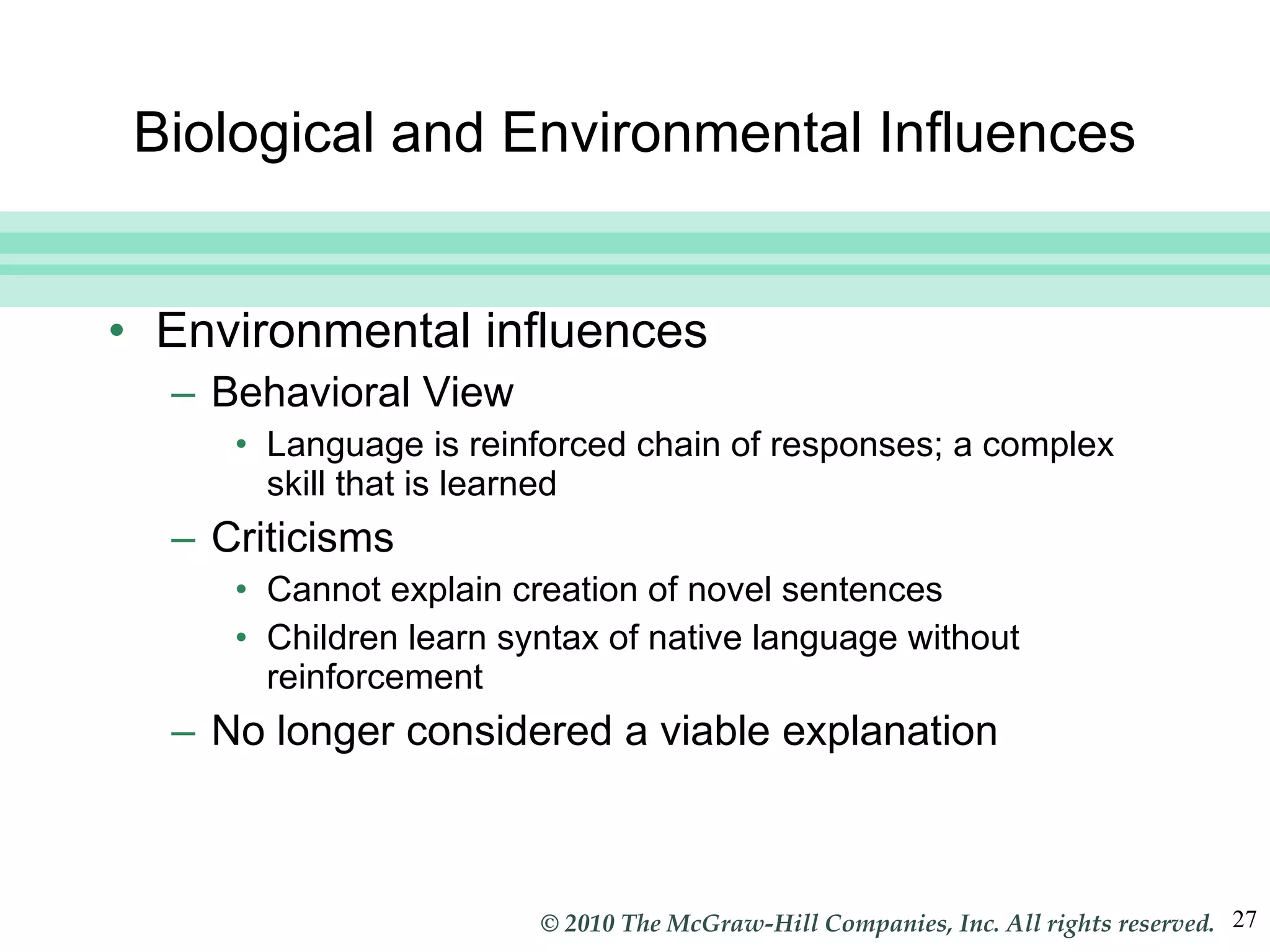
Biological and Environmental Influences Environmental influences Behavioral View Language is reinforced chain of responses; a complex skill that is learned Criticisms Cannot explain creation of novel sentences Children learn syntax of native language without reinforcement No longer considered a viable explanation
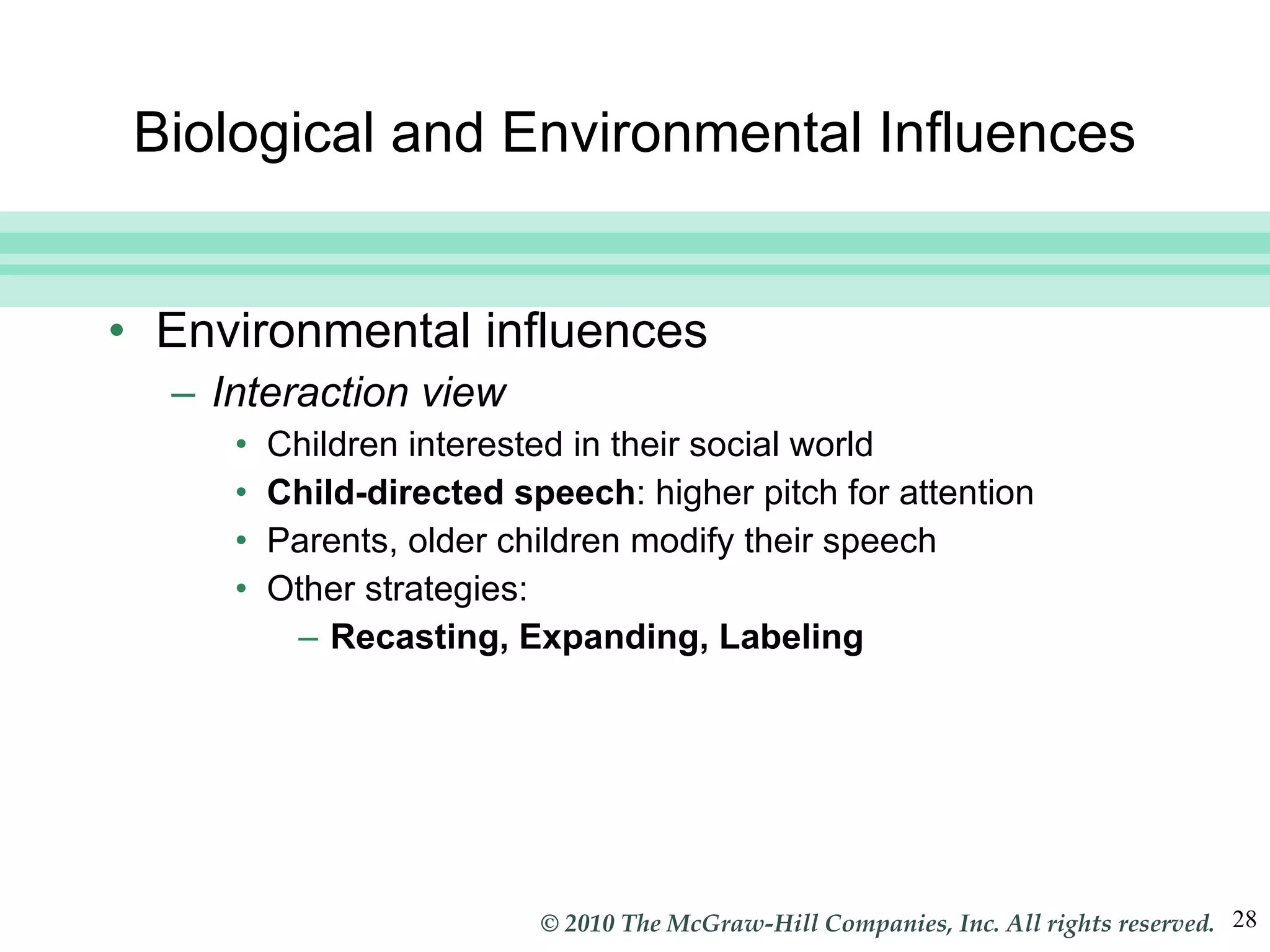
Biological and Environmental Influences Environmental influences Interaction view Children interested in their social world Child-directed speech : higher pitch for attention Parents, older children modify their speech Other strategies: Recasting, Expanding, Labeling
Biological and Environmental Influences An interactionist view of language Language has strong biological foundations Acquisition influenced by experiences; enriched environments have more positive effect Worldwide: language milestones reached about the same time Children acquire native language without explicit teaching; some without encouragement
Biological and Environmental Influences An interactionist view of language Bruner:  stresses roles of parents and teachers help construct  language acquisition support system  ( LASS ) Sociocultural context is extremely important in understanding children’s language development Resembles Vygotsky’s ZPD
The End

Santrock tls 5_ppt_ch09

  • 1.
    A Topical Approachto LIFE-SPAN DEVELOPMENT Chapter Nine: Language Development John W. Santrock
  • 2.
    What is Language?Defining language Form of communication, whether spoken, written, or signed, based on system of symbols Infinite generativity: ability to produce an endless number of meaningful sentences using a finite set of words and rules Genie, Wild Boy of Aveyron: raise questions about determinants of language
  • 3.
    Language’s Rule SystemsPhonology Sound system of language; how the sounds are used, combined — phoneme : smallest unit of sound Morphology Morphemes : units of meaning in word formation Syntax Ways words are combined to form acceptable phrases and sentences Semantics Meanings of words and sentences Pragmatics Appropriate use of language in context; can be cery complex
  • 4.
    How Language DevelopsInfancy Babbling, gestures, and other vocalizations Crying present at birth Cooing: occurs at 2 to 4 months of age Babbling: begins at about 6 months of age Gestures: begin 8 to 12 months of age
  • 5.
    How Language DevelopsInfants recognizing language sounds “Citizens of the world” Newborns recognize sound changes Recognize own language sounds at 6 months First words Receptive exceeds spoken vocabulary Timing of first word, vocabulary spurt varies
  • 6.
    How Language DevelopsInfants recognizing language sounds Asian child learns verbs earlier than child learning English Referential and expressive styles Overextension and underextension of words Two-word utterances (18-24 months of age) Telegraphic speech
  • 7.
    Variation in LanguageMilestones Fig. 9.3
  • 8.
    How Language DevelopsEarly childhood Complex sentences at 2 to 3 years of age Become more sensitive to language sounds; morphology rules, some overgeneralizations Learn and apply syntax rules; auxillary-inversion rule takes longer
  • 9.
    How Language DevelopsEarly childhood Vocabulary development is dramatic to age 6 Fast mapping Many hypotheses why this occurs Give novel labels to novel objects Use of mutual exclusivity Benefit from hearing mature speakers
  • 10.
    How Language DevelopsSES is linked to language development Welfare parents talk less to their children Provide less elaboration Talk less about past events Maternal language and literacy skills positively related to child’s vocabulary; not talkativeness Frequent pointing, gestures Use of diverse vocabulary
  • 11.
    Language Input andYoung Children’s Vocabulary Development Fig. 9.6
  • 12.
    Fig. 9.6 LanguageInput and Young Children’s Vocabulary Development
  • 13.
    How Language DevelopsAdvances in pragmatics 6-year-old is better conversationalist Young children start using extended discourse Learn cultural rules, politeness, and become sensitive to adapting their speech to the setting Age 4 to 5: can change speech style at will More polite, formal when with adults
  • 14.
    How Language DevelopsMiddle and late childhood New skills learned when entering school Alphabetic principle Learning diverse uses of language, sounds Vocabulary and grammar Process of categorizing becomes easier From age 6 to 11 — 14,000 to 40,000 words Improved logical reasoning, analytic skills
  • 15.
    How Language DevelopsMiddle and late childhood Development of metalingusitic awareness Knowledge about language; improves considerably during elementary school years In adolescence: most know rules for appropriate language use Child with large vocabulary learns to read easier Vocabulary development linked to comprehension
  • 16.
    How Language DevelopsMiddle and late childhood Whole language approach Instruction to parallel child’s natural language Learning; reading should be whole, meaningful Basic-skills-and-phonics approach Instruction should teach phonics and its basic rules Reading should involve simplified materials
  • 17.
    How Language DevelopsMiddle and late childhood Writing 2- to 3-year-olds emerge from scribbling to begin printing letters Most 4-year-olds can print their names; most 5-year-olds can reproduce letters, words Reversed letters are normal Adults should encourage early writing
  • 18.
    How Language DevelopsMiddle and late childhood Years of practice needed for good writing Linked to cognitive and language skills Concerns about students’ writing competence Grades 4 to 12: about 70% are low-achieving High school grads: 50% not ready for college-level writing Good writing results from good teaching efforts
  • 19.
    How Language DevelopsBilingualism and second language learning Sensitive periods vary across different language systems Native-like accent best learned before age 12 Adults learn faster than children, attainment not as high as children’s U.S. students lag behind students in developed countries in learning a second language United States: many miss out on benefits of bilingualism
  • 20.
    How Language DevelopsAdolescence Increased use and understanding of Sophisticated words Analysis and abstract thinking Metaphors : implied comparison of unlike things Satire : use of irony, derision, or wit to expose folly or wickedness
  • 21.
    How Language DevelopsAdolescence Much better at organizing ideas and writing Dialect : variety of language distinguished by vocabulary, grammar, or pronunciation Adolescent dialect with peers often uses jargon or slang Usually used to indicate group membership
  • 22.
    How Language DevelopsAdulthood and aging Distinct personal linguistic style is part of identity Vocabulary often continues to increase throughout adult years until late adulthood Most common complaint: retrieving words, hard to hear in less than ideal listening conditions Tip-of-the-tongue phenomenon Non-language factors may be cause of decline in language skills in older adults
  • 23.
    Biological and EnvironmentalInfluences Biological influences Evolution and the brain’s role in language Human language acquired 100,000 years ago Specific brain regions predisposed to language Wernicke’s area: in brain’s left hemisphere involved in language comprehension
  • 24.
    Biological and EnvironmentalInfluences Biological influences Broca’s area: in brain’s left frontal lobe involved in speech production If damaged — fluent incomprehensible speech produced Aphasia : language disorder resulting from brain damage; loss of ability to use words
  • 25.
    Broca’s and Wernicke’sAreas of the Brain Fig. 9.7
  • 26.
    Biological and EnvironmentalInfluences Chomsky Humans biologically prewired for language Language acquisition device (LAD) : biological endowment to detect features, rules of language Theoretical, not physical part of brain Evidence of uniformity in language milestones across languages and cultures
  • 27.
    Biological and EnvironmentalInfluences Environmental influences Behavioral View Language is reinforced chain of responses; a complex skill that is learned Criticisms Cannot explain creation of novel sentences Children learn syntax of native language without reinforcement No longer considered a viable explanation
  • 28.
    Biological and EnvironmentalInfluences Environmental influences Interaction view Children interested in their social world Child-directed speech : higher pitch for attention Parents, older children modify their speech Other strategies: Recasting, Expanding, Labeling
  • 29.
    Biological and EnvironmentalInfluences An interactionist view of language Language has strong biological foundations Acquisition influenced by experiences; enriched environments have more positive effect Worldwide: language milestones reached about the same time Children acquire native language without explicit teaching; some without encouragement
  • 30.
    Biological and EnvironmentalInfluences An interactionist view of language Bruner: stresses roles of parents and teachers help construct language acquisition support system ( LASS ) Sociocultural context is extremely important in understanding children’s language development Resembles Vygotsky’s ZPD
  • 31.