Language Acquisition
Ching-fen Hsu
2013/9/13
Lecture 1
Prelinguistic Communication
• Unique human capacity
• > 2.5m sound system: cooing babbling
jargoning recognizable words
• > 7m infants become familiar with sound patterns of
languages & adept at interacting with people & objects
around
• Primary intersubjectivity: 3m infants’ ability to match
one’s behavior to that of another person and to share
experiences in direct face-to-face interaction
• Secondary intersubjectivity: 9-12m, ability to share
mental states with another person & to understand
what they are intending to do, i.e., social referencing
(joint attention: sharing knowledge about events &
objects; pointing); precursor to language acquisition
Pointing and Communication
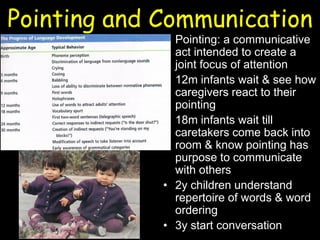
• Pointing: a communicative
act intended to create a
joint focus of attention
• 12m infants wait & see how
caregivers react to their
pointing
• 18m infants wait till
caretakers come back into
room & know pointing has
purpose to communicate
with others
• 2y children understand
repertoire of words & word
ordering
• 3y start conversation
Puzzle of Language Development
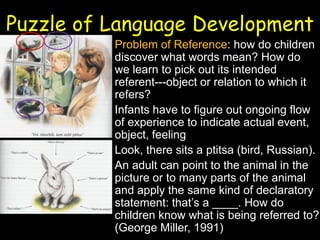
• Problem of Reference: how do children
discover what words mean? How do
we learn to pick out its intended
referent---object or relation to which it
refers?
• Infants have to figure out ongoing flow
of experience to indicate actual event,
object, feeling
• Look, there sits a ptitsa (bird, Russian).
• An adult can point to the animal in the
picture or to many parts of the animal
and apply the same kind of declaratory
statement: that’s a ____. How do
children know what is being referred to?
(George Miller, 1991)
Problem of Grammar• Comprehensible sentence must be governed by
grammar, rules for sequencing words in a sentence &
ordering of parts of words for a particular lg
• 7m infants: sensitive to word orderings in simple S &
extract word patterns
• Learn grammatical rules from errors: “My doggy runned
away” “Mommy, Johnny camed late”
• Children confuse grammatical forms
• Problem of central coherence (recursion): embedding of
S within each other
• Recursion: provides language with great economy and
flexibility of expression
i.e., the boy who went to the beach saw some fish and
got a sunburn (3 propositions)
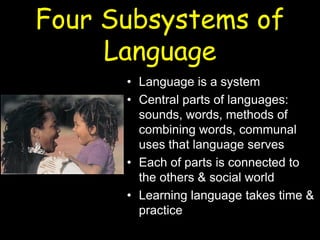
Four Subsystems of
Language
• Language is a system
• Central parts of languages:
sounds, words, methods of
combining words, communal
uses that language serves
• Each of parts is connected to
the others & social world
• Learning language takes time &
practice
I. Sounds
• 1y children begin to vocalize particular sounds &
sound sequences that make up words in language of
their community
• Takes several years for children to master
pronunciation of words
• Children’s native sound system develops unevenly
• Some sounds master late, i.e., /l/
lucky vs. Yucky (substitution)
• Children understand phonemes by minimal pairs
• Children’s attention to differences bet sounds is not
simply a mechanical skill but develops along with
growing understanding of meanings of words
International Phonetic
Alphabet: Consonant
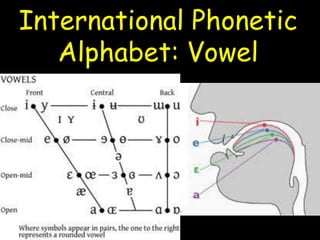
International Phonetic
Alphabet: Vowel
II. Words
• Words are more than a set of
sounds that communicate
• Words are symbols: stand for
something beyond
themselves
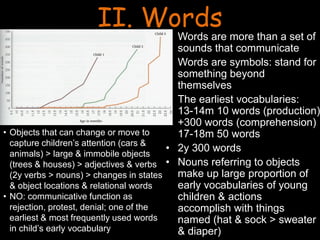
• The earliest vocabularies:
13-14m 10 words (production)
+300 words (comprehension)
17-18m 50 words
• 2y 300 words
• Nouns referring to objects
make up large proportion of
early vocabularies of young
children & actions
accomplish with things
named (hat & sock > sweater
& diaper)
• Objects that can change or move to
capture children’s attention (cars &
animals) > large & immobile objects
(trees & houses) > adjectives & verbs
(2y verbs > nouns) > changes in states
& object locations & relational words
• NO: communicative function as
rejection, protest, denial; one of the
earliest & most frequently used words
in child’s early vocabulary
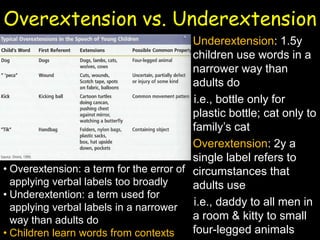
Overextension vs. Underextension
• Underextension: 1.5y
children use words in a
narrower way than
adults do
i.e., bottle only for
plastic bottle; cat only to
family’s cat
• Overextension: 2y a
single label refers to
circumstances that
adults use
i.e., daddy to all men in
a room & kitty to small
four-legged animals
• Overextension: a term for the error of
applying verbal labels too broadly
• Underextention: a term used for
applying verbal labels in a narrower
way than adults do
• Children learn words from contexts
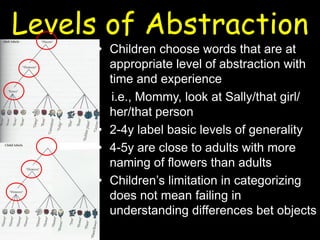
Levels of Abstraction
• Children choose words that are at
appropriate level of abstraction with
time and experience
i.e., Mommy, look at Sally/that girl/
her/that person
• 2-4y label basic levels of generality
• 4-5y are close to adults with more
naming of flowers than adults
• Children’s limitation in categorizing
does not mean failing in
understanding differences bet objects
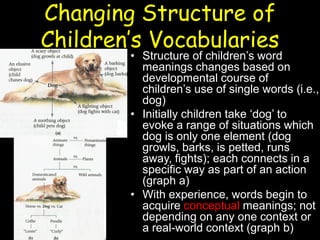
Changing Structure of
Children’s Vocabularies
• Structure of children’s word
meanings changes based on
developmental course of
children’s use of single words (i.e.,
dog)
• Initially children take ‘dog’ to
evoke a range of situations which
dog is only one element (dog
growls, barks, is petted, runs
away, fights); each connects in a
specific way as part of an action
(graph a)
• With experience, words begin to
acquire conceptual meanings; not
depending on any one context or
a real-world context (graph b)
Words as Mediators• Humans have a double world: objects &
situations can be perceived by senses;
indirectly manipulate things which cannot
be perceived
• 11-12m infants discover sound sequences
can recruit adults’ attention & help; making
sounds to anticipate/guide/stimulate own &
others’ actions & feelings
• Language acts as mediator; children make
something happen without doing the thing
themselves
• As children start understand words,
children can be influenced by others
directly (nonverbal actions) & indirectly
(words & culturally organized knowledge
that words embody)
• Beautiful intellectual power of human
III. Sentences
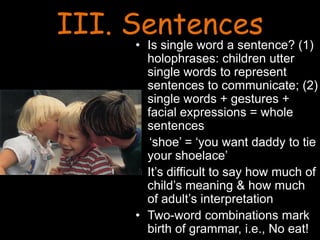
• Is single word a sentence? (1)
holophrases: children utter
single words to represent
sentences to communicate; (2)
single words + gestures +
facial expressions = whole
sentences
‘shoe’ = ‘you want daddy to tie
your shoelace’
• It’s difficult to say how much of
child’s meaning & how much
of adult’s interpretation
• Two-word combinations mark
birth of grammar, i.e., No eat!
Increasing Complexity
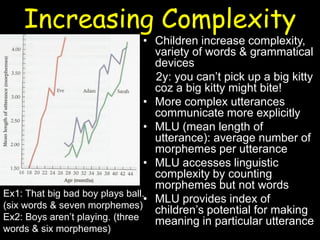
• Children increase complexity,
variety of words & grammatical
devices
2y: you can’t pick up a big kitty
coz a big kitty might bite!
• More complex utterances
communicate more explicitly
• MLU (mean length of
utterance): average number of
morphemes per utterance
• MLU accesses linguistic
complexity by counting
morphemes but not words
• MLU provides index of
children’s potential for making
meaning in particular utterance
Ex1: That big bad boy plays ball.
(six words & seven morphemes)
Ex2: Boys aren’t playing. (three
words & six morphemes)
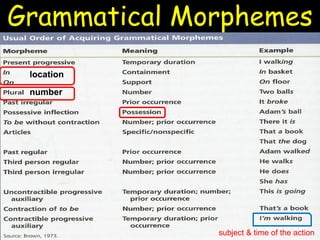
Grammatical Morphemes
location
number
subject & time of the action
Figurative Speech
• Metaphors = figurative speech
2.5y banana: telephone
• Creative process of language; essential tool of
human thought
• Children have to recognize similarity bet two
things & express it in a new way
• 2-6y children use metaphors without
understanding figurative meaning of adult speech
耳邊風 碰釘子
• Develop through childhood into adulthood
IV. The Use of Language• Master language = grammatical rules + word
meanings + pragmatic uses
• Pragmatics: ability to select words & orderings
in contexts
• Conversational acts: actions that achieve goals
through lg
• Protoimperatives: engage another person to
achieve desired object, i.e., a child holds up a
cup & say ‘more’
• Protodeclaratives: initiate & maintain dialogues
with adults, i.e., pointing & giving (toys)
• Word sequence accomplish alternative goals (Is
the door shut? = please shut the door; you have
forgotten to shut the door again)
• 2y can understand alternative goals
Conversational Conventions
• 3-4y children can solicit information (what happened?),
action (put the toy down), assert facts & rules (we have a
boat), utter warnings (watch out)
• Four basic rules in conversation: cooperative principle
(1)the maxim of quantity
(2)the maxim of quality
(3)the maxim of relevance
(4)the maxim of clarity
• Irony violates rules
• Children acquire social knowledge that regulate what is to
be said & how to say it
Explanations of Language
Acquisition
• Biological-maturation perspective: nativist approach
•Nativism: language acquisition is attributed largely to
nature
•Children mature language-using capacity naturally with
minimum input from E & special training
•Environmental-learning approach: attributes language to
nurture (language environment & teaching activities)
•En-learning does not come from imitation
•Imitation cannot explain two basic puzzles (how children
learn referents of words & how they master grammar) &
En-learning still contains nature (connectionism)
•Nativism agrees that E contributes to lg acquisition
The Nativist Explanation
• Noam Chomsky: children acquire lg quickly effortlessly
with no instruction & learning mechanisms
• Lg is innate & develops through universal process of
maturation
• Lg learning is like maturation of child’s body in a
predetermined way with appropriate nutrition & E
stimulation
• Lg = mental organ, special psychological mechanism
(children acquire verbal & nonverbal beh by causal
observation & imitation of adults & children)
• Lg = distinct piece of biological makeup of our brains;
distinct from general abilities processing info or intelligent
beh
The Nature of Language
• Surface structure: actual Ss people produced
• Deep structure: basic set of rules of lg derives Ss
• LAD (language acquisition devise): innate lg-processing
capacity that is programmed to recognize universal rules
that underlie lgs that a child hear
• LAD = lg genetic code; with maturation & interaction with
E, LAD enables children increasing complex lg forms to
form adult capacity
Child: Nobody don’t like me
Mother: No, say “nobody likes me”
Child: Nobody don’t like me
Mother: No, now listen carefully; say “nobody likes me”
Child: No! Nobody don’t likes me
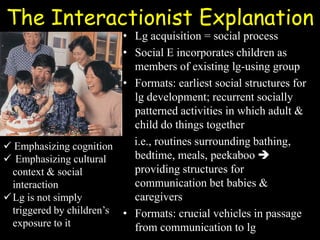
The Interactionist Explanation
• Lg acquisition = social process
• Social E incorporates children as
members of existing lg-using group
• Formats: earliest social structures for
lg development; recurrent socially
patterned activities in which adult &
child do things together
i.e., routines surrounding bathing,
bedtime, meals, peekaboo 
providing structures for
communication bet babies &
caregivers
• Formats: crucial vehicles in passage
from communication to lg
 Emphasizing cognition
 Emphasizing cultural
context & social
interaction
Lg is not simply
triggered by children’s
exposure to it
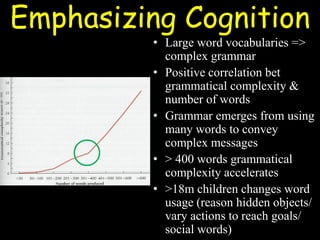
Emphasizing Cognition
• Large word vocabularies =>
complex grammar
• Positive correlation bet
grammatical complexity &
number of words
• Grammar emerges from using
many words to convey
complex messages
• > 400 words grammatical
complexity accelerates
• >18m children changes word
usage (reason hidden objects/
vary actions to reach goals/
social words)
Emphasizing Cultural Context &
Social Interaction
• Children constitute language acquisition support
system (LASS) from formatted events in
acquisition
• LASS: parental behaviors and formatted events
for children to acquire language; E complement to
innate biological LAD
• Language acquisition emerges from different
contributing factors, e.g., general cognitive
capacities & culturally organized E
Essential Ingredients of
Language Acquisition
Biological Prerequisites for
Language
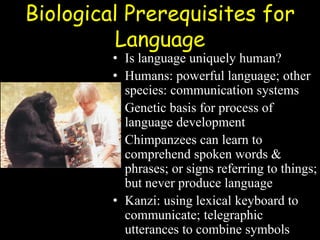
• Is language uniquely human?
• Humans: powerful language; other
species: communication systems
• Genetic basis for process of
language development
• Chimpanzees can learn to
comprehend spoken words &
phrases; or signs referring to things;
but never produce language
• Kanzi: using lexical keyboard to
communicate; telegraphic
utterances to combine symbols
Language & Brain Damage
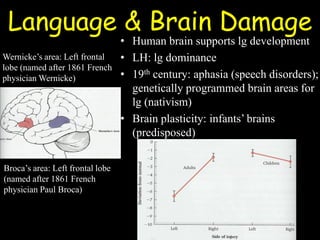
• Human brain supports lg development
• LH: lg dominance
• 19th century: aphasia (speech disorders);
genetically programmed brain areas for
lg (nativism)
• Brain plasticity: infants’ brains
(predisposed)
Broca’s area: Left frontal lobe
(named after 1861 French
physician Paul Broca)
Wernicke’s area: Left frontal
lobe (named after 1861 French
physician Wernicke)
Language & Cognitive Development
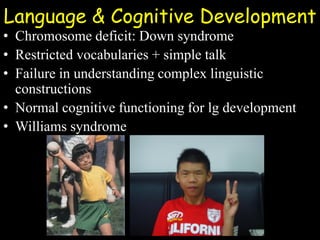
• Chromosome deficit: Down syndrome
• Restricted vocabularies + simple talk
• Failure in understanding complex linguistic
constructions
• Normal cognitive functioning for lg development
• Williams syndrome
The Environment of
Language Development
• Lg-support system in
acquisition (e.g., Genie)
• Active participation in
human activity to learn lg
(deaf children delay learning
in hearing E)
• Deaf children are forced to
learn lip-reading but not
signs (home-sign system
invention)
• Home sign starts as pointing
• Hearing children one-word
stage = home-sign children
sign one words
• Hearing children multiword
sentence = home-sign
children sign >3 signs
Nicaraguan Sign Language
• Children generate signed utterances of greater
complexity than gestures
• <1970s deaf Nicaraguans were socially isolated &
marginalized
• 1977 25 deaf children in school to 100
• 1979 >400 adolescents in a vocational school
• Little success in lipreading or fingerspelling
• Children started using invented home signs &
complexity increase
• Pidgin creation: combination of simple phrases; no
formal grammar; proto-language
• Later conventionalized & stylized lg generates with
spatial arrangements to make grammatical distinctions
Interaction & Fast Mapping
• Children quickly acquire words in community
without efforts
• Color-naming test: chromium color from olives
• 1-week or 6-week after children have influence of
this test
• Children learn lg ≠ from adults’ explicit reward ≠
from imitation
• Fast mapping: children quickly form idea of
meaning of unfamiliar words in familiar & highly
structured social interaction
Cognitive Principles for
Fast Mapping
• (1) whole-object principle: children connect whole
objects with new words
• (2) mutual-exclusivity principle: children learn one
name for one object & exclude known objects &
application for new objects
• (3) categorizing principle: extend to similar objects
e.g., categorization test of three picky puppets on
animals (“name”, examples, “grouping” only);
only “name” works
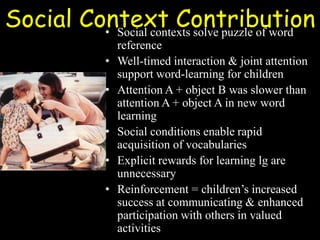
Social Context Contribution• Social contexts solve puzzle of word
reference
• Well-timed interaction & joint attention
support word-learning for children
• Attention A + object B was slower than
attention A + object A in new word
learning
• Social conditions enable rapid
acquisition of vocabularies
• Explicit rewards for learning lg are
unnecessary
• Reinforcement = children’s increased
success at communicating & enhanced
participation with others in valued
activities
Deliberate Instruction
• No firm conclusions about parental feedback work
• No effect on children’s lg development by
expanding & correcting incorrect sentences
• Kaluli (New Guinea) children are taught lg as they
are taught other culturally valued forms (“elema”
repeat words that their mother say); Samoans;
working class mothers in Baltimore, Maryland
• Motherese: speech directed to young children with
high-pitched voice, boundary-emphasis bet clauses;
simplified vocabulary
Language Exposure
Influences Development
• Grading lg (isolated constituents) helps model
correct grammatical structure, e.g., “put the red
truck in the box now…the red truck…no, the red
truck…in the box”
• Adults’ reformulations of children’s utterances, e.g.,
“Mommy wash”, ”Yes, Mommy is washing her
face”, “Daddy sleep”, “Yes, Daddy is sleeping.
Don’t wake him up”
Teaching Implications
卡爾威特資優教育法
Questions?

Language acquisition 1

  • 1.
  • 2.
    Prelinguistic Communication • Uniquehuman capacity • > 2.5m sound system: cooing babbling jargoning recognizable words • > 7m infants become familiar with sound patterns of languages & adept at interacting with people & objects around • Primary intersubjectivity: 3m infants’ ability to match one’s behavior to that of another person and to share experiences in direct face-to-face interaction • Secondary intersubjectivity: 9-12m, ability to share mental states with another person & to understand what they are intending to do, i.e., social referencing (joint attention: sharing knowledge about events & objects; pointing); precursor to language acquisition
  • 3.
    Pointing and Communication •Pointing: a communicative act intended to create a joint focus of attention • 12m infants wait & see how caregivers react to their pointing • 18m infants wait till caretakers come back into room & know pointing has purpose to communicate with others • 2y children understand repertoire of words & word ordering • 3y start conversation
  • 4.
    Puzzle of LanguageDevelopment • Problem of Reference: how do children discover what words mean? How do we learn to pick out its intended referent---object or relation to which it refers? • Infants have to figure out ongoing flow of experience to indicate actual event, object, feeling • Look, there sits a ptitsa (bird, Russian). • An adult can point to the animal in the picture or to many parts of the animal and apply the same kind of declaratory statement: that’s a ____. How do children know what is being referred to? (George Miller, 1991)
  • 5.
    Problem of Grammar•Comprehensible sentence must be governed by grammar, rules for sequencing words in a sentence & ordering of parts of words for a particular lg • 7m infants: sensitive to word orderings in simple S & extract word patterns • Learn grammatical rules from errors: “My doggy runned away” “Mommy, Johnny camed late” • Children confuse grammatical forms • Problem of central coherence (recursion): embedding of S within each other • Recursion: provides language with great economy and flexibility of expression i.e., the boy who went to the beach saw some fish and got a sunburn (3 propositions)
  • 6.
    Four Subsystems of Language •Language is a system • Central parts of languages: sounds, words, methods of combining words, communal uses that language serves • Each of parts is connected to the others & social world • Learning language takes time & practice
  • 7.
    I. Sounds • 1ychildren begin to vocalize particular sounds & sound sequences that make up words in language of their community • Takes several years for children to master pronunciation of words • Children’s native sound system develops unevenly • Some sounds master late, i.e., /l/ lucky vs. Yucky (substitution) • Children understand phonemes by minimal pairs • Children’s attention to differences bet sounds is not simply a mechanical skill but develops along with growing understanding of meanings of words
  • 8.
  • 9.
  • 10.
    II. Words • Wordsare more than a set of sounds that communicate • Words are symbols: stand for something beyond themselves • The earliest vocabularies: 13-14m 10 words (production) +300 words (comprehension) 17-18m 50 words • 2y 300 words • Nouns referring to objects make up large proportion of early vocabularies of young children & actions accomplish with things named (hat & sock > sweater & diaper) • Objects that can change or move to capture children’s attention (cars & animals) > large & immobile objects (trees & houses) > adjectives & verbs (2y verbs > nouns) > changes in states & object locations & relational words • NO: communicative function as rejection, protest, denial; one of the earliest & most frequently used words in child’s early vocabulary
  • 11.
    Overextension vs. Underextension •Underextension: 1.5y children use words in a narrower way than adults do i.e., bottle only for plastic bottle; cat only to family’s cat • Overextension: 2y a single label refers to circumstances that adults use i.e., daddy to all men in a room & kitty to small four-legged animals • Overextension: a term for the error of applying verbal labels too broadly • Underextention: a term used for applying verbal labels in a narrower way than adults do • Children learn words from contexts
  • 12.
    Levels of Abstraction •Children choose words that are at appropriate level of abstraction with time and experience i.e., Mommy, look at Sally/that girl/ her/that person • 2-4y label basic levels of generality • 4-5y are close to adults with more naming of flowers than adults • Children’s limitation in categorizing does not mean failing in understanding differences bet objects
  • 13.
    Changing Structure of Children’sVocabularies • Structure of children’s word meanings changes based on developmental course of children’s use of single words (i.e., dog) • Initially children take ‘dog’ to evoke a range of situations which dog is only one element (dog growls, barks, is petted, runs away, fights); each connects in a specific way as part of an action (graph a) • With experience, words begin to acquire conceptual meanings; not depending on any one context or a real-world context (graph b)
  • 14.
    Words as Mediators•Humans have a double world: objects & situations can be perceived by senses; indirectly manipulate things which cannot be perceived • 11-12m infants discover sound sequences can recruit adults’ attention & help; making sounds to anticipate/guide/stimulate own & others’ actions & feelings • Language acts as mediator; children make something happen without doing the thing themselves • As children start understand words, children can be influenced by others directly (nonverbal actions) & indirectly (words & culturally organized knowledge that words embody) • Beautiful intellectual power of human
  • 15.
    III. Sentences • Issingle word a sentence? (1) holophrases: children utter single words to represent sentences to communicate; (2) single words + gestures + facial expressions = whole sentences ‘shoe’ = ‘you want daddy to tie your shoelace’ • It’s difficult to say how much of child’s meaning & how much of adult’s interpretation • Two-word combinations mark birth of grammar, i.e., No eat!
  • 16.
    Increasing Complexity • Childrenincrease complexity, variety of words & grammatical devices 2y: you can’t pick up a big kitty coz a big kitty might bite! • More complex utterances communicate more explicitly • MLU (mean length of utterance): average number of morphemes per utterance • MLU accesses linguistic complexity by counting morphemes but not words • MLU provides index of children’s potential for making meaning in particular utterance Ex1: That big bad boy plays ball. (six words & seven morphemes) Ex2: Boys aren’t playing. (three words & six morphemes)
  • 17.
  • 18.
    Figurative Speech • Metaphors= figurative speech 2.5y banana: telephone • Creative process of language; essential tool of human thought • Children have to recognize similarity bet two things & express it in a new way • 2-6y children use metaphors without understanding figurative meaning of adult speech 耳邊風 碰釘子 • Develop through childhood into adulthood
  • 19.
    IV. The Useof Language• Master language = grammatical rules + word meanings + pragmatic uses • Pragmatics: ability to select words & orderings in contexts • Conversational acts: actions that achieve goals through lg • Protoimperatives: engage another person to achieve desired object, i.e., a child holds up a cup & say ‘more’ • Protodeclaratives: initiate & maintain dialogues with adults, i.e., pointing & giving (toys) • Word sequence accomplish alternative goals (Is the door shut? = please shut the door; you have forgotten to shut the door again) • 2y can understand alternative goals
  • 20.
    Conversational Conventions • 3-4ychildren can solicit information (what happened?), action (put the toy down), assert facts & rules (we have a boat), utter warnings (watch out) • Four basic rules in conversation: cooperative principle (1)the maxim of quantity (2)the maxim of quality (3)the maxim of relevance (4)the maxim of clarity • Irony violates rules • Children acquire social knowledge that regulate what is to be said & how to say it
  • 21.
    Explanations of Language Acquisition •Biological-maturation perspective: nativist approach •Nativism: language acquisition is attributed largely to nature •Children mature language-using capacity naturally with minimum input from E & special training •Environmental-learning approach: attributes language to nurture (language environment & teaching activities) •En-learning does not come from imitation •Imitation cannot explain two basic puzzles (how children learn referents of words & how they master grammar) & En-learning still contains nature (connectionism) •Nativism agrees that E contributes to lg acquisition
  • 22.
    The Nativist Explanation •Noam Chomsky: children acquire lg quickly effortlessly with no instruction & learning mechanisms • Lg is innate & develops through universal process of maturation • Lg learning is like maturation of child’s body in a predetermined way with appropriate nutrition & E stimulation • Lg = mental organ, special psychological mechanism (children acquire verbal & nonverbal beh by causal observation & imitation of adults & children) • Lg = distinct piece of biological makeup of our brains; distinct from general abilities processing info or intelligent beh
  • 23.
    The Nature ofLanguage • Surface structure: actual Ss people produced • Deep structure: basic set of rules of lg derives Ss • LAD (language acquisition devise): innate lg-processing capacity that is programmed to recognize universal rules that underlie lgs that a child hear • LAD = lg genetic code; with maturation & interaction with E, LAD enables children increasing complex lg forms to form adult capacity Child: Nobody don’t like me Mother: No, say “nobody likes me” Child: Nobody don’t like me Mother: No, now listen carefully; say “nobody likes me” Child: No! Nobody don’t likes me
  • 24.
    The Interactionist Explanation •Lg acquisition = social process • Social E incorporates children as members of existing lg-using group • Formats: earliest social structures for lg development; recurrent socially patterned activities in which adult & child do things together i.e., routines surrounding bathing, bedtime, meals, peekaboo  providing structures for communication bet babies & caregivers • Formats: crucial vehicles in passage from communication to lg  Emphasizing cognition  Emphasizing cultural context & social interaction Lg is not simply triggered by children’s exposure to it
  • 25.
    Emphasizing Cognition • Largeword vocabularies => complex grammar • Positive correlation bet grammatical complexity & number of words • Grammar emerges from using many words to convey complex messages • > 400 words grammatical complexity accelerates • >18m children changes word usage (reason hidden objects/ vary actions to reach goals/ social words)
  • 26.
    Emphasizing Cultural Context& Social Interaction • Children constitute language acquisition support system (LASS) from formatted events in acquisition • LASS: parental behaviors and formatted events for children to acquire language; E complement to innate biological LAD • Language acquisition emerges from different contributing factors, e.g., general cognitive capacities & culturally organized E
  • 27.
  • 28.
    Biological Prerequisites for Language •Is language uniquely human? • Humans: powerful language; other species: communication systems • Genetic basis for process of language development • Chimpanzees can learn to comprehend spoken words & phrases; or signs referring to things; but never produce language • Kanzi: using lexical keyboard to communicate; telegraphic utterances to combine symbols
  • 29.
    Language & BrainDamage • Human brain supports lg development • LH: lg dominance • 19th century: aphasia (speech disorders); genetically programmed brain areas for lg (nativism) • Brain plasticity: infants’ brains (predisposed) Broca’s area: Left frontal lobe (named after 1861 French physician Paul Broca) Wernicke’s area: Left frontal lobe (named after 1861 French physician Wernicke)
  • 30.
    Language & CognitiveDevelopment • Chromosome deficit: Down syndrome • Restricted vocabularies + simple talk • Failure in understanding complex linguistic constructions • Normal cognitive functioning for lg development • Williams syndrome
  • 31.
    The Environment of LanguageDevelopment • Lg-support system in acquisition (e.g., Genie) • Active participation in human activity to learn lg (deaf children delay learning in hearing E) • Deaf children are forced to learn lip-reading but not signs (home-sign system invention) • Home sign starts as pointing • Hearing children one-word stage = home-sign children sign one words • Hearing children multiword sentence = home-sign children sign >3 signs
  • 32.
    Nicaraguan Sign Language •Children generate signed utterances of greater complexity than gestures • <1970s deaf Nicaraguans were socially isolated & marginalized • 1977 25 deaf children in school to 100 • 1979 >400 adolescents in a vocational school • Little success in lipreading or fingerspelling • Children started using invented home signs & complexity increase • Pidgin creation: combination of simple phrases; no formal grammar; proto-language • Later conventionalized & stylized lg generates with spatial arrangements to make grammatical distinctions
  • 33.
    Interaction & FastMapping • Children quickly acquire words in community without efforts • Color-naming test: chromium color from olives • 1-week or 6-week after children have influence of this test • Children learn lg ≠ from adults’ explicit reward ≠ from imitation • Fast mapping: children quickly form idea of meaning of unfamiliar words in familiar & highly structured social interaction
  • 34.
    Cognitive Principles for FastMapping • (1) whole-object principle: children connect whole objects with new words • (2) mutual-exclusivity principle: children learn one name for one object & exclude known objects & application for new objects • (3) categorizing principle: extend to similar objects e.g., categorization test of three picky puppets on animals (“name”, examples, “grouping” only); only “name” works
  • 35.
    Social Context Contribution•Social contexts solve puzzle of word reference • Well-timed interaction & joint attention support word-learning for children • Attention A + object B was slower than attention A + object A in new word learning • Social conditions enable rapid acquisition of vocabularies • Explicit rewards for learning lg are unnecessary • Reinforcement = children’s increased success at communicating & enhanced participation with others in valued activities
  • 36.
    Deliberate Instruction • Nofirm conclusions about parental feedback work • No effect on children’s lg development by expanding & correcting incorrect sentences • Kaluli (New Guinea) children are taught lg as they are taught other culturally valued forms (“elema” repeat words that their mother say); Samoans; working class mothers in Baltimore, Maryland • Motherese: speech directed to young children with high-pitched voice, boundary-emphasis bet clauses; simplified vocabulary
  • 37.
    Language Exposure Influences Development •Grading lg (isolated constituents) helps model correct grammatical structure, e.g., “put the red truck in the box now…the red truck…no, the red truck…in the box” • Adults’ reformulations of children’s utterances, e.g., “Mommy wash”, ”Yes, Mommy is washing her face”, “Daddy sleep”, “Yes, Daddy is sleeping. Don’t wake him up”
  • 38.
  • 39.